Korean J Perinatol Vol.26, No.3, Sep., 2015 http://dx.doi.org/10.14734/kjp.2015.26.3.229
� Original Article �
쌍태아 서로간의 출생체중 불일치 수준은 출생체중 차 의 절대 값이나, 출생체중의 차이에 대한 백분율로 표시하 는 방법, 그리고 체중 차이의 백분율에 대한 95 퍼센타일 값 또는 평균값에 표준편차를 적용한 값으로 표시된다.1 쌍 태아의 출생체중 불일치 수준이 1% 증가하면 신생아의 불 량한 예후에 대한 위험도가 4.2% 증가하며,2 불일치 수준 25% 이상에서는 태아사망,3, 4 신생아사망5 위험도가 높고, 출생체중 불일치 수준 29% 이상일 때 부당경량아 발생 위 Received: 31 July 2015
Revised: 25 September 2015 Accepted: 30 September 2015 Correspondence to: Dar Oh Lim, PhD
Department of Health Administration, Kongju National University, 56 Gongjudaehak-ro, Gongju 32588, Korea
Tel: +82-41-850-0327, Fax: +82-41-850-0320 E-mail: [email protected]
Copyrightⓒ 2015 by The Korean Society of Perinatology
This is an Open Access article distributed under the terms of the Creative Commons Attribution Non-Commercial License (http://creativecommons.org/license/
by-nc/3.0/), which permits unrestricted non-commercial use, distribution, and reproduction in any medium, provided that the original work is properly cited.
The Korean Journal of Perinatology · pISSN 1229-2605 eISSN 2289-0432 · e-kjp.org
우리나라 쌍태아의 성별, 출생순위별 출생체중 불일치 수준에 관한 연구; 2008-2013
서울대학교 의학연구원 인구의학연구소1, 서울대학교병원 산부인과2, 공주대학교 보건행정학과3
박상화
1^신재준
2^김훈
1, 2^임달오
3The Discordance of Intra-twin Birth Weight by Infantile Gender and Birth Order in Korea; 2008-2013
Sang Hwa Park
1, Jae Jun Shin
2, Hoon Kim
1,2, and Dar Oh Lim
3Institute of Reproductive Medicine and Population1, Medical Research Center, Seoul National University Department of Obstetrics and Gynecology2, Seoul National University Hoapital, Seoul, Korea
Department of Health Administration3, Kongju National University, Kongju, Korea
Purpose: To investigate the incidence of intra-twin birth weight discordance and its association with infantile gender and birth order.
Methods: We used the data of birth from 2008 to 2013 of Korea Statistics (38,140 pairs of twins). Adjusted logistic regression analyses were performed to describe the birth weight discordance (≥25%) according to in
fantile gender and birth order (twin A: 1st, twin B: 2nd). Birth weight discordance was calculated as 100 x (birth weight difference/birth weight of the heavier twin).
Results: Twin A (mean 2.431 kg) was heavier than twin B (mean 2.359 kg), and the weight difference was 0.281 kg on average. Overall incidence of birth weight discordance was 8.3 percent. The incidence of discor- dance was 8.8 percent among unlike-sexed pairs and 8.0 percent among like-sexed pairs. Twins with birth weight A≥B (10.2 percent) showed higher incidence of discordance than twins with birth weight A<B (5.4 percent), with an odds ratio (OR) of 1.870 (95% confidence interval (CI): 1.7192.034). Unlikesexed twins were associated with higher probability of discordance compared to likesexed twins (OR 1.456, 95% CI:
13.101.619). Odds ratio of discordance was 2.918 (2.5023.403) in unlikesexed twins (malefemale) with birth weight (A≥B) as compared to like-sexed twins (female-female) with birth weight (A<B).
Conclusion: Birth weight discordance was associated with unlike-sexed twin pairs and difference of inter-twin birth weight by birth order. However, close attention should be paid to the discordance of twin body weight to reduce the risk of adverse outcome.
Key Words: Twin birth, Birth weight discordance, Deciles
분하고 각각의 데이터 파일에 출생지역(코드번호: 11010- 39020), 결혼연월, 임신기간(주), 모의 연령(세)의 변수를 이용하여 통합 기준변수(11-010-2000-01-38-35) 를 생성하였다. 파일 통합 기준변수를 이용하여 첫째아 파 일에 둘째아의 출생아 성, 출생체중이 서로 짝을 이루도록 데이터를 통합하였다. 데이터 파일을 통합한 결과 짝을 이 루지 않은 1,013건(출생체중 분류 미상 37건 포함)이 결 측값으로 제외되었으며, 최종적으로 서로 짝을 이룬 수는 39,141쌍으로 집계되었다. 출생체중 계측치의 정확성 및 신 뢰성을 기하기 위해 출생장소를 의료기관 중심으로 하였는 데, 우리나라의 경우 의료기관 분만율은 2010-2011년에 98%로 보고된 바 있어,13 대부분의 분만이 의료기관에서 이루어지고 있기 때문에 가정 분만(376건) 및 기타 장소 (82건), 분류 미상(13건)은 연구대상에서 제외하였다. 혼 인 내 출생아에 비해 산전관리 등의 여건이 다를 것으로 판 단되어 혼인 외 출생 481건, 분류 미상 56건을 제외하였는 데, 우리나라의 혼인 외 출생 빈도는 2008-2012년에 2%
수준으로 보고된 바 있다.14 그리고 임신기간 분류 미상 5 건, 출산연령이 10대(63건)와 연령 미상 24건을 제외하였 다. 본 연구자료에서 제외된 데이터 수는 1,001건(중복 제 외 포함)이었으며 최종적으로 38,140건이 집계되었다.
2. 연구 방법
본 연구에서는 쌍태아 A(첫째아)와 B(둘째아)의 출생체 중의 불일치 수준을 분석하기 위하여 출생체중 불일치율 [(체중차이 절대값/쌍태아 A, B 중 더 무거운 체중)×100]
을 산출하였다. 쌍태아의 성 구조(남-남, 여-여, 남-여, 여-남)에 따른 평균출생체중과 출생체중의 차를 ANOVA 검정을 하였다. 그리고 쌍태아 A와 B의 출생체중을 합한 값에 대한 십분위수의 해당 구간별 출생체중 불일치 수준 25% 이상 발생 빈도를 분석하였다. 그리고 쌍태아의 성 구 조, 출생순위별 출생체중 크기의 차이(A<B 또는 A≥B)에 따른 불일치 수준 25% 이상 발생 빈도를 비교하였다.
쌍태아의 성 구조 및 출생순위별 체중 크기에 따른 출생 체중 불일치 수준 25% 이상의 발생 위험도(교차비: odds ratio)를 추정을 위한 로지스틱 회귀분석(logistic regres- sion)을 위해 모의 학력, 직업, 출산연령, 출생연도, 임신기 험이 높고,6 아동기에 신체발육 상태가 불량한 것으로 보고
된 바 있다.7
우리나라 쌍태아 발생률은 체외수정과 같은 보조생식술 이 도입된 이후 증가하였고,8 쌍태아 발생률은 1981-1991 년 출생 천명당 10명, 2006년에 23명으로 보고된 바 있다.9 Liu 등(2015)은 중국(1995-2012년)에서 쌍태아의 평균 출생체중은 매 5년간 0.01 kg씩 감소하고, 쌍태아 출생체 중의 불일치 수준은 증가하는 것으로 보고하였다. 우리나 라의 쌍태아 출생체중 불일치 수준과 관련한 연구는 지역 사회 인구집단 중심이 아닌 일부 의료기관 분만 통계자료 를 대상으로 제한적으로 이루어진 바 있다.10-12 본 연구에 서는 2008-2013년간 우리나라 출생신고에 의해 집계된 인구동태통계자료에서 쌍태아 관련 자료를 이용하여 쌍태 아의 성 구조 및 출생순위별 출생체중 불일치 수준을 비교 분석하고자 하였다.
대상 및 방법
1. 대상
본 연구는 2008년부터 2013년까지 우리나라 인구동태 통계자료를 이용하였으며, 통계청 마이크로데이터 서비스 시스템(MDSS, http://mdss.kostat.go.kr)으로부터 출생 신고 원시통계자료를 획득하였다. 출생신고에 의해 얻어지 는 통계정보는 출생지역(구, 시, 군별 행정구역), 출생연월, 다태아 여부(단태, 쌍태, 삼태아 이상), 다태아 출생순위, 출 생아의 성, 임신기간(주), 결혼상태(혼인 내, 혼인 외), 결혼 연월, 출산연령(만 연령), 모의 학력, 모의 직업, 출생장소 (자택, 병원, 기타), 총 출생아 수, 출생체중(kg, 소수점 두 자리) 등이다.
2008-2013년 전체 출생자료 2,773,182건 중에서 쌍태 아 수는 80,210건이었고, 연도별로는 2008년 12,653건, 2009년 11.905건, 2010년 12,633건, 2011년 13,583건, 2012년 15,321건, 2013년 14,115건이었다. 전체 쌍태아 를 출생순위로 구분해 보면 첫째아는 40,154건, 둘째아는 40,054건, 미상 2건이었다. 첫째아와 둘째아를 하나의 동 일한 레코드에 서로 짝을 이루도록 원시통계자료를 다음과 같이 변환하였다. 먼저 첫째아, 둘째아로 두 개의 파일로 구
간, 쌍태아 A, B의 출생체중 합의 십분위수 등의 변수를 이 용하였다. 종속변수는 출생체중 불일치율 25% 이상군을
‘1’, 25% 미만군을 ‘0’으로 부호화하였고, 독립변수로는 출 생체중이 ‘A<B’인 경우 기준군(0)으로 ‘A≥B’를 비교군(1) 으로 하였고, 쌍태아의 성 구조는 ‘여-여’를 기준군(0)으 로 하였으며 나머지 3개 성 구조를 비교군으로 하였다. 이 외 독립 변수로는 출생연도(2008-2013), 출산연령(20 세, 25세, 30세, 35세, 40세), 교육수준(중졸 이하=1, 고졸
=2, 전문대 이상=3), 모의 직업(있음=0, 없음=1), 임신기 간(최소=21주, 최대=43주), 출생체중 십분위수(최소=1, 최대=10)를 이용하였다. 주요 변수 별로 출생체중 불일치 수준 25% 이상의 교차비와 95% 신뢰구간(95% confi- dence interval)을 산출하였다. 출생통계 원시자료 분석을 위해 SPSS 16.0 (SPSS Inc., Chicago, IL, USA)을 이용 하였다.
본 연구 대상의 경우 분만 후 신생아가 모두 생존하여 출 생신고를 했을 때 쌍을 이루는 조합이 되고, 반면 쌍태아 어느 한쪽이 사산이나 신생아 사망으로 종결되어 출생신 고가 자체가 누락될 때에는 출생순위별로 어느 한쪽에 결 측값이 발생하게 된다. 이러한 경우는 연구대상에서 제외 되기 때문에 실제 쌍태아 발생 건보다 과소 집계된 것으로 추정 할 수 있다. 총 38,140쌍의 출생연도별 분포는 2008 년부터 2012년까지 각각 16.1%, 14.4%, 15.7%, 16.9%, 19.2%, 17.8%였고, 출산연령은 20-24세 2.4%, 25-59 세 22.0%, 30-34세 52.2%, 35-39세 21.4%, 40세 이 상 2.0%였으며, 임신기간은 최소 21주, 최대 43주 범위였
고, 교육수준은 중졸 이하 1.4%, 고졸 27.2%, 전문대학 이 상이 71.4%였으며, 직업이 있는 경우 31.5%, 무직(주부 포 함)이 68.5%였다.
결 과
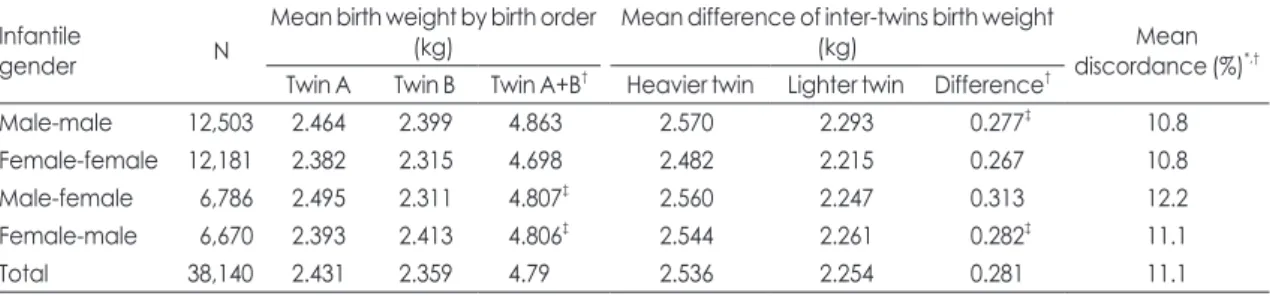
쌍태아 A (첫째아)의 평균 출생체중은 2.431 kg, 쌍태아 B (둘째아)는 2.359 kg이었으며, 쌍태아의 성 구조(남-남, 여-여, 서로 다른 성)에 상관없이 평균체중은 쌍태아 A가 더 무거운 것으로 나타났다(Table 1). 쌍태아의 출생체중 차 이(더 무거운 체중-더 가벼운 체중)는 평균 0.281 kg이었 고, 쌍태아의 성 구조에 따른 출생체중 차이는 동일 성 보다 서로 다른 성일 때 출생체중 차이가 큰 것으로 나타났으며, 쌍태아 출생체중의 평균 불일치율은 11.1%였으며, 성 구조 가 남-여일 때 평균 불일치율이 12.2%로 가장 높았다.
Table 2는 쌍태아 A, B의 출생체중 합에 대한 십분위수 에 따른 25% 이상 출생체중 불일치 수준의 빈도를 나타 낸 것으로 십분위수가 증가할수록 25% 이상 불일치 수준 은 감소하였다. 출생체중 25% 이상 불일치 수준 발생 빈도 는 8.3%였고, 쌍태아 출생체중의 크기가 ‘A<B’일 때 25%
이상 불일치 발생빈도는 5.4%, ‘A≥B’는 10.2%로 약 1.9배 높았고, 모든 십분위수에서 발생 빈도가 높았다. 그리고 성 구조가 동일한 경우는 25% 이상 불일치 빈도는 8.0%였으 며, 성 구조가 다를 때는 8.8%였으며, 출생체중 2분위 수 이상부터 다른 성 구조에서 25% 이상 불일치 빈도가 약간 높게 나타났다.
Table 1. Mean Birth Weight of Inter-twin, and Mean Difference of Inter-twin Birth Weight by Birth Order and Infantile Gender, 2008-2013
Infantile
gender N
Mean birth weight by birth order
(kg) Mean difference of inter-twins birth weight
(kg) Mean
discordance (%)*,†
Twin A Twin B Twin A+B† Heavier twin Lighter twin Difference†
Male-male 12,503 2.464 2.399 4.863 2.570 2.293 0.277‡ 10.8
Female-female 12,181 2.382 2.315 4.698 2.482 2.215 0.267 10.8
Male-female 6,786 2.495 2.311 4.807‡ 2.560 2.247 0.313 12.2
Female-male 6,670 2.393 2.413 4.806‡ 2.544 2.261 0.282‡ 11.1
Total 38,140 2.431 2.359 4.79 2.536 2.254 0.281 11.1
*Birth weight discordance (%) = birth weight difference/birth weight of heavier twinx100.
†ANOVA test, P<0.01.
‡ Non-significant difference between groups by post hoc multiple comparison (least significant difference, LSD).
Table 3은 쌍태아의 성, 출생순위에 따른 출생체중의 크 기별 25% 이상 불일치 수준의 발생 위험도(교차비)를 산 출하기 위해 출생연도, 출산연령, 모의 학력 및 직업, 임신 기간, 출생체중 십분위수 등의 변수를 이용하여 로지스틱 회귀분석 결과를 나타낸 것이다. 쌍태아 출생체중의 크기 가 ‘A<B’에 비해 ‘A≥B’가 25% 이상 불일치 발생 위험도는 1.870 (95% 신뢰구간: 1.719-2.034)로 유의한 차가 있었 으며(P<0.01), 성 구조에서는 여-여보다 남-남에서 교차 비가 1.265 (1.151-1.391), 남-여는 1.456 (1.310-1.619)
으로 유의하였고(P<0.01), 반면 여-남은 유의한 차가 없 는 것으로 나타났다.
Table 4는 쌍태아의 출생순위별 출생체중 크기와 성 구 조를 서로 통합하여 25% 이상 출생체중 불일치 수준의 교 차비를 산출한 것으로 성 구조가 여-여이고 체중의 크기 가 ‘A<B’인 경우에 불일치 발생 빈도가 5.3%로 가장 낮았 으며, 남-여(A≥B)인 경우 불일치 빈도가 12.6%로 가장 높았으며 교차비는 2.918 (2.502-3.403), 그 다음이 남- 남(A≥B)으로 불일치 빈도는 9.8%였으며 교차비는 2.313 Table 2. Birth Weight Discordance of ≥25% Percent in Inter-twin by Total Twin Birth Weight Deciles
Deciles*
Birth weight discordance
(%) ≥25% discordance by birth order†
[% (n)] ≥25% discordance by infantile gender [% (n)]
≤24 ≥25 Total (n) A < B A ≥ B Like-sex Unlike-sex
First 79.6 20.4 100.0 (3,821) 13.5 (1,602) 25.3 (2,219) 21.2 (2,540) 18.7 (1,281) Second 85.1 14.9 100.0 (3,856) 9.7 (1.490) 18.1 (2.366) 14.8 (2,518) 15.0 (1.338) Third 89.0 11.0 100.0 (3,918) 6.5 (1,493) 13.7 (2,425) 10.4 (2,599) 12.1 (1,319) Fourth 91.8 8.2 100.0 (3,776) 5.0 (1,472) 10.3 (2,304) 7.3 (2,477) 9.9 (1,299)
Fifth 93.5 6.5 100.0 (3,797) 4.7 (1,471) 7.7 (2,326) 5.9 (2,475) 7.7 (1,322)
Sixth 94.2 5.8 100.0 (4,035) 3.3 (1,537) 7.4 (2,498) 5.3 (2,548) 6.8 (1,487)
Seventh 94.8 5.2 100.0 (3,644) 3.4 (1,411) 6.3 (2,233) 4.7 (2,331) 6.0 (1,313) Eighth 96.2 3.8 100.0 (3,731) 2.9 (1,609) 4.5 (2,122) 3.2 (2,382) 5.0 (1,349)
Ninth 95.9 4.1 100.0 (3,867) 3.1 (1,597) 4.8 (2,270) 3.4 (2,400) 5.2 (1,467)
Tenth 97.6 2.4 100.0 (3,695) 2.2 (1,618) 2.6 (2,077) 2.2 (2,414) 2.8 (1,281)
Total 91.7 8.3 100.0 (38,140) 5.4 (15,300) 10.2 (22,840) 8.0 (24,684) 8.8 (13,456)
*Total twin birth weight deciles.
†A≥B: heavier twin A (1st birth order), A<B: heavier twin B (2nd birth order).
Table 3. Odds Ratio of ≥25 Percent Discordance of Inter-twin Birth Weight by Birth Order and Infantile Gender
Variables Discordance of inter-twin birth weight (%) Odds ratio of ≥25% discordance† (95% confidence interval)
≤24 ≥25
Weight difference of birth order*
Twin A<B‡ 94.6 5.4 1.000
Twin A≥B 89.8 10.2 1.870 (1.719-2.034)∮
Infantile gender
Male-male 91.9 8.1 1.265 (1.151-1.391)∮
Female-female‡ 92.2 7.8 1.000
Male-female 89.6 10.4 1.456 (1.310-1.619)∮
Female-male 92.8 7.2 1.110 (0.987-1.247)
Logistic regression adjusted by maternal and others variables.
*Twin A (1st birth order), twin B (2nd birth order).
†Odds ratio: logistic regression adjusted by maternal age (20, 25, 30, 35, 40), maternal occupation (none=1, yes=0), education (≤ middle=1, high=2, college & university=3), total twin birth weight deciles (1-10), gestational age (21-43 weeks), and year of birth (2008-2013).
‡Reference group.
∮P<0.01.
(1.992-2.686)이었다.
고 찰
본 연구에서 쌍태아 A (첫째아)가 B (둘째아)보다 평균 72 g 더 무거운 것으로 나타났는데, Orlebeke 등(1993)은 쌍태아에서 첫째아가 둘째아보다 평균 61 g 무겁다고 보고 하였으며,15 쌍태아 A가 B보다 출생체중이 무겁지만,16 첫째 아가 둘째아보다 항상 무거운 것은 아니라고 하였다.1 본 연 구에서 쌍태아의 출생체중의 차이(무거운 체중-가벼운 체 중)는 평균 281 g 이었으며, 출생체중 평균 불일치율 11.1
%였으며, 성 구조에 따른 출생체중 차이는 여-여인 경우 267 g으로 평균 불일치율이 10.8%, 남-여는 313 g으로 평균 불일치율이 12.2%로 가장 크게 나타났다.
본 연구에서 쌍태아의 출생체중 불일치 수준 25% 이상 발생 빈도는 8.3%였으며, 미국의 출생통계(1995-1997:
147,262쌍)에서 출생체중 불일치 수준 25% 이상 빈도는 8.6%,5 이스라엘 출생통계(1990-1995)에서는 발생 빈도 가 10.7%로 보고된 바 있다.16 출생체중 불일치 관련 연구 (31개)를 분석한 결과에 의하면 불일치 수준이 20% 이상 의 발생 빈도는 최소 14%에서 최대 41% 범위로 보고된 바 있고,17 미국 출생통계(1995-1998: 340,446쌍)의 출생체 중 불일치 수준 20%의 빈도는 11.2%, 30%의 빈도는 3.3
%, 40% 이상의 빈도는 1.2%로 보고되었다.18
본 연구에서 쌍태아 출생체중 합에 대한 십분위수별 출 생체중 불일치 수준 25% 이상 빈도는 십분위수가 증가하 면 불일치 빈도는 감소하였는데 1분위 수에서 25% 이상 불일치 빈도는 20.4%, 십분위수에서는 2.4%였다. Blick- stein 등은 출생체중 1분위 수의 25% 이상 불일치 빈도는 22.6%, 십분위수에서는 4.8%로 보고 하였다.16 출생체중 십분위수와 불일치 수준(25%)의 발생 빈도와는 음의 대 수(inverse logarithmic) 관계가 있고,19 불일치 수준 15- 24%의 발생 빈도와 십분위수는 음의 선형(linear) 관계 가 있고, 불일치 수준 25% 이상은 음의 대수 관계가 있는 것으로 보고된 바 있다.20 본 연구에서도 별도의 표로 제시 하지 않았으나 비선형 곡선 추정 결과 출생체중 십분위수 와 25% 이상 불일치 빈도는 음의 대수관계가 있는 것으로 나타났다(25% 이상 불일치 빈도(%)= -7.67 ln (십분위 수)+19.8, R2=0.98, P<0.01, ln: 자연로그).
본 연구에서 쌍태아 출생체중의 크기가 ‘A<B’일 때 25
% 이상 불일치 빈도는 5.4%, ‘A≥B’는 10.2%로 높았으며, 모든 십분위수에서 같은 현상을 나타내었다. Blickstein 등 은 출생체중 불일치 수준이 25% 이상인 경우 둘째아가 출 생체중이 첫째아보다 작을 위험이 3-6배 높다고 보고하였 다.16 본 연구에서 출생체중 크기가 ‘A<B’에 비해 ‘A≥B’가 25% 이상 불일치 발생 위험도는 1.870로 유의한 차가 있 었다(P<0.01). Blickstein 등은 첫째아가 둘째아보다 체중 이 더 큰 경우 25% 이상 불일치 빈도는 8.6%, 체중의 크기 Table 4. Odds Ratio of ≥25 Percent Discordance in Inter-twin Birth Weight by Infantile Gender & Birth Order
Infantile gender by weight difference of birth order
Discordance of inter-twin birth weight (%) Odds ratio of ≥25% discordance*
(95% confidence interval)
≤24 ≥25
Male-male (A<B) 94.4 5.6 1.291 (1.083-1.540)‡
Male-male (A≥B) 90.2 9.8 2.313 (1.992-2.686)‡
Female-female (A<B)† 94.7 5.3 1.000
Female-female (A≥B) 90.4 9.6 1.841 (1.585-2.139)‡
Male-female (A<B) 95.4 4.6 0.944 (0.731-1.219)
Male-female (A≥B) 87.4 12.6 2.918 (2.502-3.403)‡
Female-male (A<B) 94.1 5.9 1.299 (1.073-1.573)‡
Female-male (A≥B) 91.3 8.7 1.828 (1.529-2.185)‡
Logistic regression adjusted by maternal and others vari ables.
*Odds ratio: logistic regression adjusted by maternal age (20, 25, 30, 35, 40 years), maternal occupation (none=1, yes=0), education (≤ middle=1, high=2, college & university=3), total twin birth weight deciles (1-10), gesta tional age (21-43 weeks), and year of birth (2008-2013).
†Reference group.
‡P<0.01.
가 그 반대는 불일치 빈도가 3.5%로 보고하였다.16 쌍태아 의 출생순위는 단일자연분만의 경우 산과적 중재가 없는 상태에서 순위가 정해지지만, 제왕절개분만은 단일자연분 만과 달리 산과적 중재가 개입된 순위로 볼 수 있다. 출생 체중 불일치 수준이 증가하면 제왕절개분만 위험도가 증 가하는데 불일치 수준이 20% 이상에서 위험도(교차비) 가 1.4,21 29% 이상이면 1.87로 보고된 바 있다.22 국민건 강보험통계에 의한 우리나라 쌍태아의 제왕절개분만율은 87.8%로 자연분만의 점유율은 매우 낮은 것으로 보고된 바 있다.23 그러나, 본 연구의 원시자료는 분만방법에 대한 세부 정보가 없어 분만방법별 출생체중 불일치 수준을 분 석하지 못하였다.
쌍태아의 출생체중 불일치 수준이 동일 성 구조보다 다 른 성 구조에서 높으며,5 다른 성 구조에서 이융모막성(di- chorionicity)이 흔히 관찰되고, 이융모막성 자궁 환경이 일융모막성(mono-chorionicity)보다 체중 불일치 수준 을 더 크게 한다.24 통계적으로 유의하지는 않으나 동일 성 구조보다 다른 성 구조에서 태아의 발육 속도가 크고, 또한 임신기간도 긴 것으로 보고된 바 있다.25 출생체중 불일치 수준이 동일하더라도 이란성보다 일란성에서 주산기의 불 리한 예후에 대한 위험이 더 크고,26 동일 성 구조는 출생체 중 불일치 수준이 15% 이상에서, 다른 성 구조는 불일치 수준이 30% 이상에서 사산, 신생아사망, 조기분만 위험도 가 증가하는 것으로 보고되었다.27 본 연구에서 성 구조가 같은 경우는 25% 이상 불일치 빈도는 8.0%였으며, 성 구 조가 다른 경우는 8.8%였다. 미국 출생통계(1995-1997:
152,233쌍)에서 25% 이상 불일치 빈도는 남-남 8.4%, 여-여 8.6%, 남-여가 9.2%였으며,28 Tan 등(2005)은 불 일치 수준 25% 이상 빈도에서 성 구조가 남-남 8.2%, 여-여 8.5%, 남-여 9.1%로 보고 하였다.5 이스라엘 출생 통계에서 불일치(25% 이상) 빈도는 성 구조가 다른 경우 10.2%, 같은 성 구조는 9.3%로 보고된 바 있다.20 본 연구 에서 출생체중 2분위 수 이상부터 동일 성 구조보다 다른 성 구조에서 출생체중 불일치 25% 이상 빈도가 약간 높게 나타났다. 출생체중 10분위에 따른 불일치 수준 20% 이 하의 경우 발생 빈도는 성 구조에 따라 큰 변동이 없으나, 불일치 수준이 25% 이상에서는 십분위수가 증가하면 불
일치 빈도가 유의하게 감소하고, 다른 성 구조일 때 3-십 분위수에서 불일치 수준이 높은 것으로 보고된 바 있다.5 본 연구에서 불일치 수준 25% 발생 위험도는 성 구조가 여-여에 비해 남-남에서 교차비가 1.265, 남-여의 경우 1.456으로 유의하였다(P<0.01). 그리고 성 구조가 여-여 이면서 체중의 크기가 ‘A<B’인 경우 25% 이상 불일치 빈 도가 5.3%로 가장 낮았고, 남-여(A≥B)는 불일치 빈도가 12.6%로 가장 높았고 교차비는 2.918로 나타났다.
쌍태아의 출생체중 불일치 수준과 관련한 연구에서 위 험 요인으로 전자간증, 고혈압, 당뇨, 선천성 기형, 흡연과 출산연령의 증가,29 초산, 성 구조, 임신기간, 분만 방법 등 다양하고,30 Miller 등(2012)은 1) 모성 요인인 출산연령, 보조생식술, 초산, 흡연, 산전관리 불량, BMI 수치의 급격한 변동, 2) 태아 요인으로 일란성, 다른 성 구조, 부당 경량아, 바이러스 감염, 3) 태반 요인으로 보고하였다.17 이와 같이 쌍태아의 출생체중 불일치 수준에 관련한 기여 인자가 매 우 다양하고 또한 서로 복합적으로 작용한다. 출생체중 불 일치 수준에 영향을 주는 제반 변수를 보다 심층적으로 규 명하기 위해서는 출생신고에 의해 집계되는 인구동태통계 로는 한계점이 있을 것으로 보여진다. 따라서 대규모의 의 료기관 분만통계를 이용하여 다양한 산과적 정보를 기초 로 한 접근이 필요할 것으로 사료된다.
본 연구에서는 2008-2013년간 우리나라 출생신고에 의해 집계된 인구동태통계자료에서 쌍태아 관련 자료를 중 심으로 쌍태아의 성 구조 및 출생순위별 출생체중 불일치 수준을 비교 분석하였으며, 모자 보건 증진을 위한 기초자 료를 제공할 수 있는 연구이다.
References
1) Blickstein I, Lancet M. The growth discordant twin. Obstet Gynecol Surv 1988;43:50915.
2) Vergani P, Locatelli A, Ratti M, Scian A, Pozzi E, Pezzullo JC, et al. Preterm twins: what threshold of birth weight dis
cordance heralds major adverse neonatal outcome? Am J Obstet Gynecol 2004;191:14415.
3) Hollier LM, McIntire DD, Leveno KJ. Outcome of twin pregnancies according to intrapair birth weight differences.
Obstet Gynecol 1999;94:100610.
4) Blickstein I, Keith LG. Neonatal mortality rates among growth-discordant twins, classified according to the birth weight of the smaller twin. Am J Obstet Gynecol 2004;190:
170-4.
5) Tan H, Wen SW, Fung Kee Fung K, Walker M, Demissie K.
The distribution of intra-twin birth weight discordance and its association with total twin birth weight, gestational age, and neonatal mortality. Eur J Obstet Gynecol Reprod Biol 2005;121:2733.
6) Jacobs AR, Demissie K, Jain NJ, Kinzler WL. Birth weight discordance and adverse fetal and neonatal outcomes among triplets in the United States. Obstet Gynecol 2003;101:909
14.
7) Buckler JM, Green M. Birth weight discordance of twin pairs and their subsequent growth patterns. Ann Hum Biol 2011;38:27180.
8) Park SH, Kim TJ, Moon SY, Kim SH. Study on Trends of Multiple Birth in Korea: 19821998. Korean J Perinatol 2001;
12:44952.
9) Park SH, Chun DW, Kim JS, Han JH. Secular on Trends of Twin Births in Korea: 19812006. Journal of Reproductive Medicine and Population 2009;22:1528.
10) Yang SH, Park SH, Choi SM, Seo YS, Roh JR, Jeong JH. A comparison of perinatal outcomes according to the degrees of birth weight discordance in twin gestations. Korean J Obstet Gynecol 1998;41:23127.
11) Lim JE, Park SH, Cho KM, Sul HJ, Kim T, Kim HJ, et al.
Perinatal outcomes according to intrapair birth weight difference in twin gestations. Korean J Obstet Gynecol 2003;
46:50913.
12) Lee KJ, Hur J, Yoo J. Twin weight discordance and maternal weight gain in twin pregnancies. Int J Gynaecol Obstet 2007;
96:17680.
13) Lim DO, Kim JS, Chun DW, Han JH, Park SH. Secular trends of home and hospital births in Korea. The Journal of Reproductive Medicine and Population 2012;25:95103.
14) Lim DO, Park SH. Risk Factors for Preterm Birth and Low Birth Weight in Extramarital Birth: 20082012 Birth Certificated Data. The Korean Society of Health Service Management 2014;8:13745.
15) Orlebeke JF, van Baal GC, Boomsma DI, Neeleman D.
Birth weight in opposite sex twins as compared to same sex dizygotic twins. Eur J Obstet Gynecol Reprod Biol 1993;50:
958.
16) Blickstein I, Goldman RD, SmithLevitin M, Greenberg M, Sherman D, Rydhstroem H. The relation between inter-twin birth weight discordance and total twin birth weight. Obstet Gynecol 1999;93:1136.
17) Miller J, Chauhan SP, Abuhamad AZ. Discordant twins:
diagnosis, evaluation and management. Am J Obstet Gy- necol 2012;206:1020.
18) Kontopoulos EV, Ananth CV, Smulian JC, Vintzileos AM.
The influence of mode of delivery on twin neonatal mortality in the US: variance by birth weight discordance. Am J Obstet Gynecol 2005;192:2526.
19) Bagchi S, Salihu HM. Birth weight discordance in multiple gestations: occurrence and outcomes. J Obstet Gynaecol 2006;26:2916.
20) Blickstein I, Goldman RD, Mazkereth R. Adaptive growth restriction as a pattern of birth weight discordance in twin gestations. Obstet Gynecol 2000;96:98690.
21) Mazher SB, Kanwal S. Twin birth weight discordance:
associated factors and outcome. J Coll Physicians Surg Pak 2010;20:3914.
22) Amaru RC, Bush MC, Berkowitz RL, Lapinski RH, Gaddipati S. Is discordant growth in twins an independent risk factor for adverse neonatal outcome? Obstet Gynecol 2004;103:716.
23) Lim DO, Han JH, Park SH. Method of Delivery in Korean Singleton Birth, 20032012. Journal of Reproductive Medi
cine and Population 2014;27:95102.
24) Eberle AM, Levesque D, Vintzileos AM, Egan JF, Tsapanos V, Salafia CM. Placental pathology in discordant twins. Am J Obstet Gynecol 1993;169:9315.
25) Luke B, Hediger M, Min SJ, Brown MB, Misiunas RB, GonzalezQuintero VH, et al. Gender mix in twins and fetal growth, length of gestation and adult cancer risk. Paediatr Perinat Epidemiol 2005;19 Suppl 1:417.
26) Harper LM, Weis MA, Odibo AO, Roehl KA, Macones GA, Cahill AG. Significance of growth discordance in appropria
tely grown twins. Am J Obstet Gynecol 2013;208:393 e15.
27) Ananth CV, Demissie K, Hanley ML. Birth weight discor
dancy and adverse perinatal outcomes among twin gestations in the United States: the effect of placental abruption. Am J Obstet Gynecol 2003;188:95460.
28) Wen SW, Tan H, Yang Q, Walker M. Prediction of intra
twin birth weight discordance by binary logistic regression analysis. Gynecol Obstet Invest 2006;62:18692.
29) Sannoh S, Demissie K, Balasubramanian B, Rhoads GG.
Risk factors for intrapair birth weight discordance in twins. J Matern Fetal Neonatal Med 2003;13:2306.
30) Tobe RG, Mori R, Shinozuka N, Kubo T, Itabashi K. Birth
weight discordance, risk factors and its impact on perinatal mortality among Japanese twins: data from a national project during 20012005. Twin Res Hum Genet 2010;13:4904.
= 국 문 초 록 =
목적: 본 연구는 쌍태아에서 성 구조 및 출생순위별 출생체중 불일치 수준 25% 이상 발생 위험도를 산출하고자 하였다.
방법: 우리나라 인구동태통계 원시자료(2008-2013)에서 쌍태아 38,140쌍의 기록을 조사하여 출생연도, 출산연령, 모 의 학력 및 직업 유무, 임신기간, 출생체중 십분위수 등의 변수를 이용하여 로지스틱 회귀분석을 하였다.
결과: 쌍태아 A (첫째아)의 평균 출생체중은 2.431 kg, 쌍태아 B (둘째아)는 2.359 kg이었으며, 쌍태아의 출생체중 차이 (무거운 체중-가벼운 체중)는 평균 0.281 kg이었다. 쌍태아 A, B의 출생체중 합의 십분위수가 증가할수록 25% 이상 불 일치 빈도는 감소하였으며, 쌍태아의 출생체중 25% 이상 불일치 빈도는 8.3%였고, 출생체중의 크기가 ‘A<B’인 경우 25% 이상 불일치 빈도는 5.4%, ‘A≥B’는 10.2%로 나타났고, 성 구조가 동일한 경우는 25% 이상 불일치 빈도는 8.0%, 성 구조가 다른 경우는 8.8%였다. 쌍태아 출생체중 크기가 ‘A<B’에 비해 출생체중 크기가 ‘A≥B’인 경우 25% 이상 불 일치 발생 위험도는 1.870 (95% 신뢰구간: 1.719-2.034)로 유의 하였으며(P<0.01), 쌍태아의 성 구조에서는 출생체중 25% 이상 불일치 발생 위험도는 여-여에 비해 남-남에서 교차비가 1.265 (95% 신뢰구간: 1.151-1.391), 남-여는 1.456 (1.310-1.619)으로 유의하였다(P<0.01). 그리고 성 구조가 여-여이면서 출생체중의 크기가 A<B’인 경우 출생체중 25%
이상 불일치 빈도가 5.3%로 가장 낮았으며, 반면 남-여(A≥B)에서 불일치 빈도는 12.6%로 가장 높았고, 교차비는 2.918 (2.502-3.403)이었다.
결론: 출생체중 불일치는 쌍태아의 성 구조 및 출생 순위에 따른 체중 차이와 상관 관계를 보였다.
중심 단어:쌍태아, 출생체중 불일치, 성 구조, 출생 순위