• 검색 결과가 없습니다.

JSUJournal of Surgical Ultrasound

N/A
N/A
Protected

Academic year: 2021

Share "JSUJournal of Surgical Ultrasound"

Copied!
4
0
0

로드 중.... (전체 텍스트 보기)

전체 글

(1)

Journal of Surgical Ultrasound is an Open Access Journal. All articles are distributed under the terms of the Creative Commons Attribution Non-Commercial License (http://creativecommons.org/licenses/by-nc/4.0/) which permits unrestricted non-commercial use, distribution, and reproduction in any medium, provided the original work is properly cited.

Copyright ⓒ 2015 by The Korean Surgical Ultrasound Society

ISSN 2288-9140

Open-approach Radiofrequency Ablation of Hepatocellular Carcinoma using Intraoperative Ultrasonography

Ho-Joong Choi

1

, Jae-Kyung Seo

1

, Seung-Hoon Lee

1

, Yeon-Soo Lim

2

, Il-Young Park

1

Departments of

1

Surgery and

2

Radiology Bucheon St. Mary’s Hospital, College of Medicine, The Catholic University of Korea, Bucheon, Korea

Received April 15, 2015 Revised May 7, 2015 Accepted May 9, 2015

Liver resection remains the ‘gold standard’ for curative treatment of Hepatocellular carcino- ma (HCC). However hepatic resection remains unsatisfactory due to recurrence and several complications in cases of severe liver cirrhosis. Radiofrequency ablation (RFA) is used fre- quently in the small and deep located HCC. Percutaneous RFA has a limitation to approach in some cases of HCC. We tried the open approach RFA in cases where the percutaneous ap- proach was difficult and the open approach RFA was performed successfully.

Keywords: Hepatocellular carcinoma, Radiofrequency ablation, Ultrasonography Correspondence to:

Il-Young Park

Department of Surgery, Bucheon St. Mary’s Hospital, College of Medicine, The Catholic University of Korea, Sosa-dong, Wonmi-gu, Bucheon 420-717, Korea Tel: +82-32-340-7021 Fax: +82-32-340-7021 E-mail: [email protected]

INTRODUCTION

Hepatocellular carcinoma (HCC) is the fifth most common solid tumor in the world.(1) In recent years, radiofrequency ablation (RFA) has been used to treat small HCC. The most common approach is percuta- neous RFA. However, this involves the possibility of severe complications in certain cases.(2) Here we re- port two cases of open-approach RFA on patients unsuitable for percutaneous RFA.

CASE REPORTS

1. Case 1

A 78-year-old female patient was admitted for an incidentally discovered liver mass. Patient had un- derlying type II diabetes, and alcoholic liver cirrho- sis. During liver evaluation, magnetic resonance im-

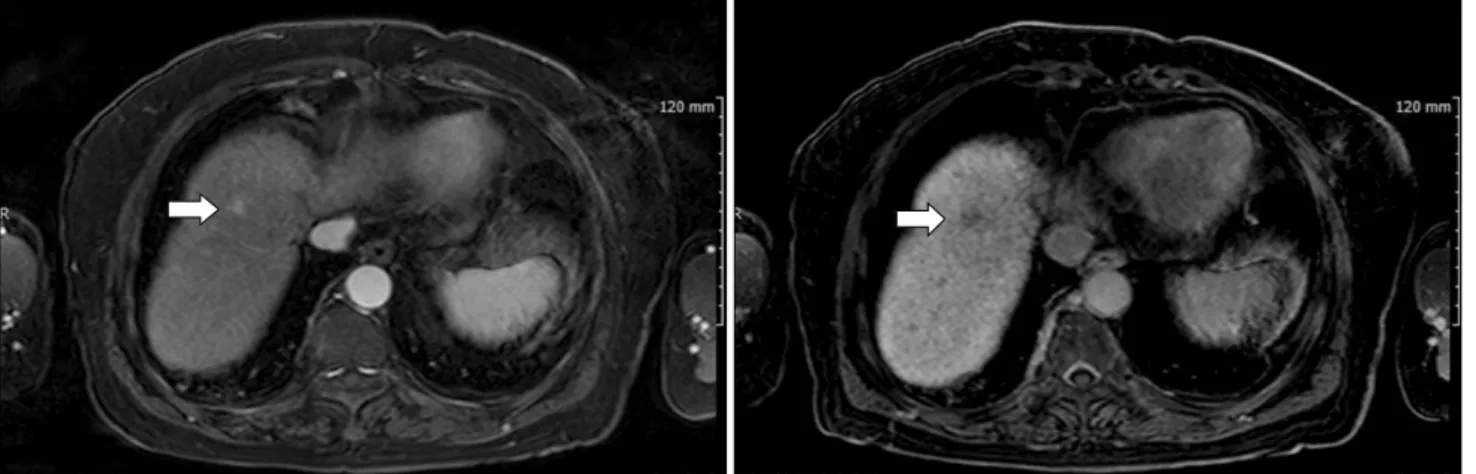
aging (MRI) showed a 1.5cm nodule at segment 8 of the liver (Fig. 1). Preoperative α-fetoprotein (AFP) and protein induced by vitamin K absence/antago- nist-II (PIVKA-II) levels were within normal limits.

Percutaneous RFA was deemed difficult because the nodule was located near the liver dome. We attempted open-approach RFA. A right subcostal incision was made. After right liver mobilization, the nodule was found by intraoperative-ultrasonography (Fig. 2A).

Ultrasound guided RFA was performed on the lo- calized cancer mass (Fig. 2B). An abdominal CT scan was performed the next day to confirm proper abla- tion. It showed complete ablation of the cancer nodule and a small amount of right pleural effusion. There were no complications of the procedure and the pa- tient was discharged on post-operative ninth day.

During a 9 month follow-up period, AFP and PIVKA-II levels remained within normal levels. Follow-up CT

CASE REPORT

J Surg Ultrasound 2015;2:22-25 JSU Journal of Surgical Ultrasound

(2)

Ho-Joong Choi, et al.: Open-approach Radiofrequency Ablation of Hepatocellular Carcinoma using Intraoperative Ultrasonography

23

Fig. 1. MRI (primovist) showed a 1.5 cm sized HCC at segment 8 (white arrow).

Fig. 2. (A) Intraoperative ultrasound showed a hypoechoic mass (white arrow), (B) RFA probe located and ablated the tumor mass.

images show no recurrence.

2. Case 2

A 57-year-old male patient was admitted for a re- current liver mass. The patient had underlying liver cirrhosis induced by hepatitis B and he had received transarterial chemoembolization (TACE) 6 years ago due to HCC. But, follow-up MRI showed HCC recur- rence. A 1.5 cm nodule was discovered on segment 7 of the liver (Fig. 3). Initially, TACE was attempted to treat this recurrent mass. However TACE failed due to arterial cannulation was impossible. The patient was not suitable for percutaneous RFA because the nodule was close to the diaphragm. Open-approach RFA was attempted instead of percutaneous RFA

(Fig. 4). A right subcostal incision was made and in- traoperative-ultrasound guided RFA was performed.

Though abdominal CT the following day did not show arterial enhancement, the ablation zone did not seem enough. In a follow-up MRI, recurrence was seen along the margin of the ablated nodule 7 months later after RFA. This time, TACE was successfully done to treat the recurred tumor. AFP and PIVKA-II levels decreased to normal at 2 months after TACE.

DISCUSSION

Hepatic resection remains the gold standard for

patients with HCC. However, the majority of primary

liver cancers cannot undergo curative resection at

(3)

J Surg Ultrasound Vol. 2, No. 1, 2015

24

Fig. 4. Intraoperative ultrasound is being used by surgeon to localize and ablate the tumor (Black arrow: ultrasound probe, white arrow:

RFA probe).

Fig. 3. MRI (primovist) showed an 1.5 cm sized HCC at segment 7 (white arrow).

the time of diagnosis.(3) RFA is an alternative treat- ment that can be done in cases where resection is not suitable. In small and deep HCC, RFA is a useful al- ternative.(4) Open approach RFA and hepatic re- section had similar survival benefits.(5) In general, the percutaneous approach is preferred than the open method. Benefits of the percutaneous approach are less invasiveness, reduced post-operative pain, shorter hospitalization, and reduced cost.(6) However per- cutaneous RFA is difficult if the cancer is close to the gallbladder, major vessels, bile ducts or the dia- phragm.(7,8) If percutaneous RFA is done in such lo- cations, it is possible to burn vital organs such as the

heart and lungs. Open approach RFA is indicated if patient has history of multiple abdominal operations or tumor is situated at the right posterior sector where a full mobilization of the right lobe is needed.(8) Open approach RFA can also ablate larger tumors by repeatedly placing RFA electrodes at multiple sites.(9) The advantages of open approach RFA are better can- cer staging, reduced adjacent organ injury, greater accessibility and the possibility of performing simul- taneous organ resection.(6) In our cases, open-ap- proach RFA was necessary because the tumors were located close to the diaphragm at segments 7 and 8.

Percutaneous RFA and open approach RFA showed no significant difference in survival.(8) The same prin- ciples of open approach RFA can be applied to laparo- scopic RFA. Laparoscopic RFA is an alternative to open approach RFA, and has the same outcome.(10) In conclusion, open approach RFA is useful in situa- tions where percutaneous RFA is difficult or risky.

Surgeons can ablate tumors effectively without hurt- ing vital organs with open approach RFA.

REFERENCES

1. El-Serag HB. Hepatocellular carcinoma: an epidem- iologic view. J Clin Gastroenterol 2002;35(5 Suppl 2):

S72-8.

2. Nemcek AA. Complications of radiofrequency ablation

(4)

Ho-Joong Choi, et al.: Open-approach Radiofrequency Ablation of Hepatocellular Carcinoma using Intraoperative Ultrasonography

25 of neoplasms. Semin Intervent Radiol 2006;23:177-87.

3. Yang JD, Roberts LR. Hepatocellular carcinoma: A glob- al view. Nat Rev Gastroenterol Hepatol 2010;7:448-58.

4. Cucchetti A, Piscaglia F, Cescon M, Ercolani G, Pinna AD. Systematic review of surgical resection vs radio- frequency ablation for hepatocellular carcinoma. World J Gastroenterol 2013;19:4106-18.

5. Lei J, Wang W, Yan L. Surgical resection versus open- approach radiofrequency ablation for small hepato- cellular carcinomas within Milan criteria after suc- cessful transcatheter arterial chemoembolization. J Gastrointest Surg 2013;17:1752-9.

6. Crucitti A, Danza FM, Antinori A, Vincenzo A, Pirulli PG, Bock E, et al. Radiofrequency thermal ablation (RFA) of liver tumors: percutaneous and open surgical ap- proaches. J Exp Clin Cancer Res 2003;22(4 Suppl):

191-5.

7. Abe T, Shinzawa H, Wakabayashi H, Aoki M, Sugahara K, Iwaba A, et al. Value of laparoscopic microwave co- agulation therapy for hepatocellular carcinoma in re- lation to tumor size and location. Endoscopy 2000;32:

598-603.

8. Wong J, Lee KF, Yu SC, Lee PS, Cheung YS, Chong CN, et al. Percutaneous radiofrequency ablation versus surgical radiofrequency ablation for malignant liver tumours: the long-term results. HPB (Oxford) 2013;

15:595-601.

9. Minami Y, Kudo M. Radiofrequency ablation of hep- atocellular carcinoma: Current status. World J Radiol 2010;2:417-24.

10. Sakoda M, Ueno S, Iino S, Minami K, Ando K, Kawasaki Y, et al. Endoscopic versus open radiofrequency abla- tion for treatment of small hepatocellular carcinoma.

World J Surg 2013;37:597-601.

수치

Fig. 1. MRI (primovist) showed a 1.5 cm sized HCC at segment 8 (white arrow).
Fig. 4. Intraoperative ultrasound is being used by surgeon to localize  and ablate the tumor (Black arrow: ultrasound probe, white arrow:

참조

관련 문서

A source of light waves moving to the right with velocity 0.7c. The frequency is higher on the right, and lower

However, all greetings are usually used to welcome people and wish them

If both these adjustments are considered, the resulting approach is called a bootstrap-BC a -method (bias- corrected-accelerated). A description of this approach

The proposal of the cell theory as the birth of contemporary cell biology Microscopic studies of plant tissues by Schleiden and of animal tissues by Microscopic studies of

(2) For automatic operation of the actuator, fully raise the handwheel if the actuator is of the direct action type or fully lower the handwheel if the actuator is of

• The supply and demand curves cross at the equilibrium price and quantity.. • You can read off approximate equilibrium values

A tangential section of the common ivy, Hedera helix, shows some vasicentric tracheids to the left of the vessel, which is the white space at right.. A maceration of the wood

(1) Where the subject-matter insured is destroyed, or so damaged as to cease to be a thing of the kind insured, or where the assured is irretrievably deprived thereof, there