한국에서 분리된 Streptococcus mutans의 분자 역학 및 특성
김세연
1, 배일권
2, 이정하
1, 신정환
3, 김진범
11부산대학교 치의학전문대학원 예방과사회치의학교실, 2신라대학교 보건복지대학 치위생학과,
3인제대학교 의과대학 진단검사의학과
Molecular epidemiology and characterization of Streptococcus mutans strains in Korea
Se-Yeon Kim1, Il Kown Bae2, Jung-Ha Lee1, Jeong Hwan Shin3, Jin-Bom Kim1
1Department of Preventive and Community Dentistry, School of Dentistry, Pusan National University, Yangsan,
2Department of Dental Hygiene, College of Health and Welfare, Silla University,
3Department of Laboratory Medicine, Inje University College of Medicine, Busan, Korea
Copyright © 2020 by Journal of Korean Academy of Oral Health
This is an open-access article distributed under the terms of the Creative Commons Attribution Non-Commercial License (http://creativecommons.org/licenses/by-nc/4.0/), which permits unrestricted non-commercial use, distribution, and reproduction in any medium, provided the original work is properly cited.
Objectives: We investigated the characteristics of Streptococcus mutans in the national culture collection from Korea. Twenty-nine (dental plaque, n=27; endodontic infections, n=1; blood, n=1) isolates were included in this study.
Methods: Antimicrobial susceptibilities were tested using the disk diffusion test. Multilocus se- quence typing (MLST), serotyping, and collagen-binding genes were used for polymerase chain reaction (PCR) and direct sequencing. A collagen-binding (to assess the adhesion properties) assay was performed. S. mutans demonstrated high susceptibility to antimicrobial agents. Differences in collagen-binding abilities of the cnm-positive and -negative groups were compared using the Mann-Whitney U test (P<0.05).
Results: MLST analyses revealed 25 sequence types (STs), 17 of which (ST213-ST229) contained new alleles. The strains were classified into four serotypes with the c type encompassing 79.3% of all strains, while the e, f, and k types representing 6.9% each. Analysis of the cnm and cbm genes, which encode the two surface adhesin components of S. mutans, revealed three cnm-positive strains, each displaying greater adhesion ability than those of the cnm-negative strains.
Conclusions: This study highlights the presence of a wide variety of S. mutans genotypes in Korea.
These findings may provide useful information regarding the pathogenesis of infectious diseases, such as dental caries.
Key Words: Adhesion, Bacteremia, Collagen binding, MLST, Infection, Inflammation, Streptococcus mutans
Received: December 16, 2019 Revised: February 12, 2020 Accepted: February 25, 2020
Corresponding Author: Jin-Bom Kim Department of Preventive and Community Dentistry, School of Dentistry, Pusan National University, 49 Busandaehak-ro, Mulgeum-eup, Yangsan 50612, Korea Tel: +82-51-510-8223
Fax: +82-51-510-8221 E-mail: [email protected]
https://orcid.org/0000-0001-8619-2741
*This work was supported by the National Research Foundation of Korea (NRF) grant funded by the Korea government (MSIT) (No. NRF-2018R1A5A2023879).
JKAOH is available at http://www.jkaoh.org pISSN 1225-388X / eISSN 2093-7784
Introduction
Streptococcus mutans is a gram-positive facultative an- aerobic oral bacterium that is considered the major causative agent of dental caries1). There are numerous reports in which S.
mutans isolates have been found to mediate dental caries and dental plaque on the tooth surface in human2,3). S. mutans gen-
erates an extracellular polysaccharide from sucrose which helps in the attachment of the bacterium. Furthermore, S. mutans also adhere to the external enamel thus assisting the progress of colonization4). The high cariogenicity of S. mutans is mainly due to its ability to adhere to tooth surfaces. S. mutans comprises four serotypes (c, e, f, and k), according to the different polysac- charide composition of the cell wall, consisting of rhamnose-
glucose polymers5,6). The distribution frequency of these sero- types among clinical oral isolates has been investigated7,8) and the majority of them, approximately 70-80%, were classified as serotype c, followed by e (20%), while serotypes f and k were found to be extremely rare, accounting for less than 5%.
Several bacterial surface proteins have been shown to have collagen-binding capability. In this regard, the collagen-binding proteins Cnm and Cbm are important cell surface antigens in- volved in the adhesion of S. mutans to collagenous tissues9,10). Cnm has been shown to bind to type I collagen11), a major or- ganic component of dentin. The distribution frequencies of cnm and cbm in S. mutans oral strains are approximately 10-20%
and 2%, respectively12). Recent studies on cnm and cbm have linked the encoded adhesins to extraoral conditions, including infective endocarditis, hemorrhagic stroke, and atherosclerotic plaque development13-15). Endodontic infection is considered an important cause of bacteremia; however, little is known regard- ing the presence of S. mutans in dental pulp tissue16).
Multilocus sequence typing (MLST) is an unambiguous pro- cedure for characterising isolates of bacterial species using the sequences of internal fragments of each house-keeping genes.
For each house-keeping gene, the different sequences present within a bacterial species are assigned as distinct alleles and, it is a way to define for each isolate, the alleles at each of the loci define the allelic profile or sequence type. It is a high-resolution genetic typing approach to identify species and strains of pathogens impacting human health17).
Few reports have described the molecular characteristics of S. mutans isolated from various specimens, in Korea.
The aim of this study was to investigate the distribution, an- timicrobial susceptibilities, adhesion properties, and molecular characteristics of S. mutans isolated from carious lesions and other specimens. Genotyping of S. mutans for epidemiological studies is important for an in-depth understanding of dental caries initiation and progression.
Materials and Methods
1. Bacterial strains and antimicrobial susceptibilities A total of 29 isolates of S. mutans were obtained from the Korean Collection for Oral Microbiology (KCOM) and the Na- tional Culture Collection for Pathogens (NCCP). They included one blood isolate (NCCP PO 1463), one specimen isolate from an endodontic infection (KCOM 2084), and twenty-seven iso- lates from dental plaques. The control strains used in this study were ATCC 25175 and UA159, which is isolated from caries le- sion. Identification of the strains was confirmed by 16S rRNA
sequencing and matrix-assisted laser desorption/ionization mass spectrometry. S. mutans was grown in Brain Heart Infu- sion medium (BHI, BactoTM BHI, BD, NJ, USA) containing 1%
dextrose18), at 37℃ in an aerobic chamber. An optical density (OD) of 1.0 was determined to correspond to 2×10⁹ colony forming units/mL at 620 nm wavelength. For bacterial prepara- tion, an overnight culture was diluted to an OD620 of 1.0 in BHI broth. S. mutans strains were tested for susceptibility to anti- microbials by the disc diffusion method according to the Clini- cal and Laboratory Standards Institute (CLSI) guidelines19). The antimicrobial agents used were penicillin G (10 mg), vancomycin (30 mg), erythromycin (15 mg), tetracycline (30 mg), rifampicin (5 mg), trimethoprim-sulfamethoxazole (1.25 mg+23.75 mg), chlor- amphenicol (30 mg), clindamycin (2 mg), and levofloxacin (5 mg), respectively (Rosco, Tehran, IRI).
2. Amplification of bacterial serotyping and adhesion (cnm, cbm) genes
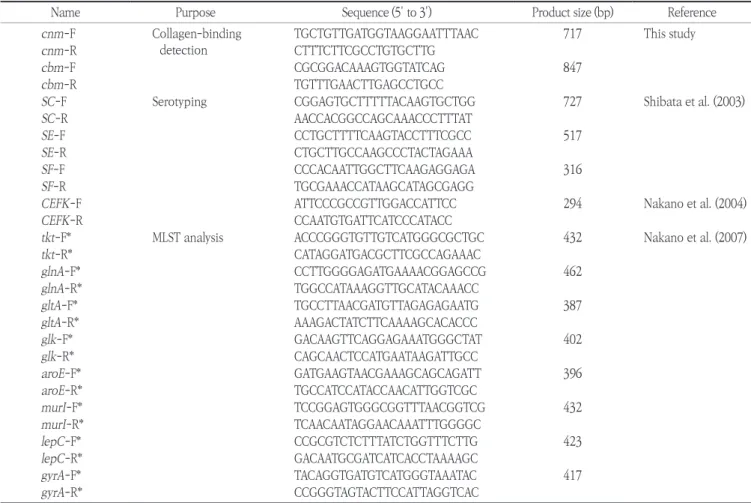
Primers used in this study are listed in Table 1. The primers for PCR amplification and sequencing were designed by select- ing consensus sequences in multilple-nucleotide alignment collagen-binding gene (cnm and cbm) by using the Primer3 program (http://bioinfo.ut.ee/primer3-0.4.0/)9,10). The serotype of each S. mutans strain was determined by PCR using serotype- specific sets of primers for serotypes c, e, f, and k20).
3. Multilocus sequence typing (MLST)
MLST is a highly discriminatory method for characterizing bacterial isolates on the basis of the sequence type (ST)21-23). Internal fragments of eight housekeeping gene loci were am- plified, namely tkt (transketolase), glnA (glutamine synthetase subunit 1a), gltA (glutamate synthase), glk (glucose kinase), gyrA (DNA gyrase subunit A), aroE (shikimate-5 dehydrogenase), murI (glutamate racemase), and lepC (signal peptidase 1), and their nucleotide sequences were determined. The sequence of each housekeeping gene fragment was compared with the al- lele sequences on the MLST site (http://pubmlst.org/oralstrep/) in order to assign allele numbers using a non-redundant data- base. For each strain, eight allele numbers defined the allelic profile and, consequently, the ST of that strain22-24). We defined as groups of two or more independent isolates sharing identical alleles at five or more loci.
4. Collagen-binding assay of S. mutans strains A collagen-binding assay was performed to confirm the ad- hesion ability of S. mutans. Briefly, 2 mg of type I collagen in 0.25 M acetic acid (Katayama Chemical Industries Co., Ltd., Osaka,
JPN) were used for coating the wells of 96-well tissue culture plates (Corning Inc., NY, USA) and incubated overnight at 4℃.
The plates were washed three times with phosphate buffered saline (PBS) and 5% bovine serum albumin (Bio Basic, NY, USA) in PBS was used as a blocking agent at 37℃ for 1.5 h. Next, the wells were washed again with PBS containing 0.01% Tween 20 (Sigma, Darmstadt, DEU). Cells from the overnight cultures of S. mutans grown in BHI broth were collected by centrifugation, resuspended, and an aliquot of 2×10⁹ cells was added to each well. After a 3-h incubation at 37℃, adherent cells were washed three times with PBS and then fixed with 200 ml 25% formal- dehyde at room temperature for 30 min. After three additional washes with PBS, the adherent cells were stained with 200 ml 0.05% crystal violet for 1 minute and washed three times with PBS. Next, the dye was dissolved by adding 200 ml 7% acetic acid and the A620 values were determined (Elisa Reader, Tecan, AUT). Data were expressed as the mean±standard deviation of triplicate experiments20,25).
5. Statistics
The statistical analysis was performed with Statistical Pack- age for the Social Sciences (SPSS Statistics for Windows, version 23, IBM Co., Armonk, NY, USA). The collagen-binding abilities of the cnm-positive and cnm-negative strains were compared using a Mann-Whitney’s U test. P-values below 0.05 were con- sidered to be significant.
Results
1. Antimicrobial susceptibilities
Control strains of S. mutans (ATCC 25175, UA159) were isolated from carious lesions and twenty-nine S. mutans strains were isolated from a variety of specimens, such as blood, end- odontic infection, and dental plaque. The isolated S. mutans strains were not resistant to antibiotics, as assessed by the anti- microbial susceptibility test.
Table 1. PCR primers for S. mutans used in this study
Name Purpose Sequence (5' to 3') Product size (bp) Reference
cnm-F Collagen-binding detection
TGCTGTTGATGGTAAGGAATTTAAC 717 This study
cnm-R CTTTCTTCGCCTGTGCTTG
cbm-F CGCGGACAAAGTGGTATCAG 847
cbm-R TGTTTGAACTTGAGCCTGCC
SC-F Serotyping CGGAGTGCTTTTTACAAGTGCTGG 727 Shibata et al. (2003)
SC-R AACCACGGCCAGCAAACCCTTTAT
SE-F CCTGCTTTTCAAGTACCTTTCGCC 517
SE-R CTGCTTGCCAAGCCCTACTAGAAA
SF-F CCCACAATTGGCTTCAAGAGGAGA 316
SF-R TGCGAAACCATAAGCATAGCGAGG
CEFK-F ATTCCCGCCGTTGGACCATTCC 294 Nakano et al. (2004)
CEFK-R CCAATGTGATTCATCCCATACC
tkt-F* MLST analysis ACCCGGGTGTTGTCATGGGCGCTGC 432 Nakano et al. (2007)
tkt-R* CATAGGATGACGCTTCGCCAGAAAC
glnA-F* CCTTGGGGAGATGAAAACGGAGCCG 462
glnA-R* TGGCCATAAAGGTTGCATACAAACC
gltA-F* TGCCTTAACGATGTTAGAGAGAATG 387
gltA-R* AAAGACTATCTTCAAAAGCACACCC
glk-F* GACAAGTTCAGGAGAAATGGGCTAT 402
glk-R* CAGCAACTCCATGAATAAGATTGCC
aroE-F* GATGAAGTAACGAAAGCAGCAGATT 396
aroE-R* TGCCATCCATACCAACATTGGTCGC
murI-F* TCCGGAGTGGGCGGTTTAACGGTCG 432
murI-R* TCAACAATAGGAACAAATTTGGGGC
lepC-F* CCGCGTCTCTTTATCTGGTTTCTTG 423
lepC-R* GACAATGCGATCATCACCTAAAAGC
gyrA-F* TACAGGTGATGTCATGGGTAAATAC 417
gyrA-R* CCGGGTAGTACTTCCATTAGGTCAC
*The asterisks indicate 8 housekeeping genes, tkt (transketolase), glnA (glutamine synthetase subunit 1a), gltA (glutamate synthase), glk (glucose kinase), aroE (shikimate-5 dehydrogenase), murI (glutamate racemase), lepC (signal peptidase 1) and gyrA (DNA gyrase subunit A).
2. Bacterial serotypes and adhesion genes
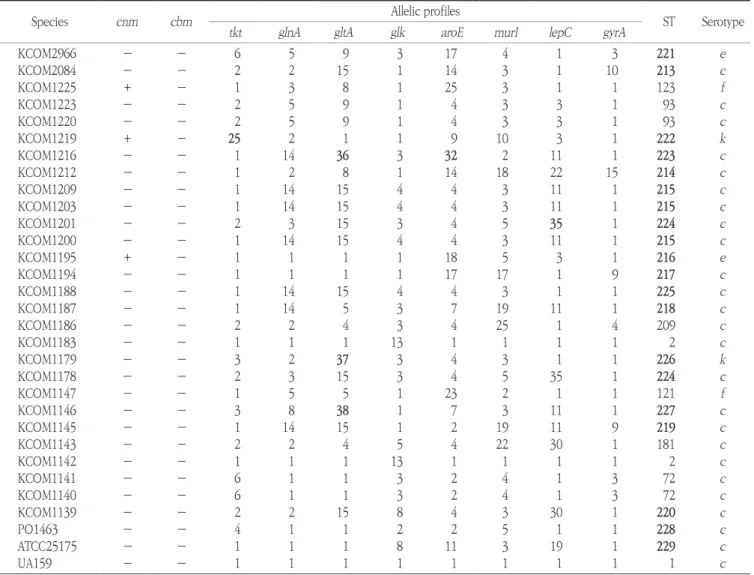
The serotypes of 29 S. mutans strains were classified into four types, namely c, e, f, and k. Twenty-three isolates belonged to the control strain serotype, type c, whereas two isolates represented each of the e, f, and k serotypes (Table 2). In the analysis of cnm and cbm genes known to be associated with the adhesion properties of S. mutans, three cnm-positive strains (KCOM1225, KCOM1219, KCOM1195) were detected.
3. MLST analysis
MLST analysis of 31 S. mutans strains, including the control strains, revealed 25 STs, 17 of which (ST213 to ST229) contained new alleles. The allelic gene of tkt (#25), gltA (#36 to 38), aroE (#32), and lepC (#35) were defined the new type of alleles among the eight housekeeping gene. The existing sequence type was
almost identified in the dental plaque. Among the newly regis- tered sequence type was identified in 14 of dental plaque, 1 of endodontic infection and blood. The control strain of S. mutans (ATCC25175) isolated from active caries subject was also reg- istered with new sequence type. All new alleles defined in the present study are shown in bold in Table 2.
4. Collagen-binding activity
As a result of triplicate evaluation, the 29 S. mutans isolates showed collagen-binding activities in the range from 0.051 to 0.183 OD620 values. The control strains S. mutans ATCC 25175 and S. mutans UA 159 showed collagen-binding activities of 0.052, whereas the values corresponding to the activities of the cnm-containing strains were 0.139, 0.159, and 0.183, with a mean value of 0.160±0.022. However, the collagen-binding ac-
Table 2. Characteristics of S. mutans strains analyzed by PCR and sequencing
Species cnm cbm Allelic profiles
ST Serotype
tkt glnA gltA glk aroE murI lepC gyrA
KCOM2966 ― ― 6 5 9 3 17 4 1 3 221 e
KCOM2084 ― ― 2 2 15 1 14 3 1 10 213 c
KCOM1225 + ― 1 3 8 1 25 3 1 1 123 f
KCOM1223 ― ― 2 5 9 1 4 3 3 1 93 c
KCOM1220 ― ― 2 5 9 1 4 3 3 1 93 c
KCOM1219 + ― 25 2 1 1 9 10 3 1 222 k
KCOM1216 ― ― 1 14 36 3 32 2 11 1 223 c
KCOM1212 ― ― 1 2 8 1 14 18 22 15 214 c
KCOM1209 ― ― 1 14 15 4 4 3 11 1 215 c
KCOM1203 ― ― 1 14 15 4 4 3 11 1 215 c
KCOM1201 ― ― 2 3 15 3 4 5 35 1 224 c
KCOM1200 ― ― 1 14 15 4 4 3 11 1 215 c
KCOM1195 + ― 1 1 1 1 18 5 3 1 216 e
KCOM1194 ― ― 1 1 1 1 17 17 1 9 217 c
KCOM1188 ― ― 1 14 15 4 4 3 1 1 225 c
KCOM1187 ― ― 1 14 5 3 7 19 11 1 218 c
KCOM1186 ― ― 2 2 4 3 4 25 1 4 209 c
KCOM1183 ― ― 1 1 1 13 1 1 1 1 2 c
KCOM1179 ― ― 3 2 37 3 4 3 1 1 226 k
KCOM1178 ― ― 2 3 15 3 4 5 35 1 224 c
KCOM1147 ― ― 1 5 5 1 23 2 1 1 121 f
KCOM1146 ― ― 3 8 38 1 7 3 11 1 227 c
KCOM1145 ― ― 1 14 15 1 2 19 11 9 219 c
KCOM1143 ― ― 2 2 4 5 4 22 30 1 181 c
KCOM1142 ― ― 1 1 1 13 1 1 1 1 2 c
KCOM1141 ― ― 6 1 1 3 2 4 1 3 72 c
KCOM1140 ― ― 6 1 1 3 2 4 1 3 72 c
KCOM1139 ― ― 2 2 15 8 4 3 30 1 220 c
PO1463 ― ― 4 1 1 2 2 5 1 1 228 c
ATCC25175 ― ― 1 1 1 8 11 3 19 1 229 c
UA159 ― ― 1 1 1 1 1 1 1 1 1 c
Bold letters indicate new alleles and sequence type (ST) registered with PubMLST for S. mutans MLST scheme in this study.
tkt (#25), GenBank accession no. AB281747; gltA (#36), GenBank accession no. AB281970; gltA (#37), Genbank accession no. AB281943; gltA (#38), GenBank accession no. AB282001; aroE (#32), GenBank accession no. AB282285; lepC (#35), GenBank accession no. AB282484.
tivity of cnm-negative strains not identified by ranged from 0.051 to 0.061, with a mean of 0.054±0.002. The difference observed between cnm-positive and -negative strains was statistically sig- nificant (Fig. 1, P<0.001).
Discussion
Streptococcus mutans is generally known as a major patho- gen responsible for dental caries and, occasionally, as a possible causative agent of bacteremia and infective endocarditis5,6). Several S. mutans strains were shown to possess collagen-bind- ing activities26,27). Most of them display cell-surface collagen- binding proteins and the genes encoding them (cnm, cbm) have been cloned and sequenced9,10). This study was conducted to investigate the resistance status of S. mutans isolated from vari- ous specimens, including dental plaque, endodontic infection, and blood, as well as the mechanism of adhesion of different S.
mutans strains. All the 29 strains, isolated from clinical settings, were found to be susceptible to the antimicrobial agents tested, indicating that treatment failure due to acquired resistance was unlikely. However, biofilms were reported to be resistant to an- timicrobial agents in the oral environment28,29). Although MLST analysis has been widely applied in recent study, but this is the first report of the MLST based epidemiology study of Strepto- coccus mutans in Korea.
The cnm and cbm gene fragments were used as primers to evaluate the adhesion genes in strains of S. mutans, including control strian of S. mutans (UA159 and ATCC 25175)20,30). In S.
mutans, the collagen-binding adhesin protein encoded by cnm has been described as a strain-specific collagen-binding mole- cule11). The frequency of cnm gene in previously identified cnm- positive strains isolated from clinical specimens was approxi- mately 20%12), which differs from the approximate 10% value
observed in the present study. Evaluation of the adhesion ability of S. mutans showed that the three strains expressing cnm displayed higher collagen-adhesion ability when compared to other strains. The collagen-binding activity of the cnm-positive strains corresponded to 0.139, 0.159, and 0.183 OD620 values, respectively. The mean collagen-binding activity of the cnm- positive strains was approximately three times higher compared to that of the cnm-negative strains.
S. mutans is classified into serotypes c, e, f, and k based on the chemical composition of serotype polysaccharides; 70-80%
of the species are classified as serotype c; 20%, serotype e; less than 5%, serotypes f and serotype k in the mouth25). The isola- tion of single serotypes was displayed the following distribution among the four serotypes; c type, 79.3%; e, f and k type, 6.9%, respectively. The cbm-positive strain has been associated with serotype k10), but the isolates identified by this serotype in our study did not express a cbm gene. In a previous study focusing on cnm-positive S. mutans, serotypes f, k, c, and e were found in 81.3%, 41.7%, 7.0%, and 3.2% cases, respectively10,24). The se- rotypes of cnm-positive S. mutans were confirmed as e, f, and k (6.2%, respectively). However, one strain isolated from an endo- carditis infection did not carry the cnm gene. Differences were observed in these studies between cardiovascular patients (single serotype, 41.0%; multiple serotypes, 53.8%), healthy mothers (single serotype, 75.0%; multiple serotypes, 25.0%) and healthy children (single serotype, 78.3%; multiple serotypes, 21.7%)12,24). The isolation of single serotypes was displayed the following distribution among the four serotypes; c type, 79.3%; e, f and k type, 6.9%, respectively.
Although MLST analysis is a commonly used genotyping method, little is known about its application in the dental field.
In this study, eight housekeeping loci were used because con- stitutive genes and their products are typically needed for main- tenance of cell. Among the 17 newly identified STs, ST216 could be classified, by matching 5 or more genes, into the same clonal complex as ST1, ST150, ST165, ST169, and ST192 isolated from the USA. Although, based on the same criterium, ST217 could be classified into the same clonal complex as ST1, the other newly identified STs were different from those reported in previ- ous studies. In general, serotypes are related to the entire geno- type defined by the ST, and closely related STs constitute similar clonal complexes. Therefore we confirmed that in S. mutans the same ST may associate to different serotype or gene expression.
The control strain S. mutans UA 159 belonged to ST1, but the other control strain (S. mutans ATCC 25175) was was registered as ST229 and assigned to serotype c. Similar characteristics were observed in ST121, ST123, ST181, and ST20920). The strains
0.200 0.180 0.160 0.140 0.120 0.100 0.080 0.060 0.040 0.020 0.000 OD620
cnm+ cnm
Fig. 1. Comparison of collagen-binding activities between cnm-posi- tive (cnm+)and cnm-negative (cnm-) strains.
belonging to ST121 and 123 with same in four alleles were as- signed to serotype f; ST181 and 209 with same in four alleles were assigned to serotype c. The strains identified by ST2, ST93 and ST72 were also assigned to serotype c.
The discrepancies observed in various studies based on MLST might be accounted for by differences in recombination, in S. mutans, resulting in heterogeneous virulence23). Among the 17 newly analyzed STs (ST213-228), ST216 could be classi- fied into the same clonal complex by matching 5 or more genes with ST1, ST150, ST165, ST169, and ST192 isolated from the USA. Although the isolates Thailand ST126 and ST217 could be classified into the same clonal complex by matching 5 or more genes with ST1, the other newly discovered STs were differ- ent from those reported in previous studies. The strain classi- fied as ST229 was the control strain ATCC 25175 isolated from caries active subject. This study has been used to investigate characteristics of S. mutans strains isolated from Korea, there is the limit that could not be verified for non-isolated S. mutans strains. Therefore, it is necessary to subsequent analysis for later isolated S. mutans strains.
In conclusions, the analysis of 29 S. mutans strain isolates from various specimens revealed 17 STs with new alleles. In the evaluation of cnm and cbm, i.e., genes associated with the adhesion ability of S. mutans, three cnm-positive strains were detected, all displaying adhesion abilities 3 times higher than those of cnm-negative strains. These findings may provide po- tentially useful information on the pathogenesis of infectious diseases including dental caries.
Conclusions
This study was to investigate the distribution, antimicrobial susceptibilities, adhesion properties, and molecular characteris- tics of S. mutans isolated from carious lesions and other speci- mens.
1. The analysis of 29 S. mutans strain isolates from various specimens revealed 17 STs with new alleles in Korea.
2. The serotypes of 29 S. mutans strains were classified into four types (c, e, f, and k).
3. In the evaluation of genes associated with the adhesion ability of S. mutans, three cnm-positive strains were detected.
Moreover, the adhesion properties of cnm-positive strains were significantly 3 times greater than those of cnm-negative strains.
These findings may provide potentially useful information on the pathogenesis of infectious diseases including dental car- ies.
ORCID
Se-Yeon Kim, https://orcid.org/0000-0002-9683-352X Il Kown Bae, https://orcid.org/0000-0003-1633-3240 Jung-Ha Lee, https://orcid.org/0000-0002-4737-7150 Jeong Hwan Shin, https://orcid.org/0000-0003-3960-6969
References
1. Ajdić D, McShan WM, McLaughlin RE, Savić G, Chang J, Carson MB, et al. Genome sequence of Streptococcus mutans UA159, a car- iogenic dental pathogen. Proc Natl Acad Sci USA 2002;99:14434- 14439.
2. Switalski LM, Butcher WG, Caufield PC, Lantz MS. Collagen medi- ates adhesion of Streptococcus mutans to human dentin. Infect Im- mun 1993;61:4119-4125.
3. Miller JH, Avilés-Reyes A, Scott-Anne K, Gregoire S, Watson GE, Sampson E, et al. The collagen binding protein Cnm contributes to oral colonization and cariogenicity of Streptococcus mutans OMZ175. Infect Immun 2015;83:2001-2010.
4. Banas JA. Virulence properties of Streptococcus mutans. Front Biosci 2004;9:1267-1277.
5. Nakano K, Ooshima T. Serotype classification of Streptococcus mutans and its detection outside the oral cavity. Future Microbiol 2009;4:891-902.
6. Nakano K, Nomura R, Nemoto H, Mukai T, Yoshioka H, Shudo Y, et al. Detection of novel serotype k Streptococcus mutans in infective endocarditis patients. J Med Microbiol 2007;56:1413-1415.
7. Hirasawa M, Takada K. A new selective medium for Streptococcus mutans and the distribution of S. mutans and S. sobrinus and their serotypes in dental plaque. Caries Res 2003;37:212-217.
8. Nakano K, Nomura R, Nakagawa I, Hamada S, Ooshima T. Dem- onstration of Streptococcus mutans with a cell wall polysaccharide specific to a new serotype, k, in the human oral cavity. J Clin Micro- biol 2004;42:198-202.
9. Nakano K, Nomura R, Taniguchi N, Lapirattanakul J, Kojima A, Naka S, et al. Molecular characterization of Streptococcus mutans strains containing the cnm gene encoding a collagen-binding adhe- sin. Arch Oral Biol 2010;55:34-39.
10. Nomura R, Nakano K, Naka S, Nemoto H, Masuda K, Lapirat- tanakul J, et al. Identification and characterization of a collagen- binding protein, Cbm, in Streptococcus mutans. Mol Oral Microbiol 2012;27:308-323.
11. Sato Y, Okamoto K, Kagami A, Yamamoto Y, Igarashi T, Kizaki H.
Streptococcus mutans strains harboring collagen-binding adhesin. J Dent Res 2004;83:534-539.
12. Nomura R, Nakano K, Taniguchi N, Lapirattanakul J, Nemoto H, Grönroos L, et al. Molecular and clinical analyses of the gene en- coding the collagen-binding adhesin of Streptococcus mutans. J Med Microbiol. 2009;58:469-475.
13. Nakano K, Hokamura K, Taniguchi N, Wada K, Kudo C, Nomura R, et al. The collagen-binding protein of Streptococcus mutans is involved in haemorrhagic stroke. Nat Commun 2011;2:485.
14. Kojima A, Nakano K, Wada K, Takahashi H, Katayama K, Yoneda M, et al. Infection of specific strains of Streptococcus mutans, oral bacteria, confers a risk of ulcerative colitis. Sci Rep 2012;2:332.
15. Lapirattanakul J, Nakano K, Nomura R, Hamada S, Nakagawa I, Ooshima T. Demonstration of mother-to-child transmission of Streptococcus mutans using multilocus sequence typing. Caries Res 2008;42:466-474.
16. Nomura R, Ogaya Y, Nakano K. Contribution of the collagen- binding proteins of Streptococcus mutans to bacterial colonization of inflamed dental pulp. PLoS One 2016;11:e0159613.
17. Pérez-Losada M, Cabezas P, Castro-Nallar E, Crandall KA. Pathogen typing in the genomics era: MLST and the future of molecular epi- demiology. Infect Genet Evol 2013;16:38-53.
18. Cai JN, Jung JE, Lee MH, Choi HM, Jeon JG. Sucrose challenges to Streptococcus mutans biofilms and the curve fitting for the biofilm changes. FEMS Microbiol Ecol 2018;94.
19. Patel J, Cockerill F, Alder J, Bradford P, Eliopoulos G, Hardy D, et al. Performance standards for antimicrobial susceptibility testing;
twenty-fourth informational supplement. PA:Clinical and Labora- tory Standards Institute;2014;34:1-266.
20. Lapirattanakul J, Nakano K, Nomura R, Leelataweewud P, Chalerm- sarp N, Klaophimai A, et al. Multilocus sequence typing analysis of Streptococcus mutans strains with the cnm gene encoding collagen- binding adhesin. J Med Microbiol 2011;60:1677-1684.
21. Momeni SS, Whiddon J, Cheon K, Moser SA, Childers NK. Assess- ment of two multilocus sequence typing (MLST) schemes available for Streptococcus mutans. Arch Oral Biol 2015;60:1769-1776.
22. Nakano K, Nemoto H, Nomura R, Homma H, Yoshioka H, Shudo Y, et al. Serotype distribution of Streptococcus mutans a pathogen of dental caries in cardiovascular specimens from Japanese patients. J Med Microbiol 2007;56:551-556.
23. Do T, Gilbert SC, Clark D, Ali F, Fatturi Parolo CC, Maltz M, et al.
Generation of diversity in Streptococcus mutans genes demonstrat- ed by MLST. PLoS One 2010;5:e9073.
24. Nakano K, Lapirattanakul J, Nomura R, Nemoto H, Alaluusua S, Grönroos L, et al. Streptococcus mutans clonal variation revealed by multilocus sequence typing. J Clin Microbiol 2007;45:2616-2625.
25. Lapirattanakul J, Nomura R, Nemoto H, Naka S, Ooshima T, Na- kano K. Multilocus sequence typing of Streptococcus mutans strains with the cbm gene encoding a novel collagen-binding protein. Arch Oral Biol 2013;58:989-996.
26. Abranches J, Miller JH, Martinez AR, Simpson-Haidaris PJ, Burne RA, Lemos JA. The collagen-binding protein Cnm is required for Streptococcus mutans adherence to and intracellular invasion of hu- man coronary artery endothelial cells. Infect Immun 2011;79:2277- 2284.
27. Nomura R, Naka S, Nemoto H, Inagaki S, Taniguchi K, Ooshima T, et al. Potential involvement of collagen-binding proteins of Strepto- coccus mutans in infective endocarditis. Oral Dis 2013;19:387-393.
28. García-Godoy F, Hicks MJ. Maintaining the integrity of the enamel surface: the role of dental biofilm, saliva and preventive agents in enamel demineralization and remineralization. J Am Dent Assoc 2008;139 Suppl:S25-34.
29. Goyal D, Sharma S, Mahmood A. Inhibition of dextransucrase activ- ity in Streptococcus mutans by plant phenolics. Indian J Biochem Biophys 2013;50:48-53.
30. Shibata Y, Ozaki K, Seki M, Kawato T, Tanaka H, Nakano Y, et al.
Analysis of loci required for determination of serotype antigenicity in Streptococcus mutans and its clinical utilization. J Clin Microbiol 2003;41:4107-4112.