• 검색 결과가 없습니다.

Single-incision Laparoscopic Surgery for Simultaneous Appendectomy and Cholecystectomy

N/A
N/A
Protected

Academic year: 2021

Share "Single-incision Laparoscopic Surgery for Simultaneous Appendectomy and Cholecystectomy"

Copied!
4
0
0

로드 중.... (전체 텍스트 보기)

전체 글

(1)

Journal of Minimally Invasive Surgery Vol. 17. No. 3, 2014 □ Case Report □

pISSN 2234-778X, eISSN 2234-5248 http://dx.doi.org/10.7602/jmis.2014.17.3.51

This is an open-access article distributed under the terms of the Creative Commons Attribution Non-Commercial License (http://creativecommons.org/licenses/

by-nc/3.0) which permits unrestricted non-commercial use, distribution, and reproduction in any medium, provided the original work is properly cited.

Single-incision Laparoscopic Surgery for Simultaneous Appendectomy and Cholecystectomy

Sang-Hong Choi, M.D., Seung-Hyun Lee, M.D., Byung-Kwon Ahn, M.D., Sung-Uhn Baek, M.D.

Department of Surgery, Kosin University College of Medicine, Busan, Korea Single-incision laparoscopic surgery (SILS) has become popu-

lar due to the advantage of m inim izing surgical. W e report on tw o cases of sim ultaneous appendectom y and chol- ecystectom y using a single-incision laparoscopic technique.

The patients w ere 49- and 50-year old fem ales diagnosed w ith acute appendicitis w ith concom itant cholelithiasis. Body m ass indices of the patients were 22.3 and 26.0. A 3 cm ab- dom inal incision w as m ade via the um bilicus, and a single port platform w as created using a sm all w ound retractor (ALEXIS

®

wound retractor S, Applied Medical, Santa Margarita, CA, USA) and a surgical glove. Cholecystectom y w as per-

form ed first, follow ed by the appendectom y. The operation tim es were 165 and 280 m inutes, and blood loss was 50 and 150 cc, respectively. The postoperative hospital stays w ere five and seven days, and one patient had a w ound serom a as a surgical com plication. W e believe that SILS for sim ulta- neous appendectom y and cholecystectom y is a feasible and safe m inim ally invasive procedure.

󰠏󰠏󰠏󰠏󰠏󰠏󰠏󰠏󰠏󰠏󰠏󰠏󰠏󰠏󰠏

Key words: Single-incision laparoscopic surgery, Appendectomy, Cholecystectom y

Received May 18, 2014, Revised August 5, 2014, Accepted August 19, 2014

※ Corresponding author:Seung-Hyun Lee

Department of Surgery, Kosin University College of Medicine, 34 Amnam-dong, Seo-gu, Busan 602-702, Korea

Tel:+82-51-990-6462, Fax:+82-51-246-6093 E-mail:[email protected]

INSTRUCTION

Single-incision laparoscopic surgery (SILS) is an innovative surgical procedure performed via a single umbilical laparo- scopic incision compared with the several abdominal trocar sites required during conventional laparoscopic surgery. Rece- ntly, SILS has become more popular due to the advantage of minimizing surgical trauma for a wide variety of surgical proce- dures in the fields of general surgery, urology, and gynecology.

1

Although many studies have showed that SILS is a feasible, safe procedure, it is technically challenging compared with con- ventional laparoscopic surgery.

Appendectomy and cholecystectomy are two of the most fre- quently performed operations to utilize SILS.

2-4

However, there are no reported cases of simultaneous appendectomy and chol- ecystectomy using a single-incision laparoscopic technique.

Herein, we report two cases of simultaneous appendectomy and cholecystectomy using the single-incision laparoscopic techn- ique.

CASE REPORTS 1) Case 1

A 49-year-old female patient presented to the emergency de- partment with a chief complaint of right lower quadrant ab- dominal pain. Two days prior to admission, she experienced ep- igastric discomfort, which did not improve after taking diges- tive medicine. She reported a shifting pain to the right lower abdomen quadrant on the day of admission. She also com- plained of intermittent nausea but denied vomiting. She had in- termittent epigastric and right upper quadrant abdominal pain.

She had no history of previous abdominal surgery.

On admission, the patient’s height, weight, and body mass index were 156 cm, 57 kg, and 22.3, respectively. Vital signs were normal with blood pressure of 100/90 mmHg, pulse rate of 72 beats/min, respiration rate of 20/min, and body temper- ature of 37.4

o

C. Physical examination revealed tenderness and rigidity in the right lower abdominal quadrant. Intestinal sounds were audible on auscultation but were weak with decreased frequency. Laboratory investigations revealed the following:

white blood cell count, 9,200/mm

3

(72.8% neutrophils); hemo-

globin, 9.8 g/dl; hematocrit, 30.4%; platelet count, 278×10

3

/

mm

3

; serum protein, 6.6 g/dl; serum albumin 3.7 g/dl; total bi-

lirubin, 0.3 mg/dl; alanine aminotransferase 17 IU/l; aspartate

aminotransferase, 13 IU/l; alkaline phosphatate, 51 U/L; amy-

lase, 51 U/L; lipase, 34 U/L; creatinine, 0.5 mg/dl; serum Na,

139 meq/l; serum K, 3.7 meq/l.

(2)

52 Journal of Minimally Invasive Surgery Vol. 17. No. 3, 2014

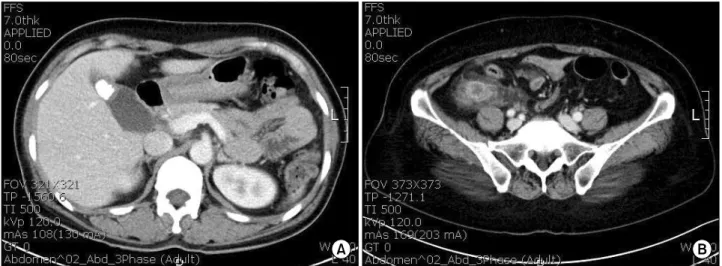
Fig. 1. Computed tomography revealed about 1.7 cm sized stone in the gall bladder. The wall of the gall bladder was slightly thickened (A). Suspicious thickening of the wall of the appendix was also identified (B).

Fig. 2. Homemade single-port platform.

Computed tomography revealed an approximately 1.7 cm stone in the gall bladder and a slightly thickened gall bladder wall. Suspicious thickening of the wall of the appendix was al- so identified (Fig. 1A and 1B). A presumptive diagnosis of acute appendicitis with concomitant cholelithiasis was made.

On the day of admission, the patient underwent emergent sur- gery and elected to undergo simultaneous cholecystectomy.

After counseling the patient extensively on the various laparo- scopic techniques, she gave consent for a simultaneous appen- dectomy and cholecystectomy with the single-incision laparo- scopic technique.

With the patient under general anesthesia, a 3.0-cm umbilical vertical skin incision and a 2.0-cm fasciotomy were made to insert a wound retractor (ALEXIS

®

wound retractor S, Applied Medical, Santa Margarita, CA, USA). A surgical glove was ap-

plied to the wound retractor with a 5 mm trocar on first finger tip, a 10 mm trocar on third finger tip, and a 10 mm trocar on fifth finger tip. Pneumoperitoneum was created with CO2 gas insufflation, and abdominal pressure was maintained at 10∼

12 mmHg. Surgery was performed by inserting a 10 mm, 0 degree laparoscopic camera through the trocar of the third fin- ger and inserting the surgical instruments through the remaining two trocars (Fig. 2).

Cholecystectomy was performed first and in a standard manner. The gall bladder was placed into an Endo-Catch bag and relocated to the right upper quadrant of the abdomen.

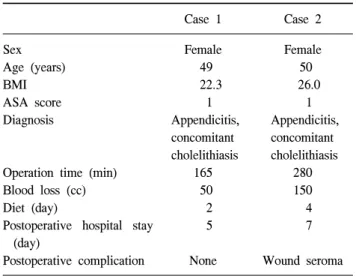
Appendectomy was performed after the cholecystectomy was completed. The base of the appendix was tied two times with an endo-loop, and two graspers were used to retrieve the appen- dix and Endo-Catch bag containing the gall bladder. The surgi- cal glove was then separated from the wound retractor to re- trieve the specimens. The operation time was 165 minutes and blood loss was 50 cc. A liquid diet was started on postoperative day 2, and the total hospital stay was 5 days. The postoperative recovery was uneventful (Table 1).

2) Case 2

A 50-year-old female patient presented to the emergency de- partment with a chief complaint of right lower abdominal quad- rant pain that developed 5 days prior. She visited a local medi- cal clinic and was diagnosed with acute appendicitis after an ultrasound examination. She had intermittent epigastric and right upper quadrant abdominal pain. She had no history of pre- vious abdominal surgery.

On admission, the patient’s height, weight, and body mass

(3)

Sang-Hong Choi et al.: Single-incision Laparoscopic Surgery for Simultaneous Surgery 53

Table 1. Single-incision laparoscopic surgery for simultaneous appendectomy and cholecystectomy

Case 1 Case 2

Sex Age (years) BMI ASA score Diagnosis

Operation time (min) Blood loss (cc) Diet (day)

Postoperative hospital stay (day)

Postoperative complication

Female 49 22.3

1 Appendicitis, concomitant cholelithiasis

165 50 2 5 None

Female 50 26.0

1 Appendicitis, concomitant cholelithiasis

280 150 4 7 Wound seroma

index were 158 cm, 65.3 kg, and 26.0, respectively. Vital signs were normal with a blood pressure of 120/90 mmHg, pulse rate of 68 beats/min, respiration rate of 20/min, and body temper- ature of 36.7

o

C. Physical examination revealed tenderness and rigidity of the right lower abdominal quadrant. Laboratory in- vestigations revealed the following: white blood cell count, 11,400/mm

3

(62.4% neutrophils); hemoglobin, 12.7 g/dl; hema- tocrit, 36.4%; platelet count, 242×10

3

/mm

3

; total bilirubin, 0.9 mg/dl; alanine aminotranferase, 38 IU/l; aspartate amino- transferase, 41 IU/l; alkaline phosphatate, 139 U/L; amylase, 68 U/L; lipase, 48 U/L; creatinine, 0.5 mg/dl; serum Na, 141 meq/l; serum K, 3.9 meq/l.

Computed tomography revealed several stones in the gall bladder, slightly thickened gall bladder wall, and thickening of the appendix wall. A presumptive diagnosis of acute appendici- tis with concomitant cholelithiasis was then made. On the day of admission, the patient underwent emergent surgery using the same technique as in Case 1. The total operation time was 280 minutes with a blood loss of 150 cc. Liquid diet was started on postoperative day 4, and the total hospital stay length was 7 days. The patient suffered a wound seroma as the only post- operative complication (Table 1).

DISCUSSION

SILS represents an innovative technique of minimally in- vasive surgery. The advantages of SILS include a reduction in the number of incisions, improved cosmetic results, decreased postoperative pain, fewer wound-related complications, and de- creased hospital stay. An apparent advantage of SILS is the ex-

cellent cosmetic results through an intra-umbilical or a sub-um- bilical incision of 1.5∼2.5 cm in length. However, SILS has intra-operative procedure-related challenges, including instru- ment crowding and crossover, limited view, and inadequate retraction. These challenges may be related to higher rates of intra-operative and postoperative complications.

5

Recently, in spite of the intra-operative procedure-related challenges, SILS has been used for a variety of general, uro- logic, and gynecologic surgeries.

1-3

Appendectomy and chol- ecystectomy are two of the most frequently performed proce- dures to utilize SILS.

2-4

For the efficacy and safety of SILS in appendectomy compared to conventional laparoscopic surgery, Gao et al.

6

reported results of a meta-analysis. The mean oper- ative time was found to be significantly longer in SILS com- pared to conventional laparoscopic surgery. There were no sig- nificant differences in visual analogue scale (VAS) pain scores, wound infection rates, overall complications, or postoperative hospital stays. They concluded that SILS represents a possible alternative to conventional laparoscopic surgery for appen- dectomy. For cholecystectomy, Markar et al.

7

reviewed seven randomized controlled trials containing a total of 195 chol- ecystectomies using SILS and 180 conventional laparoscopic surgeries. The study showed that the operative time was sig- nificantly longer in the SILS group, but no significant differ- ences were found between the groups in terms of postoperative complication incidence, postoperative pain scores (VAS), or length of hospital stay. They concluded that SILS chol- ecystectomy is a safe procedure for the treatment of un- complicated gallstone disease.

For SILS, an intra-umbilical or sub-umbilical incision is used as the initial port placement to perform a variety of general sur- gery, urologic, and gynecologic procedures. This umbilical in- cision site can be used to perform multiple concomitant procedures. In the literature, a few simultaneous procedures us- ing SILS have been reported, such as hysterectomy and appen- dectomy, bilateral nephrectomy, cholecystectomy and ovary cystectomy, cholecystectomy and hysterectomy, as well as her- niorrhaphy and nephrectomy.

8-10

However, there are no reports of simultaneous appendectomy

and cholecystectomy using the single-incision laparoscopic

technique. In this report, two cases of simultaneous appendec-

tomy and cholecystectomy were performed for appendicitis

with uncomplicated cholelithiasis by one surgeon. For the oper-

ative platform, a single-port setting was created using a small

wound retractor (ALEXIS

®

wound retractor S, Applied Medical,

Santa Margarita, CA, USA) and a surgical glove. The operation

time was not short (165 and 280 mins). The case 1 was the

(4)

54 Journal of Minimally Invasive Surgery Vol. 17. No. 3, 2014

first case of single-port surgery for the surgeon. The long oper- ation time is considered to relate with the learning curve for single port surgery. However, reduction in the number of port placements and small single wound may be considered as its advantages. We believe that SILS for simultaneous appendec- tomy and cholecystectomy is a feasible and safe minimally in- vasive procedure.

REFERENCES

1) Ahmed K, Wang TT, Patel VM, et al. The role of single- incision laparoscopic surgery in abdominal and pelvic surgery:

a systematic review. Surg Endosc 2011;25:378-396.

2) Chow A, Purkayastha S, Paraskeva P. Appendicectomy and cholecystectomy using single-incision laparoscopic surgery (SILS): the first UK experience. Surg Innov 2009;16:211-217.

3) Hong TH, You YK, Lee KH. Transumbilical single-port laparoscopic cholecystectomy: scarless cholecystectomy. Surg Endosc 2009;23:1,393-1,397.

4) Chouillard E, Dache A, Torcivia A, et al. Single-incision laparoscopic appendectomy for acute appendicitis: a prelim-

inary experience. Surg Endosc 2010;24:1,861-1,865.

5) Rehman H, Ahmed I. Technical approaches to single port/

incision laparoscopic appendectomy: a literature review. Ann R Coll Surg Engl 2011;93:508-513.

6) Gao J, Li P, Li Q, Tang D, Wang DR. Comparison between single-incision and conventional three-port laparoscopic appen- dectomy: a meta-analysis from eight RCTs. Int J Colorectal Dis 2013;28:1,319-1,327.

7) Markar SR, Karthikesalingam A, Thrumurthy S, Muirhead L, Kinross J, Paraskeva P. Single-incision laparoscopic surgery (SILS) vs. conventional multiport cholecystectomy: systematic review and meta-analysis. Surg Endosc 2012;26:1205-1213.

8) Page T, Soomro NA. Bilateral simultaneous single-port (LESS) laparoscopic nephrectomy (laparoendoscopic single site surgery). Indian J Urol 2010 Oct;26(4):590-592.

9) Surico D, Gentilli S, Vigone A, Paulli E, Leo L, Surico N.

Laparoendoscopic single-site surgery for treatment of con- comitant ovarian cystectomy and cholecystectomy. J Minim Invasive Gynecol 2010;17:656-659.

10) Hart S, Ross S, Rosemurgy A. Laparoscopic single-site com-

bined cholecystectomy and hysterectomy. J Minim Invasive

Gynecol 2010;17:798-801.

수치

Fig.  1.  Computed  tomography  revealed  about  1.7  cm  sized  stone  in  the  gall  bladder
Table  1.  Single-incision  laparoscopic  surgery  for  simultaneous  appendectomy  and  cholecystectomy

참조

관련 문서

With the increase of the dental implant procedure, there are many cases of Maxillary Sinus Floor Elevation Surgery(MSFES). Additionally, its side effect has

Patient had laparoscopic surgery on the adnexal tumor and excised tissue was removed through Douglas pouch incision by single surgeon.. Results: The mean age

Using this leap motion, a surgeon can perform the virtual shoulder arthroscopic surgery skillfully and reduce mistakes in surgery.. The simulation using leap motion shows

The aim of this study was to evaluate the sealing ability in Type II root canal obturation by comparing the presence of voids between single cone technique using Endoseal MTA

In this thesis, tracked vehicle's dynamic performance of the two models, single-body model and Multi-body model, were compared through the numerical simulation.. The

Simultaneous Measurements of the Wake Flow of a Circular Cylinder with a Flexible Film and Its Motions using

 Application of nano : single electron memory combination of Single Electron Box.

This paper proposed the simultaneous impact monitoring techniques to identify the impact location and to detect the impact damage using the propagation property of