This is an Open Access article distributed under the terms of the Creative Commons Attribution Non-Commercial License (http: //creativecommons.org/licenses/by- nc/4.0/) which permits unrestricted non-commercial use, distribution, and reproduction in any medium, provided the original work is properly cited.
© 2019 THE KOREAN SOCIETY OF MYCOLOGY.
https://doi.org/10.4489/KJM.20190003
Accepted: August 19, 2018 Revised: August 19, 2018 Received: August 9, 2018 Kor. J. Mycol. 2019 March, 47(1): 19-27
OPEN ACCESS pISSN : 0253-651X eISSN : 2383-5249
RESEARCH ARTICLE
우포 습지에 분포하는 수지상균근균 포자의 다양성
고강문1, 박혁1, 가강현2 , 엄안흠1,*
1한국교원대학교 생물교육과, 2국립산림과학원 산림소득자원연구과
Spore Diversity of Arbuscular Mycorrhizal Fungi in Upo Wetland
Kang-Moon Ko1, Hyeok Park1, Kang-Hyeon Ka2 , Ahn-Heum Eom1,*
1Department of Biology Education, Korea National University of Education, Cheongju 28173, Korea
2Special Forest Products Division, National Institute of Forest Science, Suwon 16631, Korea
*Corresponding author: [email protected]
ABSTRACT
We extracted arbuscular mycorrhizal fungal (AMF) spores from rhizospheres of three plants from Upo Wetland, Korea. We identified the isolated AMF spores based on morphological characteristics and phylogenetic analysis of partial 18S rDNA nucleotide sequences. The species diversity of AMF spores was calculated among the study sites and host plants.
Consequently, nine species from six genera of AMF spores were identified. We confirmed the species diversity of the AMF spores in rhizospheres affected by host plants in the wetland.
In the course of this study, we confirmed a previously unreported AMF species in Korea:
Diversispora epigaea. We described the morphological features and molecular characteristics of this previously unreported AMF species.
Keywords: Acaulospora koskei, Arbuscular mycorrhizal fungi, Diversispora epigaea, Upo Wetland
서론
수지상균근균(ArbuscularMycorrhizalFungi, AMF)은 육상 식물과 공생 관계를 이루는 가장 대표적 인 균근균이다. Glomeromycota문에 속하는[1] AMF는 토양 내에서는 무성 포자의 형태로 존재하다 가 식물의 뿌리 속에 균사를 침투시켜 수지상균근을 형성하며, 80% 이상의 다양한 육상 식물이 이 러한 AMF와의 공생 구조를 갖는다[2]. AMF는 기주식물에서 광합성 산물을 공급받고 기주식물의 인산 흡수 능력 증가, 식물 뿌리 병원체에 대한 저항성 제공과 수분 및 염분, 중금속 등에 의해 식물 이 받는 스트레스에 대한 내성 획득 등의 도움을 제공하여 식물의 적응도를 높인다[3-6].
경남 창녕군에 위치하고 있는 우포 습지는 국내 최대의 내륙 습지로써, 수생·습생 식물을 포함하 여 총 86과 350여종에 달하는 식물이 서식하고 있는 지역이다[7]. AMF는 본래 습지 생태계에는 영 향을 많이 미치지 못하는 것으로 알려져 왔으며[8, 9] 우리 나라에서도 대부분의 AMF 관련 연구는
Kang Hyun Ka
http://orcid.org/0000-0002-9364-626X Ahn-Heum Eom
http://orcid.org/0000-0002-6821-1088
내륙의 산림 토양[10-11] 혹은 경작지[12-13] 등에 국한되어 있었으나, 최근의 연구 결과에서 습지 식 물의 뿌리에도 상당 부분 AMF가 영향을 줄 수 있다는 것이 밝혀짐에 따라[14] 습지에서의 AMF에 대한 연구가 필요한 실정이다. 본 연구에서는 우포 습지에서 가장 흔하게 발견되는 식물인 갈대 (PhragmitescommunisTrin.), 물억새(Miscanthussacchariflorus (Maxim.) Franch.), 잠자리피(Trisetum bifidum (Thunb.) Ohwi) 3종의 식물 근권에서 AMF포자를 분리하여 우포 습지 토양 내의 AMF 다양 성을 확인하고, 그 과정에서 확인된 AMF 미기록종의 특성에 대해 보고하고자 한다.
재료 및 방법
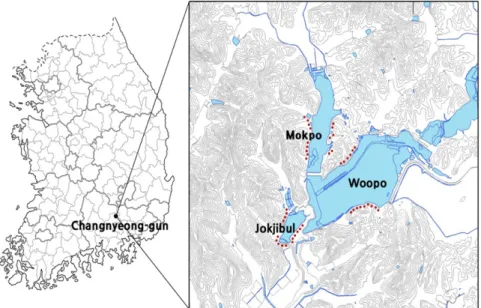
연구에 사용된 근권 토양의 수집은 2017년 5월 경상남도 창녕군의 우포늪에서 실행되었다. 우포 습 지는 크게 우포, 쪽지벌, 목포, 사지포 4곳의 늪과 토평천이라는 하천으로 이루어지는데, 이 중 서 로 인접해 있는 지역인 우포(N35°32'48.8", E28°24'38.2"~N35°32'56.0", E128°24'55.7"), 목포 (N35°33'14.2", E128°24'10.6"~N35°33'27.7", E128°24'12.2"), 쪽지벌(N35°32'52.0", E128°24'18.8"~ N35°32'59.9", E128°24'13.3") 3곳의 늪지 부근에서 채집을 진행하였다(Fig. 1). 갈대, 물억새, 잠자리 피 3종의 기주 식물을 3곳의 채집위치에서 100m씩 이동하면서 5샘플씩 반복채집하여 총 45점의 샘플을 확보하였다. 근권 토양은 기주 식물의 뿌리에서 10cm 이상 토양을 파내어 근권당 1kg 정도 씩 채집하였고, 채집된 토양은 기주식물과 함께 폴리에틸렌 백에 담아 밀봉한 후 24시간 내에 실험 실로 운반하였다. 야외 토양에서 AMF 포자를 추출하기 위해 65°C의 오븐(WiseVen, DAIHAN Scientific, Korea)에서 72시간 동안 건조했으며, 건조된 토양 10g씩에서, AMF 포자를 추출하였다 [15].
추출된 AMF 포자는 해부현미경 및 광학현미경 상에서 관찰하여 형태적 특성을 확인하였다.
AMF 포자 PVLG (polyvinylalcohol-lacticacid-glycerol)와 Melzer’sreagent를 떨어뜨린 후 광학현미경 상 에서 포자의 크기, 형태, 표면 등을 관찰하였다[16, 17]. 형태적 특성을 통해 분류된 포자를 0.2ml
Fig. 1. The information about sampling sites based on GPS coordinates. The dotted marks
indicate sampling sites.tube에 한 개씩 넣고 깨뜨려 genomicDNA를 추출한 뒤 분자적 분석을 위해 18SrDNA지역을 증폭 하였다. PCR은 AML1, AML2 프라이머를 이용하였으며 annealing 온도는 56°C로 설정하여 수행하 였다[18]. PCR이 완료된 후 agarosegel에서 20분간 전기영동하여 780bp 크기의 DNA단편을 확인하 여 DNA 염기서열 분석을 의뢰하였다(SolGent, Daejeon, Korea). 분석된 염기서열을 NCBI상에서
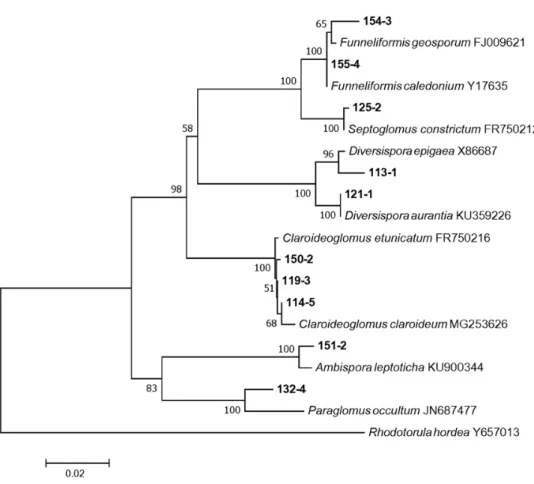
BLAST하여 일치도가 가장 높은 종을 확인하고, MEGA7 프로그램을 이용하여[19] neighbor-joinning phylogenetictree를 작성하였다(Fig. 2). 미기록종 AMF포자의 경우 18SrDNA 와 internaltranscribed spacer (ITS) 지역을 포함하는 “Krügerfragment”[20]의 1,500bp 길이의 DNA절편을 증폭하여 분자적 분석을 위와 동일하게 진행하였다. PCR과정은 nestedPCR로 2회에 걸쳐 진행되었으며, 1차 PCR은 SSUmAf, LSUmAr 프라이머를 이용하였고, annealing 온도는 60°C로 설정하여 수행하였다[19]. 1차 PCR 산물을 1/10 로 희석한 DNA를 2차 PCR의 templateDNA로 사용하였으며, 2차 PCR은 SSUmCf, LSUmAr 프라이머를 이용하였고 annealing 온도는 63°C 로 설정하여 수행하였다[20].
형태적 특성과 분자적 분석을 종합하여 최종적으로 동정된 AMF 포자의 relativeabundance를 구하 고, 근권 샘플 별로 AMF의 종 다양성 지수(Shannon’sdiversityindex), 종 균등도(speciesevenness) 를 구하고 one-wayANOVA 방법을 이용하여 지역 및 기주 식물에 따른 AMF 포자의 다양성을 비교하 였다. 또한 nonmetricmultidimensionalscaling (NMS)를 이용하여 군집 구조를 분석하였다.
Fig. 2. Neighbor-joining phylogenetic tree based on 18S partial rDNA sequences. Rhodotorula
hordea was used as an outgroup. Numbers on branches indicate bootstrap values (1,000
replicates). Fungal strain isolated in this study is in bold.결과 및 고찰
우포 습지의 근권 토양 45점에서 AMF 포자를 분리한 결과 6속 9종의 AMF 포자가 확인되었으며, 지역별로는 우포에서 4속 7종, 목포에서 5속 7종, 쪽지벌에서 5속 6종의 포자가 확인되었고, Ambisporaleptoticha와 Diversisporaaurantia는 잠자리피의 근권에서만 확인되었으며, Claroideoglomus
claroideum과 Funneliformis geosporum은 갈대와 잠자리피의 근권에서만 확인되었고 Paraglomus occultum, Septoglomusconstrictum은 물억새와 잠자리피의 근권에서만 확인되었다(Table1). 지역별 로는 우포에서 4속 7종, 목포에서 5속 7종, 쪽지벌에서 5속 6종의 포자가 확인되었고 D. aurantia는 우포의 근권에서만 확인되었으며 S. constrictum은 쪽지벌의 근권에서만 확인되었고, A. leptoticha와 F. geosporum은 우포와 목포의 근권에서만 확인되었으며 P. occultum은 목포와 쪽지벌의 근권에서 만 확인되었다(Table2). 기존의 국내 선행 연구에서는 경기[10], 충북[21], 전남[11] 등의 내륙 산림 토양에서 Acaulospora 속과 Ambispora 속이 우점하였으며 충남의 도서 지역에서도 Acaulospora 속이 우점한다는 결과가 존재하는데[22], 본 연구에서는 이러한 연구들과는 다르게 Acaulospora에 속하 는 AMF가 근권 토양 내에서 확인되지 않았으며 Diversispora, Funneliformis 등에 속하는 AMF 포자 를 주로 확인할 수 있었다. 세 지역 모두 Funneliformiscaledonium이 우점하는 것을 확인하였는데, 실 제로 선행 연구에서 F. caledonium이 습지의 근권에서 분리된 기록이 상당수 존재한다[23-25]. 야외 토양에서 확인된 AMF 종 중 Diversisporaepigaea는 국내 미기록종으로 확인되었다.
Diversispora epigaea (B.A. Daniels & Trappe) C. Walker & A. Schüßler, The Glomeromycota: a species list with new families and new genera: 43 (2010)
갈대, 물억새, 잠자리피의 근권에서 모두 분리되었다. 포자는 토양 내에서 단독으로 형성되며 간혹 2~3개씩 붙어 형성되는 것이 관찰된다. 포자의 크기는 80~150μm 정도이며, 포자의 표면 형태는 불 규칙한 타원형 혹은 구형으로 크기와 형태가 매우 다양하다. 포자 표면의 색은 노란 빛을 띠는 황
Table 1. Relative abundance and community sturctures of arbuscular mycorrhizal fungal spores
isolated from rhizospheres of different host plants in Upo Wetlands.AMF species Relative abundance (Mean ± SE)
P. communis M. sacchariflorus T. bifidum P-value
Ambispora leptoticha 0 0 0.07±0.05 0.14
Claroideoglomus claroideum 0.43±0.30 0 0.06±0.04 0.33
Claroideoglomus etunicatum 0.02±0.02 0.06±0.04 0.17±0.08 0.10
Diversispora aurantia 0 0 0.04±0.03 0.17
Diversispora epigaea 0.02±0.02 0.14±0.08 0.06±0.05 0.30
Funneliformis caledonium 0.31±0.11 0.48±0.12 0.46±0.10 0.51
Funneliformis geosporum 0.001±0.001 0 0.03±0.02 0.19
Paraglomus occultum 0 0.27±0.27 0.01±0.01 0.50
Septoglomus constrictum 0 0.03±0.03 0.10±0.07 0.24
Shannon’s index 0.16±0.09 0.23±0.09 0.53±0.09 0.01
Species evenness 0.17±0.09 0.33±0.13 0.64±0.09 0.01
Number of species 0.73±0.28 1.13±0.19 2.07±0.80 0
Number of spores 9.20±4.85 6.80±3.37 12.93±2.96 0.52
갈색 혹은 연갈색이며 포자 표면은 금색의 광택으로 빛난다(Fig. 3A, 3B, 3C). 포자의 벽은 2개의 층 (L1, L2layer)으로 이루어져 있는데 바깥쪽의 L1과 안쪽의 L2로 구분되고, L2는 두꺼운 laminae형태 로 되어 있는 경우도 있으며(Fig. 3D, 3E) L2에서 부착균사 방향으로 휘어져 나가는 형태의 septum 이 확인되기도 한다(Fig. 3F). Melzer’sreagent에는 별다른 반응을 보이지 않았다.
Specimen examined
:
Upo wetland, Changryeong-gun, Gyeongsangnam-do, Korea, N35°33'27.3", E128°24'12.2", May26, 2017, Diversisporaepigaea, isolatedfromrhizosphereofPhragmitescommunis, isolate113-1, GenBankNo. MK583669.Fig. 3. Spores of Diversispora epigaea isolated from rhizosphere. Whole spores (A), spore
mounted in PVLG (B, C), characteristics of spore walls (D, E), subtending hyphae (F) (scale bars =100 μm).Table 2. Relative abundance and community sturctures of arbuscular mycorrhizal fungal spores
isolated from different sampling sites of Upo Wetlands.AMF species Relative abundance (Mean ± SE)
Upo Mokpo Chokjibul P-value
Ambispora leptoticha 0.05±0.05 0.03±0.03 0 0.57
Claroideoglomus claroideum 0.03±0.03 0.02±0.02 0.07±0.04 0.40 Claroideoglomus etunicatum 0.11±0.06 0.04±0.03 0.10±0.06 0.61
Diversispora aurantia 0.04±0.03 0 0 0.17
Diversispora epigaea 0.06±0.05 0.02±0.02 0.10±0.05 0.49
Funneliformis caledonium 0.41±0.12 0.50±0.10 0.42±0.11 0.84
Funneliformis geosporum 0.03±0.03 0.10±0.07 0 0.27
Paraglomus occultum 0 0.03±0.03 0.01±0.01 0.51
Septoglomus constrictum 0 0 0.03±0.03 0.38
Shannon’s index 0.30±0.12 0.29±0.09 0.33±0.10 0.97
Species evenness 0.33±0.11 0.40±0.12 0.41±0.12 0.89
Number of species 1.33±0.30 1.27±0.25 1.33±0.27 0.98
Number of spores 13.13±4.70 9.93±4.19 5.87±1.83 0.41
Note: D. epigaea는 분자적 증거를 기반으로 2010년 Walker & Schüßler에 의해 Glomus에서 Diversispora 로 속이 변경되었으며[26], 최초로 기록된 종명은 Glomusepigaeus (1979)이다[27]. 본 연구에서 확인 된 AMF 포자는 갈색 혹은 황갈색을 띠며 구형 혹은 광타원형의 포자를 형성하는 형태적 특성이 원 기재문과 일치하였다[27]. DNA 염기서열 분석 결과 18SrDNA 지역의 염기서열은 D. epigaea X86687.1과 99%의 일치도를, Krügerfragment의 DNA 염기서열은 D. epigaeaFR686939.1과 97%의 일치도를 보였으며 모두 같은 계통을 형성하였다(Fig. 4).
기주 식물별로 종 다양성을 분석한 결과 상대 수도와 포자 수는 서로 유의미한 차이가 없었으나 잠자리피의 근권에서 종 다양성 지수와 종 균등도가 가장 유의미하게 높았으며, 갈대의 근권에서 가장 낮은 것을 확인하였다(Table1). 채집 지역 별로 종 다양성을 비교하였을 때에는 유의미한 결 과가 나타나지 않은 것으로(Table2) 유추해 볼 때 습지 근권에서 AMF의 종 다양성은 토양의 지역 보다는 기주 식물의 종에 따른 영향이 더 크다고 볼 수 있었다.
또한 NMS분석의 결과 갈대와 물억새 근권의 AMF 군집은 분석된 plot 상에서 서로 가까이 위치 하는 반면에, 잠자리피 근권의 AMF 군집은 보다 멀리 떨어져 위치하는 것을 확인할 수 있었다(Fig. 5). 이러한 결과는 습지 내에서의 식물 중 특정 종의 근권에서는 다른 식물들과 다른 형태의 AMF 군집 구조가 발달하며, 기주 식물의 종에 따라 근권 토양 내의 AMF 군집에 변화가 발생할 수 있다 는 점을 시사한다[11].
Fig. 4. Neighbor-joining phylogenetic tree based on sequences of Krüger fragment. Acaulospora delicata was used as
an outgroup. Numbers on branches indicate bootstrap values (1,000 replicates). Fungal strain isolated in this study is in bold.적요
우포 습지에 서식하는 식물의 근권 토양에서 수지상균근균(AMF) 포자를 추출하였다. 추출한 포자 는 형태적 특성과 18SrDNA 염기서열의 분자적 분석을 이용해 동정하였다. 그 결과 6속 9종의 AMF 포자가 분리된 것을 확인하였으며, 종 다양성 지수를 계산하여 분석한 결과 습지에서 AMF 포자의 종 다양성은 식물에 의해 영향을 받는 것을 확인하였다. 연구 과정에서 국내 미기록종 1종 을 확인하였으며, 확인된 종은 Diversisporaepigaea이다. 미기록종 AMF 포자의 형태적 특성 및 분자 적 분석의 결과에 대해 서술하였다.
Fig. 5. Non-metric multidimensional scaling (NMS) plots for the spore communities of
arbuscular mycorrhizal fungi isolated from rhizosphere of three different host plants within sampling sites of Woopo Wetlands.REFERENCES
1. Schüßler A, Schwarzott D, Walker C. A new fungal phylum, the Glomeromycota: phylogeny and evolution. Mycol Res 2001;105:1413-21.
2. Smith SE, Read D. Mycorrhizal Symbiosis. 3rd ed. London: Academic Press; 2008.
3. Dodd JC. The role of arbuscular mycorrhizal fungi in agro- and natural ecosystems. Outlook Agricul 2000;29:55-62.
4. Wang B, Qiu YL. Phylogenetic distribution and evolution of mycorrhizas in land plants.
Mycorrhiza 2006;16:299-363.
5. Hirrel MC, Gerdemann JW. Improved growth of onion and bell pepper in saline soils by two vesicular-arbuscular mycorrhizal fungi. Soil Sci Soc Am J 1980;44:654-5.
6. Newsham KK, Fitter AH, Watkinson AR. Arbuscular mycorrhiza protect an annual grass from root pathogenic fungi in the field. J Ecol 1995;83:991-1000.
7. Oh KH, Kim CS, Lee PH, Son SG. Flora in woopo wetland and topyeong stream. J Wetlands Res 2004;6:107-18.
8. Cooke JC, Butler RH, Madole G. Some observations on the vertical distribution of vesicular arbuscular mycorrhizae in roots of salt marsh grasses growing in saturated soils. Mycologia 1993;85:547-50.
9. Peat HJ, Fitter AH. The distribution of arbuscular mycorrhizas in the British flora. New Phytol 1993;125:845-54.
10. Park SH, Eo JK, Ka KH, Eom AH. Diversity of arbuscular mycorrhizal fungi of woody plants in Mt. Munan. Kor J Mycol 2011;39:1-6.
11. Lee EH, Ka KH, Eom AH. Diversity of arbuscular mycorrhizal fungi in rhizospheres of Camellia japonica and neighboring plants inhabiting Wando of Korea. Kor J Mycol 2014;42:34-9.
12. Lee JE, Eom AH. Effect of organic farming on spore diversity of arbuscular mycorrhizal fungi and glomalin in soil. Mycobiology 2009;37:272-6.
13. Kil YJ, Eo JK, Eom AH. Diversities of arbuscular mycorrhizal fungi in cultivated field soils of Korean ginseng. Kor J Mycol 2012;40:1-6.
14. Xu Z, Ban Y, Jiang Y, Zhang X, Liu X. Arbuscular mycorrhizal fungi in wetland habitats and their application in constructed wetland: a review. Pedosphere 2016;26:592-617.
15. Daniels BA, Skipper HA. Methods for the recovery and quantative estimation of propagules from soil. In: Schenck NC, editor. Methods and principles of mycorrhizal research. St. Paul.
Minn: American Phytopathological Society; 1982. p. 29-35.
16. Morton JB. Variation in mycorrhizal and spore morphology of Glomus occultum and Glomus
diaphanum as influenced by plant host and soil environment. Mycologia 1985;77:192-204.
17. Gerdemann JW, Trappe JM. The endogonaceae in the Pacific Northwest. New York: The New York Botanical Garden; 1974.
18. Lee J, Lee S, Young JPW. Improved PCR primers for the detection and identification of arbuscular mycorrhizal fungi. FEMS Microbiol Ecol 2008;65:339-49.
19. Kumar S, Stecher G, Tamura K. MEGA7: molecular evolutionary genetics analysis version 7.0 for bigger datasets. Mol Biol Evol 2016;33:1870-4.
20. Krüger M, Stockinger H, Krüger C, Schüßler A. DNA-based species level detection of Glomeromycota: one PCR primer set for all arbuscular mycorrhizal fungi. New Phytol 2009;183:212-23.
21. Park H, Lee EH, Ka KH, Eom AH. Spore diversity of arbuscular mycorrhizal Fungi in a
post-mining area in Korea. Kor J Mycol 2016;44:82-6.
22. Lee JY, Lee EH, Ka KH, Eom AH. Community structure of arbuscular mycorrhizal fungi in the islands of Chungnam, Korea. Kor J Mycol 2016;44:16-22.
23. Silvani VA, Colombo RP, Scorza MV, Bidondo LF, Rothen CP, Scotti A, Fracchia S, Godeas A. Arbuscular mycorrhizal fungal diversity in high-altitude hypersaline Andean wetlands
studied by 454-sequencing and morphological approaches. Symbiosis 2017;72:143-52.
24. Stenlund DL, Charvat ID. Vesicular arbuscular mycorrhizae in floating wetland mat communities dominated by Typha. Mycorrhiza 1994;4:131-7.
25. Zubek S, Majewska ML, Błaszkowski J, Stefanowicz AM, Nobis M, Kapusta P. Invasive plants affect arbuscular mycorrhizal fungi abundance and species richness as well as the performance of native plants grown in invaded soils. Biol Fert Soils 2016;52:879-93.
26. Schüßler A, Walker C. The Glomeromycota: a species list with new families and new genera.
Royal Botanic Garden Edinburgh, Gloucester, UK; 2010.
27. Daniels BA, Trappe JM. Glomus epigaeus sp. nov., a useful fungus for vesicular–arbuscular mycorrhizal research. Can J Bot 1979;57:539-42.