DOI:10.4489/KJM.2011.39.1.001
1
문안산의 목본식물과 공생하는 수지상균근균의 다양성
박상희1·어주경2·가강현3·엄안흠1*
1한국교원대학교 생물교육과, 2서울대학교 산림과학부 산림환경, 3국립산림과학원 녹색자원이용부
Diversity of Arbuscular Mycorrhizal Fungi of Woody Plants in Mt. Munan
Sang-Hee Park1, Ju-Kyeong Eo2, Kang-Hyeon Ka3 and Ahn-Heum Eom1*
1Department of Biology Education, Korea National University of Education, Chungbuk 363-791, Korea
2Department of Forest Science, Seoul National University, Seoul 151-742, Korea
3Department of Forest Resources Utilization, Korea Forest Research Institute, Seoul 130-712, Korea (Received 9, December 2010., Accepted 8, March 2011)
ABSTRACT : This study was conducted to reveal the diversity of arbuscular mycorrhizal fungi (AMF) in Mt. Munan, based on the morphological and molecular characters. Soil and root samples were collected from the rhizosphere of host plants including Lindera obtusiloba, Stephanandra incisa, Styrax obassis and Symplocos sawafutagi and AMF were trap-cultured with Sorghum bicolor as a host plant in a greenhouse. The spores were extracted from the cultured soils and five species were identified using morphological and molecular characteristics; Acaulospora longula, A. mellea, Ambispora leptoticha, Gigaspora margarita and Paraglomus occultum. The distribution of AMF showed different trends according to host plants. The dominant AMF species were A. longula in L. obtusiloba, A. leptoticha in S. incisa, S. obassis and S. sawafutagi.
KEYWORDS : Acaulospora longula, Acaulospora mellea, Ambispora leptoticha, Arbuscular mycorrhizal fungi, Gigaspora margarita, Paraglomus occultum
서 론
수지상균근균(Arbuscular Mycorrhizal Fungi)은 전 세계적 으로 약 200여종이 보고되고 있으며(Redecker and Raab, 2006), 70-90%의 육상 식물과 공생하고 있다(Smith and Read, 2008). 이러한 수지상균근균은 무기양분과 수분 공급, 병원균과 환경 스트레스에 대한 저항성, 토양의 안정도 증 가 등으로 식물의 생장에 긍정적인 효과를 주고 있다.
우리나라에서는 1980년대 초반부터 균근균의 연구가 시 작되었으며, 재배 작물에 대한 접종 효과와 수지상균근균의 분포양상 등에 대한 연구가 주를 이루었다(손보균 등, 1994;
박향미 등, 1999; 강석범 등, 2003). 우리나라 목본식물에 대한 균근균의 연구는 주로 외생균근균에 대해서 이루어졌 으며 내생균근균에 대한 연구는 매우 단편적이다. 목본식물에 대한 수지상균근균의 연구는 이경준 등(1983)이 한국의 산 림에 분포하는 목본식물 중 50속 68종의 뿌리에서 내생균 근의 감염을 확인하였고, 구창덕 등(1992)은 우리나라 산림 토양에 분포하는 Glomus 속에 관한 연구를, Eom 과 Lee (1989)은 산림 및 해안지역에서 발견된 내생균근 등에 대 한 연구를 수행하였다. 이들 연구는 주로 수지상균근균의
형태적 특징에 대해서만 이루어졌으며, 분자적 수준에서의 종 동정이나 생태학적 수준에서의 숙주특이성에 대한 연구는 미흡한 실정이다.
따라서 본 연구에서는 산림에서 목본식물과 공생하는 수 지상균근균을 수집·배양하여 형태적 특성 및 분자생물학적 특성을 이용하여 종 동정을 하였다. 또한 수지상균근균과 숙 주식물간의 분포특성을 조사하였기에 이를 보고하고자 한다.
재료 및 방법
식물 뿌리와 토양 채취
경기도 남양주시 화도면 문안산(N 37o37´, E 127o19´)의 세 지역을 선정했으며, 각 지역에 공통적으로 분포하고 있는 생강나무(Lindera obtusiloba Blume), 국수나무[Stephanandra incisa (Thunb.) Zabel], 쪽동백나무(Styrax obassis Siebold et Zucc.), 노린재나무(Symplocos sawafutagi Nagamasu)를 숙주식물로 선택하였다. 수지상균근균의 채집을 위해 4종의 숙주식물 뿌리 일부와 뿌리 부근의 토양을 약 1000 g 채 취하였다.
뿌리 염색과 감염 확인
뿌리는 10% KOH 용액에서 121oC로 15분간 가열하여
*Corresponding author <E-mail : [email protected]>
2 박상희 등 세포 내용물들을 제거하였으며, 증류수로 씻어낸 후 1%
HCl 용액을 넣어 12-24시간 상온에 두었다. 그 후 0.05%
trypan blue 용액을 넣고 121oC에서 15분간 가열하였고, acidic glycerol로 탈색한 후 DIC현미경(ZEISS Axio Imager A1) 하에서 수지상균근균의 감염여부를 확인하였다(Koske and Gemma, 1989).
배양 및 포자 추출
채집한 토양과 뿌리를 접종원으로 하고, 수수(Sorghum bicolor)를 숙주식물로 하여 5개월간 온실에서 배양하였다.
충분한 관수와 함께 low P (1/20 phosphate) Hoagland solution (Millner and Kitt, 1992) 200 mL를 7일 단위로 공급하였 다. 배양된 건조 토양 10 g에서 wet sieving 및 sucrose density gradient centrifugation method (Daniels and Skipper, 1982)를 사용하여 포자를 추출하였다.
형태형질 및 분자생물학적 분석
추출된 포자들은 Melzer’ reagent 와 PVLG를 사용하여 프레파라트로 제작한 후 크기나 포자벽 그리고 균사 부착 형태 등을 해부현미경과 광학현미경을 이용하여 관찰하고 기록하였다(Schenck and Perez, 1990; Morton and Redecker, 2001; Walker et al., 2007).
분자생물학적 분석을 위하여 DNA를 추출 후 nested PCR (Van Tuinen et al., 1998)을 사용하여 18s rDNA를 증폭 하였다. nested PCR의 조건은 Lee(2003)가 사용한 방법을 따랐다. 첫 번째 PCR은 universal primer NS1과 NS4를 사용하였으며, 두 번째 PCR은 수지상균근균에 특이적인 primer AML1과 AML2를 사용하여 수행하였다. 염기서열 분석은 SolGent Co. (Korea)에 의뢰하였고, 분석된 염기 서열들을 NCBI에서 BLAST하여 일치도가 가장 높은 종을 확인하였다. 각 종들 간의 계통관계를 분석하기 위하여 bootstrap 분석은 1000 replicates를 선택하였고, MEGA 4 (Tamura et al., 2007)를 이용하여 계통수를 완성하였다.
결과 및 고찰
수지상균근균의 감염확인과 동정
목본 식물들의 뿌리는 수지상균근균이 감염되어 있다는 것을 확인하였으며, 뿌리 내 균사 (intraradical hyphae)와
vesicle, hyphal coils 등도 관찰하였다. 본 연구에서는 쪽 동백 등 총 12종의 뿌리를 염색한 결과 이경준 등(1983)의 연구에서 내생균근균을 가진다고 보고된 목본식물 중 재확 인된 종은 병꽃나무(Weigela subsessilis), 쥐똥나무(Ligustrum obtusifolium), 야광나무(Malus baccata), 산사나무(Crataegus pinnatifida), 국수나무(Stephanandra incisa), 때죽나무(Styrax japonica), 노간주나무(Juniperus rigida) 였고, Viburnum 속 과 Styrax 속에 속하는 종인 산가막살나무(Viburnum wrightii), 쪽동백나무(Styrax obassis) 도 역시 내생균근균을 가졌다.
그 밖에 생강나무(Lindera obtusiloba), 노린재나무(Symplocos sawafutagi), 다래(Actinidia arguta) 등에서 추가로 확인 되었다.
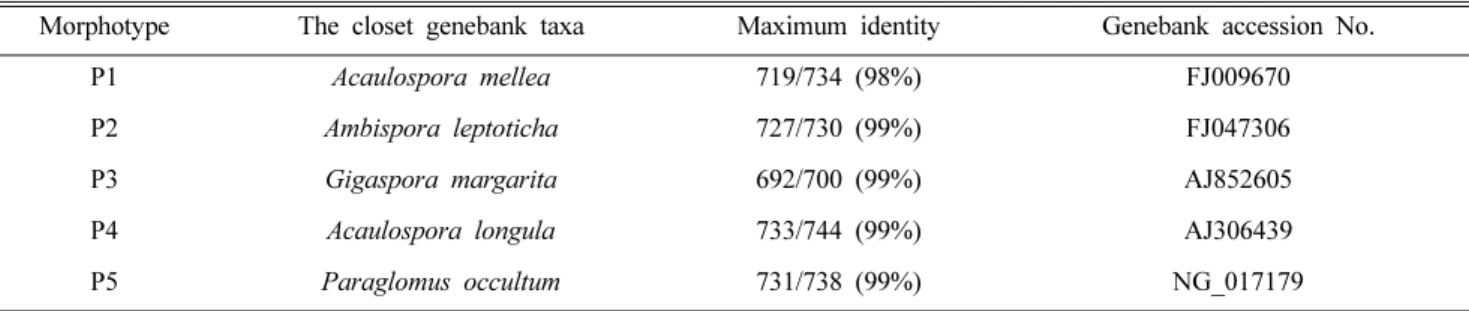
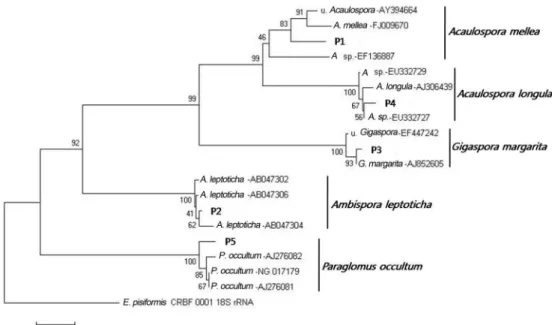
포자의 형태적 동정은 포자의 크기, 색깔, 포자벽의 구조, Melzer’s reagent와의 반응 등을 이용하였다. 추출한 포자들 의 형태 형질과 18s rDNA분석 결과 확인된 종은 Acaulospora mellea, Acaulospora longula, Ambispora leptoticha, Gigaspora margarita, Paraglomus occultum 으로 총 4속 5종이었다 (Table 1; Fig. 1). 이들 5종의 형태적 특징을 Fig. 2-6에 나타냈다.
본 연구에서 동정한 5종의 AMF 중 A. mellea 는 우리 나라 산림에서 처음으로 확인되었다. A. leptoticha는 최근 분자적 증거에 의해 Archaeospora 속에서 Ambispora 속 으로 이동되었다(Walker et al., 2007). 수지상균근균의 포 자가 형성될 때 Glomoid 포자나 Acaulosporoid 포자 형 태를 가지거나 또는 두 가지 모두 가지는 경우가 있는데, A. leptoticha 는 두 가지 형태를 모두 볼 수 있다(Fig. 4).
Glomoid 포자는 거의 색깔이 없는 투명한 색이며, 포자를 눌러서 깼을 때 잘 깨지지 않고, 주름지게 된다. Acaulosporoid 포자는 흰색의 포자형성 소낭(sporiferous saccule)과 연결 된 균사의 측면부위에서 포자가 형성된다.
수지상균근균은 현재 전 세계 식물 중 25만종 이상에서 발견될 정도로 육상생태계 어디에서나 널리 존재한다(Finlay, 2008). 다양한 계통형(phylotype)이 발견되고 있으며 이는 공식적으로 기술된 약 200여종의 수지상균근균보다 훨씬 많다(Pik et al., 2008; Vandenkoornhuyse et al., 2007). 또한 이들 대다수의 계통형들이 명명되지 않았으며(Gamper et al., 2009), 배양조차 되지 않기 때문에 앞으로도 수지상균근 균에 대한 형태적 및 분자생물학적인 연구는 더욱 진행되 어야 할 것이다.
Table 1. BLAST result of AMF spores from NCBI
Morphotype The closet genebank taxa Maximum identity Genebank accession No.
P1 Acaulospora mellea 719/734 (98%) FJ009670
P2 Ambispora leptoticha 727/730 (99%) FJ047306
P3 Gigaspora margarita 692/700 (99%) AJ852605
P4 Acaulospora longula 733/744 (99%) AJ306439
P5 Paraglomus occultum 731/738 (99%) NG_017179
Fig. 1. Phylogenetic relationships among five species of AMF. Endogone pisiformis was used as an outgroup.
Fig. 2. Spores of Acaulospora mellea. A. Broken spore in Melzer's reagent with inner membrane having a positive reaction (light purple). B-C. Wall structure: outer wall (ow), middle walls (mw), inner wall (iw). D. The region of the hyphal attachment (arrow). E. Young spore attached to empty hyphal terminus. F. Spores in water. Scale bar = 50µm.
Fig. 3. Spores of Acaulospora longula. A-B. Note the multiple walls. Broken spores stained with Melzer’s reagent(A-C) or unstained(D). E.
Empty hyphal terminus(T) doubled over the tapering hypha, and a newly formed a spore(S). F. Spores in water. Scale bar = 50µm.
4 박상희 등
Fig. 4. Spores of Ambispora leptoticha. A-B. Glomoid spores. A. Intact spores with a pedicel. B. Lightly crushed spore with wall groups. The two interlocking, scalloped components of group 2 separated slightly. C-E. Acaulosporoid spores. Collapsed saccule with the acaulosporoid spore attached by a long pedicel. D. Reaction to Melzer’s reagent, showing the rust-brown reaction of the outer wall group. F. A cluster of five spores with adherent soil particles. Scale bar = 50µm.
Fig. 5. Spores of Gigaspora margarita. A-B. Spores in water. C. Mature spore. D-E. Broken spore showing five walls. F.
Laminated spore wall. Scale bar = 50µm.
Fig. 6. Spores of Paraglomus occultum. A. Spores in water. Spores stained with Melzer’s reagent(B, E, F) or unstained(C, D). D.
Showing three adherent layers (L1-L3) of the spore wall.
숙주식물에 따른 수지상균근균의 분포
숙주식물로 선정된 4가지 식물에 따른 수지상균근균 포 자의 상대수도와 상대빈도를 산출하였다(Fig. 7). 생강나무 에서는 A. longula가, 국수나무, 쪽동백나무, 노린재나무 에서는 A. leptoticha가 우점종이었다. A. leptoticha는 모든 식물 중에 30% 이상 고르게 분포하기 때문에 각 식물들에 대한 분포양상이 비슷해 보이며, A. longula는 생강나무와 국수나무에서 발견되지 않았다.
수지상균근균의 숙주특이성에 대해서는, 숙주 식물이 다른 균류의 생식(포자 형성율), 생장, 생존율을 다르게 하여 수 지상균근균 군집의 구성과 구조를 확실히 변화시킬 수 있고 (Giovannetti and Gianinazzi-Pearson, 1994; Westover et al., 1997), 뿌리에 대한 탄소 분배 조절, 2차 대사산물의 생산, 토양 환경 조건의 변화에 의해 직접적으로 수지상균근균 구 성에 영향을 줄 수 있다고 보고되었다(Hetrick and Bloom, 1986; Sanders and Fitter, 1992; Bever et al., 1996). 또한 Eom 등(2000)은 수지상균근균이 어느 정도의 숙주특이성 이 있고, 무작위적으로 분포하는 것이 아니라는 실험 결 과를 보여주었다. 식물군집 구조는 수지상균근균의 군집 구 조에 영향을 주고, 수지상균근균 군집 구조 역시 식물의 군 집 구조에 영향을 준다고 할 수 있다(Eom et al., 2000). 이 연구 결과, 숙주식물에 따라 어느 정도 수지상균근균이 다 르게 분포하는 경향을 보이고 있어 앞으로 더 많은 관찰 과 연구가 필요할 것으로 생각된다.
적요
본 연구에서는 수지상균근균(AMF)의 형태적 및 분자 생물학적 특징을 바탕으로 문안산에 분포하는 수지상균근 균의 종 다양성을 분석하였다. AMF 시료는 생강나무(Lindera obtusiloba), 국수나무(Stephanandra incisa), 쪽동백(Styrax
obassis), 노린재나무(Symplocos sawafutagi)의 뿌리와 뿌리 부근의 토양에서 채취하였으며, 수수(Sorghum bicolor)를 숙주식물로 사용하여 포자를 배양하였다. 추출된 포자들의 형태 형질과 염기서열을 분석한 결과 Acaulospora longula, A. mellea, Ambispora leptoticha, Gigaspora margarita, Paraglomus occultum 등 4속 5종이 동정되었으며, 숙주 식물에 따른 수지상균근균의 분포는 수종에 따라서 다른 경 향을 보였다. 생강나무에서는 A. longula가, 국수나무, 쪽동 백나무, 노린재나무에서는 A. leptoticha가 우점종이었다.
감사의 글
본 연구는 국립산림과학원 일반과제(FP 0801-2010-01) 연구비로 수행되었으며, 연구비 지원에 감사드립니다.
참고문헌
강석범, 문두길, 정종배. 2003. 화산회토양에서 인산 시용 수준별 탱자 유묘의 공생 균근 형성과 생육 및 무기양분 흡수. 한국토 양비료학회 36:311-322.
구창덕, 김태훈, 이창근, 이원규, 강창호, 이병천, 이승규. 1992.
우리나라의 산림토양에 분포하는 포자낭과를 형성하는 아버스큘 균근균, Glomus 속. 한국균학회지 20(1):29-36.
손보균, 허상만, 김길용. 1994. 딸기 묘 초기생육에 미치는 VA 균 근균의 접종효과. 한국토양비료학회지 27(1):54-63.
이경준, 구창덕. 1983. 한국의 목본식물의 외생 및 내생균근에 관한 분류학적 분포 조사. 한국임학회지 59:37-45.
박향미, 강항원, 감위금, 박경배, 이상선, 송승달. 1999. Arbuscular mycorrhiza의 접종방법 및 인산시용량이 고추(Capsicum annum L.)의 초기생장에 미치는 영향. 한국토양비료학회 32:68-75.
Bever, J., Morton, J., Antonovics, J. and Schultz, P. 1996. Host- dependent sporulation and species diversity of arbuscular mycorrhizal fungi in a mown grassland. J. Ecol. 84:71-82.
Daniels, B. and Skipper, H. 1982. Methods for the recovery and quantitative estimation of propagules from soil. In: Shenck N. C.
Fig. 7. Relative abundance and relative frequence of AMF according to host plants. Relative abundance = (number of spores of a species/total number of spores) × 100. Relative frequency = (number of samples in which the species was observed/total number of samples) × 100.
6 박상희 등 ed. Methods and principles of mycorrhizal research. Am. Pathol.
Soc., St. Paul, Minnesota, pp. 29-35.
Eom, A. H, Hartnett, D. and Wilson, G. 2000. Host plant species effects on arbuscular mycorrhizal fungal communities in tallgrass prairie. Oecologia 122:435-444.
Eom, A. H. and Lee. S. S. 1989. Endomycorrhizal fungi identified on the soils in forest and coast areas. Kor. J. Mycol. 17:14-20.
Finlay, R. 2008. Ecological aspects of mycorrhizal symbiosis: with special emphasis on the functional diversity of interactions involving the extraradical mycelium. J. Exp. Bot. 59:1115.
Gamper, H., Walker, C. and Schüβler, A. 2009. Diversispora celata sp.
nov: molecular ecology and phylotaxonomy of an inconspicuous arbuscular mycorrhizal fungus. New Phytol. 182:495-506.
Giovannetti, M. and Gianinazzi-Pearson, V. 1994. Biodiversity in arbuscular mycorrhizal fungi. Mycol. Res. 98:705-715.
Hetrick, B. and Bloom, J. 1986. The influence of host plant on production and colonization ability of vesicular-arbuscular mycorrhizal spores. Mycologia 78:32-36.
Koske, R. and Gemma, J. 1989. A modified procedure for staining roots to detect VA mycorrhizas. Mycol. Res. 92:486-488.
Lee, J. K. 2003. Molecular biological identification of arbuscular mycorrhizal fungi collected from plant roots. MS Dissertation, Korea National University of Education, Cheongweon, Korea.
Millner, P. and Kitt, D. 1992. The Beltsville method for soilless production of vesicular-arbuscular mycorrhizal fungi. Mycorrhiza 2:9-15.
Morton, J. and Redecker, D. 2001. Two new families of Glomales, Archaeosporaceae and Paraglomaceae, with two new genera Archaeospora and Paraglomus, based on concordant molecular and morphological characters. Mycologia 93:181-195.
Pik, M., Moora, M., Zobel, M., Saks, U., Wheatley, R., Wright, F.
and Daniell, T. 2008. High diversity of arbuscular mycorrhizal fungi in a boreal herb rich coniferous forest. New Phytol. 179:
867-876.
Redecker, D. and Raab, P. 2006. Phylogeny of the Glomeromycota (arbuscular mycorrhizal fungi): recent developments and new gene markers. Mycologia 98:885.
Sanders, I. and Fitter, A. 1992. Evidence for differential responses between host-fungus combinations of vesicular-arbuscular mycorrhizas from a grassland. Mycol. Res. 96:415-419.
Schenck, N. and Perez, Y. 1990. Manual for the identification of VA mycorrhizal fungi. 3rd Ed. Synergistic, University of Florida, Gainesville.
Smith, S. E. and Read, D. J. 2008. Mycorrhizal symbiosis. Academic Press.
Tamura, K., J. Dudley, J., Nei, M. and Kumar, S. 2007. MEGA4:
molecular evolutionary genetics analysis (MEGA) software version 4.0. Mol. Biol. Evol. 24: 1596.
Van Tuinen, D., Jacquot, E., Zhao, B., Gollotte, A. and Gianinazzi- Pearson, V. 1998. Characterization of root colonization profiles by a microcosm community of arbuscular mycorrhizal fungi using 25S rDNA-targeted nested PCR. Mol. Ecol. 7:879-887.
Vandenkoornhuyse, P., Mahe, S., Ineson, P., Staddon, P., Ostle, N., Cliquet, J., Francez, A., Fitter, A. and Young, J. 2007. Active root- inhabiting microbes identified by rapid incorporation of plant- derived carbon into RNA. Proc. Nat. Ac. Sci. 104:16970.
Walker, C., Vestberg, M., Demircik, F., Stockinger, H., Saito, M., Sawaki, H., Nishmura, I. and Schüβler, A. 2007. Molecular phylogeny and new taxa in the Archaeosporales (Glomeromycota):
Ambispora fennica gen. sp. nov., Ambisporaceae fam. nov., and emendation of Archaeospora and Archaeosporaceae. Mycol. Res.
111:137-153.
Westover, K., Kennedy, A. and Kelley, S. 1997. Patterns of rhizosphere microbial community structure associated with co-occurring plant species. J. Ecol. 85:863-873.