137
충남 오서산에 분포하는 소나무와 일본잎갈나무에서 분리 한 내생균의 다양성
어주경
1·김창균
1·이향범
2·엄안흠
1*
1한국교원대학교 생물교육과, 2전남대학교 응용생물공학부
Diversity of Endophytic Fungi Isolated from Pinus densiflora and Larix kaempferi in Mt. Oser, Korea
Ju-Kyeong Eo
1, Chang-Kyun Kim
1, Hyang Burm Lee
2and Ahn-Heum Eom
1*
1Department of Biology Education, Korea National University of Education, Chungbuk, 363-791, Korea
2Division of Applied Bioscience & Biotechnology, Chonnam National University, Gwangju 500-757, Korea
ABSTRACT : Diversity of endophytic fungi of two species associated with host plants, Pinus densiflora and Larix kaempferi in Mt.
Oser were investigated. Endophytic fungi were isolated from surface sterilized leaves of the 13 host plants and identified by morphological traits and rDNA ITS sequences analysis. Totally 37 isolates were discovered and identified into 17 taxa. Of them, 59% isolates belonged to Leotiomycetes, 30% isolates Sordariomyetes, 8% isolates Dothideomycetes and 3% isolates Agaricomycetes. Results showed a similar diversity pattern with previous studies. Also, species diversity (H’) of endophytic fungi isolated from L. kaempferi was higher than that from P. densiflora. The endophytic species composition showed significant differences between host plants. Particularly, taxon of Lophodermium is a major genus in the host plants. However, critical research of the endophytic species diversities within the genus in Korea is required. The communities of endophytic fungi isolated in this study showed differences in diversities and species composition between host plants.
KEYWORDS : Endophytes, Fungal diversity, Host specificity, Larix kaempferi, Pinus densiflora
서 론
내생균은 식물체에 공생하는 균으로써 명확한 병증을 나타내지 않는 특성을 보이고 있다(Carroll, 1988). 이들은 일반적으로 식물과의 공생관계를 통해서 양분을 공급받으 며, 그에 반해서 식물체의 생화학적인 보호기작과 함께 생 장, 서식에 불리한 환경요인에 대해 긍정적인 역할을 한다
고 보고 있다(Carroll, 1988; Schulz and Boyle, 2005). 또 한 생리활성 물질인 2차 대사산물에 대한 생물자원의 유 용성도 부각되어 새로운 균주를 탐색하는 연구들이 다양하 게 수행되고 있다(Amirita et al., 2012; Nath et al., 2012;
Wang et al., 2008). 그러나 목본 식물에서 내생균의 다양 성과 숙주식물과의 관계에 대한 연구는 초본 식물에 비해 상대적으로 부족한 상황이다(Ganley et al., 2004). 현재 국 내의 내생균에 대한 연구는 생물다양성 및 생물자원으로 써 접근하고자 하는 연구들이 이루어지고 있으나, 일부 지 역과 숙주식물에 제한되어 있는 실정이다(Kil et al., 2009;
Kim et al., 2012; Yoo and Eom, 2012; Kim et al., 2013).
침엽수는 전세계적으로 분포하고, 약 600여 종이 알려져 있으며(Farjon, 1998), 우리나라에도 도입종과 자생종 및 종 이하 분류군을 비롯하여 64개의 분류군이 분포하는 것 으로 보고 있다(Lee, 1983). 현재 전 세계적인 기후온난화 의 영향으로 침엽수림의 쇠퇴가 빈번하게 발생하고 있으며, 우리나라 또한 예외가 아니다. 따라서 이들에 대한 보전적 가치뿐만 아니라 침엽수와 관련된 독특한 생물다양성에 대한 구체적인 연구들이 시급한 실정이다(Kong, 2006). 그
*Corresponding author E-mail: [email protected] Received September 2, 2013 Revised September 16, 2013 Accepted September 16, 2013
This is an Open Access article distributed under the terms of the Creative Commons Attribution Non-Commercial License (http://
creativecommons.org/licenses/by-nc/3.0/) which permits unrestricted non-commercial use, distribution, and reproduction in any medium, provided the original work is properly cited.
Kor. J. Mycol. 2013 June, 41(3): 137-141 http://dx.doi.org/10.4489/KJM.2013.41.3.137 pISSN 0253-651X
© The Korean Society of Mycology
러므로 본 연구에서는 우리나라의 침엽수에 분포하는 내 생균의 다양성에 대한 기초 자료로서 충남 오서산에 서식 하는 침엽수 중 소나무(Pinus densiflora Siebold et Zucc,) 와 일본잎갈나무(Larix kaempferi (Lamb.) Carr.)의 잎에서 내생균을 분리하여 이들의 다양성을 알아보고 숙주식물에 따른 내생균 군집을 비교·분석해 보고자 한다.
재료 및 방법
충남지역의 오서산(N 38o 27', 126o 39')에서 건강한 소나 무 6개체와 일본잎갈나무 7개체를 선별하여 각각에서 소 지를 채집하였다. 채집된 소지에서 무작위적으로 침엽을 채취한 후 표면살균과정을 수행하였다. 먼저 이물질을 제 거하기 위하여 흐르는 물로 세척한 다음 무균 실험대 내에 서 1% 차아산염소산나트륨(NaOCl) 용액에 3분, 70% 에 탄올에 2분간 처리한 후, 멸균수로 2회 세척하고 다음 과 정을 진행하였다. 표면 살균된 침엽은 가위를 이용하여 약 5 mm 정도의 길이로 자른 후 PDA 배지에 각각 4개의 절 편을 치상하고, 25oC의 암소에서 배양 후 계대배양을 통해 순수한 균주를 분리하였다(Kil et al., 2009).
분리된 내생균들은 DNeasy Plant SV mini kit (Gene- All, Korea)의 방법에 따라 genomic DNA를 추출하였다.
추출된 DNA는 ITS1F와 ITS4를 이용하여 증폭하였다 (Gardes and Bruns, 1993). PCR 수행 조건은 predenatu- ration 94oC에서 5 min 후, denaturation을 94oC 30 sec, annealing을 50oC에서 30 sec, elongation을 72oC에서 1 min을 1 cycle로 해서 총 30회를 진행하였으며, 최종적으 로 72oC에서 5 min 간 PCR 산물을 안정화시켜 4oC에서 보관하였고, 최종 산물은 전기영동하여 확인 후 염기서열 분석(SolGent, Korea)을 의뢰하였다(Kim et al., 2012). 분 석된 염기서열들은 NCBI에서 BLAST 분석을 통하여 유사 도를 확인한 후 계통수를 통해 근연 분류군 간의 염기서열 비교하고 가장 근접한 분류군을 선택하였으며, MEGA5 (Tamura et al., 2011)를 이용하여 계통수를 완성하였다.
그리고 동정된 내생균 분류군들에 대해서는 숙주식물에 따른 종 다양성(Shannon의 다양성 지수, H')과 분포양상 을 분석하였다.
결과 및 고찰
총 13개체의 숙수식물로부터 37개의 균주를 분리하였다.
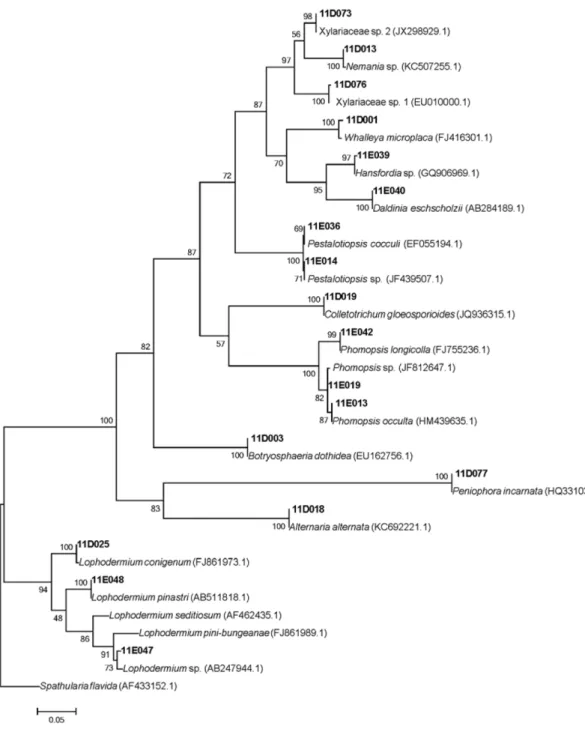
분리된 균들의 염기서열 분석결과 총 17개의 분류군으로 나누어 볼 수가 있었다(Fig. 1). 분석된 염기서열은 BLAST 결과 기존의 균주들과 모두 98% 이상 유사도를 보였다.
그러나 염기서열을 통해 동정한 일부 분류군들(11E047, 11D076, 11D073, 11E039, 11E014, 11E019)은 염기서열만 으로는 종으로 한정하기에는 부족한 것으로 판단되며, 이 를 보다 명확히 규명하기 위해 자세한 형태적, 분자적 연
구가 필요할 것으로 판단된다.
본 연구에서 두 종의 소나무과 식물에서 분리한 내생균 들은 강(class) 수준에서는 크게 4개의 강(Sordariomycetes, Dothideomycetes, Leotiomycetes, Agaricomycetes)으로 나 누어지고 있는데, 이는 침엽수에서 분리한 내생균의 선행 연구 결과와 유사한 양상이다(Arnold, 2007; Kim et al., 2012). 총 17개의 분류군 중에서 2개의 그룹(Lophodermium sp., Whalleya microplaca)만이 두 종의 숙주식물 모두에서 공통적으로 발견되었으며, 나머지 분류군들은 공통적인 분포를 보이지 않았다. 또한 두 수종 모두에서 Lophoder- mium sp.가 제일 풍부하게 분포하는 것으로 나타났으나, 소나무에서는 다른 분류군들에 비해 높은 비율을 보였다 (Table 1).
분석결과 소나무와 일본잎갈나무에서는 비슷한 수의 균 주가 분리되었음에도 불구하고 종다양성 지수인 H'은 일 본잎갈나무에서 약 2배 이상 높게 나타났으며, 내생균의 분 류군 수도 약 2배 이상 높은 값을 보였다(Table 1). 이와 같 은 결과는 기본적으로 숙주식물의 다양성에 기인하는 것 으로 생각된다. 특히, 내생균의 분포에 영향을 미치는 요 인은 일차적으로 숙주식물이므로 동일한 미기후상태를 나 타낸다고 할지라도 다양한 숙주식물의 존재여부가 동일한 숙주식물에 비해서 내생균에게 필요한 보다 많은 생태적 지위를 제공할 수 있기 때문으로 보인다. 따라서 선행연구 와 비교해 볼 때, 일본잎갈나무의 새로운 생태적 지위가 내생균의 다양성에 영향을 미치는 주요 요인이라고 볼 수 있을 것이다(Yoo and Eom, 2012).
본 연구결과 소나무에서 분리한 균주의 약 40% 정도가 Lophodermium 속에 속하는 내생균으로 나타났다. 우리나 라에서 소나무 등의 침엽수에서 수행한 내생균 관련 선행 연구 결과들(Kil et al., 2009; Seo et al., 2009; Yoo and Eom, 2012)에서도 Lophodermium 속의 내생균이 약 40~
60% 정도의 비율로 다수를 차지하는 것으로 나타났다. 이 는 일본잎갈나무에서 분리한 내생균에서 Lophodermium 속에 속하는 내생균 (22%)에 비하면 상당히 높은 비율이 며, 이를 통해 소나무속 식물과 Lophodermium 속에 속하 는 내생균 사이에 어느 정도의 특이적인 관계가 존재하고 있는 것으로 생각된다.
내생균의 숙주특이성에 대해서는 초본식물에서 많은 연 구가 수행되어 숙주식물인 Festuca arundinacea와 Neoty- phodium 속의 내생균 간의 공진화 관계에 대해서 잘 알려 져 있다(Bacon and White, 2000). 그러나 목본식물과 내생 균의 숙주특이성에 대해서는 많은 연구가 이루어지지 않 았으나, 계속적인 연구를 통해서 소나무속 식물과 Lopho- dermium속에 속하는 종들 사이에 일어나는 상호작용에 대한 연구와 함께 내생균과 목본식물과의 숙주특이성에 대한 연구를 수행할 필요가 있다. 특히, 목본식물에서 내 생균의 전이는 수평적 전이에 기초하여 대부분 무작위적 으로 발생하는 것으로 보고 있음에도 불구하고(Saikkonen
et al., 2004), 이제까지의 연구결과들을 보면 소나무속 식 물에서 Lophodermium 속에 속하는 내생균이 높은 비율로 발견되고 있다. 또한 Arnold 등(2007)도 Lophodermium 속에 속하는 내생균들이 소나무과 식물에서 매우 빈번히 출현한다고 보고 하였는데, 이와 같은 결과는 국외에 분포 하는 소나무속 숙주식물에서도 본 연구를 포함한 국내의 연구 결과와 유사한 경향성이 있음을 확인할 수 있었다.
현재 전 세계적으로 Lophodermium 속에는 약 100여 종 이 분포하고 있는 것으로 보고되고 있으며(Ortiz-Garca et al., 2003), 중국에는 약 50여 종이 있는 것으로 파악되고
있으나(Lin et al., 2012), 한국에는 약 10여 종이 보고되어 왔다(Lee et al., 1989). 이들은 또한 대부분 소나무속에 속 하는 수종에서 분리된 종으로 본 연구에서도 일부 동일한 종이 분리되었다. 그러나 현재까지 기록된 종으로 특징지 을 수 없는 다수의 Lophodermium 속에 속하는 균들이 분 리되었으며, 이 분류군들은 계통수상에서 그 위치를 보면 크게 2개의 그룹으로 구분되었다(Fig. 1). Ortiz-Garca 등 (2003)에 의하면 내생균이 각각 다른 숙수식물의 물리적 구조나 2차 대사산물 등에 영향을 받아 염기서열의 분지 가 발생하기도 하며, 동일한 숙수식물에 감염된 동일한 내
Fig. 1. Phylogenetic tree of endophytic fungi from P. densiflora and L. kaempferi in Mt. Oser. ITS and 5.8S rDNA region were used for the sequence analysis to confirm the topological appropriation of the fungal isolates. Sphatularia flavida was used as an outgroup and bootstrap values are shown at the branches (1,000 replicates).
생균이라도 넓은 분포역을 갖는 숙주식물에서는 분포지역 에 따라 내생균의 염기서열에 변이가 발생한다고 보고한 연구결과 등으로 볼 때, 이 분류군에 대하여 형태 및 분자 적인 후속 연구를 계속하여 이들을 규명할 필요가 있을 것 으로 보인다.
적 요
오서산의 소나무와 일본잎갈나무 두 수종의 침엽에서 내 생균의 다양성을 분석하였다. 총 13개체의 숙수식물에서 채집한 침엽을 표면살균하여 분리한 균주들은 형태적인 특징과 rDNA 유전자(ITS 부위) 분석을 수행하였다. 그 결 과 총 37개의 균주가 분리되었으며 이들은 17개의 분류군 으로 묶을 수 있었다. 그 중 59%는 Leotiomycetes에 속하 였으며, 30%는 Sordariomyetes에, 8%는 Dothideomycetes에 속하였으며, 3%는 Agaricomycetes에 속하는 균으로 판명 되었다. 이러한 결과들은 선행연구의 결과들과 매우 유사 하였으며 소나무에서보다 일본잎갈나무에서 내생균의 종 다양성이 높게 나타났다. 특히 Lophodermium 속에 속하 는 분류군들이 내생균의 다양성에서 주요한 균류로 확인 되었으며, 한국에 분포하는 Lophodermium 속 내 종들에 대한 심도 있는 연구가 요구된다.
감사의 글
본 연구는 환경부 재원으로 국립생물자원관의 지원을 받 아 수행된 연구(NIBR No 2013-02-001) 결과의 일부로 연 구비 지원에 감사드립니다.
참고문헌
Amirita, A., Sindhu, P., Swetha, J., Vasanthi, N. and Kannan, K.
2012. Enumeration of endophytic fungi from medicinal plants and screeening of extracellular enzymes. World J. Sci. Tech.
2:13-19.
Arnold, A. E. 2007. Understanding the diversity of foliar endo- phytic fungi: Progress, challenges, and frontiers. Fungal Biol.
Rev. 21:51-66.
Bacon, C. and White, J. 2000. Microbial endophytes. CRC Press, New York.
Carroll, G. 1988. Fungal endophytes in stems and leaves: From latent pathogen to mutualistic symbiont. Ecology 69:2-9.
Farjon, A. 1998. World checklist and bibliography of conifers.
Royal Botanic Gardens, Kew.
Ganley, R. J., Brunsfeld, S. J. and Newcombe, G. 2004. A commu- nity of unknown, endophytic fungi in western white pine.
Proc. Natl. Acad. Sci. USA 101:10107-10112.
Gardes, M. and Bruns, T. 1993. ITS primers with enhanced Table 1. The closest taxa of representative isolates using ITS region from L. kaempferi and P. densiflora in Mt. Oser
Strain No. The Closest GenBank Taxa (Accession Number) Maximum Identity (%)
Relative Abundance*
P. densiflora L. kaempferi
11E047 Lophodermium sp. (AB247944.1) 99 0.63 0.22
11E048 Lophodermium pinastri (AB511818.1) 100 0.11
11D003 Botryosphaeria dothidea (AB511818.1) 99 0.06
11D076 Xylariaceae sp. (EU010000.1) 99 0.05
11D073 Xylariaceae sp. (JX298929.1) 99 0.06
11D001 Whalleya microplaca (FJ416301.1) 98 0.11 0.11
11D036 Pestalotiopsis cocculi (EF055194.1) 99 0.06
11E042 Phomopsis longicolla (FJ755236.1) 99 0.06
11E039 Hansfordia sp. (GQ906969.1) 99 0.06
11E040 Daldinia eschscholzii (AB284189.1) 99 0.06
11D018 Alternaria altermata (JF742669.1) 99 0.11
11D019 Colletotrichum gloeosporioides (JQ936315.1) 99 0.06
11D025 Lophodermium conigenum (FJ861973.1) 99 0.05
11D077 Peniophora incarnata (HQ331031.1) 99 0.05
11E013 Phomopsis occulta (HM439635.1) 99 0.06
11E014 Pestalotiopsis sp. (JF439507.1) 100 0.06
11E019 Phomopsis sp. (JF812647.1) 99 0.06
Total number of isolates 19 18
Shannon diversity index (H’) 1.23 2.43
Species richness 6 13
*Relative abundance indicates the percentages of the number of isolates in the study sites of the total numbers of isolates
specificity for basidiomycetes - application to the identification of mycorrhizae and rusts. Mol. Ecol. 2:113-118.
Kil, Y J., Eo, J. K. and Eom, A. H. 2009. Molecular identification and diversity of endophytic fungi isolated from Pinus densi- florain Boeun, Korea. Kor. J. Mycol. 37:130-133. (in Korean).
Kim, C. K., Eo, J. K. and Eom, A. H. 2012. Diversity of foliar endophytic fungi isolated from Lindera obtusiloba in Korea.
Kor. J. Mycol. 40:136-140. (in Korean).
Kim, C. K., Eo, J. K. and Eom, A. H. 2013. Diversity and seasonal variation of endophytic fungi isolated from three conifers in Mt. Taehwa, Korea. Mycobiology 41:82-85.
Kong, W. S. 2006. Biogeography of native Korean Pinaceae. J. Kor.
Geograph. Soc. 41:73-93. (in Korean).
Lee, S. G., Lee, K. J., La, Y. J., Yang, S. I. and Yi, C. K. 1989. Iden- tification of Lophodermium species associated with needle- cast disease of pines in Korea. J. Kor. Forest. Soc. 78:218-227.
(in Korean).
Lee, T. B. 1983. Gymnosperms in Korea. Bull. Kwanak Arboretum 4:1-22. (in Korean).
Lin, Y. R., Liu, H. Y., Hou, C. L., Wang, S. J., Ye, M., Huang, C. L., Xiang, Y. and Yu, S. M. 2012. Flora fungorum sinicorum.
Science Press, Beijing. (in Chinese).
Nath, A., Raghunatha, P. and Joshi, S. 2012. Diversity and biolo- gical activities of endophytic fungi of Emblica officinalis, an ethnomedicinal plant of India. Mycobiology 40:8-13.
Ortiz-Garca, S., Gernandt, D. S., Stone, J. K., Johnston, P. R., Chapela, I. H., Salas-Lizana, R. and Alvarez-Buylla, E. R. 2003.
Phylogenetics of Lophodermium from pine. Mycologia 95:846- 859.
Saikkonen, K., Wali, P., Helander, M. and Faeth, S. H. 2004. Evolu- tion of endophyte-plant symbioses. Trends Plant Sci. 9:275- 280.
Schulz, B. and Boyle, C. 2005. The endophytic continuum. Mycol.
Res. 109:661-686.
Seo, S. T., Kim, K. H., Kim, M. J., Hong, J. S., Park, J. H. and Shin, S. C. 2009. Diversity of fungal endophytes from Pinus korai- ensis leaves in Koea. Kor. J. Mycol. 37:108-110. (In Korean) Tamura, K., Peterson, D., Peterson, N., Stecher, G., Nei, M. and
Kumar, S. 2011. MEGA5: Molecular evolutionary genetics analysis using maximum likelihood, evolutionary distance, and maximum parsimony methods. Mol. Biol. Evol. 28:2731- 2739.
Wang, Y. T., Lo, H. S. and Wang, P. H. 2008. Endophytic fungi from Taxus mairei in Taiwan: first report of Colletotrichum gloeosporioides as an endophyte of Taxus mairei. Botanic.
Stud. 49:39-43.
Yoo, J. J. and Eom, A. H. 2012. Molecular identification of endophytic fungi isolated from needle leaves of conifers in Bohyeon mountain, Korea. Mycobiology 40:231-235.