1. Introduction 1.1 Necessity of the study
Nurse turnover is a major concern in the healthcare industry around the world[1].
According to a survey on the status of hospital
Factors Influencing Turnover Intention in Clinical Nurses:
Affective Events, Affect, and Job Satisfaction
Yoonjeong Lee, Hyunli Kim
*Professor, College of Nursing, Chungnam National University
임상간호사의 이직의도에 영향을 미치는 요인:
정서사건, 정서, 직무만족
이윤정, 김현리
*충남대학교 간호대학 교수
Abstract This research was conducted to investigate the influence of affective events, affect, and job satisfaction on clinical nurse’s turnover intention and to provide guidelines for interventions and strategies to decrease turnover intention. The participants consisted of 296 nurses recruited from three general hospitals in South Korea. Data was collected by a structured self-report questionnaire, and were analyzed using SPSS Statistics 24.0 and AMOS 24.0. The final path model was a good fit for the data based on the model fit indices. In the path analysis, positive events, negative events, positive affect, negative affect, and job satisfaction had statistically significant effects on turnover intention, explaining 37.0% of the variance. This research provided evidence identifying factors influencing turnover intention in clinical nurses. Therefore, findings from this research can be used to design appropriate strategies to decrease the clinical nurse's turnover intention.
Key Words : Nurses, Events, Affect, Job Satisfaction, Turnover Intention
요 약 본 연구는 정서사건과 정서, 직무만족이 임상간호사의 이직의도에 미치는 영향을 확인하고 이직의도를 감소시 키기 위한 중재 및 전략에 대한 지침을 제공하기 위하여 수행되었다. 정서사건과 정서, 직무만족, 이직의도의 관계는 경로분석을 활용하여 검증하였다. 총 296명의 임상간호사를 대상으로 구조화된 자기보고식 설문지를 통해 수집하였고, 수집된 자료는 SPSS Statistics 24.0과 AMOS 24.0 프로그램을 활용하여 분석하였다. 최종 경로모형은 권장 적합도 수준에 적합하였고, 경로분석 결과, 긍정과 부정사건, 긍정과 부정정서, 직무만족은 이직의도에 통계적으로 유의한 영 향을 미쳤으며, 이 변수들의 설명력은 37.0%이었다. 본 연구는 임상간호사의 이직의도에 미치는 영향요인을 확인하였 으며, 임상간호사의 이직의도를 감소시키기 위한 전략수립에 기여할 것이다.
주제어 : 간호사, 사건, 정서, 직무만족, 이직의도
*Corresponding Author : Hyunli Kim([email protected]) Received July 25, 2019
Accepted October 20, 2019
Revised September 25, 2019 Published October 28, 2019
nursing staff placement conducted by the Korean Hospital Nurses Association in 2017, the rate of nurse turnover in South Korea is 13.8% on average[2]. Compared to other OECD countries, South Korea has a lower rate of active nurses relative to licensees, demonstrating inefficient use of the nursing workforce[3]. This is not only a challenge on the level of individuals and hospital organizations but a national problem with regard to the provision and advancement of efficient healthcare services. Clinical nurses provide essential nursing services[3] and play a critical role in ensuring patient safety and satisfaction as well as the quality of medical services[4,5].
A high turnover among nurses results in financial losses stemming from recruitment and training of new nurses, lower satisfaction, and reduced morale among employees, all of which threaten efficiency and productivity in hospital operations[6,7]. This may also cause increased anxiety among patients and negatively impact their health as they feel that they are not receiving high-quality care services[6,7].
Furthermore, the incompetency of inexperienced nurses can lead to various medical errors that may compromise the health and even lives of patients[6,7]. Turnover means the cessation of membership in an organization by an individual who received monetary compensation from the organization[8]. The turnover intention is considered a critical indicator in predicting the actual turnover[9]. In this regard, efforts to identify and alleviate turnover intention will contribute to lowering the turnover rate among nursing professionals.
In Affective Events Theory (AET), Weiss and Cropanzano[10] explain the impact on work attitudes and behaviors by affective reactions, which refer to positive or negative affective experiences among individual employees caused by specific events on the condition that employees have affective responses to work
events that occur in their work environments. In other words, the affective responses that employees experience in relation to the events occurring in their organization influence their work attitudes, including job satisfaction, which then lead to judgment-driven behaviors such as turnover[10,11]. The theory proposes positive affect and negative affect: the former refers to one's propensity to experience enthusiastic, active, and responsive states and the latter to one's sensitivity to negative events and inclination to experience negative emotions such as anger, guilt, and fear. Positive affect indicates more adaptive behaviors than negative affect[12,13].
Basch and Fisher[14] used interviews to classify 14 positive affective events that induce positive emotion, including goal achievement and receiving recognition, and 13 negative affective events that cause negative emotion, including task problems and making mistakes. The affective events emotions matrix classified by Basch and Fisher[14]. This affective events tool was modified and validated by Chun[15]. Chun[15]
was to define the relationships among affective event and emotions. In a study by Shin[16], work events (positive events, negative events) had a significant effect on the affective reaction (positive affect, negative affect), and affective reaction had a significant effect on the job satisfaction. The study also reported, affective reaction worked as mediators between the work events and job satisfaction[16]. Job satisfaction, which includes affective aspects, is defined as a pleasurable emotional state stemming from the appraisal of job achievement and experience[17].
While the correlation between affect and job satisfaction is well established[18], there is little research in the field of nursing studies about the impact of affective events and affect relations on job satisfaction based on Affective Events Theory.
Job satisfaction among nursing professionals is reported to be a significant determinant of turnover intention[19,20] and a motivator behind
nurse retention.
While there is a plethora of domestic studies on nurses' turnover intention, little research has been done on positive or negative affective experiences among clinical nurses in relation to affective events in hospital environments and the impact of their consequent job satisfaction on turnover intention.
By finding methods to decrease turnover intention, it may be possible to retain clinical nurses within their workplace. Using Affective Events Theory and a literature review, this study attempts to examine the relations and pathways of action between affective events, affect, and job satisfaction experienced by clinical nurses and turnover intention and to provide basic data for efforts to reduce the turnover rate among nurses.
1.2 Purpose of the study
The purpose of this study was to investigate the relationships among affective events, affect, job satisfaction, and turnover intention of clinical nurses and to provide an explanation about turnover intention among Korean clinical nurses.
1.3 Hypothetical path model
Affective Events Theory[10,11] and a literature review were selected as a theoretical guide for this study. Therefore, the exogenous variable is affective events, and endogenous variables are affect, job satisfaction, and turnover intention. A hypothetical path model of clinical nurses' turnover intention was constructed, as seen in
Fig. 1.
2. Method
2.1 Study design
This study employed a cross-sectional design and used path analysis, proposing a hypothesized path model for explaining clinical nurses’
turnover intention. And the influencing factors, which included relationships among affective events, affect, job satisfaction, and turnover intention, were developed by conceptualizing literature review.
2.2 Participants
Participants were nurses from three general hospitals located in South Korea. Participants had to fulfill the following criteria: at least 6 months of clinical experience, understanding of the study purpose, and consent to participate.
296 clinical nurses were included in this study for the final analysis. A sample of 15 to 20 participants per observed variable, or at least 200 samples per path model, is required for maximum likelihood method. Thus, the sample size of the current study was adequate for the research[21].
2.3 Instruments
2.3.1 Affective eventsAffective events were measured using the affective events emotions matrix classified by Basch and Fisher[14], modified and validated by Chun[15]. This tool consists of 12 positive event questions and 10 negative event questions measured on a five-point Likert scale. Higher scores refer to better perception of affective events. Cronbach’s alpha was reported as .82 for positive events and as .84 for negative events in the study by Chun[15]. The reliability was Cronbach’s ⍺= .88~ .83 in this study.
Fig. 1. Hypothetical path model diagram.
2.3.2 Affective reaction
Affective reaction was assessed using the Positive Affect and Negative Affect Schedule developed by Watson et al.[13] and validated by Lee, Kim, and Lee’s tool[22]. This tool consists of 10 positive affect questions and 10 negative affect questions measured on a five-point Likert scale. Higher scores refer to better perception of affect. Cronbach’s alpha was reported as .84 for positive affect and as .87 for negative affect in the study by Lee et al.[22]. The Cronbach’s alpha for this study was .84~ .87.
2.3.3 Job satisfaction
Job satisfaction was measured using Baek and Jang’s tool[23], which was adapted from Price and Mueller[9]. This tool consists of 5 questions measured on a five-point Likert scale. Higher scores refer to better perception of job satisfaction. Cronbach’s alpha was reported as .88 in the study by Baek and Jang[23]. The Cronbach’s alpha for this study was .89.
2.3.4 Turnover intention
Turnover intention was measured using the instrument developed by Lawler[24], translated and modified by Park’s tool[25]. This tool consists of 4 questions measured on a five-point Likert scale. Higher scores refer to better perception of turnover intention. Cronbach’s alpha was reported as .88 in the study by Park[25]. The Cronbach’s alpha for this study was .90.
2.4 Data collection and ethical considerations
After receiving IRB approval, the researcher directly contacted the nursing departments of three university hospitals. We sought consent to allow nurses to participate in this study and explained the purpose and procedure of the study to all participating nurses and they could withdraw from the study at any point during their participation without any penalty. Inaddition, we secured their written agreement to participate. The survey was then completed anonymously. We also secured their written agreement to participate. Data were collected using structured self-report questionnaires between August and September 2017. The final sample consisted of 296 clinical nurses.
2.5 Data analysis
The data collected in this study were analyzed using SPSS statistics ver. 24.0 and AMOS ver. 24.0 programs. In order to examine the general characteristics of the participants and the measured variables, descriptive statistics were used. Internal reliabilities of the measurement tools were tested using Cronbach's ⍺. The normality of the measured variables was tested using skewness and kurtosis. Pearson's correlation coefficient was used to evaluate the correlations between variables. The tolerance and variation inflation factor were used to check multicollinearity. In order to evaluate the fitness of the hypothesized and modified path models, χ
2, GFI, CFI, NFI, IFI, SRMR, and RMSEA were used.
Path analysis was estimated by the method of maximum likelihood. Bootstrapping was conducted to examine the statistical significance of the modified path model's direct effects, indirect effects, and total effects.
3. Results
3.1 General characteristics of participants
The general characteristics of the participants included gender, age, marital status, education level, department, clinical experience, work pattern, and type of employment. Most participants were female nurses (97.3%). Of the 296 participants, the average age was 31.01±7.84 years, and more than half were single (65.9%). A total of 201 participants (67.9%) were Bachelorgraduates. Participating nurses were working in the medical ward (44.9%), the surgical ward (32.1%), the intensive care unit (13.9%), and other departments (9.1%). The average length of clinical experience was 8.40±7.80 years. Most participants worked a 3-shift duty (79.8%) and were permanent employees (85.5%). Table 1.
Table 1. General Characteristics of Subjects (N=296)
Characteristics Categories n (%) M±SD
Gender
Male 8 (2.7)
Female 288 (97.3)
Age (year) <30 175 (59.1)
31.01±7.84
30-39 79 (26.7)
≥40 42 (14.2)
Marital status
Single 195 (65.9)
Married 101 (34.1)
Education level
College 40 (13.5)
Bachelor 201 (67.9)
≥Master 55 (18.6)
Department Medical ward 133 (44.9) Surgical ward 95 (32.1)
ICU 41 (13.9)
Other 27 (9.1)
Clinical experience (year)
≤3 84 (28.4)
8.40±7.80
>3∼≤5 58 (19.6)
>5 154 (52.0)
Work pattern
Daytime work 46 (15.5)
2-shift 14 (4.7)
3-shift 236 (79.8) Employment
type
Temporary 43 (14.5) Permanent 253 (85.5) M = Mean; SD = Standard deviation
3.2 Descriptive statistics of variables, test of normality, and multicollinearity
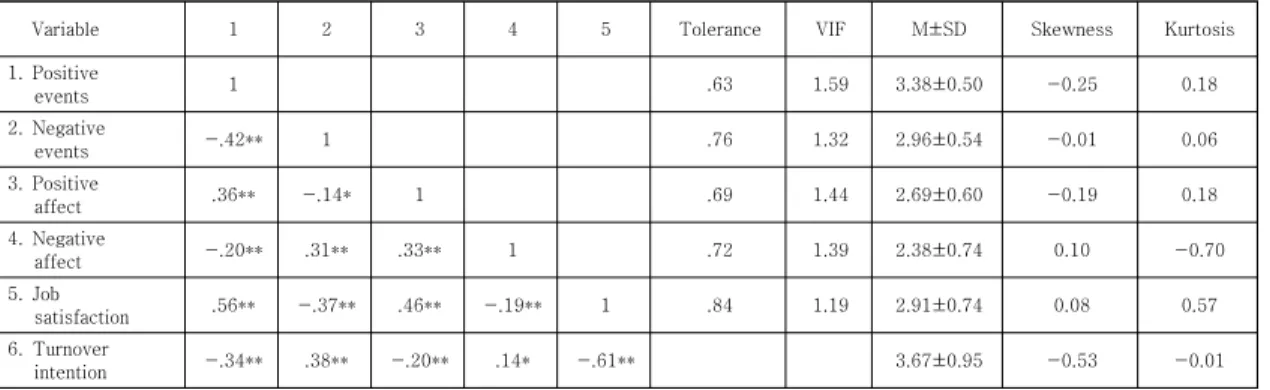
In the descriptive statistics, the mean score of positive events was 3.38±0.50, that of negative events was 2.96±0.54, that of positive affect was 2.69±0.60, that of negative affect was 2.38±0.74, that of job satisfaction was 2.91±0.74, and that of turnover intention was 3.67±0.95. All absolute values of skewness were less than 2 (0.01~0.53), and all absolute values of kurtosis were less than 2 (0.01~0.70). Therefore, as expected, the results of skewness and kurtosis met the assumption of a normal distribution. The test for multicollinearity between variables was conducted looking at tolerance, variance inflation factor, and correlation coefficient. All variance inflation factors were less than the absolute value 10 (1.19~1.59), all tolerances were more than the absolute value 0.10 (0.63~0.84), and the absolute values for correlation coefficients were between .14 and .61; therefore, multicollinearity was not problematic. The data were suitable to testing the hypothetical path model. Table 2.
3.3 Path model analysis
The fit of the hypothetical path model was χ2 (p)=137.72 (p<.001), GFI=.88, CFI=.75, NFI=.74, IFI=.75, SRMR=.14, RMSEA=.22. The fit did not reach the recommended standard[21]. The hypothetical path model was revised considering
Table 2. Descriptive Statistics and Correlation among Measured Variables.
Variable 1 2 3 4 5 Tolerance VIF M±SD Skewness Kurtosis
1. Positive
events 1 .63 1.59 3.38±0.50 -0.25 0.18
2. Negative
events -.42** 1
.76 1.32 2.96±0.54 -0.01 0.06
3. Positive
affect .36** -.14* 1 .69 1.44 2.69±0.60 -0.19 0.18
4. Negative
affect -.20** .31** .33** 1
.72 1.39 2.38±0.74 0.10 -0.70
5. Job
satisfaction .56** -.37** .46** -.19** 1 .84 1.19 2.91±0.74 0.08 0.57
6. Turnover
intention -.34** .38** -.20** .14* -.61**
3.67±0.95 -0.53 -0.01
*p<.05, **p<.001
the modification index from the path analysis results[21]. Adding a path between job satisfaction and two exogenous variables (positive events and negative events), the fitness indices for the modified path model improved to χ2 (p)=21.28 (p=.002), GFI=.98, CFI=.97, NFI=.96, IFI=.97, SRMR=.04, RMSEA=.09. Therefore, we adopted the modified path model with better fitness as the final model. Table 3.
The path coefficient of the modified path model was evaluated. Among the seven paths of the modified path model, all seven paths were significant. Fig. 2. The direct paths from positive events to positive affect (β=.39, p<.001) and from negative events to negative affect (β=.30, p<.001) were statistically significant. Job satisfaction had four significant direct paths from positive events (β= .33, p<.001), negative events (β=-.11, p=.028), positive affect (β=.40, p<.001), and negative affect (β=-.21, p<.001). The direct path from job satisfaction to clinical nurse’s turnover intention (β=-.61, p<.001) was statistically significant.
Fig. 2. Modified path model diagram.
When examining direct, indirect, and total effects of variables and statistical significance in the modified path model, positive events, negative events, positive affect, negative affect, and job satisfaction had statistically significant effects on turnover intention. Positive events, negative events, positive affect, and negative affect had indirect and total effects on turnover intention. Job satisfaction had direct and total effects on turnover intention. These variables explained 37.0% of the variance in clinical
Table 4. Standardized Direct, Indirect, and Total Effects for the Modified Path Model Endogenous
variables
Exogenous
variables β (S.E.) C.R. (p) SMC Standardized
Direct effect (p)
Standardized Indirect effect (p)
Standardized Total effect (p)
Positive affect Positive events .39 (.05) 8.01 (<.001) .15 .39 (.003) .39 (.003)
Negative affect Negative events .30 (.07) 5.93 (<.001) .09 .30 (.004) .30 (.004)
Job satisfaction
Positive events .33 (.03) 6.28 (<.001) .44
.33 (.003) .16 (.003) .48 (.004) Negative events -.11 (.04) -2.20 (.028) -.11 (.044) -.06 (.003) -.17 (.003)
Positive affect .40 (.03) 7.51 (<.001) .40 (.009) .40 (.009)
Negative affect -.21 (.03) -4.13 (<.001) -.21 (.007) -.21 (.007)
Turnover intention
Positive events
.37
-.29 (.003) -.29 (.003)
Negative events .11 (.003) .11 (.003)
Positive affect -.24 (.006) -.24 (.006)
Negative affect .13 (.006) .13 (.006)
Job satisfaction -.61 (.05) -13.14 (<.001) -.61 (.006) -.61 (.006)
S.E. =Standard estimates; C.R. =Critical ratio; SMC=Squared multiple correlation Table 3. Fit Index of the Hypothetical Model and Modified Path Model
Model x2(p) GFI CFI NFI IFI SRMR RMSEA
Evaluation criteria >.05 ≥.90 ≥.90 ≥.90 ≥.90 ≤.05 ≤.10
Hypothetical model 137.72 (p<.001) .88 .75 .74 .75 .14 .22
Modified model 21.28 (p=.002) .98 .97 .96 .97 .04 .09
nurses’ turnover intention. Positive events, negative events, positive affect, and negative affect had statistically significant effects on job satisfaction.
Positive events and negative events had direct, indirect, and total effects on job satisfaction.
Positive affect and negative affect had direct and total effects on job satisfaction. These variables explained 44.0% of the variance in clinical nurses’ job satisfaction. Positive events had direct and total effects on positive affect, explaining 15.0% of the variance in positive affect. Negative events had direct and total effects on negative affect, explaining 9.0% of the variance in negative affect. Table 4.
4. Discussion and Conclusion
Based on Affective Events Theory[10,11] and previous studies, this research examined the relationship between turnover intention and affective events, affect, and job satisfaction among Korean clinical nurses. We found a mediating effect of positive and negative affect on positive and negative events and job satisfaction. Affect and job satisfaction worked as double mediators between on affective events and turnover intention. We found a direct relationship between positive and negative events and job satisfaction.
The turnover intention among clinical nurses in this study was 3.67 on a 5-point scale, which is slightly greater than 3.45 in previous research[26]
that used the same measurement tool. The previous study[26] concluded that turnover management is needed if the score is three points or higher, thus the nurses who participated in this research seem to need turnover management.
Based on the current research, the most significant factor in turnover intention was job satisfaction and it had direct effects. Job satisfaction had a negative impact on turnover intention. This finding is in line with the results
of previous studies, which concluded that job satisfaction has a critical impact on nurses' turnover intention[19,20]. Here, job satisfaction refers to a positive and pleasurable emotional state obtained as a result of the evaluation of one's job and job experiences[24]. The greater the job satisfaction, the lower the inclination to leave the current organization[24]. The findings of this research show that efforts to improve job satisfaction among clinical nurses are necessary in order to lower their turnover intention. In addition, this research has also confirmed that positive events, positive affect, negative affect, and negative events all influenced job satisfaction. In particular, both positive and negative events had direct and indirect effects while both positive and negative affect had direct effects. Positive events/affect and negative affect/events were positively and negatively associated with job satisfaction, respectively. This result is different from the findings of other research. For example, a study of Dutch nurses[27] found that both positive and negative events impacted positive and negative emotions;
and job satisfaction was positively influenced by positive emotions but not influenced by events and negative emotions. These findings indicate that both affective events and affect significantly influence job satisfaction in Korean clinical nurses. Therefore, programs should be developed to strengthen the positive and negative affective reaction of clinical nurses.
This research has verified strong positive correlations between positive events and positive affect and between negative events and negative affect, as supported by the findings of previous studies[15]. Furthermore, job satisfaction was greater with higher positive affect and lower with higher negative affect. Affective events had indirect effects on job satisfaction through the mediating effect of affect. This result supports that affective events that employees experience within the workplace influence work attitudes
(job satisfaction) and behaviors (turnover) through affective reactions. Unlike previous research, this study has also confirmed the direct effects of affective events on job satisfaction. This suggests that job satisfaction is associated with not only emotional aspects but also cognitive aspects as well.
In terms of factors impacting turnover intention, both positive and negative events had indirect and total effects. Using job satisfaction as a mediator, the turnover intention declined with more positive events such as involvement in problem solving, involvement in decision making, receiving recognition and goal achievements but increased with negative events such as conflicts with Customers, work overload, task problems and making mistakes, and lack of influence or control work colleagues and supervisor. With recent shifting paradigms and changing medical environments, clinical nurses may more sensitively respond to affective events. Hospital administrators will need to be more aware of and manage affective events in order to ensure the effective management of nursing resources by increasing their job satisfaction and hence reducing their turnover intention.
According to this research, both positive and negative affect showed indirect effects. Through the mediator of job satisfaction, greater positive affect (enthusiastic, proud, interested, etc.) was associated with lower turnover intention and greater negative affect (nervous, hostile, distressed, etc.) with increased turnover intention. This result is in line with previous research[28]
showing that positive affect has indirect effects on turnover intention through the mediator of job satisfaction. Based on this finding that negative affect also has indirect effects on turnover intention, it is advised that both positive affect and negative affect need attention.
Emotional management programs should be developed to help enhance positive affect while alleviating negative affect among clinical nurses.
Efforts to create a positive work experience, considering affective events and affect in nursing, will promote job satisfaction and individual well-being among clinical nurses, which will then contribute to lowering their turnover intention.
Based on these findings, this study warrants further research on the development and corroboration of the effect of intervention programs to reduce turnover intention among clinical nurses by using determinants of such intention.
In contrast to previous studies on clinical nurses' turnover intention, this research used a path analytic model in order to verify the relations among affective events, affect, job satisfaction, and turnover intention and to provide a practical and specific data regarding efforts to reduce turnover intention. This research is meaningful in that it has brought a new perspective to studies on turnover intention among clinical nurses.
REFERENCES
[1] C. M. Duffield, M. A. Roche, C. Homer, J. Buchan & S.
Jimitrelis. (2014). A comparative review of nurse turnover rates and costs across countries. Journal of Advanced Nursing, 70(12), 2703-2712.
DOI : 10.1111/jan.12483
[2] Korean Hospital Nurses Association. (2018). Survey on the status of hospital nursing staff placement: 2017 Annual report. Seoul: Korean Hospital Nurses Association.
[3] S. Y. Park. (2018). Issues and challenges of nursing workforce supply to improve the quality of health care services. Korean Journal of Converging Humanities, 6(1), 31-54.
DOI : 10.14729/converging.k.2018.6.1.31
[4] R. L. Kane, T. A. Shamliyan, C. Mueller, S. Duval & T.
J. Wilt. (2007). The association of registered nurse staffing levels and patient outcomes: Systematic review and meta-analysis. Medical Care, 45(12), 1195-1204.
DOI : 10.1097/mlr.0b013e3181468ca3
[5] A. J. Lankshear, T. A. Sheldon & A. Maynard. (2005).
Nurse staffing and healthcare outcomes: A systematic
review of the international research evidence.
Advances in Nursing Science, 28(2), 163-174.
DOI : 10.1097/00012272-200504000-00008 [6] J. K. Kim & M. J. Kim. (2011). A review of research on
hospital nurses' turnover intention. Journal of Korean Academy of Nursing Administration, 17(4), 538-550.
DOI : 10.11111/jkana.2011.17.4.538
[7] S. R. LIOU. (2009). Nurses' intention to leave:
Critically analyse the theory of reasoned action and organizational commitment model. Journal of Nursing Management, 17(1), 92-99.
DOI : 10.1111/j.1365-2834.2008.00873.x
[8] R. D. Iverson, (1993). Employee intent to stay: An empirical test of a revision of the Price and Mueller model. Doctoral dissertation. University of lowa, lowa City. USA.
[9] J. L. Price & C. W. Mueller. (1981). A causal model of turnover for nurses. Academy of Management Journal, 24(3), 543-565.
DOI : 10.5465/255574
[10] H. M. Weiss & R. Cropanzano. (1996). Affective events theory: A theoretical discussion of the structure, causes and consequences of affective experiences at work. Research in Organizational Behavior: An Annual Series of Analytical Essays and Critical Reviews, 18, 1-74.
[11] N. M. Ashkanasy & C. S. Daus. (2002). Emotion in the workplace: The new challenge for managers. Academy of Management Perspectives, 16(1), 76-86.
DOI : 10.5465/ame.2002.6640191
[12] D. Watson & L. A. Clark. (1999). The PANAS-X: Manual for the positive and negative affect schedule-expanded form. [Internet]. Iowa City: Univ. Iowa. 1994 [cited 2019 May 30]. [Online]
https://ir.uiowa.edu/cgi/viewcontent.cgi?article=1011
&context=psychology_pubs
[13] D. Watson, L. A. Clark & A. Tellegen. (1988).
Development and validation of brief measures of positive and negative affect: The PANAS scales.
Journal of Personality and Social Psychology, 54(6), 1063-1070.
DOI : 10.1037//0022-3514.54.6.1063
[14] J. Basch & C. D. Fisher. (2000). Affective job events–
emotions matrix: A classification of job related events and emotions experienced in the workplace.
Emotions in the Workplace: Research, Theory, and Practice. Westport, CT: Quorum Books, 36-48.
[15] E. Y. Chun. (2005). The effect of organizational justice in relation between affective events and emotions.
Master's thesis. Korea University, Seoul, Korea.
[16] Y. S. Shin, T. I. Kang & S. E. Yun. (2014). The effects which work events were experienced by employees on the service quality in local healthy family support center: Mediating effect of affective reaction and job satisfaction. Korean Journal of Human Ecology, 23(5),
773-787.
DOI : 10.5934/kjhe.2014.23.5.773
[17] E. A. Locke. (1976). The nature and causes of job satisfaction. Handbook of industrial and organizational psychology. Chicago: RandMc Narlly.
[18] C. D. Fisher. (2000). Mood and emotions while working: Missing pieces of job satisfaction? Journal of Organizational Behavior, 21(2), 185-202.
DOI : 10.1002/(sici)1099-1379(200003)21:2<185::aid- job34>3.0.co;2-m
[19] Y. O. Lee & J. Y. Kang. (2018). Related factors of turnover intention among Korean hospital nurses: A systematic review and meta-analysis. Korean Journal of Adult Nursing, 30(1), 1-17.
DOI : 10.7475/kjan.2018.30.1.1
[20] M. J. Yoo. & J. K. Kim. (2016). A structural model of hospital nurses' turnover intention: Focusing on organizational characteristics, job satisfaction, and job embeddedness. Journal of Korean Academy of Nursing Administration, 22(3), 292-302.
DOI : 10.11111/jkana.2016.22.3.292
[21] J. P. Yu. (2012). The concept and understanding of structural equation modeling. Seoul: Hannare Publishing Co, 1-567.
[22] H. H. Lee, E. J. Kim & M. K. Lee. (2003). A validation study of Korea positive and negative affect schedule:
The PANAS scales. Korean Journal of Clinical Psychology, 22(4), 935-946.
[23] M. Baek & K. S. Jang. (2016). Development and verification on the effectiveness of coaching program for nurses. Journal of Health Informatics and Statistics, 41(1), 57-66.
DOI : 10.21032/jhis.2016.41.1.57
[24] E. E. Lawler. (1983). Satisfaction and behavior. New York: McGraw-Hill Companies.
[25] H. Park. (2002). Relationship between perceived nursing care role orientation, job characteristics, and turnover among nurses. Master's thesis. Yonsei University, Seoul, Korea.
[26] S. H. Kim & M. A. Lee. (2014). Effects of emotional labor and communication competence on turnover intention in nurses. Journal of Korean Academy of Nursing Administration, 20(3), 332-341.
DOI : 10.11111/jkana.2014.20.3.332
[27] V. Meeusen, K. van Dam, A. van Zundert & J. Knape.
(2010). Job satisfaction amongst Dutch nurse anaesthetists: The influence of emotions on events.
International Nursing Review, 57(1), 85–91.
DOI : 10.1111/j.1466-7657.2009.00763.x
[28] S. O. Kim & Y. H. Kang. (2016). A prediction model on the male nurses' turnover intention. Korean Journal of Adult Nursing, 28(5), 585-594.
DOI : 10.7475/kjan.2016.28.5.585
이 윤 정(Yoonjeong Lee) [정회원]
․ 2015년 2월 : 충남대학교 대학원 간 호학과(간호학 석사)
․ 2018년 2월 : 충남대학교 대학원 간호 학과(간호학 박사)
․ 2018년 4월 ~ 현재 : 충남대학교 간호 대학 산학협력중점교수
․ 관심분야 : 근로환경, 근로자 건강증진, 삶의 질
․ E-Mail : [email protected]
김 현 리(Hyunli Kim) [정회원]
․ 1986년 2월 : 충남대학교 대학원 간 호학과(간호학 석사)
․ 2000년 8월 : 연세대학교 대학원 간호 학과(간호학 박사)
․ 1989년 9월 ~ 현재 : 충남대학교 간호 대학 간호학과 교수
․ 관심분야 : 건강증진, 지역사회 만성질 환자 간호
․ E-Mail : [email protected]