538
Copyright © 2020 The Korean Society of Fisheries and Aquatic Science pISSN:0374-8111, eISSN:2287-8815
서 론
쏘가리
(mandarin fish Siniperca scherzeri)
는한국,
중국과베 트남등의동아시아지역에주로서식하는담수어종으로상업 적으로매우중요한위치를차지하고있다(Zhou et al., 1988).
쏘가리는맛이좋을뿐아니라성장이비교적빠르고
,
질병에 대한저항성도높아서경제적으로전망이밝은내수면양식전 략품종이다(Su et al., 2005; Sankian et al., 2017).
하지만남획 과서식지감소로인하여쏘가리의자연자원량이급격하게감 소하고있고(Zhang et al., 2009),
소비자들의수요는계속증가 하고있어양식기술의개발을통한생산량증대가절실한어종 이다.
쏘가리의상업적중요성에도불구하고쏘가리실용사료 는아직개발되지않은상태이며,
쏘가리는육식성이매우강하기때문에양식장에서는살아있는먹이를먹여서사육되고있 는실정이다
(Sankian et al., 2017).
살아있는먹이로쏘가리를 사육하는것은비경제적이며비효율적인양식방법이다.
따라 서쏘가리양식산업을발전시키기위해서는쏘가리치어의사 료순치기술을개발하는것이중요하며,
이를통한쏘가리실 용사료의개발이이루어져야할것이다.
최근에충청북도내수 면연구소에서쏘가리를대량으로배합사료에순치시킬수있 는기술을개발하였다(Kim, 2015).
이러한결과를바탕으로쏘 가리전용사료개발을위한단백질과지질함량에대한연구가 수행되었다(Sankian et al., 2017).
또한쏘가리의적정사육수 온(Kim and Lee, 2016; Kim and Lee, 2017)
및사육밀도(Lee and Kim, 2017)
에관한연구도수행되었다.
향후산업적으로쏘가리양식생산량을증대시키기위해서는
사료 공급 횟수가 쏘가리(Siniperca scherzeri) 치어의 성장 및 체조성에 미치는 영향
김이오·오승용
1·이상민
2*
충청북도내수면산업연구소, 1한국해양과학기술원 해양생물자원연구단, 2강릉원주대학교 해양생물공학과
Influence of Different Feeding Frequency on the Growth and Body Composition of Juvenile Mandarin Fish Siniperca scherzeri Reared in a Recirculating Aquaculture System (RAS)
Yi-Oh Kim, Sung-Yong Oh1 and Sang-Min Lee2*
Chungcheongbuk-do Inland Fisheries Research Institute, Chungju 27432, Korea
1Marine Bio-Resources Research Unit, Korea Institute of Ocean Science & Technology, Busan 49111, Korea
2Department of Marine Biotechnology, Gangneung-Wonju National University, Gangneung 25457, Korea
A feeding trial was conducted to investigate the effect of feeding frequency on the growth performance and body composition of juvenile mandarin fish Siniperca scherzeri . Triplicate groups of fish (initial fish weight, 7.5 g/fish) were fed to apparent satiation at one, two, three or four meals per day for 8 weeks. The results showed that weight gain of fish fed one meal per day was significantly (P<0.05) lower than those fish fed two, three or four meals per day.
Feed efficiency of fish fed two meals per day was significantly (P<0.05) higher than other experimental groups. The plasma cholesterol content was significantly lower in fish fed one meal per day than those fed two, three or four meals per day. Consequently, we can conclude that feeding juvenile mandarin fish twice daily to apparent satiation is ac- ceptable and sufficient to achieve good growth and feed efficiency, as fish performance was not remarkably enhanced when feeding increased from two to four times per day.
Keywords: Mandarin fish, Siniperca scherzeri , Feeding frequency, Growth, Feed utilization
*Corresponding author: Tel: +82. 33. 640. 2414 Fax: +82. 33. 640. 2417 E-mail address: [email protected]
This is an Open Access article distributed under the terms of the Creative Commons Attribution Non-Commercial Licens (http://creativecommons.org/licenses/by-nc/3.0/) which permits unrestricted non-commercial use, distribution, and reproduction in any medium, provided the original work is properly cited.
Received 6 July 2020; Revised 10 August 2020; Accepted 11 August 2020 저자 직위: 김이오(연구원), 오승용(연구원), 이상민(교수) https://doi.org/10.5657/KFAS.2020.0538
Korean J Fish Aquat Sci 53(4), 538-543, August 2020
사육방법
,
배합사료품질향상및사료공급체계등과같은다 양한연구들이필요하다.
어류의성장에영향을미치는요인들 중에서사료섭취는사육환경,
배합사료조성,
사료형태및사 료공급방법등에영향을받기때문에(Lee et al., 2000a; Lee et al., 2000b),
사육환경,
사료품질향상및사료공급체계를 연구하는것이어류의성장및사료이용성개선에도움이된다(Lee et al., 2000b; Ng et al., 2000).
특히,
사료공급횟수는어 류의사료섭취량,
성장및노폐물배출에영향을미치는중요한 요인이다(Silva et al., 2007; Biswas et al., 2010).
부적절한사 료공급횟수는어류의성장및사료효율을감소시키고,
궁극적 으로어류의양식생산비용을증가시킨다(Booth et al., 2008;
Oh and Maran, 2014).
따라서성공적인어류양식을위해서는 최적의사료공급횟수에대한정보가필수적이다(Silva et al., 2007; Oh and Maran, 2014).
그러나,
어류의최대성장을위한 적정사료공급횟수는어종,
어체크기,
사료형태,
사료조성,
사료공급률등에따라다르다고보고되어 있다
(Wang et al.,
1998; Company et al., 1999).
사료공급이부족하면어류의성 장저하및폐사율이높아지고(Xie et al., 2011),
과도한사료공 급은노동과생산비증가의요인이될뿐아니라수질을악화시 킨다고보고되어있다(Biswas et al., 2006).
따라서쏘가리양 식산업화를위해서는적정사료공급횟수를조사하여양식현 장에적용할수있도록해야한다.
본연구는쏘가리치어사육 시사료공급횟수가성장,
어체성분및혈액성상에미치는영 향을조사하기위해서수행되었다.
재료 및 방법
실험어 및 사육관리
실험어로충청북도내수면산업연구소에서배합사료로순치된 쏘가리치어를사용하였으며
,
실험시작2
주전부터실험사료 를하루2
회공급하면서예비사육하였다.
예비사육후,
쏘가 리치어(7.5 g/fish)
를무작위로수조당25
마리씩3
반복으로사 육수조(200 L
원형)
에수용하여8
주간사육하였다.
쏘가리의 사육은침전조(2,000 L) 1
개와실험수조(200 L) 12
개가1
세트 가되도록설계한순환여과시스템에서수온(25°C)
과수질[pH 6.6-7.9, DO (dissolved oxygen) 6.0-7.7]
을조절하면서실시하 였다.
침전조에는깨끗한물을5 L/min
유량으로계속보충하 면서여분의사육수는퇴수구를통해빠져나가도록하였다.
또 한,
침전조에수중펌프를사용하여각각의실험수조에동일한양의물
(8 L/min)
을공급하여순환되도록하였으며,
수조마다에어스톤을설치하여산소를공급하였다
.
사료공급은1
일4
회(08:30, 11:30, 14:30, 17:30), 1
일3
회(08:30, 13:00, 17:30), 1
일2
회(08:30, 17:30)
및1
일1
회(08:30)
만복으로공급하였다. 실험사료
실험에사용된사료는양어가들이현장에서주로사용하는뱀
장어양성용시판분말사료
(Purinafeed, Seongnam, Korea)
와 전갱이어분을8:2
의비율로혼합한후에적당량의물을첨가 하여pellet
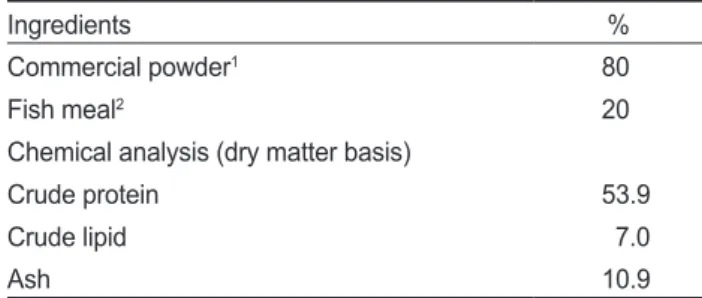
형태로사료(Table 1)
를성형하였다.
성형된실험사료를
-25°C
냉동고에보관하면서실험어류에게공급하였다.
어체측정 및 성분분석
어체측정은사육실험시작시와종료시에측정하기하루전부 터절식시킨후
, tricaine methanesulfonate (Sigma, St. Louis,
MO, USA) 100 ppm
수용액에마취시켜실험어의무게를측정하였다
.
어체의일반성분분석을위하여각실험수조에서
5
마리씩을시료로취하여냉동보관
(-25°C)
하였다.
실험사료및어체의일반성분은
AOAC (1995)
의방법에따라조단백질(N×6.25)
은Auto Kjeldahl System (Buchi B-324/435/412, Switzerland;
Metrohm 8-719/806, Swizerland)
를사용하여분석하였고,
조 지방은ether
를 사용하여추출하였으며,
수분은105°C
의dry oven
에서6
시간건조후측정하였다.
회분은600°C
회화로에 서4
시간동안태운후측정하였다.
혈액분석
실험사료공급에따른실험어의혈액성분변화를조사하기위 해실험종료시각실험수조마다쏘가리
5
마리씩무작위로추출하여헤파린이처리된
1 mL
주사기를사용하여실험어의미부혈관에서채혈하였다
.
채혈한혈액을7,500 rpm
에서10
분간 원심분리하여얻은혈장을동결보존(-70°C)
하면서혈액분석기(DRI-CHEM NX500i, FUJIFILM, Tokyo, Japan)
를사용하 여total protein (TP), total cholesterol (TCHO), glutamic oxa- loacetic transaminase (GOT), glutamic pyruvic transaminase (GPT), alkaline phosphatase (ALP), total bilirubin (TBIL)
및albumin (ALB)
을각각분석하였다.
통계분석
결과의통계처리는
SPSS Ver. 20 (SPSS Inc., Chicago, IL, U.S.A.) program
을사용하여One-way ANOVA-test
를실시한Table 1. Ingredient and proximate composition of experimental diet
Ingredients %
Commercial powder1 80
Fish meal2 20
Chemical analysis (dry matter basis)
Crude protein 53.9
Crude lipid 7.0
Ash 10.9
1Commercial bind powder for eel produced from Purinafeed incor- poration (Seongnam, Korea). 2Mackeral fish meal imported from Chile containing 73% crude protein and 9% crude lipid.
후
Duncan’s multiple range test (Duncan, 1955)
로평균간의 유의성을검정하였다.
결과 및 고찰
사료공급횟수에따른쏘가리치어의성장및사료이용성을
Table 2
에나타내었다.
사육실험기간동안의모든실험구의생존율은
98%
이상으로실험구간에유의차가없었다(P>0.05).
증중율
(weight gain, WG)
및일간성장률(specific growth rate, SGR)
은1
일1
회공급실험구가1
일2
회, 3
회및4
회공급실험 구들보다유의하게낮은결과를나타내었으며(P<0.05), 1
일2
회, 3
회및4
회공급실험구간에서는서로유의한차이가없었다(P>0.05).
사료효율(feed efficiency, FE)
은1
일2
회공급실험구 가1
일1
회, 3
회및4
회공급실험구보다유의하게높게나타내었다
.
일간사료섭취율(daily feed intake, DFI)
은사료공급횟 수가증가함에따라유의하게증가하는경향을보였으며, 1
일3
회및4
회공급실험구가1
일1
회및2
회공급실험구보다유의 하게높은값을나타내었다(P<0.05).
사료공급횟수에따른쏘가리치어의전어체일반성분분석 결과를
Table 3
에나타내었다.
전어체의수분,
단백질,
지질과 회분함량은모든실험구간에서유의차가없었다(P>0.05).
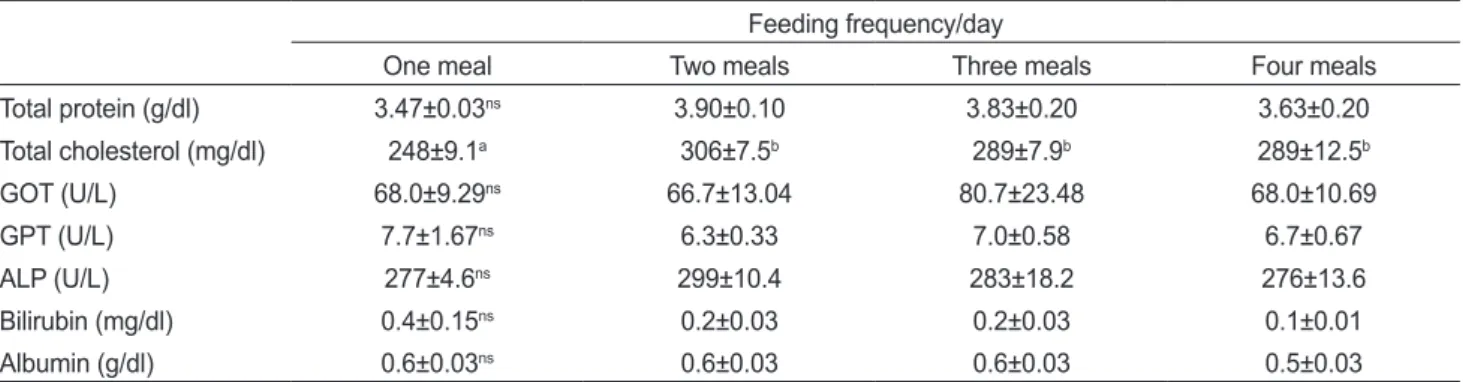
사료공급횟수에따른쏘가리치어의혈액성상결과를
Table 4
에나타내었다
.
쏘가리혈액내total protein, GOT, GPT, ALP, bilirubin
및albumin
함량은실험구간에유의차가나타나지않 았다(P>0.05). Total cholesterol
은1
일1
회실험구가1
일2
회, 3
회및4
회실험구보다 유의하게 낮은결과를나타내었으나(P<0.05), 1
일2
회, 3
회및4
회실험구간에는서로유의적인차 이는나타나지않았다(P>0.05).
Table 2. Growth performance and feed efficiency of juvenile mandarin fish Siniperca scherzeri fed experiment diet for 8 weeks1 Feeding frequency/day Survival (%) Final body weight (g/fish) WG (%)2 SGR (%/day)3 DFI(%)4 FE (%)5
One meal 100±0.0ns 14.2±0.32a 94±4.8a 1.18±0.04 a 1.70±0.01a 67±2.1a
Two meals 98±1.7 16.8±0.34b 127±5.1b 1.50±0.07b 1.81±0.02b 77±1.0b
Three meals 98±1.7 17.3±0.17b 128±4.1b 1.50±0.05b 2.11±0.02c 66±1.8a
Four meals 100±0.0 17.3±0.20b 128±3.0b 1.47±0.02b 2.19±0.04c 64±0.5a
1Values (mean±SE of replicate groups) in the same column not sharing a common superscript are significantly different (P<0.05). 2Weight gain=(final body weight-initial body weight)×100/initial body weight. 3Specific growth rate=(Ln final weight of fish–Ln initial weight of fish)×100/days of feeding trial. 4Daily feed intake=feed intake×100/[(initial fish wt.+final fish wt.+dead fish wt.)×days reared/2]. 5Feed efficiency=fish wet weight gain×100/feed intake (dry matter). nsNot significant (P>0.05).
Table 4. Plasma chemical composition of juvenile mandarin fish Siniperca scherzeri fed experiment diet for 8 weeks1 Feeding frequency/day
One meal Two meals Three meals Four meals
Total protein (g/dl) 3.47±0.03ns 3.90±0.10 3.83±0.20 3.63±0.20
Total cholesterol (mg/dl) 248±9.1a 306±7.5b 289±7.9b 289±12.5b
GOT (U/L) 68.0±9.29ns 66.7±13.04 80.7±23.48 68.0±10.69
GPT (U/L) 7.7±1.67ns 6.3±0.33 7.0±0.58 6.7±0.67
ALP (U/L) 277±4.6ns 299±10.4 283±18.2 276±13.6
Bilirubin (mg/dl) 0.4±0.15ns 0.2±0.03 0.2±0.03 0.1±0.01
Albumin (g/dl) 0.6±0.03ns 0.6±0.03 0.6±0.03 0.5±0.03
1Values (mean±SE of replicate groups) in the same row not sharing a common superscript are significantly different (P<0.05). GOT, Glu- tamic oxaloacetic transaminase; GPT, Glutamic pyruvic transaminase; ALP, Alkaline phosphatase. nsNot significant (P>0.05).
Table 3. Whole body proximate composition of juvenile mandarin fish Siniperca scherzeri fed experiment diet for 8 weeks1
Feeding frequency/day Moisture (%) Crude protein (%) Crude lipid (%) Ash (%)
One meal 72.5±0.70ns 19.1±0.08ns 3.1±0.11ns 4.5±0.60ns
Two meals 73.0±0.53 18.5±0.37 2.9±0.05 5.2±0.25
Three meals 71.4±0.30 20.3±0.55 3.5±0.38 5.2±0.36
Four meals 72.2±0.64 19.4±0.42 3.6±0.05 5.2±0.16
1Values are mean±SE of replicate groups. nsNot significant (P>0.05).
적정사료공급횟수는어종의식성
,
서식환경,
크기등의요 인에따라다르다고보고되고있다.
여러어종의적정사료공 급횟수를조사한연구결과들을보면,
무지개송어(Ruohonen et al., 1998)
및비단잉어(Kim and Lee, 2010)
는1
일4
회,
틸라 피아(Riche et al., 2004), snout bream (Tian et al., 2015)
및대 구(Choi et al, 2011)
는1
일3
회,
챠넬메기(Andrew and Page, 1975)
및산천어(Seong and Kim, 2008)
는1
일2
회,
조피볼락(Lee et al., 2000b)
은1
일1
회, estuary grouper
는2
일1
회(Chua and Teng, 1978)
가적합하다고보고되었다.
본연구에서1
일1
회보다1
일2
회공급구에서성장이좋았으나, 1
일3
회이상 공급구들에서는성장이더이상개선되지않았다.
타어종에서 도이와유사한경향은보였는데,
무지개송어(Oncorhynchus mykiss),
붉바리(Epinephelus akaara)
및넙치를대상으로한 실험에서적정사료공급횟수이상에서성장률이 더개선되 지않았다고보고되었다(Grayton and Beamish, 1977; Kayano et al., 1993; Kim et al., 2009).
반면에,
넙치와조피볼락치어 를대상으로한실험에서는일정사료공급횟수이상에서는 성장률이감소하는경향을보였다(Lee et al., 1999; Lee et al., 2000b; Lee et al., 2013).
이는사료공급횟수의증가로사료섭 취량이증가하여도과잉으로섭취된사료가체내소화관을통 과하는시간이단축되어소화율이낮아진것때문으로분석된 다(Biswas et al., 2010; Mizanur and Bai, 2014; Oh and Park,
2016).
어종과어류의크기에따라적정사료섭취횟수나섭취량이달라질수있는데
,
본연구에서의일간사료섭취율은사료 공급횟수가증가함에따라1
일3
회공급구까지는증가하였으 나, 1
일3
회이상에서는더이상증가하지않았다.
이러한결과 로부터,
쏘가리는사료공급횟수가일정수준이상을초과하면 더이상먹이섭취량이증가되지않음을알수있다.
무지개송 어, red-spotted grouper,
조피볼락및넙치를대상으로한연구 에서도적정사료공급횟수이상에서는성장및사료섭취율이 더이상증가하지않는것으로보고되어(Grayton and Beamish, 1977; Kayano et al., 1993; Lee et al., 2000b; Kim et al., 2005),
본연구결과와일치하였다.
이처럼사료공급횟수에의한사료 섭취량이나성장이다르게나타나는것은어류의식성에따른 장의크기와길이,
사료의종류나물성,
사육환경등에따라결과가다양하게나타나는것으로생각된다
(NRC, 1993; Lee et
al., 2000b).
본연구결과에서사료효율은
1
일2
회까지는유의하게증가하 였지만, 1
일3
회부터는유의하게감소하는결과를보였다.
이전 의Mizanur and Bai (2014)
와Oh and Park (2016)
연구에서도1
일3
회이상의사료공급횟수에서사료효율이유의하게감소 하는결과를보여본실험결과와유사하였다.
이는사료공급 횟수가어류의장내소화또는흡수와밀접한관계가있는것으 로보이며(Kim et al., 2009),
과잉의사료공급은소화율을감 소시킨다고보고된바있다(Henken et al., 1985).
사료를공급 하는시간간격이짧아지면,
사료가소화관내를더빠르게통과하여소화율에영향을미친다
.
또한,
매일장시간걸쳐반복 된먹이섭취행위로어류의유영활동을증가시켜,
에너지낭비로인해성장이낮아질수있다고보고된바있다
(Johansen
and Jobling, 1998).
그러나돌돔(Oh and Maran, 2014)
과rohu (Biswas et al., 2006)
의경우사료공급횟수가사료효율에영 향을미치지않는것으로나타나,
어종및실험환경에따라달 라지는것으로나타났다.
사료공급횟수의증가는쏘가리치 어의혈장성상변화중total cholesterol
농도에영향을미쳤으 며,
사료섭취율이증가함에따라어체의혈액내콜레스테롤함 량이증가한다는다른연구결과와유사한경향을나타내었다(Shimeno et al., 1997; Oh and Park, 2016 ).
본연구결과에서사료공급횟수에따라쏘가리치어의사료 섭취량이달라졌으며
,
체중과사료효율에영향을미치는것으 로나타났다.
쏘가리의성장및사료이용성을고려하면만복으 로사료를치어에게공급할경우하루2
회가적당할것으로판 단된다.
사 사
이연구는해양수산부재원으로 해양수산과학기술진흥원에 서지원하는수산실용화기술개발사업
(
쏘가리배합사료및순치기술개발
)
과2020
년도강릉원주대학교전임교원연구년지원에의해수행되었으며
,
이에감사드립니다.
References
Andrew JW and Page JW. 1975. The effects of frequency of feeding on culture of catfish. Trans Am Fish Soc 104, 317- AOAC (Association of Official Analytical Chemists). 1995. Of-321.
ficial Methods of Analysis, 16th edition. Association of Of- ficial Analytical Chemists, Arlington, VA, U.S.A.
Biswas G, Jena JK, Singh SK, Patmajhi P and Muduli HK.
2006. Effect of feeding frequency on growth, survival and feed utilization in mrigal, Cirrhinus mrigala, and rohu,
Labeo rohita, during nursery rearing. Aquaculture 254, 211-
218. https://doi.org/10.1016/j.aquaculture.2005.08.001.Biswas G, Thirunavukkarasu AR, Sundaray JK and Kaliasam M. 2010. Optimization of feeding frequency of Asian sea- bass Lates calcarifer fry reared in net cages under brack- ishwater environment. Aquaculture 305, 26-31. https://doi.
org/10.1016/j.aquaculture.2010.04.002 .
Booth MA, Tucker BJ, Allan GL and Fielder DS. 2008. Effect of feeding regime and fish size on weight gain, feed intake and gastric evacuation in juvenile Australian snapper Pagrus au-
ratus. Aquaculture 282, 104-110. https://doi.org/10.1016/j.
aquaculture.2008.06.027.
Choi YU, Park HS and OH SY. 2011. Effects of stocking den- sity and feeding frequency on the growth of the pacific cod,
Gadus macrocephalus. Korean J Fish Aquat Sci 44, 58-63.
https://doi.org/10.5657/kfas.2011.44.1.058.
Chua TE and Teng SK. 1978. Effects of feeding frequency on the growth of young estuary grouper, Epinephelus tauvina (Forskal), culture in floating net-cages. Aquaculture 14, 31- 47. https://doi.org/10.1016/0044-8486(78)90138-2.
Company R, Calduch-Giner JA, Kaushik S and Perez-Sanchez J. 1999. Growth performance and adiposity in gilthead sea bream (Sparus aurata): risks and benefits of high energy diets. Aquaculture 171, 279-292. https://doi.org/10.1016/
S0044-8486(98)00495-5.
Duncan DB. 1955. Multiple-range and multiple F tests. Biomet- rics 11, 1-42.
Grayton BD and Beamish FWH. 1977. Effects of feeding fre- quency on food intake, growth and body composition of rainbow trout Salmo gairdneri. Aquaculture 11, 159-172.
https://doi.org/10.1016/0044-8486(77)90073-4.
Henken AM, Kleingeld DW and Tijssen PAT. 1985. The effect of feeding level on apparent digestibility of dietary dry met- ter, crude protein and gross energy in the African catfish
Clarias gariepinus (Burchell 1822). Aquaculture 51, 1-11.
https://doi.org/10.1016/0044-8486(85)90235-2.
Johansen SJS and Jobling M. 1998. The influence of feeding re- gime on growth and slaughter trails of cage-reared Atlantic salmon. Aquac Int 6, 1-17.
Kayano Y, Yao S, Yamamoto S and Nakagawa H. 1993.
Effects of feeding frequency on the growth and body con- stituents of young red-spotted grouper, Epinephelus akaara.
Aquaculture 110, 271-278. https://doi.org/10.1016/0044- 8486(93)90375-9.
Kim KD, Nam MM, Kim KW, Lee HY, Hur SB, Kang YJ and Son MH. 2009. Effects of feeding frequency on growth and body composition of sub-adult flounder Paralichthys
olivaceus in suboptimal water temperature. Korean J
Fish Aquat Sci 42, 262-267. http://dx.doi.org/10.5657/kfas.2009.42.3.262.
Kim KM, Kim KD, Choi SM, Kim KW and Kang YJ. 2005.
Optimum feeding frequency of extruded pellet for the growth of juvenile flounder, Paralichthys olivaceus during the summer season. J Aquaculture 18, 231-235.
Kim YO. 2015. The study aquaculture of Siniperca scherzeri.
The research report of Chungcheongbuk-do Inland Fisheries Research Institute, Munhwa Publishing Co., Chungju, Korea, 7-15.
Kim YO and Lee SM. 2010. Effects of feeding frequency and satiation rate on the growth and body composition of Red- and White-colored carp, Cyprinus carpio var. koi. Ko- rean J Fish Aquat Sci 43, 320-324. https://doi.org/10.5657/
kfas.2010.43.4.320.
Kim YO and Lee SM. 2016. Effect of water temperature on growth and body composition of juvenile mandarin fish
Siniperca scherzeri. Korean J Fish Aquat Sci 49, 607-611.
https://doi.org/10.5657/KFAS.2016.0607.
Kim YO and Lee SM. 2017. Growth and body composition of mandarin fish, Siniperca scherzeri reared at high water tem- perature. Korean J Fish Aquat Sci 50, 756-761. https://doi.
org/10.5657/KFAS.2017.0756.
Lee JH, Lee BJ, Kim KW, Han HS, Park GH, Lee JH, Yun HH and Bai SC. 2013. Optimal feeding frequency for juvenile Korean rockfish Sebastes schlegeli fed commercial diet at two different water temperatures. Korean J Fish Aquat Sci 46, 761-768. https://doi.org/10.5657/KFAS.2013.0761.
Lee SM, Cho SH and Kim DJ. 2000a. Effects of feeding fre- quency and dietary energy level on growth and body composition of juvenile flounder Paralichthys olivaceus.
Aquaculture 31, 917-921. https://doi.org/10.1046/j.1365- 2109.2000.00505.x.
Lee SM, Hwang UG and Cho SH. 2000b. Effects of feeding fre- quency and dietary moisture content on growth, body com- position and gastric evacuation of juvenile Korean rockfish
Sebastes schlegeli. Aquaculture 187, 399-409. https://doi.
org/10.1016/S0044-8486(00)00318-5.
Lee SM, Seo CH and Cho YS. 1999. Growth of the juvenile olive flounder Paralichthys olivaceus fed the diets at differ- ent feeding frequencies. Korean J Fish Aquat Sci 32, 18-21.
Lee SM and Kim YO. 2017. Effect of stocking density on the growth and body composition of the mandarin fish, Siniper-
ca scherzeri. Korean J Fish Aquat Sci 50, 762-769. https://
doi.org/10.5657/KFAS.2017.0762.
Mizanur RM and Bai SC. 2014. The optimum feeding frequen- cy in growing Korean rockfish Sebastes schlegeli rearing at the temperature of 15°C and 19°C. Asian-Australas J Anim Sci 27, 1319-1327. https://doi.org/10.5713/ajas.2014.14193.
National Research Council (NRC), 1993. Nutrient Require- ments Fishes. National Academy Press, Washington DC, U.S.A., 114.
Ng WK, Lu KS, Hashim R and Ali A. 2000. Effects of feeding rate on growth, feed utilization and body composition of a tropical bagrid catfish. Aquacult Int 8, 19-29.
Oh SY and Maran BAV. 2014. Feeding frequency influences growth, feed consumption and body composition of juve- nile rock bream Oplegnathus fasciatus. Aquacult Int 23, 175-184.
Oh SY and Park JW. 2016. Feeding frequency influences the growth, food consumption, body composition and he- matological response of the Korean rockfish, Sebastes
schlegelii. Korean J Fish Aquat Sci 49, 600-606. https://doi.
org/10.5657/KFAS.2016.0600.
Riche M, Haley DI, Oetker M, Garbrecht S and Garling DL.
2004. Effects of feeding frequency on gastric evacuation and the return of appetite in tilapia Oreochromis niliticus.
Aquaculture 234, 657-673. https://doi.org/10.1016/j.aqua- culture.2003.12.012.
Ruohonen KJ, Vielman J and Grove DJ. 1998. Effects of feeding frequency on growth and food utilization of rainbow trout
Oncorhynchus mykiss fed low-fat herring or dry pellets.
Aquaculture 165, 111-121. https://doi.org/10.1016/S0044- 8486(98)00235-X.
Sankian Z, Khosravi S, Kim YO and Lee SM. 2017. Effect of dietary protein and lipid level on growth, feed utilization and muscle composition in golden mandarin fish Siniperca
scherzeri. Fish Aqu Sci 20, 7. https://doi.org/10.1186/
s41240-017-0053-0.
Seong KB and Kim DH. 2008. Effects of feeding frequency on the optimum growth of cherry salmon, Oncorhynchus
masou. Korean J Fish Aquat Sci 41, 343-345. http://dx.doi.
org/10.5657/kfas.2008.41.5.343.
Shimeno S, Shikata T, Hosokawa H, Masumoto T and Kheyyali D. 1997. Metabolic responses to feeding rates in common carp, Cyprinus carpio. Aquaculture 151, 371-377. https://
doi.org/10.1016/S0044-8486(96)01492-5.
Silva CR, Gomes LC and Brandao FR. 2007. Effect of feeding rate and frequency on tambaqui Colossoma macropomum growth, production and feeding costs during the first growth phase in cages. Aquaculture 264, 135-139. https://doi.
org/10.1016/j.aquaculture.2006.12.007.
Su SQ, Zhang HQ, He ZY and Zhang ZX. 2005. A compara- tive study of the nutrients and amino acid composition of the muscle of Siniperca cuuatsi and Siniperca scherzeri. J Southwest Agric Univ 27, 898-901.
Tian HY, Zhang DD, Li XF, Zhang CN, Qian Y and Liu WB.
2015. Optimum feeding frequency of juvenile blunt snout bream Megalobrama amblycephala. Aquaculture 437, 60- 66. https://doi.org/10.1016/j.aquaculture.2014.11.032.
Wang N, Hayward RS and Noltie DB. 1998. Effects of feeding frequency on food consumption, growth size variation and feeding pattern of age-0 hybrid sunfish. Aquaculture 165, 261-267. https://doi.org/10.1016/S0044-8486(98)00266-X.
Xie F, Ai Q, Mai K, Xu W and Ma H. 2011. The optimal feeding frequency of large yellow croker (Pseudosciaena crocea, Richardson) larvae. Aquaculture 311, 162-167. https://doi.
org/10.1016/j.aquaculture.2010.12.005.
Zhang L, Wang YJ, Hu MH, Fan QX, Cheung SG, Shin PKS Li H and Cao L. 2009. Effect of the timing of initial feeding on growth and survival of spotted mandarin fish Siniperca
scherzeri larvae. J Fish Biol 75, 1158-1172. https://doi.
org/10.1111/j.1095-8649.2009.02328.x.
Zhou CW, Yang Q and Cai DL. 1988. On the classification and distribution of the Sinipercinae fishes (Family Serranidae).
Zool Res 9, 113-126.