607
Copyright © 2016 The Korean Society of Fisheries and Aquatic Science pISSN:0374-8111, eISSN:2287-8815
서 론
쏘가리속
(Siniperca)
에해당되는어류는한국,
중국및베트 남에분포하며,
현재까지9
종이알려져있다(Zhao et al., 2006).
우리나라와중국에는쏘가리
, Siniperca scherzeri Steindachner
가서식하고있으며,
남해나서해로흐르는큰하천의중상류에 서식한다(Cheng and Zheng, 1987; Kim and Kang, 1993).
최 근우리나라에서쏘가리는담수어종중소비자들의기호도가 매우높아지고있는어종이다.
쏘가리를대상으로채란,
부화와 양성(Kim et al., 1988; Lee et al., 1992),
질병(Jang et al., 1997)
및자어기사육(Myoung et al., 1999)
에관한연구들이일부수 행되어왔지만,
치어기이후의식용어류생산을위한연구는거 의없는실정이다.
이는쏘가리가살아움직이는작은어류만을 먹는강한육식성으로인하여사료공급이어려워다양한연구 가이루어지지못했기때문이다.
현재까지쏘가리종묘생산을위한양식장에서는잉어나붕어
의자어를어린쏘가리에게먹이로공급하면서
3-4 cm
까지키 운후,
방류사업에참여하고,
나머지는살아있는먹이공급이어 려워지면굶겨죽이는실정이다.
또한,
하천에서식하는살아있 는어류를불법으로포획하여쏘가리에게공급하면서치어를6 cm
정도까지키운후에냉동어류를공급하여양성하는양어장 도있다.
이러한양식방법은하천의자원을고갈시키고,
냉동어 류의공급불안정,
냉동보관에따른경영비상승,
산패에따른 질병발생등의여러가지문제점을가지고있다.
따라서
,
쏘가리의완전양식을위해서는성장에적합한배합 사료개발과종묘생산된치어를사료로양성하는기술을개발 하는것이시급하다.
최근충청북도내수면연구소에서쏘가리 를배합사료로사육하는연구에성공하면서(Kim, 2015),
이를 기반으로하여현재배합사료개발을위한실험을수행하고있 으며,
양성을위한사육도가능해져쏘가리양식산업화가앞당 겨질것으로전망된다.
외부환경요인중에서사육수온은어류의성장
,
생존및생사육 수온에 따른 쏘가리(Siniperca scherzeri) 치어의 성장 및 체조성 변화
김이오·이상민
1*
충청북도내수면연구소, 1강릉원주대학교 해양생물공학과
Effect of Water Temperature on Growth and Body Composition of Juvenile Mandarin Fish Siniperca scherzeri
Yi-Oh Kim and Sang-Min Lee
1
*Department of Inland Fisheries Research Institute, Chungju 27329, Korea
1
Department of Marine Biotechnology, Gangneung-Wonju National University, Gangneung 25457, Korea
This study was conducted to investigate the effects of different water temperatures on growth, survival, biochemical composition, and blood physiological parameters of juvenile mandarin fish Siniperca scherzeri . Feed-trained juvenile fish were subjected to four water temperatures (20, 23, 26 and 29℃) with two replicate groups. The fish were fed to apparent satiation twice daily using a formulated diet containing 55% crude protein and 6% crude lipid. After the 8-week feeding trial, survival was >96% in all groups. Weight gain and feed efficiency of fish reared at 26 and 29℃
were higher than those reared at 20℃. The protein efficiency ratio, daily feed intake, and whole body proximate composition were not affected by water temperature. These results indicate that a suitable water temperature range for optimal growth and feed efficiency of juvenile mandarin fish is 26-29℃ under these experimental conditions.
Key words: Mandarin fish, Siniperca scherzeri , Water temperature, Growth, Feed utilization
This is an Open Access article distributed under the terms of the Creative Commons Attribution Non-Commercial Licens (http://creativecommons.org/licenses/by-nc/3.0/) which permits unrestricted non-commercial use, distribution, and reproduction in any medium, provided the original work is properly cited.
http://dx.doi.org/10.5657/KFAS.2016.0607 Korean J Fish Aquat Sci 49(5) 607-611, October 2016
Received 30 September 2016; Revised 20 October 2016; Accepted 20 October 2016
*Corresponding author: Tel: +82. 33.640.2414 Fax: +82. 33. 640. 2955
E-mail address: [email protected]
리대사에가장큰영향을미치는요인으로알려져있으며
(Brett and Groves, 1979; Jobling, 1997; Johnston, 2006),
사료섭취 에도직접적인영향을미쳐사료효율및사료이용성에영향을 주는중요한요소이다(Yamamoto et al., 2007; Bogevik et al.,
2010).
일반적으로쏘가리를양식하는양어가들은계절에따라겨울철에
10℃
전후부터여름철에28℃
까지의수온범위에서쏘가리를사육하고있다
.
하지만,
쏘가리를대상으로배합사료 공급과사육수온에대한연구는매우제한적이다.
대상어류에 적합한수온에서는사료섭취,
소화및사료의영양이용성이향 상되지만(Bogevik et al., 2010),
적합한수온이하에서는사료 섭취및성장의감소되고(Bendiksen et al., 2002),
효소활성및 삼투압조절변화가초래된다(Mccormick et al., 1996).
반면에 너무높은수온에서사육되는어류는대사장애및먹이섭취감 소등의부작용이초래된다(Sun and Chen, 2009; Bermudes et al., 2010).
하지만쏘가리의적정성장과생존에대해연구된수 온자료가없는실정이므로,
본연구는쏘가리양식을위한사 육기술중배합사료를공급하였을때성장에적합한수온을규 명하고자수행하였다.
재료 및 방법
실험어 및 사육관리
실험어로 충청북도내수면연구소에서 종묘생산된 쏘가리를 배합사료에순치시켜사육하다가평균체중
11.4±0.15 g
의치 어를사용하였다.
사육실험시작2
주전부터쏘가리치어를각 수조마다무작위로40
마리씩수용하여수온20℃, 23℃, 26℃
및
29℃
에적응시켰다.
사육수온은자동온도조절기를각각의 순환여과사육시스템에설치하여조절하였다.
각수온별로2
반 복으로원형FRP
수조(200 L)
에실험어를수용하여1
일2
회만 복으로실험사료를8
주간공급하였다.
사육시스템은반순환여 과방식으로2 L/min
의물이계속순환되도록흘려주고,
산소공 급을위해에어스톤을설치하였다.
실험사료
실험에사용된사료는뱀장어양성용시판분말사료에칠레산 전갱이어분
(Table 1)
을20%
혼합하여적당량의물을첨가하여pellet (
직경2 mm)
형태로제조한후, -25℃
냉동고에서보관하 며실험에사용하였다.
어체측정 및 성분분석
어체측정은사육실험시작시와종료시에측정전일절식시킨 후
tricaine methanesulfonate (MS 222, Sigma, St. Louis, MO,
USA) 100 ppm
수용액에마취시켜실험어의무게를측정하였다
.
무게측정후실험수조마다5
마리씩sampling
하여비만도,
간중량지수및내장중량지수를구하였다.
또한,
어체의성분분 석을위하여각실험수조에서10
마리씩시료로취하여냉동보관
(-25℃)
하였다.
실험사료 및 어체의 일반성분은
AOAC (1990)
의 방법에 따라 조단백질(N×6.25)
은Auto Kjeldahl System (Buchi B-324/435/412, Switzerland; Metrohm 8-719/806, Swizer- land)
를사용하여분석하였고,
조지방은ether
를사용하여추출 하였으며,
수분은105℃ dry oven
에서6
시간건조후측정하였 다.
회분은600℃
회화로에서4
시간동안태운후측정하였다. 혈액분석
혈장성분의변화를조사하기위해각실험수조쏘가리치어
5
마리씩무작위로추출하여헤파린이처리된1 mL
주사기를사용하여실험어의미부혈관에서채혈하였다
.
채혈한혈액을7,500 rpm
에서10
분간원심분리하여얻은혈장을동결보존(-70℃)
하면서화학성분을 분석하였다.
혈액은혈액자동분석기
(DRI-CHEM NX500i, FUJIFILM)
를 사용하여total pro- tein (TP), total cholesterol, glutamic oxaloacetic transaminase (GOT), glutamic pyruvic transaminase (GPT), alkaline phos- phatase (ALP), triglyceride, bilirubin, albumin
을분석하였다. 통계분석
결과의통계처리는
SPSS Ver. 20 (SPSS Inc., Chicago, IL, USA) program
을사용하여One-way ANOVA-test
를실시한 후Duncan’s multiple range test (Duncan, 1955)
로평균간의 유의성을검정하였다.
결과 및 고찰
8
주간의사육실험후,
성장및사료이용성을Table 2
와3
에 각각나타내었다.
사육실험기간동안의생존율은96.3%
이상 으로 나타났으며,
모든 실험구간에 통계적인 차이는없었다(P>0.05).
증중율및사료효율은사육수온이증가함에따라증 Table 1. Ingredient and proximate composition of experimental diet% Ingredients
Commercial diet1 80
Mackerel fish meal2 20
Chemical analysis (dry matter basis)
Crude protein 54.9
Crude lipid 5.8
Ash 13.9
1Commercial bind meal for eel produced in Purinafeed incorpo- ration (Seongnam, Korea). 2Imported from Chile containing 73%
crude protein and 9% crude lipid.
가하는경향을보였으며
,
증중율은수온26℃
와29℃
실험구 가수온20℃
실험구보다유의하게높았다(P<0.05).
사료효율 은수온26℃
와29℃
실험구가수온20℃
와23℃
실험구보다 유의하게높았다(P<0.05).
쏘가리치어의일일사료섭취율,
일 일단백질섭취율,
단백질효율,
비만도,
간중량지수 및 내장중 량지수는사육수온에따른유의적인차이는나타나지않았다(P>0.05).
사육수온은어류의대사와성장에영향을미치는중요한요 소이다
(Herzig and Winkler, 1986; Iwata et al., 1994).
일정범 위내에서사육수온이높아질수록어류의대사율이증가되고 먹이섭취가촉진되어성장도향상되는것으로보고되어있다(Seikai et al., 1986; Fonds, 1979).
하지만,
적정성장을위한수 온보다더높아지면어류의사료섭취가감소되는등부작용이 초래된다(Maccarthy et al., 1998).
쏘가리의성장과사료효율 은본연구에서설정된수온범위내에서수온이증가할수록높 아져차이를보였으나,
일일사료섭취율,
일단백질섭취율및단 백질효율은사육수온에따른차이를보이지않았다.
이와같이 본연구에서사료섭취율이기존의연구결과와는달리사육수 온에따라차이를보이지않은것은어종의서식특성등에의한 것으로판단된다.
예를들면,
수온변화폭이좁은해양에서식 하는어류와달리수온변화폭이상대적으로넓은담수에서서 식하는어류는수온에대한내성이일반적으로높다.
본연구 에사용된쏘가리의경우도담수에서식하는어류이므로본실험에서설정된수온범위에서는먹이섭취에영향을받지않았 기때문에사료섭취율이차이를보이지않은것으로판단된다
.
온수성담수어종인잉어를대상으로수온별로사육실험한결과
,
수온15-25℃
에서수온이증가함에따라성장이증가하였고
25℃
와30℃
간에는차이가없었다고보고하였다(Suzuki et al., 1977).
수온에따른잉어치어의성장실험에서24-30℃
범 위에서큰차이는없었지만최대성장율은27℃
에서나타났다 고보고하였다(Goolish and Adelman, 1984). Lumpfish (Cy- clopterrus lumps)
를대상으로수온4-13℃
에서사육한결과,
수온이증가함에따라유의하게성장이증가하는결과를나타 내었다(Ane et al., 2014).
본실험의쏘가리에서도수온이증가 함에따라성장및사료효율이좋아지는결과를나타내어앞에 서언급한연구결과와유사한경향을나타내었다.
본실험조건하에서수온
26-29℃
가쏘가리치어가성장에적합한수온으로판단된다
.
반면에사육수온이증가함에따라성장및사료효 율이증가하다가한계수온이상에서는오히려성장및사료효 율이유의하게감소하는것으로보고되고있으므로(Imad et al., 2008; Sun et al., 2006; Zhao et al., 2009),
본연구의쏘가리를 대상으로도금후29℃
보다높은수온에서도추가적인사육실 험이필요할것으로생각된다.
사육실험종료후전어체일반성분분석결과를
Table 4
에나 타내었듯이,
전어체의수분,
단백질,
지질및회분함량은본연 구에서설정된사육수온의모든실험구간에서유의차는없었 Table 2. Growth performance and feed efficiency of juvenile Siniperca scherzeri (initial averaging 11.4±0.15 g/fish) reared at different water temperatures for 8 weeks1Water temperature (℃) Initial mean body weight (g) Survival (%) Final mean
weight (g) Weight gain (%) 2 SGR (%/day) 3 Feed efficiency (%)4
20 11.6±0.15 97.5±0.00ns 18.2±1.15a 57.2±7.60a 0.3±0.04a 52.4±2.25a
23 11.6±0.20 96.3±1.25 21.2±0.10ab 82.7±2.00ab 0.4±0.00ab 63.6±2.40a
26 11.2±0.35 97.5±0.00 26.1±1.41bc 134.9±15.75b 0.6±0.05bc 93.7±4.80b
29 11.5±0.40 96.3±1.25 28.1±2.45c 145.0±29.45 b 0.7±0.08 c 101.3±9.15b
1Values (mean ± SE of replications) in the same column not sharing a common superscript are significantly different (P<0.05). 2Weight gain (%) = (final body weight - initial body weight)×100/initial body weight. 3Specific growth rate = (Ln final weight of fish – Ln initial weight of fish)×100/days of feeding trial. 4Feed efficiency (%) = Fish wet weight gain×100/feed intake (dry matter).
Table 3. Daily feed intake (DFI), daily protein intake (DPI), protein efficiency ratio (PER), hepatosomatic index (HSI), visceralsomatic index (VSI), condition factor (CF) of juvenile Siniperca scherzeri reared at different water temperatures for 8 weeks1
Water temperature (℃) DFI2 (%) DPI3 (%) PER4 (%) HSI5 VSI6 CF7
20 1.49±0.01ns 0.81±0.04ns 0.95±0.05ns 1.2±0.38ns 5.9±0.54ns 1.0±0.05ns
23 1.61±0.08 0.88±0.05 1.16±0.04 1.4±0.20 5.7±0.19 1.1±0.03
26 1.51±0.03 0.83±0.09 1.71±0.02 2.0±0.23 7.8±1.44 1.3±0.07
29 1.44±0.05 0.79±0.17 1.85±0.02 1.2±0.22 5.1±0.12 1.1±0.09
1Values are mean ± SE of replication group. 2Daily feed intake = feed intake×100/[(initial fish wt.+final fish wt.+dead fish wt.)×days reared / 2]. 3Daily protein intake = protein intake×100/[(initial fish wt.+final fish wt.+dead fish wt.)×days reared / 2]. 4Protein efficiency ratio = wet weight gain/protein intake. 5Hepatosomatic index (HSI) = Liver weight×100/ body weight. 6Visceralsomatic index (VSI) = Viscera weight×100/ body weight. 7Condition factor (CF) = Body weight×100/total body length (cm)3. ns Not significant (P>0.05).
다
(P>0.05).
사육수온에따른체조성의변화는어종마다다르 게나타나므로대상어종마다수온변화에대한영향을각각평 가할필요가있는것으로알려져있다(Cui and Wootton, 1988).
Peres and Oliva-Teles (1999)
와Moreira et al. (2008)
는유럽산 배스(Dicentrarchus labrax)
를대상으로수온별사육실험에서 두실험모두전어체에유의한차이를나타내었으나,
서로다른 경향을보였다.
또한,
큰입배스(Micropterus salmoides)
를대상 으로한사육실험에서는20℃
실험구가26℃
와32℃
실험구보 다전어체수분함량이유의하게높게나타났다(Tidwell et al., 2003).
반면에Sea bass (Sparus aurata) (Couto et al., 2008)
와Asian catfish (Clarias batrachus)
를대상으로한각각의수온별 실험에서는전어체의수분,
단백질,
지질및회분함량에유의차 가나타내지않아서(Singh et al., 2009)
본실험의결과와유사 한경향을나타내었다.
사육실험후
,
실험어의미부동맥에서채혈한혈액(
혈청)
의화학성상변화를
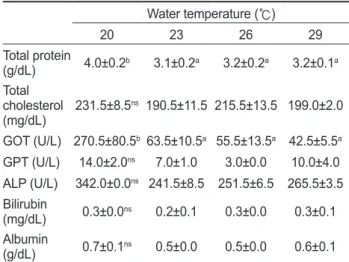
Table 5
에나타내었다. Total cholesterol, GPT, ALP, bilirubin
및albumin
함량은모든실험구간유의한차이 가나타나지않았다. Total protein
과GOT
함량은수온20℃
실 험구가다른수온실험구보다유의하게높은값을나타내었다(P<0.05). GOT, GPT
와같은혈중transaminase
의측정은어류 의간과신장의조직학적인손상을가리키는지표로서사용되 었는데(Kristofferson et al., 1974),
본연구의GOT
의결과에서수온
20℃
실험구가다른실험구에비해유의하게높은것은저온에서대사저하등의부작용이초래될가능성이있음을암 시한다
.
이상의결과로부터,
쏘가리는온수성담수어종으로분 류되어야할것으로보이며,
본실험조건에서쏘가리치어의최 적성장및사료효율을위한사육수온은26-29℃
가적합할것 으로판단된다.
사 사
이연구는해양수산부재원으로 한국해양과학기술진흥원에 서지원하는수산실용화기술개발사업
(
쏘가리배합사료및순 치기술개발,
과제번호D11524615H480000120)
에의해수행 되었으며,
이에감사드립니다.
References
Ane VN, Erik V, Atle F, Thor AH, Patrick R, Gerhard E, Tor AE, Inger-Britt FP and Albert KI. 2014. The effect of tempera- ture and fish size on growth of juvenile lumpfish (Cyclop-
terus lumpus L.). Aquaculture 434, 296-302.
AOAC (Association of Official Analytical Chemists). 1995. Of- ficial Methods of Analysis, 16th edition. Association of Of- ficial Analytical Chemists, Arlington,Virginia, USA.
Bendiksen EA, Jobling M and Arnesen AM. 2002. Feed intake of Atlantic salmon parr Salmo salar L. in relation to tem- perature and feed composition. Aquacult Res 33, 525-532.
Bermudes M, Glencross B, Austen K and Hawkins W. 2010.
The effects of temperature and size on the growth, energy budget and waste outputs of barramundi (Lates calcarifer).
Aquaculture 306, 160-166.
Bogevik AS, Henderson RJ, Mundheim H, Waagbo R, Tocher DR and Olsen RE. 2010. The influence of temperature on the apparent lipid digestibility in Atlantic salmon (Salmo
salar) fed Calanus finmarchicus oil at two dietary levels.
Aquaculture 309, 143-151.
Brett JR and Groves TDD. 1979. Physiological energetics. Fish Physiol 8, 279-352.
Cheng Q and Zheng B. 1987. Systematic Synopsis of Chinese Fishes. Science Press Beijing, Beijing, China, 284-286.
Couto A, Enes P, Peres H and Oliva-Teles A. Effect of water temperature and dietary starch on growth and metabolic uti- lization of diets in gilthead sea bream (Sparus aurata) juve- nile. Com Biochem Physiol 151, 45-50.
Table 4. Whole body proximate composition (%) of juvenile Siniperca scherzeri reared at different water temperatures for 8 weeks1
Water temperature
(℃)
Moisture
(%) Crude protein
(%) Crude lipid
(%) Ash (%)
20 73.7±0.91ns 18.0±1.08ns 2.6±1.23ns 6.9±0.02ns 23 75.5±0.30 17.6±0.70 2.2±0.15 7.0±0.02 26 75.5±1.61 17.7±0.99 3.5±0.61 6.5±0.54 29 73.5±0.49 17.7±0.14 4.4±0.35 7.5±0.43
1Values are mean ± SE of replication group. nsNot significant (P>0.05).
Table 5. Plasma chemical composition of juvenile Siniperca scher- zeri reared at different water temperatures for 8 weeks1
Water temperature (℃)
20 23 26 29
Total protein
(g/dL) 4.0±0.2b 3.1±0.2a 3.2±0.2a 3.2±0.1a Total
cholesterol
(mg/dL) 231.5±8.5ns 190.5±11.5 215.5±13.5 199.0±2.0 GOT (U/L) 270.5±80.5b 63.5±10.5a 55.5±13.5a 42.5±5.5a GPT (U/L) 14.0±2.0ns 7.0±1.0 3.0±0.0 10.0±4.0 ALP (U/L) 342.0±0.0ns 241.5±8.5 251.5±6.5 265.5±3.5 Bilirubin
(mg/dL) 0.3±0.0ns 0.2±0.1 0.3±0.0 0.3±0.1 Albumin
(g/dL) 0.7±0.1ns 0.5±0.0 0.5±0.0 0.6±0.1
1Values (mean±SE of replications) in the same row not sharing a common superscript are significantly different (P<0.05). nsNot sig- nificant (P>0.05).
Cui Y and Wootton J. 1988. Bioenergetics of growth of a cypri- nid, Phoxinus phoxinus (L.): the effect of ration and temper- ature on growth rate and efficiency. J Fish Biol 33, 763-779.
Duncan DB. 1955. Multiple-range and multiple F tests. Biomet- rics 11, 1-42.
Fonds M. 1979. Laboratory observation on the influence of tem- perature and salinity on development of the eggs and growth of the larvae of Solea solea. Mar Ecol Prog Seri 1, 91-99.
Goolish EM and Adelman IR. 1984. Effects of ration size and temperature on the growth of juvenile common carp (Cypri-
nus carpio L.). Aquaculture 36, 27-35.
Herzig A and Winkler H. 1986. The influence of temperature on the embryonic development of three cyprinid fishes Abram-
ics brama, Chalcalburnus chalcoides mento and Vimba vimba. J Fish Biol 28, 171-181.
Imad PS, Chadi M and Joly G. 2008. Effects of temperature on survival and growth of juvenile spinefoot rabbitfish (Siga-
nus rivulatus). Aquacult Res 39, 491-497.
Iwata N, Kikuchi K, Honda H, Kiyono M and Kurokurg M.
1994. Effects of temperature on the growth of Japanese flounder. Fish Sci 60, 527-531.
Jang SI, Lee WO, Lee JY, Cho JH, Kim SM and Kim KJ. 1997.
Mass mortality by Aeromonas hydrophila infection in the production of the Korea mandarin fish fingerling, Siniperca
scherzeri. J Aquacult 10, 439-447.
Jobling M. 1997. Temperature and Growth: Modulation of Growth Rate Via Temperature Change. Cambridge Univer- sity Press, Cambridge, U.K.
Johnston IA. 2006. Environment and plasticity of myogenesis in teleost fish. J Exp Biol 209, 2249-2264.
Kim YI. 2015. The study aquaculture of Siniperca scherzeri.
The research report of Chungcheongbuk-do Inland Fisher- ies Research Institute in 2015. 7-15.
Kim IS and Kang EJ. 1993. Coloured fishes of Korea. Academy Publishing Company, Seoul, Korea, 477.
Kim JD, Jung JY and Lee CH. 1988. Study on the egg taking and hatching of Siniperca scherzeri Steindachner. Bull Nat’l Fish Res Dev Agency Korea 42, 81-85.
Kristofferson R, Broberg S, Oskari A and Pekkarinen M. 1974.
Effect of a sublethal concentration of phenol on some blood plasma enzyme activities in the pike (Esoxlucius L.) in brackish water. Ann Zool Fennici 11, 220-223.
Lee CH, Chang KN, Lee SD and Choi NJ. 1992. A study on the cultivation of Siniperca scherzeri Steindachner. Bull Nat’l Fish Res Dev Agency Korea 46, 183-193.
Maccarthy I, Moksness E and Pavlov DA. 1998. The effects of temperature on growth rate and growth efficiency of juve- nile common wolfish. Aquacult Int 6, 207-218.
Mccormick SD, Shimpton JM and Zydlewski JD. 1996. Tem- perature effects on osmoregulatory physiology of juvenile anadromous fish. Society for experimental biology seminar series. Cambridge university press, NY, USA, 279-301.
Moreira IS, Peres H, Couto A, Enes P and Oliva-Teles A. 2008.
Temperature and dietary carbohydrate level effects on per- formance and metabolic utilization of diets in European sea bass (Dicentrarchus labras) juvenile. Aquaculture 274, 153- Myoung JG, Jung C, Han MS, Kim BG, Kim HB, Choi HJ and 160.
Kim MS. 1999. Effect of delayed initial feeding on body form, mortality and cannibalism in larval stages of mandarin fish, Siniperca scherzeri (Teleostei ; Centropomidae). J Kor Fish Soc 32, 669-673.
Peres H and Oliva-Teles A. 1999. Influence of temperature on protein utilization in juvenile European seabass (Dicentrar-
chus labrax). Aquaculture 17, 337-348.
Seikai M, Tanangonan JB and Tanaka M. 1986. Temperature influence on larval growth and meta morphosis of the Japa- nese flounder Palalichthys olivaceus in the laboratory. Bull Jap Soc Sci Fish 52, 977-982.
Singh RK, Desai AS, Chavan PA and Khandagale PA. 2009.
Effect of water temperature on dietary protein requirement, growth and body composition of Asian catfish, Clarias ba-
trachus. J Termal Biol 34, 8-13.
Sun L, Chen H and Huang L. 2006. Effect of temperature on growth and energy budget of juvenile cobia (Rachycentron
canadum). Aquaculture 261, 872-878.
Sun L and Chen H. 2009. Effects of ration and temperature on growth, fecal production, nitrogenous excretion and energy budget of juvenile cobia (Rachycentron canadum). Aqua- culture 292, 197-206.
Suzuki R, Yamaguchi M and Ishikawa K. 1977. Differences in growth rate in two races of the common carp at various wa- ter temperature. Bull Fresh Fish Res Lab 27, 21-26.
Tidwel JH, Cole SD, Bright LA, Arnum AV and Asharian D.
2003. Effect of water temperature on growth, survival and biochemical composition of largemouth bass, Micropterus
salmoides. J World Aquacult Soc 34, 175-183.
Yamamoto T, Shima T, Furuita H, Sugita T, and Suzuki N. 2007.
Effects of feeding time, water temperature, feeding frequen- cy and dietary composition on apparent nutrient digestibility in rainbow trout Oncorhynchus mykiss and common carp
Cyprinus carpio. Fish Sci 73, 161-170.
Zhao J, Wang W, Li S and Cai WQ. 2006. Structure of the mito- chondrial DNA control region of the sinipercine fishes and there phylogenetic relationship. Acta Genetica Sinica 33, 793-799.
Zhao H, Han D, Xie S, Zhu X, and Yang Y. 2009. Effect of wa- ter temperature on the growth performance and digestive enzyme activities of Chinese longsnout catfish (Leiocassis