677
고등어과 물치다래속( Auxis, Scombridae) 자어의 분자동정 및 형태발달
지환성·유준택1·유정화2·김진구✽
부경대학교 자원생물학과, 1국립수산과학원 자원관리과, 2유정화해양연구소
Molecular Identification and Morphological Development of Auxis (Scombridae) Larvae
Hwan Sung Ji, Joon-Taek Yoo
1, Jung Hwa Ryu
2and Jin Koo Kim
✽Department of Marine Biology, Pukyong National University, Busan 608-737, Korea
1Fisheries Resources Research Department, NFRDI, Busan 619-705, Korea
2RyuJungHwa Marine Research Institute, Busan 614-811, Korea
Eleven individual larvae (3.6-8.0 mm notochord length, NL) were collected from the southern East Sea of Korea in July, 2010, and the adjacent Sea of Jeju Island in August, 2011. Five individuals were identified using mitochon- drial DNA cytochrome oxidase subunit I (COI) sequences (494 base pairs). All were identified as
Auxis rochei
, their mtCOI sequences being consistent with those of adultA. rochei
(d=0.000), followed byAuxis thazard
(d=0.027). In terms of morphology,A. rochei
larvae showed a preflexion stage of 4.8 mm NL, but a flexion stage between 5.2-6.2 mm NL, and subsequently a postflexion stage between 6.6-8.0 mm NL. During the larval stage,A. rochei
differed fromA. thazard
in having no (or few) melanophores in the lateral caudal region.Key words :
Auxis rochei
, Lavae, Identification, mtCOI, Morphological development서 론
농어목(Perciformes), 고등어과(Scombridae)에 속하는 물치 다래속(Auxis) 어류는 열대 및 온대 해역에 걸쳐 분포하며, 전세 계적으로 1속 2종(몽치다래 Auxis rochei, 물치다래 Auxis thaz- ard)이 보고되어 있다(Kim et al., 2005; Nelson, 2006; Konishi and Nakabo, 2007). 이 두종의 학명은 학자들간에 조금씩 다르 게 사용되고 있는데, 일부 학자들은 두종을 아종으로 간주하기 도 한다(Collette and Aadland, 1996; Kim et al., 2004; Koutra- kis et al., 2004; FishBase, 2011). 우리나라에는 몽치다래가 주 로 어획되며, 연 평균어획량은 1900톤으로 1991년에 최고 어획 고를 나타내었으며, 이후 증감을 반복하다가 최근에 다시 감소 추세를 보이고 있다(NFRDI, 2005). 몽치다래의 산란기는 6-7 월로 보고되어 있다(Kim et al., 2004; NFRDI, 2005).
물치다래속 자어는 외부형태적으로 가다랑어속(Katsu- wonus), 점다랑어속(Euthynnus), 참다랑어속(Thunnus) 자어 와 유사하지만, 꼬리의 등쪽 및 배쪽 가장자리에 흑색소포가 나 타나는 점에서 잘 구분된다(Okiyama and Ueyanagi, 1978). 물 치다래속 자어에 관한 연구로는 인도양 및 대서양산 Auxis spp.
의 난발생 및 형태발달(Jones, 1960; Richards, 2006), 일본산
Auxis sp.의 형태기재(Okiyama, 1988), 대서양산 몽치다래, A.
rochei의 소화관 및 형태 발달(Morote et al., 2008), 인도양산 물 치다래속을 포함한 고등어과 자치어 19종의 분자동정(Robert- son et al., 2007), 북태평양산 물치다래속을 포함한 고등어과 자 치어 9종의 분자동정(Paine et al., 2008) 등이 있다. 국내의 경우 물치다래속 자어의 출현에 관한 보고(Kim, 1984; Kim and Yoo, 1999; Yoo et al., 1999; Han et al., 2002)는 있지만, 정확한 종동 정 및 형태특징에 관한 연구는 미비한 실정이다.
최근, 지구온난화에 따른 수온상승과 함께 명태, 연어 등과 같은 냉수성 어종은 사라지고, 오징어류, 다랑어류 등의 난수 성 어종의 국내 출현빈도가 점차 증가 추세에 있다(Kim, 2009;
Choi et al., 2008). 이처럼 한국 연근해로 새롭게 유입되는 어종 의 정착 또는 산란 여부에 따라 수산자원의 구조가 변화될 수 있 다. 한국 연근해 수산자원을 합리적으로 관리하기 위해서는 초 기자원의 생태에 대한 이해가 매우 중요하다. 초기자원의 분석 을 위해서는 종수준의 난자치어 동정이 필수적으로 선행되어야 겠지만, 자치어는 발육단계별 형태적 특징이 급격히 변하기 때 문에(Kendall et al., 1984) 정확한 종동정을 위해서는 분자동정 에 의한 검정절차가 필요하고, 이를 통한 발육단계별 형태특징 자료가 확보되어야 한다. 미국유전자은행(NCBI)의 어류 DNA 정보가 급격히 증가하고 있으며, 뿐만 아니라 국내에서도 어류 를 대상으로 한 DNA 데이터베이스가 빠르게 축적되고 있어 자
*Corresponding author: [email protected]
류수를 넣고 Thermal cycler(MJ mini PTC-1148, USA)를 이 용하여 다음과 같은 조건으로 PCR을 수행하였다; Initial dena- turation은 94℃에서 5분, PCR 반응은 35회 반복(denatuation 은 94℃에서 30초, annealing은 56.5℃에서 30초, extension 은 72℃에서 1분), final extension은 72℃에서 7분 실시하였다.
PCR 최종산물의 정제는 ExoSAP-IT(Biochemical Co., USA) 을 이용하였다.
분자변이분석
미토콘드리아 DNA 염기서열은 BioEdit version 7의 ClustalW(Thompson et al., 1994)를 이용하여 정렬하였으며 비 교그룹으로 NCBI(National Center for Biotechnology Informa- tion)에 등록된 고등어과 어류 10종 및 전갱이과 2종(갈전갱이 Carangoides equula, 전갱이 Trachurus japonicus)을 외집단으 로 설정하였다. 유전거리는 Mega 4(Tamura et al., 2007)에서 Kimura-2-parameter모델(Kimura, 1980)로 계산하였으며, 계통 수는 MEGA 4의 근린결합법(Neighbor joining)을 이용하여 작 성하였고, bootstrap은 1,000번 수행하였다.
결과 및 고찰
형태기재
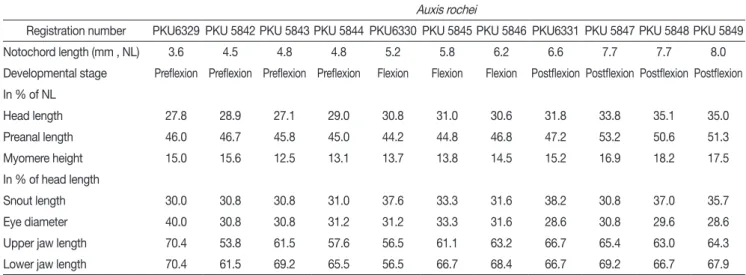
동해에서 채집된 물치다래속 자어의 계측치는 Table 1과 같 다. 물치다래속 자어는 두고가 높고, 6-7개의 전개새골 가시, 두
재료 및 방법
채 집
2010년 7월 한국 동해 남부 해역(N35°28′05″, E130°07′
52″)및 2011년 8월 제주 주변해역(N33°30′21″, E127°45′
32″; N32°30′23″, E126°45′12″) 에서 IKMT net와 Bongo net로 수심 10m를 수평인망하여 물치다래속으로 추정되는 자 어 11개체(3.6-8.0 mm NL)를 채집하였다. 분자동정을 위해 채 집 후 99% 에탄올에 고정하였으며, 조사가 끝난 표본은 부경대 학교(Pukyoung National University, PKU) 어류학실험실 표본 실(Ichthyology laboratory collection)에 등록(PKU5842-5849, PKU6329-6331), 보관하였다.
형태분석
몸의 각 부위의 계수 및 계측은 Okiyama and Ueyanagi (1978)의 방법을 따라 입체현미경(Olympus SZX-16, Japan) 하에서 관찰하였고, 0.1 mm 단위까지 측정하였다. 종 동정 및 각 발육단계별 용어는 Russell (1976), Kendall et al. (1984) 및 NFRDI (2007)을 따랐다.
DNA추출, PCR 및 Sequencing
Genomic DNA는 Chelex resion 100 용액(Bio-rad)을 이 용하여 물치다래속 자어의 우측 눈을 추출하였다. 미토콘드리
Auxis rochei
Registration number PKU6329 PKU 5842 PKU 5843 PKU 5844 PKU6330 PKU 5845 PKU 5846 PKU6331 PKU 5847 PKU 5848 PKU 5849
Notochord length (mm , NL) 3.6 4.5 4.8 4.8 5.2 5.8 6.2 6.6 7.7 7.7 8.0
Developmental stage Preflexion Preflexion Preflexion Preflexion Flexion Flexion Flexion Postflexion Postflexion Postflexion Postflexion In % of NL
Head length 27.8 28.9 27.1 29.0 30.8 31.0 30.6 31.8 33.8 35.1 35.0
Preanal length 46.0 46.7 45.8 45.0 44.2 44.8 46.8 47.2 53.2 50.6 51.3
Myomere height 15.0 15.6 12.5 13.1 13.7 13.8 14.5 15.2 16.9 18.2 17.5
In % of head length
Snout length 30.0 30.8 30.8 31.0 37.6 33.3 31.6 38.2 30.8 37.0 35.7
Eye diameter 40.0 30.8 30.8 31.2 31.2 33.3 31.6 28.6 30.8 29.6 28.6
Upper jaw length 70.4 53.8 61.5 57.6 56.5 61.1 63.2 66.7 65.4 63.0 64.3
Lower jaw length 70.4 61.5 69.2 65.5 56.5 66.7 68.4 66.7 69.2 66.7 67.9
Table 1. Comparison of proportional measurements among 11 larval specimens of Auxis rochei
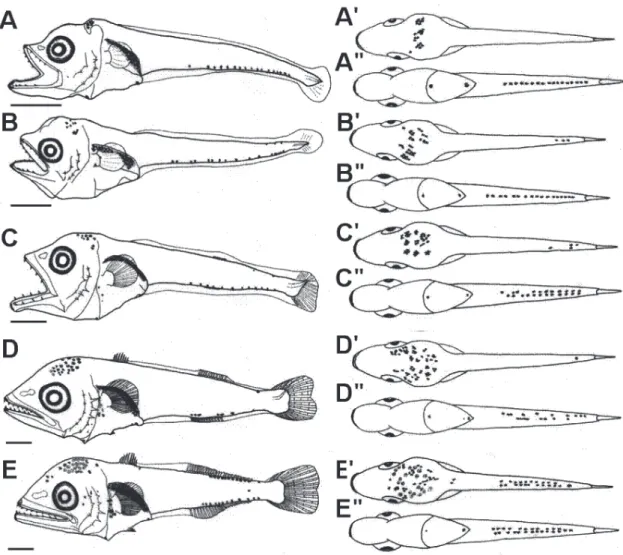
Fig. 1. Larval development of Auxis rochei, East Sea of Korea. A-B: preflexion larvae, 4.5 mm NL (A), dorsal view (A'), ventral view (A"); 4.8 mm NL (B), dorsal view (B'), ventral view (B"); C: flexion larvae, 6.2 mm NL (C), dorsal view (C'), ventral view (C"); D-E: postflexion larvae, 7.7 mm NL (D), dorsal view (D'), ventral view (D"); 8.0 mm NL (E), dorsal view (E'), ventral view (E"). Scale bars= 0.5 mm.
정부에 나뭇가지 모양의 흑색소포의 분포, 주둥이 경사가 완만 한 형태 특징 등에 의해 물치다래속 자어로 판단되었다(Oki- yama, 1988; Richards, 2006).
척색장 3.6-4.8 mm 전기자어(Preflexion larvae; PKU5842 -5844, PKU6329) : 두장은 척색장의 27.1-29.0%로 큰 비중을 차지 하며, 근절고는 척색장의 12.5-15.6%로 낮고 항문장은 척 색장의 45.0-46.7%로 몸의 중앙보다 약간 앞쪽에 위치한다. 입 은 매우 크고 양턱에는 1열의 이빨이 있다. 콧구멍은 눈 전방에 2개 있다. 모든 지느러미는 막지느러미 형태이다(Figs. 1A, B).
흑색소포는 두정부에 나뭇가지 모양으로 분포하며, 복강의 등쪽 가장자리를 따라 짙게 분포한다(Figs. 1A', B'). 꼬리의 배쪽 정 중선을 따라 별 모양의 흑색소포가 1열로 나타나며, 꼬리의 등 쪽에는 거의 없거나 흔적적으로 출현한다(Figs. 1A", B").
척색장 5.2-6.2 mm 중기자어(Flexion larvae; PKU5845
-5846, PKU6330) : 척색의 말단이 등쪽으로 휘기 시작한다 (Fig. 1C). 두장은 척색장의 30.6-31.0%, 항문장은 척색장의 44.2-46.8%, 근절고는 척색장의 13.7-14.5%로 두장비가 전기 자어기에 비해 증가한다. 이 시기에 가슴지느러미 연조 및 꼬리 지느러미가 처음으로 분화되어 나타나는데 가슴지느러미 연조 수는 17-18개, 꼬리지느러미 연조수는 19-20개가 관찰된다. 흑 색소포는 두정부 후방 및 복강의 등쪽 가장자리를 따라 짙게 분 포한다(Figs. 1C, C'). 꼬리의 배쪽 정중선을 따라 별 모양의 흑 색소포가 2열로 분포하며(Fig. 1C"), 꼬리의 등쪽에는 흑색소포 가 희미하게 분포한다(Fig. 1C').
척색장 6.6-8.0 mm 후기자어(Postflexion larvae; PKU5847 -5849, PKU6331) : 두장은 척색장의 31.8-35.1%, 항문장은 척 색장의 47.2-53.2%, 근절고는 척색장의 15.2-18.2%로 중기자 어기 보다 전체적으로 증가한다. 이시기에는 모든 지느러미가
분화중인데, 가슴지느러미 연조수는 21-22개, 제1등지느러미 극조수는 7-8개, 제2등지느러미 연조수는 11개, 뒷지느러미 연 조수는 12-13개, 꼬리지느러미 연조수는 23-24개가 관찰된다 (Figs. 1D-E). 이시기에 토막지느러미가 분화중이다. 두정부에 는 나뭇가지 모양 흑색소포가 조밀하게 나타나며, 복강의 등쪽 가장자리에도 짙게 분포한다(Figs. 1D', E'). 척색장 7.7 mm 자 어에서는 흑색소포가 꼬리부위의 배쪽 정중선을 따라 1열 또는 2열로 분포하고, 꼬리의 등쪽 및 배쪽에는 각각 1개씩 분포하나 측면에는 어떠한 흑색소포도 없다(Fig. 1D"). 반면 척색장 8.0 mm 자어에서는 꼬리의 등쪽 및 배쪽 정중선을 따라 별 모양으 로 2열로 나타나는데 특히 등쪽 정중선의 경우 흑색소포가 새롭
게 다수 출현하며(Figs. 1E', E"), 꼬리의 측면에는 이전까지 관 찰되지 않던 1개의 흑색소포가 관찰된다.
유사종과의 비교 : Jones (1960)에 의하면, 물치다래속 2종 의 자어는 계수형질로는 구분이 어렵지만, 꼬리측면의 흑색소포 유무(몽치다래 자어는 꼬리 측면에 없으나 물치다래 자어는 꼬 리 측면에 발달)에서 잘 구분된다고 보고한 바 있다. 본 연구에 서 몽치다래 자어는 꼬리 측면에 대부분 흑색소포를 가지지 않 아 Jones (1960)와 잘 일치하였다(Table 2). 그러나, 척색장 8.0 mm 개체에서는 꼬리 측면에 흑색소포가 희미하게 관찰되어 (Fig. 1E), 물치다래 자어가 아닌가 의심하였으나 mtDNA 분석 결과, 몽치다래 자어로 확인되어 흑색소포의 개체변이로 추정 Thunnus albacares absent absent more than 1/3 of NL pointed (equal to ED) present
Thunnus thynnus absent absent more than 1/3 of NL pointed (equal to ED) present
Scomber japonicus present absent less than 1/3 of NL rounded absent
Acanthocybium solandri absent absent more than 1/3 of NL pointed (more than 3 times of ED) present Sarda orientalis absent absent more than 1/3 of NL pointed (more than 1.5 times of ED) present Scomberomorus niphonius absent present more than 1/3 of NL pointed (more than 1.5 times of ED) present
(1) (2) (3) (4) (5) (6) (7) (8) (9) (10) (11) (12) (13) (14) (15) (16) Auxis sp. A (1)
Auxis sp. B (2) 0.000 Auxis sp. C (3) 0.000 0.000 Auxis sp. D (4) 0.000 0.000 0.000 Auxis sp. E (5) 0.000 0.000 0.000 0.000 Auxis rochei (6) 0.000 0.000 0.000 0.000 0.000 Auxis thazard (7) 0.027 0.027 0.027 0.027 0.027 0.027 Scomber japonicus (8) 0.159 0.159 0.159 0.159 0.159 0.159 0.151 Scomber australasicus (9) 0.162 0.162 0.162 0.162 0.162 0.162 0.151 0.006 Scomberomorus niphonius (10) 0.179 0.179 0.179 0.179 0.179 0.179 0.166 0.194 0.197 Acanthocybium solandri (11) 0.144 0.144 0.144 0.144 0.144 0.144 0.144 0.193 0.191 0.191 Sarda orientalis (12) 0.178 0.178 0.178 0.178 0.178 0.178 0.161 0.226 0.223 0.183 0.194 Thunnus albacares (13) 0.112 0.112 0.112 0.112 0.112 0.112 0.115 0.180 0.183 0.156 0.147 0.169 Katsuwonus pelamis (14) 0.082 0.082 0.082 0.082 0.082 0.082 0.078 0.170 0.172 0.158 0.171 0.167 0.127 Euthynnus affinis (15) 0.116 0.116 0.116 0.116 0.116 0.116 0.096 0.176 0.179 0.166 0.158 0.180 0.117 0.089 Carangoides equula (16) 0.194 0.194 0.194 0.194 0.194 0.194 0.185 0.214 0.214 0.204 0.213 0.239 0.204 0.202 0.199 Trachurus japonicus (17) 0.195 0.195 0.195 0.195 0.195 0.195 0.193 0.217 0.222 0.224 0.219 0.238 0.212 0.201 0.207 0.013 Table 3. Genetic distance among 10 scombrids species and 2 outgroups (Carangoides equula and Trachurus japonicus)
Fig. 2. Relative growth between notochord length and head length (A), preanal length (B), and myomere height (C) of Auxis rochei.
된다. 몽치다래 자어는 가다랑어 Katsuwonus pelamis, 점다랑 어 Euthynnus affinis, 황다랑어 Thunnus albacares 및 참다랑어 Thunnus orientalis 자어와 달리 제1등지느러미와 제2등지느러 미가 동시에 분화된다(나머지 종은 제1등지느러미가 먼저 분화 되며 크기도 상대적으로 크다)(Okiyama and Ueyanagi, 1978;
Okiyama, 1988)(Table 2). 한편, 삼치속(Scomberomorus) 자 어는 두정부에 1개의 극을 가지는 점에서 몽치다래 및 나머지 고등어과 어류와 잘 구분된다. 한편, 꼬치삼치 Acanthocybium solandri 자어는 주둥이 길이가 매우 길게 신장되어 있는데 안경 의 3배 이상인 반면, 몽치다래는 안경과 주둥이 길이가 비슷하 다. 고등어 Scomber japonicus 자어와는 척색장에 대한 두장비 (몽치다래는 1/3 보다 크나 고등어는 1/3 보다 작음), 주둥이 모 양(몽치다래는 끝이 뾰족하나 고등어는 끝이 뭉툭함), 전새개부 극의 유무(몽치다래는 6-7개의 극이 있으나 고등어는 극이 없 음)에서 잘 구분된다(Okiyama and Ueyanagi, 1978; Okiyama, 1988; Kim et al., 2008b)(Table 2).
몽치다래는 척색장 5.2 mm 부터 척색말단이 휘기 시작하는 데, Richards (2006)에 의하면 척색장 5.2 mm 부터 휘기 시작한 다고 하여 잘 일치하였다. 또한, 발육단계별 계측형질 변화에서 척색장(NL)에 대한 두장(HL), 항문전장(PAL) 및 근절고(MH) 는 모두 양의 상대 성장을 나타내었으며, 상대성장식은 다음과 같다. HL=1.79NL+20.36(r2= 0.89), PAL=1.75NL+36.9(r2=
0.69), MH=1.04NL+8.77(r2= 0.63). 상기 3가지 형태형질의 성 장 기울기를 통해 항문이 가장 빠르게 몸의 후방으로 이동하고, 근절고가 가장 느리게 성장하는 것을 알 수 있다(Table 1, Fig.
2).
발육단계별 지느러미의 형성은 꼬리지느러미부터 형성되기 시작하여 척색장 6.6 mm에 제1등지느러미 극조가 6개, 제2등지 느러미 연조가 10개, 뒷지느러미 연조가 12개 관찰되었으며, 척 색장 7.7-8.0 mm에 제1등지느러미 극조가 7-8개, 제2등지느러 미 연조가 11개, 뒷지느러미 연조가 12-13개로, 성어 몽치다래 (제1등지느러미 극조가 10-11개, 제2등지느러미 연조가 10-12 개, 뒷지느러미 연조가 12-13개)(Kim et al., 2005; Nakabo, 2002)와 대부분 일치하며 제1등지느러미만 정수에 도달하지 못 한 것을 알 수 있다.
몽치다래의 산란기는 6-7월로(Kim et al., 2004; NFRDI, 2005) 본 조사의 자치어 출현시기 결과(7-8월)와 거의 일치하 며, 고등어의 산란기인 5-6월(Kim et al., 2008b)에 비하면 조금 늦고, 참다랑어의 산란기인 7-8월(Miyashita et al., 2001; Kim et al., 2004)과는 거의 같은 것을 알 수 있다.
분자동정
동해 남부에서 채집된 물치다래속 자어 8개체는 성어 몽치다 래 A. rochei와 100% 일치하였고, 성어 물치다래 A. thazard와 는 97.3%로 가까웠다(Table 3). 고등어과 자치어의 분자연구는 최근 활발히 진행되고 있다. Chow et al. (2003)은 고등어과 자 치어 13종의 분자식별 마커로 PCR-RFLP(restriction fragment length polymorphism) 밴드 패턴을 제시한 바 있다. 또한, Rob- ertson et al. (2007)는 고등어과 치어 5종의 분자동정에서 몽치 다래와 물치다래 사이의 미토콘드리아 DNA Cytb 270 bp에서 95% 일치도를 보고하였다. 반면, 미토콘드리아 DNA COI 268 bp로 고등어과 자어를 분자동정한 Paine et al. (2008)의 결과에
graphic conditions around the waters of Jeju Island. J Env Bio 29, 419-425.
Chow S, Nohara K, Tanabe T, Itoh T, Tsuji S, Nishikawa Y, Uyeyanagi S and Uchikawa K. 2003. Genetic and morphological identification of larval and small juvenile tunas(Pisces: Scombridae) caught by a mid-water trawl in the western Pacific. Bull Fish Res Agen 8, 1-14.
Collette BB and Aadland CR. 1996. Revision of the frigate tunas(Scombridae, Auxis), with descriptions of two new subspecies from the eastern Pacific. Fish Bull 94, 423- 441.
FishBase. 2011. World wide web electronic publication. Re- trieved from on June 2011.
Han KH, Shin YH and Hwang DS. 2002. Seasonal variations in species composition of ichthyoplankton off kohung peninsula, Korea. Korean J Ichthyol 14, 45-52.
Ji HS and Kim JK. 2010. Molecular and morphological identi- fication of ophichthid leptocephali from the South Sea of Korea. Korean J Ichthyol 22, 279-284.
Jones S. 1960. Notes on eggs, larvae and juveniles of fishes from indian waters. Indian J Fish 9, 413-421.
Kartavtsev YP and Lee JS. 2006. Analysis of nucleotide diver- sity at the cytochrome b and cytochrome oxidase 1 genes at the population, specise, and genus levels. Russian J ge- netics 42, 341-362.
의하면, 몽치다래와 물치다래 사이의 유전거리가 97%로 가깝 게 나타나 서로 다른 영역간에 유전적 차이가 있음을 알 수 있다.
Cytb(Kartavtse and Lee, 2006)와 COI(Ward et al., 2009) 두 유 전자 영역의 변이율을 고려하면, 고등어과 어류의 경우 변이가 더 많은 Cytb가 종간 비교에 더 적합한 것으로 사료된다. 근린결 합수(NJ-tree)에 의하면 Auxis sp. 자어는 몽치다래 성어와 일직 선상에 유집되었으며, 이어 물치다래 성어와 유집되었고, 가다 랑어, 점다랑어, 황다랑어, 꼬치삼치, 삼치속, 줄삼치속(Sarda) 순으로 유집되었으며, 고등어속과 가장 멀리 유집되었다(Fig.
3). 이는 Robertson et al. (2007) 및 Paine et al. (2008)의 분자 계통결과와는 잘 일치하지만, Okiyama and Ueyanagi (1978)의 형태계통결과와는 다소 차이를 보여 향후 이에 대한 면밀한 재 검토가 필요하다.
사 사
본 논문은 국립수산과학원 근해어업자언조사(승인번호: RP- 2011-FR-040) 및 부경대학교의 지원으로 이루어졌으며, 연구 비 지원에 감사드립니다.
참고문헌
Choi YM, Yoo JT, Choi KH, Kim JK, Kim YS and Kim JB.
2008. Ecosystem structure and trophic level to the oceano-
Fig. 3. Neighbor-joining tree based on partial mtDNA cytochrome oxidase subunit I (COI) nucleotide sequences showing the rela- tionships among Auxis sp. specimens (Auxis sp. A-E) and 10 scombrids and 2 outgroups. Bar indicates genetic distance of 0.02.
Katsuwonus pelamis (EU752104) Euthynnus affinis (EU752082) Thunnus albacares (HM452166)
Acanthocybium solandri (DQ107694) 59
0.02
100
100
Scomberomorus niphonius (HM068278) Sarda orientalis (EF609593) Scomber japonicus (EU752183)
Scomber australasicus (EU595280) Carangoides equula (AY541645)
Trachurus japonicus (EU266385)
Kendall AW, Ahlstrom EH and Moser HG. 1984. Early life history stages of fishes and their characters. In: Ontogeny and Systematics of Fishes. Moser HG and Richards WJ, eds. Allen Press INC., Lawrence, U.S.A., 11-22.
Kim BJ, Kim S, Seo HS and Oh J. 2008a. Identification of Albula sp.(Albulidae: Albuliformes) leptocephalus col-
lected from the southern coastal waters of Korea using cytochrome b DNA sequences. Ocean Sci J 43, 101-106.
Kim DH, Kim DJ, Yoon SJ, Hwang HG, Kim EO, Son SG and Kim JK. 2008b. Development of the eggs, larvae and ju- veniles by artificially-matured pacific mackerel, Scomber japonicus in the Korean waters. J Kor Fish Soc 41, 471-
477.
Kim IS, Choi Y, Lee CL, Lee YJ, Kim BJ and Kim JH. 2005.
Illustrated book of Korean fishes. Kyo-Hak Publishing Co., Seoul, Korea, 455-461.
Kim JK. 2009. Diversity and conservation of Korean marine fishies. Korean J Ichthyol 21, 52-62.
Kim S and Yoo JM. 1999. Distribution of fish larvae and the front structure of the Korea strait in summer. Korean J Ichthyol 11, 72-85.
Kim YS, Han KH, Kang CB and Kim JB. 2004. Commercial fishes of the coastal and offshore waters in Korea. Hangel, Busan, Korea, 230-239.
Kim YU. 1984. The distribution of fish larvae in the Korea strait. Bull Korean Fish Soc 17, 230-243.
Kimura M. 1980. A simple method for estimating evolutionary rates of base substitutions through comparative studies of nucleotide sequences. J Mol Evol 16, 111-120.
Konishi H and Nakabo T. 2007. Color guide to the Japanese fishes for sportfishermen. Enterbrain, Tokyo, Japan, 248.
Koutrakis ET, Kallianiotis AA and Tsikliras AC. 2004. Tempo- ral patterns of larval fish distribution and abundance in a coastal area of northern Greece. Sci Mar 68, 585-595.
Kwun HJ and Kim JK. 2010. Validation of morphology-based identification of two Cynoglossidae larvae using Mito- chondrial DNA. Kor J Fish Aquat Sci 43, 482-488.
Miyashita S, Sawada Y, Okada T, Murata O and Kumai H.
2001. Morphological development and growth of labora- tory-reared larval and juvenile Thunnus thynnus(Pisces:
Scombridae). Fish Bull 99, 601-616.
Morote E, Olivar MP, Pankhurst PM, Villate F. 2008. Trophic ecology of bullet tuna Auxis rochei larvae and ontogeny of feeding-related organs. Mar Ecol Prog Ser 353, 243- 254.
Nakabo T. 2002. Fishes of Japan with pictorial keys to the spe- cies. English ed. Tokai University Press, Tokyo, Japan, 1346-1351.
Nelson JS. 2006. Fishes of the world. 4th ed. John Wiley & Sons
Inc., Hoboken, U.S.A., 432-433.
NFRDI. 2005. Ecology and Fishing Ground. Ye-mun-sa, Busan, Korea, 127-132.
NFRDI. 2007. Report of the Woking Group on the Ichthyopla- nkton(WGI). Ye-mun-sa, Busan, Korea, 18-45.
Okiyama M. 1988. An atlas of the early stage fishes in Japan.
Tokai University Press, Tokyo, Japan, 608-624.
Okiyama M and Ueyanagi S. 1978. Interrelationships of scom- broid fishes: An aspect from larval morphology. Bull Far Fish Res Lap 16, 103-113.
Paine MA, McDowell JR and Graves JE. 2008. Specific iden- tification using COI sequence analysis of scombrid larvae collected off the Kona coast of Hawaii Island. Ichthyol Res 55, 7-16.
Richards WJ. 2006. Scombridae. In: Early stages of Atlantic fishes an identification guide for the western central North Atlantic-II. Richards W.J, ed. Taylor and Francis, U.S.A., 2187-2227.
Russell FS. 1976. The eggs and planktonic stages of British marine fishes. Academic Press, London, U.K., 22-29.
Robertson MD, Ovenden JR and Barker SC. 2007. Identifica- tion of small juvenile scombrids from northwest tropical Australia using mitochondrial DNA cytochrome b se- quences. Ichthyol Res 54, 246-252.
Tamura K, Dudley J, Nei M and Kumar S. 2007. MEGA4:
Molecular Evolutionary Genetics Analysis(MEGA) soft- ware version 4.0. Mol Biol Evol 24, 1596-1599.
Thompson JD, Higgins DG and Gibson TJ. 1994. CLUSTAL W: improving the sensitivity of progressive multiple sequence alignment through sequence weighting, posi- tionspecific gap penalties and weight matrix choice. Nucl Acids Res 22, 4673-4680.
Ward RD, Hanner R and Hebert PDN. 2009. The campaign to DNA barcode all fishes, FISH-BOL. J Fish Biol 74, 329- 356.
Yoo JM, Lee EK and Kim S. 1999. Distribution of ichthyo- plankton in the adjacent waters of Yousu. J Korean Fish Soc 32, 295-302.
2011년 8월 9일 접수 2011년 10월 11일 수정 2011년 11월 15일 수리