서 론
가자미목(Pleuronectiformes), 둥글넙치과(Bothidae) 어류 는 인도양, 태평양 및 대서양의 열대, 온대 해역에 분포하며 (Masuda et al., 1984; Kim et al., 2005; Nelson et al., 2016) 전 세계적으로 20속 163종(Nelson et al., 2016), 일본에는 15속 37종(Nakabo, 2013), 우리나라에는 9속 11종이 보고되어 있다 (Kim, 2011; Han et al., 2012).
둥글넙치과 어류에 대한 이전 연구로 국외에서는 동백가자 미(Psettina iijimae)와 흰비늘가자미(Laeops kitaharae)의 초 기발생(Fukui and Ozawa, 1990) 및 동백가자미 자치어의 형태 발달(Lalithambika, 1989), 동백가자미속(Psettina) 3종의 자 치어에 관한 연구(Amaoka, 1976), Arnoglossus laterna의 성 장, 산란, 섭이(Gibson and Ezzi, 1980), 고베둥글넙치(Crossor
hombus kobensis)의 산란행동(Moyer et al., 1985) 등 다양한
연구가 수행되었으나 우리나라에서는 한국산 흰비늘가자미의 후기자어와 치어 출현 보고(Youn et al., 1998) 및 한국산 둥글 넙치과 어류의 미기록종 보고(Kim et al., 2010, 2011; Lee and Choi, 2010; Han et al., 2012) 등 소수의 단편적인 연구만 이루 어져 왔다. 이처럼 둥글넙치과 어류의 자치어는 형태적으로 유 사하여 종 수준에서의 동정이 어려울 뿐 아니라, 초기 생활사 에 대한 국내 연구 또한 매우 부족한 실정이다. Okiyama(2014) 에 의하면 둥글넙치과 어류 자치어 38종의 형태, 분포, 출현에 관한 정보가 수록되어 있지만, 지역 간 형태 변이 등을 고려한 다면 분자 동정을 통한 보다 면밀한 조사연구가 필요하다.
환경변화에 따른 외부 형태형질의 다양성 및 종간 경계의 명확한 구분을 위하여 최근에는 다양한 분자기법이 적용되 고 있으며(Kim et al., 2003; Song et al., 2014, 2017), 특히 어 란 또는 자어와 같은 외부 형태 특징만으로 종 동정이 어려운 경우에 광범위하게 이용되고 있다(Kwun and Kim, 2010; Lee and Kim, 2014; Lee et al., 2014). 본 조사에서도 자연 상태에 서 채집된 둥글넙치과 자어를 종 수준까지 동정하기 위해 분 자방법을 적용하였다. 따라서, 본 연구는 2016년 6~11월에 제
—244 — http://www.fishkorea.or.kr
* Corresponding author: JinKoo Kim Tel: 82516295927, Fax: 82516295931, Email: [email protected] ISSn: 1225-8598(Print), 2288-3371(online)
accepted: December 27, 2017
한국 남해에서 채집된 사량넙치 Psettina tosana 자어의 분자 동정 및 형태 발달
지재민·유효재·황강석1·박정호1·이정훈1·김진구
*
부경대학교 자원생물학과, 1국립수산과학원 연근해자원과
Molecular Identification and Morphological Development of Larvae of Psettina tosana Collected from Southern Sea of Korea by Jae-Min Ji, Hyo-Jae Yu, Kang-Seok Hwang1, Jeong-Ho Park1, Jeong-Hoon Lee1 and Jin-Koo Kim* (Department of Marine Biology, Pukyong national university, Busan 48513, republic of Korea; 1fisheries resources Management Division, national Institute of fisheries Science, Busan 46083, republic of Korea)
ABSTRACT A total of 15 larvae [3.53~19.49mm standard length(SL)] belonging to the family Bothidae collected from the southern sea of Korea in 2016 were identified as Psettina tosana based on 434 base-pair sequences of mitochondrial DNA cytochrome c oxidase subunit I. Larvae of Psettina tosana have anterior-most two elongated dorsal fin rays. Uniserial melanophores present on the dorsal and anal fin base, whereas melanophores on the body absent. An inflection point in the relative growth of head length and head depth against SL was shown between 9.93mm and 10.73mm SL. The examined larvae of Psettina tosana are clearly distinguished from the most similar species, Psettina iijimae in having no melanophore patches in the proximity of dorsal and anal fin base.
Key words: Psettina tosana, larvae, molecular identification, morphological development
주도 주변 해역과 남해에서 채집된 둥글넙치과 어류 자어를 DNA 염기서열을 이용하여 종 수준까지 동정하고, 자어의 발 달 단계별 외부 형태를 상세히 기술하여 동백가자미속 자어의 종 동정에 도움이 되고자 한다.
재료 및 방법
1. 재료
본 연구에 사용된 둥글넙치과 어류 자어는 2016년 6월에 10 개체(후기자어: 10개체), 10월에 4개체(전기자어: 2개체, 중기 자어: 1개체, 후기자어: 1개체), 11월에 1개체(후기자어: 1개체) 를 대상으로 하였으며, 이들은 모두 제주도 주변 해역 및 남해 에서 봉고네트(망구 80cm, 망목 550μm)로 채집되었다(Fig.
1). 채집된 표본은 선상에서 5% 중성 해수포르말린수용액으 로 1시간 동안 고정하고 이후 세척하여 1L 용기에 담은 뒤 알 코올(99%)로 보관 후 부경대학교 어류학 실험실로 운반하여 등록 및 보관하였다(표본번호: PKUI 529543).
2. 분자 분석
총 DNA는 Chelex 100 resin(Biorad, USA)을 이용하여 둥 글넙치과 자어의 왼쪽 눈알에서 추출하였다. Mitochondrial DNA cytochrome c oxidase subunit I(mtDNA COI) 영역은 VF2(5ʹTCA ACC AAC CAC AAA GAC ATT GGC AC3ʹ)와 FishR2(5ʹACT TCA GGG TGA CC G AAG AAT CAG AA
3ʹ) primer(Ward et al., 2005)를 이용하여 증폭하였다. Poly
merase chain reaction(PCR)은 10X PCR buffer 2μL, 2.5mM dNTP 1.6μL, VF2 primer 1μL, FishR2 primer 1μL, Takara Taq polymerase 0.1μL를 섞은 혼합물에 total DNA 1μL를 첨 가한 후, 총 20μL가 될 때까지 3차 증류수를 넣고 Thermal cycler(Biorad MJ mini PCT1148, USA)를 이용하여 다음과 같은 조건에서 PCR을 수행하였다; Initial denaturation 95°C 에서 5분; PCR reaction 35 cycles(denaturation 95°C에서 1 분, annealing 52°C에서 1분, extension 72°C에서 1분); final extension 72°C에서 5분. 염기서열은 ABI PRISM 3730XL Analyzer(96 capillary type)에서 BigDye(R) Terminator v3.1 Cycle Sequencing Kits(Applied Biosystems)를 이용하여 얻 었다. 둥글넙치과 자어의 염기서열은 NCBI에 등록하였다 (MG1276212771).
MtDNA COI 염기서열의 정렬은 BioEdit(ver. 7)(Hall, 1999) 의 CLUSTAL W(Thompson et al., 1994)를 이용하여 정렬하 였다. 유전거리는 MEGA 5(Tamura et al., 2011)의 Pairwise distance를 Kimura2parameter 모델(Kimura, 1980)로 계산하 였다. 근린결합수(Saitou and Nei, 1987)는 MEGA 5(Tamura et
al., 2011)에서 작성하였으며 bootstrap은 1000번 수행하였다.
염기서열을 비교하기 위하여 부경대학교(Pukyong National University, PKU)에 등록된 사량넙치(PKU8682; KF965433) 의 염기서열과 National Center for Biotechnology Information (NCBI)에 등록된 둥글넙치과 어류 동백가자미(P. iijimae, KU945118), 목탁가자미(Arnoglossus japonicus, KU945120), 노랑반점가자미(Arnoglossus polyspilus, EF607331), 별목탁 가자미(Bothus myriaster, KU885587), 긴가자미(Parabothus kiensis, KP267575), 검은꼬리넙치(Japonolaeops dentatus, JQ681381) 6종의 염기서열을 이용하였다.
3. 형태 분석
종 동정과 자어의 각 부위별 용어는 Russel(1976), Kim et al.(2011), Okiyama(2014) 등의 문헌을 참고하였고, 총 16개 의 형태형질을 측정 및 계수하였다. 계측형질로 전장(total length, TL), 체장(standard length, SL), 항문전장(preanal length, PAL), 체고(greatest body depth, GBD), 몸 중앙부 체 고(body depth at middle of the body, BDM), 두장(head length, HL), 두고(head depth, HD), 안경(orbit diameter, OD), 문장 (snout length, SNL), 후안와장(postorbital length, POL), 상 악장(upper jaw length, UJL)의 11개 형질을 입체해부현미경 (SZH16, Olympus, Japan) 하에서 관찰하였으며, 현미경용 사 Fig. 1. Map showing the sampling area of Psettina tosana larvae in the southern sea of Korea(=Korea Strait) and around Jeju Island.
40
38
36
34
32
30
latitude(°n)
124 126 128 130 132 longitude(°e)
진촬영장치(ImagePro plus 2.0, Media Cybernetics)로 0.1mm 단위까지 측정하였다. 계수형질로 등지느러미 기조수(dorsal fin rays, D), 뒷지느러미 기조수(anal fin rays, A), 꼬리지느러 미 기조수(caudal fin rays, C), 가슴지느러미 기조수(pectoral fin rays, P1), 배지느러미 기조수(pelvic fin rays, P2)의 5개 형 질을 입체해부현미경(SZH16, Olympus, Japan) 하에서 계수 하였다.
결 과
1. 분자 동정
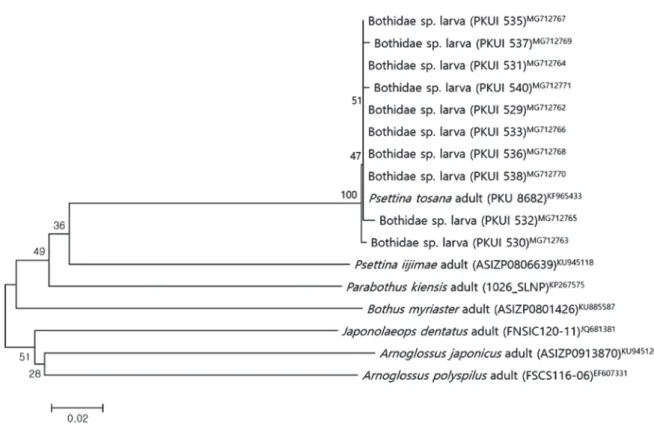
둥글넙치과 자어 10개체에서 mtDNA COI 영역 434 base
pair의 염기서열을 얻었으며, 이를 사량넙치 성어(PKU8682) 를 포함하여 둥글넙치과 어류 7종의 염기서열과 비교하 였다. 둥글넙치과 자어 10개체는 사량넙치 성어와 잘 일 치하였으며(K2P 유전거리, d =0.000~0.007), 동백가자미 (Psettina iijimae; d =0.225~0.232), 긴가자미(Parabothus kiensis; d=0.235~0.241), 검은꼬리넙치(Japonolaeops den- tatus, d=0.264~0.272), 별목탁가자미(Bothus myriaster; d=
0.275~0.278), 노랑반점가자미(Arnoglossus polyspilus, d=
0.277~0.284), 목탁가자미(Arnoglossus japonicus; d = 0.290~0.293) 순으로 명확한 차이를 보였다(Fig. 2).
2. 형태 발달
사량넙치 자어의 계수 및 계측 결과는 Table 1에 나타내 었다. 척색 말단의 굴곡 전단계인 전기자어(preflexion larva, n=2)는 체장 3.5~3.73mm, 척색 말단의 굴곡 단계인 중기자 어(flexion larva, n=1)는 6.67mm, 척색 말단의 굴곡 후단계 인 후기자어(postflexion larva, n=12)는 체장 9.08~19.49mm 범위로 확인되었다. 사량넙치 전기자어는 가늘고 긴 체형을 보이나 성장하면서 복부와 체고가 커지고 항문의 위치가 전방 으로 이동하는 경향을 보였다(Fig. 3). 체장에 대한 체고의 비 율은 전기자어 12.77%, 중기자어 29.54%, 후기자어 40.02~
52.08%였고, 체장에 대한 몸 중앙부 체고의 비율도 전기자어 6.28%, 중기자어 20.55%, 후기자어 29.64~47.34%로, 성장하 면서 체고가 커지는 경향을 보였다(Fig. 4A, B). 체장 3.73mm 부터 체장 9.93mm까지는 두장과 두고의 비율이 증가하는 추 세를 보이지만 체장 10.73mm부터는 감소하는 추세로 바뀌었 다(Fig. 4C, D). 한편 체장에 대한 안경과 상악장의 비율은 성 장할수록 작아지는 경향을 보였다(Fig. 4E, F).
Fig. 2. Neighborjoining tree based on partial mtDNA CO1 sequences, showing the relationships among Psettina tosana larvae collected from Korea and seven bothid species. The tree was constructed using the Kimura 2parameter model and 1000 bootstrap replications. The superscripts indicate NCBI registration number. The bottom bar indicates a genetic distance of 0.02.
1) 지느러미 발달
체장 3.53~3.73mm의 전기자어 시기에는 막지느러미가 몸 통을 감싸고 있으며 두정부에는 가장 앞쪽에 길게 신장된 2 개의 등지느러미 기조가 관찰되었다. 등지느러미 기조는 체 장 9.08~19.49mm인 후기자어 시기에 89~97개가 관찰되었
으며 또한 같은 시기에 뒷지느러미 기조가 69~77개 관찰되었 다(Table 1). 척색말단의 굴곡은 체장 6.67mm인 중기자어 시 기에 시작되었으며(Fig. 3B), 체장 9.08mm 이후 개체에서 척 색말단의 굴곡이 완료되어 꼬리지느러미가 완성되었다. 배지 느러미는 후기자어 시기인 11.49mm 개체부터 관찰되기 시작 Fig. 3. Development of larvae of Psettina tosana. (A) preflexion stage, PKU530, 3.73mm SL; (B) flexion stage, PKU531, 6.67mm SL; (C) post
flexion stage, PKU533, 9.79mm SL; (D) postflexion stage, PKU543, 19.49mm SL(Scale bars indicate 1.0mm).
(A) (B)
(C) (D) Table 1. Measurements and counts of larvae of Psettina tosana
Preflexion larvae Flexion larvae Postflexion larvae
PKUI 529~PKUI 530 PKUI 531 PKUI 532~PKUI 543
n=2 n=1 n=12
Total length 14.19±4(9.33~21.92)
Standard length(SL) 3.63±0.14(3.53~3.73) 6.67 13.19±3.57(9.08~19.49)
Measurements(% of SL)
Preanal length 43.72 34.99 38.33±1.8(35.86~41.25)
Greatest body depth 12.77 29.54 47.13±3.78(40.02~52.08)
Body depth at middle of body 6.28 20.55 39.77±5.42(29.64~47.34)
Head length 19.58 19.41 20.83±1.81(18.28~23.6)
Head depth 15.1 16.6 17.41±1.99(14.38~20.6)
Orbit diameter 8.32 5.97 5.05±0.77(3.96~6.72)
Snout length 5.63 6.9 6.56±0.92(5.25~8.09)
Postorbital length 5.87 9.28 10.35±1.07(8.37~12.35)
Upper jaw length 8.58 6.13 5.6±0.57(4.78~6.54)
Lower jaw length 9.66 7.77 6.99±0.56(6.33~7.87)
Counts
Caudal-fin rays X ? 13~18
Dorsal-fin rays X ? 89~97
Anal-fin rays X ? 69~77
X, absent; ?, present, but damaged.
하였으나, 가슴지느러미는 후기자어 시기까지 부채 모양의 막 지느러미만 관찰되었을 뿐 지느러미 기조는 출현하지 않았다 (Fig. 3D).
2) 흑색소포 분포
체장 3.53~3.73mm의 전기자어에서는 소화관 끝, 항문 부 근에 점 모양의 흑색소포가 불규칙적으로 소량 출현하였고 체 측에는 흑색소포가 전혀 관찰되지 않았다. 체장 9.08mm인 후 기자어 시기부터 등지느러미와 뒷지느러미 기저에 점 모양의 작은 흑색소포가 일렬로 나타나기 시작하였으며, 이들은 성장 함에 따라 더욱 선명해졌다. 체측의 흑색소포는 후기자어 시 기까지 관찰되지 않았다(Fig. 3C, D).
고 찰
본 연구는 2016년 6~11월 동안 우리나라 제주도 주변 해역 및 남해에서 채집된 둥글넙치과 자어를 대상으로 분자 동정 을 실시하였으며 그 결과 사량넙치의 자어로 확인되었고, 이 들 자어의 계측자료를 일본산 사량넙치 자어(Okiyama, 2014) 와 비교했을 때 대부분 잘 일치하는 결과를 보였다(Table 1).
Okiyama(2014)에 의하면, 일본산 사량넙치 자어는 체장 2.6 mm일 때 항문 위 몸의 복부에 1개의 흑색소포를 가지나 이 흑색소포는 체장 5mm 이후부터는 보이지 않게 되고, 체장 8.4mm 이후부터 등지느러미와 뒷지느러미 기조가 정수에 달 하고 가슴지느러미 기조는 변태 직전에 출현한다고 언급한 Fig. 4. Changes of (A) greatest body depth(GBD), (B) body depth at middle of body(BDM), (C) head length(HL), (D) head depth(HD), (E) orbit diameter(OD), (F) upper jaw length(UJL) expressed as percent of standard length(SL) with growth in Psettina tosana larvae.
(A)
(C)
(E)
(B)
(D)
(F)
60.00 50.00 40.00 30.00 20.00 10.00 0.00
24.00 23.00 22.00 21.00 20.00 19.00 18.00 17.00 16.00
9.00 8.00 7.00 6.00 5.00 4.00 3.00
60.00 50.00 40.00 30.00 20.00 10.00 0.00
22.00 20.00 18.00 16.00 14.00 12.00 10.00
9.00 8.00 7.00 6.00 5.00 4.00 3.00 y=22.57In(x)-11.044
r2=0.8485
y= -0.4294x+26.467 r2=0.8716
y= -0.4826x+23.696 r2=0.7966 y=0.7643x+11.978
r2=0.8926 y=0.6044x+16.517
r2=0.5903
y= -2.491In(x)+11.359 r2=0.8987
y=24.763In(x)-23.752 r2=0.9192
y= -1.995In(x)+10.666 r2=0.8101
greatest body depth, gBD
head length, hl
orbit diameter, oD
Body depth at middle of the body, BDM
head depth, hD
upper jaw length, uJl 0.00 5.00 10.00 15.00 20.00 25.00
Standard length(mm)
0.00 5.00 10.00 15.00 20.00 25.00 Standard length(mm)
0.00 5.00 10.00 15.00 20.00 25.00 Standard length(mm)
0.00 5.00 10.00 15.00 20.00 25.00 Standard length(mm)
0.00 5.00 10.00 15.00 20.00 25.00 Standard length(mm)
0.00 5.00 10.00 15.00 20.00 25.00 Standard length(mm)
gBD(%)hl(%) oD(%) BDM(%)hD(%) uJl(%)
바 있다. 본 연구에서 관찰된 사량넙치 자어 또한 Okiyama (2014)의 형태 특징과 대부분 잘 일치하였다.
둥글넙치과 어류가 가자미과 어류와 구분되는 자어기의 특 징은 우측 눈이 이동하여 어체의 왼쪽에 위치한다는 점과 길 게 신장된 등지느러미 기조를 가진다는 점이다. 한편, 넙치과 어류의 넙치(Paralichthys olivaceus) 자어는 사량넙치 자어와 유사하게 길게 신장된 등지느러미 기조를 가지지만, 등지느러 미 기조수(사량넙치: D. 89~101 vs. 넙치: D. 77~81), 뒷지느 러미 기조수(사량넙치: A. 69~80 vs. 넙치: A. 59~61) 및 체 측 흑색소포 유무로 사량넙치 자어와 잘 구분된다(Okiyama, 2014).
우리나라에는 둥글넙치과 어류에 속하는 동백가자미속 어 류에 사량넙치와 동백가자미 2종이 알려져 있다(Kim, 2011).
사량넙치와 동백가자미는 자어기 외부 형태가 유사할 뿐 아 니라 지느러미 기조수(사량넙치: D. 89~101, A. 69~80 vs. 동 백가자미: D. 86~93, A. 68~74)에서도 일부 중복되어 구분하 기 어렵지만(Okiyama, 2014), 두 종은 등지느러미와 뒷지느러 미 기저 근처의 흑색소포군(melanophore patch)의 유무에서 잘 구분된다(사량넙치: 0개 vs. 동백가자미: 등지느러미 4개, 뒷지느러미 2개)(Fig. 5). 이 연구 결과는 과거 일본에서 보고 된 동백가자미의 자어기 형태 특징과 잘 일치한다(Fukui and Ozawa, 1990).
사량넙치 자어는 체장에 대한 두장 및 두고의 비율이 체장 9.93mm 자어를 기준으로 그 이전에는 증가 추세를 보이다가 이후 감소 추세로 바뀌었다(Fig. 4C, D). 이는 사량넙치 자어의 머리 길이와 높이가 체장 9.93mm까지는 빠르게 자라다가 이 후 증가 속도가 완만해지는 결과로 해석된다. 모든 둥글넙치과 어류에서 체장에 대한 두장 및 두고의 비율이 증가 추세 이후 감소 추세를 보이는 것은 아니지만(Ozawa and Ozawa, 1986), 동백가자미는 중기자어 시기인 체장 5.8mm(Lalithambika, 1989), 흰비늘가자미(L. kitaharae)는 후기자어 시기인 체장 10~10.8mm(Amaoka, 1972), Trichopsetta ventralis는 체장
9.4mm(Futch, 1977) 시기에 변곡점을 가지는 점에서 사량넙 치(후기자어기)와 비슷한 결과를 보였다. 전장에 대한 계측치 의 비율이 변곡점을 보이는 시기가 척색 굴곡기, 착저기, 치어 기로 종마다 다른 것은 가자미과 어류에서 잘 알려진 바 있다 (Aritaki et al., 2000, 2001; Byun et al., 2013). 따라서 추후 다 른 둥글넙치과 자치어의 체장에 대한 두장 및 두고 비율의 변 곡점 해석에 대한 추가적인 연구가 필요할 것으로 생각된다.
요 약
본 연구는 2016년에 한국 남해에서 채집된 둥글넙치과 자 어를 분자방법으로 동정하였으며, 자어의 크기별 외부 형태 를 상세히 기술하였다. 채집된 자어 15개체(3.53~19.49mm 체장)의 mitochondrial DNA(mtDNA) cytochrome c oxidase subunit I gene(COI) 434bp의 염기서열을 비교한 결과, 모두 사량넙치로 확인되었다. 사량넙치의 자어는 2개의 길게 연장 된 등지느러미 기조를 가지며, 등지느러미와 뒷지느러미 기저 에 흑색소포가 일렬로 나 있는 반면 체측에는 흑색소포가 없 었다. 성장하면서 체장에 대한 두장 및 두고의 비율이 증가 추 세에서 감소 추세로 바뀌는 변곡점이 체장 9.93mm~10.73 mm에서 확인되었다. 사량넙치 자어는 형태적으로 가장 유사 한 동백가자미(Psettina iijimae)와 달리 등지느러미와 뒷지느 러미의 기저 근처에 흑색소포군을 가지지 않는 점에서 잘 구 분된다.
사 사
이 논문은 2017년 국립수산과학원 수산과학연구사업 (R2017027)의 지원으로 수행되었으며, 논문을 세심하게 검토 해 주신 세 분 심사위원께 감사 드립니다.
Fig. 5. Photos showing diagnostic characters distinguishing the Psettina tosana larva(A, 9.79mm SL) and Psettina iijimae larva(B, 7.79mm SL). Psettina iijimae larva has several melanophore patches in dorsal fin base(four) and anal fin base(two), but Psettina tosana larva has no melanophore patches.
(A) (B)
REFERENCES
Amaoka, K. 1972. Studies on the larvae and juveniles of the sinis
tral flounders-III. Laeops kitaharae. Ichthyol. Res., 19: 154
Amaoka, K. 1976. Studies on the larvae and juveniles of the sinistral 162.
flounders-VI. Psettina iijimae, P. tosana, and P. gigantea.
Ichthyol. Res., 22: 201206.
Aritaki, M., K. Ohta, Y. Hotta and M. Tanaka. 2001. Morphological development and growth of laboratoryreared spotted hali
but Verasper variegatus. Nippon Suisan Gakk., 67: 5866.
(in Japanese)
Aritaki, M., S. Suzuki and K.I. Watanabe. 2000. Morphological de
velopment and growth of laboratory-reared barfin flounder Verasper moseri. Nippon Suisan Gakk., 66: 446453.(in Japanese)
Byun, S.G., C.B. Kang, K.H. Han and J.K. Kim. 2013. Relative growth of Microstomus achne(Pleuronectidae, PISCES) during early life stage. Kor. J. Fish. Aquat. Sci., 46: 970
972.(in Korean)
Fukui, A. and T. Ozawa. 1990. Early ontogeny of two bothid spe
cies, Psettina iijimae and Laeops kitaharae. Ichthyol. Res., 37: 127132.
Futch, C.R. 1977. Larvae of Trichopsetta ventralis(Pisces: Bothi
dae), with comments on intergeneric relationships within the Bothidae. Bull. Mar. Sci., 27: 740757.
Gibson, R.N. and I.A. Ezzi. 1980. The biology of the scaldfish, Ar
noglossus laterna(Walbaum) on the west coast of Scotland.
J. Fish Biol., 17: 565575.
Hall, T.A. 1999. BioEdit: A userfriendly biological sequence align
ment editor and analysis program for Windows 95/98/NT.
Nucleic Acids Symp., 41: 9598.
Han, S.H., M.J. Kim and C.B. Song. 2012. First record of the bothid flounder, Asterorhombus intermedius(Bothidae, Pleuronec
tiformes) from Korea. Korean J. Ichthyol., 24: 139142.
Kim, B.J. 2011. Fish species of Korea. In: National Institution of Biological Resources(ed), National list of species of Korea:
vertebrates. Nat. Ins. Biol. Res., Incheon, pp. 175177.(in Korean)
Kim, I.S., Y. Choi, C.L. Lee, Y.J. Lee, B.J. Kim and J.H. Kim. 2005.
Illustrated book of Korean fishes. Kyo-Hak Publishing Co., Seoul, 615pp.(in Korean)
Kim, J.K., J.H. Ryu, S. Kim, D.W. Lee, K.H. Choi, T.Y. Oh, K.S.
Hwang, J.N. Kim, H.J. Kwun, H.S. Ji and J.N. Oh. 2011.
An identification guide for fish eggs, larvae and juveniles of Korea. Hanguel graphics, Busan, 275pp.(in Korean) Kim, M.J., C.M. Choi and C.B. Song. 2010. First record of the
bothid flounder Arnoglossus polyspilus(Bothidae, Pleu
ronectiformes) from Korea. Korean J. Ichthyol., 22: 132
135.
Kim, M.J., J.H. Choi, T.Y. Oh, J.N. Kim and C.B. Song. 2011. First record of a bothid flounder, Japonolaeops dentatus(Bothi
dae, Pleuronectiformes) from Jeju Island, Korea. Korean J.
Ichthyol., 23: 242245.
Kim, Y.J., I.C. Kim, S.Y. Lee, W.O. Lee, Y.C. Cho and J.S. Lee.
2003. The use and conservation in molecular phylogeny of fish mitochondrial DNAs in Korean waters. Korean J. Ecol.
Environ., 36: 221234.(in Korean)
Kimura, M. 1980. A simple method for estimating evolutionary rates of base substitutions through comparative studies of nucleotide sequences. J. Mol. Evol., 16: 111120.
Kwun, H.J. and J.K. Kim. 2010. Validation of morphologybased identification of two Cynoglossidae larvae using mitochon
drial DNA. Kor. J. Fish. Aquat. Sci., 43: 482488.(in Kore
an)
Lalithambika Devi, C.B. 1989. Developmental characters of Pset- tina iijimae(Jordan and Starks), bothid flat fishes-pisces. J.
Indian Fish. Assoc., 19: 717.
Lee, H.H. and Y. Choi. 2010. The sinistral flounder Engyprosopon grandisquama(Pleuronectiformes: Bothidae), a new record from Korea. Korean J. Ichthyol., 22: 285288.
Lee, H.W., S.J. Lee, J.H. Yang, J.B. Lee, H.K. Cha and J.K. Kim.
2014. Occurrence of eggs and larvae of blackfin flounder Glyptocephalus stelleri(Pleuronectidae, Pisces) off Wang
dolcho, East Sea. Kor. J. Fish. Aquat. Sci., 47: 654658.(in Korean)
Lee, S.J. and J.K. Kim. 2014. Identification of Trichiurus(Pisces:
Trichiuridae) eggs and larvae from Korea, with a taxonomic note. Kor. J. Fish. Aquat. Sci., 17: 137143.
Masuda, H., K. Amaoka, C. Araga, T. Uyeno and T. Yoshino. 1984.
The fishes of the Japanese Archipelago(text). Tokai Univer
sity Press, Tokyo, Japan, 437pp.(in Japanese)
Moyer, J.T., Y. Yogo, M.J. Zaiser and H. Tsukahara. 1985. Spawn
ing behavior and social organization of the flounder Cros- sorhombus kobensis(Bothidae) at Miyakejima, Japan.
Ichthyol. Res., 32: 363367.
Nakabo, T. 2013. Fishes of Japan with pictorial keys to the species.
3rd ed. Tokai University Press, Hadano, pp. 16621674.(in Japanese)
Nelson, J.S., T.C. Grande and M.V. Wilson. 2016. Fishes of the world. John Wiley & Sons, pp. 447448.
Okiyama, M. 2014. An atlas of the early stage fishes in Japan. Tokai University Press, Tokyo, Japan, pp. 14111479.(in Japa
nese)
Ozawa, T. and T. Ozawa. 1986. Studies on the oceanic ichthyo
plankton in the western North Pacific. Kyushu University Press, Japan, pp. 321420.
Russell, F.S. 1976. The eggs and planktonic stages of british marine fishes. Academic Press, London, pp. 1-524.
Saitou, N. and M. Nei. 1987. The neighborjoining method: a new method for reconstructing phylogenetic trees. Mol. Biol.
Evol., 4: 406425.
Song, Y.S., H.J. Kwun, J.K. Kim and H. Senou. 2014. A new record of juvenile Chromis mirationis(Perciformes: Pomacent
ridae) from Korea, revealed by molecular analysis, with a comparison to juvenile chromis notata. Kor. J. Fish. Aquat.
Sci., 17: 263267.
Song, Y.S., J.K. Kim, J.H. Kang and S.Y. Kim. 2017. Two new species of the genus Atractoscion, and resurrection of the species Atractoscion atelodus(Günther 1867)(Perciformes:
Sciaenidae). Zootaxa, 4306: 223237.
Tamura, K., D. Peterson, N. Peterson, G. Stecher, M. Nei and S.
Kumar. 2011. MEGA5: Molecular evolutionary genetics analysis using maximum likelihood, evolutionary distance, and maximum parsimony methods. Mol. Biol. Evol., 28:
27312739.
Thompson, J.D., D.G. Higgins and T.J. Gibson. 1994. CLUSTAL W:
improving the sensitivity of progressive multiple sequence alignment through sequence weighting, positionspecific gap penalties and weight matrix choice. Nucl. Acid Res., 22: 46734680.
Ward, R.D., T.S. Zemlac, B.H. Innes, P.R. Last and P.D. Hebert.
2005. DNA barcoding Australia’s fish species. Philos. Trans.
R. Soc. London B., 360: 18471857.
Youn, C.H., S.H. Huh and I.S. Kim. 1998. Occurrence of postlar
vae and juveniles of Laeops kitaharae(Bothidae, Pleu
ronectiformes) in Korea. Korean J. Ichthyol., 10: 200206.