서 론
괴도라치(Chirolophis japonicus)는 농어목(Perciformes) 장갱이과(Stichaeidae)에 속하는 어류로 같은 과에는 벼슬 베도라치(Alectrias benjamini), 가시베도라치(Lumpenella longirostris), 얼룩괴도라치(Ascoldia variegata), 송곳니베도 라치(Bryozoichthys lysimus) 등 총 14속 26종이 국내에 서식 하는 것으로 보고되어 있다(Kim et al., 2005; NIBR, 2011). 이 중 Chirolophis 속은 눈의 위쪽, 뺨과 아래턱에 꽃송이 같은 촉
모가 있는 형태적 특징을 지니며, 괴도라치를 포함한 꽃송이 괴도라치(C. snyderi) 및 왜도라치(C. wui) 등 3종이 이에 속 한다.
장갱이과 어류에 대한 연구로는 종묘생산(Lee and Jo, 1995, 1997), 분류학적 재검토(Kim and Kang, 1991), 자치어 분 류(Kunihiko and Amaoka, 1980), 그물베도라치(Dictyosoma burgeri)의 난 발생 및 자어의 형태발달(Park et al., 2014b), Opisthocentrus tenuis의 생활사(Shiogaki, 1981), O. ocellatus 생활사(Shiogaki, 1982), 초기생활사(Shiogaki and Dotsu, 1972;
Shiogaki, 1983) 및 생식주기(Jin et al., 2007) 등이 수행되었다.
현재 우리나라에 서식하는 장갱이과 어류는 산란행동 및 초 기자어의 형태가 밝혀진 종이 적고, 자치어 시기를 분류할 수
—63 — http://www.fishkorea.or.kr
한국산 괴도라치 (Chirolophis japonicus)의 산란행동, 난 발생과 자어의 형태발달
박재민·이성훈1·최재영2·한경호1,*
경상북도 토속어류산업화센터, 1전남대학교 양식생물학전공, 2전라남도 국제갯벌연구소
Spawning behavior and Morphological Development of the Eggs and Larvae of the Fringed blenny, Chirolophis japonicus from Korea(Pisces: Stichaeidae) by Jae Min Park, Sung Hun Lee1, Jae Young Choi2 and Kyeong Ho Han1,* (Gyeongsangbuk-do Native Fish Business Center, Uiseong 769-921, Korea; 1Chonnam National University, Department of Aqualife Science, Yeosu 550-749, Korea; 2Jeollanam-do Intemational Tidal Flat Research Institute, Sinan 535-802, Korea)
ABSTRACT This research is about spawning behavior and morphological development of the eggs and larvae of fringed blenny which lives in Korean sea. It helps to find out the relation between fringed blenny larvae and other stichaeidae larva. Moreover, it is going to use for the basic data of taxonomical research. There were 8 mother fishes(total length 31.8~34.0cm, average 32.9±0.21 cm), which were captured from the cost of Sindeok-dong, Yeosu-si, Jeollanam-do from December, 2010. we used trap to capture them. Mother fishes were brought to glass aquarium(50×30 ×35 cm) and nurtured with recirculate rearing system. Breeding water temperature was 12.3~15.8°C (average 14.1±2.47) and salinity was 32.5~33.5‰(average 33.0±0.05‰). fertilized egg was round, opaque demersal egg. The size was 1.81~2.19mm(average 2.00±0.27mm, n=50). Incubation was begun after 271 hours and 30 minutes from fertilization. It started with piercing the egg membrane.
prelarvae had length of 8.45~8.84mm(average 8.65±0.28mm, n=5) right after the incubation, and both mouth and anus were opened. After 11 days from the incubation, postlarvae had length of 10.5~11.3mm(average 10.9±0.57mm), and the number of myotomes was increased to 66.
Key words: Chirolophis japonicus, egg development, larvae, spawning behavior
* Corresponding author: Kyeong Ho Han Tel: 82-61-659-7163, Fax: 82-61-659-7169, E-mail: [email protected]
있는 기초자료가 부족한 실정이다. 초기생활사에 대한 연구는 종의 산란장소 선택 및 난 발생과 자치어 형태발달 등의 생식 전략을 분석하는 학문으로서 종의 특징을 규명하고, 유사종 과의 분류학적 유연관계를 밝히는데 적용되어 왔다(Tanaka, 1973; Balon, 1985). 우리나라에서는 종 보존을 위한 기초자료 로 이용하고자 초기생활사 및 인공사육 기술개발에 대한 연구 가 이루어지고 있는데 해산어류에서는 Saddleback clownfish (Yoon et al., 2005), Maroon clownfish(Kim et al., 2007), Cinnamon clownfish(Noh et al., 2011), 앞동갈베도라치(Park et al., 2014a) 및 그물베도라치(Park et al., 2014b) 등이 연구되 었다.
따라서 본 연구에서는 우리나라 연안에 서식하는 괴도라치 의 산란행동 및 난 발생과 자어 형태발달을 조사하여 다른 장 갱이과 어류 자어와의 유연관계 및 생물학적 특징을 밝혀 분 류학적 연구의 기초자료로 이용하고자 한다.
재료 및 방법
1. 친어사육 및 산란행동
실험에 사용된 친어는 평균전장 32.9±0.21cm(31.8~34.0) 로 2010년 12월 전남 여수시 신덕동 연안에서 원통형 통발 을 이용해 수컷 3마리와 암컷 5마리를 채집하여 실험실로 수 송 후 사각 유리수조(50×30×35cm)에 수용하여 순환여과 식으로 사육하였다(Fig. 1). 먹이는 갯지렁이와 냉동 조갯살 을 매일 2회에 걸쳐 공급하였다. 사육수온은 12.3~15.8℃(평 균 14.1±2.47)를 유지하였고, 염분농도는 32.5~33.5‰(평균 33.0±0.05‰)의 범위를 유지하였다. 수조 내 자연산란유도를 위해 반원형 PVC 파이프를 넣어주어 친어의 산란행동을 관찰 하였다.
2. 난 발생 과정 및 자어의 형태발달
수정란은 500mL 유리비이커에 수용하였고, 사육수온은 12.3~15.8℃(평균 14.1±2.47)를 유지하였으며, 염분농도는
32.5~33.5‰(평균 33.0±0.05‰)의 범위를 유지하였다. 사육 수는 매일 1/2씩 3회 환수하였고, 난의 크기는 50개를 무작위 로 추출하여 만능투영기(Nikon JP V-12B, Japan)를 사용, 관찰 및 스케치하였으며, 난의 크기는 0.01mm까지 측정하였다.
부화 직후의 자어는 지수식으로 사육하였고, 에어레이션 으로 산소를 공급시켜 주었다. 자어의 먹이는 부화 직후부 터 11일까지 기수산 로티퍼(Brachionus rotundiformis)를 mL 당 5~10개체 공급하였고, 자어의 형태발달 과정은 부화 직 후부터 1일마다 5마리씩 채취하여 마취제(MS-222, Ethyl 3-aminobenzoate methanesulfonate, Sigma Aldrich Co., St.
Louis, USA)를 이용하여 마취시킨 후, 어체의 각 부위를 입 체 해부현미경(Nikon NM-40, Japan) 하에서 디지털카메라 (Nikon Coolpix 995, Japan)를 사용하여 관찰 및 스케치 하였 다. 자어의 형태발달 단계는 Kendall(1984)에 따랐다.
결 과
1. 산란행동
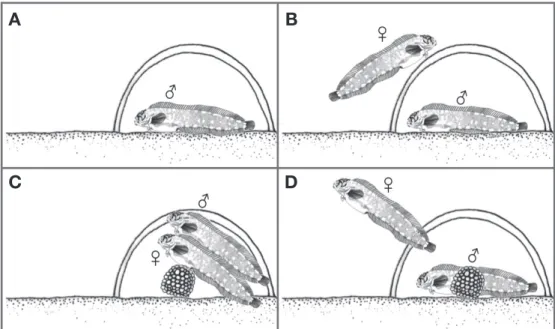
괴도라치는 반원형 PVC 내부에 산란하였으며, 산란행동은 Fig. 2와 같았다. 산란기간 동안의 수컷은 PVC 내부에 자리를 잡고 머무는 행동을 보였다(Fig. 2A). 암컷은 산란 2~3일전부 터 먹이를 섭취하지 않았고, 수조 벽면을 오르내리며 유영하 는 특이행동을 보였으며, 생식공이 돌출 되었다(Fig. 2B). 암 컷은 수컷이 머무는 산란장소 내부로 들어왔고, 수컷은 암컷 의 몸을 휘어감은 상태에서 산란과 방정을 하였다(Fig. 2C).
산란이 끝난 암컷은 산란장소를 벗어났고, 수컷은 알 덩어리 를 몸으로 감싼 뒤 부화할 때까지 보호하였다. 수컷은 꼬리를 이용하여 산소를 공급해주었고, 폐사한 난은 입으로 제거해주 었다(Fig. 2D).
2. 난의 형태
수정란은 구형으로 백색의 불투명한 침성 점착란이었고, 다 수의 소유구를 가졌으며, 난의 크기는 1.81~2.19mm(평균 Fig. 1. Lateral view of fringed blenny, Chirolophis japonicus. Scale bar=1.0cm.
2.00±0.27mm, n=50)였다. 난은 서로 점착되어 있었고, 암컷 1마리의 산란수는 8,523~12,032개(평균 10,277개, n=1)였다.
3. 난 발생 과정
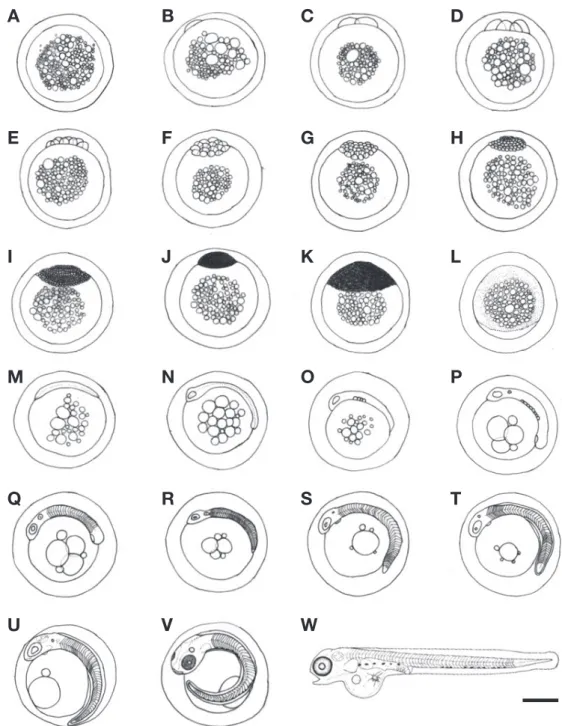
수정란을 어미의 산란과 동시에 채취하여 관찰한 결과, 물 을 흡수하여 팽창된 상태였고(Fig. 3A), 수정 3시간 후에는 배 반이 형성되었으며(Fig. 3B), 수정 6시간 15분 후에는 배반에 같은 크기의 난할이 둘로 나누어지면서 2세포기에 달하였다 (Fig. 3C). 수정 6시간 55분 후에는 4세포기에 달하였고(Fig.
3D), 수정 9시간 5분 후에는 8세포기에 달하였으며(Fig. 3E), 수정 10시간 35분 후에는 16세포기에 달하였다(Fig. 3F). 수정 12시간 10분 후에는 32세포기에 달하였고(Fig. 3G), 수정 13 시간 10분 후에는 64세포기에 달하였으며(Fig. 3H), 수정 15 시간 35분 후에는 128세포기에 달하였다(Fig. 3I). 수정 18시 간 5분 후에는 상실기에 달하였고(Fig. 3J), 수정 25시간 15분 후에는 포배기에 달하였으며(Fig. 3K), 수정 47시간 38분 후 에는 배반이 난황의 2/3를 덮어 내려와 중기 낭배기에 달하였 다(Fig. 3L). 수정 69시간 38분 후에는 배체가 형성되었고, 유 구의 수가 25~29개로 줄어들었다(Fig. 3M). 수정 80시간 58 분 후에는 안포가 형성되었고(Fig. 3N), 수정 86시간 58분 후 에는 4개의 근절이 형성되었다(Fig. 3O). 수정 105시간 8분 후 에는 이석이 형성되었고, 근절은 8개로 증가하였으며, Kuffer’s vesicle이 형성되었다(Fig. 3P). 수정 109시간 28분 후에는 근
절 수가 24~25개로 증가하였고, 안구에는 렌즈가 형성되었다 (Fig. 3Q). 수정 113시간 44분 후에는 Kuffer’s vesicle이 소실 되었고, 이 시기의 근절 수는 54개로 증가하였다(Fig. 3R). 수 정 120시간 4분 후에는 심장이 형성되었고, 유구의 수는 4개 로 줄어들었다(Fig. 3S). 수정 126시간 24분 후에는 난황으로 부터 꼬리가 분리되었고, 꼬리지느러미에는 막으로 된 지느러 미가 형성되었으며, 이 시기의 근절 수는 55~58개로 증가하 였다(Fig. 3T). 수정 148시간 45분 후에는 배체의 움직임이 활 발해졌고, 뇌가 분화하였다(Fig. 3U). 수정 269시간 24분 후에 는 머리 부분에 입과 막으로 된 가슴지느러미가 형성되었고, 꼬리 기저부분과 눈에는 흑색소포가 침착하였다(Fig. 3V). 수 정 271시간 30분 후에는 머리부터 난막을 뚫고 나오면서 부화 가 시작되었다(Fig. 3W).
4. 자어의 형태발달
부화 직후 전기 자어는 전장 8.45~8.84mm(평균 8.65±
0.28mm, n=5)로 입과 항문이 열려있었고, 난황은 흡수되지 않았으며, 1개의 유구를 가지고 있었다. 막으로 된 지느러미는 두부 뒷부분부터 난황이 끝나는 부분까지 연결되어 있었다. 나뭇가지 모양의 흑색소포는 소화관 위쪽 6개와 꼬리기저부 에 10개가 침착되어 있었고, 안구에도 색소포가 침착되어 있 었다. 이 시기의 근절 수는 54개였다(Fig. 4A).
부화 2일째 전기 자어는 전장 8.66~8.91mm(평균 8.79±
Fig. 2. The spawning behavior of fringed blenny, Chirolophis japonicus. A: It looks like he was staying inside of PVC; B: The female fish hadn’t eaten any food from two or three days ago. Moreover, it is unusual that she swam up and down along the surface of the wall; C: The female fish came into the spawning site which the male fish was staying in, and they started spawning and ejaculate while the male fish was coiling around the female fish; D: After spawning, female fish left that place. And then, the male fish covered their eggs with his whole body and kept them safe until hatching.
A b
C D
0.18mm)로 꼬리 기저부분에 침착 되었던 흑색소포는 몸통 중앙에 위치하였고, 나뭇가지 모양의 색소포가 24개로 증가하 였으며, 소화관 위쪽의 흑색소포는 8개로 증가하였다. 이 시기 의 근절 수는 55개로 증가하였다(Fig. 4B).
부화 5일째 후기 자어는 전장 9.78~10.6mm(평균 10.2±
0.58mm)로 난황이 흡수되었고, 먹이를 섭취하기 시작하였으 며, 흑색소포는 두부 뒷부분에 나뭇가지 모양으로 3개 침착되 었다. 몸통 중앙에 위치한 흑색소포는 16개로 줄어들었고, 꼬
리 기저부분에는 24개의 흑색소포가 침착되었다. 이 시기의 근절 수는 65개로 증가하였다(Fig. 4C).
부화 7일째 후기 자어는 전장 9.94~10.8mm(평균 10.4±
0.61mm)로 가슴지느러미 아래쪽에 2개의 나뭇가지 모양 흑 색소포가 침착되었고, 소화관 위쪽에 침착된 흑색소포는 진하 게 착색되었다. 가슴지느러미에는 2개의 줄기가 형성되었다 (Fig. 4D).
부화 11일째 후기 자어는 전장 10.5~11.3mm(평균 10.9±
Fig. 3. The egg development of fringed blenny, Chirolophis japonicus. Scale bar=1.0mm. (Shown in Table 1).
A b C D
E F G H
I J K L
M N O P
Q R S T
U V W
0.57mm)로 두부 뒷부분에 침착된 3개의 흑색소포는 1개로 연결되었고, 소화관 위쪽에 침착되었던 색소포는 가슴지느러 미 끝 부분부터 항문까지 진하게 착색되었다. 꼬리기저 끝 부 분에는 1개의 점 모양으로 침착되었고, 꼬리지느러미는 부채 꼴 모양으로 분화하기 시작하였다. 이 시기의 근절 수는 66개 로 증가하였다(Fig. 4E).
고 찰
베도라치류의 산란행동에는 세줄베도라치 Ernogrammus hexagrammus(Lee and Jo, 1995), 그물베도라치(Park et al., 2014b), O. tenuis(Shiogaki, 1981) 및 O. ocellatus(Shiogaki, 1982) 등과 같이 난괴를 형성하여 수컷이 몸으로 감싸서 보호 하는 종과 저울베도라치 Istiblennius stellifer(Kim and Han, 1989), 청베도라치 Entomacrodus stellifer lighti(Kim et al.,
1992) 및 앞동갈베도라치 Omobranchus elegans(Park et al., 2014a) 등과 같이 난괴를 형성하지 않고, 물체의 표면에 알을 한 층으로 부착하고 수컷이 보호하는 종이 있는데 괴도라치는 난괴를 형성하여 수컷이 몸으로 감싸서 보호하는 행동을 보여 전자에 속하였다.
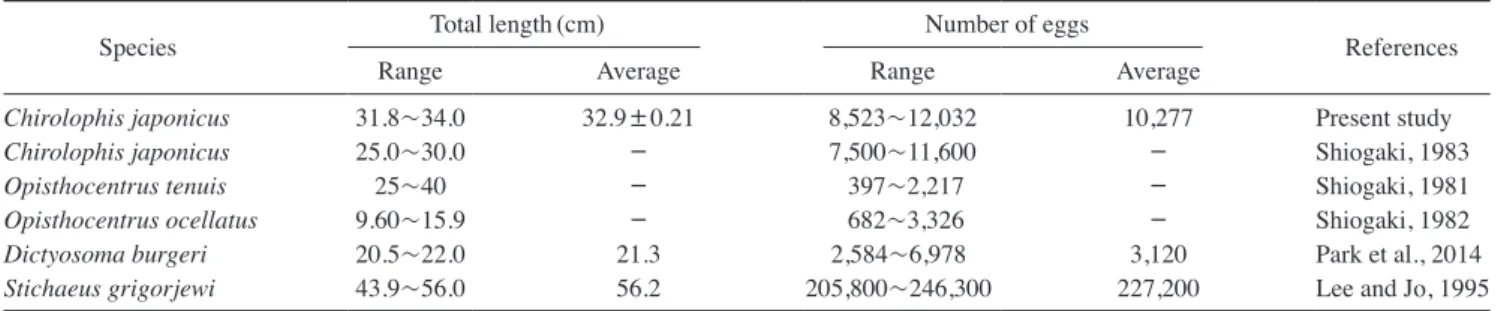
괴도라치의 산란수는 8,523~12,032개(평균 10,277개)로 일본산 괴도라치(Shiogaki, 1983) 7,500~11,600개로 유사하 였고, O. tenuis(Shiogaki, 1981) 397~2,217개, O. ocellatus (Shiogaki, 1982) 682~3,326개, 그물베도라치(Park et al., 2014b) 2,584~6,978개로 보다 많았으며, 장갱이 Stichaeus grigorjewi(Lee and Jo, 1995)는 205,800~246,300개로 보다 작았다. 산란수의 차이는 어미의 크기와 종에 따라 차이가 있 는 것으로 생각된다(Table 2).
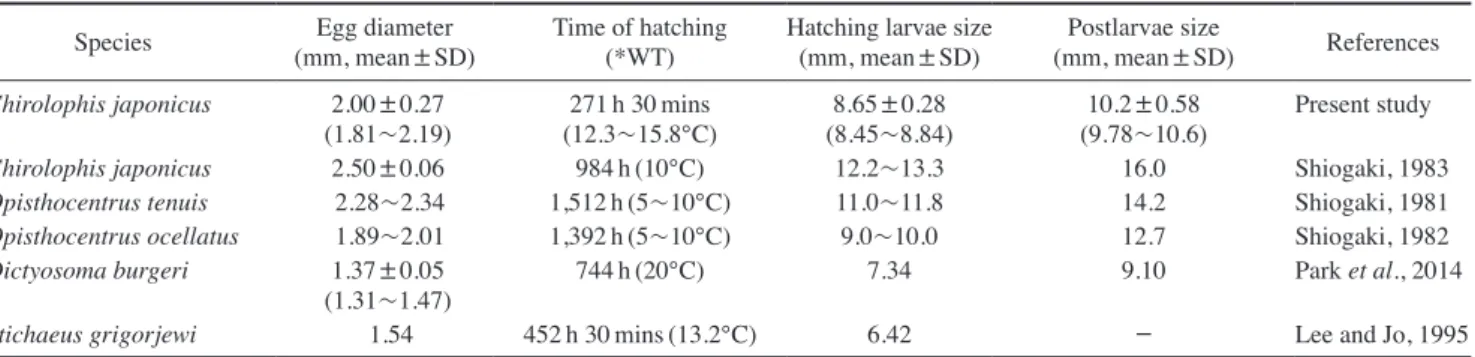
수정란의 평균 난경은 2.00±0.27mm였고, 일본산 괴도라치 (Shiogaki, 1983)는 2.50±0.06mm로 보다 짧았다. 같은 과 어 류인 장갱이(Lee and Jo, 1995) 1.54mm, 그물베도라치(Park Table 1. Egg and embryonic development fringed blenny, Chirolophis japonicus reared at a mean temperature of 14.1℃
Stage Elapsed time Charaters Fig. 3 Zygote period
Fertilization 0hrs 00min A
Cell cleave period
1 cell 3h 00min Blastodisc B
2 cell 6h 15min 2 blastodisc is cleavage C
4 cell 6h 55min 2-2 array of blastomeres D
8 cell 9h 05min 2-4 array of blastomeres E
16 cell 10h 35min 4-4 array of blastomeres F
32 cell 12h 10min 4-8 array of blastomeres G
64 cell 13h 10min 8-8 array of blastomeres H
128 cell 15h 35min 8-16 array of blastomeres I
Blastula period
Morula 18h 05min The number of blastomeres were increased and this size became smaller,
blastomeres were overlapped. J
Blastula 25h 15min Marginal cell was expanded slopingly to vegetal pole. K
Gastula period
Gastrulation 47h 38min Blastula came down and cover the yolk. L
Embryonic period
69h 38min Embryonic development M
80h 58min Optic vesicle development N
86h 58min 4 myotomes O
105h 08min 8 myotomes, Formation of otolith and Kupffer’s vesicles P
109h 28min 24-25 myotomes, Formation of lens Q
113h 44min 54 myotomes, Formation of auditory vesicles, disappear Kupffer’s vesicles R
Beginning of heart beating 120h 04min Heart beating S
126h 24min Embryo fin development T
148h 45min Development of brain U
269h 24min Formation of mouse and pectoral fin V
Hatching 271h 30min Hatching is beginning W
et al., 2014b) 평균 1.37±0.05mm로 보다 길었고, O. tenuis (Shiogaki, 1981) 2.28~2.34mm로 짧았으며, O. ocellatus (Shiogaki, 1982)는 1.89~2.01mm로 유사하였다.
부화에 소요되는 시간을 비교해보면 괴도라치는 수온 12.3~15.8℃(평균 14.1±2.47)에서 271시간 30분이 소요되 었고, 일본산 괴도라치(Shiogaki, 1983)의 경우, 수온 10℃
에서 984시간이 소요되었다. O. ocellatus(Shiogaki, 1982)는
5~10℃에서 1,392시간이 소요되었고, O. tenuis(Shiogaki, 1981)는 수온 5~10℃에서 1,512시간이 소요되었다. 부화에 소요되는 시간은 비교적 낮은 수온에서 장시간 소요되었는 데 이와 같은 경향은 넙치 Paralichthys olivaceus(Kim et al., 2010), 능성어 Epinephelus septemfasciatus(Park et al., 2014c) 등에서 나타났다. 장갱이과 어류는 수온이 낮은 겨울에서 이 른 봄에 산란하는 종이 많아 발생속도가 비교적 느려 부화까
A
b
C
D
E
Fig. 4. Morphological development of the prelarvae and postlarvae fringed blenny, Chirolophis japonicus. Scale bars=1.0 mm. A: 8.65 mm in total length(TL) newly hatched larvae; B: 8.79mm in TL, 2 days after hatching; C: 10.2mm in TL, 5 days after hatching; D: 10.4mm in TL, 7 days after hatching; E: 10.9mm in TL, 11 days after hatching. Scale bars=1.0mm.
Table 2. Comparison of the spawning amount and total length stichaeidae fishes
Species Total length(cm) Number of eggs
References
Range Average Range Average
Chirolophis japonicus 31.8~34.0 32.9±0.21 8,523~12,032 10,277 Present study
Chirolophis japonicus 25.0~30.0 - 7,500~11,600 - Shiogaki, 1983
Opisthocentrus tenuis 25~40 - 397~2,217 - Shiogaki, 1981
Opisthocentrus ocellatus 9.60~15.9 - 682~3,326 - Shiogaki, 1982
Dictyosoma burgeri 20.5~22.0 21.3 2,584~6,978 3,120 Park et al., 2014
Stichaeus grigorjewi 43.9~56.0 56.2 205,800~246,300 227,200 Lee and Jo, 1995
지 시간이 많이 소요된다. 그러나 같은 장갱이과 어류 가운데 낮은 수온 임에도 불구하고 부화에 소요되는 시간이 다른 것 은 종마다 산란 적수온이 다르기 때문인 것으로 판단된다.
부화 자어의 전장을 비교해보았을 때 괴도라치는 전장 8.45~8.84mm(평균 8.65±0.28mm)로 일본산 괴도라치 (Shiogaki, 1983) 전장 12.2~13.3mm, O. tenuis(Shiogaki, 1981) 전장 11.0~11.8mm, O. ocellatus(Shiogaki, 1982) 전장 9.0~10.0mm에 비해 짧았다.
어류는 전기자어기 말기에 난황이 모두 흡수되고 먹이를 섭취하면 후기자어기로 이행하게 된다. 후기자어기로 이행 하는 시기를 사육수온에 따라 비교해보면 괴도라치는 수온 12.3~15.8℃(평균 14.1±2.47) 부화 5일 후 평균 전장 10.2 mm일 때 난황이 흡수되면서 후기자어기로 이행하였다. 일 본산 괴도라치(Shiogaki, 1983)는 수온 10.0℃ 부화 15일 후 평균 전장 16.0mm일 때 난황과 유구를 모두 흡수하여 후기 자어기로 이행하였다. O. ocellatus(Shiogaki, 1982)는 수온 5~10℃ 부화 후 23일째 평균 전장 12.7mm로 난황과 유구를 모두 흡수하였고, O. tenuis(Shiogaki, 1981)는 수온 5~10℃
부화 20일째 평균 전장 14.2mm로 난황과 유구를 모두 흡수 하면서 후기자어기로 이행하였다. 본 연구에서 수온범위는 12.3~15.8℃로 다른 종들 보다 5~10℃ 높았고 후기자어기 로 이행하는 시기가 빨랐다. 이와 같은 경향은 후기자어기로 이행하는 시기가 수온에 따른 영향을 받는 것으로 생각된다 (Table 3).
부화 자어의 흑색소포 위치를 비교해보면 괴도라치는 소 화관 위쪽과 꼬리 기저부분에 침착하였고, 일본산 괴도라치 (Shiogaki, 1983)의 경우 난황 위쪽과 아래쪽에 침착되어 있는 것을 제외하고는 흑색소포 위치가 동일하였으며, O. ocellatus (Shiogaki, 1982)와 O. tenuis(Shiogaki, 1981)도 마찬가지로 소화관 위쪽과 꼬리 기저부분에 흑색소포 침착 위치가 동일하 여 초기 부화자어를 분류하기는 어려울 것으로 보인다. 그러 나 괴도라치는 성장하면서 두부주변에 촉모를 가져 다른 베도 라치류와 쉽게 구분할 수 있을 것으로 판단된다. 본 연구에서
괴도라치의 부화자어를 실내수조에서 사육한 결과 부화에 소 요되는 시간이 오래 걸리면서 수생균이나 물곰팡이로 인해 부 화율이 좋지 않았다. 또한 부화자어의 초기폐사율이 높아 생 존율을 높이기 위해서는 적합한 사육환경 조건을 밝히기 위한 연구가 필요할 것으로 생각된다.
요 약
본 연구는 우리나라 연안에 서식하는 괴도라치의 산란행동 및 난 발생과 자어 형태발달을 조사하여 다른 장갱이과 어류 자어와의 유연관계를 밝혀 분류학적 연구의 기초자료로 이용 하고자 한다. 실험에 사용된 친어는 평균전장 32.9±0.21cm (31.8~34.0)로 2003년 12월 전남 여수시 신덕동 연안에서 원 통형 통발을 이용해 8개체를 채집하여 실험실로 수송 후 사 각 유리수조(50×30×35cm)에 수용하여 순환여과식으로 사 육하였다. 사육수온은 12.3~15.8℃(평균 14.1±2.47)를 유지 하였고, 염분농도는 32.5~33.5‰(평균 33.0±0.05‰)의 범위 를 유지하였다. 수정란은 구형으로 백색의 불투명한 침성 점 착란이었다. 난의 크기는 1.81~2.19mm(평균 2.00±0.27mm, n=50)이었다. 부화는 수정 271시간 30분 후 머리부터 난막 을 뚫고 나오면서 시작되었다. 부화 직후 전기 자어는 전장 8.45~8.84mm(평균 8.65±0.28mm, n=5)로 입과 항문이 열 려있었고, 1개의 유구를 가지고 있었다. 부화 11일째 후기 자 어는 전장 10.5~11.3mm(평균 10.9±0.57mm)로 이 시기의 근절 수는 66개로 증가하였다.
인 용 문 헌
Balon, E.K. 1985. Early Life Histories of Fishes: New developmen- tal, ecological and evolutionary perspectives. DR W. Junk Publishers, Dordrecht, 280pp.
Table 3. Comparison characters of the eggs and larvae characters in the stichaeidae fishes Species Egg diameter
(mm, mean±SD) Time of hatching
(*WT) Hatching larvae size
(mm, mean±SD) Postlarvae size
(mm, mean±SD) References Chirolophis japonicus 2.00±0.27
(1.81~2.19) 271h 30mins
(12.3~15.8℃) 8.65±0.28
(8.45~8.84) 10.2±0.58
(9.78~10.6) Present study
Chirolophis japonicus 2.50±0.06 984h(10℃) 12.2~13.3 16.0 Shiogaki, 1983
Opisthocentrus tenuis 2.28~2.34 1,512h(5~10℃) 11.0~11.8 14.2 Shiogaki, 1981
Opisthocentrus ocellatus 1.89~2.01 1,392h(5~10℃) 9.0~10.0 12.7 Shiogaki, 1982
Dictyosoma burgeri 1.37±0.05
(1.31~1.47) 744h(20℃) 7.34 9.10 Park et al., 2014
Stichaeus grigorjewi 1.54 452h 30mins(13.2℃) 6.42 - Lee and Jo, 1995
*WT: water temperature.
Jin, Y.S., J.I. Han, C.B. Park, C.H. Lee, B.H. Kim, H.J. Baek, H.B.
Kim and Y.D. Lee. 2007. Reproductive cycle of ribbed gun- nel Dictyosoma burgeri. Korean J. Ichthyol., 19: 8-15.(in Korean)
Kim, I.S. and E.J. Kang. 1991. Taxonomic revision of the suborders blennioidei and zoarcoidei(Pisces, Perciformes) from Ko- rea. Korean J. Zool., 34: 500-525.(in Korean)
Kim, I.S., Y. Choi, C.L. Lee, Y.J. Lee, B.J. Kim and J.H. Kim. 2005.
Illustrated Book of Korean Fishes. Kyo Hak Publishing, Seoul, Korean, 360pp.(in Korean)
Kim, J.S., Y.U. Choi, S. Rho, Y.S. Yoon, M.M. Jung, Y.B. Song, C.H.
Lee and Y.D. Lee. 2007. Spawning behavior, egg and larvae developments of maroon clownfish, Premnas biaculeatus. J.
Aquaculture, 20: 96-105.(in Korean)
Kim, Y.S., Y.H. Do, S.Y. Kim and Y.J. Chang. 2010. Developmen- tal speed of olive flounder Paralichthys olivaceus eggs in various water temperatures. Dev. Reprod., 14: 59-63.(in Korean)
Kim, Y.U. and K.H. Han. 1989. Egg development and morphology of larval blenniid fish, Istiblennius stellifer(Jordan et Sny- der) reared in the laboratory. Korean J. Ichthyol., 1: 9-18.(in Korean)
Kim, Y.U., K.H. Han and C.B. Kang. 1992. Morphological and skeletal development of larvae and juveniles of Entomacro- dus stellifer lighti(Herre). Korean J. Ichthyol., 4: 31-43.(in Korean)
Kendall, A.W. Jr., E.H. Ahlstrom and H.G. Moser. 1984. Early life history stages of fishes and their characters. In: Moser, H.G.
et al.(eds.), Ontogeny and systematics of fishes. Am. Soc.
Ichthyol. Herpetol., Spec. Publ., 1: 11-22, Allen Press, Law- rence, KS.
Kunihiko, T. and K. Amaoka. 1980. Blennioide of the young larvae classification of appearing in southern Hokkaido coastal areas studies. Bull. of the faculty of Fish. Hokkaido Univ., 31: 16-49.
Lee, J.U. and J.Y. Jo. 1995. Studies on the seeding production of long shanny, Stichaeus grigorjewi Herzenstein. J. Aquacul- ture, 8: 195-207.(in Korean)
Lee, J.U. and J.Y. Jo. 1997. Seedling production of long shanny, Sti-
chaeus girgorjewi Herzenstein 2. Effect of temperatures on the growth and survival of larvae. J. Aquaculture, 10: 239- 253.(in Korean)
NIBR. 2011. National list of species of Korea(Vertebrates). Nation- al institute of biological resources, pp. 137-140.(in Korean) Noh, G.E., S. Rho, S.O. Sin and Y.J. Chang. 2011. Spawning pe- riodicity and behavior of Amphiprion melanopus and de- velopment of mass hatching system for clownfishes. Dev.
Reprod., 15: 133-141.(in Korean)
Park, J.M., K.H. Han, N.R. Kim, S.J. Oh, M.H. Son, K.M. Kim, M.J.
Jeon, J.M. Kim. S.H. Park and J.K. Cho. 2014a. Spawning behavior and early life history of the elegant blenny, Omo- branchus elegans(Pisces: Blenniidae). Korean J. Ichthyol., 26: 25-33.(in Korean)
Park, J.M., K.H. Han, N.R. Kim, C.K. Hong, J.Y. Park and J.K.
Cho. 2014b. Spawning behavior and morphological devel- opment of the eggs and larvae of the blennioid fish, Dictyo- soma burgeri from Korea(Pisces: Stichaeidae). Korean J.
Ichthyol., 26: 267-273.(in Korean)
Park, J.M., J.K. Cho, K.H. Han, N.R. Kim, H.K. Hwang, K.M. Kim, J.I. Myeong and M.H. Son. 2014c. Early life history of the sevenband grouper, Epinephelus septemfasciatus from Ko- rea. Dev. Reprod., 18: 13-23.(in Korean)
Shiogaki, M. 1981. Notes on the life history of the stichaeid fish Opisthocentrus tenuis. Japan J. Ichthyol., 28: 319-328.
Shiogaki, M. 1982. Life history of the stichaeid fish Opisthocentrus ocellatus. Japan J. Ichthyol., 29: 77-85.
Shiogaki, M. 1983. On the life history of the stichaeid fish Chirolo- phis japonicus. Japan J. Ichthyol., 29: 446-455.
Shiogaki, M. and Y. Dotsu. 1972. Life history of the blennioid fish, Dictyosoma burgeri. Fish. Nagasaki Univ., 33: 21-38.
Tanaka, S. 1973. Significations of egg and larval surveys in the stud- ies of population dynamics of fish. In: Blaxter, J.H.S.(ed.), The early life history of fish, Springer-Verlag, pp. 151-157.
Yoon, Y.S., S. Rho, Y.U. Choi, J.S. Kim and Y.D. Lee. 2005. Studies on seed production of Saddleback clownfish, Amphiprion polymnus 1) Spawning, egg development and larvae culture.
J. Aquaculture, 18: 107-114.(in Korean)