서 론
점몰개 Squalidus multimaculatus는 잉어과(Cyprinidae) 모 래무지아과(Gobioninae) 몰개속(Genus Squalidus)에 속하는 소형 일차 담수어류로서 Hosoya and Jeon(1984)에 의해 신종 으로 발표된 한국 고유어종이다. 본 종은 우리나라 동해안 남 부의 형상강, 영덕 오십천, 울진왕피천 등 동해 남부 연안에 유입되는 하천에 제한적인 분포범위를 가지고 있는 것으로 보 고되었으나(Kim, 1997; Jeon and Kim, 1998; Kim and Park, 2002), 최근 강원도 고성군의 배봉천 등 일부 하천에 인위적으 로 이입되어 분포지역이 확대되었다(Ko et al., 2013).
한편 우리나라에 분포하는 몰개속 어류는 S. gracilis maji
mae, S. japonicus coreanus, S. chankaensis tsuchigae, S.
multimaculatus 4종으로 모두 고유종 및 아종이다. 국내의 몰 개속 어류에 대한 연구는 한국산 몰개속 어류의 분류학적 재 검토(Kim and Lee, 1984), 난 발생(Park et al., 2005a) 및 산란 행동(Park et al., 2005b), S. japonicus coreanus의 개체군 생태 (Byeon, 2012) 등의 연구가 진행되어 왔으나, 몰개속 어류 중 난 발생에 대한 연구는 S. gracilis majimae를 대상으로 수행한 연구가 유일하다.
담수어류의 초기 생활사 연구는 산란지 선택과 난 발생과 정 및 이후의 자어기, 치어기, 미성어기 등을 거쳐가면서 종 의 특성에 따른 고유형질이 다양하게 나타나게 된다(Park et al., 2005a). 또한 생물체의 개체발생은 계통발생을 반복하는 특징을 가지고 있기 때문에 어류의 초기 생활사에 대한 연구 는 종의 특징을 구명하는 것은 물론 유사종과의 계통 및 분류
—52 — http://www.fishkorea.or.kr
* Corresponding author: InChul Bang Tel: 82415301286, Fax: 82415301493, Email: [email protected] ISSn: 1225-8598(Print), 2288-3371(online)
accepted: february 10, 2017
점몰개 Squalidus multimaculatus (Gobioninae)의 난 발생 및 자치어 형태 발달
송하윤·고명훈1·서인영2·문신주2·방인철2,
*
국립수산과학원 중앙내수면연구소, 1이화여자대학교 에코과학부, 2순천향대학교 생명시스템학과
Morphological Development of Egg and Larvae of Squalidus multimaculatus(Gobioninae) by Ha-Yoon Song, Myeong-Hun Ko1, In-Young Seo2, Shin-Joo Moon2 and In-Chul Bang2,* (Inland fisheries research Institute, national Institute of fisheries Science, gapyeong 12353, republic of Korea; 1Division of ecoscience, ewha Womans university, Seoul 03760, republic of Korea; 2Department of life Science, Soonchunhyang university, asan 31538, republic of Korea)
ABSTRACT The egg development and early life history of Korean endemic fish, Squalidus multimaculatus(Gobioninae), were investigated. The eggs from the females were obtained by injecting 10IU/g of human chorionic gonadotropin and inseminated by wet method in the laboratory. The fertilized eggs were 0.8~0.9mm in diameter and had no oil globules. The embryo began to hatch about 65 hrs after fertilization under water temperature of 24±1°C. The newly-hatched larvae were 2.5~3.1mm in total length, and their mouth and anus were not opened. Four days after hatching, the postlarva were 4.0~4.2mm in total length, and their york sacs were completely absorbed.
They entered the juvenile stage when all fin-rays were formed at 30 days after hatching, and their total length were 11.2~15.7mm. At 45 days after hatching, the external from of juveniles were similar to those of adults(total length were 18.8~22.5mm), and 80 days after hatching, the external characteristics from of juveniles were same to adults(total length were 25.7~35.9mm).
Key words: Endemic fish, Squalidus multimaculatus, egg development, early life history
학적 유연관계를 연구하는데 중요한 기초 연구자료로 활용되 며(Blaxter, 1974; Balon, 1985; Kim et al., 2014; Ko and Won, 2015), 이러한 기초 연구자료는 인공증식기술 확립과 어족 자원의 이용 및 보존방안 연구에 활용하고 있다(ME, 2009;
Song et al., 2009).
이에 담수어류의 초기생활사 연구의 중요성을 인식함에 따 라 최근 우리나라에 분포하는 멸종위기 담수어류를 대상으 로 관련 연구가 진행된 바 있으며(MLTM, 2010, 2011; NIBR, 2013), 관상어로 가치가 높은 납자루아과 어류와(Kim et al., 2014) 경제적 가치가 높은 어종에(Kang and Lee, 1996; Han et al., 2001; Park et al., 2015, 2016) 집중되어 관련연구가 주로 진행되었다.
하지만 우리나라에 분포하는 담수어류인 몰개속 어류는 4 종 모두 고유종임에도 불구하고 S. gracilis majimae를 제외한 나머지 3종에 대한 난 발생 및 초기생활사에 대한 연구는 전 혀 진행되지 않았다. 따라서 본 연구는 우리나라 고유종인 S.
multimaculatus의 기초 생물학적 연구로 인공수정을 통한 난 발생 과정과 이후의 자치어 발달을 관찰하여 종 다양성 보존 및 몰개속 어류 간 분류학적 연구의 기초자료로 제공하고자 한다.
재료 및 방법
1. 실험어의 확보
본 연구에 사용한 S. multimaculatus의 어미는 2011년 5월 에 강원도 고성군 현내면 일대의 배봉천에서 족대(망목 4×4 mm)를 사용하여 암컷 10개체(전장 6.9±1.0cm, 체중 3.4±1.4 g), 수컷 10개체(전장 5.8±0.6cm, 체중 2.3±0.3g)를 채집한 뒤 실험실에서 수온 24°C로 사육 관리하였다.
2. 산란유도 및 관리
채집된 개체 중 성숙한 개체들을 선별하여 HCG(human chorionic gonadotropin) 호르몬을 10IU/g의 농도로 암컷개체 에 복강 주사한 뒤, 12시간 경과 후 복부를 압박하여 채란한 뒤 습식법으로 인공수정하였다. 사육 수온은 24±1°C로 유지 하여 관리하였다. 부화 자어의 사육은 난황흡수가 거의 완료 되는 부화 후 4일부터 윤충류(rotifer) 공급을 시작하였고, 부 화 14일째부터는 알테미아(brine shrimp) 유생과 미립자 배합 사료를 성장에 따라 공급하였다. 사육 용수는 부화 후 30일까 지 매일 오전과 오후에 1/2씩 환수하였다.
3. 난 발생 및 자치어 관찰
직경 7cm 유리 패트리디쉬에 수정란을 분산 수용하여 해부
현미경(SZXILLB 100, Olympus Co., Japan)의 10×~50×배 율로 관찰하였다. 성장단계에 따른 자치어의 형태 발달과정은 부화 직후부터 부화 후 100일까지 마취제(MS222, Tricaine methanesulfonate; Sindel Co., Canada)를 사용하여 마취한 후 1일 20개체씩 전장과 체중을 측정하였다. 난 발생과정의 단계 표기와 용어는 Balon(1975)와 Soin et al.(1981)에 따랐다.
결 과
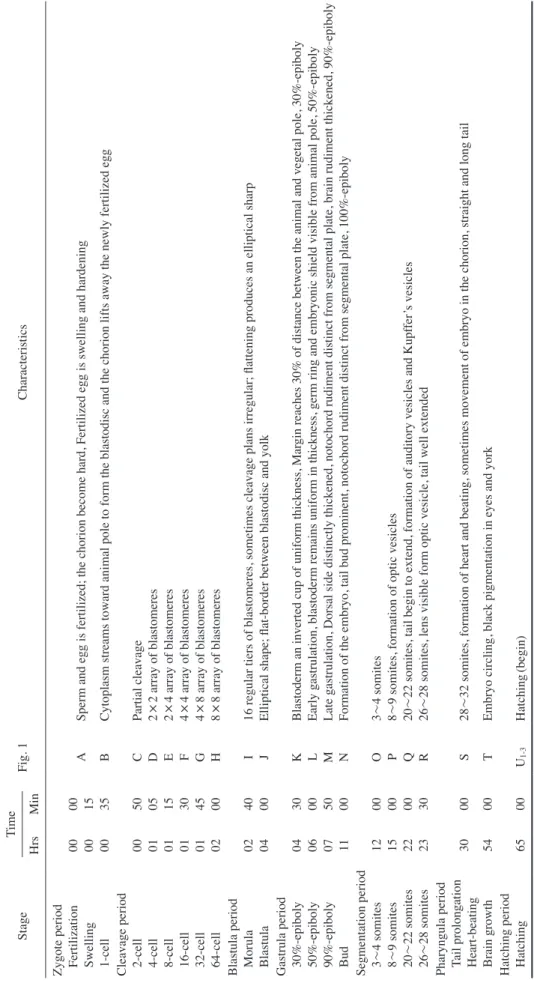
S. multimaculatus의 난 발생 과정은 총 7단계로 구분하였으 며(수정, 난할, 포배, 낭배, 체절형성, 기관 형성, 부화), 발생기 간(period)과 세부발생 단계(stage)는 Table 1에 각각 제시하 였다.
1. 수정 및 난 발생
Step I. 난 팽창 및 동물극으로의 세포질 응집(zygote)
Stage A. S. multimaculatus의 수정란의 크기는 직경이 0.8~0.9mm(평균 0.8±0.03mm, n =30)로 구형의 투명한 황색을 나타내는 침성 점착란이었으며, 세포질에 유구(Oil droplets)가 존재하지 않았다. 인공수정 직후 수분을 흡수하여 팽창하기 시작하였으며 난막과 난황이 분리되었다(Fig. 1A).
Stage B. 수정 후 15분 이내로 세포질이 동물극으로 응집되 는 것이 관찰되었고, 수정 후 35분이 경과하면 세포질로부터 동물극으로 응집이 계속되어 배반(blastodisc)이 동물극에 형 성되었다(Fig. 1B).
Step II. 난할과정(cleavage)
Stage C. 수정 후 50분에 배반의 중앙부분이 수직 이등분되 어 2세포기로 이행하였다(Fig . 1C).
Stage D. 수정 후 1시간 5분에 2세포기의 할구가 수직 이등 분되며 4세포기에 도달하였다(Fig. 1D).
Stage E. 이후 15분 간격으로 난할이 이루어져 수정 후 1시 간 15분 후에는 8세포기로 이행하였다(Fig. 1E).
Stage F. 수정 후 1시간 30분에는 할구수가 더 증가하여 16 세포기에 도달하였다(Fig. 1F).
Stage G. 수정 후 1시간 45분에 32세포기로 이행하였다(Fig.
1G).
Stage H. 수정 후 2시간을 전후하여 64세포기에 도달하였으 며, 할구가 작아지고 조밀하게 응집되었다. 이후 난할의 속도 가 점차적으로 감소하였다(Fig. 1H).
Step III. 포배형성과정(blastula)
Stage I. 이후 계속 발생이 진행되어 수정 후 2시간 40분에 는 할구의 크기가 더욱 작아지고, 세포의 수가 증가하며 상실
Table 1. Time required for embryonic stages of Squalidus multimaculatus at 25°C StageTime Fig. 1Characteristics HrsMin Zygote period Fertilization
0000 ASperm and egg is fertilized; the chorion become hard, Fertilized egg is swelling and hardening Swelling0015 1cell0035BCytoplasm streams toward animal pole to form the blastodisc and the chorion lifts away the newly fertilized egg
Cleavage period 2cell0050CPartial cleavage 4cell0105D2×2 array of blastomeres 8cell0115E2×4 array of blastomeres 16cell0130F4×4 array of blastomeres 32cell0145G4×8 array of blastomeres 64cell0200H8×8 array of blastomeres
Blastula period Morula 0240I16 regular tiers of blastomeres, sometimes cleavage plans irregular; flattening produces an elliptical sharp Blastula0400JElliptical shape; flat-border between blastodisc and yolk
Gastrula period 30%
epiboly0430KBlastoderm an inverted cup of uniform thickness, Margin reaches 30% of distance between the animal and vegetal pole, 30%epiboly 50%epiboly0600LEarly gastrulation, blastoderm remains uniform in thickness, germ ring and embryonic shield visible from animal pole, 50%epiboly 90%epiboly0750MLate gastrulation, Dorsal side distinctly thickened, notochord rudiment distinct from segmental plate, brain rudiment thickened, 90%epiboly Bud1100NFormation of the embryo, tail bud prominent, notochord rudiment distinct from segmental plate, 100%epiboly
Segmentation period 3~4 somites1200O3~4 somites 8~9 somites1500P8~9 somites, formation of optic vesicles 20~22 somites2200Q20~22 somites, tail begin to extend, formation of auditory vesicles and Kupffer’s vesicles 26~28 somites2330R26~28 somites, lens visible form optic vesicle, tail well extended
Pharyngula period Tail prolongation ~3000S2832 somites, formation of heart and beating, sometimes movement of embryo in the chorion, straight and long tail Heartbeating Brain growth5400TEmbryo circling, black pigmentation in eyes and york
Hatching period Hatching 6500U13Hatching(begin)
배(morula)를 뚜렷하게 형성하였다(Fig. 1I).
Stage J. 수정 후 4시간을 전후하여 포배기(blastula)에 도달 하여 배반의 가장자리가 식물극쪽으로 완만하게 기울어져 확 장되었다(Fig. 1J).
Step IV. 낭배형성과정(gastrula)
Stage K. 수정 후 4시간 30분을 전후하여 배반이 아래쪽으
로 확장되어 난황의 1/3을 덮게 되었으며, 배반의 가장자리가 점차 증가하여 식물극을 덮는 피복현상(epiboly)이 유지되어 30% epiboly시기에 도달하였다(Fig. 1K).
Stage L. 수정 후 6시간을 전후하여 피복현상이 식물극쪽으 로 확장되며 배반이 난황의 1/2을 덮어 50% epiboly시기이고, 배환(germ ring)이 최대로 확장되었다(Fig. 1L).
Stage M. 수정 후 7시간 50분을 전후하여 배반이 난황의 Fig. 1. Egg development of Squalidus multimaculatus. Time required for each developmental stage is shown in Table 1. A, Formation of perivi
telline membrane, 15min after fertilization; B, Formation of blastodisc, 35min after fertilization; C, 2 cells stage, 50min after fertilization; D, 4 cell stage, 1hr 5min after fertilization; E, 8 cells stage, 1hr 15min after fertilization; F, 16 cells stage, 1hr 30min after fertilization; G, 32 cells stage, 1hr 45min after fertilization; H, 64 cells stage, 2hr after fertilization; I, Morula stage, 2hr 40min after fertilization; J, Blastula stage, 4hr after fertilization; K, 30%epiboly, 4hr 30min after fertilization; L, Early gastrulation (50%epiboly), 6hr after fertilization; M, Late gastrulation (90%epiboly), 7hr 50min after fertilization; N, Embryo formation, 11hr after fertilization; O, 3~4 somites, 12hr after fertilization; P, 8~9 so
mites, formation of optic vesicles, 15hr after fertilization; Q, 20~22 Tail begin to extend, 22hr after fertilization; R, 26~28 somites, lens visible from optic vesicle, 23hr 30min after fertilization; S, Formation of heart, 30hr after fertilization; T, Embryo circling, black pigmentation in eyes and york, 54hr after fertilization; U1U3, The hatched larva, 65~77hr after fertilization, 2.8mm in total length. The bar indicates 1mm.
A B C D E F
G H I J K L
M N O P Q R
S T U
1U
2U
32/3를 덮어 70% epiboly시기였으며, 낭배기(gastrula)에 도달 하였다(Fig. 1M).
Stage N. 수정 후 약 11시간을 전후하여 배반이 난황의 대 부분을 덮어 100% epiboly기에 도달하였으며, 신경습(neural fold)이 난황 위에 형성되었다. 이후에 발생을 계속하여 유백 색의 배체(blastoderm)가 엷게 나타났다(Fig. 1N)
Step V. 기관형성과정(segmentation)
Stage O. 수정 후 12시간을 전후하여 배체의 형태가 뚜렷하 게 나타나며, 3~4개의 체절(somites)이 형성되었으나 안포는 (optic vesicles) 형성되지 않았다(Fig. 1O).
Stage P. 수정 후 15시간을 전후하여 배체의 머리부분에 안 포가 형성되기 시작하였고 체절의 수는 8~9개로 개체에 따라 차이가 나타났다(Fig. 1P).
Stage Q. 수정 후 22시간을 전후하여 안포가 명확해지고, 체절의 수는 20~22개로 증가되었으며 안포 뒤쪽으로 이포 (aduitory vesicle)가 생기고 꼬리 쪽에 Kupper’s vesicle가 형 성되었다. 난황이 원추형으로 연장되어 변형됨에 따라 꼬리부 분이 난황으로부터 떨어져 천천히 신장되기 시작하였다(Fig.
1Q).
Stage R. 수정 후 23시간 30분을 전후하여 안포안에 렌즈 (lens)가 형성되기 시작하였으며, 체절의 수는 26~28개로 증 가하면서 꼬리가 난황으로부터 명확하게 분리되어 신장되었 다(Fig. 1R).
Step VI. 심장박동과 흑색소포형성(pharyngula)
Stage S. 수정 후 30시간을 전후하여 난황 앞쪽에 심장이 형 성되어 발달됨에 따라 서서히 고동하기 시작하였으며, 배체 의 간헐적인 운동이 시작되었다. 체절은 28~32개로 증가되었 고 꼬리 부분이 더욱 길게 신장되어 난황으로부터 분리되었다 (Fig. 1S).
Stage T. 수정 후 54시간을 전후하여 꼬리부분이 길게 신장 되어 두부를 감싸게 되었고 배체의 활발한 회전운동이 관찰되 었다. 또한 난황과 두부에 흑색소포(melanophores)가 출현하 기 시작하였고 특히 안포에 흑색소포가 진하게 착색되는 특징 이 나타났다(Fig. 1T).
Step VII. 부화(hatching)
수정 후 65시간을 전후하여 배체의 회전운동이 활발해졌으 며, 약화된 난막을 배체가 꼬리부분부터 뚫고 부화하기 시작 하였고(Fig. 1U13) 수정 후 77시간을 전후하여 부화가 완료되 었다.
2. 자어 및 치어의 형태 발달
Step I. 전기자어기(prelarva)
Stage A. 부화 직후의 자어는 전장이 2.5~3.1mm(평균 2.8
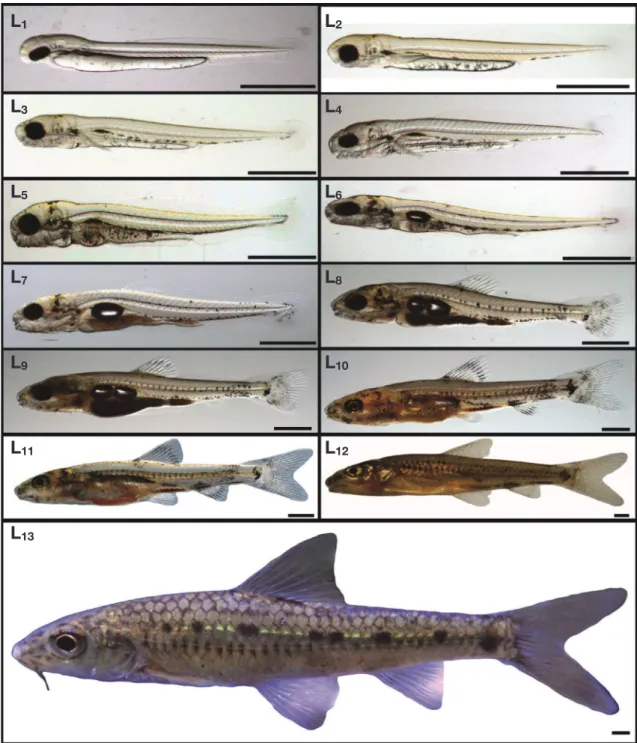
mm, n=20)로 입과 항문은 열려있지 않았고, 흑색소포는 눈과 난황에 제한적으로 분포하여 체색은 무색 투명하였다. 자어의 등지느러미, 뒷지느러미 및 꼬리지느러미는 막지느러미로 연 결되어 있었고, 이 시기 부화자어는 활발한 유영력을 갖지는 못하지만 부화 후 4시간을 전후하여 꼬리를 이용하여 올챙이 처럼 유영하였다(Fig. 2L1).
Stage B. 부화 후 1일째의 자어는 전장 3.5~3.9mm(평균 3.7mm, n=20)로 부채모양의 가슴지느러미가 발달하며, 난황 앞과 아래쪽으로 장하난황정맥이 발달함에 따라 혈액이 활발 하게 흐르는 것이 관찰되었다(Fig. 2L2).
Stage C. 부화 후 2일째의 자어는 전장 3.7~4.0mm(평균 3.9mm, n=20)로 척색아래를 따라 혈액이 흐르고 있는 것이 관찰되며, 별 모양의 흑색소포가 두부 윗부분과 부레, 체측 근 절상을 따라서 출현하기 시작하였다(Fig. 2L3).
Stage D. 부화 후 3일째의 자어는 전장 3.7~4.2mm(평균 4.0mm, n=20)로 두부가 발달하여 입이 열리게 되었으나, 항 문은 열려있지 않았다. 또한 가슴지느러미가 두부의 2/3길이 까지 신장되었으며 난황의 70%가 흡수되었다. 흑색소포는 중 뇌부분과 체측근절상에 다수 출현하고, 눈에는 동공을 제외하 고 거의 완전히 짙게 착색이 되었다(Fig. 2L4).
Stage E. 부화 후 4일째의 자어는 전장 3.9~4.3mm(평균 4.1 mm, n=20)로 난황 흡수가 90% 이상 완료되며 입과 항문이 완전히 열리게 되었고 윤충을 섭식하기 시작하였다. 항문의 위치는 전장의 70% 지점으로 난황의 바로 뒤쪽에 위치하였다 (Fig. 2L5).
Step II. 후기자어기(postlarva)
Stage F. 부화 후 5일째의 자어는 4.0~4.5mm(평균 4.3mm, n=20)로 난황이 완전히 흡수되었고 윤충을 활발하게 섭식하 였다. 한 개의 부레가 몸 중앙에서 신장되어 뚜렷하게 관찰이 되었다(Fig. 2L6).
Stage G. 부화 후 15일째의 자어는 전장 4.3~6.0mm(평균 5.2mm, n=20)로 알테미아를 활발하게 섭식하며, 한 개의 부 레가 몸 중앙에서 크게 신장되었다. 원형의 흑색소포는 체측 면에 원형으로 분포하며, 막지느러미에서 등지느러미 원기와 꼬리지느러미가 발달하기 시작하였으나 배지느러미와 뒷지느 러미의 원기는 나타나지 않았다(Fig. 2L7).
Stage H. 부화 후 17일째의 자어는 전장 6.0~7.9mm(평균 6.8mm, n=20)로 척색말단이 위로 굽었으며 지느러미의 발달 이 활발하게 일어나 등지느러미 기조가 9개 나타났고 꼬리지 느러미 기조는 20~22개가 나타났다. 복부에 위치한 막지느러 미에서 배지느러미와 뒷지느러미의 원기가 분리되어 융기되 기 시작하였다(Fig. 2L8).
Stage I. 부화 후 20일째의 자어는 전장 7.4~10.6mm(평균 8.8mm, n=20)로 부레가 두 개로 나누어졌으며, 막지느러미
에서 등지느러미와 꼬리지느러미가 분리되어 등지느러미 기 조수 II, 7개, 꼬리지느러미 기조수 19(10+9)개로 분화하여 상엽과 하엽으로 구분되었다. 또한 항문 뒤쪽 3/4 지점에 뒷지 느러미의 기조가 5개 나타나 발달하기 시작하였다(Fig. 2L9).
Stage J. 부화 후 25일째의 자어는 전장 8.0~12.9mm(평균 10.4mm, n=20)로 모든 지느러미가 막지느러미로부터 분리 되어 나타났다(Fig. 2L10).
Fig. 2. Larva and juvenile development of Squalidus multimaculatus. L1. Newly hatched prelarva, 77hrs. after fertilization, 2.8mm in total length; L2. 1 days after hatching, 3.7mm in total length; L3. 2 days after hatching, 3.9mm in total length; L4. 3 days after hatching, 4.0mm in to
tal length; L5. 4 days after hatching, 4.1mm in total length; L6. Postlarva, 5 days after hatching, 4.3mm in total length; L7. 15 days after hatching, 5.2 mm in total length; L8. 17 days after hatching, 6.8mm in total length; L9. 20 days after hatching, 8.8mm in total length; L10. 25 days after hatch
ing, 10. 4mm in total length; L11. Juvenile, 30 days after hatching, 13.3mm in total length; L12. 45 days after hatching, 20.3mm in total length;
L13. 80 days after hatching, 32.1mm in total length. The bar indicates 1mm.
L
1L
2L
3L
4L
5L
6L
7L
8L
9L
10L
11L
12L
13Step III. 치어기(juvenile)
Stage K. 부화 30일째의 자어는 전장 11.2~15.7mm(평균 13.3mm, n=20)로 부레의 발달이 완료되었으며, 각 지느러미 의 기조수는 D :III, 7; A :III, 6; V :II, 7; C. 10+9로 정수에 달 하여 치어기로 이행하였다(Fig. 2L11).
Stage L. 부화 45일째는 전장이 18.8~22.5mm(평균 20.3 mm, n=20)로 모든 지느러미의 기능이 완벽해지며, 성어와 유 사한 체색과 체형을 갖추기 시작하였다(Fig. 2L12).
Stage M. 부화 80일 후에는 전장이 25.7~35.9mm(평균 32.1mm, n=20)로 외부 형태 및 체측 검은 반문의 모양이 성 어와 동일하였다(Fig. 2L13).
고 찰
어류의 난 발생과 초기생활사 연구는 산란장소의 선택, 난 발생 및 자치어 발달 등의 과정에서 대상종의 생식방법과 발 생학적인 특징을 파악하여 유사종과의 분류학적 유연관계를 규명하며(Blaxter, 1974; Balon, 1985; Lee et al., 2011; Ko and Won, 2016), 어류의 종 보전과 생태계내 복원을 위한 인공종 묘생산 기술확보에 목적이 있다(Song et al., 2008; Song et al., 2009; Park et al., 2016).
S. multimaculatus와 근연종 간 수정란의 특징을 비교하면 S. multimaculatus의 수정란은 난막에 점액질을 가지는 구형의 투명한 황색을 띈 침성 분리 점착란으로 S. gracilis majimae (Park et al., 2005a)와 유사한 반면에 중국에 분포하는 동일 속 어류인 S. argentatus는 부성란의 특징을 보여(Wang et al., 2010) 종간 차이를 보였다. 수정란의 크기는 평균 0.87mm로 몰개속 어류인 S. gracilis majimae 2.9mm(Park et al., 2005a), S. argentatus 3.35mm(Wang et al., 2010)에 비해 작았으나, 모 두 유구를 가지지 않는 특징을 나타내었다. 또한 모래무지아과 어류인 Gobiobotia macrocephala 1.08mm(Ko et al., 2011a)와
는 유사하였으나, Pseudopuntungia nigra 2.18mm(Lee et al., 2004), Pseidogobio esocinus 1.98mm(Lee et al., 2008)에 비하 여 S. multimaculatus의 수정란은 다른 모래무지아과 종들에 비하여 크기가 상대적으로 작은 편이었다(Table 2).
겨울에 산란하는 종은 여름에 산란하는 종보다 난의 크기가 크고 봄과 여름에 산란을 하는 종은 작은 알을 생산하며 일 괄적으로 산란하는 생태적인 특징을 가진다(Ware, 1975). 몰 개속 어류의 산란시기는 S. japonicus coreanus 6~8월(Kim, 1997; Byeon, 2012), S. gracilis majimae 5~6월(Chyung, 1977;
Kim, 1997)이며, 일본산 S. japonicus japonicus는 5~6월로 종 간 차이가 있었다(Nakabo, 1993). 또한 산란기가 8월까지 상 대적으로 긴 S. japonicus coreanus의 성숙란의 크기는 0.64 mm로 수정란의 크기가 0.87mm인 S. multimaculatus와 유사 하였으나 산란기가 5~6월인 S. gracilis majimae에 비해 작았 다. 따라서 종에 따라 산란시기와 난경에 차이가 있었으며, S.
multimaculatus의 개체군 생태연구를 통해 국내에 분포하는 몰개속 어류 간 비교 연구가 필요하였다.
잉어과 어류는 난막에 점착성이 강한 점액질을 가지고 있어 수정란이 수초나 자갈 등의 물체에 부착하여 수정란의 유실 을 방지하고 원활한 산소공급을 유도하는 등 수정란의 생존과 부화율을 높이기 위한 생태적인 특징을 가지고 있으며(Han et al., 2001; Park et al., 2016), 이에 따른 생태적인 특징이 반영 된 결과로 종에 따라 수정란의 난막과 점액질 두께, 수정란의 크기 등이 종에 따라 차이가 나타난다(Park et al., 2015, 2016;
Ko and Won, 2016). 따라서 위와 같이 몰개속 어류는 동일 속 내에서도 부성란과 침성 분리 점착란으로 수정란의 특징이 종 에 따라 차이를 보이므로 몰개속 어류의 유연관계 파악을 위 한 분류형질로 이용할 수 있을 것으로 여겨진다.
S. multimaculatus의 수정 후 부화까지 소요된 시간은 수온 24±1°C에서 약 65시간 경과 후 부화되어, S. gracilis majimae 의 부화가 평균수온 26°C에서 57시간(Park et al., 2005a), S.
argentatus(Wang et al., 2010)의 24~25°C에서 40시간보다 Table 2. Comparisons of egg developmental characteristics in Gobioninae fishes
Species Egg size(mm) Hatching larval size(mm) Time of hatching(water temp.) Reference Genus Squalidus
S. multimaculatus 0.87±0.03 2.8±0.1 66~77h(24℃) Present study
S. gracilis majimae 2.9±0.3 3.3±0.2 57h 49m(26℃) Park et al., 2005
S. argentatus 3.35±0.4 3.84±0.3 40h(24.6~25.5℃) Wang et al., 2010
Genus Pseudogobio
P. esocinus 1.98±0.1 4.61±0.8 164h(19℃) Lee et al., 2008
Genus Pseudopuntungia
P. tenuicorpa 1.96±0.08 8.6±0.2 168~312h(23℃) Ko et al., 2012
P. nigra 2.18 5.81 198h(19℃) Lee et al., 2004
Genus Gobiobotia
G. macrocephala 1.08±0.05 4.6±0.16 107h(23℃) Ko et al., 2011a
G. brevibarba 2.0±0.06 5.5±0.29 100~130h(23℃) Ko et al., 2011b
길게 소요되었으며, 일본에 분포하는 S. gracilis gracilis가 온 도의 조절 없이 자연상태에서 70시간(Nakamura, 1969)이 소 요되어 종에 따라 차이를 보였다. 한편 모래무지속 어류인 P.
tenuicorpa는 평균수온 23°C에서 168~312시간(Ko et al., 2012), Gobiobotia brevibarba 평균수온 23°C에서 100~130시 간(Ko et al., 2011b), P. esocinus 평균수온 19°C에서 164시간 (Lee et al., 2008)이 소요되어, 몰개속 어류는 다른 모래무지아 과 어류에 비해 부화기간이 상대적으로 짧아 차이를 보였다 (Table 2).
수온은 어종에 따라 발생과 성장에 적합한 적정 수온 범위 를 가지고 있으며, 생활사와 생태적 특성에 따라 종간 차이를 보인다. 따라서 수온은 어류의 종묘생산과 초기발생에 있어 수온은 발생과정, 난 발생 속도 및 부화율에 중요한 영향을 미 치는 환경요인으로 작용한다(Cho et al., 2015). 수온 등의 환 경요인 외에도 어류의 난 발생은 난의 크기에 따라 개체 발생 시간에 종간 차이가 나타나고 난의 크기가 작을수록 근연종들 에 비해 부화시간이 빠른 경향을 보이며(Back, 1978; Song et al., 2008, 2009; Ko and Won, 2015), 난과 부화 자어의 크기가 클수록 생존율이 높아진다(Duarte and Alcaraz, 1989).
S. multimaculatus는 수정란의 크기가 몰개속 어류 중에서 도 가장 작았으나 부화까지 소요되는 시간이 가장 길었다. 이 는 난 발생시 수온의 차이에 의한 영향이 반영된 것으로 판단 되어 동일한 조건에서 비교가 필요하였고, 난의 크기가 가장 크지만 부화시간이 가장 짧은 중국에 분포하는 근연종인 S.
argentatus는 수정란이 분리 부성란으로 다른 근연종들과 산 란습성 및 수정란의 특성 등 생태적인 차이에 의해 비슷한 수 온에서도 상대적으로 빠른 부화가 진행된 것으로 판단된다.
난 발생 과정 말기에 배체의 눈에 흑색소포가 검게 착색되는 특징은 부화시간이 1~2일로 짧은 어류인 Cobitis choii(Song et al., 2008)와 Microphysogobio yaluensis(Back, 1978), Korea
cobitis naktongensis(Song et al., 2009)는 자어의 눈이 부화 후에 흑색소포가 검게 착색되는 특징을 가지고 있으며, 부화 시간이 5~8일이 소요되는 Puntungia herzi(Lee et al., 2002), Coreoleuciscus splendidus(Song, 1977), P. nigra(Lee et al., 2004), G. macrocephala(Ko et al., 2011a), G. brevidarba(Ko et al., 2011b)의 모래무지아과 어류는 난 발생 과정 말기에 배 체의 눈에 흑색소포가 검게 착색되는 특징이 나타나는 것으 로 보고되었다. S. gracilis majimae 또한 난 발생 과정 말기에 배체의 눈에 흑색소포가 검게 착색되는 특징을 보였고(Park et al., 2005a), S. gracilis majimae와 S. multimaculatus 두 종은 부화시간이 58~65시간으로 다른 모래무지아과 어류에 비해 비교적 짧은 편이었으나 난 발생 과정 중 배체의 눈이 흑색소 포에 의해 검게 착색되는 특징을 공통적으로 가지고 있었다.
S. multimaculatus의 부화 직후 자어의 평균전장은 2.8mm로 동일 속 어종인 S. gracilis majimae 3.3mm(Park et al., 2005a),
S. argentatus 3.8mm(Wang et al., 2010)에 비하여 작았다. 또 한 모래무지아과 어류인 모래무지 4.6mm(Lee et al., 2008), G.
brevidarba 5.5mm(Ko et al., 2011b), P. tenuicorpa 8.6mm(Ko et al., 2012), P. nigra 5.8mm(Lee et al., 2004)보다 작게 나타 나 S. multimaculatus 부화자어의 크기는 모래무지속 어류 중 에서도 가장 작게 나타났다(Table 2).
각 지느러미 줄기수가 정수에 달하여 모든 지느러미의 형성 이 완료되는 치어기는 부화 30일째로 전장이 평균 12.0mm로 P. tenuicorpa 10일 10.6mm(Ko et al., 2012), G. macrocephala 15일 8.6mm(Ko et al., 2011a)에 비해 느렸으며, P. esocinus 42일 16.7mm(Lee et al., 2008), P. nigra 44일 14.5mm(Lee et al., 2004)보다 빠르게 나타나 종간에 차이를 보였다.
S. multimaculatus의 초기생활사 특징을 유연종인 몰개속 어 류 2종과 비교 정리하면, S. gracilis majimae와 동일하게 침 성 분리 점착란의 특징을 보이며 공통적으로 유구가 존재하지 않았다. 그러나 부성란인 S. argentatus와 차이를 보였으며, 난 경, 부화시간, 부화자어의 크기 등에서는 S. multimaculatus가 다른 두 종에 비해 작고 부화시간이 긴 특징을 나타내어 종간 차이를 보였다. 위와 같은 성숙란과 부화자어의 크기, 부화소 요시간, 후기자어 및 치어기로의 이행시기, 체측반문 형성시기 등의 초기생활사 특징은 근연종과의 분류학적 유연관계 파악 에 기초자료로서 분자계통학적 연구결과와 비교 자료로 이용 되고 있다(Ko and Won, 2016).
우리나라에 분포하는 몰개속 어류 4종은 체측 반문, 입수염 길이 및 측선상부 비늘 수 등(Kim et al., 2005)과 같은 형태적 인 분류형질에 의해 종 구분이 가능하다. 이와 같이 성어의 경 우에는 형태적인 차이에 의해 분류가 가능하나 이들 몰개속 어류의 자치어 시기에 대한 형태적 특징에 대한 연구는 본 연 구 대상종인 S. multimaculatus를 제외하고는 부족한 실정이 다. 따라서 본 연구에서 제시된 바와 같이 동일 속(Geuns) 내 에서도 수정란의 특징과 초기발생에서 차이가 나타나기 때문 에 S. japonicus coreanus와 S. chankaensis tsuchigae 두 종에 대한 발생학적 연구가 필요하며, 특히 S. gracilis majimae의 경우 난 발생 이후의 초기생활사 연구는 진행된 바 없으므로 이들 몰개속 어류에 대한 추가연구가 필요하였다.
요 약
한국고유어종 Squalidus multimaculatus의 난 발생 과정 및 초기 생활사를 연구하였다. 성숙된 암컷 친어에 HCG(human chorionic gonadotropin)를 10IU/g의 농도로 주사하여 성숙 란을 얻었으며, 습식법으로 인공수정하였다. 수정란의 직경은 0.8~0.9mm로 원형으로 투명한 황색을 띈 침성 점착란이었으 며, 유구는 없었다. 부화는 수온 평균 24±1°C에서 수정 후 65
시간을 전후하여 시작하였다. 부화자어는 전장이 2.5~3.1m로 입과 항문은 열려있지 않았다. 부화 후 5일째 자어는 전장이 4.0~4.2mm로 난황이 완전히 흡수되며 입과 항문이 완전히 열리면서 후기자어로 이행하였다. 부화 후 30일째 개체의 전 장은 11.2~15.7mm로 모든 지느러미의 기조수가 정수에 달 하며 몸의 무늬가 어미와 유사한 치어 단계로 이행하였다. 부 화 45일 후에는 전장이 18.8~22.5mm로 자라 외형이 성어와 유사하였고, 80일 후에는 25.7~35.9mm로 자라 외형과 반문 이 성어와 동일하였다.
사 사
본 논문의 자료분석과 교정에 힘써주신 국립수산과학원 중 앙내수면연구소 이완옥 연구관님께 감사드립니다. 본 연구논 문을 세밀하게 교정해 주시고 부족한 내용을 지목하여 논문의 질을 향상시켜 주신 익명의 심사자들께도 감사드립니다.
REFERENCES
Back, Y.G. 1978. On the life history of Microphysogobio yaluensis (Mori). Korean J. Limnol., 11: 4350.
Balon, E.K. 1975. Terminology of intervals in fish development. J.
Fish. Res. Board Can., 32: 16631670.
Balon, E.K. 1985. Early Life Histories of Fishes: New evelopmen
tal, ecological and evolutionary perspectives. Dr. W. Junk publisher., Dordrecht, 280pp.
Blexter, J.H.S. 1974. The early life history of fish. Spring-Verlag.
Berlin, 765pp.
Byeon, H.K. 2012. Population ecology of Squalidus japonicus coreanus(Cyprinidae) in the Namhan River, Korea. Kor. J.
Env. Eco., 26: 367373.(in Korean)
Cho, J.K., C.G. Hong, J.Y. Park, M.H. Son, C.K. Park and J.M.
Park. 2015. Effects of water temperature and salinity on the egg development and larvae of sevenband grouper, Epi- nephelus septemfascuatus. Korean J. Ichthyol., 27: 2125.
(in Korean)
Chyung, M.K. 1977. The Fishes of Korea. Iljisa., Korea, 727pp.(in Korean)
Duarte, C.M and M. Alcaraz. 1989. To produce many small or few large eggs: a sizeindependent reproductive tactic of fish.
Oecologia, 80: 401404.
Han, K.H., D.S. Jin, D.J. Yoo, S.R. Baek and D.S. Hwang. 2001.
The early life history of the crucian carp, Carassius auratus in Korea. Bull. Yuso Nat. Univ., 16: 379389.(in Korean) Hosoya, K. and S.L. Jeon. 1984. A new cyprinid fish, Squalidus
multimaculatus, from small rivers on the eastern slope of the Taebaik Mountain Chain, Korea. Korean J. Lim., 17:
4149
Jeon, S.L. and Y.J. Kim. 1998. First record of the Squalidus multi- maculatus(Pisces: Cyprinidae) from Wangpiriver, Kyong
sangbukdo, Korea. J. Basic Sci., 11: 15.(in Korean) Kang, E.J. and C.H. Lee. 1996. Early life history of Korean bull
head, Pseudobagurus fulvidraco(Pisces, Bagridae), from Korea. Korean J. Ichthyol., 8: 8389.(in Korean)
Kim, C.H., W.S. Choi, D.H. Kim and J.M. Beak. 2014. Egg devel
opment and early life history of Korean endemic species, Acheilognathus majusculus(Acheilognathinae). Korean J.
Ichthyol., 26: 1724.(in Korean)
Kim, I.S. 1997. Illustrated Encycolopedia of Fauna & Flora of Korea, Vol. 37, Freshwater Fishes. Ministry of Education, Yeongi, pp. 211217.(in Korean)
Kim, I.S. and J.Y. Park. 2002. Freshwater fishes of Korea. Kyohak Publishing Co. Ltd., Seoul, 449pp.(in Korean)
Kim, I.S. and Y.J. Lee. 1984. Taxonomic review of genus Squalidus (Cyprinidae, Pisces), Bull. Korean Fish. Soc., 17: 132138.
Kim, I.S., Y. Choi, C.L. Lee, Y.J. Lee, B.J. Kim and J.H. Kim. 2005.
Illustrated Book of Korean Fishes. Kyohak Publishing Co.
Ltd., Seoul, 615pp.(in Korean)
Ko, M.H., W.J. Kim, S.Y. Park and I.C. Bang. 2011a. Egg develop
ment and early life history of the endangered species Go- biobotia macrocephala(Cyprinidae). Korean J. Ichthyol., 23: 196205.(in Korean)
Ko, M.H., S.Y. Park, I.R. Lee and I.C. Bang. 2011b. Egg devel
opment and early life history of the endangered species Gobiobotia brevibarba(Pisces: Cyprinidae). Korean J.
Limnol., 44: 136143.(in Korean)
Ko, M.H., S.Y. Park and I.C. Bang. 2012. Egg development and early life history of the Slender Shinner, Pseudopuntungia tenuicorpa(Pisces: Cyprinidae). Korean J. Ichthyol., 24:
4855.(in Korean)
Ko, M.H., S.J. Moon and I.C. Bang. 2013. Fish community struc
ture and inhabiting status of endangered species in Babong stream. Korean J. Limnol., 46: 192204.(in Korean) Ko, M.H. and Y.J. Won. 2016. Egg development and early life his
tory of the Korean spin loach, Cobitis tetralineata(Pisces:
Cobitidae). Korean J. Ichthyol., 27: 95103.(in Korean) Lee, S.H., K.H. Han and D.S. Hwang. 2002. The early life history
and spawning behavior of the Puntungia herzi. J. Inst. Sci.
Yosu Natl Univ., 4: 115126.(in Korean)
Lee, S.H., K.H. Han, S.M. Yun, D.S. Hwang, D.J. Yu, C.R. Lee, I.S.
Kim and Y.M. Son. 2004. Early life history and spawning behavior of Pseudopuntungia nigra. Korean J. Ichthyol., 16: 309316.(in Korean)
Lee, S.H., G.N. Oh, K.S. Kim, Y.S. Oh, K.W. Kang, J.H. Hwang, B.I.
Lee, W.K. Lee and K.H. Han. 2008. Embryonic and larval development of goby minnow, Pseudogobio esocinus. Dev, Reprod., 12: 283288.(in Korean)
Lee, W.O., K.H. Kim, J.M. Beak, Y.J. Kang, H.Z. Jeon and C.H.
Kim. 2011. Embryonic development and early life history of the northern loach, Cobitis pacifica(Pisces: Cobitidae).
Korean J. Limnol., 44: 18.(in Korean)
ME(Ministry of environment). 2009. Development of genetic diversity analysis, culture and ecosystem restoration tech
niques for endangered fish, Iksookimia choii. Soonchunhy
ang University, Asan, 506pp.(in Korean)
MLTM(Ministry of Land & Transport and Maritime Affairs). 2010.
Culture and Restoration of Endangered Species in the Major Four River Drainages. Soonchunhyang University, Asan, 489pp.(in Korean)
MLTM(Ministry of Land & Transport and Maritime Affairs). 2010.
Culture and Restoration of Endangered Species in the Ma
jor Four River Drainages(II). Soonchunhyang University, Asan, 364pp.(in Korean)
Nakabo, T. 1993. Fishes of Japan: with pictorial keys to the species.
Tokai University Press, Japan, pp. 230231.(in Japanese) Nakamure, M. 1969. Cyprinid fishes of Japan. Research Institute of
Natural Resources. pp. 105106, 126137.
NIBR(National Institute of Biological Resources). 2013. Breeding Manual of Endangered Freshwater Fish. Incheon, 239pp.(in Korean).
Park, J.M., H.S. Yim, Y.S. Lee, H.Y. Kim and K.H. Han. 2015.
Egg development of the ussurian bullhead fish, Leiocassis ussuriensis(Pisces: Bagridae) morphological development of its larvae and juveniles. Dev. Reprod., 19: 189196.(in Korean)
Park, J.M., S.M. Yoon, Y.S. Seo, K.H. Han and D.J. Yu. 2016. Mor
phological development of eggs, larvae and juveniles of the starlet sturgeon, Acipenser tuthenus(Pisces: Acipenseridae).
Korean J. Ichthyol., 28: 179185.(in Korean)
Park, K.S., Y.P. Hong, U.K. Moon, S.S. Choi and K.K. An. 2005a.
The egg development of Korean slender gudgeon, Squali- dus gracilis majimae(Cypriniformes: Cyprinidae). Korean J. Limnol., 38: 7382.(in Korean)
Park, K.S., Y.P. Hong, S.S. Choi and K.K. An. 2005b. The spawn
ing behavior of Korean slender gudgeon, Squalidus gracilis majimae(Cypriniformes: Cyprinidae). Korean J. Limnol., 38: 207216.(in Korean)
Soin, S.G., A.O. Kasutyan and N.I. Pashchenko. 1981. Ecological and morphological analysis of the development of the min
now, Phoxinus phoxinus(Cyprinidae). J. Ichthyol., 21: 90
105.
Song, H.H. 1977. Studies on the spawning and early development of Coreoleuciscus splendidus Mori. J. Sci. Edu. Jeonju Na
tional University of Education, 3: 4960.(in Korean) Song, H.Y., W.J. Kim, W.O. Lee and I.C. Bang. 2008. Morphologi
cal development of egg and larvae of Iksookimia choii(Co
bitidae). Korean J. Limnol., 41: 104110.(in Korean) Song, H.Y., H. Yang, E.M. Jo, H.C. Sin and I.C. Bang. 2009. Mor
phological development of egg and larvae of Koreocobitis nakdongensis(Cobitidae). Korean J. Ichthyol., 21: 247252.
(in Korean)
Ware, D.M. 1975. Relation between egg size, growth, and natural mortality of larval fish. J. Fish. Res. Board Can., 32: 2503- 2512.
Wang, Q.Q., J.M. WU, F.T. Zhang and J.W. Wang. 2010. Early De
velopment and Starvation Tolerance of the Larva of Squal- idus argentatus in Chishui River. Chinese J. Zoology, 45:
1120.