ABSTRACT
Objectives: The purpose of this study is to investigate the effect of health behavior on oral health of Korean adolescents.
Methods: The study subjects were 1,071 adolescents of 13-18 years old from Korea National Health and Nutrition Examination Survey (KNHANES) 2010-2012. Male students were 54.5% and female students were 45.5%. The study consisted of two groups:
13-15 years old and 16-18 years old groups. Data were analyzed by SAS 9.13 version.
Results: Those who ingested alcohol had gingival bleeding in 41.0% and 31.0% in those who did not. Those who did not have regular oral examinations had 38.5% of gingival bleeding while those with regular oral examination had 29.7% of gingival bleeding (p<0.01). Students between 16 to 18 years old without oral care products tended to have more gingival bleeding than those who use auxiliary oral hygiene devices (OR=2.658, 95% CI=1.327-5.324).
Conclusions: The oral health management of adolescents is closely related to health behavior. Cessation of alcohol ingestion and smoking is very important to improve the adolescent oral health.
Key Words: adolescents, health behavior, oral health, periodontal disease
색인: 건강행태, 청소년 구강건강, 청소년 치주질환서론
15)청소년기는 비교적 만성질환의 유병률이 낮은 편이지만 이 시기에 이루어지는 건강신념이나 행동습관은 생애에서 삶의 질에 영향을 주게 된다[1]. 구강질환은 청소년기의 건 강 문제 중 하나로 치주질환을 비롯한 구강질환들이 청소년 기에 발병하기 시작한다는 점에서 청소년을 대상으로 한 구 강보건사업의 체계적인 수립이 중요하다[2].
Copyrightⓒ2016 by Journal of Korean Society of Dental Hygiene
This is an open-access article distributed under the terms of the Creative Commons Attribution Non-Commercial License (http://creativecommons.org/
licenses/by-nc/3.0/), which permits unrestricted non-commercial use, distribution, and reproduction in medium, provided the original work is properly cited.
치주질환은 치주조직에 생기는 질병으로 초기 병소에 의 한 자각증상이 나타나지 않고, 그대로 방치하는 경우들이 많아 일반적으로 치료시기를 놓치기 쉬운 질환이다. 치주질 환은 치아우식증과 달리 나이가 들어감에 따라 유병률 및 발병률이 계속적으로 증가되는 양상을 띠고[3], 평균 수명 의 연장과 더불어 더욱 중요한 건강문제로 인식되고 있다 [4]. 그러므로 치주질환을 예방하기 위해서 학령기에 올바 른 구강보건신념이 중요하다[5].
건강보험심사평가원 [6]에 발표에 따르면 2010년 우리나 라 청소년 중 16.2%는 치주질환을 앓고 있고, 67.8%가 구 강통증 및 치은 출혈증상을 경험한 적이 있어 청소년 구강 건강에 문제점이 있는 것으로 나타났다[7]. 특히 치석유병
http://dx.doi.org/10.13065/jksdh.2016.16.04.617 ISSN 2288-2294
(Online)J
청소년의 건강행태가 치주질환에 미치는 영향
마재경⋅박의정
1⋅김창윤
2대구보건대학교 치위생과⋅1영남외국어대학 치위생과⋅2영남대학교 의과대학 예방의학교실
Effect of health behavior on periodontal disease of adolescents
Jae-Kyung Ma⋅Eui-Jung Park
1⋅Chang-Yoon Kim
2Department of Dental Hygiene, Daegu Health University⋅1Department of Dental Hygiene, Youngnam Foreign Language College⋅Department of Preventive Medicine and Public Health, Yeungnam University, College of Medicine
*Corresponding Author: Chang-Yoon Kim, Department of Preventive Medicine and Public Health, Yeungnam University, College of Medicine, 170, Hyeonchung-ro, Nam-gu, Daegu, 42415, Korea, Tel: +82-53-620-4371, Fax: +82-53-653-2061, E-mail: [email protected] Received: 7 April 2016; Revised: 22 August 2016; Accepted: 22 August 2016
한국치위생학회
률은 만 15세 청소년의 경우 35.6%로 높은 편이다[8].
청소년의 구강건강관련 선행연구는 구강건강 행위와 주 관적 구강건강에 관한 많은 연구가 보고되고 있다. 청소년 의 정기검진율은 낮게 나타나고 있으며, 점심식사 후 칫솔 질은 고등학생이 높은 편이며, 주관적 구강건강인지도가 높 은 집단은 잇솔질 실천, 정기적 치과방문을 더 자주 하는 것 으로 밝혀졌다[9,10]. 또한 청소년 건강행태 온라인 조사 자 료를 활용하여 청소년의 치석제거경험 및 칫솔질 횟수 분석 연구가 이루어지기도 하였고[5,11], 연령에 따른 치주질환과 의 관련성, 스트레스 인지수준이 식습관 및 구강건강행태에 미치는 영향을 연구하였다[12,13]. 그러나 우리나라 청소년 의 구강건강 중 치주질환에 대한 연구는 성인을 대상으로 한 연구에 비하면 미흡한 상황이다. 특히 청소년의 치주질 환에 대한 인식과 교육은 잘 이루어지지 못하고 있다[14].
이 연구에서는 제5기 국민건강영양조사 자료를 이용하 여 인구사회학적 특성, 음주와 흡연, 정신건강상태, 구강건 강행태가 청소년의 치주질환에 어떠한 영향을 미치는지 알 아보고자 하였다.
연구방법
1. 연구 대상
이 연구는 제5기 국민건강영양조사 원시자료를 활용하여 구강검진이 시행된 2010년과 2012년도 자료를 바탕으로 치주 건강상태에 대한 연구를 시행하였으며 , 2011년도의 경우 치주 구강검사가 공개되지 않아 포함하지 않았다. 연구대상자는 13-18세 청소년으로 결측치를 제외한 1,071명을 대상으로 남 학생 54.5%, 여학생 45.5%였다. 연령은 13세 15.1%, 14세 16.6%, 15세 16.9%, 16세 17.9%, 17세 18.7%, 18세 14.8%
였고 , 13세-15세, 16세-18세 두 개의 집단으로 구분하여 분석 을 실시하였다.
2. 연구 방법
제 5기 국민건강영양조사에서 건강 설문조사는 자기기입식 으로 전체 항목 중 음주, 스트레스 등의 항목과 공통조사영역 외에 흡연 , 정신건강 등을 추가로 조사하였으며 13세-18세 청 소년을 대표하도록 가중치를 부여하여 분석하였다. 대상자의 인구사회학적 특성, 음주와 흡연경험, 정신건강상태, 구강건강 행태를 독립변수로 하였고, 종속변수는 치주건강상태로 분석 하였다. 구강검진조사는 직접 계측, 관찰 등의 방법으로 수행 하였다. 종속변수에서 치주건강상태의 구강검진 기준은 세계 보건기구에서 권장하는 기준을 우리나라의 실정에 맞게 사용 하였다. 치주낭 깊이의 측정은 훈련된 조사자에 의해 지역사회 치주지수 (community periodontal index, CPI) 기준에 따라 조 사하였다. 치주지수는 건전 0, 출혈 1, 치석형성 2, 천치주낭형
성 3, 심치주낭형성 4로 구분해서 조사하였으며, 자료 분석에 서는 건전과 출혈 이상으로 구분하여 분석하였다 . 사용한 설문 의 신뢰도 분석결과 Cronbach’s α는 0.762로 나타났다.
3. 자료 분석
이 연구의 자료는 SAS(Ver 9.13)를 사용하여 분석하였 으며 국민건강영양조사의 표본설계를 적용하여 복합표본분 석방법을 이용하였다. 연구대상자의 인구사회학적 특성, 음 주와 흡연경험, 정신건강상태, 구강건강행태의 분포는 빈도 와 가중치 %를 구하였고, 연구대상자의 음주와 흡연, 정신 건강, 구강건강행태의 조사된 특성별 치주질환과의 차이는 chi-square test를 실시하였다. 조사된 각 특성에 따른 치주 질환과의 관련성을 알아보기 위해서 단변량 분석에서 유의 하였던 항목들을 독립변수로 하고, 치주건강상태를 종속변 수로 하여 다중로지스틱회귀분석을 실시하였다. 통계적 유 의성 판정을 위한 수준은 p<0.05로 하였다.
연구결과
1. 청소년의 건강행태 분포
청소년의 건강행태 분포는 <Table 1>과 같다. 음주경험 이 있는 학생은 13세-15세 18.6%, 16세-18세는 59.9%로 나타났으며 , 흡연의 경우 흡연을 하는 학생은 13세-15세 11.4%, 16세-18세 25.2%로 나타났다. 13세-15세 보다 16 세-18세가 흡연과 음주 모두 경험이 높은 것으로 나타났다.
스트레스 인지정도는 13세-15세에서 ‘적게 느낌’ 76.6%,
‘많이 느낌’ 23.4%로 나타났다. 16세-18세에서 ‘적게 느낌’
71.8%, ‘많이 느낌’ 28.2%로 나타났다. 2주 이상 연속 우울 감 여부는 13세-15세에서 아니오 91.9%, 16세-18세에서 아 니오 88.1%이었다.
2. 청소년의 구강건강행태 분포
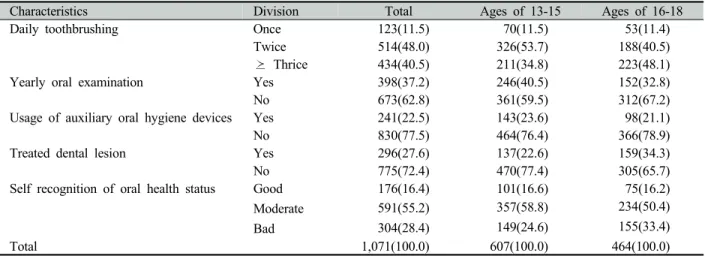
청소년의 구강건강행태 분포는 <Table 2>와 같다. 1일 칫
솔질 횟수에서 13세-15세는 2회 53.7%로 가장 많았고, 3회
이상 34.8%, 1회 이하 11.5% 순이었다. 1년간 구강검진 여부
는 검진을 하는 경우가 40.5%로 검진을 하지 않는 경우
59.5% 보다 낮았다. 구강보조용품 사용여부에서는 사용하는
경우가 23.6%로 사용하지 않는 경우 76.4% 보다 낮았으며,
치과 치료 여부에서는 치료한 경우가 77.4%로 치료하지 않은
경우 22.6%보다 높았다. 그리고 본인인지 구강건강상태에서
보통이 58.8%로 가장 높게 나타났고, 나쁨 24.6%, 좋음
16.6% 순으로 나타났다. 1일 칫솔질 횟수에서 16세-18세는
3회 이상 48.1%로 가장 높게 나타났으며, 2회 40.5%, 1회
이하 11.4%로 나타났다. 1년간 구강검진여부에서는 검진을
한 경우가 32.8%로 검진을 하지 않은 경우 67.2% 보다 낮았 다. 구강보조용품 사용여부에 있어서는 사용하는 경우가 21.1%로 사용하지 않는 경우 78.9% 보다 낮았다. 치과 치료 여부에 있어서는 치료한 경우가 65.7%로 치료하지 않은 경 우 34.3% 보다 높았다. 본인인지 구강건강상태는 보통 50.4%로 가장 높게 나타났고, 나쁨 33.4%, 좋음 16.2% 순 으로 나타났다.
3. 음주 및 흡연에 따른 치주건강상태의 차이
음주 및 흡연에 따른 치주건강상태의 차이는 <Table 3>
과 같다. 평생음주경험이 있는 경우 출혈 이상 치주조직이 41.0%로 평생음주경험이 없는 경우 출혈 이상 치주조직 31.0%와 유의한 차이가 나타났다(p<0.05).
4. 구강건강행태에 따른 치주건강상태의 차이
구강건강행태에 따른 치주건강상태의 차이는 <Table 4>
와 같다. 1년간 구강검진 여부에 따른 치주건강상태는 구강 검진을 받은 대상자에서 출혈이상 치주조직 29.7%로 구강 검진을 받지 않은 대상자의 출혈 이상 치주조직 38.5%와
유의한 차이가 있었다 (p<0.01). 구강보조용품을 사용하는 대상자의 출혈이상 치주조직 22.5%로 구강보조용품을 사용 하지 않는 사람의 출혈이상 치주조직 38.8%와 유의한 차이 가 있었다(p<0.01). 치과 치료 여부에서도 치료한 경우가 출혈이상 치주조직 32.4%로 치료하지 않은 경우의 출혈 이 상 치주조직 41.5%와 유의한 차이가 있었다(p<0.01). 본인 인지 구강건강상태에 따른 출혈 이상 치주조직의 분포는 나 쁨 45.0%로 가장 높았고, 보통 30.8%, 좋음 30.7% 순으로 나타났으며 유의한 차이가 있었다 (p<0.01).
1년간 구강검진 여부에 따른 치주건강상태는 13세-15세 에서 구강검진을 받은 대상자는 출혈이상 치주조직 22.8%, 구강검진을 받지 않은 대상자는 출혈 이상 치주조직 31.9%
로 유의한 차이가 있었고 (p<0.05), 치과 치료 여부에 따른 치주건강상태는 치료한 경우가 출혈 이상 치주조직 36.2%, 치료하지 않은 경우가 출혈 이상 치주조직 25.3%로 유의한 차이가 있었다(p<0.05). 본인인지 구강건강상태에 따른 출 혈 이상 치주조직 분포는 나쁨 38.3%이 가장 높았고, 보통 24.6%, 좋음 23.6% 순으로 구강건강상태인지와 치주조직 건강은 유의한 차이가 있었다(p<0.05).
구강보조용품을 사용하는 대상자의 출혈 이상 치주조직
Characteristics Division Total Ages of 13-15 Ages of 16-18
Daily toothbrushing Once 123(11.5) 70(11.5) 53(11.4)
Twice 514(48.0) 326(53.7) 188(40.5)
Thrice 434(40.5) 211(34.8) 223(48.1)
Yearly oral examination Yes 398(37.2) 246(40.5) 152(32.8)
No 673(62.8) 361(59.5) 312(67.2)
Usage of auxiliary oral hygiene devices Yes 241(22.5) 143(23.6) 98(21.1)
No 830(77.5) 464(76.4) 366(78.9)
Treated dental lesion Yes 296(27.6) 137(22.6) 159(34.3)
No 775(72.4) 470(77.4) 305(65.7)
Self recognition of oral health status Good 176(16.4) 101(16.6) 75(16.2)
Moderate 591(55.2) 357(58.8) 234(50.4)
155(33.4) 149(24.6)
304(28.4) Bad
Total 1,071(100.0) 607(100.0) 464(100.0)
Table 2. Distribution on oral health behavior of adolescents Unit: N(%)
Characteristics Division Total Ages of 13-15 Ages of 16-18
Lifetime drinking experience Yes 391(36.5) 113(18.6) 278(59.9)
No 680(63.5) 494(81.4) 186(40.1)
Smoking experience Yes 186(17.4) 69(11.4) 117(25.2)
No 885(82.6) 538(88.6) 347(74.8)
Stress recognition level High 273(25.5) 142(23.4) 131(28.2)
Low 798(74.5) 465(76.6) 333(71.8)
Depression (≥ 2weeks) Yes 104(9.7) 49(8.1) 55(11.9)
No 967(90.3) 558(91.9) 409(88.1)
Total 1,071(100.0) 607(100.0) 464(100.0)
Table 1. Distribution on health behavior of adolescents Unit: N(%)
Characteristics Division
Total
p-value
*Ages of 13-15
p-value
*Ages of 16-18
p-value
*Sound Bleeding
abnormality Sound Bleeding
abnormality Sound Bleeding
abnormality Daily toothbrushing Once 76(60.6) 47(39.4) 0.659 52(71.4) 18(28.6) 0.418 24(49.2) 29(50.8) 0.366
Twice 355(65.9) 159(34.1) 243(69.5) 83(30.5) 112(61.5) 76(38.5)
≥ Thrice 296(64.5) 138(35.5) 166(75.9) 45(24.1) 130(57.0) 93(43.0)
Yearly Oral examination
Yes 287(70.3) 111(29.7) 0.009
**195(77.2) 51(22.8) 0.023
*92(62.2) 60(37.8) 0.265
No 440(61.5) 233(38.5) 266(68.1) 95(31.9) 175(56.0) 138(44.0)
Use of auxiliary oral hygiene devices
Yes 192(77.5) 49(22.5) <0.001
***120(78.9) 23(21.1) 0.123 72(75.9) 26(24.1) 0.002
**No 535(61.2) 295(38.8) 341(69.6) 123(30.4) 194(53.8) 172(46.2)
Teated dental lesion Yes 175(58.5) 121(41.5) 0.015
*95(63.8) 42(36.2) 0.028
*80(54.7) 79(45.3) 0.319
No 552(67.6) 223(32.4) 366(74.7) 104(25.3) 186(59.8) 119(40.2)
Self recognition of oral health status
Good 129(69.3) 47(30.7) 0.002
**79(76.4) 22(23.6) 0.044
*50(62.6) 25(37.4) 0.073
Moderate 418(69.2) 173(30.8) 278(75.4) 79(24.6) 140(62.2) 94(37.8)
Bad 180(55.0) 124(45.0) 104(61.7) 45(38.3) 76(50.2) 79(49.8)
Total 1,071(100.0) 461(71.8) 146(28.2) 266(58.0) 198(42.0)
*
p<0.05,
**p<0.01,
***p<0.001 by Chi-square test
Table 4. Difference of periodontal health status according to oral health behavior Unit: N(%)
Characteristics Division Total ages of 13-15 ages of 16-18
OR 95% CI OR 95% CI OR 95% CI
Stress recognition level High 1.174 (0.824, 1.674) 1.375 (0.788, 2.399) 1.045 (0.654, 1.670)
Low Ref Ref Ref
Depression(> 2 weeks) Yes 1.259 (0.723, 2.192) 0.883 (0.355, 2.195) 1.627 (0.722, 3.665)
No Ref Ref Ref
Lifetime
drinking experience
Yes Ref Ref Ref
No 1.029 (0.632, 1.676) 1.008 (0.509, 1.994) 1.017 (0.573, 1.805)
Smoking experience Yes Ref Ref Ref
No 1.084 (0.697, 1.685) 0.914 (0.397, 2.106) 1.194 (0.703, 2.027) Daily toothbrushing ≤ Once 0.972 (0.550, 1.718) 0.868 (0.402, 1.876) 1.025 (0.481, 2.181) Twice 0.901 (0.631, 1.286) 1.102 (0.667, 1.820) 0.814 (0.495, 1.340)
≥ Thrice Ref Ref Ref
Yearly oral examination Yes Ref Ref Ref
No 1.228 (0.904, 1.668) 1.375 (0.805, 2.090) 1.080 (0.646, 1.806) Usage of auxiliary oral hygiene
devices
Yes Ref Ref Ref
No 2.054 (1.311, 3.218) 1.467 (0.758, 2.841) 2.658 (1.327, 5.324) Treated dental lesion Yes 1.150 (0.824, 1.605) 1.410 (0.831, 2.395) 1.036 (0.680, 1.577)
No Ref Ref Ref
Self recognition of oral health status Good 1.108 (0.687, 1.785) 1.165 (0.599, 2.266) 1.015 (0.547, 1.885) Moderate 1.697 (0.990, 2.911) 1.641 (0.699, 3.852) 1.616 (0.809, 3.228)
Bad Ref Ref Ref
*
by multiple logistic regression analysis OR, odds ratio; CI, confidence interval
Table 5. Factors affecting peridontal health status Characteristics Division
Total
p-value
*Ages of 13-15
p-value
*Ages of 16-18
p-value
*Sound Bleeding
abnormality Sound Bleeding
abnormality Sound Bleeding
abnormality Lifetime
drinking experience
Yes 233(59.0) 158(41.0) 0.039
*80(68.7) 33(31.3) 0.514 153(55.8) 125(44.2) 0.326
No 494(69.0) 186(31.0) 381(72.6) 113(27.4) 113(61.7) 73(38.3)
Smoking experience
Yes 117(59.0) 69(41.0) 0.133 51(69.2) 18(30.8) 0.664 66(53.7) 51(46.3) 0.323
No 610(66.3) 275(33.7) 410(72.2) 128(27.8) 200(59.6) 147(40.4)
Total 1,071(100.0) 461(71.8) 146(28.2) 266(58.0) 198(42.0)
*
p<0.05 by Chi-square test
Table 3. Difference of periodontal health status according to smoking and drinking Unit: N(%)
의 분포는 16세-18세에서 24.1%로 사용하지 않는 대상자 46.2%와 유의한 차이가 있었다(p<0.01).
5. 치주건강상태에 영향을 미치는 요인