
JKSCI
A Study on Effective Software Education Model by Disability Type for Youth
1)
Hyun Ju Lee*, Won Joo Lee**, Hoe Kyung Jung***
*Teacher, Daejeon Jungang High School, Daejeon, Korea
**Professor, Dept. of Computer Science, Inha Technical College, Incheon, Korea
***Professor, Dept. of Computer Engineering, Pai Chai University, Daejeon, Korea
[Abstract]
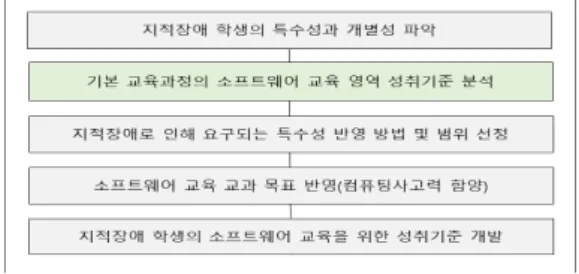
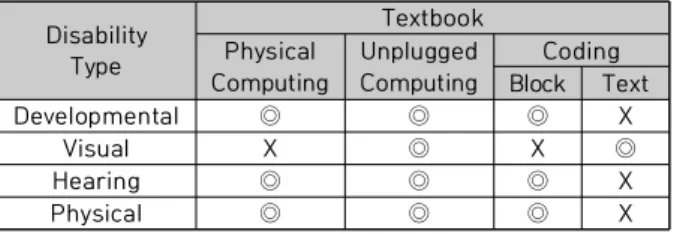
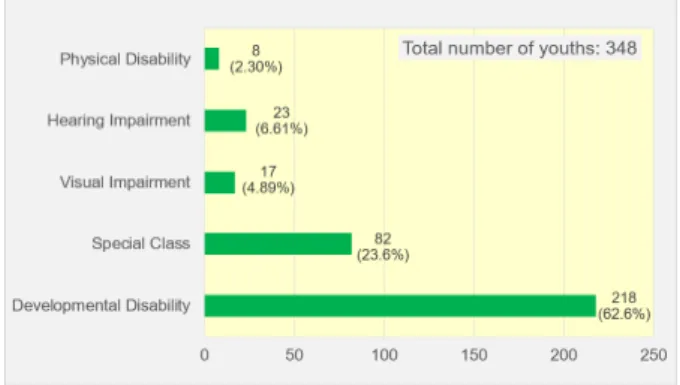
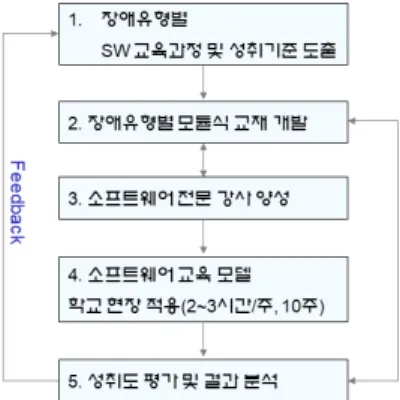
In this paper, we propose an effective software education model for youths with disability. This software education model consists of a four-step process. In the first step, it draws the education curriculum of the software education for different types of disabled youths based on the results of comparative analysis of software education field in special education curriculum. In the second step, it suggests achievement standards for effective software education for the disabled students by classifying students with intellectual disabilities and visual, hearing, and physical disabilities without any multiple disabilities. In the third step, the study developed a modular textbook comprised of unplugged activities using coding robot Albert, physical computing, and block/text coding with the reflection of the characteristic of each type of disability. In the fourth step, it applied the textbook to the school field and educated disabled students focusing on experience to allow them to think logically and by stages about different problems they face in daily lives. In addition, by analyzing the results of youths' performance evaluation and surveys, it was shown that 82.3% of developmental disabilities, 78.8% of visual impairments, 90.9% of hearing impairments, and 78.8% of physically disabilities achieved achievements above the “medium” level. These results prove that the software education model for youths with disabilities proposed in this paper is very effective in improving computational chinking of youths with disabilities.
▸Key words: Achievement standard, Coding robot albert, Computational Thinking, Disability type, Modular textbook
∙First Author: Hyun Ju Lee, Corresponding Author: Won Joo Lee, Hoe Kyung Jung
*Hyun Ju Lee ([email protected]), Daejeon Jungang High School
**Won Joo Lee ([email protected]), Dept. of Computer Science, Inha Technical College
***Hoe Kyung Jung ([email protected]), Dept. of Computer Engineering, Pai Chai University
∙Received: 2020. 09. 21, Revised: 2020. 10. 08, Accepted: 2020. 10. 08.
Copyright ⓒ 2020 The Korea Society of Computer and Information http://www.ksci.re.kr pISSN:1598-849X | eISSN:2383-9945
![[초안작성용지][초안작성용지]](data:image/gif;base64,R0lGODlhAQABAIAAAP///wAAACH5BAEAAAAALAAAAAABAAEAAAICRAEAOw==)