Corresponding author: Lee Misuk, Tel. +82-62-530-1345, Fax. +82-62-530-1349 E-mail: [email protected]
This research is a part of master’s thesis.
This research was presented at the 2014 Spring Conference of The Korean Society of Fashion Business.
This research was supported in 2014 by the MOE (The Ministry of Education), Republic of Korea, under the BK21 plus project (S13HR15D0801) supervised by the NRF (National Research Foundation of Korea).
A Study on the Red Carpet Dress of Film Festivals in the Great China Region
Wang Ling · Lee Misuk⁺
Dept. of Clothing and Textiles, Chonnam National University
Dept. of Clothing and Textiles, Chonnam National University, Human Ecology Research Institute, Chonnam National University
Abstract
The purpose of this study is to establish the basic materials necessary for red carpet fashion design by examining the formativeness and fashion images of red carpet dresses at film festivals in the Great China Region. For the purpose of this study, research methods include a literature review on the origin and significance of red carpet dresses, the characteristics of film festivals in the Great China Region and their red carpet dresses as well as an analysis of the formative features and images of 615 red carpet dresses collected from each film festival official homepage, diverse media articles, and online search sites (www.google.com, www.hao123.com). The research finding can be summarized as follows: First, the formative features of red carpet dress designs were analyzed herein. It was found that the most frequently appearing type of silhouette was straight followed by hourglass and bulk in order. More specifically these included fit and flare, mermaid, trapeze, and slim in order. For the neckline styles, strapless was the most frequently seen followed by camisole, jewel, and one shoulder. Solid colors were more often seen than multiple colors. Bk, W, R, and YR were the most frequent main solid colors in order. Solid materials were frequent as well, such as soft and shiny materials.
Non-patterned and unadorned styles were most frequent as for pattern types and details and trimmings. Second, the fashion images of red carpet dresses in the Great China Region were analyzed. The most frequent images were elegant, feminine, ethnic, modern, classic, avant-garde, others, mannish and sportive, in order.
Key words : fashion image, formativeness, Great China Region film festival, red carpet, red carpet dress
I. Introduction
Films are one of the most wide-reaching and influential ways of artistic expression. They record history, transfer and succeed culture and spread human thoughts. In recent modern days, films, thanks to the remarkable growth of mass media, have become an indispensible refreshment in our lives within a close reach of us (Kuang, 2012).
At film festivals, a party of all people involving in movie and films, which film wins the prize matters of course, but what kind of dresses actresses wear also equally matters. One of the most interested parts of yearly film awards is top actors and actresses stepping on a red carpet in plenty of diverse styles from the entrance amid cheering fans. Innovative media advancement enabled people to watch such festivals and events in real time through various media. The looks of actresses taking poses on the red carpet can meet tremendous reactions through broadcasting or newspapers, etc. in real time (J. Lim, 2011). Film festival dresses worn by actresses on the red carpet, in particular, often make one of the largest issues of the year in the fashion industry and are watched with huge interest by the industry people. Such huge interest even generated a now word, 'red carpet look'. That much is how significant any celebrity’s red carpet look is through which we can even peek at future fashion trends (M. Park
& Ko, 2013).
The widespread effect of Hollywood films in the world has gathered global attention to the Academy Award along with star actresses’
dresses as well. As such, in step with the rising interest in Asian culture, and more Chinese films going abroad and winning international prizes, the red carpet dresses of Chinese actresses
have also grasped attention (For instance, Manyu Zhang, starting from Berlin Film Festival in 1992, won the best actress award in Cannes film festival in 2004, receiving great attention. Li Gong won the best actress award in Venice Film Festival in 1992. Qi Shu won the best actress prizes in Cannes in 2001 and 2006). The increasing number of high-profile Chinese actresses has attracted more global interest. In this situation, more studies have become necessary on their red carpet dresses that can let the world know Chinese identity, beauty and culture and create economic and cultural effects as well.
Studies on red carpet fashion styles have been continuously published since the mid 2000s but they have been onely on South Korean events such as DaeJong Film Festival, Paeksang Awards, and Blue Dragon Awards (Byun & Lee, 2008; Cha, 2011; Chung & Kim, 2005; Kang & Lee, 2009; E. Lee, 2005; J. Lim, 2011; Son & Kim, 2011) along with Academy Awards and Grammy Award, a music award (M.
Park & Ko, 2013) and not been on film-festival dresses in the Great China Region (Great China Region referring to broader areas under huge cultural and economic influence of Chinese people, including China, Taiwan, Hong Kong and Macao. These states call themselves as the grand Chinese area or grand Chinese district).
In this recognition, the present study analyzed the formativeness and images of red carpet dresses of Chinese actresses in order to establish the basic materials necessary for red carpet look. For the research method, the researcher first studied extant literature and other relevant materials to understand the characteristics and red carpet dresses of Great China Region festivals and analyzed the formative characteristics and fashion images
shown in red carpet dresses from 2005 to 2013 Chinese film events (China Golden Rooster and Hundred Flowers Film Festival, TaiPei Golden Horse Film Festival, and Hong Kong Film Awards) based on data collection from movie award sites and relevant information sites, etc.
II. Theoretical Background
1. The Origin and Significance of Red Carpet
Red carpet is a term used to refer to a red rug put on floor for important persons to step on. It was originated from Oresteia, a masterpiece written by ancient Greek poet Aeschy-los, in the section for Agamemnon when he walked on a red road to come home from the Trojan War. Then, European royal families started to floor roads with red carpets to welcome important guests (M. Park & Ko, 2013).
The color red symbolizes power and authority in the ancient and medieval times of the west so red carpets were a means to express royal dignity and majesty. But today, in the modern mass society, they are used as a symbol of the dignity of film festivals and an expression of the honor and glory of star celebrities instead of a means to symbolize upper-class power and authority.
Actresses attending film awards, as they may win a prize in a live broadcasting, try to dress up as much as they can from hair styles, dresses to make-up (E. Lee, 2005). They stand in the center of spotlight and boast of their styles in photo zones on the red carpet. Their dresses are like fashion exhibition, so behind the scene, star celebrities compete closely for styles (M. Park & Ko, 2013). In other words, actresses’
red carpet look reflects the most updated fashion trends of the time, affects general fashion styles and serves as a means to gauge how popular a celebrity is.
2. Film Festivals and Red Carpet Dress of the Great China Region
1) China Golden Rooster and Hundred Flowers Film Festival
The China Golden Rooster and Hundred Flowers Film Festival combined the titles of two film awards in China – Golden Rooster Award and Hundred Flowers Award. The former was named as it was first held in 1981, the year of rooster. The Chinese movie men association has appointed juries every year to select and award good films. The latter is organized by a popular film magazine 'Public Movie'. It was first held in 1962 but suspended from 1964 to 1979 for political reasons and resumed in 1980. 'Public Movie' readers vote to award. For this reason, the Golden Rooster Award is called a prize from experts and the Hundred Flowers Award is called as a prize from the general public. From 1992, the two awards were organized on the sidelines of ‘China Golden Rooster and Hundred Flowers Film Festival’. But from 2005, the title changed to ‘China Golden Rooster and Hundred Flowers Award and those have been staged every other years (China Golden Rooster and Hundred Flowers Film Festival, 2013).
From the 1990s to early 2000s, actresses participating the award showed diverse kinds of styles ranging from dresses to casual clothes. In 1993, Li Gong who attended the 2nd Golden Rooster and Hundred Flowers Award, won the hundred flowers prize and golden-rooster best actress award with two films. In the ceremony
venue, she wore a white shirt and black pants and black vest to express calm and casual image (Figure 1). Bingbing Fan won the hundred-flowers best actress award in the 13th event and she wore a long white dress with camisole neckline and shirring and frill details for innocent and elegant look (Figure 2).
2) Golden Horse Awards Film Festival
The Tai-pei Golden Horse Awards Film Festival has the longest history among the film festivals in the Great China Region. In the early stage, as China and Hong Kong had no similar event to this, the award has become one of the most watched festivals in the Great China Region. Until now, Golden Horse Awards has served as a landmark event in this region, exercising especially large influence in the art film area.
The awards is a key movie cultural event in Taiwan, comprising the area of Great China film competition for golden horse awards and the area of international film competition for golden horse international film festival. The title is a combination of the name ‘Geumun’, a Taiwanese island near the mainland China and
‘Majo’, an islet near Taiwan. The awards was first held in 1962 and organized by Xing Wen Ju. It is to award people producing and contributing good movies by the Taiwanese government for the development of film production industry. In 1980, Golden Horse International Festival was added. For the event, films with high artistic values have been invited from around the world in order to introduce excellent global movies to domestic viewers for their extended movie horizon and to encourage more creative activities of film producers (Golden Horse Awards Film Festival, 2013).
Actresses attending film festivals in the 1960s mostly wore the traditional Chinese costume called qipao. Back then, it was equal to an evening dress. From the 1970s to 1980s, more preferred dresses were in various silhouettes and materials such as fit and flare, rather than qipao. From the 1990s to early 2000s, actresses tried to show sexy feminine look by stressing their body line.
Actress Min You who won the best actress award in the 1st event in 1962 with the film
‘Sun, Moon and Stars’ wore a qipao for the ceremony. Back then some magazine article said she gave a modern look despite wearing the traditional qipao (Figure 3). Ping Wang won the best actress award in 1982 the 19th event and she wore a fit and flare dress with spangle-trimmed in the mixture of satin and chiffon (Figure 4). Junru Wu, the winner of the 40th best actress award in 2003 wore a yellow dress with camisole neckline together with a fur shawl (Figure 5).
3) Hong Kong Film Awards Film Festival
The Hong Kong Film Awards Film Festival is one of the most important movie festivals in the Great China Region and said to be the best award in the region as a whole. Its top award, in particular, is as an Oscar prize for the Hong Kong picture people with full dignity in the area.
The award was first held in 1982 during the period of Nouvelle Vogue of the Hong Kong film industry by the magazine, City Entertainment.
The renowned movie magazine in Hong Kong was first published in 1979 and ever since it has dealt with diverse areas including movies, movie reviews and creation. Back then, the Hong Kong film industry was already developed to reach a certain scale, taking a good position in the
Asian and even in the global movie industry.
Still, there was not a single film festival in Hong Kong or any government organization devoted to film management. In this recognition, the Hong Kong festival invited movie critics every year thanks to the City Entertainment and selected
Figure 1.
The 2nd Golden Rooster and Hundred Flowers
Award in 1993 - Li Gong (巩俐) - www.hao123.com
Figure 2.
The 13th Golden Rooster and Hundred Flowers
Award in 2004 - Bingbing Fan (范冰冰)
- www.hao123.com
Figure 3.
The 1stGolden Horse Awards in 1962 -
Min You (尤敏) - www.goldenhorse.org.tw
Figure 4.
The 19th Golden Horse Awards in 1982 - Ping Wang (汪萍) - www.hao123.com
Figure 5.
The 40th Golden Horse Awards in 2003 - Junru Wu (吴君如) - www.hao123.com
Figure 6.
The 5th Hong Kong Film Awards in 1986 - Xiaofeng Wang (王小鳳)
- www.hao123.com
Figure 7.
The 12th Hong Kong Film Awards in 1993 -
Manyu Zhang (张曼玉) - www.hkfaa.com
Figure 8.
The 21st Hong Kong Film Awards in 2002 - Aijia Zhang (张艾嘉) - www.hao123.com dozens of films for the development of the industry. In 1983, the Hong Kong Film Awards Limited was established. Starting from the 8th event in 1989, multiple organizations have been established on the voluntary basis such as the picture people association, film directors’
association, scenario writers’ association, etc.
And their scale and influence have grown day association, by day by joining forces with the award and Hong Kong government (Hong Kong Film Awards Film Festival, 2013).
Red carpet dresses of the award in the 1980s were diverse not only in terms of materials but also silhouettes. From the 1990s to early 2000s, red carpet look of actresses attending the award included graceful dresses along with casual, modern and diverse other styles. Xiaofeng Wang who won the best actress award in the 5th event in 1986, wore a dress with over-exaggerated sleeves together with a belt to give simple but unique image (Figure 6). Manyu Zhang who received the best actress award in the 12th best actress award in 1993 wore a thin and see-through satin blouse and tight pants with diverse patterns in patchworks such as geometric and abstract patterns, making a sophisticated and unique look (Figure 7). Aijia Zhang who won the best actress award in the 21st event in 2002 won a black slim dress with camisole neckline (Figure 8).
III. Analysis of Red Carpet Dresses in the Great China Region
1. Subject and Method of Analysis 1) Analysis Subject and Data Collection
This research subjects were limited to the red carpet dresses of actresses attending the 3 key film festivals in the Great China Region – China Golden Rooster and Hundred Flowers Film Festival, and Golden Horse Awards Film Festival and Hong Kong Film Awards Film festival – from
2005 to 2013. Of the 623 sets of data materials collected from each corresponding festival official homepages, diverse press releases and search sites (www.google.com, www.hao123.com), etc., 8 sets were excluded for their impossibility to analysis and 615 photos of red carpet dresses were finally selected.
2) Research Method
Based on extant literature and related papers (Cha, 2011; M. Lee, 1999; E. Lee, 2005; J. Lee
& Cho, 2008; J. Lim, 2011; S. Lim & Lee, 2010;
M. Park & Ko, 2013; Son & Kim, 2011), the formativeness of red carpet dresses of the Great China Region was studied herein by classifying their characteristics into shape, color, material and detail and trimmings and they were also examined for change in trend according to each year.
Specifically, the shape was analyzed by centering on silhouette and necklines. Silhouette was largely divided into hourglass, straight and bulk types then, further into fit and tight, fit and flare, princess, crinoline, mermaid, minaret, empire, slim, H line, tent, trapeze, cocoon, and wineglass types. The necklines were grouped into jewel, round, U, square, sweetheart, V, decollete, plunging, camisole, strapless, boat, off shoulder, halter, and one shoulder.
Colors were divided into solid and multi-color then, by centering on main colors, color data were collected and chromatic colors were categorized according to the 10 hue system of Munsell R, YR, Y, GY, G, BG, B, PB, P and RP. Achromatic colors were grouped in Wh, Gr and BK.
Materials were analyzed with the focus on fabric sensation and patterns. That is, fabric sensation was divided largely into solid material and mixed material and solid materials were further divided
into shiny, metallic, soft, stiff, thin and see-through, rough and thick types. Patterns were first divided into patterned and non-patterned and the patterned dresses were classified into simple, and complex patterns. Simple patterns were further separated into geometric, traditional, natural and abstract patterns.
Dress details and trimmings were divided into drape, pleats, frill and ruffle, gather, shirring, flounce, ribbon, tap, fringing, slit, sequin, spangle, beads, crystal, embroidery, corsage, button, belt, fur, string, feather, etc.
Fashion images were classified into 8 categories of classic, elegance, feminine, ethnic, avant-garde, sportive, mannish and modern as well as others for ambiguous cases with more than single images. Then chronological trend was examined. In this research red carpet dress formativeness and image analysis, the present study researcher and 5 other fashion design experts were involved for research objectivity.
3. Results and Discussion
1) Formativeness (1) Shape
Red carpet dress silhouettes are an essential factor determining the image of an actress. In other words, dress silhouette is the first to be considered in the process of searching for a good style fitting an actress’ physical features with appropriate appeal to the press medial and general people (E. Lee, 2005).
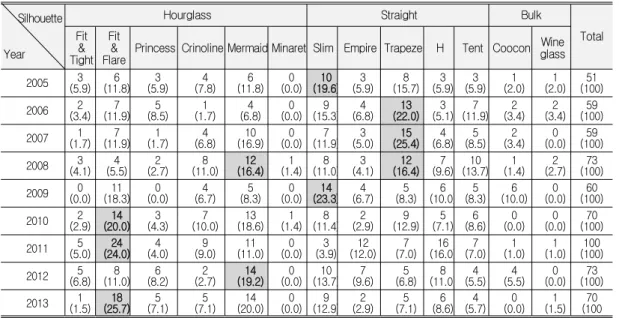
Red carpet dresses in the Chinese region were analyzed and straight (49.8%) was found the most, followed by hourglass (46.3%), and bulk (3.9%) (Table 1). More specifically, fit and flare (16.1%) was more frequent, then mermaid
(14.5%), trapeze (12.8%) and slim (12.7%) in order. Cha (2010) found, in her study on red carpet dresses in Academy Award and Cannes Film Festival from 2006 to 2009, fit and flare most often. As such, fit and flare style is most popular style among the red carpet dress styles.
It is because the style gives the image of elegance and romanticism and at the same time sexually attractiveness by showing part of actresses’ body silhouette, catching more eyes of people than any other silhouettes.
The chronological silhouette trend was analyzed as in Table 2. In 2005 and 2009, slim silhouette was the most popular and in 2006 and 2007, trapeze was the most frequent. In 2008, trapeze silhouette and mermaid type were also seen often, accounting for 16.4%. However, in 2010, 2011 and 2013, fit and flare was seen more from 20.0%, to 24.0% and to 25.7%, respectively. In 2012, mermaid type was most often with 19.2%.
Necklines are important part of making the overall image of an actress, effectively and expressing individual desire for beauty and personality. Necklines determine the whole look of a dress (M. Park, 2013).
Necklines of red carpet dresses in the Chinese region were analyzed as in Table 3.
Strapless necklines were the most popular with 29.9%, followed by camisole (9.3%), jewel (8.5%), one shoulder (8.1%), V (6.7%) / round (6.7%), and decollete (6.3%). Strapless necklines are deemed to flatter the look of actresses the most so it was preferred the most.
Chronically, neckline trend was examined as shown in Table 4. In 2005, camisole neckline was seen most often with 19.6%. From 2006 to 2013, strapless neckline was seen the most followed by divers types of other necklines. In other words, in 2005, decollete was the most
popular; 2006, V; 2007, camisole; 2008, halter;
2009, camisole; 2010, one shoulder/boat; 2011, jewel/V; 2012, jewel; and 2013, round necklines.
In 2013, plunging neckline dresses were worn the most than other years and it seems not to be irrelevant with the 2013 S/S fashion trend.
Balmain, Giambattista Valli and others showed collections with plunging necklines emphasizing
Table 1. Red Carpet Dress Silhouette frequency (%)
Silhouette
Hourglass 285 (46.3) Straight 306 (49.8) Bulk 24 (3.9)
Total Fit &
Tight Fit
& Flare
Prince ss Crinolin
e Mermai
d Minaret Slim Empire Trapeze H Tent Coocon Wineglass
Total 22
(3.6) (99) 16.1 (29)
4.7 (44) 7.1 (89)
14.5 (2) 0.3 (78)
12.7 (40)
6.5 (79)
12.8 (58) 9.4 (51)
8.3 (17)
2.8 (7)
1.1 (615) 100
Silhouette
Year
Hourglass Straight Bulk
Total Fit
& Tight
Fit
&
Flare Princess Crinoline Mermaid Minaret Slim Empire Trapeze H Tent Coocon Wine glass
2005 3
(5.9) 6 (11.8) 3
(5.9) 4
(7.8) 6
(11.8) 0 (0.0) 10
(19.6) 3
(5.9) 8
(15.7) 3 (5.9) 3
(5.9) 1
(2.0) 1
(2.0) 51 (100)
2006 2
(3.4) 7 (11.9)
5 (8.5)
1 (1.7)
4 (6.8)
0 (0.0)
9 (15.3)
4 (6.8)
13 (22.0)
3 (5.1)
7 (11.9)
2 (3.4)
2 (3.4)
59 (100)
2007 1
(1.7) 7 (11.9) 1
(1.7) 4
(6.8) 10
(16.9) 0 (0.0) 7
(11.9) 3 (5.0) 15
(25.4) 4 (6.8) 5
(8.5) 2
(3.4) 0
(0.0) 59 (100)
2008 3
(4.1) 4
(5.5) 2
(2.7) 8
(11.0) 12 (16.4) 1
(1.4) 8 (11.0) 3
(4.1) 12 (16.4) 7
(9.6) 10 (13.7) 1
(1.4) 2
(2.7) 73 (100)
2009 0
(0.0) 11 (18.3) 0
(0.0) 4
(6.7) 5
(8.3) 0
(0.0) 14 (23.3) 4
(6.7) 5
(8.3) 6 (10.0) 5
(8.3) 6
(10.0) 0 (0.0) 60
(100)
2010 2
(2.9) 14 (20.0) 3
(4.3) 7
(10.0) 13 (18.6) 1
(1.4) 8 (11.4) 2
(2.9) 9
(12.9) 5 (7.1) 6
(8.6) 0
(0.0) 0
(0.0) 70 (100)
2011 5
(5.0) 24 (24.0)
4 (4.0)
9 (9.0)
11 (11.0)
0 (0.0)
3 (3.9)
12 (12.0)
7 (7.0)
16 (16.0)
7 (7.0)
1 (1.0)
1 (1.0)
100 (100)
2012 5
(6.8) 8 (11.0) 6
(8.2) 2
(2.7) 14
(19.2) 0 (0.0) 10
(13.7) 7
(9.6) 5
(6.8) 8 (11.0) 4
(5.5) 4
(5.5) 0
(0.0) 73 (100)
2013 1
(1.5) 18 (25.7) 5
(7.1) 5
(7.1) 14
(20.0) 0 (0.0) 9
(12.9) 2
(2.9) 5
(7.1) 6 (8.6) 4
(5.7) 0
(0.0) 1
(1.5) 70 (100 Table 2. Chronological Trend of Red Carpet Dress Silhouette frequency (%)
Table 3. Red Carpet Dress Neckline frequency (%)
Neckline Jewel Round U SquareSweethe
art V Decollete Plunging Camisole Strapless Boat Off the
shoulderHalter One shoulder Total Total 53
(8.6) 41 (6.7) 13
(2.1) 13 (2.1) 19
(3.1) 41 (6.7) 39
(6.3) 32 (5.2) 57
(9.3) 184 (29.9) 29
(4.7) 9 (1.5) 35
(5.7) 50 (8.1) 615
(100) the breast lines ("fashion trend", 2013).
(2) Colors
As the 21st century is also called as the era of colors, colors have become more important than any other times. Colors are one of the visual elements perceived faster and easier than
any other linguistic factors. They are immediate and emotional with stronger power of symbolism and expression than others. Colors, especially in dresses, are a fundamental factor expressing personal impression, preference, character and
Table 4. Chronological Trend of Red Carpet Dress Neckline frequency (%) Neckline
Year Jewel Round U Square Sweeth
eart V Decollete Plunging Camisole Strapless Boat Off the
shoulder Halter One should
er Total
2005 2
(3.9) 4 (7.8) 0
(0.0) 1 (2.0) 5
(9.8) 3 (5.9) 7
(13.7) 4 (7.8) 10
(19.6) 6 (11.8) 2
(3.9) 1 (2.0) 4
(7.8) 2 (3.9) 51
(100)
2006 4
(6.8) 0 (0.0) 1
(1.7) 3 (5.1) 2
(3.4) 7 (11.9) 5
(8.5) 1 (1.7) 6
(10.2) 19 (32.2) 3
(5.1) 1 (1.7) 6
(10.2) 1 (1.7) 59
(100)
2007 4
(6.8) 3 (5.1) 3
(5.1) 0 (0.0) 0
(0.0) 2 (3.4) 3
(5.1) 3 (5.1) 11
(18.6) 16 (27.1) 1
(1.7) 1 (1.7) 3
(5.1) 9 (15.3) 59
(100)
2008 4
(5.5) 2 (2.7) 3
(4.1) 0 (0.0) 4
(5.5) 3 (4.1) 3
(4.1) 1 (1.4) 5
(6.8) 29 (40.0) 2
(2.7) 1 (1.4) 9
(12.3) 7 (9.6) 73
(100)
2009 3
(5.0) 3 (5.0) 1
(1.7) 1 (1.7) 0
(0.0) 1 (1.7) 5
(8.3) 2 (3.3) 8
(13.3) 24 (40.0) 1
(1.7) 0 (0.0) 6
(10.0) 5 (8.3) 60
(100)
2010 3
(4.3) 2 (2.9) 1
(1.4) 2 (2.9) 0
(0.0) 6 (8.6) 6
(8.6) 1 (1.4) 6
(8.6) 25 (35.7) 8
(11.4) 1 (1.4) 1
(1.4) 8 (11.4) 70
(100)
2011 10
(10.0) 9 (9.0) 3
(3.0) 1 (1.0) 5
(5.0) 10 (10.0) 7
(7.0) 6 (6.0) 6
(6.0) 24 (24.0) 5
(5.0) 3 (3.0) 2
(2.0) 9 (9.0) 100
(100)
2012 14
(19.2) 4 (5.6) 0
(0.0) 1 (1.4) 1
(1.4) 8 (11.0) 1
(1.4) 3 (4.1) 4
(5.6) 25 (34.2) 2
(2.7) 0 (0.0) 3
(4.1) 7 (9.6) 73
(100)
2013 9
(12.9) 14 (20.0) 1
(1.4) 4 (5.7) 2
(2.9) 1 (1.4) 2
(2.9) 11 (15.7) 1
(1.4) 16 (22.9) 5
(7.1) 1 (1.4) 1
(1.4) 2 (2.9) 70
(100)
aesthetical sensitivity (H. Park, Lee, Yeom, Choi,
& Park, 2006). Therefore, fashion look expressed through colors is one of the key image-making strategies for actresses walking on red carpets to grasp public eyes.
In this recognition, red carpet dress colors in the Chinese region were examined. As a result, solid-color dresses were more than multi-colored dresses. Chronically, in every year, solid colors were more often seen than multi-colors (Table 5).
The main colors (Of the 615 dresses, 12 had no main color accounting for at least 50% of themselves) which accounted for at least 50% of the red carpet dresses were examined as in Table 6. Chromatic colors (51.6%) were more than achromatic colors (48.4%). More
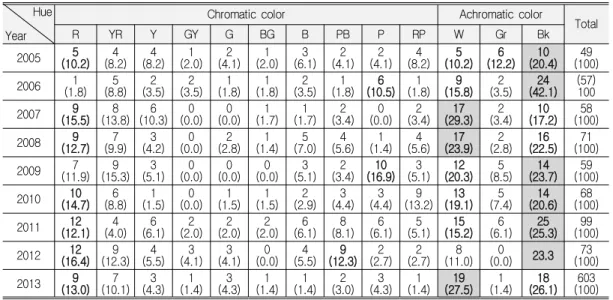
specifically, Bk was the most frequent (24.5%), followed by W (19.1%), R (12.3%) and YR (9.8%) in order. That is, excluding the study of M. Park and Ko (2013) which reported red was the most-seen color in Academy Award, studies
by Chung and Kim (2005), J. Lim (2005), and Cha (2010) stated black as the most frequently seen dress color. As such, black was the most popular as well for the color of red carpet dresses in the Chinese region seemingly because black gives a sophisticated yet glamorous look and it makes one look slimmer. So the color has long been preferred on red carpets. White, for its propensity to glint back light, is effective in a strong stage spotlight to flatter up the look of actresses as has been also preferred together with black in the region. Red is also one of the most effective colors to give feminine and challenging impression on red carpets (J. Lim, 2011) and is the most favored color in the Chinese region.
The yearly color examination results are in
Table 7. Black was most popular excluding 2007, 2008, and 2013 when white prevailed.
Next, in 2005 Gr and R/W; 2006 and 2009, Wand P; 2010 and 2011, W and R; and 2010, R
Table 5. Chronological Trend of red Carpet Dress Color frequency (%) Year
Color 2005 2006 2007 2008 2009 2010 2011 2012 2013
Solid colors
36 (61.0)
35 (59.3)
41 (69.5)
55 (75.3)
39 (65.0)
45 (64.3)
66 (66.0)
50 (68.5)
49 (70.0) Multi
Colors
15 (39.0)
24 (40.7)
18 (30.5)
18 (24.7)
21 (35.0)
25 (35.7)
34 (34.0)
23 (31.5)
21 (30.0)
Hue Chromatic color 311 (51.6) Achromatic color
292 (48.4) Total
R YR Y GY G BG B PB P RP W Gr Bk
Total 74 (12.3)
59 (9.8)
32 (5.3)
9 (1.5)
14 (2.3)
8 (1.3)
27 (4.5)
33 (5.5)
24 (4.0)
31 (5.1)
115 (19.1)
29 (4.8)
148 (24.5)
603 (100)
Table 6. Red Carpet Dress Main Color frequency (%)
and PB followed. Red carpet dress color is not closely related to the fashion trends. That is, red carpet dress colors have been different from fashion trend such as pink in the 2009 S/S collection; black and white in the 2010 S/S collection; vivid neon color 2012 S/S collection;
orange, pink, yellow, green in the 2012 F/W collection; white in the 2013 S/S collection;
metallic color in the 2013 F/W collection.
(3) Materials
Clothes deliver general impression via their own formative elements. If shapes are an explanatory design factor, colors or materials are factors implying sensitive image. Materials, in particular, deliver the sense of touch and synesthesia thus, image impression through materials is move effective (Y. Park, Kim, Lee,
Shin, Choi, & Choi, 2001). In this recognition, 615 pieces of Chinese red carpet dresses were analyzed for their materials, centering on the fabric sensation and patterns.
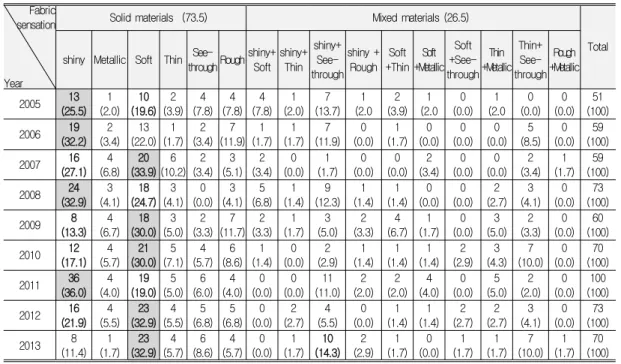
The fabric sensation analysis results are described in Table 8. Solid materials accounted for 73.5% and mixed materials, 26.5%. More specifically, soft materials were used the most (27.0%), followed by shiny materials (24.7%), shiny + thin/see-through (8.8%) and rough and thick materials (7.0%). Such a finding is different from that of the study by Cha(2010) where shiny materials were seen more often followed by soft materials and thin and see-through materials.
That is, shiny materials expresses fancy, graceful and feminine look and effective in stage spotlights to flatter up an actress. Therefore, it was found to be the most favored by not just Cannes Film Festival but also most other film events including those of South Korea. But the Chinese film festivals were found to prefer soft materials than shiny materials. This is because soft materials give elegant and romantic
impression and soft femininity at the same time.
Yearly fabric sensation analysis results are in Table 9. In 2005, 2006, 2008 and 2011, shining materials were seen the most frequently and in 2007, 2009, 2010, 2012 and 2013, soft materials
Hue Year
Chromatic color Achromatic color
Total
R YR Y GY G BG B PB P RP W Gr Bk
2005 5
(10.2) 4 (8.2) 4
(8.2) 1 (2.0) 2
(4.1) 1 (2.0) 3
(6.1) 2 (4.1) 2
(4.1) 4 (8.2) 5
(10.2) 6 (12.2) 10
(20.4) 49 (100)
2006 1
(1.8) 5 (8.8) 2
(3.5) 2 (3.5) 1
(1.8) 1 (1.8) 2
(3.5) 1 (1.8) 6
(10.5) 1 (1.8) 9
(15.8) 2 (3.5) 24
(42.1) (57) 100
2007 9
(15.5) 8 (13.8) 6
(10.3) 0 (0.0) 0
(0.0) 1 (1.7) 1
(1.7) 2 (3.4) 0
(0.0) 2 (3.4) 17
(29.3) 2 (3.4) 10
(17.2) 58 (100)
2008 9
(12.7) 7 (9.9) 3
(4.2) 0 (0.0) 2
(2.8) 1 (1.4) 5
(7.0) 4 (5.6) 1
(1.4) 4 (5.6) 17
(23.9) 2 (2.8) 16
(22.5) 71 (100)
2009 7
(11.9) 9 (15.3) 3
(5.1) 0 (0.0) 0
(0.0) 0 (0.0) 3
(5.1) 2 (3.4) 10
(16.9) 3 (5.1) 12
(20.3) 5 (8.5) 14
(23.7) 59 (100)
2010 10
(14.7) 6 (8.8) 1
(1.5) 0 (0.0) 1
(1.5) 1 (1.5) 2
(2.9) 3 (4.4) 3
(4.4) 9 (13.2) 13
(19.1) 5 (7.4) 14
(20.6) 68 (100)
2011 12
(12.1) 4 (4.0) 6
(6.1) 2 (2.0) 2
(2.0) 2 (2.0) 6
(6.1) 8 (8.1) 6
(6.1) 5 (5.1) 15
(15.2) 6 (6.1) 25
(25.3) 99 (100)
2012 12
(16.4) 9 (12.3) 4
(5.5) 3 (4.1) 3
(4.1) 0 (0.0) 4
(5.5) 9 (12.3) 2
(2.7) 2 (2.7) 8
(11.0) 0
(0.0) 23.3 73 (100)
2013 9
(13.0) 7 (10.1) 3
(4.3) 1 (1.4) 3
(4.3) 1 (1.4) 1
(1.4) 2 (3.0) 3
(4.3) 1 (1.4) 19
(27.5) 1 (1.4) 18
(26.1) 603 (100) Table 7. Chronological Trend of Red Carpet Dress Color frequency (%)
Table 8. Red Carpet Dress Fabric Sensation frequency (%)
Fabr ic sens
atio n
Solid materials 425 (73.5) Mixed materials 163 (26.5)
Total shiny Meta
llic Soft Thin See- throu gh
Rou gh
shiny + Soft
shiny + Thin
shiny + See- throu gh
shiny + Rough
Soft +Thin
Soft +Met allic
Soft +See - throu
gh Thin +Met allic
Thin + See- throu gh
Rou gh +Met
allic
Total 152 (24.7)
27 (4.4)
166 (27.0)
33 (5.4)
31 (5.0)
43 (7.0)
15 (2.4)
7 (1.1)
54 (8.8)
9 (1.5)
13 (2.1)
10 (1.6)
31 (5.0)
5 (0.8)
17 (2.8)
2 (0.3)
615 (100)
were more often. In 2013, soft materials were followed by the mixture of shining, thin and see-through materials.
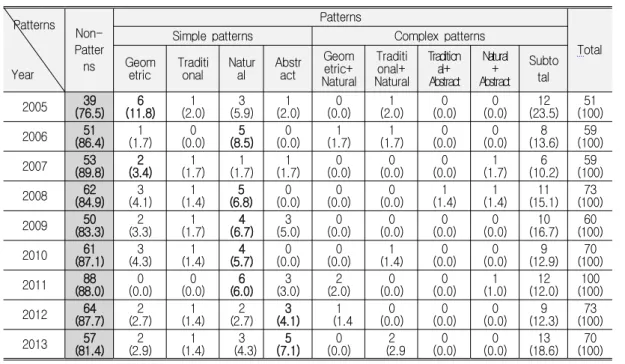
Red carpet dress patterns in the Chinese region were examined. As in Table 10, non-patterned dresses (85.4%) were far more seen than patterned dresses (14.6%). This is
consistent with the research result of M. Park and Ko (2011) that both Academy Award and Grammy Award showed non-patterned dresses the most, signaling that red carpet dresses tended to stress fabric sensation rather than
patterns. Natural patterns were shown the most frequently among the patterned dresses.
The chronological trend is exhibited in Table 11. Throughout the whole period from 2005 to 2013, non-patterned dresses appeared more often. Following them, geometric patterns were second-mostly seen in 2005 and 2007; natural