• 검색 결과가 없습니다.

Preparation of Spherical TiO<sub>2</sub> Nanoparticles Using Amphiphilic PCZ-r-PEG Random Copolymer Template Membrane

N/A
N/A
Protected

Academic year: 2021

Share "Preparation of Spherical TiO<sub>2</sub> Nanoparticles Using Amphiphilic PCZ-r-PEG Random Copolymer Template Membrane"

Copied!
7
0
0

로드 중.... (전체 텍스트 보기)

전체 글

(1)

DOI: https://doi.org/10.14579/MEMBRANE_JOURNAL.2019.29.3.183

1. Introduction 1)

Mixed matrix membranes (MMMs) composed of in- organic fillers with organic polymer matrix is a prom- ising candidate for gas separation process. Incorpora- tion of porous inorganic filler and high permselective

polymer matrix can overcome intrinsic limitation of polymer membrane. There were various inorganic fill- ers to achieve high gas separation performance such as carbon-based materials[1,2], zeolite[3] and metal ox- ides[4,5].

Nanostructured materials synthesized are one of the

Corresponding author(e-mail: [email protected], http://orcid.org/0000-0002-3820-141X)

양친성 PCZ-r-PEG 랜덤 공중합체 분리막을 이용한 구형 이산화티타늄 나노입자의 제조

이 재 훈*⋅라즈쿠마 파텔**,†

*연세대학교 화공생명공학과, **연세대학교 융합과학공학부 (2019년 6월 24일 접수, 2019년 6월 27일 수정, 2019년 6월 27일 채택)

Preparation of Spherical TiO

2

Nanoparticles Using Amphiphilic PCZ-r-PEG Random Copolymer Template Membrane

Jae Hun Lee* and Rajkumar Patel**

,†

*Department of Chemical and Biomolecular Engineering, Yonsei University, 50 Yonsei-ro, Seodaemun-gu, Seoul 03722, Korea

**Energy and Environmental Science and Engineering, Integrated Science and Engineering Division (ISED), Underwood International College, Yonsei University, 85, Songdogwahak‐ro, Yeonsu-gu, Incheon 21983, Korea

(Received June 24, 2019, Revised June 27, 2019, Accepted June 27, 2019)

요 약: 양친성 PCZ-r-PEG 랜덤 공중합체를 기반으로 한 수열합성법을 통해 자가조립된 메조기공 이산화티타늄 마이크로 스피어를 합성하였다. 중합된 PCZ-r-PEG는 푸리에 변환 적외분광법(fourier transform infrared spectroscopy, FT-IR), 핵자기 공명(nuclear magnetic resonance, NMR), 젤 투과 크로마토그래피(gel permeation chromatography, GPC) 그리고 투과전자 현 미경(transmission electron microscopy, TEM)을 통해 그 특성이 분석되었다. 다공성 이산화티타늄 입자는 PCZ-r-PEG, 글루 코스(glucose), 물을 테트라히드로푸란(tetrahydrofuran, THF) 용액에 분산시킨 뒤 150°C, 12시간 동안 반응시켰다. 다공성 이 산화티타늄 입자의 구조와 결정성 분석을 위해 주사전자현미경(scanning electron microscopy, SEM)과 엑스선 회절(X-ray diffraction, XRD)이 사용되었다.

Abstract: Amphiphilic PCZ-r-PEG random copolymer assisted solvothermal process is used to prepare mesoporous TiO

2

microspheres generated from nanoparticles by self-assembly method. Synthesized PCZ-r-PEG is characterized by Fourier transform infrared spectroscopy (FT-IR), nuclear magnetic resonance (NMR), gel permeation chromatography (GPC) and transmission electron microscopy (TEM). The mesoporous TiO

2

are prepared by PCZ-r-PEG, glucose, water in tertrahydrofuran solution at 150°C for 12 h and the TiO

2

microspheres are calcined at 550°C for 30 min to further crystallize and organic residue are removed. Morphology and crystallization phase is characterized by scanning electron microscopy (SEM) and X-ray diffraction (XRD) respectively. The mesoporous TiO

2

crystallized in pure anatase phase with diameter of 300 ± 20 nm.

Keywords: TiO

2

, solvothermal, polymer, self-assembly

(2)

most important area of research due to the correlation between the specific morphology and unique proper- ties[6,7]. Mesoporous TiO

2

has large surface area and unique pore structure distribution which resulted in several applications in electrochemical devices, air pro- tection and membranes[8-12]. TiO

2

with specific mor- phology can be prepared by hydrothermal, sol-gel, hy- drolysis and precipitation[13-20].

Solvothermal process is one of the simplest method for preparation of well-designed morphology with po- rosity and high crystallinity. Structure directing agent induced solvothermal process leads to in situ growth of crystallized metal oxide. Yu et al. prepared hollow in- organic microsphere by chemically induced self-trans- formation method. In this solvothermal process two different approach for self-transformation is followed.

Firstly, polymer (poly(4-styrenesulfonate)) mediated method to prepare calcium carbonate hollow micro- sphere. Secondly fluoride mediated approach with NH

4

F, SnF

2

as source to prepare TiO

2

and SnO

2

hollow sphere respectively[21]. Ti (SO

4

)

2

and NH

4

F is used to pre- pare TiO

2

hollow sphere by hydrothermal method[22].

Xi et al. prepared hybrid TiO

2

in French fries like mor- phology by P123 as the structure directing directing agent[23]. Hydrated salt assisted solvothermal (HAS) strategy is utilized to prepare TiO

2

hollow sphere with hybrid composition[24]. Roh et al. prepared TiO

2

hol- low nanosphere by solvothermal process with poly- ethylene glycol (PEG) as the structure directing agent.

It is used to prepare mixed matrix membrane for car- bon dioxide (CO

2

) separation process[25]. Chen et al.

reported the synthesis of monodisperse mesoporous anatase TiO

2

by sol-gel and solvothermal process with hexadecylamine as the structuring agent[26]. In a sim- ilar process Cheng et al. reported TiO

2

microsphere with nonanoic acid as the structure directing agent[27].

In this work PCZ-r-PEG random copolymer is syn- thesized by solution condensation process and charac- terized by FTIR,

1

H-NMR, TEM etc. Sol-gel solution of TTIP is prepared and poured into THF solution con- taining random copolymer which act as a structure di- recting agent in the solvothermal process. The prepared

spherical TiO

2

is calcined and characterized by SEM and XRD.

2. Experiments

2.1. Materials

Poly(ethylene glycol) (2,000 g/mol), pyridine (99%), bisphenol Z (98%), triphosgene (98%), dicholoromethane (99.9%), titanium (iv) isopropoxide (TTIP, 97%), hy- drogen chloride solution (HCl, 37%) and D-glucose are procured from Aldrich. Diethyl ether (99%), and tetra- hydrofuran (99.5%) are bought form J. T. Baker. All the chemicals are used without further purification.

2.2. Synthesis of PCZ-r-PEG random copolymer Amphiphilic random PCZ-r-PEG copolymer is syn- thesized by solution condensation polymerization. Fixed amount of poly(ethylene glycol) and bisphenol Z are taken in an round bottom flask and 75 mL of dichloro- methane is added into it. The solution is stirred on a magnetic stirrer. Pyridine (50 mmol) is added into the round bottom flask and mixed well to prepare com- pletely homogenous solution. Fixed amount of triphos- gene is dissolved in 20 mL of dichloromethane. Round bottom flask is kept on an ice bath to reduce the tem- perature of the reaction mixture. Triphosgene solution is added drop by drop for a long period of time for completion of reaction. Further the reaction is carried out overnight and then precipitated in diethyl ether.

The product is filtered and dissolved further in dichlo-

romethane for several times. Finally, the product is

dried completely in a vacuum oven. The molar ratio of

the bisphenol Z : triphosgene : poly(ethylene glycol) is

9 : 4 : 50 respectively. 0.18 g of PCZ-r-PEG amphi-

philic random copolymer is dissolved in 35 mL of

tetrahydofuran. 0.6 g of glucose is dissolved in 3 mL

of deionized water. Sol-gel solution of titanium isoprop-

oxide is prepared by adding hydrochloric acid with a

volume ratio of 2 : 1 and stirred for some time. Glucose

solution is added slowly to the polymer solution with

continuous stirring. Then the sol-gel solution is added

to the above solution gradually and stirred for about 2

(3)

h. The solution is transferred to a teflon autoclave and packed in a stainless jacket which is transferred to an oven and kept for 12 h at 150°C. The autoclave is cooled to room temperature and the resultant solution is centrifuged at 5,000 rpm to separate the product. The brown color product is washed with tetrahydrofuran and ethanol to remove the side product. The solution is kept in oven at 100°C for some time to dry the solvent.

The product is then calcined in a furnace at 550°C for 30 min with a ramping rate of 4 °C/min. Then the fur- nace is cooled to room at a control rate of 0.5 °C/min.

The obtained spherical TiO

2

product is checked by scan- ning electron microscope and X-ray diffraction.

2.3. Characterization

FT-IR spectra of the samples are measured in Ex- calibur series FT-IR (DIGLAB Co., Hannover, Germany) in the frequency range of 4,000~600 cm

-1

with an atte- nuated total reflection facility.

1

H-NMR characterization is performed in 600 MHz high resolution NMR spec- trometer (Avance 600 MHz FT-NMR spectrometer, Bruker, Ettlingen, Germany). XRD of the samples are measured in Rigaku RINT2000 (Japan) wide-angle go- niometer with a Cu cathode operated at 40 kV and 300 mA. The wavelength of the radiated wave is 1.54 Å, operate in a 2θ range of 10~80° with a scan rate of 4 min

-1

. Field emission-scanning electron microscope (FE-SEM) model no S-4700, Hitachi, is used to meas- ure the morphological properties of the samples. Energy filtered transmission electron microscopy (EF-TEM) is measured by Philips CM30 microscope operating at 300 kV after casting the solution on a copper grid.

3. Results and Discussion

Aromatic polycarbonate is prepared by different meth- ods like interfacial condensation reaction of phosgene and aromatic diol, base catalyzed transesterification of bisphenol and diphenyl carbonate, reaction of phosgene with a bisphenol solution containing tertiary amine [28-31]. Thermotropic liquid crystalline polycarbonate is prepared by using triphosgene[32-34]. Randomly bran-

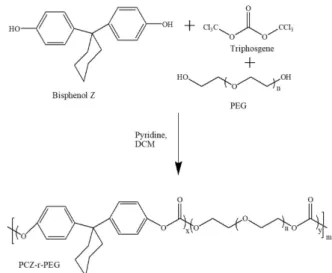
Fig. 1. Synthesis scheme of PCZ-r-PEG copolymers.

Fig. 2.

1

H-NMR spectrum of PCZ-r-PEG copolymer.

ched polycarbonate is prepared by bisphenol A, tri- phosgene and tris(4-hydroxy-phenyl) ethane[35]. In this work amphiphilic PCZ-r-PEG random copolymer is pre- pared by reaction between bisphenol Z, triphosgene and PEG which is presented in Fig. 1.

1
H-NMR spectra of the amphiphilic PCZ-r-PEG is

presented in Fig. 2. The aromatic proton peak appears

in the region of 7 ~ 8 ppm. Phenyl proton “b” from bi-

sphenol Z adjacent to the electron withdrawing ether

group appears in the downfield region of 7.4 ppm. The

proton “c” from the same phenyl group adjacent to the

cyclohexane group appear at the upfield region of 7.2

ppm. Aliphatic methylene protons “c” of polyethylegly-

col appears at higher field of 3.4 ppm. The percentage

(4)

Fig. 3. FTIR spectra of PCZ homopolymer and PCZ-r-PEG copolymers.

Fig. 4. TEM images of PCZ-r-PEG copolymers.

of PCZ and PEG in the amphiphilic PCZ-r-PEG ran- dom copolymer is calculated from representative peak at 7.4 and 3.4 respectively. The actual mass ratio of PCZ : PEG are around 47 : 53. Synthesis of PCZ-r-PEG is checked by FTIR spectroscopy as presented in Fig. 3.

The carbonate group of the polycarbonate copolymer appears at 1,769 cm

-1

. The aromatic benzene ring of bisphenol Z appears at 1,503 cm

-1

. The ether group pres- ent in the polyethylene glycol is represented by peak at 1,103 cm

-1

. The FTIR character showed that the am- phiphilic PCZ-r-PEG random copolymer is successfully synthesized.

Transmission electron microscope of the amphiphilic PCZ-r-PEG random copolymer is presented in Fig. 4 which showed phase separated morphology. The darker region represented by the hydrophobic polycarbonate Z region with higher electron density. The hydrophilic poly(ethylene glycol) group is represented by brighter region. The induced repulsion between the hydrophilic and hydrophobic region leads to the self-assembly in to nanophase region of the amphiphilic random copolymer.

Amphiphilic PCZ-r-PEG copolymer with micro-phase separated morphology due to the hydrophilic and hy- drophobic domain played a crucial role of structure di- recting agent for crystalline growth. Titanium precursor TTIP interact specifically with the hydrophilic poly(eth- ylene glycol) of the copolymer and crystallization is in- itiated during the hydrothermal process. Hydrophobic PCZ remain ideal during the process due to the inert- ness towards the TTIP precursor. Hydrophilic sugar molecule plays an important role of growth directing agent of TiO

2

crystal. The steric hindrance between the amphiphilic macromolecule and TTIP precursor is re- duced by the presence of small hydrophilic glucose molecule. It induces better interaction between the TiO

2

precursor and the amphiphilic macromolecules. During calcination the crystal growth is enhanced and the hy- drophobic PCZ group present in the amphiphilic PCZ-r-PEG random copolymer generate mesoporous structure in the TiO

2

sphere.

TiO

2

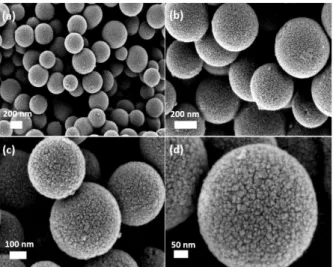
mesoporous sphere is characterized by SEM as presented in Fig. 5. The size of the mesosphere is around 300 nm. The enlarged size of the sphere is pre- sented in Fig. 5(d) that shows the interconnected po- rous structure. The individual crystals are segregated to form the mesoporous large TiO

2

sphere. The crystal- linity phase of the TiO

2

spheres are characterized by XRD analysis as presented in Fig. 6. Mesoporous TiO

2

beads are crystallized in pure anatase phase which is

indicated in the XRD. The peaks at 25.3, 37.86, 48.02,

54.06, 54.9, 62.56, 68.52, 70.08, and 75.07° corresponds

to the reflection from 101, 004, 200, 105, 211, 204,

116, 220 and 215 crystal plane of the anatase phase,

respectively[36].

(5)

Fig. 5. SEM images of (a) TiO

2

microspheres (b~d) Enlarged images of TiO

2

microspheres.

Fig. 6. XRD patterns of TiO

2

microspheres.

4. Conclusions

Micro-phase separation behavior of an amphiphilic random PCZ-r-PEG copolymer is used as a structure directing agent for preparation of mesoporus TiO

2

by solvothermal process. Smaller hydrophilic glucose mol- ecules induced better interaction between the random macromolecules and the TiO

2

precursor leading to self-assembly of nanoparticles and formation of meso- porous TiO

2

structure. TiO

2

mesospheres prepared after calcination crystallize in pure anatase phase.

Reference

1. L. Yu, F. Lin, W. Xiao, D. Luo, and J. Xi,

“CNT@polydopamine embedded mixed matrix mem- branes for high-rate and long-life vanadium flow batteries”, J. Membr. Sci., 549, 411 (2018).

2. S. Quan, S. W. Li, Y. C. Xiao, and L. Shao,

“CO

2

-selective mixed matrix membranes (MMMs) containing graphene oxide (GO) for enhancing sus- tainable CO

2

capture”, Int. J. Greenh. Gas Con., 56, 22 (2017).

3. A. E. Amooghin, M. Omidkhah, and A. Kargari,

“Enhanced CO

2

transport properties of membranes by embedding nano-porous zeolite particles into Matrimid

®

5218 matrix”, RSC Adv., 5, 8552 (2015).

4. J. Kim, Q. Fu, K. Xie, J. M. Scofield, S. E.

Kentish, and G. G. Qiao, “CO

2

separation using sur- face-functionalized SiO

2

nanoparticles incorporated ultra-thin film composite mixed matrix membranes for post-combustion carbon capture”, J. Membr. Sci.,

515, 54 (2016).

5. X. Y. Chen, H. Vinh-Thang, D. Rodrigue, and S.

Kaliaguine, “Effect of macrovoids in nano-silica/

polyimide mixed matrix membranes for high flux CO

2

/CH

4

gas separation”, RSC Adv., 4, 12235 (2014).

6. M. P. Pileni, “Nanocrystal self-assemblies: Fabrica- tion and collective properties”, J. Phys. Chem. B,

105, 3358 (2001).

7. B. Kim, S. L. Tripp, and A. Wei, “Self-organization of large gold nanoparticle arrays”, J. Am. Chem.

Soc., 123, 7955 (2001).

8. M. M. Momeni and Y. Ghayeb, “Photoelectroche- mical water splitting on chromium-doped titanium dioxide nanotube photoanodes prepared by sin- gle-step anodizing”, J. Alloys Compds., 637, 393 (2015).

9. G. Fu, G. Wei, Y. Yang, W. C. Xiang, and N.

Qiao, “Facile synthesis of Fe-doped titanate nano- tubes with enhanced photocatalytic activity for cas- tor oil oxidation”, J. Nanomat., 2013, 4 (2013).

10. S. Khan, I. A. Qazi, I. Hashmi, M. A. Awan, and

(6)

N. S. Zaidi, “Synthesis of silver-doped titanium TiO

2

powder-coated surfaces and its ability to in- activate Pseudomonas aeruginosa and Bacillus sub- tilis”, J. Nanomater., 2013, 8 (2013).

11. K. Liu, S. Lin, J. Liao, N. Pan, and M. Zeng,

“Synthesis and characterization of hierarchical struc- tured TiO

2

nanotubes and their photocatalytic per- formance on methyl orange”, J. Nanomat., 2015, 8 (2015).

12. S. Pan, Y. Zhao, G. Huang, J. Wang, S. Baunack, T. Gemming, M. Li, L. Zheng, O. G. Schmidt, and Y. Mei, “Highly photocatalytic TiO

2

interconnected porous powder fabricated by sponge templated atomic layer deposition”, Nanotechnol., 26, 364001 (2015).

13. F. Liu, C.-L. Liu, B. Hu, W.-P. Kong, and C.-Z.

Qi, “High temperature hydrothermal synthesis of crystalline mesoporous TiO

2

with superior photoca- talytic activities”, Appl. Surf. Sci., 258, 7448 (2012).

14. H. Mehranpour, M. Askari, M. S. Ghamsari, and H. Farzalibeik, “Study on the phase transformation kinetics of sol-gel drived TiO

2

nanoparticles”, J.

Nanomat., 2010, 5 (2010).

15. G. Cappelletti, S. Ardizzone, F. Spadavecchia, D.

Meroni, and I. Biraghi, “Mesoporous titania nano- crystals by hydrothermal template growth”, J. Na- nomat., 2011, 9 (2011).

16. T. Xu, H. Zheng, P. Zhang, W. Lin, and Y. Seki- guchi, “Hydrothermal preparation of nanoporous TiO

2

films with exposed {001} facets and superior photocatalytic activity”, J. Mater. Chem. A, 3, 19115 (2015).

17. H. A. Hamad, M. M. Abd El-latif, A. B. Kashyout, W. A. Sadik, and M. Y. Feteha, “Influence of cal- cination temperature on the physical properties of nano-titania prepared by sol gel/hydrothermal meth- od”, Russ. J. Phys. Chem. A, 89, 1896 (2015).

18. M. M. Mohamed, W. A. Bayoumy, M. Khairy, and M. A. Mousa, “Synthesis of micro-mesoporous TiO

2

materials assembled via cationic surfactants:

Morphology, thermal stability and surface acidity characteristics”, Micropor. Mesopor. Mat., 103, 174

(2007).

19. B. Sun, G. Zhou, C. Shao, B. Jiang, J. Pang, and Y. Zhang, “Spherical mesoporous TiO

2

fabricated by sodium dodecyl sulfate-assisted hydrothermal treatment and its photocatalytic decomposition of papermaking wastewater”, Powder Technol., 256, 118 (2014).

20. A. A. Ismail and D. W. Bahnemannb, “Mesoporous titania photocatalysts: Preparation, characterization and reaction mechanisms”, J. Mater. Chem., 21, 11686 (2011).

21. J. Yu, H. Guo, S. A. Davis, and S. Mann, “Fabrica- tion of hollow inorganic microspheres by chemi- cally induced self-transformation”, Adv. Funct. Mater.,

16, 2035 (2006).

22. J. Yu, S. Liu, and H. Yu, “Microstructures and photoactivity of mesoporous anatase hollow micro- spheres fabricated by fluoride-mediated self-trans- formation”, J. Catalysis, 249, 59 (2007).

23. G. Xi, S. Ouyang, and J. Ye, “General synthesis of hybrid TiO

2

mesoporous “French Fries” toward improved photocatalytic conversion of CO

2

into hydrocarbon fuel: A case of TiO

2

/ZnO”, Chem.

Eur. J., 17, 9057 (2011).

24. X. Lu, F. Huang, X. Mou, Y. Wang, and F. Xu,

“A general preparation strategy for hybrid TiO

2

hi- erarchical spheres and their enhanced solar energy utilization efficiency”, Adv. Mater., 22, 3719 (2010).

25. D. K. Roh, S. J. Kim, W. S. Chi, J. K. Kim, and J. H. Kim, “Dual-functionalized mesoporous TiO

2

hollow nanospheres for improved CO

2

separation membranes”, Chem. Commun., 50, 5717 (2014).

26. G. D. Cheng, L. Cao, F. Huang, P. Imperia, Y.-B.

Cheng, and R. A. Caruso, “Synthesis of mono- disperse mesoporous titania beads with controllable diameter, high surface areas and variable pore di- ameter (14-23 nm)”, J. Am. Chem. Soc., 132, 4438 (2010).

27. Q.-Q. Cheng, Y. Cao, L. Yang, P.-P. Zhang, K.

Wang, and H.-J. Wang, “Synthesis of titania mi-

crospheres with hierarchical structures and high

photocatalytic activity by using nonanoic acid as

(7)

the structure-directing agent”, Mater. Lett., 65, 2833 (2011).

28. C. Tian, Z. Zhang, J. Hou, and N. Luo, “Surfac- tant/copolymer template hydrothermal synthesis of thermally stable, mesoporous TiO

2

from TiOSO

4

”, Mater. Lett., 62, 77 (2008).

29. P. W. Morgan, “Linear condensation polymers from phenolphthalein and related compounds”, J. Polym.

Sci. A, 2, 437 (1964).

30. J. A. Moore and T. Tannahill, “Homo- and co-poly- carbonates and blends derived from diphenolic acid”, High Perform. Polym., 13, 305 (2001).

31. W. B. Kim and J. S. Lee, “Comparison of poly- carbonate precursors synthesized from catalytic re- actions of bisphenol-A with diphenyl carbonate, di- methyl carbonate, or carbon monoxide”, J. Appl.

Polym. Sci., 86, 937 (2002).

32. B. Woo and K. Y. Choi, “Melt polycondensation of bisphenol A polycarbonate by a forced gas sweep- ing process”, Ind. Eng. Chem. Res., 40, 1312 (2001).

33. S. J. Sun, K. Y. Hsu, and T. C. Chang, “Thermotro- pic liquid crystalline polycarbonates. VI. Synthesis and properties of fully aromatic liquid crystalline polycarbonates by interfacial or solution polycon- densation”, Polym. J., 29, 25 (1997).

34. S. J. Sun, Y. C. Liao, and T. C. Chang, “Studies on the synthesis and properties of thermotropic liq- uid crystalline polycarbonates. VII. Liquid crystal- line polycarbonates and poly(ester-carbonate)s de- rived from various mesogenic groups”, J. Polym.

Sci. A, 38, 1852 (2000).

35. M. J. Marks, S. Munjal, S. Namhata, D. C. Scott, F. Bosscher, J. A. De Letter, and B. Klumperman,

“Randomly branched bisphenol A polycarbonates.

I. Molecular weight distribution modeling, inter- facial synthesis, and characterization”, J. Polym. Sci.

A Polym. Chem., 38, 560 (2000).

36. B. D. Cullity, “Elements of x-ray diffraction”, Addi-

son-Wesley Pub. (1978).

수치

Fig. 1. Synthesis scheme of PCZ-r-PEG copolymers.
Fig. 4. TEM images of PCZ-r-PEG copolymers.
Fig. 5. SEM images of (a) TiO 2  microspheres (b~d)  Enlarged images of TiO 2  microspheres.

참조

관련 문서

• For the continuous random variable Y the probability density function f ( y ) can be represented by an equation , which can be described graphically by a curve. •

Surface characteristics and structure of anodic oxide films containing Ca and P on a titanium implant material.. Preperation of bioactive metal via anodic

Fourth, reality therapy group counseling program was effective in improving prisoners' social relationships which is one of the sub factors of

Bactericidal effect of photocatalytic reactor depending on the UV-A illumination time and flow rate of V.. Bactericidal effect of photocatalytic reactor

This study was conducted to recognize the importance of self - management of dance major students and to understand the relationship between the sub -

Perpendicular order of cylindrical domains of block copolymer can be obtained by tuning the interactions. Using Random Copolymer Brush to

Perpendicular order of cylindrical domains of block copolymer can be obtained by tuning the interactions. Using Random Copolymer Brush to

이 스케일억 제제들로는 Acrylic acid-hydroxypropyl acrylate copolymer, Styrene sulfonic acid-maleic acid copolymer, Acrylic acid-sulfonic acid copolymer