Introduction
Interstitial lung diseases (ILDs), a group of diseases that has not been actively researched so far and garnered little inter- est. However, recently, interest in ILDs has been raised, being motivated by cumulative findings from continuous research.
Those researches have given us better understanding of the disease. In the meantime, recent development of new treat- ments for idiopathic pulmonary fibrosis (IPF) have also raised related interest.
With support from the Korean Academy of Tuberculosis and Respiratory Diseases, the guideline committee, which is composed mainly of the Korean ILD Study Group, developed guidelines for the treatment of various interstitial pneumonias, including IPF. Through discussion among the members, we
Korean Guidelines for Diagnosis and
Management of Interstitial Lung Diseases:
Part 1. Introduction
Sung-Woo Park, M.D., Ph.D.
1, Ae Rin Baek, M.D.
1, Hong Lyeol Lee, M.D., Ph.D.
2, Sung Whan Jeong, M.D., Ph.D.
3, Sei-Hoon Yang, M.D.
4, Yong Hyun Kim, M.D.
5and
Man Pyo Chung, M.D., Ph.D.
6, on behalf of the Korean Interstitial Lung Diseases Study Group
1
Division of Respiratory and Allergy, Department of Internal Medicine, Soonchunhyang University Bucheon Hospital, Soonchunhyang University College of Medicine, Bucheon,
2Division of Pulmonary and Critical Care Medicine, Department of Internal Medicine, Inha University College of Medicine, Incheon,
3Department of Internal Medicine, Gachon University Gil Medical Center, Incheon,
4Division of Pulmonary and Critical Care Medicine, Department of Internal Medicine, Wonkwang University School of Medicine, Iksan,
5Division of Allergy and Pulmonology, Department of Internal Medicine, Bucheon St.
Mary’s Hospital, College of Medicine, The Catholic University of Korea, Bucheon,
6Division of Pulmonary and Critical Care Medicine, Department of Medicine, Samsung Medical Center, Sungkyunkwan University School of Medicine, Seoul, Korea
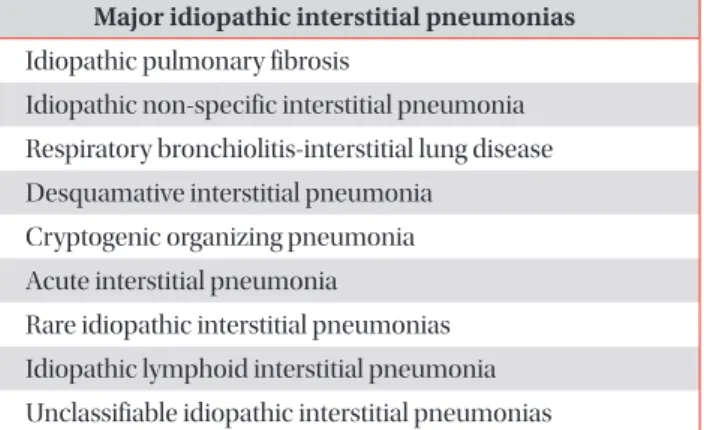
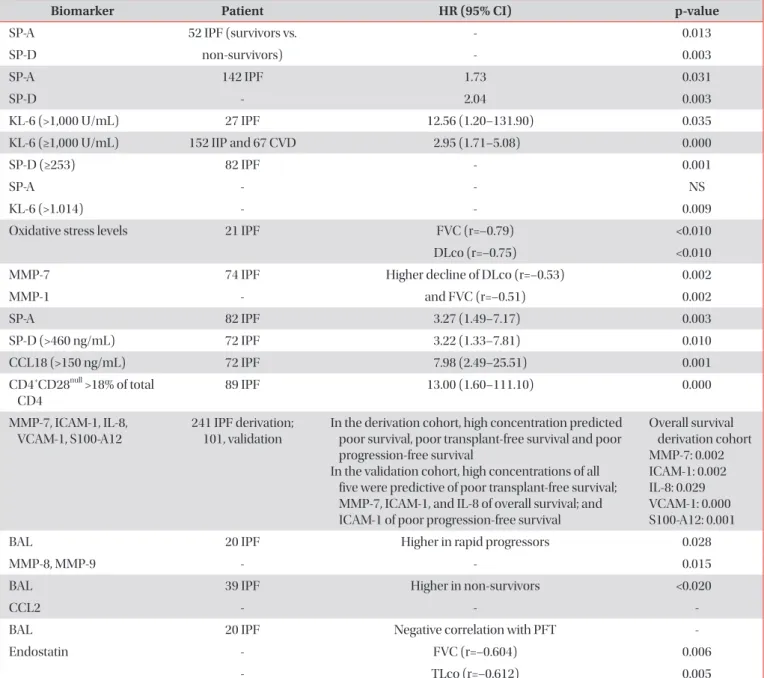
Idiopathic interstitial pneumonia (IIP) is a histologically identifiable pulmonary disease without a known cause that usually infiltrates the lung interstitium. IIP is largely classified into idiopathic pulmonary fibrosis, idiopathic non-specific interstitial pneumonia, respiratory bronchiolitis–interstitial lung disease (ILD), cryptogenic organizing pneumonia, desquamative interstitial pneumonia, and acute interstitial pneumonia. Each of these diseases has a different prognosis and requires specific treatment, and a multidisciplinary approach that combines chest high-resolution computed tomography (HRCT), histological findings, and clinical findings is necessary for their diagnosis. Diagnosis of IIP is made based on clinical presentation, chest HRCT findings, results of pulmonary function tests, and histological findings. For histological diagnosis, video-assisted thoracoscopic biopsy and transbronchial lung biopsy are used. In order to identify ILD associated with connective tissue disease, autoimmune antibody tests may also be necessary. Many biomarkers associated with disease prognosis have been recently discovered, and future research on their clinical significance is necessary. The diagnosis of ILD is difficult because patterns of ILD are both complicated and variable. Therefore, as with other diseases, accurate history taking and meticulous physical examination are crucial.
Keywords: Lung Diseases, Interstitial; Idiopathic Interstitial Pneumonias; Classification; Diagnosis
Address for correspondence: Man Pyo Chung, M.D., Ph.D.
Division of Pulmonary and Critical Care Medicine, Department of Medicine, Samsung Medical Center, Sungkyunkwan University School of Medicine, 81 Irwon-ro, Gangnam-gu, Seoul 06351, Korea
Phone: 82-2-3410-3423, Fax: 82-2-3410-3849 E-mail: [email protected]
Received: Dec. 6, 2018 Revised: Feb. 19, 2019 Accepted: Mar. 18, 2019 Published online: May. 31, 2019
cc It is identical to the Creative Commons Attribution Non-Commercial License (http://creativecommons.org/licenses/by-nc/4.0/).