41(2) : 130 135 (2010)
130
산초 (Zanthoxylum schnifolium)열매 추출물의 항산화 및 α-Glucosidase 저해 활성
오상미·한 웅·왕명현 *
강원대학교 의생명과학대학 의생명공학부
Antioxidant and α-glucosidase Inhibition Activity from Different Extracts of Zanthoxylum schnifolium Fruits
Sang-Mi Oh, Woong Han and Myeong-Hyeon Wang*
Department of Medical Biotechnology, College of Biomedical Science, Kangwon National University, Chuncheon, Kangwon-do, 200-701, Korea
Abstract − This study was performed to the activity of antioxidant and anti-diabetic from Zanthoxylum schnifolium fruit. The Zanthoxylum schnifolium fruits were extracted with water, 100% methanol, 100% ethanol, 70% methanol and 70% ethanol. The activities of each extracts were measured by antioxidant tests, such as total phenolic contents, total flavonoid contents, hydroxyl radical activity, DPPH radical scavenging activity, reducing power and α -glucosidase inhibition activity assay. The water extract represented the highest activity in the antioxidants properties in vitro , including hydroxyl radical activity, DPPH radical scav- enging activity, reducing power. Furthermore, water extract also showed significantly high total phenolic contents but the 100%
methanol extract showed high total flavonoid contents estimated as 196.48 µ g/mg. The IC
50values for α -glucosidase inhibition activity of the 100% ethanol and 100% methanol extracts were 275.66 µ g/mg and 261.44 µ g/mg. Our results indicated that the Zanthoxylum schnifolium fruit expected to be useful as antioxidants.
Key words − Anti-diabetic, antioxidant, total flavonoid contents, total phenolic contents, Zanthoxylum schnifolium
산초 ( Zanthoxylum schnifolium ) 는 운향과에 속하는 낙엽관
목으로 잎은 호생하고 우상복엽으로 광택이 있고 꽃은 자 웅이가화로 취산화서이고 액생하며 단성이며 , 열매는 향신
료로 이용되는데 9~10 월에 성숙한 과실을 따서 햇볕에 말
린 뒤 종자를 기름이 나올 때까지 볶아서 사용하고 예부터 민간요법으로 눈의 피로 회복에 사용 하였다 .1)또한 , 산초
는 비위와 허리 , 무릎을 덥혀주고 통증을 억제 하며 그 외
설사 , 소화장애 , 급만성 위염 , 요통에 사용된다고 보고 되었
다 .2-5)기존 연구 결과에 의하면 , 산초의 부위별 추출물 및
분획물에 대한 항산화 활성을 측정한 결과 잎 추출물과 분 획물에서 비교적 높은 항산화 활성을 보인다고 보고되었 고 ,2)열매는 혈청 콜레스테롤 농도 감소 효과와 항균활성에
대한 연구가 진행되었으나 아직까지 많이 진행되지는 않은 실정이다 .6-8)
식물은 superoxide 와 같은 활성산소가 광합성 과정에서
많이 발생되기 때문에 이에 대한 산화적 손상을 보호하는 이차대사산물과 효소를 이용한 방어체계가 발달되어 있으 며 , 이러한 식물을 이용하여 자유라디칼 소거능 물질의 개
발과 관련 하여 소거물질의 탐색은 의미가 있다 .9) 활성산소
는 수퍼옥사이드 라디칼 (Superoxide radical, O2·-), 과산화수
소 (Hydrogen oxyzen, H2O
2), 하이드록실 라디칼 (Hydroxyl radical, ·OH), 일중항산소 (Singlet oxygen) 와 같은 반응성이
매우 큰 산소를 말하는 것으로 이는 생체에 치명적인 산소 독성을 일으키며 , 이들 활성산소는 세포구성성분들을 파괴
함으로써 노화 , 암 , 뇌졸중 , 심장질환 , 피부질환 , 소화기질환 ,
염증 등의 각종 질병을 일으키는 것으로 보고되었다 .10-13)이
에 대하여 , 활성산소를 제거하기 위한 BHT, BHA 등과 같
은 합성 항산화제들이 많이 개발되었으나 이는 발암성이 강 하고 독성이 존재한다는 문제점이 보고되어 천연자원을 이
용한 활성이 높은 물질을 찾는 것이 유용하다 .14-16)현재 우
리나라의 식생활의 변화에 따라 고혈압 , 당뇨병 , 동맥경화
*교신저자(E-mail):[email protected] (Tel): +82-33-250-6486
증 , 뇌졸중과 같은 성인병이 증가하고 있으며 , 당뇨병은 현
대에서 고질적인 만성질병으로서 특히 선진국일수록 발생 빈도가 높다 .17)
본 연구에서는 산초 열매 ( 종자와 과피 ) 추출물을 이용하
여 항산화 및 항당뇨의 효능탐색을 체계적으로 수행하여 활 성산소에 의한 질병 치료와 항당뇨 치료제로서의 개발을 타 진하기 위하여 수행하였다 .
재료 및 방법
실험재료 − 본 실험에 쓰인 산초 ( Zanthoxylum schnifolium )
열매 ( 종자와 과피 ) 는 충북 단양군에서 2009 년 10 월에 채취
하여 10 시간 열풍건조 시킨 후 분쇄하여 시료 중량 대비 20
배의 물 (water), 100% 에탄올 (EtOH), 100% 메탄올 (MeOH), 70% EtOH, 70% MeOH 의 추출용매를 이용하여 24 시간 동
안 실온에서 1 차 침지 한 뒤 상층액을 회수 후 동량의 추출
용매로 다시 24 시간 추출 후 여과한 뒤 감압 농축하여 시
료로 사용하였다 .
총 페놀성 화합물 함량 측정 − 총 페놀성 화합물 함량은 페놀성 물질이 phosphomolbdic acid 와 반응하여 청색으로
발색되는 것을 이용한 Folin-Denis 방법에 따라 분석하였
다 .18) 1 mg/ml 의 농도로 조제한 추출물 0.25 ml 에 Folin- Denis reagent 0.5 ml 을 넣고 탄산나트륨 (Na
2CO
3, 0.35 g/
ml) 용액을 0.5 ml 넣어준 다음 실온에서 30 분 간 보관한
뒤 UV/VIS 분광광도계 (Optizen 2120UV, Mecasys, Korea)
를 이용하여 760 nm 에서 흡광도를 측정하였다 . 측정된 흡
광도는 Vitamin A 의 한 종류인 탄닌산 (Tannic acid) 를 이
용하여 작성된 표준곡선을 이용하여 검량선을 작성한 뒤 각 용매에 녹인 산초 열매 추출물의 총 페놀성 화합물의 함량 을 계산하였다 .
총 플라보노이드 화합물 함량 측정 − 1 mg/ml 의 농도로
추출물을 제조하여 , 10% Aluminum chloride (AlCl3) 을 녹
인 MeOH 용액과 Potassium acetate (CH3COOH) 를 1 M 의
농도가 되도록 혼합하여 40 분 간 실온에서 보관한 뒤 UV/
VIS 분광광도계 (Optizen 2120UV, Mecasys, Korea) 를 이용
하여 415 nm 에서 흡광도를 측정하였다 .19)이 때 각 용매에
녹인 산초 열매 추출물의 총 플라보이드 화합물의 함량은
quercetin 을 이용하여 작성한 표준곡선으로부터 구하였다 .
하이드록시 라디칼(Hydroxyl radical, · OH)소거능 측정
− Hydroxyl radical 소거능 측정은 Fenton 반응으로 생성된
·OH 에 의해 핵산의 구성당인 deoxyribose 가 분해되는 정도
를 TBA 발색법을 이용하여 측정하였다 .20)시험관에 0.5 mg/
ml 농도의 추출물을 0.2 ml 넣고 10 mM 의 FeSO
4·7H
4O 용
액과 EDTA 용액 각 0.2 ml, 10 mM 의 2-deoxyribose 용액 0.2 ml, 0.1 M 의 phosphate buffer (pH7.4) 1 ml, 10 mM 의 H2O
2 0.2 ml 을 가한다 . 그리고 37
oC incubator 에서 4 시간 반
응시킨 뒤 2.8 % TCA (Trichloroacetic acid) 용액과 1 % TBA (Thiobarbituric acid) 용액을 순서대로 1 ml 씩 첨가하
여 100oC 탕욕상에 10 분간 놓아둔 뒤 Cooling 하여 UV/VIS
분광광도계 (Optizen 2120UV, Mecasys, Korea) 를 이용하여 532 nm 에서 흡광도를 측정하였다 . Positive control 로써 gallic acid 를 같은 농도로 사용하였다 .
Hydroxyl radical scavenging activity (%) = [1-(A
1-A
2)/
A0]×100
A0 ; Control 의 흡광도 A
1; Sample 의 흡광도 A
2; Blank(without 2-deoxyribose) 의 흡광도
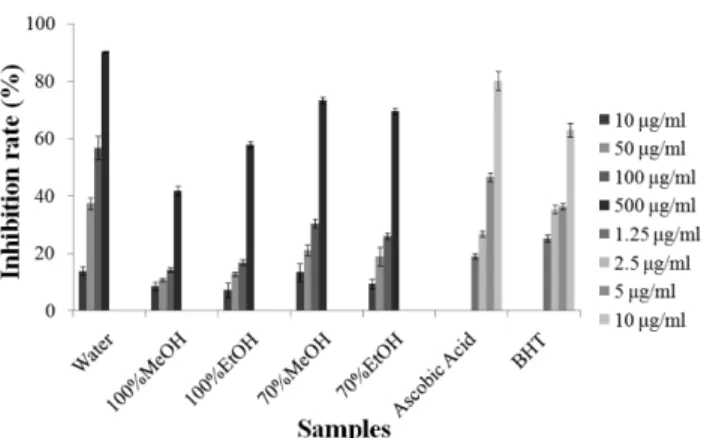
DPPH 라디칼(1.1-Diphenyl-2-picrylhydrazyl radical)소 거능 측정 − 산초 열매 추출물을 각 농도별 (10, 50, 100, 500 µ g/ml) 로 물 (water) 추출물만을 물에 녹이고 나머지 70%
EtOH, 70% MeOH, 100% EtOH, 100% MeOH 추출물은
모두 MeOH 에 녹여 제조한 시료 0.1 ml 에 0.2 mM 의 MeOH 에 녹인 DPPH 0.1 ml 을 가하고 Vortexing 후 30oC
의 Dark chamber 에 30 분간 반응하여 515 nm 에서 흡광도 (Multiplater spectrophotometer ELx800TM, BioTek, USA)
를 측정하여 농도에 따른 DPPH radical 소거능을 확인하였
다 .21)시료를 첨가하지 않은 Negative control 과 비교하여 자
유라디칼 소거활성은 백분율로 나타내고 , Positive control 로
는 Vitamin C 의 한 종류인 ascobic acid 와 BHT 를 사용하였
다 .
Scavenging rate (%) = [1-(A
1-A
2)/A0]×100
A0 ; Control 의 흡광도 A
1; Sample 의 흡광도 A
2; Blank(without sample) 의 흡광도
환원력(Reducing power)의 측정 − Moreni 등 방법에 의
거하여 시료의 reducing power 를 측정하였다 .22) 0.1 mg/ml
의 농도로 조제한 시료 0.2 ml 에 0.2 M 의 phosphate buffer (pH6.6) 0.5 ml 과 1% potassium ferricyanide [K3Fe(CN)6]
0.5 ml 을 넣은 다음 50
oC 에서 30 분간 반응시킨다 . 반응 후 , 0.5 ml 의 10% TCA (Trichloroacetic acid) 용액을 넣은 뒤
실온에서 10 분간 놓아두고 상층액 0.5 ml 을 취해 3 차증류
수 0.5 ml 과 0.1% 의 FeCl3을 0.1 ml 넣어 발색반응을 유도
시킨 다음 , UV/VIS 분광광도계 (Optizen 2120UV, Mecasys,
Korea) 를 이용하여 700 nm 에서 흡광도를 측정하였다 .
Positive control 로써 Vitamin E 의 한 종류인 α -tocopherol 을
100% EtOH 에 녹여 같은 농도로 사용하였다 .
α-Glucosidase 저해 활성 측정 − Water 에 녹인 산초 열
매 추출물을 농도별로 (10, 50, 100, 500 µ l/ml) 제조하여 10 µ l 를 0.15 U/ml α -glucosidase 효소액 10 µ l, 200 mM potassium phosphate buffer (pH6.8) 10 µ l 와 혼합하여 37oC
에서 15 분간 반응시킨 뒤 기질로 사용되는 3 mM pNPG(4-
nitrophenyl- α -D-glucopyranoside) solution 20 µ l 를 가하여
37
oC 에서 10 분간 반응시켰다 . 그 후 0.1 M 의 Na
2CO
3150 µ l
을 넣어 반응을 정지시킨 뒤 405 nm 에서 흡광도
(Multiplater spectrophotometer ELx800TM, BioTek, USA)
를 측정하였다 .23) Positive control 로써 water 에 녹인 acarbose 를 농도 별로 (0.001, 0.005, 0.01, 0.05 µ l/ml) 제조
하여 사용한다 .
효소 저해 활성 (%) = [1-( A1-A
2)/A0]×100
A0 ; Control 의 흡광도 (DW instead of Sample) A
1; Sample 의 흡광도 A
2; Blank(Buffer instead of pNPG)
통계분석 − 실험결과는 3 차 반복 실험을 수행하였으며 , 그
값을 SPSS Ver. 10.0 package program (SPSS, Chicago, USA) 을 이용하여 각 시험구의 평균과 표준편차를 산출하고 Tukey 법을 이용하여 각 시험구간의 유의차를 5% ( p<0.05 )
유의 수준에서 검증하였다 .
결과 및 고찰
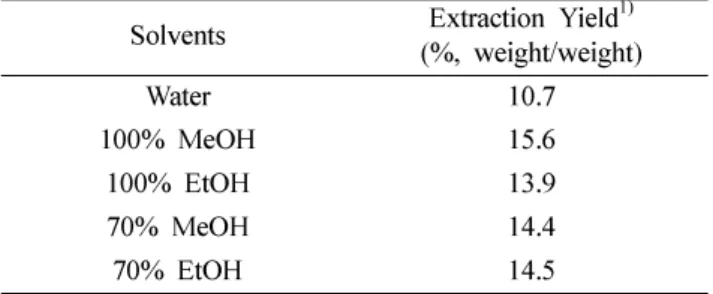
산초나무 열매 추출물의 수율 − 산초 열매 ( 종자와 과피 )
추출물은 열풍건조 후 분쇄한 뒤 시료 중량 대비 20 배의 추
출용매로 침지한 뒤 감압 농축하여 추출 수율을 구하였다 .
실험결과 water 를 용매로 한 추출물이 가장 적은 수율을 보
였고 100% MeOH, 70% EtOH, 70% MeOH, 100% EtOH
의 순서로 높은 추출수율을 보였다 (Table I). Water, 70%
EtOH, 70% MeOH 를 용매로 하였을 때는 진한 갈색의 고
체상태 추출물이 얻어졌으며 100% MeOH, 100% EtOH 를
용매로 하였을 때는 진한 초록빛의 액체상태 추출물을 얻 을 수 있었다 . 산초 열매에는 단당류의 함량이 매우 적고 대
부분이 오일류로 이루어져 있기 때문으로 판단된다 .
총 페놀성 및 총 플라보노이드 화합물 함량 − 식물의 페 놀화합물은 화학적으로 이질적인 물질들이 포함되는데 , 유
기용매에만 녹는 지용성인 것도 있고 , 수용성의 카르복실
산이나 배당체 (glucoside), 그리고 크기가 큰 중합체도 이
에 포함되고 이들의 기능은 그 구조적 다양성 만큼이나 다 양한데 이들이 가지는 Phenolic hydroxyl 기는 단백질 및 거
대분자들과 결합하는 성질을 가지며 항산화 효과 등의 생
리활성을 가진다 .24-25)각 용매에 대한 산초 열매 추출물의
총 페놀성 화합물의 함량은 water 추출물에서 가장 높은 수
치를 나타내었고 다음으로 70% EtOH, 70% MeOH 추출물
순으로 나타난 반면 , 100% EtOH, 100% MeOH 추출물에서
는 총 페놀성 화합물이 검출 되지 않았다 (Table II). 이는
산초 열매에 지용성 페놀성 화합물이 거의 없다는 것을 나 타낸다 .
플라보노이드 화합물은 이뇨작용과 항모세혈관 투과 , 항
알러지 작용 , 순환기 개선 , 혈압강하 , 살충 , 항균 , 간해독 및
항산화 작용을 한다고 알려져 있다 .26-28)각 용매에 대한 산
초 열매 추출물의 총 플라보노이드 화합물의 함량은 100%
MeOH, 100% EtOH, Water, 70% MeOH, 70% EtOH 추출
물 순서로 높은 수치를 나타내었다 (Table II). 총 페놀성 화
합물의 경우 water 추출물에서 대량 함유 하고 있으며 총
Table I . Yield of extracts obtained from different solvents of Zanthoxylum schnifolium fruits
Solvents Extraction Yield
1)(%, weight/weight)
Water 10.7
100% MeOH 15.6
100% EtOH 13.9
70% MeOH 14.4
70% EtOH 14.5
1)
One hundred grams of Zanthoxylum schnifolium fruits powder were extracted with 2L of different solvents at room temperature for 2days. After filtration, the extracts were concentrated by rotary evaporator and extraction yield was measured.
Table II. Total phenolic and flavonoid content of the different extracts from Zanthoxylum schnifolium fruits
Extracts Phenolic contents Flavonoid contents (Tan
1)mg/g) (Que
2)mg/g) Water 92.17±1.181
a44.17±1.111
c100% MeOH 0
d196.48±8.372
a100% EtOH 0
d113.06±7.561
b70% MeOH 61.15±1.751
c17.04±2.362
d70% EtOH 69.42±0.288
b14.44±1.2108
d1)
Tannic acid (Tan) was used as a standard for measuring of the total phenolic contents.
2)
Quercetin (Que) was used as a standard for measuring of the total flavonoid contents. Each value represents the mean ± SD(n=3).
a-d
values in the same row not sharing the same superscript are significantly different by Tukey’s multiple range test ( p<0.05 ).
Table III. Effect of α -glucosidase inhibition activity of the different extracts from Zanthoxylum schnifolium fruits.
Acabose was used as the positive control.
Solvents IC
501)( µ g/ml)
100% EtOH 275.66±22.9
b100% MeOH 261.44±12.9
bAcarbose 0.010±0.00006
a1)
Amount of required for 50% reduction of
α-glucosidase inhibition activity.
Each value represents the mean±SD(n=3).
a-b
values in the same row not sharing the same superscript
are significantly different by Tukey’s multiple range test
( p<0.05 ).
플라보노이드의 경우는 100% MeOH, 100% EtOH 에서 대
량 함유 하는 것으로 판단된다 .
하이드록시 라디칼(Hydroxyl radical, · OH)소거능 −
Hydroxyl radical 은 활성산소의 생산과정에 생기는 최후의
활성산소이며 , 과산화수소가 세포내의 철 (Fe) 이나 구리 (Cu)
의 금속이온과 반응하여 생성되며 , 성인병이나 암을 일으키
고 노화를 촉진시키는 가장 강력한 활성산소이다 .26) Hydroxyl radical 소거활성은 Fenton reaction 에 의해 생성된 Hydroxyl radical 이 deoxyribose 를 분해하고 이 때 생성된 MDA (malondialdehyde) 양을 확인함으로써 측정하였다 . 그 결과 ,
70% MeOH 추출물에서 가장 높은 활성을 보였으나 오차범
위 내에서 water 추출물에서 가장 높은 활성을 보였으며 , 그
다음으로 70% EtOH, 100% EtOH, 100% MeOH 추출물의
순으로 높은 수치를 나타냈다 (Fig. 1). Positive control 로는
같은 농도의 gallic acid 를 사용하였는데 산초열매 추출물이
대체적으로 낮은 수치를 보이기는 했으나 가장 높은 활성 을 보인 warer 추출물이 26.09% 로 gallic acid 의 수치인 35.34% 와 큰 차이를 보이지 않았다 .
DPPH 라디칼(1.1-Diphenyl-2-picrylhydrazyl radical)소 거능 − DPPH 는 안정한 free-radical 분자를 구성하는 어두운
색의 염료이며 , 520 nm 에서 가장 큰 파장을 흡수하는데 이
는 solution 상태에서 진한 보라빛을 나타내고 중성화 되었
을 때 색을 잃거나 옅은 노란빛을 나타내는 특성을 이용하 여 최초 radical 의 수를 측정할 수 있게 한다 .21)이를 이용
하여 산초 열매 추출물에 대한 radical 소거 능력을 측정하
였다 . 그 결과 water 추출물에서 농도 의존적으로 가장 높은
수치를 나타내었고 70% MeOH, 70% EtOH, 100% EtOH,
100% MeOH 추출물의 순서대로 높은 활성을 보였다 . water
추출물은 500 µ g/ml 농도에서 약 90% 의 수치를 나타내며
높은 활성을 보였다 (Fig. 2).
환원력(Reducing power)측정 − 환원력이 강한 물질은
생성된 활성산소를 다시 환원시켜 항산화제로서의 역할을 할 수 있으며 , 이는 활성산소에 의해 발생되는 많은 질병의
치료에 유용하게 사용될 것으로 기대된다 . 산초 열매추출물
의 환원력을 측정한 결과 Positive control 로 사용한 α - tocopherol 은 0.14 를 나타내었고 가장 높은 활성을 보였던 water 추출물은 0.05 를 나타내어 α -tocopherol 에 비해 약 35%
의 활성을 나타냈다 . 그 다음으로 70% MeOH, 70% EtOH
추출물의 순으로 활성을 나타내었다 (Fig. 3).
α-Glucosidase 저해 활성 − 탄수화물은 일반적으로 소장 을 통해 흡수되는 단당류로 변환되는데 이 때 α -glucosidase
inhibitor 는 혈당 내 탄수화물의 영향을 감소시킬 뿐만 아니
라 식후 고혈당을 효과적으로 조절하면서도 저혈당의 부작 용이 없다는 큰 장점을 가져 α -glucosidase inhibitor 로써의
작용을 하는 물질의 탐색은 매우 유용하다 .17)본 실험의 대
Fig. 1. Hydroxyl radical scavenging activity of the different extracts from Zanthoxylum schnifolium fruits. Concentration of the all extracts was 0.5 mg/ml. Gallic acid was used as the positive control. Each value represents the mean±SD(n=3).
a-b