41(9), 1197~1204(2012) http://dx.doi.org/10.3746/jkfn.2012.41.9.1197
참취 추출물과 용매분획물의 항산화 활성
전상민․이진영․김헌웅․이영민․장환희․황경아․김행란․박동식†
농촌진흥청 국립농업과학원 기능성식품과
Antioxidant Activity of Extracts and Fractions from Aster scaber
Sang-Min Jeon, Jin-Young Lee, Heon-Woong Kim, Young-Min Lee, Hwan-Hee Jang, Kyung-A Hwang, Haeng-Ran Kim, and Dong-Sik Park†
Functional Food and Nutrition Division, Dept. of Agrofood Resources, Rural Development Administration, Gyeonggi-do 441-853, Korea
Abstract
As an effort to develop functional food ingredients and to discover the biological activity, the total phenolic content, total flavonoid content, DPPH and ABTS radical scavenging activity, SOD-like activity, ferric reducing antioxidant power (FRAP), and Fe
2+chelating of Aster scaber were measured using a 70% ethanol extract and various solvent fractions. As a result, the total phenolic concent was highest in an ethyl acetate fraction of 141.9 mg GAE eq/g and the total flavonoid content was 105.6 mg QUE eq/g. The DPPH radical scavenging activity was highest in an ethyl acetate fraction of 97.1% at a concentration of 1,000 μg/mL (p<0.05). The ABTS radical scavenging activity showed a 86.9% ethyl acetate fraction and a 57.9% butanol fraction at a concentration of 125 μg/mL, and higher than that of positive control (α-tocopherol and BHT) (p<0.05). The SOD-like activity showed 42.8% in an ethyl acetate at a concentration of 1,000 μg/mL. The ethyl acetate fraction showed the highest value of FRAP at 1051.9 μM and a concentration of 1,000 μg/mL (p<0.05). The Fe
2+chelating was highest in the 70.1% chloroform fraction at a concentration of 500 μg/mL (p<0.05). There is the highest correlation between DPPH radical scavenging activity and FRAP (r=0.981) as compared to other antioxidant assays (p<0.01). With these results, we confirmed that the ethyl acetate fraction of Aster scaber has great antioxidant potential. So it can be expected to be developed into a specific functional food ingredient.
Key words: Aster scaber, total phenolic and flavonoid content, DPPH and ABTS radical scavenging, FRAP, Fe
2+chelating
†
Corresponding author. E-mail: [email protected]
†
Phone: 82-31-299-0530, Fax: 82-31-299-0504
서 론
최근 천연물을 대상으로 성인병의 주된 원인인 활성산소 종을 억제시키기 위해 항산화제에 대한 연구가 다양하게 수 행되고 있으며, 특히 동양의학과 대체의학에 대한 관심이 고조되면서 민간에서 치료 및 예방의 목적으로 사용되고 있 는 각종 생약이나 야생 산채류 등 약용식물을 대상으로 천연 항산화제에 대한 연구가 활발히 이루어지고 있다(1,2). 생체 내에서 발생하는 superoxide anion radical, hydroxyl radi- cal, singlet oxygen, hypochlorite, hydrogen peroxide 등과 같은 활성산소 종(reactive oxygen species, ROS)은 정상적 인 대사과정 중에서 지속적으로 생성되는 부산물로 DNA, 단백질, 세포 분자들의 산화적 손상을 유발하여 암, 심혈관 질환 및 퇴행성 장애 등 다양한 질병을 일으키게 된다. 이러 한 세포 내 산화 연쇄 반응의 시작이나 진행을 지연하거나 억제하는 항산화제는 산소를 제거하거나 흡수하는 것이 아
니라 free radical과 반응함으로써 특정 비타민류와 필수아 미노산 등의 손실을 최소화하거나 유지 제품의 산패를 지연 또는 방지하는 목적으로 사용되어지고 있다(3-5). 최근 식물 에서 유래된 페놀 화합물 및 비타민 등의 천연항산화제가 산화손상에 대한 화학적 예방 촉매기능이 보고됨에 따라 많 은 주목을 받아 오고 있다(6-8). 다양한 식물에 함유되어 있 는 페놀 화합물은 식물의 광합성 과정에서 생성되는 활성산 소로부터 자신을 보호할 수 있는 효소와 이차대사산물로서 free radical을 수용할 수 있는 phenolic hydroxyl기를 여러 개 가지고 있는 물질로 거대한 분자들과 결합하여 활성산소 종을 제거하는 것으로 알려지고 있다(9-11).
참취(
Aster scaber)는 우리나라 전국 각지의 산야지에 흔 히 자생하며 농가에서 재배하기도 하는 국화과(Compositae) 에 속하는 다년생초본으로 백운초, 백산국, 동풍, 나물채, 암 취 및 나물취라고도 한다. 해수․이뇨․보익․방광염․두통․
현기증 등에 효과가 있는 것으로 알려져 있다(12). 현재까지
이루어진 참취의 생리활성 연구는 유전독성 억제효과(13), 지방대사와 항산화에 미치는 영향(14), 고지혈증 예방효과 와 혈중 콜레스테롤 LDL, VLDL 농도의 저하 및 혈관 내피 세포의 변화 지연(15), HMG-CoA reductase 저해 활성(16) 등이 보고되었다. 이러한 연구는 주로 참취 조추출물을 이용 한 것으로 다양한 용매 분획물에 대한 활성 검정은 미흡한 실정이다. 따라서 본 연구는 참취 추출물과 다양한 용매 분 획물을 이용하여 항산화활성을 검정하였고 활성과 관련이 있는 총 폴리페놀 함량, 총 플라보노이드 함량을 정량하여 천연항산화 소재로서의 가치를 검토하고자 수행하였다.
재료 및 방법
재료
본 실험에 사용한 참취는 강원도 양양 서광농협에서 구입 하여 40 mesh 분쇄기(FM909T, HANIL, Wonju, Korea)로 분쇄한 후 분말상태로 조제하였다. 시료는 PE Film에 밀봉 포장 후 냉동보관(-20
oC)하여 실험에 사용하였다.
추추물 제조 및 용매 분획
참취 분말 100 g에 10배의 70% 에탄올을 첨가하고 실온에 서 24시간 진탕기(Shaker SK-71 JEIO Tech, Daejeon, Ko- rea)로 진탕하여 2회 추출하였다. 이를 여과지(No. 6, Advan- tec, Tokyo, Japan)에 여과한 뒤 rotatory vacuum evapo- rator(EYELA N-3000, Tokyo, Japan)로 40
oC에서 감압농축 한 후 동결 건조하여 70% 에탄올 추출물을 얻었다. 순차적 용매 분획은 70% 에탄올 추출물 10 g을 물 500 mL에 용해시 켜 비극성 용매인 hexane 500 mL(1,000 mL×3회)로 추출하 여 hexane 분획물을 얻었다. 그 수층을 chloroform, ethyl acetate, butanol, aqueous의 순서로 극성의 차이를 이용하여 분획물을 얻었다. 분리된 각각의 용매 분획물은 감압 농축하 여 용매를 제거한 후 -70
oC에서 동결 건조하였다. 냉동보관 (-20
oC)한 시료는 항산화 활성 분석용으로 사용하였다.
총 폴리페놀 함량
총 페놀 함량은 Folin-Denis 방법(17)을 변형하여 측정하 였다. 1 mg/mL의 농도로 용해한 시료 20 μL에 Folin-Cio- calteu's(1 N) 시약 50 μL 및 7.5% sodium carbonate 150 μ L를 차례로 가한 다음 실온에서 60분간 정치한 후 765 nm에 서 흡광도를 측정하였다. 총 페놀 함량은 gallic acid 1, 0.5, 0.25, 0.125, 0.06, 0.03, 0.015 mg/mL를 이용하여 작성한 표준 곡선으로 gallic acid equivalents(GAE/g) 단위로 나타냈다.
총 플라보노이드 함량
총 플라보노이드 함량은 Zhishen 등(18)과 Singleton 등 (19)의 방법을 응용하여 측정하였다. 각 시료 20 μL를 so- dium nitrite solution 75 μL와 3차 증류수 100 μL 혼합하여 6분간 반응시키고 aluminum chloride solution 20 μL를 첨가
하여 다시 5분간 반응시킨 후 1 M NaOH 40 μL와 섞어 510 nm에서 흡광도를 측정하였다. 총 플라보노이드 함량은 quercetin을 표준물질로 하여 작성한 표준곡선으로 querce- tin equivalents(QUE/g) 단위로 나타냈다.
DPPH 라디칼 소거능 측정
DPPH 라디칼 소거능은 Blois(20)의 방법을 변형하여 각 농도별 시료 40 μL와 1,1-diphenyl-2-picryhydrazyl(DPPH) 용액 160 μL를 가하여 잘 혼합한 다음 암소에서 30분간 반응 시킨 후 518 nm에서 흡광도를 측정하여 농도에 따른 DPPH 라디칼 소거능을 확인하였다.
ABTS 라디칼 소거능 측정
ABTS 라디칼 소거능은 Arano 등(21)과 Re 등(22)의 방 법을 변형하여 측정하였다. 7.4 mM ABTS 용액과 2.6 mM potassium persulfate를 혼합하여 암소에서 약 12시간 반응 시킨 후 734 nm에서 흡광도가 1±0.1이 되도록 희석하였다.
희석한 용액 285 μL를 취하여 각 농도별 시료 15 μL를 혼합 하여 암소에서 30분간 반응시킨 후 734 nm에서 흡광도를 측정하였다.
Superoxide dismutase(SOD) 유사활성
SOD 유사활성 측정은 Marklund와 Marklund(23)의 방법 을 변형하여 측정하였다. 과산화수소(H
2O
2)로 전환시키는 반응을 촉매하는 pyrogallol의 생성량을 측정하여 SOD 유사 활성으로 나타내었다. 일정 농도별 시료 40 μL에 pH 8.5로 보정한 Tris-HCl buffer(50 mM tris amino-methane+10 mM EDTA, pH 8.5) 120 μL와 7.2 mM pyrogallol 20 μL를 첨가하여 25
oC에서 10분간 반응시킨 후 1 N HCl 20 μL를 가하여 반응을 정지시키고 420 nm에서 흡광도를 측정하였 다. SOD 유사활성은 추출물 첨가구와 무첨가구의 흡광도 차이를 백분율로 나타내었다.
Ferric reducing antioxidant power(FRAP)에 의한 환원력 측정
FRAP에 의한 환원력 실험은 Benzie와 Strain(24)의 방법 을 변형하여 측정하였다. FRAP 시약은 300 mM acetate buffer(pH 3.5), 40 mM HCl에 용해한 10 mM TPTZ(2,4,6- tripyridyl-s-triazine) 및 20 mM FeCl
3․6H
2O를 각각 10:1:
1(v/v/v)의 비율로 혼합하여 37
oC에서 5분 동안 가온한 후 FRAP 시약으로 사용하였다. 각 농도별 시료 50 μL에 제조한 시약 150 μL를 혼합하여 37
oC에서 4분간 반응시킨 후 593 nm에서 흡광도를 측정하였으며 FeSO
4․7H
2O를 표준물질 로 하여 얻은 표준 검량선으로부터 계산하였다.
Fe
2+chelating 활성 측정
Fe
2+chelating 활성 측정은 Decker와 Welch(25)의 방법을
일부 변형하여 측정하였다. Fe
2+chelating 활성은 시료 50
μ L, 0.6 mM FeCl
2․4H
2O[iron(Ⅱ) chloride tetrahydrate] 용
Table 1. Total phenolic and flavonoid contents of Aster scaber extract and fractions
Extract solvent Total phenoilc contents (mg GAE
1)/g)
Total flavonoid contents (mg QUE
2)/g) 70% ethanol
Hexane Chloroform Ethyl acetate Butanol Aqueous
99.6±2.1
3)c4)115.7±0.4
d78.1±7.2
b141.9±6.7
e132.9±4.2
e41.0±6.0
a38.9±3.9
bc34.0±2.2
b42.0±2.0
c105.6±2.6
e60.6±4.0
d6.1±1.7
a1)
Total phenolic content was expressed as mg/g gallic acid equivalent (GAE).
2)
Total flavonoidc content was expressed as mg/g quercetin equivalent (QUE).
3)
Each value is presented as mean±standard deviation (n=3).
4)
Means within each column with different letter (a-e) different significantly (p<0.05).
액 10 μL와 증류수 90 μL 혼합한 후 실온에서 10분간 반응시 켰다. 반응 후 5 mM ferrozine[3-(2-pyridyl)-5,6-diphenyl- 1,2,4-triazine-4',4''-disulfonic acid] 용액 20 μL을 혼합하 여 실온에서 5분간 반응시킨 후 562 nm에서 흡광도를 측정 하였다.
통계처리
참취 70% 에탄올 추출물과 용매 분획물의 항산화활성 데 이터에 대한 통계분석은 SPSS(statistical package for the social science, version 12.0, Chicago, IL, USA) program을 이용하여 분산분석(ANOVA)을 실시하였으며, 실험군 간의 유의성은 Duncan의 다중범위 시험법(Duncan's multiple range test)로 p<0.05 수준에서 유의성을 검증하였다.
결과 및 고찰
총 폴리페놀 함량
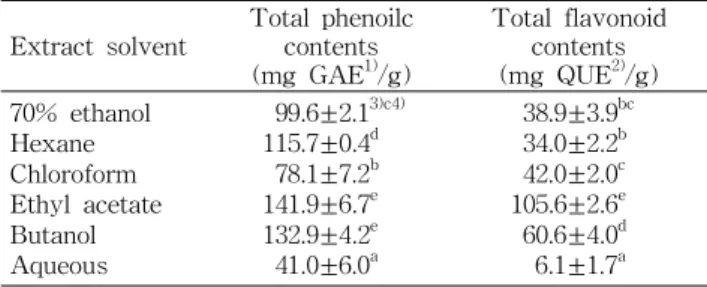
총 폴리페놀 함량은 페놀성 물질인 phosphomolybdic acid 와 반응하여 청색으로 발색하는 것을 원리(26)로 참취 추출 물과 용매 분획물에 존재하는 총 폴리페놀 함량을 gallic acid 를 기준으로 측정한 결과 Table 1과 같다. 총 폴리페놀 함량 은 70% 에탄올 추출물에서 99.6 mg GAE eq/g이었고, 용매 분획물에 대한 총 폴리페놀 함량은 ethyl acetate> butanol>
hexane> chloroform> aqueous 순으로 각각 141.9, 132.9, 115.7, 78.1 및 41 mg GAE eq/g의 함량을 나타내어 ethyl acetate 분획물에서 가장 높은 함량을 나타냈다(p<0.05). 항 산화 활성을 나타내는 약용식물 추출물에 함유된 총 폴리페 놀의 함량을 측정한 Woo 등(27)은 저먼캐모마일, 각시취, 기 생초 등에서 74.0~22.5 mg GAE/g의 폴리페놀을 함유한다 는 결과와 비교하면 참취 70% 에탄올 추출물과 용매 분획물 에 존재하는 총 폴리페놀 함량이 높은 것으로 나타났다. 미 나리 ethyl acetate 분획물에서 240.61 mg GAE eq/g의 폴리 페놀을 함유하였다는 Hwang 등(28)의 결과와 쑥부쟁이
ethyl acetate 분획물에서 4.72 mg GAE/g의 폴리페놀이 함 유되었다는 Bae와 Kim(29)의 결과와 비교하면 미나리 ethyl acetate 분획물에서는 함량이 낮으나 쑥부쟁이 ethyl acetate 분획물보다는 함량이 높았다. 또한 ethyl acetate 분획물에 서 폴리페놀 함량이 높다는 결과는 본 실험의 결과와 일치하 였다. Kim과 Suh(30)의 연구에 의하면 식물에 존재하는 페 놀 화합물은 항산화활성과 연관되므로 참취 70% 에탄올 추 출물 및 용매 분획물은 항산화 효능을 나타내는 페놀 화합물 을 함유하고 있어 천연 항산화제로 이용가치가 높다고 사료 된다.
총 플라보노이드 함량
총 플라보노이드는 노란색 또는 적자색을 띄는 색소 화합 물로 C
6-C
3-C
6의 benzopyrone 기본골격을 지니고 있으며, 식물 중에는 대부분 당과 결합된 배당체(glycoside) 형태로 존재하며 폴리페놀에 속하는 것으로 알려져 있다. 플라보노 이드는 flavones, flavonols, flavanones, flavanol 및 iso- flavones로 구성되어 있으며, 그 구조에 따라 분류되고 특정 flavonoid는 항산화, 항암, 항고열압, 항염증, 향균 및 항노화 등 여러 생리적 기능을 가지고 있는 것으로 보고되고 있다 (31-33). 참취 70% 에탄올 추출물과 용매 분획물에 존재하 는 총 플라보노이드 함량을 quercetin을 기준으로 측정한 결 과, Table 1과 같이 나타났다. 총 플라보노이드 함량은 70%
에탄올 추출물에서 38.9 mg QUE/g이었으며, 용매 분획물에 대한 총 플라보노이드 함량은 ethyl acetate> butanol>
chloroform> hexane> aqueous 순으로 각각 105.6, 60.6, 42, 34 및 6.1 mg QUE/g의 함량을 나타내어 ethyl acetate 분획 물에서 높은 함량을 나타내었으며(p<0.05), 총 폴리페놀 함 량의 결과와 일치하였다. Lee 등(34)은 약용식물인 우산나물 지상부와 뿌리 에탄올 추출물에서 31.7 및 10.5 mg QUE/g의 플라보노이드를 함유하였다는 연구결과를 보고하였고, Woo 등(27)은 국화과 식물 각시취, 구절초 에탄올 추출물에 서 65.5 및 20.25 mg QUE/g이었다는 결과와 비교하면 참취 에탄올 추출물의 플라보노이드 함량이 높음을 알 수 있었다.
DPPH 라디칼 소거능 측정
항산화 활성을 측정하는데 비교적 간단하여 가장 널리 사
용되는 방법인 DPPH 라디칼 소거능 측정은 항산화 물질에
의한 전자공여에 의해 지질과산화 연쇄반응에 관여하는 산
화성 free radical의 억제 정도를 간접적으로 측정하는 방법
이다(35). 참취 70% 에탄올 추출물과 용매 분획물의 DPPH
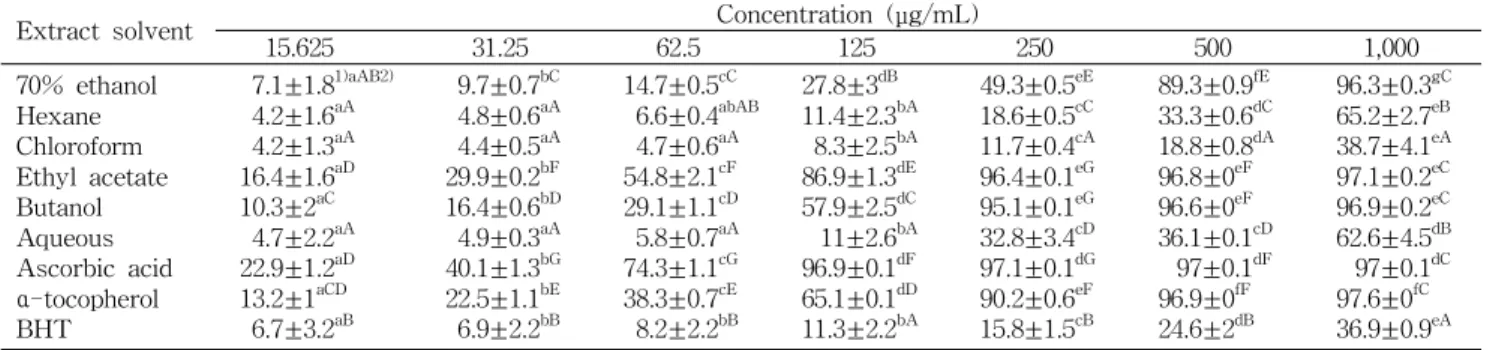
라디칼 소거능을 측정한 결과는 Table 2와 같이 농도의존적
인 경향을 보였다. 특히 ethyl acetate 분획물에서 가장 높은
소거활성을 보여 1,000 μg/mL 농도에서 97.1%의 소거능을
나타냈으며, 125 μg/mL의 농도에서 86.9%의 소거능을 보여
대조군으로 사용한 α-tocopherol과 BHT보다 높게 나타났
다(p<0.05). 또한 butanol 분획물은 125 μg/mL 농도에서
57.9%, 62.5 μg/mL 농도에서는 29.1% 소거능을 보였다(p<
Table 2. DPPH radical scavenging of Aster scaber extract and fractions
Extract solvent Concentration (μg/mL)
15.625 31.25 62.5 125 250 500 1,000
70% ethanol Hexane Chloroform Ethyl acetate Butanol Aqueous Ascorbic acid α -tocopherol BHT
7.1±1.8
1)aAB2)4.2±1.6
aA4.2±1.3
aA16.4±1.6
aD10.3±2
aC4.7±2.2
aA22.9±1.2
aD13.2±1
aCD6.7±3.2
aB9.7±0.7
bC4.8±0.6
aA4.4±0.5
aA29.9±0.2
bF16.4±0.6
bD4.9±0.3
aA40.1±1.3
bG22.5±1.1
bE6.9±2.2
bB14.7±0.5
cC6.6±0.4
abAB4.7±0.6
aA54.8±2.1
cF29.1±1.1
cD5.8±0.7
aA74.3±1.1
cG38.3±0.7
cE8.2±2.2
bB27.8±3
dB11.4±2.3
bA8.3±2.5
bA86.9±1.3
dE57.9±2.5
dC11±2.6
bA96.9±0.1
dF65.1±0.1
dD11.3±2.2
bA49.3±0.5
eE18.6±0.5
cC11.7±0.4
cA96.4±0.1
eG95.1±0.1
eG32.8±3.4
cD97.1±0.1
dG90.2±0.6
eF15.8±1.5
cB89.3±0.9
fE33.3±0.6
dC18.8±0.8
dA96.8±0
eF96.6±0
eF36.1±0.1
cD97±0.1
dF96.9±0
fF24.6±2
dB96.3±0.3
gC65.2±2.7
eB38.7±4.1
eA97.1±0.2
eC96.9±0.2
eC62.6±4.5
dB97±0.1
dC97.6±0
fC36.9±0.9
eA1)
Each value is presented as mean±standard deviation (n=3).
2)
Mean within each column (a-g) and row (A-G) with different letters differ significantly (p<0.05).
Table 3. ABTS radical scavenging of Aster scaber extract and fractions
Extract solvent Concentration (μg/mL)
15.625 31.25 62.5 125 250 500 1,000
70% ethanol Hexane Chloroform Ethyl acetate Butanol Aqueous Ascorbic acid α -tocopherol BHT
0.7±1.4
1)aAB2)0.3±0.2
aAB0.1±1.5
aA3.5±0.9
aB3.2±3.4
aB0.8±0.7
aB10.1±2.9
aC1.1±0.7
aB3.3±0.2
aB1.4±1.6
aA0.8±0.1
abA0.4±2
aA9.8±2.6
bC5.3±2.6
aB1.7±0.7
abA17.6±1.8
bD2.7±0.9
bB9.4±0.7
bC3.9±1.1
abA1.3±0
bA0.9±0.2
aA20.7±3.2
cD11.8±2.7
bC3.8±3.6
abA26.6±2
cE7.8±1
cB17.1±1.2
cD7.1±0.2
bC2.5±0.1
cA1.5±0
aA32.9±0.7
dF23.8±1.6
cE5±1.9
bcB49.5±1.1
dG19.4±2.3
dD33.3±0.4
dF15.1±1.2
cD4.7±0.8
dB2.1±0.7
aA69.6±0.9
eG38.3±1.4
dE7.6±2.3
cC93±0.5
eH38.5±1.8
eE57.2±0.9
eF29.4±1.2
dD9.7±0.2
eB5.3±0.5
bA95.5±0.1
fG73.4±2.2
eE14.1±1
dC99.9±0.1
fH72.9±4.4
fE86.3±1.4
fF65.6±6
eC20.8±0.3
fB13.5±2.4
cA98.7±0.1
gE96±0.1
fE23.8±2.3
eB99.9±0.1
fE93.6±3.7
gD100±0.1
gE1)
Each value is presented as mean±standard deviation (n=3).
2)
Mean within each column (a-g) and row (A-H) with different letters differ significantly (p<0.05).
0.05). Seo 등(1)은 남천 열매 분획 추출물의 경우 ethyl ace- tate 분획물 1,000 μg/mL 농도에서 95.5%의 소거능을 나타 냈다고 발표한 바 있고, Park(36)은 머루 과피 추추물의 eth- yl acetate 분획물 1,000 μg/mL 농도에서 93.8% 소거능을 보여 본 실험과 유사한 활성을 보였다. 또한 ethyl acetate 분획물에서 높은 활성을 나타낸 결과와도 일치하였다. Morris 등(37)의 연구결과에 의하면 DPPH 라디칼 소거능은 폴리페 놀 함량과 연관성이 있다고 보고하였으며, 참취 에탄올 추출 물의 ethyl acetate 분획물은 폴리페놀과 플라보노이드 함량 이 높게 나타난 본 연구와 일치한 결과를 나타냈다.
ABTS 라디칼 소거능 측정
ABTS 라디칼 소거능 측정은 potassium persulfate와 반 응하여 녹색의 ABTS radical을 형성하고, 생성된 양이온 (ABTS
+․)은 항산화성을 가진 물질에 의해 제거되어 radi- cal 특유의 색인 청록색이 탈색되는 것을 이용한 방법이다 (38). DPPH radical 소거활성 실험과 동일한 원리로, ABTS 시약은 합성된 radical이나 물과 유기용매 모두에 용해되므 로 극성 시료뿐만 아니라 비극성 시료의 항산화 활성 측정에 모두 사용 가능하다(39). 참취 70% 에탄올 추출물과 용매 분 획물의 ABTS 라디칼 소거능 측정 결과는 Table 3과 같이 나타났으며, DPPH 라디칼 소거능과 유사한 경향을 보였다.
Ethyl acetate와 butanol 분획물 125 μg/mL 농도에서 86.9%, 57.9%의 높은 소거능을 나타내었으며, 대조군인 α-toco-
pherol과 BHT보다 높은 소거능을 나타냈다(p<0.05). Aque- ous, hexane과 chloroform 분획물 1,000 μg/mL 농도에서 23.8%, 20.8% 및 13.5%로 다른 분획물에 비해 낮은 항산화 성을 나타내었다(p<0.05).
Superoxide dismutase(SOD) 유사활성
SOD는 생체 내에 매우 유해한 superoxide anion radi-
cal(O
2)과 반응하여 과산화수소를 생성하는 효소로 알려져
있다(40). 세포질이나 미토콘드리아에 존재하는 SOD의 작
용으로 세포를 독성으로부터 방어하게 되므로 인체 내에 없
어서는 안 될 중요한 효소이다(41). SOD 유사활성은 활성산
소 종을 hydrogen peroxide(H
2O
2)로 전환시키는 반응을 촉
매하는 pyrogallol의 생성량을 측정하는 방법이다(24). 참취
70% 에탄올 추출물과 용매 분획물의 SOD 유사활성 측정
결과는 Table 4와 같이 나타났다. Ethyl acetate 분획물
1,000 μg/mL의 농도에서 42.8%로 가장 높아(p<0.05), 대조
군인 α-tocopherol과 유사한 활성을 보였다. Choi 등(42)은
메꽃 잎 에탄올 추출물에서 12.66%, Choi 등(43)은 올리브
잎 에탄올 추출물에서 36.08%의 SOD 유사활성을 보였다고
발표한 바 있다. 따라서 참취 에탄올 추출물과 용매 분획물
은 다른 식물추출물보다 높은 SOD 유사활성을 갖고 있는
것으로 나타났다.
Table 4. SOD-like activity of Aster scaber extract and fractions
Extract solvent Concentration (μg/mL)
15.625 31.25 62.5 125 250 500 1,000
70% ethanol Hexane Chloroform Ethyl acetate Butanol Aqueous Ascorbic acid α -tocopherol BHT
1.2±2.2
1)aB2)ND
3)4.1±1.1 ND
aB2.8±0.8
aB1.4±0.3
aB5.7±2.5
aB1.7±0.9
aB0.5±0.7
aB3.8±2.7
aAB3.4±1.1
aAB1.2±0.5
aA9.9±0.8
aD5.5±0.1
aBC3.8±3.9
aAB15.3±0.9
bE8.2±1.7
aCD5.3±2.6
abBC14.6±0.3
bBC9.1±1.3
bAB4.5±1.8
bA21.8±0.6
bD18.4±1.4
bCD17.8±1.4
bCD23.1±1.6
cD19.4±8
bCD11.7±3.8
bB21.1±2.1
cC14±2.3
bcB7.3±1.6
bcA41.3±2.6
cG28.5±0.5
cDE29.5±4.1
cE35±2.9
dFD24.6±3.2
bCD26.5±1.7
cDE28.1±1
dB16.2±3.7
cdA11.2±7.6
bcdA43±7.9
cD39.4±3
cdCD41.7±4.1
dD56.1±1.7
eE37.1±4.7
cCD30.9±6
cCD32.1±1.8
eBC24.4±11.3
deAB16.4±8.4
cdA47.6±4.2
cD40.9±3.5
dCD42±4.7
dCD74.7±0.3
fE38.8±3
cCD35.4±8.7
cBC36.2±1.3
fBC28.9±3.6
eB18.4±6.8
dA48±3.7
cD42.8±3.6
dCD42.1±7.7
dCD78.5±0.5
gE43.3±6.8
cCD35.7±10.6
cBC1)
Each value is presented as mean±standard deviation(n=3).
2)
Mean within each column (a-g) and row (A-G) with different letters differ significantly (p<0.05).
3)
ND: Not detected.
Table 5. Ferric reducing antioxidant power (FRAP) of Aster scaber extract and fractions
Extract solvent FRAP value (FeSO
4eq. μM)
15.625 31.25 62.5 125 250 500 1,000
70% ethanol Hexane Chloroform Ethyl acetate Butanol Aqueous Ascorbic acid α -Tocopherol BHT
16.9±1.1
1)aD2)3.2±1aB 0.1±0.1
aA93.6±3
aF46.2±1.6
aE1.1±0.2
aAB102.3±2.2
aG47.3±2.2
aE12±1.3
aC40.2±0.8
bD12.1±0.2
bB2.7±0.2
aA202.7±6.3
bE102.1±3.2
bE7.6±0.4
bB210.3±2.1
bG103.4±3.2
bE32.8±1.3
bC85.2±3.1
cD28.6±1.1
cB10.5±0.5
bA408.5±0.3
cG193.2±13
cE20.4±1.2
cB428.8±1.9
cH210.4±3.2
cF67.2±4.5
cC164±8.3
dE58.1±4.2
dC23.9±2.4
cA689.7±3.6
dH400.4±2.2
dF42.5±3
dB845.2±3.9
dI418.2±4.3
dG134.4±7.6
dD332.2±0.6
eE126.4±4.2
eC54.9±4.2
dA943.7±0.9
eH726.9±1.6
eF94.7±1.6
eB1092.5±5.1
eI761.7±2.4
eG244.2±7.3
eD581±2.6
fE257±1.7
fC110.3±2.4
eA1037.5±2.2
fG939.8±3.2
fF204.1±6.4
fB1070.5±2.1
fH1082.4±2.2
fI337.9±2
fD901.9±2.9
gE498±2.7
gD206.1±6.4
fA1051.9±9.6
gG1018.5±5.8
gF392.4±3.1
gB1059.7±5.9
gG1157.1±4.4
gH481.2±6.1
gC1)
Each value is presented as mean±standard deviation (n=3).
2)
Mean within each column (a-g) and row (A-I) with different letters differ significantly (p<0.05).
FRAP(ferric reducing antioxidant power)에 의한 환 원력 측정
FRAP 방법은 DPPH 라디칼 소거능 검정과 같이 직접적 으로 자유라디칼을 소거하는 것과는 다른 원리로(44), 산성 pH에서 환원제에 의해 ferric tripyridyltriazine(Fe
3+-TPTZ) 복합체가 ferrous tripyridyltriazine(Fe
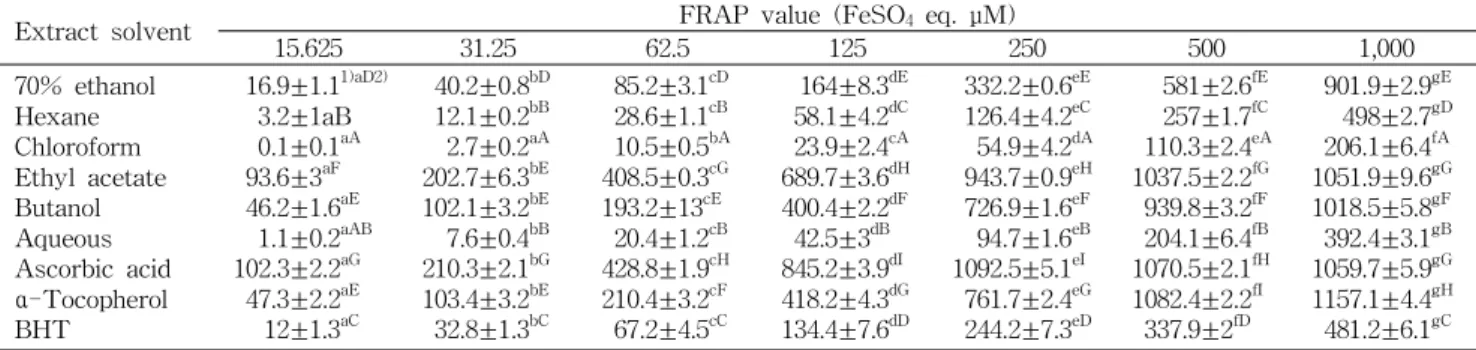
2+TPTZ)으로 전환되 는 과정을 이용한 것으로 시료 내의 총 항산화능을 측정하는 방법이다(21). 참취 70% 에탄올 추출물과 용매 분획물의 항 산화 활성 비교를 위해 FeSO
4검량선에 대입하여 FRAP value를 측정한 결과, Table 5와 같았다. 농도 1,000 μg/mL 에서 ethyl acetate 분획물 FRAP value는 1051.9 μM로 가장 높게 나타나(p<0.05) 대조군인 ascorbic acid와 유사한 활성 을 보였다. 500 μg/mL 농도에서 butanol 분획물 939.8 μM, 70% 에탄올 추출물 581 μM, hexane 분획물 498 μM, aque- ous 분획물 392.4 μM 그리고 chloroform 분획물 206.1 μM 순으로 나타났다(p<0.05). Moon 등(45)은 부추 메탄올 추출 물 0.162 μM FRAP value를 보였으며, Choi 등(46)은 칠면초 추출물 ethyl acetate 분획물이 5 mg/mL 농도에서 1.99 mM 를 나타냈으며, Ryu 등(47)은 개똥숙잎, 줄기 에탄올 추출물 1,000 μg/mL 농도에서 각각 133.58과 78.76 μM을 나타냈으 며, Kim 등(48)은 돼지감자잎 에탄올 추출물에서 0.712 mM 의 FRAP value를 나타내었다. Holasova 등(49)은 식물로부 터 추출된 페놀함량이 높을수록 항산화능이 증가한다고 보
고하였는데 이는 본 연구와 동일한 결과를 나타내었다. 따라 서 페놀 함량이 가장 높은 참취 ethyl acetate 분획물에서 높은 항산화 활성이 나타났다.
Fe
2+chelating 활성 측정
금속이온 인자(Fe, Cu, Co, Ni, Sn)는 산화 환원이 용이한 금속이나 이들의 금속염은 지질산화 과정에서 촉매로 작용 할 수 있는 금속이다. 일부 식품에 함유되어 있는 Fe
2+나 Cu
2+등은 hydroxyl radical(-OH)과 superoxide radical(O
2-) 등 의 생성을 촉진하여 식품의 지질산화를 가속화시킨다. 이러 한 금속이온인자에 대한 chelating 활성이 높을수록 지질산 화 반응에 촉매작용을 감소시킬 수 있으며, free radical의 생성을 억제함으로써 지질산화를 방지할 수 있는 능력을 측 정하는 지표로 이용된다(50,51). 참취 70% 에탄올 추출물과 용매 분획물의 chelating 활성 측정 결과, Table 6과 같이 농도의존적인 경향을 보였다. Chloroform 분획물의 500 μg/
mL 농도에서 70.1%로 가장 높은 활성을 나타났으며, ethyl
acetate, butanol 분획물에서는 4.7% 및 12.2%로 낮게 나타
났다(p<0.05). 본 연구에서 페놀 화합물 함량이 높을수록
DPPH 및 ABTS radical 소거능이 증가된 반면 Fe
2+chelat-
ing 활성 효과는 낮게 나타났다. 일반적으로 Fe
2+chelating
활성 효과는 페놀성 물질함량과 상관관계가 낮으며 금속이
온을 제거하는 물질과 라디칼 제거 물질 간의 작용기작의 차
Table 6. Fe
2+Chelating of Aster scaber extract and fractions
Extract solvent Concentration (μg/mL)
15.625 31.25 62.5 125 250 500 1,000
70% ethanol Hexane Chloroform Ethyl acetate Butanol Aqueous EDTA
9.1±1.7
1)aA2)7±4.1
aA12.8±0.8
aA2±2
aA4.9±1.4
aA7.2±0.9
aA33.5±20.6
aB9.3±0.2
aC7.5±1.8
aC17.1±0.8
aD2.1±1.1
aA5.1±1.1
aB8.1±1.8
aC59.7±0.2
bE15.8±6.6
bC8.1±1
aB29.6±1.2
bD2.9±2.8
abA5.8±2.2
aAB9.6±2.5
aB99±0.2
cE16.3±1.4
bD12.7±1.7
bC48.3±0.6
cE3.7±2.5
abA7.1±1
aB15.3±1.9
bCD99.9±0
cF18.9±1
bC19.2±1.6
cC64.7±2.8
dD4.3±1.3
abA10.3±0.8
bB21.5±2.1
cC99.9±0.1
cE33.6±0.9
cC36.9±1.6
dD70.1±2.6
eE4.7±1.2
abA12.2±1.2
bB33.4±1.3
dC99.9±0
cF59.7±2.8
dD81.8±1.5
eE80.5±6.4
fE6.2±2.1
bA19.1±2.3
cB47.2±1
eC100±0.1
cF1)
Each value is presented as mean±standard deviation (n=3).
2)
Mean within each column (a-f) and row (A-F) with different letters differ significantly (p<0.05).
Table 7. Correlations between antioxidant contents and antioxidant activities
1)TPC TFC DPPH ABTS SOD-like FRAP Chelating
TPC TFC DPPH ABTS SOD-like FRAP Chelating
0.762 1 0.536 0.564 0.197 0.628 -0.302
0.549 1 0.768 0.401 0.689 -0.673
0.913 1
2)0.793 0.981
3)-0.737
1 0.754 0.967
3)-0.880
2)0.755 1
-0.891
2)1
-0.784 1
1)
Aster scaber 70% ethanol extract and its several solvents were used in the correlation.
2)
Correlation is significant at the 0.05 level.
3)
Correlation is significant at the 0.01 level.
이점에서 비롯된다는 연구(52)와 비슷한 결과를 나타내었다.
참취 70% 에탄올 추출물과 용매 분획물의 폴리페놀 및 플라보노이드 함량과 항산화 활성 간의 상관관계
참취 70% 에탄올 추출물과 용매 분획물중의 총 폴리페놀 함량과 플라보노이드 함량, DPPH 라디칼 소거능, ABTS 라디칼 소거능, FRAP에 의한 환원력, Fe
2+chelating 활성 간의 상관관계를 분석한 결과는 Table 7과 같다. DPPH 라디 칼 소거능과 ABTS 라디칼 소거능 관계는 r=0.913으로 유의 적인 상관관계를 나타냈으며(p<0.05), DPPH 라디칼 소거능 과 FRAP에 의한 환원력 측정 관계는 r=0.981로 가장 높은 유의적 상관관계를 나타내었다(p<0.01). 이는 같은 성분이 라도 항산화 측정방법에 따라 항산화 활성이 다르게 나타난 다는 Moon 등(53)의 연구와 비슷한 결과를 나타내었다. 총 폴리페놀, 플라보노이드 함량과 철 이온은 r=-0.302 및 r=
-0.673로 상관관계가 없는 것으로 나타나 페놀성 물질과 철 이온에 대한 활성은 큰 영향을 미치지 않는다는 Choi 등(54) 의 연구와 일치한다.
요 약
본 연구는 참취 에탄올 추출물과 용매분획물의 항산화 활 성과 총 폴리페놀 함량 및 총 플라보노이드 함량을 측정하 고, 생리활성과 항산화 성분 간의 상관관계를 비교․분석하 였다. 총 폴리페놀 함량은 70% 에탄올 추출물 99.6 mg GAE eq/g으로 나타났으며, ethyl acetate 분획물 141.9 mg GAE eq/g으로 다른 분획물보다 높은 함량을 나타내었다(p<0.05).
또한 총 플라보노이드 함량도 ethyl acetate 분획물에서 105.6 mg QUE eq/g으로 높은 함량을 나타내었다(p<0.05).
DPPH 라디칼 소거능과 ABTS 라디칼 소거능의 경우 ethyl acetate 분획물 1,000 μg/mL 농도에서 97.1% 및 98.7%를 보여 대조군인 ascorbic acid, α-tocopherol 및 BHT와 유사 한 소거능을 나타내었다(p<0.05). SOD 유사활성은 ethyl acetate 분획물 1,000 μg/mL 농도에서 42.8%의 활성을 나타 내어 DPPH, ABTS 라디칼 소거능보다 비교적 낮은 활성을 나타내었다(p<0.05). FRAP에 의한 환원력 측정 결과에서도 ethyl acetate 분획물에서 높은 활성을 나타내었다(p<0.05).
그러나 Fe
2+chelating 활성 측정은 chloroform 분획물 1,000 μ g/mL 농도에서 81.8%로 높게 나타났으며, 오히려 ethyl acetate 분획물에서는 6.2%로 가장 낮게 나타났다(p<0.05).
이상의 결과 참취 70% 에탄올 추출물과 용매 분획물 중 eth- yl acetate 분획물이 다량의 폴리페놀과 플라보노이드를 함 유하고 있으며, 항산화 효과가 높게 나타났다. 따라서 참취 는 천연 항산화 소재 및 기능성식품으로의 활용 가능한 약용 식물자원인 것으로 판단된다.
감사의 글
본 연구는 농촌진흥청에서 수행한 15대 어젠다 농업연구 개발사업(과제번호 PJ007492)의 지원에 의한 연구결과의 일 부로 이에 감사드립니다.
문 헌