ORIGINAL ARTICLE
블랙 초크베리 추출물의 항산화 활성 및 아질산염 소거 활성
진동혁 신지문1) 성종환 이영근 김동섭 정헌식 장성호2) 김한수* 부산대학교 식품공학과, 1)부산대학교 생명자원과학대학, 2)부산대학교 바이오환경에너지학과
Comparison of the Antioxidant Activities and Nitrite Scavenging Activity of Black Chokeberry (Aronia melanocarpa) Extracts
Dong-Hyeok Jin, Ji-Moon Shin1), Jong-Hwan Seong, Young-Geun Lee, Dong-Seob Kim, Hun-Sik Chung, Seong-Ho Jang2), Han-Soo Kim*
Department of Food Science and Technology, Pusan National University, Miryang 50463, Korea
1)Natural Resources and Science, Pusan National University, Miryang 50463, Korea
2)Department of Bio-Environmental Energy, Pusan National University, Miryang 50463, Korea
Abstract
The purpose of this study was to measure the antioxidant activity and bioactivity of black chokeberry (Aronia melanocarpa). The black chokeberry was known to contain many physiologically active substance, such as ascorbic acid, anthocyanin, quercetin. We extracted black chokeberry powder from four solvents such as chloroform:methanol(CM, 2:1, v/v), distilled water (DW), 70% ethanol, 70% methanol. After that, we determined anthocyanin, total phenol, flavonoid content, DPPH radical scavenging activity, ABTS radical scavenging activity, ferric reducing antioxidant power, reducing power and Nitrite scavenging activity of black chokeberry extracts and as results of comparing each extract. respectively. From the above results shows that antioxidant activity and bioactivity of black chokeberry extracts was the highest in 70% methanol (p<0.05).
The results suggest that black chokeberry can be used as nutraceutical foods and natural antioxidant.
Key words : Black chokeberry (Aronia melanocarpa), Antioxidant activity, Anthocyanin, Total phenol, Flavonoid
1. 서 론1)
최근 건강의 중요성과 인간수명 연장에 따라 식품은 단순한 영양원이 아닌 기능성을 고려한 건강기능식품에 대한 관심과 소비가 증가하는 추세이며, 그중 항산화 및 노화방지와 관련된 건강기능식품에 대한 수요가 높아지 고 있다(Kim et al., 2014). 여러 질병의 주된 원인으로 알려진 free radical은 superoxide radical (O2-), singlet oxygen (1O2), hydroxyl radical (OH-), hydrogen
peroxide (H2O2) 등의 reactive oxygen species (ROS) 로 다양하게 존재하며(Halliwell et al., 1992), 단백질 변성, 지질 과산화, 세포막 파괴, DNA 손상 등과 함께 여러 산화에 의해 생성되는 생성물들은 암을 유발하고 노화와 관련해 생리적 장애를 일으킨다고 알려져 있다 (Hwang et al., 2016; Jiang, 2005). 이러한 ROS는 생 체에서 호흡 중 미토콘드리아 내에서 주로 발생하며, 이 를 제거하는 superoxide dismutase (SOD) 등 항산화 효 소들이 존재한다(Dröge, 2002). 하지만 현대 사회에서
Received 4 March, 2016; Revised 21 March, 2016;
Accepted 30 March, 2016
*Corresponding author : Han-Soo Kim, Department of Food Science and Technology, Pusan National University, Miryang 50463, Korea Phone: +82-55-350-5351
E-mail: [email protected]
ⓒ The Korean Environmental Sciences Society. All rights reserved.
This is an Open-Access article distributed under the terms of the Creative Commons Attribution Non-Commercial License (http://
creativecommons.org/licenses/by-nc/3.0) which permits unrestricted non-commercial use, distribution, and reproduction in any medium, provided the original work is properly cited.
인간은 인체에 생성되는 ROS 뿐 아니라 스트레스, 환경 오염, 생활습관 등으로 인하여 ROS에 노출되기 쉽다 (Bokov et al., 2004). 이에 식품으로 섭취할 수 있는 물 질로부터 항산화 활성에 대한 연구가 활발히 진행되고 있다(Kähkönen et al., 2001). 그중 블랙 초크베리는 장 미과 다년생 식물이며 북아메리카가 원산지이며, -40 의 추위, 강한 자외선 등의 환경에서도 잘 자라 8~9월 에 열매를 수확하여 식용 색소의 원료로 쓰이기도 하 며, 식용 또는 약용으로 사용된다(Bolling et al., 2015).
또한 ascorbic acid, anthocyanin, sorbitol, citric acid, quercetin, tannin, chlorogenic acid 등 여러 생리활성 물질을 함유하고 있어, ROS 및 free radical을 제거 및 생활습관병을 예방하는 것으로 알려져 있다(Parzonko et al., 2015). 반면에 블랙 초크베리를 용매별로 추출한 후 생리활성물질의 성분 함량과 항산화 활성을 측정하여 비교한 연구는 아직 미비한 실정이다.
이에 따라 본 연구에서는 블랙 초크베리의 chloro -form:methanol (CM, 2:1, v/v), DW (distilled water), 70% ethanol, 70% methanol의 용매별로 추출하여 anthocyanin, total phenol, flavonoid 함량을 측정하고, 항산화 능력(DPPH radical scavenging activity, ABTS radical scavenging activity), 환원력(ferric reducing antioxidant power, reducing power) 및 아질산 소거능 (nitrite scavenging activity)을 측정하여 블랙 초크베리 의 추출 용매에 따른 항산화능력을 비교하여 여러 생활 습관병 예방과 건강기능 식품 개발의 목적으로 이들의 소비를 높이고 이에 대한 기초자료를 제시함으로써 천연 항산화제 및 기능성식품으로서 이용 가능성을 검토하고 자 하였다.
2. 재료 및 방법
2.1. 실험 재료
본 실험에 사용된 시료는 2015년 9월에 폴란드산 블 랙 초크베리를 동결건조시켜 분쇄한 것을 시중에 구입 하여 deep freezer (DF-8514, Il-Shin BioBase Co., Daegu, Korea)에서 80 로 보관하며 사용하였다.
2.2. 시료의 추출
시료의 추출은 동결 저장된 블랙 초크베리 분말 100 g
을 취해 chloroform:methanol (CM, 2:1, v/v), 70%
ethanol, 70% methanol 용매를 각 10배 가하여(1:10, w/v) 상온에서 24시간씩 2회 추출한 뒤 여과(filter paper, Advantec, No.2, Tokyo, Japan)하였고, 물 추 출물은 70 에서 2시간씩 2회 추출하여 여과하였다.
추출물들은 rotary evaporator (Hei-VAP Advantage, Heidolph, Germany)를 이용하여 40 에서 감압 농축 하여 용매를 제거한 후, 고형의 시료를 회수하여 1.0, 0.6, 0.4, 0.2 mg/mL로 희석한 뒤 실험에 사용하였다.
시료의 수율은 추출 전 시료 중량에 대한 추출 후 건조 중 량 백분율(%)로 나타내었다.
2.3. Anthocyanin 함량 측정
블랙 초크베리의 anthocyanin 함량은 pH-differential 방법을 변형하여 측정하였다(kim et al., 2014). 즉, 건조 된 블랙 초크베리 분말 0.5 g에 methanol-1 M HCl (85:15, v/v) 15 mL를 가하여 30분 동안 혼합한 뒤 여과 하여 분석 시료로 사용하였다. 시료 1.0 mL에 0.025 M potassium chloride buffer (pH 1.0) 3.0 mL를 가하고 또 다른 시험관에 시료 1.0 mL에 0.4 M sodium acetate buffer (pH 4.5) 3.0 mL를 가한 후 암실에 20분간 방치 하여 UV/Vis spectrophotometer (SP-200, Analytik Jena Co., Jena, Germany)를 사용하여 510 nm 및 700 nm에서 흡광도를 측정 하였다. 블랙 초크베리의 anthocyanin 함량은 cyanidin-3-glucoside의 몰 흡광계 수( =26,900 M-1cm-1)를 이용하여 다음 식에 의해 표 시하였다(Wang et al., 2016).
Anthocyanin content =
×
×××
A = (A510 nm-A700 nm)pH1.0-(A510 nm-A700 nm)pH4.5. MW = molecular weight of cyanidin-3-glucoside
(449.2 g/mol).
DF = dilution factor.
= molar absorptivity of cyanidin-3 glucoside (26,900 M-1cm-1).
L = cell path length (1 cm).
2.4. Total phenol 함량 측정
Total phenol 함량은 Folin-Denis` 방법을 변형하여 실험하였다(Kim et al., 2013). 시료 추출액 0.5 mL에
증류수 3.0 mL을 넣고, Folin-Denis reagent 0.5 mL를 가한 후, 잘 섞어 3분간 실온에 방치한 뒤 10% Na2CO3
solution 0.5 mL을 첨가하여 실온에 1시간 방치한 후 700 nm에서 흡광도를 측정하였다. 표준물질로는 gallic acid를 사용하여 시료 1 g당 mg GAE (mg of gallic acid equivalents)로 나타내었다.
2.5. Flavonoid 함량 측정
Total flavonoid 함량은 시료 추출액 0.5 mL에 10%
aluminium nitrate 0.5 mL와 1 M potassium acetate 0.5 mL를 넣은 뒤, 80% ethanol 2.0 mL를 첨가하여 잘 혼합한 후 40분간 실온에 방치하여 반응시킨 후 415 nm 에서 흡광도 값을 측정하였다(Jing et al., 2015). 이 때 표준물질인 quercetin을 사용해 검량선을 작성하여 시료 1 g당 mg QE (mg of quercetin equivalents)로 계산하 였다.
2.6. DPPH radical scavenging activity 측정
DPPH (1,1'-diphenyl-2-picrylhydrazyl) radical scavenging activity는 각 용매 별 시료 추출물 0.2 mL 와 0.1 mM DPPH 2.8 mL를 혼합하고 암실에서 30분간 반응시킨 후 517 nm에서 흡광도를 측정하여 나타내었 다. 각 시료 추출물의 free radical scavenging activity 는 시료를 첨가하지 않은 blank의 흡광도가 50% 감소하 는데 필요한 시료의 농도인 IC50 (50% inhibitory concentration)으로 결과를 표시하였다(Blois, 1958;
Duan et al., 2014). 이 때 활성 비교를 위하여 control 로 합성항산화제인 butylated hydroxyanisole (BHA)을 사용하여 같은 방법으로 흡광도를 측정하였다.
DPPH radical scavenging activity (%)
=
×
2.7. ABTS radical scavenging activity 측정 ABTS cation decolorization assay에 의한 방법 (Floegel et al., 2011)을 변형하여 ABTS (2,2-Azino- bis-3-ethylbenzothiazoline-6-sulfonic acid) radical을 이용한 항산화력 측정을 시행하였다. 7 mM ABTS와 2.45 mM potassium persulfate를 1:1 (v/v)의 비율로 섞어 16시간 동안 암소에 방치하여 ABTS radical을 형
성시킨 후, ethanol로 희석하여 735 nm에서 흡광도 값 이 0.70(±0.02)이 되도록 하였다. 희석된 용액 3.9 mL에 시료 추출액 0.1 mL를 넣은 후 10분 뒤 734 nm에서 흡 광도를 측정하였다. Control은 BHA를 사용하였고 ABTS radical scavenging activity는 다음 식에 의하여 계산하였다.
ABTS radical scavenging activity (%)
=
×
2.8. Ferric reducing antioxidant power (FRAP) 측정 FRAP 측정은 환원력을 이용하여 항산화능을 측정하 는 방법(Ortuño et al., 2016; Raudonis et al., 2012)으 로 0.3 M sodium acetate buffer (pH 3.6)과 10 mM 2,4,6-tripyridyl-S-triazine (TPTZ) solution, 20 mM ferric chloride를 10:1:1 (v/v/v)로 혼합하여 실험 직전 에 조제하여 사용하였다. 시료 추출액 0.2 mL에 FRAP reagent 3.0 mL를 가하여 30분간 water bath에 방치한 뒤 593 nm에서 흡광도를 측정하였으며 ferrous sulfate 를 이용하여 검량선을 작성한 후 환원력을 표시하였다.
Control은 ascorbic acid를 사용하였고 이를 통해 EC50
(half maximal effective concentration)을 구하였다.
2.9. Reducing power 측정
블랙 초크베리의 용매별 추출물에 따른 reducing power의 측정은 각 시료 추출 용액 1.0 mL 에 0.2 M sodium phosphate buffer (pH 6.6) 1.5 mL와 1%
potassium ferrycyanide 1.0 mL를 넣고 50 의 water bath에서 20분간 반응 시켰다. 반응시킨 혼합액에 10%
trichloroacetic acid 1.5 mL를 가하여 섞은 후 3,000 rpm에 10분간 원심분리하여 분리된 상등액 1.0 mL를 증류수 3.0 mL 그리고 0.1% ferric chloride solution 0.2 mL와 잘 혼합시켜 10분 후 700 nm에서 흡광도를 측정하였다(Singhal et al., 2014). 또한 EC50은 control 인 BHA를 통하여 계산하였다.
2.10. Nitrite (NO2) scavenging activity 측정
아질산염 소거능은 (Johnny and Ron, 1984; Kim et al., 2014)의 방법을 변형하여 측정하였다. 시료 2.0 mL 와 1 mM sodium nitrite 1.0 mL를 혼합하여 0.2 M
Assays Black chokeberry powder
Anthocyanin content (mg/100 g) 146.13±1.06
CM1) DW2) 70% ethanol 70% methanol
Extraction yields (%) 21.66 61.52 66.10 68.61
Total phenol content (mg GAE3)/g) 33.77±0.16a6) 40.28±0.21b 55.92±0.35c 61.52±0.36d Total flavonoid content (mg QE4)/g) 16.78±0.38b 12.84±0.44a 16.58±0.32b 17.24±0.07c DPPH5) (IC50, mg/mL) 0.318±0.002d 0.250±0.001c 0.153±0.002b 0.129±0.001a ABTS (IC50, mg/mL) 1.548±0.023d 0.982±0.012c 0.523±0.002b 0.482±0.002a FRAP (EC50, mg/mL) 1.260±0.015c 1.300±0.005d 0.530±0.004b 0.485±0.010a Reducing power (EC50, mg/mL) 0.987±0.018d 0.688±0.015c 0.307±0.001b 0.292±0.007a NO2 scavenging activity (IC50, mg/mL) 3.117±0.079d 2.115±0.111c 1.033±0.004b 1.012±0.014a
1) CM: chloroform:methanol mixture (2:1, v/v)
2) DW: distilled water
3) GAE: gallic acid equivalents
4) QE: quercetin equivalents
5) DPPH radical scavenging activity (DPPH), ABTS radical scavenging activity (ABTS), ferric reducing antioxidant power (FRAP)
6) The values are means±SD (n=3). Values with the different letters in the same row are significantly different (p<0.05) by Duncan`s multiple range tests
Table 1. Contents of anthocyanin, total phenol, flavonoid, and IC50 &EC50 values in the bioactivity evaluation assays of black chokeberry (Aronia melanocarpa)
citrate buffer (pH 2.5) 7.0 mL를 첨가한 후, 37 로 1 시간 동안 반응시켰다. 반응액 1.0 mL에 2% acetic acid 3.0 mL를 넣은 후, Griess reagent (1% sulfanilic acid in 30% acetic acid:1% 1-naphthylamine in 30% acetic acid, 1:1, v/v) 0.4 mL와 15분간 반응시켜 520 nm에서 흡광도를 측정하였다. Control로는 BHA를 사용하였으 며 다음 식을 이용하여 소거능을 계산하였다.
Nitrite scavenging activity (%)
=
2.11. 통계 처리
실험 데이터는 3회 반복 측정하였으며, mean±SD (n=3)으로 표현하였다. 또한 실험 군간의 유의적인 차이 는 one-way ANOVA (analysis of variance)로 분석 한 뒤 p<0.05 수준에서 Duncan`s multiple range test에 의하여 각 농도 간의 유의성을 검증하였다. 통계처리에 대한 프로그램은 IBM SPSS statistic ver. 22를 사용하 였다.
3. 결과 및 고찰
3.1. 수 율
블랙 초크베리(Aronia melanocarpa)의 chloroform:
methanol (CM, 2:1, v/v)과 distilled water (DW), 70%
methanol 및 70% ethanol의 추출 수율은 Table 1에 나 타내었다. 각 용매별 추출 수율은 70% methanol에서 68.61%로 가장 높게 나타났고, 70% ethanol에서 66.10%, DW에서 61.52%, CM에서 21.66% 순으로 나 타났다.
3.2. Anthocyanin 함량
블랙 초크베리 분말의 anthocyanin 함량은 Table 1과 같이 146.13±1.06 mg/100 g로 나타났다. Anthocyanin 은 적색과 자색 등 식물체의 수용성 천연 색소로 최근 심혈관 질환의 바이오 마커로 사용되며 종양, 시력개 선, 노화방지, 항암, 항염, DNA 손상 방지 등의 효과가 있는 것으로 알려져 있다(Lin et al., 2016). Teoli et al.(2016)의 연구에서 블랙 초크베리의 anthocyanin 함 량은 127.89±1.57 mg/100 g으로 본 실험의 결과보다
다소 낮은 값이 나왔으나 blueberry 23.62±0.07 mg/100 g, cherry 15.91±0.10 mg/100 g, raspberry 20.36±0.25 mg/100 g, strawberry 6.89±0.48 mg/100 g으로 보고 되어 이와 비교하였을 때 블랙 초크베리의 anthocyanin 함량이 높은 것으로 판단된다.
3.3. Total phenol 함량
블랙 초크베리의 용매별 추출물에서의 total phenol 함량은 Table 1에 나타내었으며 70% methanol 추출물 에서 61.52±0.36 mg GAE/g으로 가장 높게 나왔고, 70% ethanol에서 55.92±0.35 mg GAE/g, DW에서 40.28±0.21 mg GAE/g, CM에서 33.77±0.16 mg GAE/g 순으로 CM에서 가장 낮은 값으로 관찰되었다. 기능성 식 품으로 알려져 있는 소재 중에서는 나무콩씨 물 추출물 35.50±0.09 mg GAE/g(Asma and Mohammad, 2015), 콜리플라워 24.3±4.50 mg GAE/g(Nilufer and Sedef, 2015), 삼채 잎 2.77±0.15 mg GAE/g(Hwang et al., 2015)으로 보고되어있어 블랙 초크베리의 total phenol 함량이 더 높은 것으로 나타났다. 페놀성 화합물은 항암, 항산화능 뿐 아니라, 단백질과 같은 고분자 물질과 결합 하기도 하여 인체 내에서 다양한 생리활성을 가진다고 보고되어있다(Bravo, 1998).
3.4. Flavonoid 함량
블랙 초크베리의 각 용매 추출물에서 flavonoid 함량 은 Table 1에 나타내었으며, 70% methanol 추출물에서 17.24±0.07 mg QE/g, CM 추출물이 16.78±0.38 mg QE/g, 70% ethanol 추출물 16.58±0.32 mg QE/g, DW 추출물 12.84±0.44 mg QE/g 순으로 CM 추출물과 70% ethanol 추출물은 유의적 차이가 없었다(p<0.05).
Total phenol 함량의 경우 각 용매 추출물 별로 뚜렷하게 유의적 차이가 있었고 CM 추출물에서의 함량이 가장 낮 게 나왔으나 flavonoid 함량의 경우 DW 추출물에서 가 장 낮은 결과 값이 관찰되었고 DW 추출물을 제외한 나 머지 추출물의 결과에서는 비슷한 함량을 보였다. Lee et al.(2012)은 과일의 껍질에서 많은 기능성 물질을 함유 하고 있는 것으로 보고하였으며 총 flavonoid 함량에 대 한 연구에서 오렌지 껍질과 제주감귤 껍질 4.5±0.1 mg QE/g, 멜론 껍질 15.7±0.5 mg QE/g, 바나나껍질 4.1±
0.1 mg QE/g으로 보고하였다. 또한 Slimestad et al.
(2005)의 연구에서 블랙 초크베리 분말의 총 flavonoid 함량은 71.1 mg/ 100g (fresh weight) 이상 함유되어 있 다고 보고되어 있어 블랙 초크베리의 flavonoid 함량은 높은 수준인 것으로 보인다.
3.5. DPPH radical scavenging activity
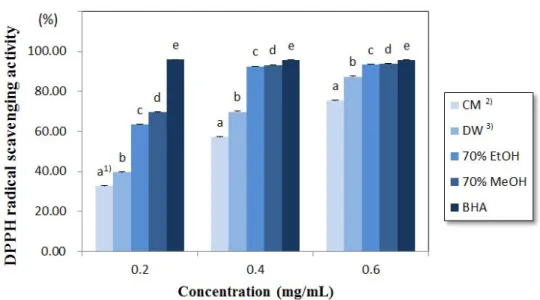
블랙 초크베리의 각 용매별 추출물과 control인 BHA 의 DPPH radical 소거능을 각 농도별로 비교한 결과를 Fig. 1에 나타내었고, IC50값을 구하여 Table 1에 나타내 었다. 각 용매별 추출물을 0.2, 0.4, 0.6 mg/mL의 농도 로 측정한 결과 농도 의존적으로 radical 소거활성이 증 가하는 경향을 보였다. 70% methanol 추출물에서 농도 별로 각각 69.58±0.19%, 93.18±0.00%, 93.74±0.07%
로 추출물 중에 가장 높은 소거활성을 보였으며, 70%
ethanol 추출물이 63.28±0.37%, 92.49±0.07%, 93.50±
0.07%으로 나타났으며, DW 추출물 39.64±0.14%, 57.15±0.37%, 75.35±0.37%, CM 추출물 32.62±0.12%, 57.15±0.37%, 75.35±0.37%로 각 용매 추출물 중 가장 낮은 소거능을 보였다. IC50은 70% methanol 추출물과 70% ethanol 추출물에서 각각 0.129±0.001, 0.153±
0.002 mg/mL로 높은 free radical 소거능을 나타내었고, DW 추출물이 0.250±0.001 mg/mL, CM 추출물 0.318
±0.002 mg/mL 순으로 전체적으로 높은 free radical 소 거활성을 가지고 있는 것으로 나타났다. 특히 70%
methanol과 70% methanol의 0.4, 0.6 mg/mL 농도에 서의 항산화능은 control로 사용한 합성항산화제인 BHA와 비슷한 90% 이상의 높은 결과를 나타내었고, 다 른 용매에서도 우수한 항산화능이 관찰되었다. DPPH radical 소거능은 polyphenol 함량이 높을수록 소거활성 이 증가되고 유의적인 상관관계를 갖는 것으로 알려져있 다(Rice-Evans et al., 1997). 각 용매별로 관찰된 total phenol의 결과와 DPPH의 항산화능의 결과가 모두 CM
< DW < 70% EtOH < 70% MeOH 용매 순으로 나타 난 것을 보았을 때 이와 같은 보고와 유사한 것으로 판단 된다.
3.6. ABTS radical scavenging activity
블랙 초크베리의 용매 농도별 추출물의 ABTS radical 소거능은 Fig. 2에 나타내었으며, 그 결과에 의한 IC50값은 Table 1에 표시하였다. ABTS radical 소거능은
Fig. 1. DPPH radical scavenging activity of various extracts from black chokeberry (Aronia melanocarpa).
1) The values are means±SD (n=3). Bars with the different letters are significantly different (p<0.05) by Duncan`s multiple range tests
2) CM: chloroform:methanol mixture (2:1, v/v) extract
3) DW: distilled water
Fig. 2. ABTS radical scavenging activity of various extracts from black chokeberry (Aronia melanocarpa).
1) The values are means±SD (n=3). Bars with the different letters are significantly different (p<0.05) by Duncan`s multiple range tests
2) CM: chloroform:methanol mixture (2:1, v/v) extract
3) DW: distilled water
각 농도가 높아짐에 따라 유의적으로 증가하였다 (p<0.05). 그중 70% methanol 추출물에서 23.73±0.17%, 41.80±0.09%, 58.59±0.17%, 70% ethanol 추출물에서 23.44±0.22%, 41.26±0.15%, 54.54±0.22%로 0.2 mg/mL의 농도에서는 두 용매의 유의적 차이가 없었으 나 농도가 증가함에 따라 유의적 차이가 나타났다 (p<0.05). DW 추출물은 농도별로 15.58±0.17%, 27.54
±0.17%, 37.31±0.15%, CM 추출물 13.09±0.09%, 21.78±0.15%, 29.49±0.09%로 다른 추출물 중 낮은 소 거능을 보였다. 또한 IC50 값은 70% methanol 추출물이 0.482±0.002 mg/mL로 높은 소거능을 보였고, 70%
ethanol 추출물이 0.523±0.002 mg/mL, DW 추출물 0.982±0.012 mg/mL, CM 추출물 1.548±0.023 mg/mL 의 순으로 나타났다. 본 실험 결과 함유하는 polyphenol 과 flavonoid의 종류와 함량에 따라 DPPH radical 소거 능과 ABTS radical 소거능의 활성도의 차이가 있다는 보고(Wang et al., 1998)와 본 실험에서의 용매별 활성 도 순을 비교하여 보았을 때 이 둘의 상관관계는 비슷한 결과가 나온다는 보고(Wootton et al., 2011)와 유사한 것으로 나타났다.
3.7. Ferric reducing antioxidant power (FRAP) 블랙 초크베리의 각 추출물에 따른 FRAP 결과는 Fig. 3에 나타내었고, EC50값은 Table 1에 나타내었다.
Ferrous sulfate를 표준물질로 사용하여 측정한 흡광도 를 검량선을 작성하여 환산한 결과 70% methanol 추출 물에서 각 농도별로 0.382±0.002, 0.728±0.008, 1.031±0.016 mM Fe2+로 유의적으로(p<0.05) 높게 나 타났으며, 70% ethanol 추출물에서 0.345±0.002, 0.670
±0.011, 0.984±0.007 mM Fe2+, CM 추출물은 0.212±
0.001, 0.397±0.001, 0.573±0.002 mM Fe2+, DW 추출 물은 0.211±0.001, 0.393±0.006, 0.565±0.001 mM Fe2+로 낮은 것으로 나타났으며, CM 추출물과 DW 추 출물의 0.2, 0.4 mg/mL의 농도에서는 유의적인 차이가 나타나지 않았으며(p<0.05), 0.6 mg/mL 농도에서는 CM 추출물이 약간 높은 것으로 관찰되었다. EC50은 70% methanol 추출물에서 0.485±0.010 mg/mL, 70%
ethanol 추출물에서 0.530±0.004 mg/mL, CM 추출물 에서 1.260±0.015 mg/mL, DW 추출물에서 1.300
±0.005 순으로 관찰되었다. 실험 결과 DPPH나 ABTS
측정에서는 CM 추출물의 결과가 DW 추출물보다 낮았 으나 FRAP 측정의 경우 용매별 flavonoid 함량 차이와 비슷한 결과가 나온 것을 알 수 있었다. 이에 블랙 초크베 리의 polyphenol 성분도 영향을 미치지만 flavonoid 성 분이 FRAP 결과에 더 영향을 미치는 것으로 사료된다.
이는 시료의 phenol과 flavonoid의 종류에 따라 항산화 능 및 환원력에 차이를 가진다는 보고(Amitabye et al., 2002)와 유사한 것으로 나타났다. 또한 119가지의 베리 류의 FRAP 측정 평균이 0.099 mM Fe2+/g으로 보고 (Carlsen et al., 2010)된 것과 비교하였을 때 블랙 초크 베리의 항산화력은 우수한 것으로 사료된다.
3.8. Reducing power
Reducing power의 결과는 Fig. 4에 나타내었고, EC50 값은 Table 1에 나타내었다. 각 용매별 추출물과 BHA의 농도가 증가함에 따라 유의적으로(p<0.05) 흡광 도가 증가하는 것을 보였고, 70% methanol 추출물에서 각 농도별로 0.183±0.004, 0.357±0.006, 0.546±0.006 으로 높게 나타났으며, 70% ethanol 추출물에서 0.175
±0.002, 0.347±0.003, 0.513±0.004로 높은 활성을 보 였다. DW 추출물 0.108±0.001, 0.196±0.004, 0.281±
0.003, CM 추출물은 0.086±0.001, 0.158±0.001, 0.223
±0.002의 흡광도가 관찰되었다. 또한 EC50 은 70%
methanol 추출물이 0.292±0.007 mg/mL, 70% ethanol 추출물 0.307±0.001 mg/mL, DW 추출물 0.987±0.018 mg/mL, CM 추출물 0.987±0.018 mg/mL의 순으로 나 타났다. 이와 같이 블랙 초크베리의 모든 용매별 추출물 에서 농도 의존적으로 환원력이 증가하는 경향을 보였고, EC50의 결과를 비교해 보았을 때 다른 항산화 결과와 마 찬가지 순으로 나타났다. 또한 70% methanol 추출물의 0.6 mg/mL 농도에서는 control에 근접한 흡광도를 나타 내었다.
3.9. Nitrite (NO2) scavenging activity
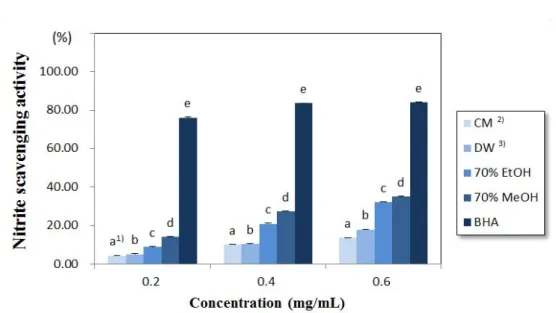
블랙 초크베리의 용매별 추출물의 NO2 소거능과 IC50
은 Fig. 5와 Table 1에 나타내었으며 모든 시료에서 농 도가 증가함에 따라 유의적인 차이를 보였다(p<0.05).
70% methanol 추출물에서 각 농도별로 14.15±0.16%, 27.48±0.34%, 35.09±0.09%, 70% ethanol 추출물 9.09±0.33%, 21.00±0.33%, 32.26±0.16%, DW 추출물
Fig. 3. Ferric reducing antioxidant power of various extracts from black chokeberry (Aronia melanocarpa).
1) The values are means±SD (n=3). Bars with the different letters are significantly different (p<0.05) by Duncan`s multiple range tests
2) CM: chloroform:methanol mixture (2:1, v/v) extract
3) DW: distilled water
4) AA: ascorbic acid
Fig. 4. Reducing power of various extracts from black chokeberry (Aronia melanocarpa).
1) The values are means±SD (n=3). Bars with the different letters are significantly different (p<0.05) by Duncan`s multiple range tests
2) CM: chloroform:methanol mixture (2:1, v/v) extract
3) DW: distilled water
Fig. 5. Nitrite scavenging activity of various extracts from black chokeberry (Aronia melanocarpa).
1) The values are means±SD (n=3). Bars with the different letters are significantly different (p<0.05) by Duncan`s multiple range tests
2) CM: chloroform:methanol mixture (2:1, v/v) extract
3) DW: distilled water
5.22±0.25%, 10.50±0.25%, 18.01±0.09%, CM 추출 물 4.46±0.09%, 10.23±0.00%, 13.71±0.09%순으로 관 찰되었고, IC50은 1.012~3.117 mg/mL 범위의 값으로 70% methanol, 70% ethanol, DW, CM 추출물 순으로 나타났다. NO2는 산성 조건 하에서 젓갈류가 많이 함유 하고있는 2급 아민 등의 아민류와 반응하여 발암물질인 nitrosamine을 형성하는 식품첨가물로 알려져 있다 (Jeong et al., 2006). 이에 flavonoid 화합물은 NO2 소 거율이 낮지만 phenol 화합물 중 phenolic acid는 NO2 를 분해하여 높은 NO2 소거능을 나타낸다고 알려져 있 다(Kang et al., 1996). 블랙 초크베리의 NO2 소거능은 control인 BHA보다는 다소 낮은 결과가 나왔으나 농도 가 증가함에 따라 소거능이 큰 폭으로 증가하는 것을 관 찰 할 수 있었다.
4. 결 론
블랙 초크베리의 chloroform:methanol (CM, 2:1, v/v), DW (distilled water), 70% ethanol, 70%
methanol 용매 추출물에서 항산화 활성 및 생리활성을
알아보고 블랙 초크베리의 바이오 자원 및 기능성 소재 로서의 가치를 검토하기 위하여 본 실험을 수행한 결과, 동결건조 블랙 초크베리 분말에서 anthocynin 성분은 146.13±1.06 mg/100 g으로 높은 함량을 가지고 있었고, 각 용매별 추출물에 대하여 total phenol, flavonoid 함 량, DPPH radical 소거능, ABTS radical 소거능, ferric reducing antioxidant power, reducing power 및 nitrite 소거능을 측정 비교한 결과 70% methanol > 70%
ethanol > DW CM 추출물 순으로 70% methanol 추 출물과 70% ethanol 추출물에서 높은 항산화능이 나타 났다. 특히 DPPH 소거능에서 70% methanol 추출물과 70% ethanol 추출물의 0.4, 0.6 mg/mL는 control인 BHA와 큰 차이없이 높은 항산화 활성도를 보였다.
anthocyanin, phenolic compound, flavonoids 등 생리 활성물질은 그 함량에 따라 항산화활성이 증가되는 것으 로 확인되었다. 따라서 본 연구 결과 블랙 초크베리의 70% methanol과 70% ethanol 추출물에서 높은 생리활 성과 항산화 활성을 가지고 있었으며 기능성 식품 및 천 연항산화제로서 응용할 가능성이 높은 것으로 사료된다.
감사의 글
이 논문은 부산대학교 기본연구지원사업(2년)에 의하 여 연구되었음.
REFERENCES
Amitabye, L. R., Theeshan, B., Mohammed, A. S., Okezi, I. A., 2002, Antioxidant activities of phenolic, proanthocyanidin, and flavonoid components in extracts of Cassia fistula, J. Agric. Food Chem., 50, 5042-5047.
Asma, H. A. S., Mohammad, A. H., 2015, Total phenols, total flavonoids contents and free radical scavenging activity of seeds crude extracts of pigeon peatradi -tionally used in Oman for the treatment of sveral chronic diseases, Asian Pac. J. Trop. Dis., 5, 316-321.
Blois, M. S., 1958, Antioxidant determinations by the use of a stable free radical, Nature, 181, 1199-1200.
Bokov, A., Chaudhuri, A., Richardson, A., 2004, The role of oxidative damage and stress in aging, Mech.
Ageing Dev., 125, 811-826.
Bolling, B. W., Taheri, R., Pei, R., Kranz, S., Yu, M., Durocher, S. N., Brand, M. H., 2015, Harvest date affects aronia juice polyphenols, sugars, and antioxidant activity, but not anthocyanin stability, Food Chem., 187, 189-196.
Bravo, L., 1998, Polyphenols: Chemistry, dietary sources, metabolism, and nutritional significance, Nutr, Rev., 56, 317-333.
Carlsen, M. H., Halvorsen, B. L., Holte, K., Bohn, S. K., Dragland, S., Sampson, L., Willey, C., Senoo, H., Umezono, Y., Sanada, C., Barikmo, I., Berhe, N., Willett, W. C., Phillips, K. M., Jacobs, D. R., Blomhoff, R., 2010, The total antioxidant content of more than 3100 foods, beverages, spices, herbs and supplements used worldwide, Nutrition Journal, 9, 1.
Dröge, W., 2002, Free radicals in the physiological control of cell function, Physiol. Rev., 82, 47-95.
Duan, Y., Kim, M. A., Kim, H. S., Seong, J. H., Lee, Y.
G., Kim, D. S., Chung, H. S., 2014, Effects of feral haw (Crataegus pinnatifida Bunge) seed extracts on the antioxidant activities, J. Life Sci., 24, 386-392.
Floegel, A., Kim, D. O., Chung, S. J., Koo, S. I., Chun,
O. K., 2011, Comparison of ABTS/DPPH assays to measure antioxidant capacity in popular antioxidant -rich US foods, J. Food Compos. Anal., 24, 1043- 1048.
Halliwell, B., Gutteridge, J. M., Cross, C. E., 1992, Free radicals, antioxidants, and human disease: where are we now?, J. Lab. Clin. Med., 119, 598-620.
Hwang, J. S., Lee, B. H., An, X., Jeong, H. R., Kim, Y.
E., Lee, I., Lee, H., Kim, D. O., 2015, Total phenolics, total flavonoids, and antioxidant capacity in the leaves, bulbs, and roots of Allium hookeri, Korean J. Food Sci. Technol., 47, 261-266.
Hwang, K. A., Kim, G. R., Hwang, Y. J., Hwang, I. G., Song, J., 2016, Oxidative stress inhibitory effects of low temperature-aged garlic (Allium stivum L.) extracts through free radical scavenging activity, J.
Korean Soc. Food Sci. Nutr., 45, 27-34.
Jeong, C. H., Nam, E. K., Shim, K. H., 2006, Activities and nitrate scavenging activity in different parts of Erigeron annuus, J. Agric. Life Sci., 40, 13-20.
Jiang, W. Y., 2005, Therapeutic wisdom in traditional Chinese medicine: a perspective from modern science, Trends Pharmacol. Sci., 26, 558-563.
Jing, E. L., Song, T. F., Zeng, H. Q., Chang, L., Shao, P.
N., 2015, Total flavonoids content, antioxidant and antimicrobial activities of extracts from Mosla chinensis Maxim. cv. Jiangxiangru, LWT-Food Sci.
Technol., 64, 1022-1027.
Johnny, M. D., Ron, B. S., 1984, Fallibility of Griess (nitrite) test, Urology, 23, 270-271.
Kähkönen, M. P., Hopia, A. I., Heinonen, M., 2001, Berry phenolics and their antioxidant activity, J.
Agric. Food Chem., 49, 4076-4082.
Kang, Y. H., Park, Y. K., Lee, G. D., 1996, The nitrite scavenging and electron donating ability of phenolic compounds, Korea J. Food Sci. Technol., 28, 232- 239.
Kim, D. B., Shin, G. H., Lee, Y. J., Lee, J. S., Cho, J. H., Baik, S. O., Lee, O. H., 2014, Assessment and comparison of the antioxidant activities and nitrite scavenging activity of commonly consumed bece -rages in Korea, Food Chem., 151, 58-64.
Kim, H. S., Duan, Y., Kim, M. A., Jang, S. H., 2014, Contents of antioxidative components from pulpy and seed in wild haw (Crataegus pinnatifida
BUNGE), J. Environ. Sci. Int., 23, 1791-1799.
Kim, J. G., Kim, H. L., Kim, S. J., Park, K. S., 2013, Fruit quality, anthocyanin and total phenolic contents, and antioxidant activities of 45 blueberry cultivars grown in Suwon, Korea, J. Zhejiang University-Sci. B (Biomedicine & Biotechnology), 14, 793-799.
Lee, M. Y., Yoo, M. S., Whang, Y. J., Jin, Y. J., Hong, M. H., Pyo, Y. H., 2012, Vitamin C, total polyphenol, flavonoid contents and antioxidant capacity of several fruit peels, Korean J. Food Sci. Technol., 44, 540- 544.
Lin, Z., Fischer, J., Wichker, L., 2016, Intermolecular binding of blueberry pectin-rich fractions and anthocyanin, Food Chem., 194, 986-993.
Nilufer, G., Sedef, N. E., 2015, Effects of cooking on in vitro sinigrin bioaccessibility, total phenols, antioxidant and actimutagenic activity of cauliflower (Brassica oleraceae L. var. Botrytis), J. Food Compos. Anal., 37, 119-127.
Ortuño, J., Serrano, R., Jordán, M. J., Bañón, S., 2016, Relationship between antioxidant status and oxidative stability in lamb meat reinforced with dietary rosemary diterpenes, Food Chem., 190, 1056-1063.
Parzonko, A., Oswit, A., Bazylko, A., Naruszewicz, M., 2015, Anthocyans-rich Aronia melanocarpa extract possesses avility to protect endothelial progenitor cells against angiotensin induced dysfunction, Phytomedicine, 22, 1238-1246.
Raudonis, R., Raudone, L., Jakstas, V., Janulis, V., 2012, Comparative evaluation of post-column free radical scavenging and ferric reducing antioxidant
power assays for screening of antioxidants in strawberries, J. Chromatogr. A., 1233, 8-15.
Rice-Evans, C. A., Miller, N. J., Paganga, G., 1997, Antioxidant properties of phenolic compounds, Trends Plant Sci., 2, 152-159.
Singhal, M., Paul, A., Singh, H. P., 2014, Synthesis and reducing power assay of methyl semicarbazone derivatives, J. Saudi Chem. Soc., 18, 121-127.
Slimestad, R., Torskangerpoll, K., Nateland, H. S., Johannessen, T., Giske, N. H., 2005, Flavonoids from black chokeberries, Aronia melanocarpa, J.
Food Compos. Anal., 18, 61-68.
Teoli, F., Lucioli, S., Nota, P., Frattarelli, A., Matteocci, F., Carlo, A. D., Caboni, E., Forni, C., 2016, Role of pH and pigment concentration for natural dye-sensitized solar cells treated with anthocyanin extracts of common fruits, J. Photochem. Photobiol.
A., 316, 24-30.
Wang, M. F., Shao, Y., Li, J. G., Zhu, N. Q., Ho, C. T., 1998, Antioxidantive phenolic compounds from sage (Salvia officinalis), J. Agric. Food Chem., 46, 4869- 4873.
Wang, Y., Zhu, J., Meng, X., Liu, S., Mu, J., Ning, C., 2016, Comparison of polyphenol, anthocyanin and antioxidant capacity in four varieties of Lonicera caerulea berry extracts, Food Chem., 197, 522-529.
Wootton, P. C., Moran, A., Ryan, L., 2011, Stability of the total antioxidant capacity and total polyphenol content of 23 commercially available vegetable juices before and after in vitro digestion measured by FRAP, DPPH, ABTS and Folin-Ciocalteu methods, Food Res. Int., 44, 217-224.