INTRODUCTION
Influenza viruses are important global pathogens with an esti- mated annual attack rate of 5–10% in adults and 20–30% in children, resulting in substantial disease incidence, hospital- ization, and mortality.
1The Advisory Committee on Immuni- zation Practices (ACIP) of the Centers for Disease Control and Prevention (CDC) recommended three U.S. Food and Drug Ad- ministration (FDA)-approved influenza antiviral agents [oral oseltamivir, inhaled zanamivir, and intravenous (IV) peramivir]
for the prevention and control of influenza during the 2015–
2016 influenza season.
2Comparison of Efficacy of Intravenous Peramivir and Oral Oseltamivir for the Treatment of Influenza:
Systematic Review and Meta-Analysis
Jonghoo Lee
1*, Ju-Hee Park
2*, Hyeyoung Jwa
1, and Yee Hyung Kim
31Department of Internal Medicine, Jeju National University Hospital, Jeju National University School of Medicine, Jeju;
2Division of Pulmonary and Critical Care Medicine, Seoul Metropolitan Government-Seoul National University Boramae Medical Center, Seoul;
3Division of Pulmonary and Critical Care Medicine, Department of Internal Medicine, Kyung Hee University Hospital at Gangdong, Kyung Hee University School of Medicine, Seoul, Korea.
Purpose: Peramivir is the first intravenously administered neuramidase inhibitor for immediate delivery of an effective single-dose
treatment in patients with influenza. However, limited data are available on intravenous (IV) peramivir treatment compared to oral oseltamivir for these patients.
Materials and Methods: With a systematic review and meta-analysis, we compared the efficacy of IV peramivir with oral oseltami-
vir for treatment of patients with seasonal influenza. MEDLINE, EMBASE, and Cochrane Central Register were searched for rele- vant clinical trials.
Results: A total of seven trials [two randomized controlled trials (RCTs) and five non-randomized observational trials] involving
1676 patients were finally analyzed. The total number of peramivir- and oseltamivir-treated patients was 956 and 720, respective- ly. Overall, the time to alleviation of fever was lower in the peramivir-treated group compared with the oseltamivir-treated group [mean difference (MD), -7.17 hours; 95% confidence interval (CI) -11.00 to -3.34]. Especially, pooled analysis of observational stud- ies (n=4) and studies of outpatients (n=4) demonstrated the superiority of the peramivir-treated group (MD, -7.83 hours; 95% CI -11.81 to -3.84 and MD, -7.71 hours; 95% CI -11.61 to -3.80, respectively). Mortality, length of hospital stay, change in virus titer 48 hours after admission, and the incidence of adverse events in these patients were not significantly different between the two groups.
Conclusion: IV peramivir therapy might reduce the time to alleviation of fever in comparison with oral oseltamivir therapy in pa-
tients with influenza; however, we could not draw clear conclusions from a meta-analysis because of the few RCTs available and methodological limitations.
Key Words: Influenza, human, peramivir, oseltamivir, fever, signs and symptoms, respiratory
pISSN: 0513-5796 · eISSN: 1976-2437
Received: February 9, 2017 Revised: March 24, 2017 Accepted: March 27, 2017
Corresponding author: Dr. Yee Hyung Kim, Division of Pulmonary and Critical Care Medicine, Department of Internal Medicine, Kyung Hee University Hospital at Gangdong, Kyung Hee University School of Medicine, 892 Dongnam-ro, Gang- dong-gu, Seoul 05278, Korea.
Tel: 82-2-440-6281, Fax: 82-2-440-8150, E-mail: [email protected]
*Jonghoo Lee and Ju-Hee Park contributed equally to this work.
•The authors have no financial conflicts of interest.
© Copyright: Yonsei University College of Medicine 2017
This is an Open Access article distributed under the terms of the Creative Com- mons Attribution Non-Commercial License (http://creativecommons.org/licenses/
by-nc/4.0) which permits unrestricted non-commercial use, distribution, and repro- duction in any medium, provided the original work is properly cited.
Yonsei Med J 2017 Jul;58(4):778-785 https://doi.org/10.3349/ymj.2017.58.4.778
Oseltamivir (F. Hoffmann-La Roche, Ltd., Basel, Switzerland) is the antiviral agent most frequently used for the treatment and prevention of influenza, and its use has increased since pandemic influenza A (H1N1) 2009. Because oseltamivir is ad- ministered via an oral route, it is often difficult to use in some cases, particularly in young children, patients with aspiration tendency, critically ill patients or patients requiring mechani- cal ventilation. Therefore, novel or additional effective agents are needed.
3Peramivir (BioCryst Pharmaceuticals Inc., Durham, NC, USA) is an antiviral agent that blocks viral growth by selectively in- hibiting neuramidase (NA), an enzyme that releases viral par- ticles from infected cells, in human influenza A and B viruses, and is administered once daily through an IV route.
3It was li- censed in Japan and South Korea in 2010.
3In the United States, IV peramivir is still under investigation as an NA inhibitor (NAI), but it was made temporarily available in 2009 for hos- pitalized patients infected with pandemic influenza A (H1N1) under an Emergency Use Authorization.
4Recent randomized controlled trials (RCTs) demonstrated that IV peramivir showed better clinical efficacy and antiviral activity than a placebo in uncomplicated influenza and was safe and well tolerated.
5,6Since the 2010s, several RCTs or observational studies (OBSs), comparing the clinical efficacy of peramivir with that of osel- tamivir in influenza patients, have been published.
7-13Howev- er, there is a lack of evidence regarding whether IV peramivir or oral oseltamivir should be used for initial treatment in pa- tients with influenza. Accordingly, the purpose of the present study was to compare the clinical efficacy of these two antiviral agents through a systematic review and meta-analysis of data from clinical trials.
MATERIALS AND METHODS
Data sources and search strategy
To identify potentially relevant articles, a comprehensive search of three electronic databases (MEDLINE, EMBASE, and Co- chrane Central Register) up to December 2016 was performed.
The search used keywords related to peramivir: BCX-1812;
RWJ 270201; oseltamivir; tamiflu; influenza; flu; H1N1; antivi- rals; and neuramidase inhibitors; search filters provided by SIGN (http://www.sign.ac.uk/methodology/filters.html) were used. There were no language restrictions and the search was limited to human studies. Trials published solely in abstract form were excluded because the methods and results could not be fully analyzed. In addition, we performed a manual search of the references listed in relevant review articles. As this study was a systematic review of published articles, nei- ther informed consent nor ethics approval was required.
Inclusion criteria
A systematic review and meta-analysis were performed on stud-
ies that met the following criteria: 1) randomized controlled or observational cohort studies that treated influenza virus in- fection; 2) comparison of IV peramivir vs. oral oseltamivir;
and 3) the presence of clinical outcomes and/or adverse events.
Study selection and data extraction
Two pulmonologists (JHL and YHK) independently retrieved potentially relevant studies and reviewed each study accord- ing to predefined criteria for eligibility, and finally extracted data. Any disagreement in the process of study selection or data extraction was resolved through consensus. A predefined form was used to extract data from each study. We used only officially published data. Primary outcomes were the time to alleviation of fever after treatment of antiviral agents. We also assessed changes in viral titer, mortality, length of hospital stay and the incidence of adverse events.
Quality assessment
As recommended by the Cochrane Collaboration, we used the Newcastle-Ottawa quality assessment scale (NOS) to assess the risk of bias in OBSs.
14NOS uses a star system to evaluate nonrandomized OBSs in the following three domains: selection, comparability and exposure/outcome. Studies that received a star in each domain were considered to be of high quality.
The quality of RCTs was assessed using the Cochrane Hand- book for Systematic Reviews of Interventions ‘risk of bias’ tool.
15Risk of bias was assigned to the following domains as ‘low’, ‘high’
or ‘unclear’: sequence generation/allocation concealment (se- lection bias), blinding of participants and personnel (perfor- mance bias), blinding of outcome assessment (detection bias), incomplete outcome data (attrition bias), selective outcome re- porting (reporting bias), and other sources of bias. Agreement between reviewers was achieved through a consensus.
Statistical analysis
We analyzed data in Review Manager Software, version 5.3 (The Nordic Cochrane Centre, The Cochrane Collaboration, Copen- hagen, Denmark). Random-effects models were applied. As for dichotomous variables, treatment effects were presented as risk ratios (RRs) with 95% confidence intervals (CIs) via the Mantel-Haenzel method. Statistical estimates for continuous variables were expressed as raw mean differences (MDs). The heterogeneity was assessed using I
2statistics on a scale of 0–
100%. I
2>50% indicated a substantial level of between-study
heterogeneity. If necessary, we also investigated the influence
of an individual study on the overall effect estimates by remov-
ing each study in turn to explore the robustness of the pooled ef-
fect. Subgroups were analyzed as necessary. A p value <0.05
was considered statistically significant.
RESULTS
Study search
A total of 19155 published articles were initially identified through database searches. After removing duplicate articles, we screened 15554 potentially eligible articles from database searches. Of these articles, 15497 were excluded based on the title and abstract.
Therefore, 57 articles remained and two potentially eligible arti- cles were added from their reference lists. A total of 59 articles underwent full-text review. Fifty-two articles were excluded for the reasons presented in Fig. 1. Finally, a total of 7 articles were included in the current analysis.
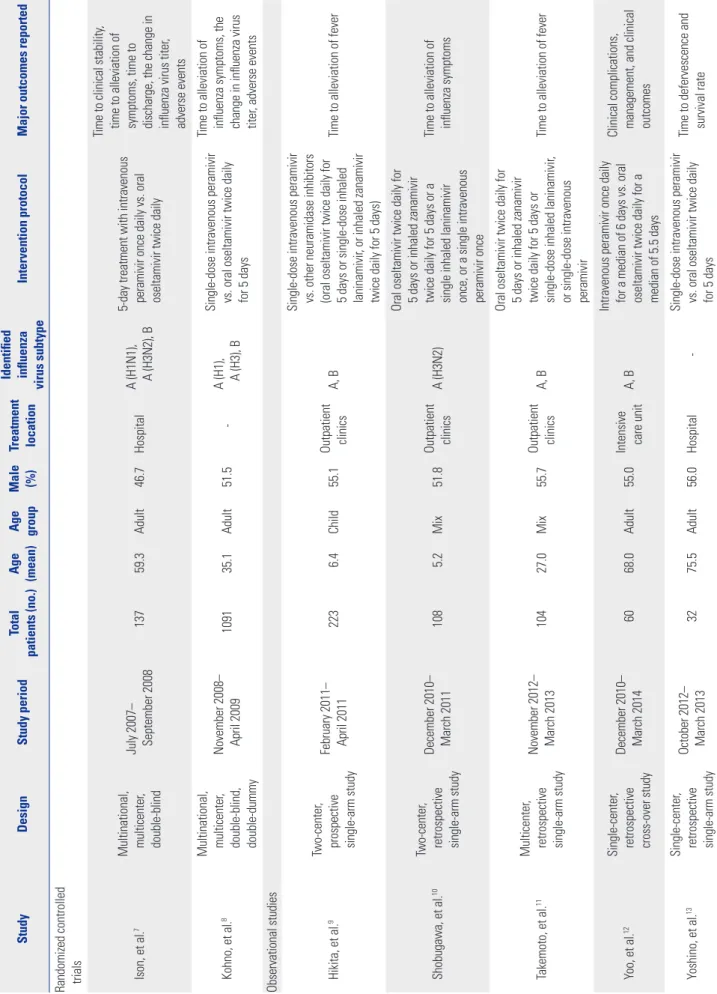
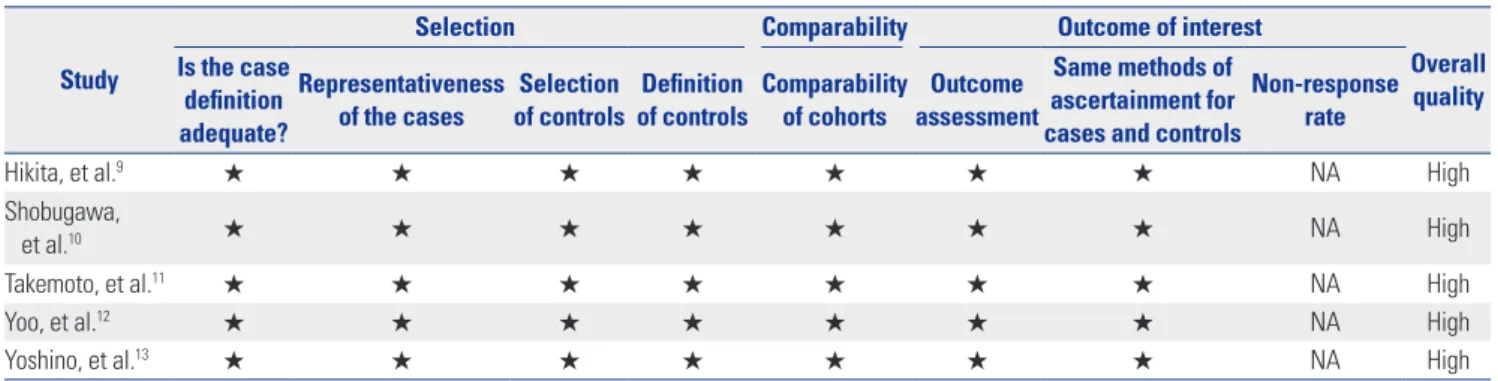
7-13Of these trials, two trials were RCTs and the remaining 5 trials were OBSs. All were published between 2011 and 2015. The features of the included studies are shown in Table 1. The number of patients in each trial ranged from 32 to 1091. The total number of patients in our systematic review and meta-analysis was 1676, of whom 956 were treated with IV peramivir and 720 received oral oseltamivir. Quality assessment findings of RCTs and non-randomized OBSs are demonstrated in Fig. 2 and Table 2, respectively.
Primary outcome
Fig. 3 shows the effect of IV peramivir and oral oseltamivir on the time to alleviation of influenza symptoms. Overall, a ran- dom effect model indicated that the peramivir-treated group had a significantly shorter time to alleviation of influenza symptoms or fever compared with the oseltamivir-treated group (MD, -7.17 hours; 95% CI -11.00 to -3.34; p<0.01; I
2=2%).
7-11,13Subgroup
analyses of RCTs and OBSs were performed. Although a pooled analysis of OBSs demonstrated the superiority of peramivir- treated group (MD, -7.83 hours; 95% CI -11.81 to -3.84; p<0.01;
I
2=0%),
9-11,13that of RCTs did not (MD, 5.86 hours; 95% CI -24.66 to 36.38; p=0.71; I
2=52%).
7,8Additionally, a subgroup analysis of studies on outpatients showed that the peramivir-treated group had significantly better outcomes than the oseltamivir-treated group (MD, -7.71 hours; 95% CI -11.61 to -3.80; p<0.01; I
2=0%, respectively) in terms of the time to alleviation of fever (Fig.
4B).
8-11However, an analysis of studies on hospitalized patients did not reveal a significant difference between groups (MD, 6.22 hours; 95% CI -24.16 to 36.60; p=0.69; I
2=50%) (Fig. 4A).
7,13Secondary outcomes
Total mortality and length of hospital stay were reported in two trials, respectively.
12,13A random effect model showed that total mortality was not significantly different between the perami- vir and oseltamivir treatment groups (28.0% vs. 34.2%; RR, 0.96; 95% CI 0.55 to 1.68; p=0.90; I
2=0%) (Fig. 5A).
12,13Length of hospital stay in the peramivir-treated group was also similar to that in the oseltamivir-treated group (MD, 0 days; 95% CI -1.19 to 1.20; p=1.00; I
2=0%) (Fig. 5B).
7,12We were able to retrieve data concerning the change in influ- enza virus titer for 48 hours after admission from two RCTs.
Pooled analysis did not reveal a significant difference between the two treatment groups (MD, -0.06 log
10TCID
50/mL; 95% CI, -0.20 to 0.08; p=0.38; I
2=0%) (Fig. 5C).
7,8Adverse events
As shown in Fig. 6A, the incidence of adverse events was not significantly different between peramivir- and oseltamivir- treated groups (72.3% vs. 75.2%; RR, 1.05; 95% CI 0.77 to 1.43;
p=0.76; I2
=63%).
7,8,13Pooled estimates also revealed no signifi- cant differences in the rates of serious adverse events between the two groups (7.2% vs. 6.8%; RR, 1.06; 95% CI 0.69 to 1.63;
p=0.80; I2
=0%) (Fig. 6B).
7,8DICUSSION
Our study showed that IV peramivir might reduce the time to al- leviation of fever compared with oral oseltamivir among pa- tients with influenza. The clinical efficacy of IV peramivir ther- apy was first reported in a placebo-controlled, double-blind phase II study in patients with uncomplicated seasonal influ- enza.
5At both 300 and 600 mg, a single IV peramivir infusion significantly reduced the time to alleviation of symptoms for adult influenza outpatients.
5After that, a randomized, double- blind phase III study conducted in Japan, Taiwan, and South Korea compared IV peramivir (a 300- or 600-mg single infusion) with oral oseltamivir (75 mg twice a day for 5 days) in uncom- plicated cases of seasonal influenza, and demonstrated the non-inferiority of peramivir therapy to oseltamivir in terms of
Records identified throughdatabase searching (n=19155)
Full-text articles assessed for eligibility (n=57)
Studies included in qualitative synthesis (n=7)
Studies included in quantitative synthesis (n=7) Records screened (n=15554)
Full-text articles excluded with following reasons (n=52) - Review articles/meta-analyses (n=14)
- Absence of either peramivir or oseltamivir (n=30) - Non-human studies (n=8)
Records owing to duplication (n=3601)
Records excluded after screening titles and abstracts (n=15497)
Additional records identified through other sources (n=2)
Fig. 1. Flow chart of study selection.
Table 1. Characteristics of the Studies Included in the Meta-Analysis Study DesignStudy periodTotal patients (no.)Age (mean)Age groupMale (%)Treatment location
Identified influenza virus subtypeIntervention protocolMajor outcomes reported Randomized controlled trials Ison, et al.7Multinational, multicenter, double-blind
July 2007– September 200813759.3Adult46.7HospitalA (H1N1), A (H3N2), B 5-day treatment with intravenous peramivir once daily vs. oral oseltamivir twice daily
Time to clinical stability, time to alleviation of symptoms, time to discharge, the change in influenza virus titer, adverse events Kohno, et al.8Multinational, multicenter, double-blind, double-dummy
November 2008– April 2009109135.1Adult51.5-A (H1), A (H3), B Single-dose intravenous peramivir vs. oral oseltamivir twice daily for 5 days
Time to alleviation of influenza symptoms, the change in influenza virus titer, adverse events Observational studies Hikita, et al.9Two-center, prospective single-arm study
February 2011– April 20112236.4Child55.1Outpatient clinicsA, B Single-dose intravenous peramivir vs. other neuramidase inhibitors (oral oseltamivir twice daily for 5 days or single-dose inhaled laninamivir, or inhaled zanamivir twice daily for 5 days)
Time to alleviation of fever Shobugawa, et al.10Two-center, retrospective single-arm study
December 2010– March 20111085.2Mix51.8Outpatient clinicsA (H3N2) Oral oseltamivir twice daily for 5 days or inhaled zanamivir twice daily for 5 days or a single inhaled laninamivir once, or a single intravenous peramivir once
Time to alleviation of influenza symptoms Takemoto, et al.11Multicenter, retrospective single-arm study
November 2012– March 201310427.0Mix55.7Outpatient clinicsA, B Oral oseltamivir twice daily for 5 days or inhaled zanamivir twice daily for 5 days or single-dose inhaled laninamivir, or single-dose intravenous peramivir
Time to alleviation of fever Yoo, et al.12Single-center, retrospective cross-over study
December 2010– March 20146068.0Adult55.0Intensive care unitA, B Intravenous peramivir once daily for a median of 6 days vs. oral oseltamivir twice daily for a median of 5.5 days
Clinical complications, management, and clinical outcomes Yoshino, et al.13Single-center, retrospective single-arm study
October 2012– March 20133275.5Adult56.0Hospital-Single-dose intravenous peramivir vs. oral oseltamivir twice daily for 5 days Time to defervescence and survival rate
the time to alleviation of symptoms.
8However, due to the scar- city of clinical comparisons, we sought to determine which an- tiviral agent was superior through a meta-analysis of previous trials.
In our study, the time to alleviation of fever was considered a primary outcome when evaluating the clinical efficacy of anti- viral agents for patients with influenza because it was regarded as the most important parameter in clinical studies. Although OBSs demonstrated the superiority of IV peramivir therapy with regard to fever, we could not draw concrete conclusions be- cause the results of subgroup analysis from RCTs were ambig- uous.
In addition, we compared the time to alleviation of fever ac- cording to whether patients were hospitalized or not. Although the US FDA approved peramivir as the first IV NAI for patients with uncomplicated influenza,
16a recent placebo-controlled, double-blind RCT did not demonstrate the clinical benefit of IV peramivir in hospitalized patients with influenza.
17No antiviral agents have been approved specifically for the treatment of influenza in hospitalized patients. In our meta-analysis, there were no statistically significant differences between treatment groups in hospitalized patients with influenza. Therefore, we
could not confirm whether IV peramivir or oral olsetamivir was more effective in patients with serious influenza requiring hospitalization.
Total mortality, length of hospital stay, and changes in viral titers are key parameters of the clinical and virological effec- tiveness of antiviral agents. Our results revealed that these pa- rameters did not differ between peramivir and olsetamivir treatment groups. In a RCT that enrolled 288 healthy volunteers (aged 18–45 years) intranasally inoculated with experimental influenza A or B, oral peramivir treatment at a dosage of 400 mg once daily for 5 days significantly reduced viral detection, de- fined by the area under the curve for nasal wash viral titers of influenza A.
18And both 400 and 800 mg once daily for 5 days reduced viral titer of influenza B.
18Although we evaluated changes in viral titers from base-line to 48 hours, no significant difference in virological effects was found between two groups.
In addition to clinical efficacy, adverse events are critical fac- tors in the selection of an antiviral agent. Although we conduct- ed a meta-analysis of adverse events using two RCT studies and one OBS,
7,8,13the results showed no statistically significant differences in rates of any or serious adverse events between patients treated with peramivir and those treated with oselta-
Table 2. Risk of Bias within Non-Randomized Trials Using Newcastle-Ottawa Scale Study
Selection Comparability Outcome of interest
Overall quality Is the case
definition adequate?
Representativeness
of the cases Selection
of controls Definition
of controls Comparability
of cohorts Outcome assessment
Same methods of ascertainment for cases and controls
Non-response rate
Hikita, et al.9 ★ ★ ★ ★ ★ ★ ★ NA High
Shobugawa,
et al.10 ★ ★ ★ ★ ★ ★ ★ NA High
Takemoto, et al.11 ★ ★ ★ ★ ★ ★ ★ NA High
Yoo, et al.12 ★ ★ ★ ★ ★ ★ ★ NA High
Yoshino, et al.13 ★ ★ ★ ★ ★ ★ ★ NA High
NA, not applicable.
Studies that received a star in all three domains were judged to be of high quality. Retrospective studies were all assumed to have adequate follow-up.
Fig. 2. Risk of bias summary (A) and risk of bias graph (B) for randomized controlled studies included in this meta-analysis.
Random sequence generation (selection bias) Allocation concealment (selection bias) Blinding of participants and personnel (performance bias) Blinding of outcome assessment (detection bias) Incomplete outcome data (attrition bias) Selective reporting (reporting bias) Other bias Ison, et al.7
Kohno, et al.8 A
Random sequence generation (selection bias) Allocation concealment (selection bias) Blinding of participants and personnel (performance bias) Blinding of outcome assessment (detection bias) Incomplete outcome data (attrition bias) Selective reporting (reporting bias) Other bias
0% 15% 50% 75% 100%
Low risk of bias Unclear risk of bias High risk of bias B
mivir. Most adverse events were mild or moderate. Pooled es- timated results suggested that the incidence of severe adverse events was similar in the peramivir and oseltamivir groups (7.2% and 6.8%, p=0.08). Gastrointestinal symptoms such as diarrhea, nausea, and vomiting were the most common adverse effects in both treatment groups. The similar clinical efficacy and adverse event findings of this systematic review suggest that the choice between oseltamivir and peramivir therapy could be decided based upon the convenience of administra-
tion (IV vs. oral), the ease with which medications can be pur- chased, and the preference of the patient or physician. Several previous OBSs and subgroup analysis in our study showed IV peramivir to have superior efficacy in terms of the time to al- leviation of fever. However, the lack of differences in total mor- tality rate, length of hospital stay and changes in viral titers indi- cate little or no difference in clinical efficacy between the two agents.
The development of influenza antiviral drug resistance in vi-
A
B
Study or subgroup Mean
40.4 78 17 31.6
15.6 102.9 6.1 18.9
35 726 4 53 818
922 48 82.1 23 44.6
32.5 86.9 5.14 24.4
124 365 104 51 644
694 23.8%
10.7%
37.6%
20.1%
92.2%
100.0%
-7.60 (-15.31 to 0.11) -4.10 (-15.74 to 7.54) -6.00 (-12.06 to 0.06) -13.00 (-21.41 to -4.59) -7.71 (-11.61 to -3.80)
-7.17 (-11.00 to -3.34)
-100 -50 0 50 100 Favours (peramivir) Favours (oseltamivir) Mean
SD Total SD Total Weight IV, random, 95% CI IV, random, 95% CI
Mean difference Mean difference
Oseltalmivir Peramivir
Hikita, et al.9 Kohno, et al.8 Shobugawa, et al.10 Takemoto, et al.11 Subtotal (95% CI)
Total (95% CI)
Heterogeneity: tau2=0.00; chi2=2.20, df=3 (p=0.53); I2=0%
Test for overall effect: Z=3.87 (p=0.0001)
Heterogeneity: tau2=0.61; chi2=5.12, df=5 (p=0.40); I2=2%
Test for overall effect: Z=3.66 (p=0.0002)
Test for overall differences: chi2=0.79, df=1 (p=0.37); I2=0%
102.5 30.9
176.6 18.7
81 23 104
72.3 34.7
76.66 18.6
41 9 50
0.7%
7.1%
7.8%
30.20 (-14.85 to 75.25) -3.80 (-18.16 to 10.56) 6.22 (-24.16 to 36.60) Ison, et al.7
Yoshino, et al.13 Subtotal (95% CI)
Heterogeneity: tau2=286.99; chi2=1.99, df=1 (p=0.16); I2=50%
Test for overall effect: Z=0.40 (p=0.69)
Fig. 4. Pooled adjusted risk ratio results for time to alleviation of fever with intravenous peramivir versus oral oseltamivir in inpatients (A) and outpa- tients (B) with influenza. SD, standard difference; IV, inverse variance; CI, confidence interval; df, degrees of freedom.
Fig. 3. Pooled adjusted risk ratio results for time to alleviation of fever among patients with influenza treated with intravenous peramivir versus oral oseltamivir in randomized controlled trials (A) and observational studies (B). SD, standard difference; IV, inverse variance; CI, confidence interval; df, degrees of freedom.
Study or subgroup Mean
40.4 17 31.6 30.9
15.6 6.1 18.9 18.7
35 4 53 23 115
922 48 23 44.6 34.7
32.5 5.14 24.4 18.6
124 104 51 9 288
694 23.8%
37.6%
20.1%
7.1%
88.6%
100.0%
-7.60 (-15.31 to 0.11) -6.00 (-12.06 to 0.06) -13.00 (-21.41 to -4.59) -3.80 (-18.16 to 10.58) -7.83 (-11.81 to -3.84)
-7.17 (-11.00 to -3.34)
-100 -50 0 50 100 Favours (peramivir) Favours (oseltamivir) Mean
SD Total SD Total Weight IV, random, 95% CI IV, random, 95% CI
Mean difference Mean difference
Oseltalmivir Peramivir
Hikita, et al.9 Shobugawa, et al.10 Takemoto, et al.11 Yoshino, et al.13 Subtotal (95% CI)
Total (95% CI)
Heterogeneity: tau2=0.00; chi2=2.11, df=3 (p=0.55); I2=0%
Test for overall effect: Z=3.85 (p=0.0001)
Heterogeneity: tau2=0.61; chi2=5.12, df=5 (p=0.40); I2=2%
Test for overall effect: Z=3.66 (p=0.0002)
Test for overall differences: chi2=0.76, df=1 (p=0.38); I2=0%
102.5 78
176.6 102.9
81 726 807
72.3 82.1
76.66 86.9
41 365 406
0.7%
10.7%
11.4%
30.20 (-14.85 to 75.25) -4.10 (-15.74 to 7.54) 5.86 (-24.66 to 36.38) Ison, et al.7
Kohno, et al.8 Subtotal (95% CI)
Heterogeneity: tau2=306.42; chi2=2.09, df=1 (p=0.15); I2=52%
Test for overall effect: Z=0.38 (p=0.71) A
B
Fig. 5. Pooled adjusted odds ratio results for secondary among patients with influenza treated with intravenous peramivir versus oral oseltamivir.
Mortality (A), length of hospital stay in days (B), and changes in viral titers from baseline (C) to 48 hours. M-H, Mantel-Haenszel; CI, confidence inter- val; df, degrees of freedom; SD, standard difference; IV, inverse variance.
B
C A
Study or subgroup
Study or subgroup Study or subgroup
Mean Mean Events
-50 -25 0 25 50
-1 -0.5 0 0.5 1 0.01 0.1 1 10 100
Favours (peramivir) Favours (oseltamivir)
Favours (experimental) Favours (control) Favours (peramivir) Favours (oseltamivir)
Mean Mean
Total
SD SD Total
SD SD
Total Total
Events
Total Total
Weight Weight
Weight
IV, random, 95% CI IV, random, 95% CI M-H, random, 95% CI
IV, random, 95% CI
IV, random, 95% CI M-H, random, 95% CI
Mean difference
Mean difference Risk ratio
Mean difference Mean difference Risk ratio
Oseltalmivir Oseltalmivir Oseltalmivir
Peramivir Peramivir Peramivir
3.7 20.5
-2.39 -1.09 15
1
16
4.1 53.5
1 0.86 34 23 57
81 34 115
81 393 474
12 0
12
3.7 20
-2.2 -1.04
26 9 35
2.6 72.2
1.4 0.84
41 26 67
41 195 236
99.9%
0.1%
100.0%
8.4%
91.6%
100.0%
96.8%
3.2%
100.0%
0.00 (-1.20 to 1.20) 0.50 (-32.57 to 33.57) 0.00 (-1.19 to 1.20)
-0.19 (-0.67 to 0.29) -0.05 (-0.20 to 0.10) -0.06 (-0.20 to 0.08) 0.96 (0.55 to 1.68) 1.25 (0.06 to 28.15) 0.96 (0.55 to 1.68)
Ison, et al.7 Yoo, et al.12 Total (95% CI)
Ison, et al.7 Kohno, et al.8 Total (95% CI) Yoo, et al.12 Yoshino, et al.13 Total (95% CI) Total events
Heterogeneity: tau2=0.00; chi2=0.00, df=1 (p=0.98); I2=0%
Test for overall effect: Z=0.00 (p=1.00)
Heterogeneity: tau2=0.00; chi2=0.30, df=1 (p=0.58); I2=0%
Test for overall effect: Z=0.87 (p=0.38)
Heterogeneity: tau2=0.00; chi2=0.03, df=1 (p=0.87); I2=0%
Test for overall effect: Z=0.13 (p=0.90)
A
B
Study or subgroup Events Total Events Total Weight M-H, random, 95% CI M-H, random, 95% CI Risk ratio Risk ratio
Oseltalmivir Peramivir
49 560 0
609 91 728 23 842
19 297 0
316 46 365 9 420
32.4%
67.6%
100.0%
1.30 (0.88 to 1.93) 0.95 (0.89 to 1.01) Not estimable 1.05 (0.77 to 1.43) Ison, et al.7
Kohno, et al.8 Yoshino, et al.13 Subtotal (95% CI) Total events
Heterogeneity: tau2=0.04; chi2=2.70, df=1 (p=0.10); I2=63%
Test for overall effect: Z=0.31 (p=0.76) 0.2 0.5 1 2 5 Favours (peramivir) Favours (oseltamivir)
Study or subgroup Events Total Events Total Weight M-H, random, 95% CI M-H, random, 95% CI Risk ratio Risk ratio
Oseltalmivir Peramivir
10 49
59 91 728 819
4 24
28 46 365 411
15.4%
84.6%
100.0%
1.26 (0.42 to 3.81) 1.02 (0.64 to 1.64) 1.06 (0.69 to 1.63) Ison, et al.7
Kohno, et al.8 Subtotal (95% CI) Total events
Heterogeneity: tau2=0.00; chi2=0.12, df=1 (p=0.73); I2=0%
Test for overall effect: Z=0.25 (p=0.80) 0.1 0.2 0.5 1 2 5 10 Favours (peramivir) Favours (oseltamivir) Fig. 6. Pooled analysis of adverse events among patients with influenza treated with intravenous peramivir versus oral oseltamivir. All adverse events (A) and serious adverse events (B). M-H, Mantel-Haenszel; CI, confidence interval; df, degrees of freedom.
ruses is a major concern. Therefore, when considering which drug to choose, resistance should be considered. The H274Y mu- tation is associated with resistance to oseltamivir and perami- vir and mutations at I222 and R292 can reduce peramivir sen- sitivity.
19The incidence of resistance to oseltamivir and/or peramivir in Japan and USA during the 2013–2014 influenza season was 4.2% and 1.2% for influenza A (H1N1) pdm09, re- spectively. This might mean that, in spite of the low resistance rate, a particular drug could be superior to others in specific sit- uations.
Our study has some limitations. First, since our meta-analy- sis considered only a small number of trials, our results should be interpreted with caution. Second, the publication bias in- herent to all meta-analyses might have influenced these re- sults. However, since the number of included trials was small, we could not estimate potential publication bias with a funnel plot for all outcomes. Third, the dosage and the duration of IV peramivir treatment varied among studies, which could affect the precision of the results. As a result, we think that addition- al large-scale RCTs are needed to overcome these limitations.
Finally, we tried to compare the efficacy of two drugs between children and adults. We found six studies for primary out- come.
7-11,13There are three studies for adults,
7,8,13and one study for children.
9The remaining two studies examined mixed group including adults and children.
10,11Accordingly, we could not per- form a meta-analysis for children group. Instead, we evaluated the time to alleviation of fever after treatment of antiviral agents on adults group.
7,8,13Pooled estimates revealed no significant difference between two treatments (MD, -2.51 hours; 95% CI -11.88 to 6.86; p=0.60; I
2=6%).
In conclusion, our systematic review and meta-analysis sug- gested that IV peramivir might reduce the time to alleviation of fever among patients with influenza compared to oral oselta- mivir. However, because the methodological limitations of the included trials and the scarcity of trials prevented us from draw- ing firm conclusions, the clinical benefit and/or superiority of IV peramivir to oral oseltamivir remains unclear in these pa- tients. Accordingly, further large-scale RCTs are needed to es- tablish appropriate criteria with regard to the selection of opti- mal NAIs for patients with influenza.
ACKNOWLEDGEMENTS
This research was supported by the 2017 scientific promotion program funded by Jeju National University.
REFERENCES
1. Vaccines against influenza WHO position paper–November 2012.
Wkly Epidemiol Rec 2012;87:461-76.
2. Centers for Diseases Control and Prevention. Vaccine Recommen- dations of the ACIP [accessed on 2016 December 27]. Available at:
https://www.cdc.gov/vaccines/hcp/acip-recs/vacc-specific/flu.
html.
3. Wester A, Shetty AK. Peramivir injection in the treatment of acute in- fluenza: a review of the literature. Infect Drug Resist 2016;9:201-14.
4. Birnkrant D, Cox E. The emergency use authorization of perami- vir for treatment of 2009 H1N1 influenza. N Engl J Med 2009;361:
2204-7.
5. Kohno S, Kida H, Mizuguchi M, Shimada J; S-021812 Clinical Study Group. Efficacy and safety of intravenous peramivir for treatment of seasonal influenza virus infection. Antimicrob Agents Chemoth- er 2010;54:4568-74.
6. Kohno S, Kida H, Mizuguchi M, Hirotsu N, Ishida T, Kadota J, et al.
Intravenous peramivir for treatment of influenza A and B virus in- fection in high-risk patients. Antimicrob Agents Chemother 2011;
55:2803-12.
7. Ison MG, Hui DS, Clezy K, O’Neil BJ, Flynt A, Collis PJ, et al. A clini- cal trial of intravenous peramivir compared with oral oseltamivir for the treatment of seasonal influenza in hospitalized adults. An- tivir Ther 2013;18:651-61.
8. Kohno S, Yen MY, Cheong HJ, Hirotsu N, Ishida T, Kadota J, et al.
Phase III randomized, double-blind study comparing single-dose intravenous peramivir with oral oseltamivir in patients with sea- sonal influenza virus infection. Antimicrob Agents Chemother 2011;55:5267-76.
9. Hikita T, Hikita H, Hikita F, Hikita N, Hikita S. Clinical effectiveness of peramivir in comparison with other neuraminidase inhibitors in pediatric influenza patients. Int J Pediatr 2012;2012:834181.
10. Shobugawa Y, Saito R, Sato I, Kawashima T, Dapat C, Dapat IC, et al. Clinical effectiveness of neuraminidase inhibitors--oseltamivir, zanamivir, laninamivir, and peramivir--for treatment of influenza A(H3N2) and A(H1N1)pdm09 infection: an observational study in the 2010-2011 influenza season in Japan. J Infect Chemother 2012;
18:858-64.
11. Takemoto Y, Asai T, Ikezoe I, Yano T, Ichikawa M, Miyagawa S, et al.
Clinical effects of oseltamivir, zanamivir, laninamivir and perami- vir on seasonal influenza infection in outpatients in Japan during the winter of 2012-2013. Chemotherapy 2013;59:373-8.
12. Yoo JW, Choi SH, Huh JW, Lim CM, Koh Y, Hong SB. Peramivir is as effective as oral oseltamivir in the treatment of severe seasonal in- fluenza. J Med Virol 2015;87:1649-55.
13. Yoshino Y, Seo K, Koga I, Kitazawa T, Ota Y. Clinical efficacy of per- amivir in adult patients with seasonal influenza during the winter of 2012 in Japan. Clin Respir J 2015;9:228-32.
14. Wells GA, Shea B, O’Connell D, Peterson J, Welch V, Losos M, et al.
The Newcastle-Ottawa Scale (NOS) for assessing the quality if non- randomized studies in meta-analyses [accessed on 2016 December 27]. Available at: http://www.ohri.ca/programs/clinical_epidemi- ology/oxford.asp.
15. Higgins JP, Altman DG, Gøtzsche PC, Jüni P, Moher D, Oxman AD, et al. The Cochrane Collaboration’s tool for assessing risk of bias in randomised trials. BMJ 2011;343:d5928.
16. Alame MM, Massaad E, Zaraket H. Peramivir: a novel intravenous neuraminidase inhibitor for treatment of acute influenza infec- tions. Front Microbiol 2016;7:450.
17. de Jong MD, Ison MG, Monto AS, Metev H, Clark C, O’Neil B, et al. Evaluation of intravenous peramivir for treatment of influenza in hospitalized patients. Clin Infect Dis 2014;59:e172-85.
18. Barroso L, Treanor J, Gubareva L, Hayden FG. Efficacy and tolera- bility of the oral neuraminidase inhibitor peramivir in experimen- tal human influenza: randomized, controlled trials for prophylaxis and treatment. Antivir Ther 2005;10:901-10.
19. Hata A, Akashi-Ueda R, Takamatsu K, Matsumura T. Safety and ef- ficacy of peramivir for influenza treatment. Drug Des Devel Ther 2014;8:2017-38.