Perioperative immunonutrition in hepatectomy:
A systematic review and meta-analysis
Chee Siong Wong1,2,3, Raaj Praseedom1, and Siong-Seng Liau1
1Department of Hepatopancreaticobiliary Surgery, Addenbrooke’s Hospital, Cambridge University Hospitals NHS Foundation Trust, Cambridge,
2University of Edinburgh, 3Royal College of Surgeons of Edinburgh, Edinburgh, UK
Backgrounds/Aims: The role of immunonutrition (IMN) after liver resections or hepatectomies remains unclear and controversial. We undertook a systematic review to evaluate the effects of IMN on clinical outcomes of patients under- going hepatectomy. Methods: Main electronic databases were searched for randomised trials reported clinical outcomes or effects of IMN. The systematic review was conducted in accordance with the PRISMA guideline and meta-analysis was analysed using fixed or random-effects models. Results: Eleven RCTs were identified. A total of 1084 patients (529 IMN and 555 Control) were included in the final pooled analysis. Of these patients, 43% (440/1016) underwent major hepatectomies and the majority are for hepatocellular carcinoma (90%, 956/1055) with Child-Pugh A disease (89%, 793/894). IMN significantly reduced post-operative wound infection (risk ratio (RR) 0.65, 95% confidence interval (CI) 0.43 to 0.96; p=0.03). IMN also had a shorter hospital stay (MD −4.97 days, 95% CI −8.23 to −1.72; p=0.003).
There was no statistically significant in other post-operative morbidities and mortality. Conclusions: Wound infection rate was not significantly different between oral and parenteral IMN group. The length of hospital stay was significantly lower in parenteral IMN group than in oral IMN group. The mortality rates were not affected. Immunonutrition should be recommended routinely as part of the nutritional support in the Enhanced Recovery after Surgery (ERAS) protocol for hepatectomy. (Ann Hepatobiliary Pancreat Surg 2020;24:396-414)
Key Words: Immunonutrition; Hepatectomy; Complication; Liver resection
Received: April 2, 2020; Revised: May 30, 2020; Accepted: June 7, 2020 Corresponding author: Chee Siong Wong
Department of Hepatopancreaticobiliary Surgery, Addenbrooke’s Hospital, Cambridge University Hospitals NHS Foundation Trust, Hills Rd, Cambridge, CB2 0QQ, UK
Tel: +44-7519928415, E-mail: [email protected]
Copyright Ⓒ 2020 by The Korean Association of Hepato-Biliary-Pancreatic Surgery
This is an Open Access article distributed under the terms of the Creative Commons Attribution Non-Commercial License (http://creativecommons.org/
licenses/by-nc/4.0) which permits unrestricted non-commercial use, distribution, and reproduction in any medium, provided the original work is properly cited.
Annals of Hepato-Biliary-Pancreatic Surgery ∙ pISSN: 2508-5778ㆍeISSN: 2508-5859
INTRODUCTION
Perioperative nutritional support (NS) have changed substantially during the last decade with the advent of Enhanced Recovery after Surgery (ERAS).1 Perioperative nutritional therapy potentially can maintain hepatocellular function, preserve protein synthesis and attenuate catabo- lic response to metabolic alteration in liver resection. The primary goal for NS in patients before and after hep- atopancreaticobiliary surgery is to quickly restore health and function to patients by minimising catabolic stress re- sponse to operation, which can be achieved by (a) Early re-establishment of oral feeding; this is facilitated by the use of ERAS protocols; (b) Support and/or restore normal digestion and intestinal absorption; and (c) Identify nutri-
tional deficits preoperatively and to correct them.2 Most patients in Western countries undergoing liver re- section have no associated cirrhosis and have no need for specialised nutritional support preoperatively and post- operatively. Majority of patients can begin an oral diet safely on the first or second day postoperative day, and they are able to tolerate a full regular diet within 5 days.
However, malnourished patients being considered for elec- tive liver resection should receive nutritional supplementa- tion preoperatively and postoperatively by the oral or en- teral route. In addition, patients undergoing extensive liver resection, particularly patients with compromised hep- atocellular functions (e.g. steatosis, chronic hepatitis, or cirrhosis), may benefit from specialised NS.
The European Society for Parenteral and Enteral Nutri-
tion (ESPEN) guidelines recommend parenteral nutrition in undernourished or malnourished surgical patients, in whom enteral nutrition is not feasible or not tolerated.3 The recent American Society for Parenteral and Enteral Nutrition (ASPEN) guidelines recommend postoperative enteral nutrition when feasible within 24 hour and post- operative parental nutrition for patients who cannot meet their energy needs orally or enterally within 5-7 days.4 The administration of parenteral nutrition via central vein catheter to well-nourished patients undergoing surgery is associated with a higher incidence of postoperative complications.5
The potential benefit of administering immunonutrition (IMN) and antioxidants to patients undergoing HPB sur- gery is controversial, although of increasing interest.6 Short courses of preoperative immune-modulating formulas, us- ing combinations of arginine, -3 fatty acids, and other nutrients, have been associated with improved surgical outcomes. These immune-modulating nutrients are key el- ements of metabolic pathways that promote attenuation of the metabolic response to stress and improve both wound healing and immune function.
Immunonutrition or immune-enhancing diets (IEDs) con- tinue to gain wider use in the care of critically ill and trauma patients. The enteral formulas contain adjunct key nutrients, such as glutamine, arginine, branched-chain amino acid (BCAA), nucleotide, omega-3 fatty acid and beta car- otene,7 are specially designed to modulate and improve immune function. Most of the randomised controlled trials performed so far in elective surgical patients have eval- uated the efficacy of enteral formulas with combination of such immune-modulating substances. Data suggest that these formulas reduce the incidence of infectious and non-infectious complications and shortened hospital stays in various elective surgeries,8 however other meta-analysis published conflicted results.9
In a larger systematic review and meta-analysis of im- munonutrition (including trials of glutamine, arginine, ome- ga-3 fatty acids, RNA, and nucleotides) recently conducted showed that there was no effect on perioperative mortality associated with major abdominal surgery. Compared with control groups, immunonutrition reduced the risk of over- all complications (odds ratio [OR] 0.79, 95% CI, 0.66 to 0.94, 41 trials) and infectious complications (OR 0.58, 95% CI 0.51 to 0.66, 66 trials), and shortened hospital
stay (mean difference −1.79 days, 95% CI −2.39 to −1.19, 52 trials). However, trials included in this meta-analysis were rather heterogeneous–mixture of surgical cases in- cluding upper gastrointestinal tract, HPB, and colorectal surgery.10 Due to inhomogeneity of various previous meta- analyses, the role for IMN (e.g. enteral or parenteral sup- plementation with arginine, glutamine, nonessential fatty acids, branched chain fatty acids, nucleotides, or RNA), remains unclear.
Minor hepatectomy is defined as the removal of two or less segments of the liver, which is often described as lobectomy. Some author considers that major hepatectomy involves removal of four or more segments of the liver.11 Most surgical textbooks defined major hepatectomy as re- section of three or more contiguous liver segments.12,13 In this review, we follow the latter definition. Major hep- atectomy is indicated for a large tumour (>5 cm) that involves most of the right or left liver or a small tumour if it is close to the liver hilum, encroaching or involving the right or left portal pedicle.12 Regardless of the ap- proach used for resection, tumours-free resection margins should be achieved, not only for the primary hepatic ma- lignancies, but also for liver metastases. Generally, ach- ieving adequate margins (approximately 1 cm of surround- ing liver tissue) is desirable, although the prognostic sig- nificant of surgical margins for patients who received pre- operative chemotherapy for colorectal cancer liver meta- stases (CRLM) is a matter of debate.13 Hepatectomy, as a rule, should only be performed in Child–Pugh A cir- rhotic patients. Child–Pugh B or C patients are at a pro- hibitive risk of early liver failure even after a minor hep- atectomy or mere laparotomy.14
The use of immune-enhancing formulas enriched with glutamine, omega-3 polysaturated fatty acids (-3 FAs), arginine and ribonucleic acids (RNA) has been found to improve clinical outcomes. A number of previous meta- analyses have evaluated the efficacy of immune-enhanc- ing formulas and have shown superior outcomes com- pared with standard formulations in certain patient popul- ations.8,15-17 To date, there is no data to support the routine use of nutritional support in well-nourished and malnour- ished patients undergoing liver resection or hepatectomy.
Our aim of this present meta-analysis was to examine the effects of perioperative immunonutrition support in pa- tients undergoing hepatectomy.
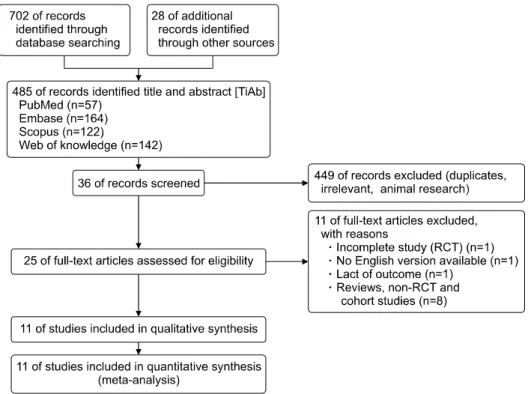
Fig. 1. PRISMA flow diagram.
RCT, randomised controlled trial.
MATERIALS AND METHODS
Search strategy
The systematic review was conducted in accordance with the Preferred Reporting Items for Systematic Reviews and Meta-analyses (PRISMA) guideline.18 This review was registered with the International Prospective Register of Systematic Review (PROSPERO) (Registration No.
CRD42017073787) and has been reported in line with AMSTAR (Assessing the methodological quality of sys- tematic reviews) Guidelines. Main electronic databases MEDLINE via PubMed (1966 to current), EMBASE (via OVID) (1980 to current), Scopus (1995 to current), Web of Science (ISI Web of Knowledge) (1900 to current), Cochrane Central Register of Controlled Trials (CENTRAL) and the Cochrane Library, and clinical trial registries (ClinicalTrial.gov and WHO International Clinical Trials Registry Platform (ICTRP)) were searched for studies re- porting outcomes of immunonutrition in hepatectomy us- ing following search terms or key words. Key words–
‘immunonutrition’; ‘enteral’; ‘hepatobiliary surgery’, ‘he- patopancreaticobiliary surgery’ or ‘liver surgery’; ‘gluta- mine’; ‘omega-3’; ‘fish oil’; ‘fatty acid’; ‘arginine’; ‘hepa- tectomy’; ‘liver resection’; ‘nutrition’; ‘complication’.
These terms were searched using Boolean operators (AND and OR) and appropriate Medical Subject Headings
(MeSH) terms were combined in the search builder. A truncation symbol (e.g. adding superscript asterisk * at the end of a word) was used wherever appropriate. Searches were not restricted by publication year, publication status or language. Relevant conference abstracts and proceed- ings presented at the American Surgical Association, Association of Surgeons of Great Britain and Ireland, Annual Conference of American College of Surgeons were hand-searched. A manual search was also conducted for reference lists in the included studies.
Study selection and data extraction
Eligible studies were included provided they met the following inclusion criteria:
(1) randomised controlled trial (RCT);
(2) patient undergoing hepatectomy (either open or lap- aroscopic approach; anatomical or non-anatomical resec- tion; for benign and malignant liver tumors);
(3) with reported outcomes comparing immunonutrition and control with or without standard nutritional supple- mentation.
We excluded following studies: non-RCT (case series, case-control study, and cohort study), narrative or expert reviews, and animal studies or trials. Article reference lists were scrutinised for relevant articles independently by two authors (CSW and SSL). Any differences in opin-
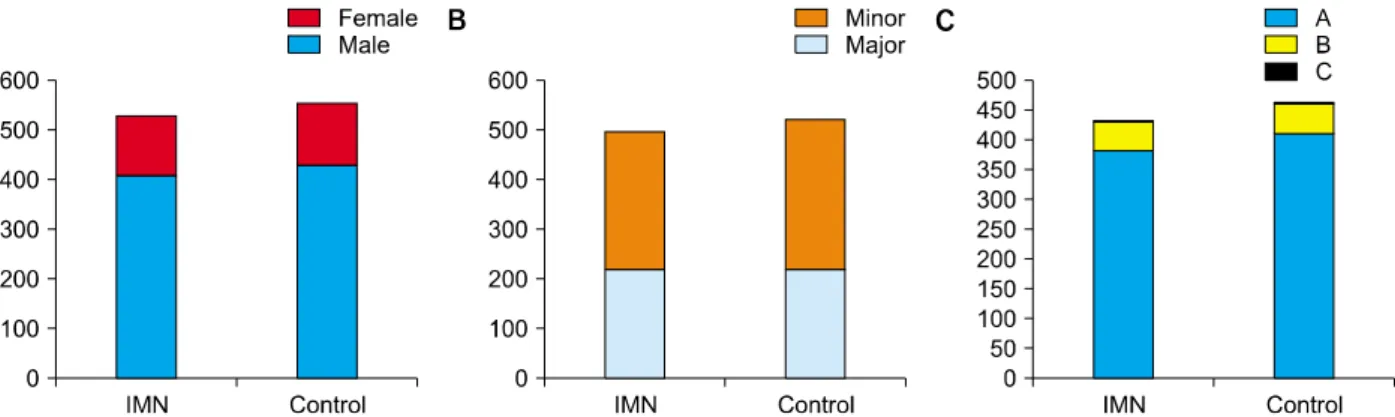
Fig. 2. (A) Histogram depicts the proportion or number of male and female patients in both IMN and control group. (B) Histogram depicts the number of major and minor liver resection in both IMN and control group. (C) Histogram depicts the proportion on Child-Pugh A, B, and C in both IMN and control group. IMN, immunonutrition.
ion were resolved through discussion or by a third re- viewer (RP).
Data available from the study for each outcome of in- terest were extracted and recorded in a formulated con- tingency table using Microsoft Excel spread sheet. Cate- gorical nominal data (dichotomous or binary data) were reported in a 2×2 table by quantifying the presence or ab- sence of that outcome of interest. Continuous data, such as length of hospital stay (days), were represented by mean and standard deviation (mean±S.D.). If the mean and standard deviation (variance) of continuous data were not available, the median, range and sample size will be used to estimate the mean and variance using the formula proposed by Hozo et al.19
The Jadad scale was used to evaluate the methodo- logical quality of the published randomised control trial.20 Three main items were scored (randomisation, double blinding, and withdrawals and dropouts). Scores range from 0 (poorest) to 5 (best). Bias risk was evaluated as per Cochrane methodology.21 Potential sources of bias are identified (selection bias, performance bias, detection bias, attrition bias, reporting bias) and graded as ‘low risk of bias’, ‘high risk of bias’, or ‘risk of bias unclear’. Publi- cation bias is visually assessed by using funnel plots.
Asymmetrical funnel plots may indicate publication bias, or be due to exaggeration of treatment effects in small studies of low quality.22
Statistical analysis
A meta-analysis was performed using the software package Review Manager (RevMan) Version 5.3.5 (Java 6 64 bits) to characterise the effect of various dichoto-
mous and continuous outcomes. Subgroup analysis was performed by using effect modification crude analysis techni- que to stratify and measure the ‘true’ effect of interven- tion on the outcome of interest. Sensitivity analysis was also performed to eliminate certain degree of bias in the pooled result of meta-analysis. Outcomes of dichotomous (binary) and continuous variables were measured using Mantel-Haenszel fixed-effect23 and DerSimonian and Laird random-effects model.24 The degree of heterogeneity obser- ved in the result was quantified using the I-squared (I2), which is presented as a percentage. A significant hetero- geneity presents when I2 >50%.25 Random effects model were used in reporting all the results unless stated otherwise.
RESULTS
The systematic review identified 485 citations, of which eleven RCSTs26-36 were identified, a total of 1190 patients recruited and included 1084 patients randomised in the fi- nal pooled analysis. A PRISMA flow diagram of the search strategy is presented in Fig. 1. Of these patient 529 received immunonutrition supplementation and 555 did not (840 men and 244 women) (Fig. 2A). All eligible studies were published between 1994 and 2017. The larg- est trial was conducted by Zhang et al.36
Standard criteria for inclusion and exclusion criteria were defined in all included studies; however, there were differences between protocols of each study. Some trials reported both major and minor liver resection,26-30,32,36
on- ly major resection,34 and the rest liver resection (unspeci- fied).31,33,35,36
A total of 440 patients and 576 patients un- derwent major and minor hepatic resection respectively–of
Table 1. Characteristic of the RCT studies included in this meta-analysis Author (year) Country Timing of
intervention
Duration of intervention
(days)
Type of immunonutrition Route of nutrition Fan et al. (1994)26 Hong Kong Pre-op (7 days) 7 BCAAs, 1.5 g/kg/day
(maximum of 1.75 liters per day)
PN via CVC San-In Group of
Liver Surgery (1997)27
China Post-operation (2-3 weeks)
365 BCAAs (Aminoleban EN,
Otsuka Pharmaceutical company, Tokyo) -50 g BD
Oral
Meng et al. (1999)28 Hong Kong Post-op day (as oral intake resume)
84 BCAAs (Aminoleban EN,
Otsuka Pharmaceutical company, Tokyo) -50 g TDS
Oral
Okabayashi et al. (2008)29 Japan Pre-op (2 weeks) - BCAAs (Aminoleban EN,
Otsuka Pharmaceutical company, Tokyo) -100 g OD
Oral
Mikagi et al. (2011)30 Japan Pre-op (5 days) 5 Omega-3 fatty acids, arginine, nucleotides (IMPACT, Ajinomoto Pharma, Tokyo)
Oral Wu et al. (2012)31 China Post-operation 5 Omega-3 fatty acids
(Omegaven, Fresenius-Kabi)
PN via CVC Gong et al. (2016)32 China Post-operation 5 Omega-3 fatty acids
(Omegaven, Sino-Swed, JiangSu)
PN via CVC Seguin et al. (2016)33 France Pre-op (7 days) 10 Omega-3 fatty acids, arginine, RNA
(IMPACT, Novartis, Bern)
Oral &
nasogastric tube Uno et al. (2016)34 Japan Pre-op (5 days) - Arginine, EPA and nucleotides
(IMPACT, Nestle, Kobe)
Oral Kikuchi et al. (2016)35 Japan Pre-op (30 days) 365 BCAAs (Livact Granules, Ajinomoto,
Tokyo)-4.74 g TDS
Oral Zhang et al. (2017)36 China Post-operation
(post-op day 1)
5 Omega-3 fatty acids
(Omegaven, Fresenius- Kabi, Germany)
PN via CVC
PN, parenteral nutrition; CVC, central venous catheter; BCAAs, branched chain amino acids; EPA, eicosapentaenoic acid; OD, once a day; BD, twice a day; TDS, Three times a day
which 496 patients were assigned to IMN group compared to 520 patients in control (Fig. 2B). There were eight studies27-29,31-33,35,36
reported and stratified patients’ prog- nosis of chronic liver disease according to Child-Pugh score.
Of that there were 382 patients with Child-Pugh A in IMN group compared to 411 in the control group (Fig. 2C).
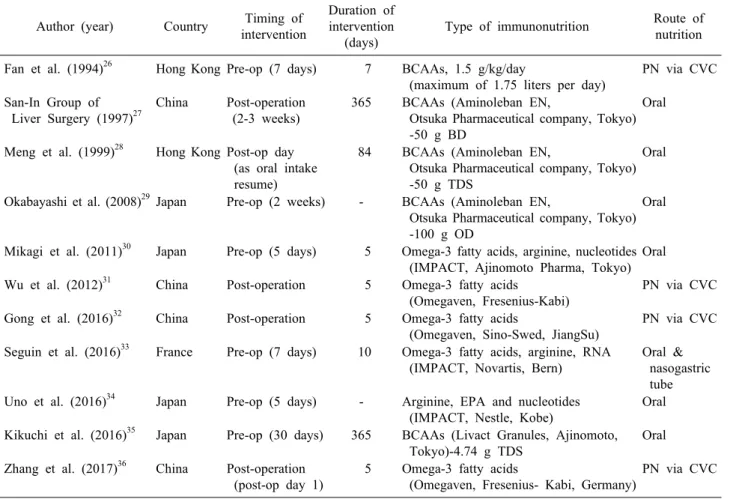
Enteral IMN was administered by oral (and/or nasogas- tric) route in seven studies27-30,33-35 and by parenteral route in four studies (Table 1).26,31,32,36
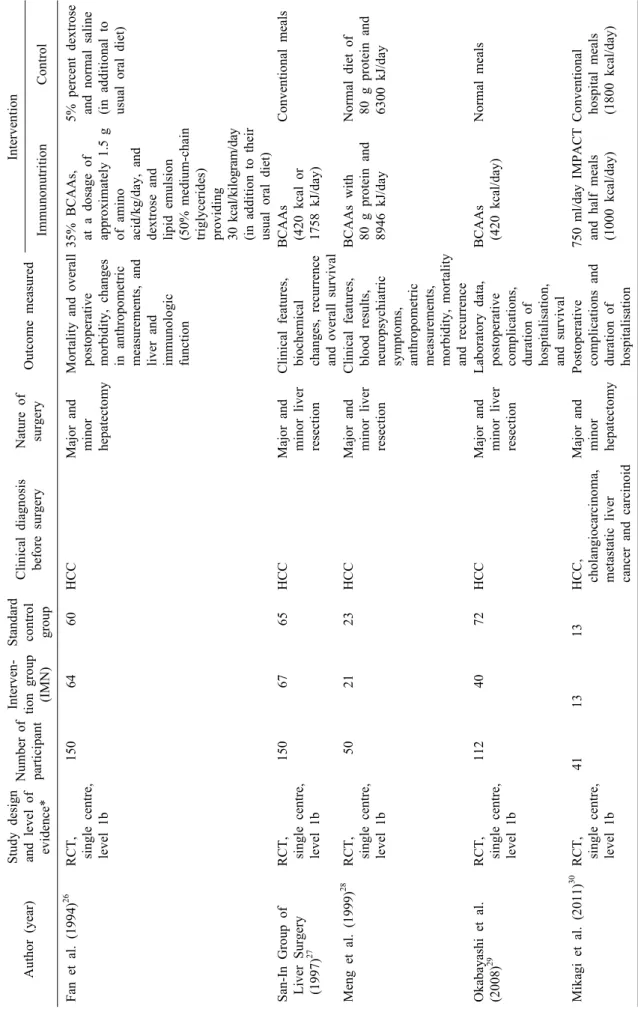
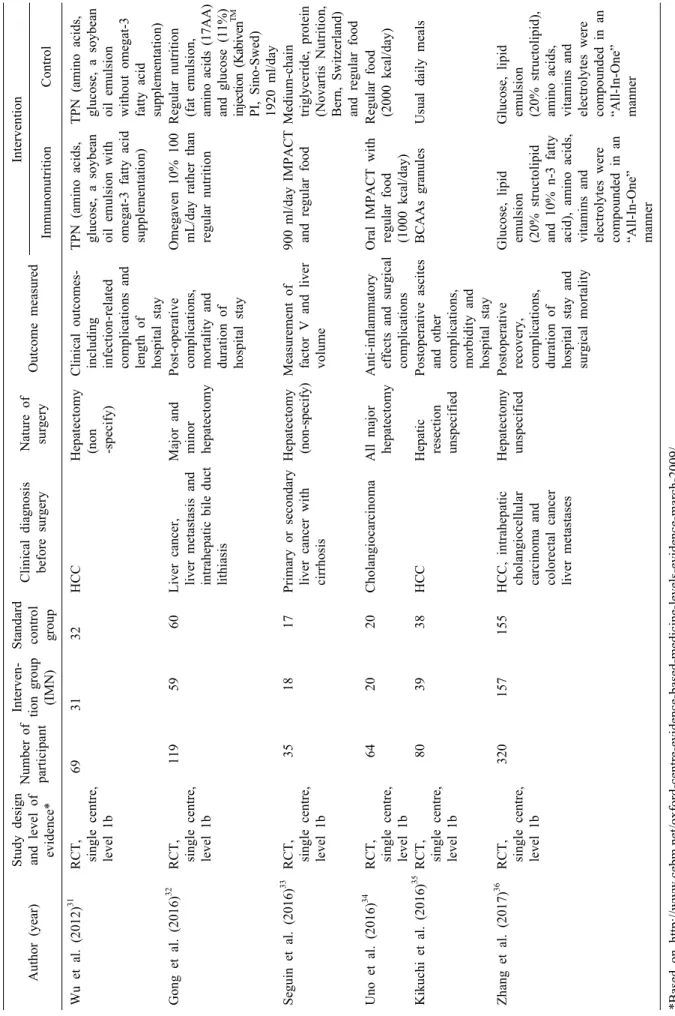
A summary of rando- mised controlled trials comparing the characteristics and outcomes of immunonutrition versus controlled group was summarised in Table 2.
Quality assessment
The quality of all clinical trials was evaluated using the Jadad score. Studies with 3 or more of a maximum of 5 points are accounted as high quality. Mode (1 and 3), median (3), and range (1-5) as calculated in the bracket.
A summary of Jadad scoring is as below (Table 3).
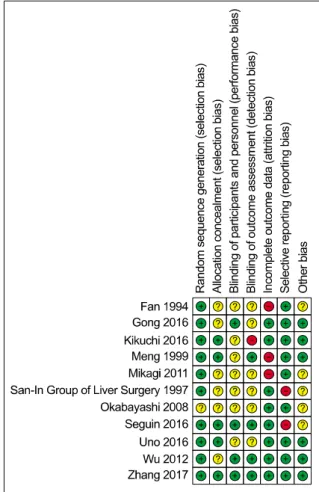
The methodological quality of each included study was assessed using the quality check list supplied in the Cochrane Handbook for Systematic Reviews of Interven- tions, which contains six items: random sequence genera- tion, allocation concealment, blinding of participants and personnel, blinding of outcome assessment, incomplete out- come data and selective reporting.
There were eleven studies included for risk of bias assessment. Individual sources of bias in studies are de- scribed below. Figs. 3 and 4 provide a graph and a table summary respectively for risk of bias in all included studies.
Randomisation
All studies except one29 described the methods of pa- tient randomisation. Most of the trials had adequate gen- eration of allocation sequence either by a random number table (Kikuchi et al.35), a computer random number gen-
Table 2. Characteristics of randomised controlled trials of immune-enhancing enteral nutrition versus controlled group Author (year)Study design and level of evidence*
Number of participant Interven- tion group (IMN) Standard control group
Clinical diagnosis before surgeryNature of surgeryOutcome measuredIntervention ImmunonutritionControl Fan et al. (1994)26 RCT, single centre, level 1b
1506460HCC Major and minor hepatectomy
Mortality and overall postoperative morbidity, changes in anthropometric measurements, and liver and immunologic function
35% BCAAs, at a dosage of approximately 1.5 g of amino acid/kg/day, and dextrose and lipid emulsion (50% medium-chain triglycerides) providing 30 kcal/kilogram/day (in addition to their usual oral diet)
5% percent dextrose and normal saline (in additional to usual oral diet) San-In Group of Liver Surgery (1997)27
RCT, single centre, level 1b 1506765HCC Major and minor liver resection Clinical features, biochemical changes, recurrence and overall survival BCAAs (420 kcal or 1758 kJ/day)
Conventional meals Meng et al. (1999)28 RCT, single centre, level 1b
502123HCC Major and minor liver resection
Clinical features, blood results, neuropsychiatric symptoms, anthropometric measurements, morbidity, mortality and recurrence BCAAs with 80 g protein and 8946 kJ/day
Normal diet of 80 g protein and 6300 kJ/day Okabayashi et al. (2008)29RCT, single centre, level 1b
1124072HCCMajor and minor liver resection Laboratory data, postoperative complications, duration of hospitalisation, and survival BCAAs (420 kcal/day) Normal meals Mikagi et al. (2011)30 RCT, single centre, level 1b
411313HCC, cholangiocarcinoma, metastatic liver cancer and carcinoid Major and minor hepatectomy Postoperative complications and duration of hospitalisation 750 ml/day IMPACT and half meals (1000 kcal/day) Conventional hospital meals (1800 kcal/day)
Table 2. Continued Author (year)Study design and level of evidence*
Number of participant Interven- tion group (IMN) Standard control group
Clinical diagnosis before surgeryNature of surgeryOutcome measuredIntervention ImmunonutritionControl Wu et al. (2012)31 RCT, single centre, level 1b
693132HCCHepatectomy (non -specify) Clinical outcomes- including infection-related complications and length of hospital stay TPN (amino acids, glucose, a soybean oil emulsion with omegat-3 fatty acid supplementation)
TPN (amino acids, glucose, a soybean oil emulsion without omegat-3 fatty acid supplementation) Gong et al. (2016)32 RCT, single centre, level 1b
1195960Liver cancer, liver metastasis and intrahepatic bile duct lithiasis Major and minor hepatectomy Post-operative complications, mortality and duration of hospital stay Omegaven 10% 100 mL/day rather than regular nutrition
Regular nutrition (fat emulsion, amino acids (17AA) and glucose (11%) injection (KabivenTM PI, Sino-Swed) 1920 ml/day Seguin et al. (2016)33 RCT, single centre, level 1b
351817Primary or secondary liver cancer with cirrhosis Hepatectomy (non-specify)Measurement of factor V and liver volume
900 ml/day IMPACT and regular foodMedium-chain triglyceride, protein (Novartis Nutrition, Bern, Switzerland) and regular food Uno et al. (2016)34 RCT, single centre, level 1b
64 2020CholangiocarcinomaAll major hepatectomy Anti-inflammatory effects and surgical complications Oral IMPACT with regular food (1000 kcal/day) Regular food (2000 kcal/day) Kikuchi et al. (2016)35 RCT, single centre, level 1b
803938HCCHepatic resection unspecified Postoperative ascites and other complications, morbidity and hospital stay BCAAs granulesUsual daily meals Zhang et al. (2017)36 RCT, single centre, level 1b
320157155HCC, intrahepatic cholangiocellular carcinoma and colorectal cancer liver metastases Hepatectomy unspecifiedPostoperative recovery, complications, duration of hospital stay and surgical mortality
Glucose, lipid emulsion (20% structolipid and 10% n-3 fatty acid), amino acids, vitamins and electrolytes were compounded in an “All-In-One” manner Glucose, lipid emulsion (20% structolipid), amino acids, vitamins and electrolytes were compounded in an “All-In-One” manner *Based on http://www.cebm.net/oxford-centre-evidence-based-medicine-levels-evidence-march-2009/ IMN, Immunonutrition; HCC, hepatocellular carcinoma; BCAAs, branched chain amino acids; EPA, eicosapentaenoic acid; TPN, total parenteral nutrition
Fig. 3. Risk of bias graph: review authors’ judgements about each risk of bias item presented as percentages across all included studies.
Table 3. Jadad scoring Author (year)
Randomi- sation
(R)
Blinding (B)
Dropout (D) Total
Fan et al. (1994)26 1 0 0 1
San-In Group of Liver Surgery (1997)27
1 0 0 1
Meng et al. (1999)28 2 1 0 3
Okabayashi et al. (2008)29 1 0 0 1
Mikagi et al. (2011)30 1 0 1 2
Wu et al. (2012)31 1 2 0 3
Gong et al. (2016)32 1 1 0 2
Seguin et al. (2016)33 2 2 1 5
Uno et al. (2016)34 2 0 1 3
Kikuchi et al. (2016)35 2 1 1 4
Zhang et al. (2017)36 2 2 1 5
Fig. 4. Risk of bias summary: review authors’ judgements about each risk of bias item for each included study.
erator (Meng et al.;28 Uno et al.34) or a block random- isation (Wu et al.;31 Seguin et al.;33 Zhang et al.36). Five included trials described the used of sealed envelopes in the generation of allocation concealment (Meng et al.;28 Seguin et al.;33 Uno et al.;34 Kikuchi et al.;35 Zhang et al.36). The remaining of the authors did not describe meth- ods of allocation concealment.
Blinding
Two studies described blinding of participants and per- sonnel (Wu et al.;31 Gong et al.32). Three studies described blinding an assessor of outcomes (Meng et al.;28 Wu et al.;31 Kikuchi et al.35). There were only three trials con- ducted double-blinding trials (Wu et al.;31 Seguin et al.;33 Zhang et al.36). The remaining trials did not clearly de- scribe the process of blinding in their studies.
Incomplete date outcome
Some of the trials26,28,30 (approximately 25%) were con- sidered to have a high risk of attrition bias because of missing or incomplete dichotomous or continuous out-
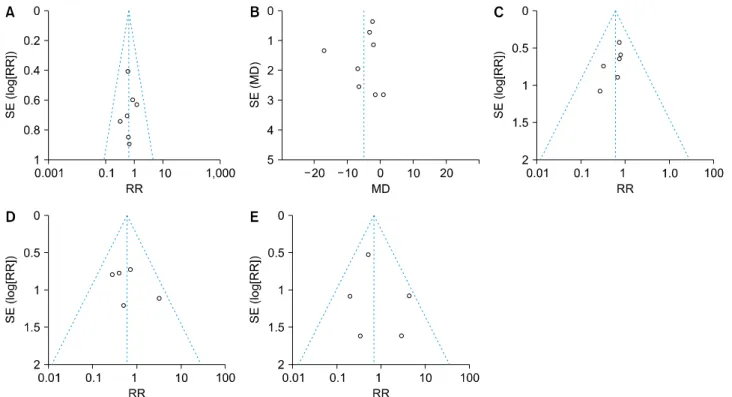
Fig. 5. Test of heterogeneity of selected randomized controlled trials on clinical impact of perioperative immunonutrition in hepatectomy. Funnel plots of comparison: immunonutrition versus controlled group for outcomes based on overall pooled data for (A) wound infection (B) length of hospital stay (C) bile leak (D) liver failure (E) mortality.
Fig. 6. Comparison IMN Vs control group. Outcome: wound infection.
come data.
Selective reporting
Most of the published reports (more than 75%) have included all expected outcomes so that they can be en- tered in the meta-analysis. We classified them as having a low risk of selective reporting bias.
Other bias
Of the eleven included studies, five reported dropouts after randomisation (Mikagi et al.;30 Seguin et al.;33 Uno et al.;34 Kikuchi et al.;35 Zhang et al.36), two30,33 were re-
garded as high risk because the dropout rate was >25%.
Publication bias
Funnel plots for log RR (mean difference in the case of hospital stay) on vertical Y-axis and effect size on hori- zontal X-axis from the included studies were used to as- sess possible publication bias.
Funnel plots as illustrated in the Fig. 5A to D showed only minor asymmetry indicates the presence of reporting bias. Visual inspection of the funnel plot indicates that ab- sence of larger studies and exaggerated intervention effect
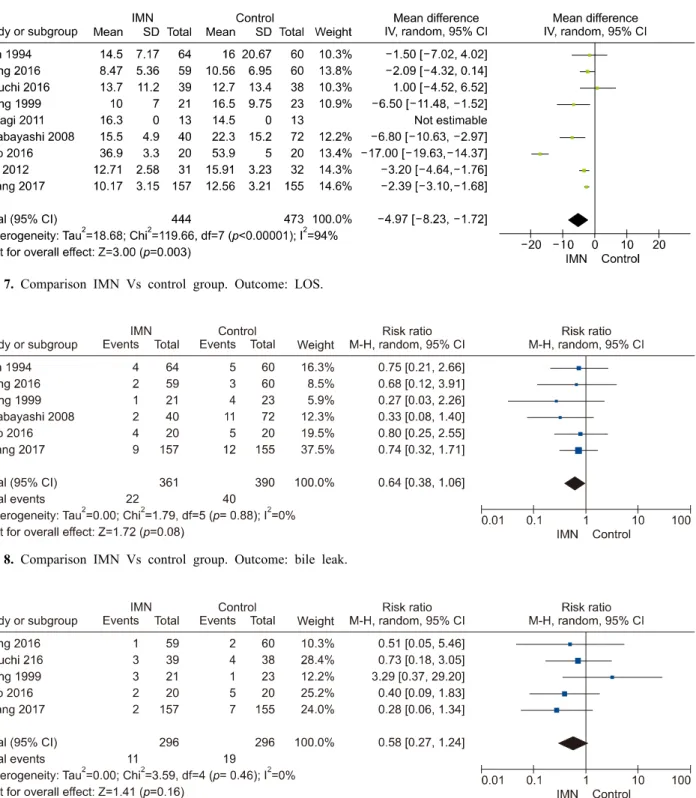
Fig. 7. Comparison IMN Vs control group. Outcome: LOS.
Fig. 8. Comparison IMN Vs control group. Outcome: bile leak.
Fig. 9. Comparison IMN Vs control group. Outcome: liver failure.
estimate (RR) produced by smaller studies may contribute to the publication bias. There was no asymmetry for mor- tality (Fig. 5E).
Quantitative data Primary outcome
(a) Wound infection (or surgical site infection) Eight trials26,28,29,32-36 reported wound infection rate fol- lowing hepatectomy. The infectious complication rate was 7.89% (33/418) in IMN group, while 12.58% (56/445) in the control group. There was statistically significant effect
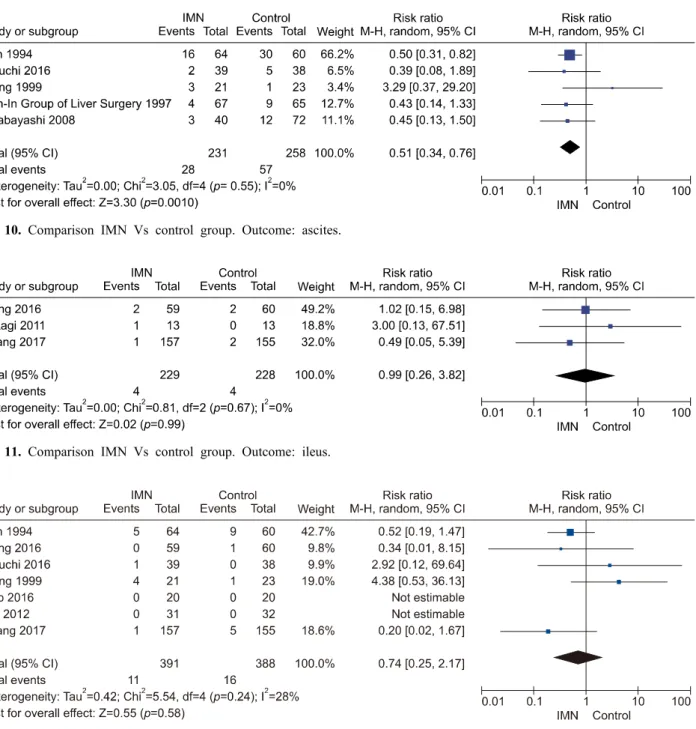
Fig. 12. Comparison IMN Vs control group. Outcome: mortality.
Fig. 11. Comparison IMN Vs control group. Outcome: ileus.
Fig. 10. Comparison IMN Vs control group. Outcome: ascites.
on the rate of wound infection between the two groups in this outcome (RR 0.65, 95% CI 0.43 to 0.96) (Fig. 6).
There was no heterogeneity in these included studies (I2=0%).
(b) Length of stay (LOS)
A pooled analysis of eight studies26,28-32,34-36 revealed length of stay was significantly shorter in IMN group (MD −4.97 days, 95% CI −8.23 to −1.72) (Fig. 7).
There was significant heterogeneity as denoted by I2. Note that the degree of freedom Q/df is >1 (119.66/7=17.09) and the p-value is significant (0.00001) indicating hetero-
geneity is significant. LOS was expressed as median with range [instead of mean and standard deviation (SD)] in two trials26,28 (this would be considered as incomplete continuous outcome data in the bias assessment).
(c) Bile leak
There was no statistically significant difference for this outcome between the two groups (RR 0.64, 95% CI 0.38 to 1.06) (Fig. 8).
(d) Liver failure
There was no statistically significant difference be- tween the two groups in this outcome (RR 0.58, 95% CI
Fig. 13. Effect of preoperative and post-operative oral IMN on wound infection.
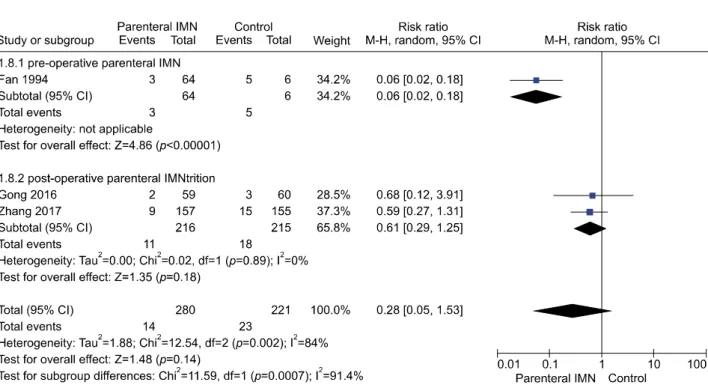
Fig. 14. Effect of preoperative and post-operative parenteral IMN on wound infection.
0.27 to 1.24) (Fig. 9).
(e) Ascites
There was statistically significant difference between the two groups in this outcome (RR 0.51, 95% CI 0.34 to 0.76) (Fig. 10). Ascites was significantly reduced in the IMN group.
(f) Ileus
There was no statistically significant difference be- tween the two groups in this outcome (RR 0.99, 95% CI 0.26 to 3.82) (Fig. 11).
Fig. 15. Effect of preoperative and post-operative oral IMN on LOS.
Fig. 16. Effect of preoperative and post-operative parenteral IMN on LOS.
Secondary outcome (a) Mortality
Seven out of eleven RCTs,26,28,31,32,34-36
enrolling 391 patients in IMN group and 388 patients in control group, reported postoperative mortality. There was no statistically significant difference between the two groups in this out- come (RR 0.74, 95% CI 0.25 to 2.17) (Fig. 12).
Subgroup and sensitivity analysis
Subgroup analysis was performed to evaluate the effect
of early administration of IMN and parenteral IMN on primary outcomes of interest (wound infection and length of hospital stay). There was no statistical significant dif- ference of the timing of IMN in oral and parenteral IMN subgroup on wound infection (Figs. 13 and 14). We ob- served a reduction in the length of hospital stay, which was not statistically significant in the oral IMN subgroup (MD −7.54 days, 95% CI −15.42 to 0.33) (Fig. 15) but was statistically significant in the parenteral IMN sub- group (MD −2.50 days, 95% CI −3.11 to −1.89) (Fig.
Fig. 17. Sensitivity analysis on primary outcome, wound infection.
Fig. 18. Sensitivity analysis on primary outcome, LOS.
16) especially if parenteral IMN was administered post- operatively.
On the other hand, sensitivity analysis revealed non-sig- nificant difference risk of wound infection (RR 0.70, 95%
CI 0.44 to 1.10) (Fig. 17) and length of hospital stay (MD
−6.34 days, 95% CI −14.88 to 2.20) (Fig. 18) when tri- als with ‘unclear’ or ‘high’ risk of bias removed. After performing a sensitivity analysis, the heterogeneity still exists in the latter outcome.
DISCUSSION
Hepatic resection is the gold standard and treatment of choice for primary liver cancers and hepatic metastases.
With modern resection techniques, mortality, for even ma- jor resection, is now 1-3%.37 In well selected patients, 5-year survival rate after liver resection for primary liver malignancy and for metastatic tumour is 35-38%38 and
30-40%39 have been reported. Malnutrition is a common problem for patient undergoing liver resection due re- duced oral intake, altered metabolic rate, hepatic in- sufficiency, and the effects of the neoplastic disease itself.
Appropriate supplementation with immunonutrition may be beneficial for the patient following major liver resec- tion.
In the context of liver resection or hepatectomy, the role and effectiveness of immunonutrition have not been established. To date, there is no meta-analysis about the effects of peri-operative immunonutrition in patients un- dergoing elective hepatectomy. The present systematic re- view and meta-analysis is the first which primarily fo- cused on the effects of enteral immunonutrition in hepa- tectomy.
Effect of immunonutrition on wound infection. Pooled analysis showed that wound infection rate was signifi- cantly reduced in IMN group (RR 0.65, 95% CI 0.43 to
0.96; X2=2.24, I2=0 per cent, Z=2.23; p=0.04). There was no difference of treatment effect in the preoperative and post-operative oral IMN subgroup analysis. Similar result was observed in the parenteral IMN subgroup analysis.
Effect of immunonutrition on length of hospital stay.
Although, the combined results showed that IMN had a shorter hospital stay (MD −4.97 days, 95% CI −8.23 to −1.72; X2=119.66, I2=94 per cent, Z=3.00; p=0.003), there was significant heterogeneity observed across these studies. Clinical reason for heterogeneity in length of hos- pital stay may likely be attributed to variable in disease status, local hospital policies or other medical co-morbid- ities requiring a longer duration of hospitalisation.
Similarly, LOS was significantly shorter in the post-oper- ative parenteral IMN subgroup analysis (MD −2.51 days, 95% CI −3.12 to −1.90) and overall parenteral subgroup analysis (MD −2.50 days, 95% CI −3.11 to −1.89).
Effect of immunonutrition on other post-operative mor- bidities. There was no statistically significant benefit on other post-operative morbidities of interest [e.g. bile leak (RR 0.64, 95% CI 0.38 to 1.06), liver failure (RR 0.58, 95% CI 0.27 to 1.24), and ileus (RR 0.99, 95% CI 0.26 to 3.82)]. Interestingly, we found that IMN is associated with a reduced risk of complication related to ascites (RR 0.51, 95% CI 0.34 to 0.76).
Effect of immunonutrition on mortality rates. Admini- stration of IMN had no influence on overall pooled mor- tality rates (RR 0.74, 95% CI 0.25 to 2.17; X2=5.54, I2=28 per cent, Z=0.55; p=0.58). Because of the very low mor- tality rate in both groups, the present pooled sample size is underpowered to show any differences in mortality rate.
In the past decades, conception of immnonutrition is of increasing interest and has been evaluated by many researchers.8 Short courses of preoperative immune-modu- lating formulas, using combinations of arginine, -3 fatty acids, and other nutrients, have been associated with im- proved surgical outcomes, but there is no conclusive evidence.6 The earliest RCTS conducted by Fan et al.26 demonstrated that a trend toward decreasing mortality and lowered complication rates. Similarly, a published RCT few years later by San-In Group of Liver Surgery27 found that long-term oral nutritional support with BCAAs im- proves clinical features particularly in patients with ad- vanced cirrhosis after major hepatic resection. The latest and largest trial published recently by Zhang et al.36 con-
cluded that -3 fatty acid-based parenteral IMN signi- ficantly improved postoperative recovery for cirrhotic pa- tient with liver cancer following hepatectomy, with a sig- nificant reduction in overall mortality and length of hospi- tal stay.
The aim of perioperative nutritional support is to sup- port liver regeneration and function and to prepare the pa- tient metabolically for the insult of the surgical operation.
Patient who may benefit from nutrition support should be appropriate identified pre-operatively as optimal nutri- tional regime could improve clinical outcome and within other postoperative complication. The key components for the appropriate identification of patient at nutritional risk include dietary history, recent weight loss, body fat, mus- cle mass, presence of fluid accumulation, and grip strength.40
In this meta-analysis of eleven RCTs evaluates the ef- fects of IMN in patients undergoing elective liver re- section, two important findings-significant reductions in postoperative wound infection and shortened hospital stay were observed when compared with a control group. De- creased infectious complications may lead to shortened postoperative hospital stay. However, the detailed mecha- nisms of IMN of which decreased the risk of infectious complications are unclear. It is known that both glutamine and -3 FAs can down-regulate pro-inflammatory cyto- kines production and enhance immunity. Studies have shown that the level of interleukin-6 (a pro-inflammatory cytokine) is significant lower in patients who received or- al IMN34 and parenteral IMN.31 A lowered levels of C-re- active protein and tumour necrosis factor-alpha (TNF-) has also been observed in the patient who received peri- operative glutamine41 and -3 FAs31 respectively.
Usually, only patients with Child-Pugh A disease are considered eligible for liver resection because post- operative mortality rates are higher for patient with higher Child-Pugh class, approaching 50% for those with Child-Pugh class C disease.13 One study recorded the out- come up to a year follow-up.27 To standardise the dichoto- mous data of this outcome, a cut-off of a month was applied. Therefore, even though positive results were ob- served i.e. it seems that ascites were significantly less common in the IMN group, but this needs to be in- terpreted in the context of clinical due to disease status (variable prognosis in cirrhotic liver based on Child-Pugh
score), malignancy (e.g. HCC, liver metastases and chol- angiocarcinoma), hypoalbuminaemia (low albumin) sec- ondary to malnutrition, and the timing when the ascites outcome was measured postoperatively.
Although most of the trials would demonstrate a com- mon objective–to evaluate the effectiveness of perioper- ative nutritional support in a form of immunonutrition in patient undergoing hepatic resection–however study proto- cols and end points seem to be varied. For instance, there is no agreed standard regime of which timing of initiation of IMN, duration and total nutritional or calories intake across all studies. It is difficult to dissect certain in- formation pertaining to premorbid status (well-nourished versus malnourish patient); diseased state (cirrhotic, stage of cancer, and severity of hepatitis) and extent of surgery (minor, partial, segmental and major hepatectomy).
The eleven studies that met the inclusion criteria were of varying quality. The majority of the included studies have achieved adequate generation of allocation sequence and allocation concealment as illustrated in Fig. 3. Selec- tion bias (biased allocation to comparison groups), per- formance bias (unequal provision of care apart from the treatment under evaluation), detection bias (biased assess- ment of outcomes), and attrition bias (biased occurrence and handling of protocol deviations and loss to follow up) can affect the internal validity of a clinical trial.
As previously mentioned, when random selection of subjects and random allocation to treatment group in the study population are not equally achieved, this could lead to sampling bias (as subset of selection bias). Less than 50% of all included studies scored low risk of perform- ance and detection bias. This suggests that most of the participants, personnel, and outcome assessors are aware of the intervention allocation after randomisation at a cer- tain point in time during the trials. Blinding can be impos- sible in some situations (e.g. patients receiving surgery or intervention). It is possible to have adequate randomisa- tion without adequate blinding–as blinding medical staff to patients’ assigned intervention may not always be feasible. In this current review, a majority of high risk of incomplete outcome data and selective reporting bias are related to missing data and incomplete outcome for a meta-analysis or failure to report expected outcome that would be expected for such a study respectively.
There is a risk of publication bias in all systematic
reviews. Publication bias occurs when relevant published or unpublished studies are not identified and included in a systematic review or meta-analysis. Publication bias can be visually assessed using a funnel plot or a statistical test (e.g. Egger regression test). The funnel plot is a plot of a measure of study size and effect size plotted on the ver- tical (Y-axis) and horizontal (X-axis) axises respectively.
In the absence of publication bias, plots will be distributed symmetrically. Although, the interpretation of the plots is largely subjective, but it offers a visual senses of the rela- tionship between effect size and precision.
In this review, the risk of publication bias was mini- mised by searching multiple sources of electronic data- bases and addition sources for both published and un- published articles, scanning the reference lists, checking registered trial (i.e. at clinicaltrials.gov), searching the
‘grey literature’, and translating non-English publication.
To minimise this further, two co-authors should assess the quality of the included studies, risk of bias and data ex- traction independently.
It has been recommended that immunonutrition should be initiated from 7 days prior to 7 days after major onco- logic GI surgery (e.g. oesophagus, stomach, pancreas, du- odenum, hepatobiliary tree).42,43 However, in this meta- analysis, pre-operative IMN supplementation did not sig- nificantly improve clinical outcomes. An early (preopera- tive) IMN was not associated with significant shortened length of hospital stay and reduction of wound infection rate (refer to subgroup analysis).
Decision on administration of nutrition supplementation is often made by a multidisciplinary team involving the surgeons, dieticians or nutritionist. Enteral nutrition should be recommended based on clinical indication and patient’s nutritional status. Post-operative surgical complications may not be attributed nutritional support alone but also could be due to other factors (surgeon’s skills, patient’s premorbid, disease and nutritional status). The primary principle is to enhance recovery and reduction of compli- cations associated with the surgery post-operatively. In this regard, nutritional support with immunonutrition in particularly, could enhance and maximise the benefit for the patients and minimising cost related to hospitalisation.
One might argue that immunonutrition should not be routinely chosen over standard oral formula due to a high cost of immunonutrition, lack of strong data to indicate
an improvement in mortality, and heterogeneity of in- dividual studies. Although positive conclusions were reached, but considering weighting some of the limitations of the data makes broad recommendation about the use of IMN tentative. What appears clear is that it is not associated with any negative outcomes. It seems fair to deduce that when delivered appropriately, both forms of nutritional support can be expected to improve organ function im- mune response equally in selected patients. Nutritional support can also minimise the metabolic response to sur- gery and improve protein synthesis and liver regeneration.
Therefore it would be beneficial in selected groups of high risk patients (for example diabetic, immunosup- pressed, and malnourished).
The high cost of these new nutritional products could be considered a major drawback for their routine use.
However, economic analyses carried out by ‘blind’ econo- mists on data gathered from randomised clinical trials showed that perioperative immunonutrition led to a sub- stantial saving in healthcare resources consumed.44 In fact, the saving due to the reduction in postoperative infectious complications by perioperative immunonutrition could offset the higher cost of the supplemental diet. A cost effective analysis would be helpful in determining this.
The strengths of our study are that it addresses a ques- tion that is very relevant to the practice of clinical surgery amongst the general surgeons and may potentially lead to the implementation of future guidelines on the use of im- muno-modulating diet in patients undergoing hepatectomy.
Although the clinical impact of IMN has been evaluated in many reviews but this is the first systematic review and meta-analysis primarily focused on the effects of enteral immunonutrition in liver surgery. We adhered to the cur- rent guideline in conducting a systematic review and used a validated method to assess the quality of all selected studies.
We have attempted to perform a subgroup analysis in view of the fact that there were different surgical proce- dures (major and minor liver resection) and liver diseases;
however this is not possible using current statistical software. Other limitations of our meta-analysis are as fol- lows (a) External validity (The extent to which the results of a trial provide a correct basis for applicability to other circumstances) is limited to only adult patients who un- derwent elective liver resection or hepatectomy; (b) A
small sample size recruited in most of the trials, and this may have an impact on the internal validity (The extent to which systematic error (bias) is minimised in a clinical trial) and might mask true effects of the outcomes; (c) A lack of high methodological quality clinical trials and presence of heterogeneity in outcome data. Trials with ad- equate generation of allocation sequence, adequate alloca- tion concealment and adequate follow-up were considered of high methodological quality.
Heterogeneity exists when the study pools data from a range of studies from different locations, time periods, and patients’ pre-operative demographic and disease pro- file (extent or staging of condition; medical co-morbid- ities; nutritional status-both malnourished and well-nour- ished patients). It is difficult to match these outcomes be- cause of the heterogeneity of study populations and study designs and protocols (including differences in the inter- ventions, timing of initiation of IMN and duration of treatment).
A prospective research requires consideration involving a larger patient group, good control for confounding fac- tors, and stratification method to further characterising pa- tients in both experimental and control groups. Stratifica- tion is a method of ensuring an equal distribution of key confounding factors between the two groups of a rando- mised trial. A better methodological quality of future RCT would be required to reduce or to eliminate the confound- ing variable. In order to improve the quality of RCTs, fu- ture studies should also be conducted and reported accord- ing to the Consolidated Standards of Reporting Trials (CONSORT) statement or checklist.45
In conclusion, wound infection rate was not signifi- cantly different between oral and parenteral IMN group.
The length of hospital stay was significantly lower in pa- renteral IMN group than in oral IMN group. The mortality rates were not affected. Immunonutrition should be rec- ommended routinely as part of the nutritional support in the Enhanced Recovery after Surgery (ERAS) protocol for hepatectomy.
ACKNOWLEDGEMENTS
This research was undertaken as part of the ChM General Surgery. It was previously accepted for poster presentation at the International Surgical Congress of the
Association of Surgeons of Great Britain and Ireland (ASGBI) in Liverpool, United Kingdom (May 2018), the World Congress of the International Hepato-Pancreato- Biliary Association in Geneva, Switzerland (September 2018), the BASO-ACS Annual Scientific Conference, Glas- gow, United Kingdom (November 2018), and the Congress of the Asian-Pacific Hepato-Pancreatico-Biliary Association, Seoul, Korea (September 2019).
ORCID
Chee Siong Wong: https://orcid.org/0000-0003-4818-5609 Raaj Praseedom: https://orcid.org/0000-0001-9541-6356 Siong-Seng Liau: https://orcid.org/0000-0001-5155-4300
AUTHOR CONTRIBUTIONS
Conceptualization: CSW, SSL. Data collection: CSW.
Formal analysis: CSW. Funding acquisition: None. Metho- dology: CSW. Project administration: RP, SSL. Visualiza- tion: None. Writing - original draft: CSW. Writing - re- view & editing: CSW, RP, SSL.
REFERENCES
1. Kehlet H. Multimodal approach to control postoperative patho- physiology and rehabilitation. Br J Anaesth 1997;78:606-617.
2. Weimann A, Braga M, Carli F, Higashiguchi T, Hübner M, Klek S, et al. ESPEN guideline: clinical nutrition in surgery. Clin Nutr 2017;36:623-650.
3. Braga M, Ljungqvist O, Soeters P, Fearon K, Weimann A, Bozzetti F. ESPEN guidelines on parenteral nutrition: surgery.
Clin Nutr 2009;28:378-386.
4. McClave SA, Taylor BE, Martindale RG, Warren MM, Johnson DR, Braunschweig C, et al. Guidelines for the provision and as- sessment of nutrition support therapy in the adult critically ill patient: Society of Critical Care Medicine (SCCM) and Ameri- can Society for Parenteral and Enteral Nutrition (A.S.P.E.N.).
JPEN J Parenter Enteral Nutr 2016;40:159-211.
5. Brennan MF, Pisters PW, Posner M, Quesada O, Shike M. A prospective randomized trial of total parenteral nutrition after major pancreatic resection for malignancy. Ann Surg 1994;220:
436-441; discussion 441-444.
6. Evans DC, Martindale RG, Kiraly LN, Jones CM. Nutrition opti- mization prior to surgery. Nutr Clin Pract 2014;29:10-21.
7. Lin E, Goncalves JA, Lowry SF. Efficacy of nutritional pharma- cology in surgical patients. Curr Opin Clin Nutr Metab Care 1998;1:41-50.
8. Marik PE, Zaloga GP. Immunonutrition in high-risk surgical pa- tients: a systematic review and analysis of the literature. JPEN J Parenter Enteral Nutr 2010;34:378-386.
9. Hegazi RA, Hustead DS, Evans DC. Preoperative standard oral nutrition supplements vs immunonutrition: results of a systematic
review and meta-analysis. J Am Coll Surg 2014;219:1078-1087.
10. Probst P, Ohmann S, Klaiber U, Hüttner FJ, Billeter AT, Ulrich A, et al. Meta-analysis of immunonutrition in major abdominal surgery. Br J Surg 2017;104:1594-1608.
11. Reddy SK, Barbas AS, Turley RS, Steel JL, Tsung A, Marsh JW, et al. A standard definition of major hepatectomy: resection of four or more liver segments. HPB (Oxford) 2011;13:494-502.
12. Fischer JE. Fischer’s mastery of surgery. 6th ed. Philadelphia:
Wolters Kluwer Health/Lippincott Williams & Wilkins, 2012.
13. Lillemoe K, Jarnagin W. Master techniques in surgery: hep- atobiliary and pancreatic surgery. Philadelphia: Wolters Kluwer, 2012.
14. Garden OJ, Parks RW. Hepatobiliary and pancreatic surgery. 5th ed. Edinburgh: Saunders Elsevier, 2014.
15. Cerantola Y, Hübner M, Grass F, Demartines N, Schäfer M.
Immunonutrition in gastrointestinal surgery. Br J Surg 2011;98:
37-48.
16. Drover JW, Dhaliwal R, Weitzel L, Wischmeyer PE, Ochoa JB, Heyland DK. Perioperative use of arginine-supplemented diets:
a systematic review of the evidence. J Am Coll Surg 2011;212:
385-399, 399.e1.
17. Marimuthu K, Varadhan KK, Ljungqvist O, Lobo DN. A meta- analysis of the effect of combinations of immune modulating nu- trients on outcome in patients undergoing major open gastro- intestinal surgery. Ann Surg 2012;255:1060-1068.
18. Moher D, Liberati A, Tetzlaff J, Altman DG. Preferred reporting items for systematic reviews and meta-analyses: the PRISMA statement. PLoS Med 2009;6:e1000097.
19. Hozo SP, Djulbegovic B, Hozo I. Estimating the mean and var- iance from the median, range, and the size of a sample. BMC Med Res Methodol 2005;5:13.
20. Jadad AR, Moore RA, Carroll D, Jenkinson C, Reynolds DJ, Gavaghan DJ, et al. Assessing the quality of reports of random- ized clinical trials: is blinding necessary? Control Clin Trials 1996;17:1-12.
21. Higgins JP, Altman DG, Gøtzsche PC, Jüni P, Moher D, Oxman AD, et al. The Cochrane Collaboration's tool for assessing risk of bias in randomised trials. BMJ 2011;343:d5928.
22. Egger M, Smith GD, Altman DG. Systematic reviews in health care: meta-analysis in context. 2nd ed. London: BMJ, 2001.
23. Mantel N, Haenszel W. Statistical aspects of the analysis of data from retrospective studies of disease. J Natl Cancer Inst 1959;
22:719-748.
24. DerSimonian R, Laird N. Meta-analysis in clinical trials. Control Clin Trials 1986;7:177-188.
25. Higgins JP, Thompson SG. Quantifying heterogeneity in a meta-analysis. Stat Med 2002;21:1539-1558.
26. Fan ST, Lo CM, Lai EC, Chu KM, Liu CL, Wong J.
Perioperative nutritional support in patients undergoing hep- atectomy for hepatocellular carcinoma. N Engl J Med 1994;331:
1547-1552.
27. San‐In Group of Liver Surgery. Long-term oral administration of branched chain amino acids after curative resection of hep- atocellular carcinoma: a prospective randomized trial. Br J Surg 1997;84:1525-1531.
28. Meng WC, Leung KL, Ho RL, Leung TW, Lau WY. Prospective randomized control study on the effect of branched-chain amino acids in patients with liver resection for hepatocellular carcinoma.
Aust N Z J Surg 1999;69:811-815.
29. Okabayashi T, Nishimori I, Sugimoto T, Maeda H, Dabanaka K, Onishi S, et al. Effects of branched-chain amino acids-enriched nutrient support for patients undergoing liver resection for hep- atocellular carcinoma. J Gastroenterol Hepatol 2008;23:1869-1873.
30. Mikagi K, Kawahara R, Kinoshita H, Aoyagi S. Effect of pre-
operative immunonutrition in patients undergoing hepatectomy;
a randomized controlled trial. Kurume Med J 2011;58:1-8.
31. Wu Z, Qin J, Pu L. Omega-3 fatty acid improves the clinical outcome of hepatectomized patients with hepatitis B virus (HBV)- associated hepatocellular carcinoma. J Biomed Res 2012;26:395- 399.
32. Gong Y, Liu Z, Liao Y, Mai C, Chen T, Tang H, et al. Effective- ness of -3 polyunsaturated fatty acids based lipid emulsions for treatment of patients after hepatectomy: a prospective clinical trial. Nutrients 2016;8:357.
33. Seguin P, Locher C, Boudjema K, Hamon C, Mouchel C, Malledant Y, et al. Effect of a perioperative nutritional supple- mentation with Oral ImpactⓇ in patients undergoing hepatic sur- gery for liver cancer: a prospective, placebo-controlled, random- ized, double-blind study. Nutr Cancer 2016;68:464-472.
34. Uno H, Furukawa K, Suzuki D, Shimizu H, Ohtsuka M, Kato A, et al. Immunonutrition suppresses acute inflammatory re- sponses through modulation of resolvin E1 in patients under- going major hepatobiliary resection. Surgery 2016;160:228-236.
35. Kikuchi Y, Hiroshima Y, Matsuo K, Kawaguchi D, Murakami T, Yabushita Y, et al. A randomized clinical trial of preoperative administration of branched-chain amino acids to prevent post- operative ascites in patients with liver resection for hepatocel- lular carcinoma. Ann Surg Oncol 2016;23:3727-3735.
36. Zhang B, Wei G, Li R, Wang Y, Yu J, Wang R, et al. n-3 fatty acid-based parenteral nutrition improves postoperative recovery for cirrhotic patients with liver cancer: a randomized controlled clinical trial. Clin Nutr 2017;36:1239-1244.
37. Agarwal A, Borley NR, McLatchie GR. Oxford handbook of op- erative surgery. 3rd ed. Oxford: Oxford University Press, 2017.
38. Cuschieri A, Steele RJC, Moossa AR. Essential surgical practice:
higher surgical training in general surgery. 4th ed. London:
Arnold, 2002.
39. Garden OJ, Parks RW. Principles and practice of surgery. 7th ed. Edinburgh: Elsevier, 2018.
40. Jensen GL, Bistrian B, Roubenoff R, Heimburger DC. Malnutri- tion syndromes: a conundrum vs continuum. JPEN J Parenter Enteral Nutr 2009;33:710-716.
41. Richard V, Dahiya D, Kaman L, Raj P, Behera A. Effect of peri- operative glutamine administration on C-reactive protein and liv- er function tests in patients undergoing hepatic resection. Pol Przegl Chir 2014;86:11-16.
42. Weimann A, Braga M, Harsanyi L, Laviano A, Ljungqvist O, Soeters P, et al. ESPEN guidelines on Enteral nutrition: surgery including organ transplantation. Clin Nutr 2006;25:224-244.
43. Consensus recommendations from the US summitt on immune- enhancing enteral therapy. JPEN J Parenter Enteral Nutr 2001;
25(2 Suppl):S61-S63.
44. Braga M, Gianotti L, Vignali A, Schmid A, Nespoli L, Di Carlo V. Hospital resources consumed for surgical morbidity: effects of preoperative arginine and omega-3 fatty acid supplementation on costs. Nutrition 2005;21:1078-1086.
45. Altman DG, Schulz KF, Moher D, Egger M, Davidoff F, Elbourne D, et al. The revised CONSORT statement for report- ing randomized trials: explanation and elaboration. Ann Intern Med 2001;134:663-694.