This is an open-access article distributed under the terms of the Creative Commons Attribution Non-Commercial License (http://creativecommons.org/
licenses/by-nc/4.0/), which permits unrestricted non-commercial use, distribution, and reproduction in any medium, provided the original work is properly cited.
CC
No evidence on the effectiveness of oral splints for the management of temporomandibular joint dysfunction pain in both short and long-term
follow-up systematic reviews and meta-analysis studies
Atef Abdel Hameed Fouda
Department of Maxillofacial Surgery, Kasr El Eyne Hospital, Cairo University, Cairo, Egypt
Abstract (J Korean Assoc Oral Maxillofac Surg 2020;46:87-98)
The aim of this study was to determine the efficacy of oral splints in reducing the intensity of pain in patients with temporomandibular joint dysfunc- tion in both short and long-term treatment durations. Electronic databases, Cochrane Library, MEDLINE via PubMed, Web of Science, Egyptian Knowledge Bank, and EMBASE were searched for randomized controlled trials comparing different types of splints to non-occluding splints, behav- ioral therapy, pharmacotherapy, counseling, and no treatment. The risk of bias was assessed by using Cochrane risk of bias recommendations. Fixed and random effects were used to summarize the outcomes. The effect estimates were expressed as standardized mean differences (SMD) or risk ratios with a 95% confidence interval (CI). Subgroup analyses were carried out according to the treatment duration. Twenty-two studies met the inclusion cri- teria. A meta-analysis of short-term studies up to three months revealed no significant difference between the study groups. However, long-term studies exhibited a significant difference in pain reduction in favor of the control group. Total analysis revealed that the control group resulted in significant pain reduction (SMD 0.14, 95% CI 0.05-0.23, P =0.002, I 2 =0%). Oral splints are not effective in reducing pain intensity or improving function in pa- tients with temporomandibular joint dysfunction.
Key words: Occlusal splints, Pain, Review, Meta-analysis
[paper submitted 2019. 9. 20 / revised 2019. 11. 30 / accepted 2019. 12. 17]
Copyright © 2020 The Korean Association of Oral and Maxillofacial Surgeons. All rights reserved.
I. Introduction
Psychologic, social, and biologic factors are several causes of temporomandibular joint dysfunction (TMJD). The relief of pain and the ability to masticate are considered the prin- cipal concerns for patients. An understanding of the psycho- logical conditions with proper treatments for chronic pain and dysfunction must be considered 1 . The ultimate success was achieved when the operator met the patients’ expectations by improving their quality of life 2 .
Successful treatment of TMJD depends on an accurate di- agnosis followed by the selection of proper treatment. Treat-
ment modalities applied to relieve pain and other symptoms of this disorder are classified into non-invasive physical ther- apy 3 , pharmacotherapy 4 , counseling assurance 5 , and occlusal splint therapy 6 . Minimally invasive arthrocentesis 7 , acupunc- ture 8 , and lasers 9 are among the invasive surgical intervention methods 10 .
Occlusal splints are considered a simple, chair-side, and less invasive treatment. Occlusal splints are the favorable treatment of choice in our institute after medications. The clinical findings of occlusal splints for the treatment of both myofascial pain dysfunction (MPD) syndrome and disk dis- placement are controversial and they may act as a placebo rather than a specific therapeutic mechanism 11 .
Regardless of the splint mode of action, many old and sev- eral recent clinical trials and systematic reviews have docu- mented its therapeutic effectiveness in reducing pain intensity and improving masticatory function in patients with painful temporomandibular disorder (TMD) 12,13 . However, most of the current literature did not demonstrate any beneficial effect in short-term 14 and long-term follow-up 15 .
Among the causes of variability between the results, pa- Atef Abdel Hameed Fouda
Department of Maxillofacial Surgery, Kasr El Eyne Hospital, Cairo University, Manial, Cairo 12111, Egypt
TEL: +20-1093440600 FAX: +20-23642938
E-mail: [email protected]
ORCID: https://orcid.org/0000-0001-6386-3696
tients with TMJD cannot be considered a homogeneous group and will respond differently, with investigators relying on subjective symptoms reported by the patients. Moreover, studies can present with inadequate sample sizes, short fol- low-up periods, poor quality of the control group, and bias in data reporting. Proper evaluation of splint appliance therapy is achieved by applying long-term follow-ups, randomized controlled study designs, recruitment of a homogeneous population, and blinding in data extraction.
The investment in evidence-based medicine and its role in improving the acceptance of studies for publication, besides the natural progress of the disease, recent diagnostic mea- sures, and improvement of communication between clini- cians and patients means it is likely these account for changes in the old concepts that previously guided temporomandibu- lar joint (TMJ) treatment.
This review was conducted to shed light on doubts about the therapeutic value of oral splints through a meta-analysis of data from different relevant randomized controlled trials (RCTs) and studies of different types of occlusal splints. Our purpose was to evaluate the effectiveness of splint therapy in ameliorating pain issues in patients with TMJD.
II. Materials and Methods
The recommendations from the PRISMA (Preferred Re- porting Items for Systematic Reviews and Meta-Analyses) statement were followed 16 .
1. Eligibility criteria 1) Inclusion criteria
RCT studies that were conducted in humans over the past twenty years. Patients with TMJD that included myofascial pain with the source of pain being either muscular or from the joint, and patients with disk displacements with or with- out reduction. Studies that compared splints to non-invasive treatment (medications-biofeedback, counseling, and non- occluding splints). Patient diagnosis was either based on Re- search Diagnostic Criteria for Temporomandibular Disorders (RDC/TMD) or clinical examination.
2) Excluded from the study
Published studies older than twenty years, studies on animals, uncontrolled studies comparing different types of splints with each other, or studies with minimally invasive treatment modalities (low-level laser, arthrocentesis, acu-
puncture, and physiotherapy). If there were multiple compari- sons within the same study, each comparison was included separately. Moreover, various intervals within the related research were recorded in each relevant subgroup.
2. Population
Patients with myofascial pain and/or disk displacement with or without reduction were included. Patients with arthri- tis or neuralgias were excluded.
3. Intervention
The study included all types of splints (stabilizing splint, Michigan splint, centric relation appliance, flat occlusal ap- pliance, soft or hard splints, vinyl appliances, and positioning splints).
4. Control group
The patients in the control group underwent medical treat- ment, biofeedback, non-occluding splints, massages, behav- ioral therapy, cognitive, counseling, or no treatment.
5. Outcome 1) Primary outcome
Pain intensity was estimated with any recognized, vali- dated pain scale: visual analogue scale, numeric rating scale, characteristic pain intensity, and symptom severity index.
Subgroup analyses were carried out for the outcomes based on the follow-up duration classified into one, two, three, six, and twelve months.
2) Secondary outcome
Maximum mouth opening (MMO) was evaluated by inter- incisal opening measured in millimeters.
6. Search methods for studies identification
The search for studies in the English language was conduct-
ed up to August 2018. The following databases were searched
individually from 1998 to the present: MEDLINE, Web of
Science, EMBASE, and Egyptian Knowledge Bank. Manual
searches, references from primary studies, and systematic
reviews for relevant data were obtained. The search used a
combination of controlled vocabulary: ‘temporomandibular
joint disorders’[MeSH Terms] OR ‘temporomandibular’[All Fields], AND ‘joint’[All Fields], AND ‘disorders’[All Fields], OR ‘temporomandibular joint disorders’[All Fields], OR (‘temporomandibular’[All Fields] AND ‘disorders’[All Fields]) OR ‘temporomandibular disorders’[All Fields], OR
‘mouth’[MeSH Terms] OR ‘mouth’[All Fields] OR ‘oral’[All Fields]) AND (‘splints’[MeSH Terms] OR ‘splints’[All Fields] OR ‘splint’[All Fields]). ‘temporomandibular joint’[MeSH Terms] OR (‘temporomandibular’[All Fields]
AND ‘joint’[All Fields]) OR ‘temporomandibular joint’[All Fields] OR ‘TMJ’[All Fields], AND ‘pain’[MeSH Terms]
OR ‘pain’[All Fields].
7. Data extraction and management
Both continuous (mean, standard deviation) and dichoto- mous (event, control) studies were included in the analysis.
8. Assessment of study risk of bias
All included studies were evaluated with consent from the Cochrane Handbook for Systematic Reviews of Interventions version 5.1.0 17 . The risk of bias was assessed using Cochrane Collaboration’s tool with response options of ‘low risk’, ‘un- clear risk’, and ‘high risk’ for the following criteria: sequence generation, allocation concealment, blinding, incomplete out- come data, reporting bias, and other biases.
9. Measurements of the treatment effect 1) Pain intensity
Standardized mean difference (SMD) with 95% confidence interval (CI) and fixed effects were used for continuous out- comes. For dichotomous outcomes, the estimate of the effect was expressed as a risk ratio (RR) together with 95% CIs and random effects.
Total collected (n=2,418)
Included Eligibility Screening Identification
Total excluded (n=103) Comparator invasive
(n=61) Full text unavailable
(n=6) Insufficient data
(n=4) Comparison between
two types of splints (n=23) Uncontrolled
(n=9) Distributed to:
Primary outcome:
Continuous pain Dichotomous pain Secondary outcome:
MMO Included studies
(n=22) Application of inclusion criteria Full text articles eligible for study after non RCTs removal
(n=125)
Not RCT (n=916) After duplicates removal
(n=1,041) Records identified through search
MEDLINE (n=1,763) EMBASE (n=51) Cochrane Library (n=385) Web of Science (n=182) Egyptian Knowledge Bank (n=5)
Manual search and references from review studies (n=32)
Duplicates (n=1,377)
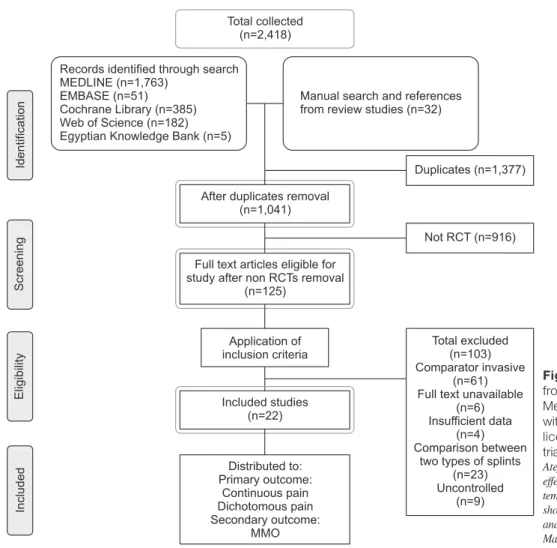
Fig. 1. Flow chart diagram. Adapted
from the article of Moher et al. (PLoS
Med 2009;6:e1000097) 38 in accordance
with the Creative Commons Attribution
license. (RCT: randomized controlled
trial, MMO: maximum mouth opening)
Atef Abdel Hameed Fouda: No evidence on the
effectiveness of oral splints for the management of
temporomandibular joint dysfunction pain in both
short and long-term follow-up systematic reviews
and meta-analysis studies. J Korean Assoc Oral
Maxillofac Surg 2020
2) Maximum mouth opening
The mean difference (MD) with 95% CI and fixed effects was used for the assessment of the outcomes.
3) Assessment of heterogeneity
Chi-square testing for heterogeneity was performed, and the extent of the inconsistency of the treatment effects (I 2 )
across the trials was measured. We considered heterogeneity substantial if I 2 was greater than 30%, or if there was a low P- value (less than 0.10) in the chi-square test for heterogeneity.
We used a fixed-effect meta-analysis for combining the data, but clinical heterogeneity random-effect was used in the sub- group analyses.
Study or subgroup IV, Fixed, 95% CI
Standardized mean difference Standardized mean difference Control
Splint
A B C D E F G Risk of bias
Up to one-month Minakuchi Minakuchi Alencar Jr Alencar Jr Haketa Niemela Giannakopoulos Hasanoglu Erbasar Hosgor
Giannakopoulos Subtotal (95% CI)
Heterogeneity: chi =6.68, df=9 ( =0.67); I =0%
Test for overall effect: Z=1.12 ( =0.26)
Up to two-months Carmeli
Raphael Minakuchi Alenccar Jr Alenccar Jr Haketa Shedden Mora Giannakopoulos Hasanoglu Erbasar Subtotal (95% CI)
Heterogeneity: chi =9.49, df=8 ( =0.30); I =16%
Test for overall effect: Z=1.74 ( =0.08)
Three-months Wahlund Wahlund Truelove Wassell Truelove Alencar Jr Alencar Jr Wahlund Conti Conti Hosgor Giannakopoulos Kokkola Subtotal (95% CI)
Heterogeneity: chi =10.82, df=12 ( =0.54); I =0%
Test for overall effect: Z=2.37 ( =0.02)
Six-months Shedden Mora Katyayan Wahlund Hosgor Kokola
Subtotal (95% CI)
Heterogeneity: chi =0.95, df=4 ( =0.92); I =0%
Test for overall effect: Z=2.17 ( =0.03)
18 18 19 19 20
24 21
22 23
14
2 2
25 26
18 19 19 20
27 21
22
2 2
29 29 30 28
30 19 19 32 31 31 23
14 15
2 2
27 37 32 23 15
2 2
P P
P P
P P
P P 5.4 5.4 0.33 0.31 43.5 3.4 3 28.9 3.5 35
2.83 10.18 3.8 0.24 0.28 36.5 3.89 33 23
164.7 164.7 1.1 18.6 1.3 0.31 0.3 3.7 1.61 1.58 3.4 26 15.95
4.21 2.23 2.8 3.2 15.95
6.4 6.4 0.21 0.23 27.1 3.2 2.7 21 0.61 15
1.68 0.97 5 0.2 0.2 28.7 2.4 16 27.8
51.5 51.5 1.4 23.7 1.5 0.2 0.26 2 0.49 0.33 1.18 14 13.05
2.5 0.72 1.6 1.12 13.05 Mean SD Total
25 25 14 14 25 39 12 20 10 22 206
18 32 25 14 14 25 27 22 20 197
42 42 56 38 54 14 14 29 12 12 10 22 13 358
27 40 17 10 13 107
5.7 10.9 0.3 0.3 33.1 4 4.08 35 3.8 34
1.44 9.88 6.4 0.27 0.27 21.3 3.9 29 23.6
148.3 156 1.1 16.4 1.1 0.24 0.24 4.4 1.3 1.3 2.8 21 11.46
3.62 1.98 2.8 2.6 11.46
15.4 14.3 0.26 0.26 26.8 2.6 2.5 27 0.57 20
1.2 1.1 17.7 0.25 0.25 26.4 2.19 15 23.8
53.8 52.7 1.3 20.9 1.3 0.24 0.24 1.8 0.29 0.29 0.67 11 9.02
2.48 0.91 1.9 0.73 9.02 Mean SD Total
23 21 14 14 19 37 12 20 10 20 190
18 31 23 14 14 19 29 20 20 188
39 39 54 34 54 14 14 28 9 9 10 20 22 346
29 40 5 10 22 106
Weight
2.4%
2.2%
1.4%
1.4%
2.1%
3.8%
1.2%
2.0%
1.0%
2.1%
19.7%
1.6%
3.1%
2.4%
1.4%
1.4%
2.1%
2.8%
2.1%
2.0%
19.0%
4.0%
4.1%
5.5%
3.6%
5.4%
1.4%
1.4%
2.8%
1.0%
0.9%
1.0%
2.1%
1.6%
34.9%
2.8%
4.0%
0.8%
1.0%
1.6%
10.1%
IV, Fixed, 95% CI
0.03 [ 0.59, 0.54]
0.50 [ 1.09, 0.09]
0.12 [ 0.62, 0.86]
0.04 [ 0.70, 0.78]
0.38 [ 0.22, 0.98]
0.20 [ 0.65, 0.25]
0.40 [ 1.21, 0.41]
0.25 [ 0.87, 0.38]
0.49 [ 1.38, 0.41]
0.06 [ 0.55, 0.66]
0.11 [ 0.31, 0.08]
0.93 [0.24, 1.62]
0.29 [ 0.21, 0.78]
0.20 [ 0.77, 0.37]
0.13 [ 0.87, 0.61]
0.04 [ 0.70, 0.78]
0.54 [ 0.07, 1.15]
0.00 [ 0.53, 0.52]
0.25 [ 0.36, 0.86]
0.02 [ 0.64, 0.60]
0.18 [ 0.02, 0.38]
0.31 [ 0.13, 0.75]
0.17 [ 0.27, 0.60]
0.00 [ 0.37, 0.37]
0.10 [ 0.37, 0.56]
0.14 [ 0.24, 0.52]
0.31 [ 0.44, 1.05]
0.23 [ 0.51, 0.98]
0.36 [ 0.89, 0.16]
0.71 [ 0.18, 1.61]
0.86 [ 0.05, 1.77]
0.60 [ 0.30, 1.50]
0.39 [ 0.22, 1.00]
0.41 [ 0.28, 1.10]
0.18 [0.03, 0.33]
0.23 [ 0.29, 0.76]
0.30 [ 0.14, 0.74]
0.00 [ 1.00, 1.00]
0.61 [ 0.29, 1.51]
0.41 [ 0.28, 1.10]
0.31 [0.03, 0.58]
Year
2001 2001 2009 2009 2010 2012 2016 2017 2017 2018
2001 2001 2001 2009 2009 2010 2013 2016 2017
2003 2003 2006 2006 2006 2009 2009 2015 2015 2015 2017 2018 2018
2013 2013 2015 2017 2018
1 0.5 0 0.5 1 Favours [splint] Favours [control]
..
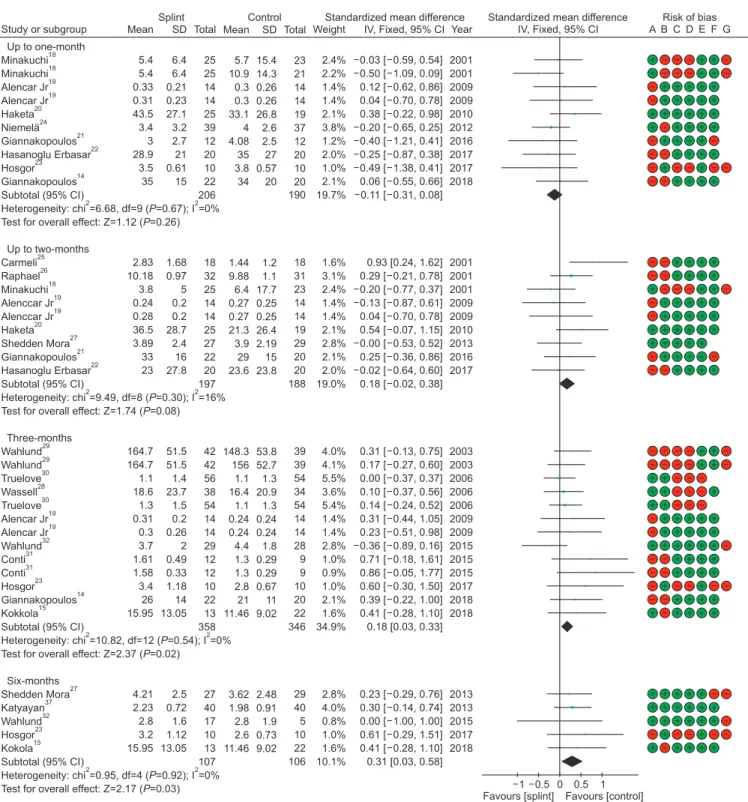
Fig. 2. Forest plot of continuous pain analysis at different intervals with risk of bias for the included studies. (SD: standard deviation, CI:
confidence interval, df: degree of freedom)
4) Assessment of reporting biases
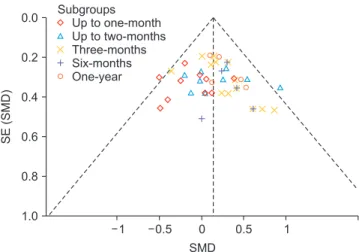
Publication bias was appraised using the symmetry of the funnel plots. We visually assessed funnel plot asymmetry.
When asymmetry was detected, investigations were per- formed using exploratory analyses.
5) Methodological quality assessment
Data synthesis and meta-analyses were performed accord- ing to the rules adopted by the Cochrane Collaboration re- viewer’s handbook 17 . All statistical analyses were conducted using Review Manager software (RevMan 5.3).
III. Results
The initial search yielded a total of 2,418 titles: 1,763 from PubMed, 51 from EMBASE, 385 from the Cochrane Cen- tral library, 182 from the Web of Science, 5 from Egyptian Knowledge Bank (ClinicalKey), and 32 through manual searches.
After reviewing the abstracts, 1,377 studies were excluded from the analysis, and 1,041 were considered for further full- text screening. Finally, a total of 22 studies 14,15,18-37 were in- cluded in this systematic review 38 .(Fig. 1)
1. Results and study characteristics 1) Primary outcome (pain intensity) (Fig. 2) (1) Short follow-up period: up to one month
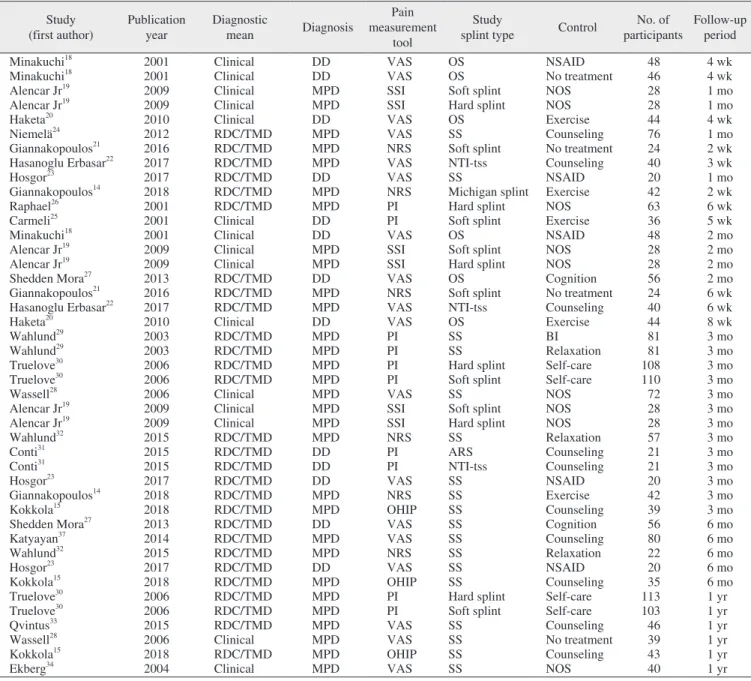
Table 1 reviews the summary of the included subgroup studies. Studies starting from the one week follow-up period up to one month included a total of eight studies with ten comparisons 14,18-24 , two of them comparing occlusal splints with medications 18,23 , and two comparisons of soft and hard occlusal splints with a non-occluding palatal splint 19 . Two studies compared occlusal splints versus exercise 14,20 , two studies compared them with counseling 22,24 , and the last two compared them with no treatment 18,21 .
Control groups in four comparisons reported better pain reduction compared to splint therapy 14,19,20 ; however, the other six comparisons favored splint therapy 18,21-24 .
Total subgroup analysis of the eight identified studies with a total of 396 participants revealed non-significant overall ef- fects on pain reduction (SMD –0.11, 95% CI –0.31 to 0.08, P=0.67, I 2 =0%).
(2) Short term evaluation: up to two months
Studies with a follow-up period greater than one month and up to two months were included. Subgroups included eight studies with nine comparisons 18-22,25-27 . Three comparisons in- volved non-occluding palatal splints 19,25,26 , three comparisons involved exercise 20,21,25 , and one study compared occlusal splints versus counselling 22 with a single comparison for ev- ery medical treatment 18 and cognition 27 .
In five comparisons, the control group exhibited better results than splints 18-20,25,26 , with four comparisons in favor of splints 18,19,22,27 . The total subgroup analysis of the identi- fied studies with a total of 385 participants revealed non-
Study or subgroup IV, Fixed, 95% CI
Standardized mean difference Standardized mean difference Control
Splint
A B C D E F G Risk of bias
One-year Truelove Truelove Wassell Qvintus Kokkola Subtotal (95% CI)
Heterogeneity: chi =1.90, df=4 ( =0.75); I =0%
Test for overall effect: Z=2.02 ( =0.04)
Total (95% CI)
Heterogeneity: chi =38.52, df=41 ( =0.58); I =0%
Test for overall effect: Z=3.17 ( =0.002)
Test for subgroup differences: chi =8.68, df=4 ( =0.07); I =53.9%
(A) Random sequence generation (selection bias) (B) Allocation concealment (selection bias)
(C) Blinding of participants and personnel (performance bias) (D) Blinding of outcome assessment (detection bias) (E) Incomplete outcome data (attrition bias) (F) Selective reporting (reporting bias) (G) Other bias
30 30 28 33 15
2 2
2 2
2 2
P P
P P
P Risk of bias legend
0.9 1 19 4.57 13.17
1.1 1 23.8 2.96 10.68 Mean SD Total
65 55 27 30 29 206
1,074 0.8 0.8 7.8 3.13 11.86
0.9 0.9 11 3.1 9.75 Mean SD Total
48 48 12 16 14 138
968 Weight
5.6%
5.1%
1.6%
2.0%
1.9%
16.3%
100.0%
IV, Fixed, 95% CI
0.10 [ 0.28, 0.47]
0.21 [ 0.18, 0.60]
0.53 [ 0.16, 1.22]
0.47 [ 0.14, 1.09]
0.12 [ 0.51, 0.76]
0.23 [0.01, 0.44]
0.14 [0.05, 0.23]
Year
2006 2006 2006 2015 2018
1 0.5 0 0.5 1 Favours [splint] Favours [control]
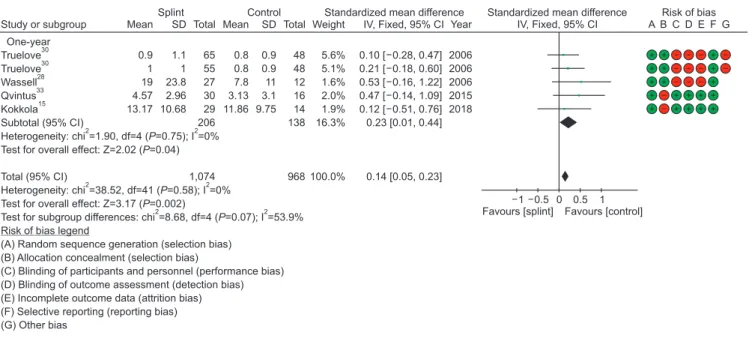
Fig. 2. Continued.
Atef Abdel Hameed Fouda: No evidence on the effectiveness of oral splints for the management of temporomandibular joint dysfunction pain in both short and long-term follow-up
systematic reviews and meta-analysis studies. J Korean Assoc Oral Maxillofac Surg 2020
significant overall effects on pain reduction (SMD 0.18, 95%
CI –0.02 to 0.38, P=0.08, I 2 =16%).
(3) Intermediate follow-up period: three months
Nine studies with thirteen comparisons at the three months’
follow-up period were included 14,15,19,23,28-32 . One study com- pared occlusal splints with medications 23 , two studies in- volved occlusal splints with a non-occluding palatal splint 19 , and three studies compared occlusal splints with counsel-
ling 15,31 . Two studies by Wahlund et al. 29,32 compared splints with relaxation, and two comparisons with self-care 30 .
In twelve studies, the control group exhibited better re- sults than the splints 14,15,19,23,28-31 , with one study in favor of splints 32 .
Total subgroup analysis of the identified studies with a total of 704 participants revealed a significant overall effect on pain reduction in favor of the control (SMD 0.18, 95% CI
Table 1. Summary of the included studies Study
(first author) Publication
year Diagnostic
mean Diagnosis
Pain measurement
tool
Study
splint type Control No. of
participants Follow-up period
Minakuchi 18 2001 Clinical DD VAS OS NSAID 48 4 wk
Minakuchi 18 2001 Clinical DD VAS OS No treatment 46 4 wk
Alencar Jr 19 2009 Clinical MPD SSI Soft splint NOS 28 1 mo
Alencar Jr 19 2009 Clinical MPD SSI Hard splint NOS 28 1 mo
Haketa 20 2010 Clinical DD VAS OS Exercise 44 4 wk
Niemelä 24 2012 RDC/TMD MPD VAS SS Counseling 76 1 mo
Giannakopoulos 21 2016 RDC/TMD MPD NRS Soft splint No treatment 24 2 wk
Hasanoglu Erbasar 22 2017 RDC/TMD MPD VAS NTI-tss Counseling 40 3 wk
Hosgor 23 2017 RDC/TMD DD VAS SS NSAID 20 1 mo
Giannakopoulos 14 2018 RDC/TMD MPD NRS Michigan splint Exercise 42 2 wk
Raphael 26 2001 RDC/TMD MPD PI Hard splint NOS 63 6 wk
Carmeli 25 2001 Clinical DD PI Soft splint Exercise 36 5 wk
Minakuchi 18 2001 Clinical DD VAS OS NSAID 48 2 mo
Alencar Jr 19 2009 Clinical MPD SSI Soft splint NOS 28 2 mo
Alencar Jr 19 2009 Clinical MPD SSI Hard splint NOS 28 2 mo
Shedden Mora 27 2013 RDC/TMD DD VAS OS Cognition 56 2 mo
Giannakopoulos 21 2016 RDC/TMD MPD NRS Soft splint No treatment 24 6 wk
Hasanoglu Erbasar 22 2017 RDC/TMD MPD VAS NTI-tss Counseling 40 6 wk
Haketa 20 2010 Clinical DD VAS OS Exercise 44 8 wk
Wahlund 29 2003 RDC/TMD MPD PI SS BI 81 3 mo
Wahlund 29 2003 RDC/TMD MPD PI SS Relaxation 81 3 mo
Truelove 30 2006 RDC/TMD MPD PI Hard splint Self-care 108 3 mo
Truelove 30 2006 RDC/TMD MPD PI Soft splint Self-care 110 3 mo
Wassell 28 2006 Clinical MPD VAS SS NOS 72 3 mo
Alencar Jr 19 2009 Clinical MPD SSI Soft splint NOS 28 3 mo
Alencar Jr 19 2009 Clinical MPD SSI Hard splint NOS 28 3 mo
Wahlund 32 2015 RDC/TMD MPD NRS SS Relaxation 57 3 mo
Conti 31 2015 RDC/TMD DD PI ARS Counseling 21 3 mo
Conti 31 2015 RDC/TMD DD PI NTI-tss Counseling 21 3 mo
Hosgor 23 2017 RDC/TMD DD VAS SS NSAID 20 3 mo
Giannakopoulos 14 2018 RDC/TMD MPD NRS SS Exercise 42 3 mo
Kokkola 15 2018 RDC/TMD MPD OHIP SS Counseling 39 3 mo
Shedden Mora 27 2013 RDC/TMD DD VAS SS Cognition 56 6 mo
Katyayan 37 2014 RDC/TMD MPD VAS SS Counseling 80 6 mo
Wahlund 32 2015 RDC/TMD MPD NRS SS Relaxation 22 6 mo
Hosgor 23 2017 RDC/TMD DD VAS SS NSAID 20 6 mo
Kokkola 15 2018 RDC/TMD MPD OHIP SS Counseling 35 6 mo
Truelove 30 2006 RDC/TMD MPD PI Hard splint Self-care 113 1 yr
Truelove 30 2006 RDC/TMD MPD PI Soft splint Self-care 103 1 yr
Qvintus 33 2015 RDC/TMD MPD VAS SS Counseling 46 1 yr
Wassell 28 2006 Clinical MPD VAS SS No treatment 39 1 yr
Kokkola 15 2018 RDC/TMD MPD OHIP SS Counseling 43 1 yr
Ekberg 34 2004 Clinical MPD VAS SS NOS 40 1 yr
(DD: disk displacement, VAS: visual analogue scale, OS: occlusal splint, NSAID: nonsteroidal antiinflammatory drugs, MPD: myofascial pain dysfunction, SSI: symptom severity index, NOS: non-occluding splint, RDC/TMD: research diagnostic criteria of temporomandibular dysfunction, SS: stabilizing splint, NRS: numeric rating scale, NTI-tss: nociceptive trigeminal inhibition-tension suppression system, PI: pain intensity, BI: brief information, ARS: anterior reposition splint, OHIP: oral health impact profile)
Atef Abdel Hameed Fouda: No evidence on the effectiveness of oral splints for the management of temporomandibular joint dysfunction pain in both short and long-term follow-up system-
atic revie. J Korean Assoc Oral Maxillofac Surg 2020
0.03-0.33, P=0.02, I 2 =0%).
(4) Long term evaluation (i) Six months
Five studies at the six months’ follow-up period 15,23,27,32,37
were included with one study comparing occlusal splints with medications 23 . Two comparisons between splint and counsel- ling 15,37 One study compared splints with relaxation 32 , while the remaining study compared occlusal splints versus cogni- tion 27 .
All five studies in the control group showed better results
than splints regarding pain reduction.
Total subgroup analysis of the identified studies with total of 213 participants revealed a significant overall effect on pain reduction in favor of the control (SMD 0.31, 95% CI 0.03-0.58, P=0.03, I 2 =0%).
(ii) One-year follow-up
Four studies with five comparisons at the one-year follow- up period 15,28,30,33 were included. One study compared occlu- sal splints with no treatment 28 , two studies compared splints and counselling 15,33 , and two comparisons of Truelove et al. 30
Study or subgroup M H, Fixed, 95% CI
Risk ratio Risk of bias
Raphael Carmeli Ekberg Wassell Qvintus
Total (95% CI) Total events
Heterogeneity: chi =1.81, df=4 ( =0.77); I =0%
Test for overall effect: Z=0.75 ( =0.45)
26 25 34
28 33
2 2
P P Risk of bias legend
(A) Random sequence generation (selection bias) (B) Allocation concealment (selection bias)
(C) Blinding of participants and personnel (performance bias) (D) Blinding of outcome assessment (detection bias) (E) Incomplete outcome data (attrition bias) (F) Selective reporting (reporting bias) (G) Other bias
0.02 0.1 0 10 50
Favours [control] Favours [splint]
..
Control Splint
3 2 17 26 8
56 13
5 30 27 29
104
Events Total Weight
8.1%
1.5%
23.2%
47.2%
20.0%
100.0%
Risk ratio M H, Fixed, 95% CI
1.31 [0.31, 5.45]
5.00 [0.30, 83.69]
1.13 [0.57, 2.27]
1.05 [0.87, 1.27]
0.88 [0.35, 2.25]
1.12 [0.84, 1.50]
Year 2001 2001 2004 2006 2015 3
0 5 11 5
24 17
5 10 12 16
60
Events Total A B C D E F G
Fig. 3. Forest plot of dichotomous pain analysis at different intervals with risk of bias for the included studies. (M–H: Mantel-Haenszel test, CI: confidence interval, df: degree of freedom)
Atef Abdel Hameed Fouda: No evidence on the effectiveness of oral splints for the management of temporomandibular joint dysfunction pain in both short and long-term follow-up systematic reviews and meta-analysis studies. J Korean Assoc Oral Maxillofac Surg 2020
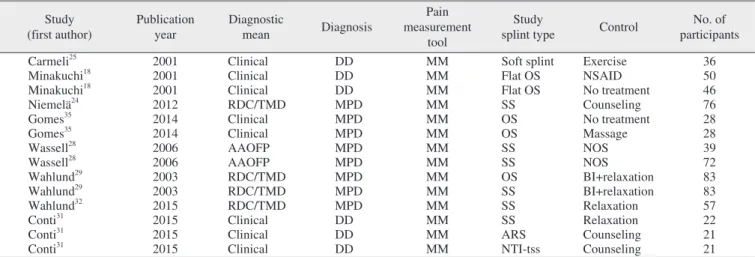
Table 2. Summary of the included studies of short- and long-term maximum mouth opening (MMO) subgroup analysis Study
(first author) Publication
year Diagnostic
mean Diagnosis
Pain measurement
tool
Study
splint type Control No. of participants
Carmeli 25 2001 Clinical DD MM Soft splint Exercise 36
Minakuchi 18 2001 Clinical DD MM Flat OS NSAID 50
Minakuchi 18 2001 Clinical DD MM Flat OS No treatment 46
Niemelä 24 2012 RDC/TMD MPD MM SS Counseling 76
Gomes 35 2014 Clinical MPD MM OS No treatment 28
Gomes 35 2014 Clinical MPD MM OS Massage 28
Wassell 28 2006 AAOFP MPD MM SS NOS 39
Wassell 28 2006 AAOFP MPD MM SS NOS 72
Wahlund 29 2003 RDC/TMD MPD MM OS BI+relaxation 83
Wahlund 29 2003 RDC/TMD MPD MM SS BI+relaxation 83
Wahlund 32 2015 RDC/TMD MPD MM SS Relaxation 57
Conti 31 2015 Clinical DD MM SS Relaxation 22
Conti 31 2015 Clinical DD MM ARS Counseling 21
Conti 31 2015 Clinical DD MM NTI-tss Counseling 21
(DD: disk displacement, MM: inter-incisal opening in millimeters, OS: occlusal splint, NSAID: nonsteroidal antiinflammatory drugs, RDC/TMD:
research diagnostic criteria of temporomandibular dysfunction, MPD: myofascial pain dysfunction, SS: stabilizing splint, BI: brief information, NTI-tss: nociceptive trigeminal inhibition-tension suppression system, AAOFP: American Academy of Orofacial Pain, ARS: anterior reposition splint, NOS: non-occluding splint)
Atef Abdel Hameed Fouda: No evidence on the effectiveness of oral splints for the management of temporomandibular joint dysfunction pain in both short and long-term follow-up system-
atic revie. J Korean Assoc Oral Maxillofac Surg 2020
compared soft and hard splints with self-care.
In all five comparisons, the control group exhibited better results than splints regarding pain reduction.
Total subgroup analysis of the identified studies with total of 344 participants revealed a significant overall effect on pain reduction in favor of the control (SMD 0.23, 95% CI 0.01-0.44, P=0.04, I 2 =0%).
(5) Total analysis
The five included subgroups reveal moderate heterogene- ity between them (I 2 =53.9%). However, no heterogeneity between the individual studies (I 2 =0%) was observed. The overall effect of the meta-analysis with a total of 2,042 par- ticipants revealed a significant difference between the control and splint therapy in favor of the control group (SMD 0.14, 95% CI 0.05-0.23, P=0.002, I 2 =0%).
(6) Dichotomous studies (Fig. 3)
Five studies were included 25,26,28,33,34 . Two studies compared manual mobilization and active exercises 25,33 , two studies compared splints with a palatal non-occluded splint 26,34 , and one study compared splints with no treatment 28 .
Total analysis of the identified studies with a total of 164 participants revealed no significant overall effects of splint therapy on pain reduction (RR 1.12, 95% CI 0.84-1.50, P=0.45, I 2 =0%).
2) Secondary outcome (1) Maximum mouth opening (i) Short-term evaluation
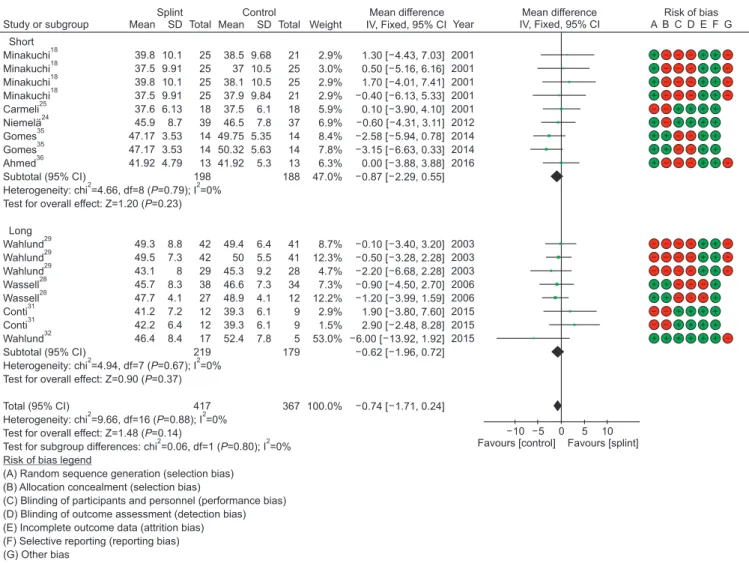
Table 2 presents a summary of the included subgroup stud- ies. Included studies involved a follow-up period up to three months. Subgroups included five studies with nine compari- sons 18,24,25,35,36 . In five comparisons, the splint group exhibited
Study or subgroup IV, Fixed, 95% CI
Mean difference Mean difference Control
Splint
A B C D E F G Risk of bias
Short Minakuchi Minakuchi Minakuchi Minakuchi Carmeli Niemela Gomes Gomes Ahmed Subtotal (95% CI)
Heterogeneity: chi =4.66, df=8 ( =0.79); I =0%
Test for overall effect: Z=1.20 ( =0.23)
Long Wahlund Wahlund Wahlund Wassell Wassell Conti Conti Wahlund Subtotal (95% CI)
Heterogeneity: chi =4.94, df=7 ( =0.67); I =0%
Test for overall effect: Z=0.90 ( =0.37)
Total (95% CI)
Heterogeneity: chi =9.66, df=16 ( =0.88); I =0%
Test for overall effect: Z=1.48 ( =0.14)
Test for subgroup differences: chi =0.06, df=1 ( =0.80); I =0%
(A) Random sequence generation (selection bias) (B) Allocation concealment (selection bias)
(C) Blinding of participants and personnel (performance bias) (D) Blinding of outcome assessment (detection bias) (E) Incomplete outcome data (attrition bias) (F) Selective reporting (reporting bias) (G) Other bias
18 18 18 18 25
24 35 35 36
2 2
29 29 29 28 28 31 31
32
2 2
2 2
2 2