• 검색 결과가 없습니다.

Uterine fibroid shrinkage after short-term use of selective progesterone receptor modulator or gonadotropin-releasing hormone agonist

N/A
N/A
Protected

Academic year: 2022

Share "Uterine fibroid shrinkage after short-term use of selective progesterone receptor modulator or gonadotropin-releasing hormone agonist"

Copied!
5
0
0

로드 중.... (전체 텍스트 보기)

전체 글

(1)

https://doi.org/10.5468/ogs.2017.60.1.69 pISSN 2287-8572 · eISSN 2287-8580

Introduction

Uterine fibroids, also termed leiomyomas or myomas, are the most common benign gynecologic tumors reportedly occur- ring in 20% to 40% of reproductive-age women [1]. About 20% to 50% women who have fibroids have symptoms in- cluding anemia caused by menorrhagia; dysmenorrhea; pres- sure effect resulting the increase rate of urinary frequency, pelvic pain, and constipation [2-4]. Fibroids also increase the chances of subfertility, miscarriage, preterm labor, obstructed labor, and postpartum hemorrhage [3-5]. Symptomatic fi- broids can be treated by surgery, medication, magnetic reso- nance guided-focused ultrasound surgery, and uterine artery

Uterine fibroid shrinkage after short-term use of selective progesterone receptor modulator or gonadotropin-releasing hormone agonist

Min Jin Lee, Bo Seong Yun, Seok Ju Seong, Mi-La Kim, Yong Wook Jung, Mi Kyoung Kim, Hyo Sook Bae, Da Hee Kim, Ji Young Hwang

Department of Obstetrics and Gynecology, CHA Gangnam Medical Center, CHA University, Seoul, Korea

Objective

The aim of this study was to evaluate the effect of short-term use of selective progesterone receptor modulator (SPRM) or gonadotropin-releasing hormone (GnRH) agonist on uterine fibroid shrinkage among Korean women.

Methods

This retrospective study involved 101 women with symptomatic uterine fibroids who received ulipristal acetate (SPRM, n=51) and leuprolide acetate (GnRH agonist, n=50) for 3 months between November 2013 and February 2015. The fibroid volume was measured both before and after treatment using ultrasonography, computed tomography, and magnetic resonance imaging. The outcomes were compared between the SPRM and GnRH agonist groups.

Results

The median rate of fibroid volume reduction after SPRM treatment was 12.4% (IQR -14.5% to 40.5%) which was significantly lower than the reduction rate observed after GnRH agonist treatment (median 34.9%, IQR 14.7% to 48.6%, P=0.004). 19 of 51 (37.3%) patients with SPRM treatment did not show any response of volume shrinkage, while 7 of 50 (14.0%) women with GnRH agonist showed no response (P=0.007).

Conclusion

Short-term SPRM treatment yields lower volume reduction than GnRH agonist treatment in Korean women with symptomatic fibroids. Further large-scale randomized trials are needed to confirm our findings.

Keywords: Gonadotropin-releasing hormone agonist; Leiomyoma; Selective progesterone receptor modulator;

Volume reduction

Articles published in Obstet Gynecol Sci are open-access, distributed under the terms of the Creative Commons Attribution Non-Commercial License (http://creativecommons.

org/licenses/by-nc/3.0/) which permits unrestricted non-commercial use, distribution, and reproduction in any medium, provided the original work is properly cited.

Copyright © 2017 Korean Society of Obstetrics and Gynecology Received: 2015.10.27. Revised: 2016.2.16. Accepted: 2016.2.22.

Corresponding author: Bo Seong Yun

Department of Obstetrics and Gynecology, CHA Gangnam Medical Center, CHA University, 566 Nonhyon-ro, Gangnam-gu, Seoul 06135, Korea

Tel: +82-2-3468-2634 Fax: +82-2-558-1112 E-mail: [email protected]

http://orcid.org/0000-0003-4352-1693

(2)

embolization among other techniques [5-8], of which surgery (myomectomy and hysterectomy) is the standard treatment, while uterus-sparing medical therapy has been used for short- term symptom relief, correction of anemia and fibroid reduc- tion before surgical therapy [9,10].

Many medications have been studied for the treatment of symptomatic fibroids. In particular, gonadotropin-releasing hormone (GnRH) agonist and selective progesterone receptor modulator (SPRM) have been used widely, as they are ap- proved by the United States Food and Drug Administration for their clinically high efficacy [11,12]. GnRH agonist sup- presses estrogen release by down-regulating the hypotha- lamic–pituitary–gonadal axis, thereby inducing amenorrhea and decreasing myoma volume. However, menopausal symp- toms including facial flushing and decreased bone marrow density can occur because of hypoestrogenemia. Because of these disadvantages, interest in another medication, namely SPRM, increased among gynecologist. Many prior studies have shown the anti-proliferative, anti-fibrotic, pro-apoptotic effects of the SPRM, ulipristal acetate on leiomyoma cells.

Ulipristal acetate (PGL4001) is a synthetic steroid derived from 19-norprogesterone and shows tissue specified agonist, antagonist or combined activity in target cells [11,13,14].

PGL4001 Efficacy Assessment in Reduction of Symptoms Due to Uterine Leiomyoma: PEARL studies are recent trials that have demonstrated the efficacy of this agent in, controlling bleeding, decreasing fibroid volume, and reducing discomfort caused by menorrhagia and anemia, for symptomatic leiomy- omas before planned surgery for numerous European white and black women [15-18].

However, to our knowledge, regarding the effect of SPRM on uterine fibroid shrinkage in Asian patients is not available.

Therefore, in the present study, we evaluated the effect of short-term use of SPRM or GnRH agonist on uterine fibroid shrinkage among Korean women.

Materials and methods

This study was approved by the institutional review board of CHA University. We retrospectively reviewed the medical records of 101 patients who received either SPRM or GnRH agonist treatment for 3 months for symptomatic uterine fi- broids between November 2013 and February 2015 at CHA Gangnam Medical Center, CHA University, Seoul, Korea. The

patients who have fibroids have symptoms including menor- rhagia, anemia, dysmenorrhea, vaginal spotting, palpable mass. They had experienced one or many complex symptoms.

The fibroid size in these patients was measured both before and after treatment, by using ultrasonography, computed to- mography, and magnetic resonance imaging. The 51 patients in the SPRM were treated with 5 mg ulipristal acetate (Inisia, Shin Poong Pharm Co., Seoul, Korea) administered orally for 3 months and the 50 patients in the GnRH agonist group re- ceived subcutaneous injections of 3.75 mg leuprolide acetate (Luphere Depot, Daewoong Co., Seoul, Korea) once a month for 3 months.

The two groups were compared for age, parity, body mass index, previous cesarean section history, anemia treatment (iron pill or intravenous, transfusion), and leiomyoma char- acteristic both before and after treatment (largest diameter, total volume of the three largest myomas, total number, and type). Leiomyoma volume (cm

3

) was calculated as width (cm)

×height (cm)×depth (cm)×0.52. Only myomas larger than 3 cm were considered among the three largest myomas. Leio- myoma types were classified as intramural, subserosal, or submucosal. Volume reduction (%) was calculated using the following formula: pretreatment volume (cm

3

)–posttreatment volume (cm

3

)/pretreatment volume (cm

3

). Response was de- fined as any kind of volume reduction after treatment, and no response as no change or volume increase.

All statistical analyses were performed by using the IBM SPSS ver. 20.0 (IBM Corp., Armonk, NY, USA). Data were described using median and interquartile range and were compared between groups by the Mann-Whitney test. For categorical variables, the chi-square test was used. A value of P<0.05 was considered to indicate statistical significance.

Results

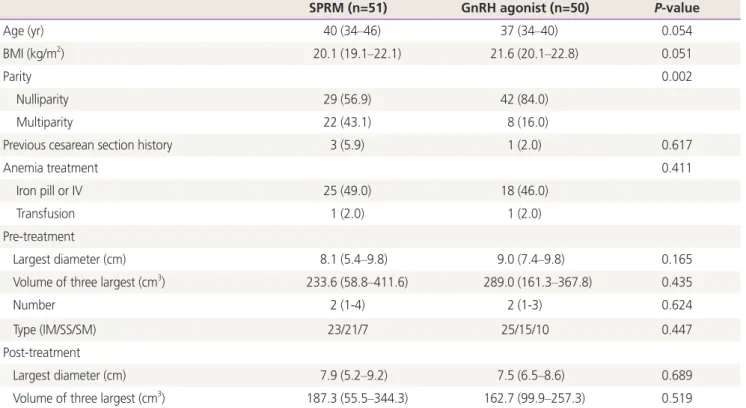
The patient demographic characteristics are presented in

Table 1. The median age was 40 years (IQR 34 to 46) for the

SPRM group and 37 years (IQR 34 to 40) for the GnRH ago-

nist group (P=0.054). Body mass index was 20.1 kg/m

2

(IQR

19.1 to 22.1) and 21.6 kg/m

2

(IQR 20.1 to 22.8) (P=0.051) in

the SPRM and the GnRH agonist groups, respectively. How-

ever, there was the significant difference in parity between

the SPRM and the GnRH agonist groups (P=0.002). With

regard to leiomyoma characteristic before and after treat-

(3)

ment, no significant differences were noted between groups.

The median largest diameter of leiomyoma in pretreatment was 8.1cm (IQR 5.4 to 9.8) in the SPRM group and 9.0 cm (IQR 7.4 to 9.8) in the GnRH agonist group (P=0.165). The median volume of three largest leiomyomas were 233.6 cm

3

(IQR 58.8 to 411.6) in the SPRM group and 289.0 cm

3

(IQR 161.3 to 367.8) in the GnRH agonist group (P=0.435), and the types of leiomyomas did not differ significantly between the groups.

The median rate of fibroid volume reduction was significantly lower in the SRPM group (median 12.4%, IQR -14.5% to 40.5%) than in the GnRH agonist group (median 34.9%, IQR 14.7% to 48.6%, P=0.004). Total 26 of 101 (25.7%) patients

after treatment showed no response to volume reduction and even an increase in volume was shown. Non-respondents were observed significantly more in SPRM group than GnRH agonist group (37.3% vs. 14.0%, P=0.007) (Table 2).

Because there was the difference in parity between two groups, we should check whether the parity was the fac- tor that was directly related to the shrinkage response. Non- respondents were observed in 16 of 71 (22.5%) nullipa- rous women and in 10 of 30 (33.3%) multiparous women (P=0.264), showing no difference in response between nul- liparous and multiparous women.

Table 1. Comparison of patient characteristics between the SPRM and GnRH agonist groups

SPRM (n=51) GnRH agonist (n=50) P-value

Age (yr) 40 (34–46) 37 (34–40) 0.054

BMI (kg/m

2

) 20.1 (19.1–22.1) 21.6 (20.1–22.8) 0.051

Parity 0.002

Nulliparity 29 (56.9) 42 (84.0)

Multiparity 22 (43.1) 8 (16.0)

Previous cesarean section history 3 (5.9) 1 (2.0) 0.617

Anemia treatment 0.411

Iron pill or IV 25 (49.0) 18 (46.0)

Transfusion 1 (2.0) 1 (2.0)

Pre-treatment

Largest diameter (cm) 8.1 (5.4–9.8) 9.0 (7.4–9.8) 0.165

Volume of three largest (cm

3

) 233.6 (58.8–411.6) 289.0 (161.3–367.8) 0.435

Number 2 (1-4) 2 (1-3) 0.624

Type (IM/SS/SM) 23/21/7 25/15/10 0.447

Post-treatment

Largest diameter (cm) 7.9 (5.2–9.2) 7.5 (6.5–8.6) 0.689

Volume of three largest (cm

3

) 187.3 (55.5–344.3) 162.7 (99.9–257.3) 0.519

Data value for categorical variables are given as number (%); Data value for numerical variables are given as median (interquartile range).

SPRM, selective progesterone receptor modulator; GnRH, gonadotropin-releasing hormone; BMI, body mass index; IM, intramural; SS, subse- rosal; SM, submucosal.

Table 2. Rate of fibroid volume reduction after treatment with SPRM or GnRH agonist

SPRM (n=51) GnRH agonist (n=50) P-value

Volume reduction (%) 12.4 (-14.5–40.5) 34.9 (14.7–48.6) 0.004

No response (n=26) 19 (37.3) 7 (14.0) 0.007

Response (n=75) 32 (62.7) 43 (86.0)

Data value for categorical variables are given as number (%); Data value for numerical variables are given as median (interquartile range).

SPRM, selective progesterone receptor modulator; GnRH, gonadotropin-releasing hormone.

(4)

Discussion

While surgery is the main treatment for symptomatic uterine fibroids, short-term medical therapy with agents like GnRH agonist or SPRM is commonly used to improve symptoms and reduce fibroid size before surgery. The median rate of fibroid volume reduction with GnRH agonist therapy reportedly ranges from 42% to 58.3% [17,19]. However, GnRH agonist causes symptoms of hypoestrogenemia such as hot flushes and osteoporosis. Recently, large-scale studies have been con- ducted on SPRM, a progesterone antagonist that specifically acts as agonist to uterine fibroids and has no effects on the normal endometrium, and SPRM has been found to be ef- fective in reducing blood loss as well as fibroid volume. Thus, SPRM has been used widely because the shortcomings of GnRH agonist are overcome with this agent [16-18].

In the present study, contrary to what was expected the rate of fibroid volume reduction was significantly lower in the SPRM group than the GnRH group. While the volume is reduction effects of the GnRH agonist in the present study were similar to those reported in other large-scale studies, the effects of SPRM were very low compared to those in previous works. In SPRM group, there were 37.3% of no respondent patients after treatment regarding to the volume reduction and even the size of leiomyoma was increased. Comparing to the GnRH agonist, this percentage was significantly higher.

So we tried to find the factor that may affect the response on shrinkage of leiomyoma after SPRM treatment. Consequently, there was no significant related factor that affect the treat- ment outcome.

In the GnRH group and the SPRM group, we found that dis- tribution of nulliparity and multiparity was different (Table 1).

We could not rule out the possibility of that differences in dis- tribution could affect the outcome, so we evaluated whether the parity was the direct related factor on fibroid volume reduction. As the result, non-respondents’ rate showed no differences according to the parity, and we found that volume reduction response was depending on the treatment option regardless of parity. Additionally, the maximum and minimum values of changes in fibroid volume after SPRM treatment showed a wide range, from 65.1% to 114.1%, showing great variation, and this results might mean that the effect of SPRM is diverse compared to GnRH agonist.

The main reason for the differences in results between our study and previous works may be differences in the study

population’s ethnicity. Most previous research targeted Cauca- sians, and no specific data is available regarding Asian women thus far. Some studies show that drug can be affected by racial/ethnic differences, especially. As described above, medi- cations might have different effect between Asian and Cauca- sians, and this can also happen in using SPRM. Moreover the formation of myomas and an increase in their size may varies among different ethnic groups [20,21]. Another reason for the difference in results could be the initial median volume of leiomyoma before treatment. The median volume of the three largest leiomyomas was 233.6 cm

3

(IQR 58.8 to 411.6) in the SPRM group and 289.0 cm

3

(IQR 161.3 to 367.8) in the GnRH agonist group in our study, while it was 79.6 cm

3

in the SPRM group and 59.2 cm

3

in the GnRH agonist group in the PEARLII study [14]. As mentioned above, the initial myoma size might cause different result when SPRM is used. However, large- scale studies on the effects of SPRM in different ethnic groups and investigations to identify factors affecting SPRM efficacy are needed to confirm this finding.

The present study has some limitations, such as its retro- spective nature and small sample size. Additionally, different techniques including ultrasonography, computed tomography and magnetic resonance imaging were used to measure the uterine fibroids volume. Nonetheless, this study is important because it is the first attempt to demonstrate the clinical ef- fects of SPRM in Korean patients.

In conclusion, short-term SPRM treatment seems to result in lower shrinkage than GnRH agonist treatment in Korean women with symptomatic fibroids.

Conflict of interest

No potential conflict of interest relevant to this article was re- ported.

References

1. Wallach EE, Vlahos NF. Uterine myomas: an overview of development, clinical features, and management. Obstet Gynecol 2004;104:393-406.

2. Buttram VC Jr, Reiter RC. Uterine leiomyomata: etiol-

ogy, symptomatology, and management. Fertil Steril

1981;36:433-45.

(5)

3. Donnez J, Jadoul P. What are the implications of myo- mas on fertility? A need for a debate? Hum Reprod 2002;17:1424-30.

4. Practice Committee of American Society for Reproduc- tive Medicine in collaboration with Society of Reproduc- tive Surgeons. Myomas and reproductive function. Fertil Steril 2008;90(5 Suppl):S125-30.

5. Talaulikar VS, Manyonda IT. Ulipristal acetate: a novel option for the medical management of symptomatic uterine fibroids. Adv Ther 2012;29:655-63.

6. McCarthy-Keith DM, Armstrong AY. Innovations in uter- ine fibroid therapy. Therapy 2011;8:189-200.

7. Tempany CM, Stewart EA, McDannold N, Quade BJ, Jolesz FA, Hynynen K. MR imaging-guided focused ultra- sound surgery of uterine leiomyomas: a feasibility study.

Radiology 2003;226:897-905.

8. Tropeano G, Amoroso S, Scambia G. Non-surgical management of uterine fibroids. Hum Reprod Update 2008;14:259-74.

9. Campo S, Garcea N. Laparoscopic myomectomy in premenopausal women with and without preoperative treatment using gonadotrophin-releasing hormone ana- logues. Hum Reprod 1999;14:44-8.

10. Lethaby A, Vollenhoven B, Sowter M. Pre-operative GnRH analogue therapy before hysterectomy or myo- mectomy for uterine fibroids. Cochrane Database Syst Rev 2001;(2):CD000547.

11. Chwalisz K, Perez MC, Demanno D, Winkel C, Schubert G, Elger W. Selective progesterone receptor modulator development and use in the treatment of leiomyomata and endometriosis. Endocr Rev 2005;26:423-38.

12. Islam MS, Protic O, Giannubilo SR, Toti P, Tranquilli AL, Petraglia F, et al. Uterine leiomyoma: available medical treatments and new possible therapeutic options. J Clin

Endocrinol Metab 2013;98:921-34.

13. Blithe DL, Nieman LK, Blye RP, Stratton P, Passaro M.

Development of the selective progesterone receptor modulator CDB-2914 for clinical indications. Steroids 2003;68:1013-7.

14. Croxtall JD. Ulipristal acetate: in uterine fibroids. Drugs 2012;72:1075-85.

15. Donnez J, Hudecek R, Donnez O, Matule D, Arhendt HJ, Zatik J, et al. Efficacy and safety of repeated use of ulipristal acetate in uterine fibroids. Fertil Steril 2015;103:519-27.e3.

16. Donnez J, Tatarchuk TF, Bouchard P, Puscasiu L, Zakha- renko NF, Ivanova T, et al. Ulipristal acetate versus pla- cebo for fibroid treatment before surgery. N Engl J Med 2012;366:409-20.

17. Donnez J, Tomaszewski J, Vazquez F, Bouchard P, Lemieszczuk B, Baro F, et al. Ulipristal acetate versus leuprolide acetate for uterine fibroids. N Engl J Med 2012;366:421-32.

18. Donnez J, Vazquez F, Tomaszewski J, Nouri K, Bouchard P, Fauser BC, et al. Long-term treatment of uterine fibroids with ulipristal acetate. Fertil Steril 2014;101:1565-73.

e1-18.

19. Mavrelos D, Ben-Nagi J, Davies A, Lee C, Salim R, Jurkovic D. The value of pre-operative treatment with GnRH analogues in women with submucous fibroids: a double-blind, placebo-controlled randomized trial. Hum Reprod 2010;25:2264-9.

20. Parker WH. Etiology, symptomatology, and diagnosis of uterine myomas. Fertil Steril 2007;87:725-36.

21. Ramamoorthy A, Pacanowski MA, Bull J, Zhang L. Ra- cial/ethnic differences in drug disposition and response:

review of recently approved drugs. Clin Pharmacol Ther

2015;97:263-73.

수치

Table 1. Comparison of patient characteristics between the SPRM and GnRH agonist groups

참조

관련 문서

In this study, a new immunocontraceptive vaccine composed of six tandem copies of gonadotropin-releasing hormone (GnRH) fused to rat granulocyte-macrophage

In this study as a first study to report the combination treatment of a GnRH agonist for 6 months plus 4 week du- ration of 10 romatise inhibitor in near menopause cases the result

The aim of the study was to evaluate the impact of body mass index (BMI) on luteinizing hormone (LH) secretion to gonadotro- pin-releasing hormone (GnRH) stimulation test in

Peng C, Fan NC, Ligier M, Vaananen J, Leung PCK Expression and regulation of gonadotropin-releasing hormone (GnRH) and GnRH receptor messenger ribonucleic acids in

This study was aimed to evaluate the efficacy of a single administration of long-act- ing gonadotrophin-releasing hormone agonist (GnRHa) as compared with daily administrations

Because prostate cancer shows androgen dependency in the early stages 1 , andro- gen-deprivation therapy with gonadotropin-releasing hor- mone (GnRH) agonists is the most