Received: February 6, 2018 Revised: March 19, 2018 Accepted: April 3, 2018
Address for Correspondence: Sanam Moradan, Department of Obstetrics and Gynecology, Abnormal Uterine Bleeding Research Center, Semnan University of Medical Sciences, Semnan, Iran
Tel: +98-091-2131-8046, Fax: +98-009-823-1446-1580, E-mail: [email protected]
Original Article
pISSN: 2288-6478, eISSN: 2288-6761 https://doi.org/10.6118/jmm.2018.24.1.62 Journal of Menopausal Medicine 2018;24:62-66
J MM
Introduction
Uterine fibroids are very common benign tumors during reproductive age group and usually are without symptoms.1,2 They have a significant effect on the quality of life (QOL) by the presence of symptom such as abnormal uterine bleed- ing - pelvic pain, urinary and gastrointestinal symptoms.2 Uterine lipoleiomyoma are rare, benign variant of uterine
fibroids and clinically similar to fibroids.3
Using surgical treatment for uterine fibroids such as hys- terectomy is the worst choice especially in regard to the effect on the QOL.1 However, magnetic resonance-guided focused ultrasound surgery (MRgFUS) in some cases is a suitable choice for treatment of intramural fibroids. In this procedure fibroid volume is decreased & the fibroid protrude toward the endometrial cavity, then hystroscopic myomec-
Gonadotropin-releasing Hormone Agonist Plus Aromatase Inhibitor in the Treatment of Uterine Leiomyoma in Near Menopause Patient: A Case Series Study
Sanam Moradan
Department of Obstetrics and Gynecology, Abnormal Uterine Bleeding Research Center, Semnan University of Medical Sciences, Semnan, Iran
Objectives: There are many drugs for of symptomatic fibroids. Gonadotropin-releasing hormone (GnRH) agonists are the well known drugs. Also, aromatase inhibitors are effective. All published studies surveyed the effect of one of these two drugs. In this study as the first study decided to evaluate the effectiveness of the combination of GnRH agonists + aromatise inhibitor on the uterine fibroids.
Methods: A cross-sectional prospective case series study was performed on 10 known cases of uterine fibroids late perimeno- pause, at least 3 myomas >5 cm, abnormal uterine bleeding and anemia due to fibroids, candidate for hysterectomy, no tendency to surgery. A single dose of Diphereline 11.25 mg, SR plus 2.5 mg of Letrozole daily for 4 weeks with add-back therapy + calcium carbonate were used. The second dose of Diphereline 11.25 mg, SR was used 3 months after the first injection. The patients were followed until 3 years.
Results: The mean age of the study group was 49.90 ± 1.66. The mean fibroid size reduced from 15.05 ± 57.20 cm to 13.56 ± 39.39 cm (P = 0.012) and fibroid volume reduced from 72.78 ± 110.6 to 50.96 ± 64.2 (P = 0.116). There was no signification chang- es in the serum level of hormones at the end of six months. Eight cases were menopause at the end of the study and hypoestro- genism symptoms did not happened in none of the cases until the end of 24 months. Except in one case, there was no need to do surgery on others.
Conclusions: Combination of Diphereline + Letrozole probably could prevent surgery in cases that have multiple fibroids, peri- menopause, anemic and candidate for surgery. (J Menopausal Med 2018;24:62-66)
Key Words: Aromatase inhibitors · Gonadotropin-releasing hormone · Leiomyoma
Sanam Moradan. GnRH Agonist Plus Aromatase Inhibitor
tomy could be a good choice.4
Various drugs are available on the treatment of symp- tomatic fibroids. These drugs may not be able to eliminate the fibroids but may reduce their related symptoms.5 Go- nadotropin-releasing hormone (GnRH) agonists are one of the well-known drugs that used in the treatment of uterine fibroids by reducing of bleeding and recovery of hemoglobin.
GnRH agonists are effective in the treatment of uterine fi- broids. Letrozole is an antiestrogen that is effective on the volume of fibroids similar to GnRH agonists.5 One study reported the effect of Letrozole on the proliferation and apoptosis of cultured fibroids cells. The result of the study showed that Letrozole could inhibit the cell proliferation and increase apoptosis.6
Add-back therapy for prevention of hypoestrogenism symptoms such as hot flush, vaginal dryness and night sweat is recommend in cases who underwent treatment with GnRH agonist and tibolone has been reported as a good choice for add-back therapy.7
Letrozole is a suitable choice for decreasing of fibroids size and heavy menstrual bleeding. It has no adverse effect on the bone mineral density (BMD).8 The serum hormonal levels of estradiole, progesterone, luteinizing hormone (LH), follicle-stimulating hormone (FSH), and testosterone do not change with Letrozole use. The main side effects of Letro- zole are nausea and vomiting that are self-limiting.9
Materials and Methods
A cross-sectional prospective case series study was per- formed on 10 known cases of uterine fibroid from April 2011 to December 2014 in University hospital Amir, Semnan, Iran. Written informed consent was obtained from all par- ticipated patients.
The inclusion criteria were late perimenopause age (47-54 years old), presence of at least 3 uterine fibroids size bigger (intramural or submucosal) than 5 cm, presence of abnormal uterine bleeding and anemia due to fibroid (mean hemato- crit, 26/47 ± 3/93) candidate for hysterectomy, no tendency to do surgery.
The exclusion criteria were acute severe vaginal bleeding, unstable hemodynamic status and presence of hypoestro-
genism symptoms (hot flush, vaginal dryness, and night sweat), decrease BMD in bone densitometry and any under- ling chronic disease.
The hormonal study consists of estradiole, progesterone, LH, FSH, and total testosterone and evaluation of serum calcium and phosphorous level was evaluated at the begin- ning of study and every 6 weeks until 6 months duration.
Then a single dose of ampoule Diphereline 11.25 mg SR (Ipsen Pharma, Paris, France) plus 2.5 mg tablet of Letro- zole (Iran hormone) daily for 4 weeks was prescribed. Add- back therapy with conjugated estrogen tablet 0.625 mg (Ab- uraihan Co., Tehran, Iran) plus medroxyprogesterone tablet (Aburaihan Co.) 2.5 mg daily +1000 mg calcium carbonate tablet (Tehran Chemie Co., Tehran, Iran) were added too.
All patient also received ferrous sulfate tablet (Maad Phar- maceutical Co., Tehran, Iran) twice daily until to improve- ment of the anemia (mean hematocrit, 36/81 ± 1/42).
The patients were followed every 6 week unit to 6 months and every 3 months until 3 years. Their medications as treatment continued until 6 months. So, every patient re- ceived 4 weeks Letrozole tab +2 dose of amp Diphereline every 3 months the add-back therapy + calcium carbonate also continued unit the end of 6 months. They were followed 2.5 years after the end time of their treatment. In every visit sonography by the same sonologist was done for evalu- ation of myoma size and uterus and ovaries.
Statistical analyses were performed using independent- samples student t-test and SPSS version 20 (SPSS Inc., Chicago, IL, USA). The P-value less than 0.05 were consid- ered statistically significant.
Results
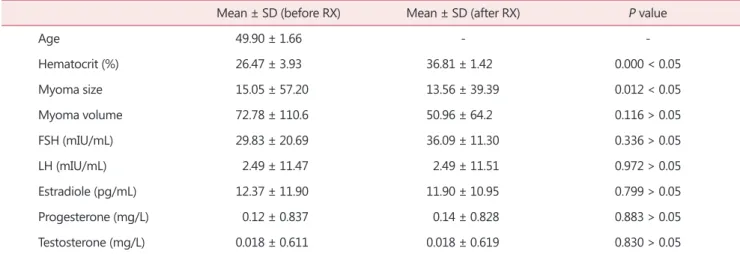
The mean age of the study group was 49.90 ± 1.66. The youngest case was 47 and the oldest was 53 years old. The mean fibroid size reduced from 15.05 ± 57.20 cm to 13.56
± 39.39 cm (P = 0.012). The mean fibroid volume reduced from 72.78 ± 110.6 to 50.96 ± 64.2 (P = 0.116) (Table 1).
There were no significant changes in the serum level of hormones at the end of six months (Table 1).
One case stops to use of Letrozole tablet after 2 week du- ration of use. She gets nervous with use of Letrozole tablet.
Journal of Menopausal Medicine 2018;24:62-66
J MM
This case also did not inject her second dose of Diphere- line and 5 months from the beginning of her medication was underwent hysterectomy because of persistent vaginal bleeding. So, nervousness happened in one case (10%) fol- lowing using of Letrozole (Table 2).
The rest nine cases to use their medication completely and were followed until 3 years.
Eight cases were menopause at the end of the study and only one case who was 51 years old at this time had some on 8 off vaginal bleeding that was mild and the patient had a normal live with sometimes use of Iron supplement. Her hormonal assay (FSH Level) showed that she is not meno- pause at this time.
Hypoestrogenism symptoms (hot flush-vaginal dryness, night sweat) did not happened in none of the cases until the end of 24 months (Table 2) but after that 3 cases (30%) had the hot flush and 2 cases (20%) had vaginal dryness near to natural menopause.
One case was 51 years old in her first visit and she had the largest fibroids among all fibroid of 10 cases (140 ×
100 × 80 mm) and fortunately, she had a good response to medication 8 natural menopause happed after 3 years with- out any complication.
Discussion
In this study combination treatment of Diphereline + Le- trozole was so effective in the treatment of multiple, symp- tomatic fibroids that none of the cases who used the drugs completely, had no need to do surgery. The surgery was done only in one case that she stops her medication.
Parsanezhad et al.10 study on 70 case with single uterine fibroids showed successfully reduced in uterine fibroid vol- ume with use of the Letrozole tab 2.5 mg daily for 12 week duration. Letrozle was more effective to decrease the total fibroid volume in comparison to triptorelin.
In this case series study the combination of Diphereline for 6 months treatment and Letrozole 2.5 tabs daily for 4 weeks was used in cases that were near to menopause and had a good success rate in treatment. Because to use of add-back therapy in this study no cases had hypoestrogen- ism symptoms at the end of 6 month treatment.
Koskas and Derrien11 study showed that Letrozole is as effective as GnRH agonists in reduction of fibroid size with less hot flush and the use of GnRH agonist is effective to decrease of uterine bleeding and correction of hemoglobin Table 1. The mean age, myoma size, volume, and hormonal levels of the study group
Mean ± SD (before RX) Mean ± SD (after RX) P value
Age 49.90 ± 1.66 - -
Hematocrit (%) 26.47 ± 3.93 36.81 ± 1.42 0.000 < 0.05
Myoma size 15.05 ± 57.20 13.56 ± 39.39 0.012 < 0.05
Myoma volume 72.78 ± 110.6 50.96 ± 64.2 0.116 > 0.05
FSH (mIU/mL) 29.83 ± 20.69 36.09 ± 11.30 0.336 > 0.05
LH (mIU/mL) 2.49 ± 11.47 2.49 ± 11.51 0.972 > 0.05
Estradiole (pg/mL) 12.37 ± 11.90 11.90 ± 10.95 0.799 > 0.05
Progesterone (mg/L) 0.12 ± 0.837 0.14 ± 0.828 0.883 > 0.05
Testosterone (mg/L) 0.018 ± 0.611 0.018 ± 0.619 0.830 > 0.05
FSH: follicle-stimulating hormone, LH: luteinizing hormone, SD: standard deviation, RX: treatment
Table 2. Side effects of medicine during 2 years treatment
Side effects n (%)
Nervousness 1 (10.0%)
Hot flush/Vaginal dryness/Night sweat 0 (0.0%)
No side effect 9 (90.0%)
Journal of Menopausal Medicine 2018;24:62-66 Sanam Moradan. GnRH Agonist Plus Aromatase Inhibitor
level, also add-back therapy with tibolone seems to reduce the hypoestrogenism symptoms of GnRH agonists.
In this study combination therapy was used because the patients had several significant size fibroids, anemia because repeated uterine bleeding, candidate for hysterectomy, wish to avoid surgical intervention and were near to menopause age. Add-back therapy for prevention of hypoestrogenism symptoms also used and fortunately were effective to pre- vent hypoestrogenic symptoms until 2 years.
Koskas and Derrien11 study reported that surgical tech- nique in cases of uterine fibroids are traditional and high recurrence rates and adhesion formation (pain-infertility) are the complication of surgical intervention. Both clinical trial and in vitro investigations have shown that aromatase inhibitor might reduce the growth of fibroid and so to pre- vent surgical intervention.
In our study also combination treatment of Diphereline plus Letrozole inhibits the growth of fibroid and was the success for to prevent to do a surgical intervention in nine cases.
Duhan et al.9 study reported that use of Letrozole 2.5 mg daily in 12 week duration in the treatment of fibroid had no signification effect on the serum estradiole, progesterone, LH, FSH, and lipid profile. Also, the main adverse effect of Letrozole was hot flush and nausea.
In this study also the serum level of estradiole, progester- one, LH, FSH, and testosterone had no significant change.
The only adverse effect of treatment was nausea 8 getting nervous in first 2 weeks of the beginning of medication.
The effectiveness of aromatase inhibitors in the treat- ment of fibroid is reported in several studies. They might be effective as monotherapy12 on the intravenous fibroid13 and atypical fibroid.14 An astrozole can reduce the fibroid volume, pain, and menstrual bleeding due to the fibroid. GnRH ago- nist is, also can reduce bleeding and recover the hemoglobin level in cases of fibroid.5
In this study as a first study to report the combination treatment of a GnRH agonist for 6 months plus 4 week du- ration of 10 romatise inhibitor in near menopause cases the result of study showed that with adding of add-back thera- py plus calcium carbonate near 90% of cases were success- fully treated without any side effect and thereby eliminating to need to do surgical intervention.
Acknowledgement
I acknowledge the members of the research committee of Semnan University of medical science for their support in this research.
Conflict of Interest
No potential conflict of interest relevant to this article was reported.
References
1. Parker WH. Uterine fibroids. In: Berek JS, Novak E, edi- tors. Berek & Novak’s gynecology. 15th ed. Philadelphiam PA: Lippincott Williams & Wilkins; 2015. pp.438-69.
2. Song H, Lu D, Navaratnam K, Shi G. Aromatase inhibi- tors for uterine fibroids. Cochrane Database Syst Rev 2013:
Cd009505.
3. Oh SR, Cho YJ, Han M, Bae JW, Park JW, Rha SH. Uter- ine lipoleiomyoma in peri or postmenopausal women. J Menopausal Med 2015; 21: 165-70.
4. Jeong JH, Hong GP, Kim YR, Hong DG, Ha JE, Yeom JI, et al. Expulsion of fibroids to the endometrial cavity after magnetic resonance imaging-guided high intensity focused ultrasound surgery (MRgFUS) treatment of intramural uterine fibroids. J Menopausal Med 2016; 22: 139-45.
5. Koskas M, Chabbert-Buffet N, Douvier S, Huchon C, Pa- ganelli E, Derrien J. Role of medical treatment for symp- tomatic leiomyoma management in premenopausal women.
J Gynecol Obstet Biol Reprod (Paris) 2011; 40: 858-74.
6. Han M, Kim JY, Park JE, Kim JM, Lee KS. Effects of le- trozole on proliferation and apoptosis in cultured leiomyoma cells treated with prostaglandin E(2). Eur J Obstet Gynecol Reprod Biol 2008; 138: 83-8.
7. Gocmen A, Kara IH, Karaca M. The effects of add-back therapy with tibolone on myoma uteri. Clin Exp Obstet Gy- necol 2002; 29: 222-4.
8. Gurates B, Parmaksiz C, Kilic G, Celik H, Kumru S, Sim- sek M. Treatment of symptomatic uterine leiomyoma with letrozole. Reprod Biomed Online 2008; 17: 569-74.
9. Duhan N, Madaan S, Sen J. Role of the aromatase inhibi- tor letrozole in the management of uterine leiomyomas in premenopausal women. Eur J Obstet Gynecol Reprod Biol 2013; 171: 329-32.
Journal of Menopausal Medicine 2018;24:62-66
J MM
10. Parsanezhad ME, Azmoon M, Alborzi S, Rajaeefard A, Za- rei A, Kazerooni T, et al. A randomized, controlled clinical trial comparing the effects of aromatase inhibitor (letrozole) and gonadotropin-releasing hormone agonist (triptorelin) on uterine leiomyoma volume and hormonal status. Fertil Steril 2010; 93: 192-8.
11. Koskas M, Derrien J. Medical treatment of symptomatic uterine leiomyomata in premenopausal woman. Presse Med 2013; 42: 1122-6.
12. Ferrero S, Venturini PL, Remorgida V. Letrozole monother-
apy in the treatment of uterine myomas. Fertil Steril 2010;
93: e31; author reply e2.
13. Biri A, Korucuoglu U, Zumrutbas N, Tiras B, Guner H. In- travenous leiomyomatosis treated with aromatase inhibitor therapy. Int J Gynaecol Obstet 2008; 101: 299-300.
14. Yoon G, Kim TJ, Sung CO, Choi CH, Lee JW, Lee JH, et al. Benign metastasizing leiomyoma with multiple lymph node metastasis: a case report. Cancer Res Treat 2011; 43:
131-3.