http://dx.doi.org/10.5468/ogs.2014.57.6.478 pISSN 2287-8572 · eISSN 2287-8580
Introduction
The reported incidence of cancers among women aged 15 to 34 years is reported to be 106 per 100,000 women in Re- public of Korea. They are 5.4 per 100,000 women for cervical cancer, 3.1 per 100,000 women for ovarian cancer [1]. When detected in early stages, most gynecologic cancers have a good cure rate. Gynecologic oncologists are concerned not only with provision of a disease-free state but also with preser- vation of an optimum quality of life after cancer treatment as development in treatment regimens and supportive care strat- egies. Ovarian preservation has become a major issue to gyne- cologic oncology in premenopausal patients, due to both the increasing age at childbearing and the increasing incidence of gynecologic cancer in young patients. These days, possibility of preservation of fertility primarily depends on the extent and
type of cancer in young patients with gynecologic cancer. Cur- rent options for preservation of fertility in gynecological cancer patients before the initiation of cancer-directed therapy are ovarian suppression and cryopreservation of embryo or un-
The feasibility and efficacy of gonadotropin-releasing
hormone agonists for prevention of chemotherapy induced ovarian failure in patient with gynecological malignancies
Chan-Yong Park, Sun-Young Jung, Kwang-Beom Lee, Sun-Hye Yang
Department of Obstetrics and Gynecology, Gil Hospital, Gachon University of Medicine and Science, Incheon, Korea
Objective
To assess the effects of a gonadotropin-releasing hormone agonist (GnRH-a) depot (Leuprolide acetate) in women with gynecologic cancer receiving chemotherapy while taking a continuous add-back on the prevention of premature ovarian failure.
Methods
Fourteen premenopausal patients with gynecological malignancies who had undergone conservation of ovaries surgery received a GnRH-a depot plus add-back until chemotherapy was completed. Four weeks thereafter, a hormonal profile (follicle stimulating hormone) was measured.
Results
The mean follicle stimulating hormone level was 15.8 IU/L. All patients exhibited a restoration of ovarian failure during follow-up. One patient became pregnant during the follow-up period.
Conclusion
In the short term, GnRH-a appears to protect ovarian function and ability to achieve pregnancy following chemotherapy. The result of our study needs further elucidation in a large randomized controlled trial.
Keywords: Adjuvant chemotherapy; Fertility preservation; Gonadotropin releasing hormone agonist; Ovarian
neoplasms; Uterine cervical neoplasms
Received: 2014.3.28. Revised: 2014.5.21. Accepted: 2014.6.13.
Corresponding author: Kwang-Beom Lee
Department of Obstetrics and Gynecology, Gil Hospital, 21 Namdong-daero 774beon-gil, Namdong-gu, Incheon 405-760, Korea
Tel: +82-32-460-3254 Fax: +82-32-460-3290 E-mail: [email protected]
Articles published in Obstet Gynecol Sci are open-access, distributed under the terms of the Creative Commons Attribution Non-Commercial License (http://creativecommons.
org/licenses/by-nc/3.0/) which permits unrestricted non-commercial use, distribution, and reproduction in any medium, provided the original work is properly cited.
Copyright © 2014 Korean Society of Obstetrics and Gynecology
fertilized oocytes [2]. The aim of this retrospective study was to evaluate the efficacy of gonadotropin-releasing hormone agonist (GnRH-a) in preventing development of ovarian failure in premenopausal gynecological cancer patients undergoing adjuvant chemotherapy.
Materials and methods
This retrospective study consisted of uterine cervical cancer and ovary cancer patients who were treated between March 2008 and June 2011 at Gachon University Gil Medical Center (GMC) in Incheon, Republic of Korea. The clinical and patho- logic records were reviewed for all patients who underwent conservation of ovary or ovaries. The data were obtained using electronic patient records, and the following parameters were collected: histology, age, date of diagnosis, chemotherapy/add- back therapy/GnRH-a regimen, number of cycles, follicle stimu- lating hormone (FSH) level, date of last follow-up. All treatment was given at the GMC, and electronic records of the GMC pharmacy were used to verify the chemotherapy/add-back therapy/GnRH-a regimen, dose, and number of cycles admin- istered. Leuprolide acetate depot 3.75 mg (Ruprin, CJ, Seoul, Korea) was administered subcutaneously at least 1 week before the first cycle of chemotherapy and then every 4 week for the duration of chemotherapy. The last administration of Leuprolide acetate was given before the last cycle of chemotherapy.
Taxane and platinum based compounds are common agents in chemotherapy regimen of gynecologic cancer. There were three kinds of dose regimen used in this study population, as follows:
BEP: Belomycin 15 mg/m
2, Etoposide 100 mg/m
2, Cisplatin 20 mg/m
2TP: Paclitaxel 175 mg/m
2, Carboplatin target value AUC 5 CBDCA: Carboplatin target value AUC 5
FSH level was used as the biochemical marker of menopausal status and evaluated 4 weeks after the last cycle of chemo- therapy. A FSH level above 40 IU/L indicated a post-menopausal status. Menstrual activity was recorded after chemotherapy in uterine preservation cases. The success of the experimental treatment was defined by the resumption of menstrual activity within 12 months after the last cycle of chemotherapy or by the occurrence of a FSH level ≤40 IU/L within 12 months after the last cycle of chemotherapy. During treatment a continu- ous estrogen or combined progestin preparation as add-back was administered every day. The add-back consisted of 1.03
mg 17b-estradiol and 0.5 mg norethisterone acetate (Activelle, NovoNordisk, Seoul, Korea) in uterine conservation cases or es- tradiol (Progynova, Bayer, Seoul, Korea) in hysterectomy cases.
Treatment with the GnRH-a plus add-back was continued until the chemotherapy was completed.
Results
In our institution, there were 221 women (134 cervical cancer, 87 ovarian cancer) who had undergone radical surgery. Of these, 14 premenopausal women (3 ovarian cancer, 11 cervi- cal cancer) received a GnRH-a for protection from chemother- apy induced ovarian failure and then they had the follow-up by single surgeon. The mean age was 31 years (range, 20–44 years), and the mean parity was 1.2±1.1. One of the fourteen patients had both ovaries preserved, and the rest had unilat- eral ovary. Eleven cervical cancer patients who had undergone hysterectomy received estradiol (Progynova) for add-back ther- apy. Three ovarian cancer patients who received estradiol and norethisterone acetate (Activelle) resumed menstruation. Dur- ing 116 days, the mean duration of chemotherapy, 4 to 6 cy- cles of depot injection of GnRH-a were offered as the patients received 4 or 6 chemotherapy. Three protocols were used: BEP in ovarian cancer and CBDCA or CBDCA plus taxane in cervi- cal cancer. The mean FSH level was 15.8 IU/L. Only one of the 14 patients in the study group experienced premature ovarian failure (POF) with a FSH level >40 IU/L and temporary vasomo- tor symptoms. After three months of estrogen therapy, FSH level was 6.49 IU/L and vasomotor symptoms were relieved.
No patient developed POF within 1,306 days, the mean du- ration of follow-up. Although two patients became lost to follow-up, they had continued over 3 years of follow-up. One patient became pregnant following chemotherapy (Table 1).
Discussion
The strength of this study is that the study group maintained
under clinical observation by single surgeon in single medical
center, on leuprolide acetate activity in preventing chemother-
apy-induced menopause. All patients exhibited a restoration
of ovarian suppression after approximately 3.6 years of follow-
up. Chemotherapy-related amenorrhea rates have been
demonstrated to vary from 30% to 76% in several clinical
studies, depending on the average age of the cohort and the
used chemotherapeutic protocol [3-8]. Although taxane and platinum based compounds are common chemotherapeutic agents in gynecologic cancer, only cisplantin has been studied for its platinum-induced ovarian toxicity. In an in vitro human tissue model study, histological and immunohistochemical changes with primordial follicles destruction of ovarian injury induced by cisplatin was depicted. However, there is insuf- ficient or only inconsistent evidence for the potential gonado- toxicity of taxane [9]. Fertility preservation before treatment is simple for male: banking of sperm. On the other hand, it is far more complicated in female since various factors such as age
of patient, type of treatment, diagnosis, whether she has a partner, the time available and the high potential that gyneco- logic cancer has metastasized to her ovaries, must be taken in consideration [10].
Current options for preservation of fertility in gynecological cancer patients before the initiation of cancer-directed therapy are ovarian suppression or cryopreservation of embryos or unfertilized oocytes. The most effective and established means of preserving fertility in female cancer patient is embryo or oo- cyte cryopreservation. However, because of the requirements for scheduling and procedures, these interventions may entail a delay in cancer treatment. Besides, there is a necessity for a male partner or sperm donor to create an embryo, which can arouse ethical considerations. Alternatively, GnRH-a is a useful strategy for prevention of POF in case of extensive comorbidi- ties associated with POF, compounded by poor compliance with or contraindications for hormonal therapy.
There are several possible mechanisms through which GnRH-a may protect the ovary during chemotherapy. It is well known that prepubertal children receiving chemotherapy are more likely to maintain gonadal function than young adults. This allows for a hypothesis that inhibition of the hy- pothalamic-pituitary axis by GnRH-a may bring out quiescent gonads, simulating the prepubertal state, and thus rendering the gonads less susceptible to cytotoxic treatment [11,12].
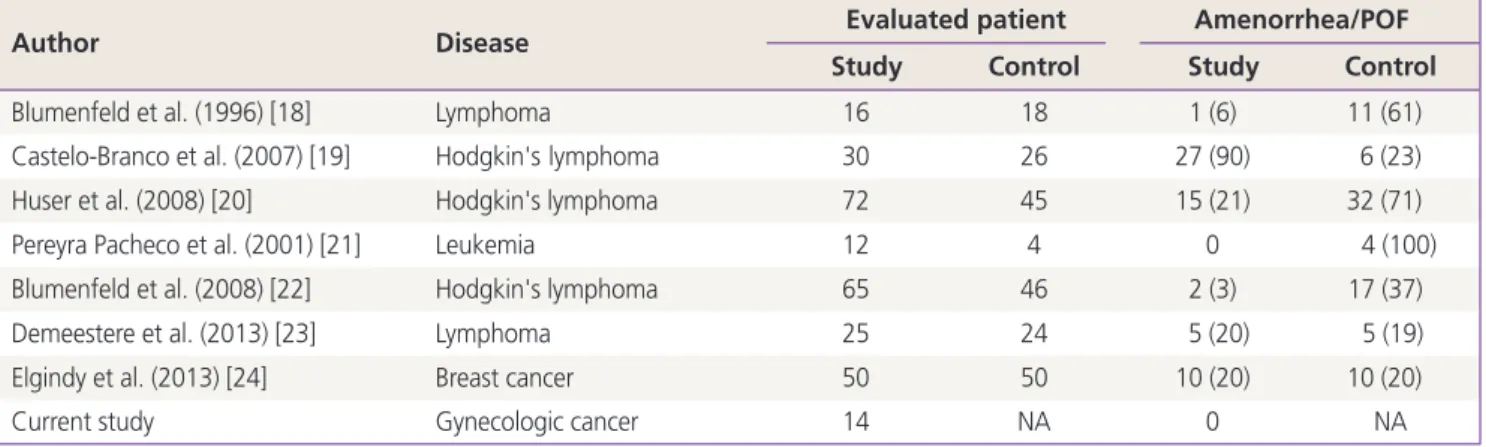
Alternatively, the direct influence of GnRH-a on the ovary and reduced blood flow to the ovary may suppress ovarian func- tion, thus rendering the gonads less susceptible to cytotoxic treatment [13]. The effectiveness of a GnRH-a during chemo- therapy to preserve ovarian function was first demonstrated in rodents and monkeys in the 1980s [14-16]. However, ovarian suppression through GnRH-a or antagonist treatment during chemotherapy is highly controversial as a method to maintain fertility [17]. Blumenfeld et al. [18] first described the protec- tive effect of GnRH-a on ovarian function when administered concomitantly with chemotherapy, and our study, as well as other previous studies, confirms these results [19-21]. In a cohort of 111 patients with lymphoma, 3.1% and 37% of pa- tients developed POF in the GnRH-a and retrospective control groups, respectively [22] (Table 2).
In contrast, Demeestere et al. [23] showed that there was no significant difference in chemotherapy induced POF after 1 year of follow-up between GnRH-a treated patient versus control group in Hodgkin or non-Hodgkin lymphoma. A recent study demonstrated no benefit of using GnRH-a in patients with breast cancer receiving cyclophosphamide-based chemotherapy
Table 1. Patient’s characteristicsCharacteristics Values
Age (yr) 31±6.5 (20–44)
Parity 1.2±1.1 (0–3)
Diagnosis
Ovarian cancer IC 3/14 (21.4)
Cervical cancer IB1 6/14 (42.9)
Cervical cancer IB2 5/14 (35.7)
Conservation of ovaries no.
1 13/14 (92.9)
2 1/14 (7.1)
Hysterectomy 11/14 (78.6)
Chemotherapy cycle
4 3/14 (21.4)
6 11/14 (78.6)
Duration (day) 116±14.9
Regimen
BEP 3/14 (21.4)
Taxane + CBDCA 7/14 (50.0)
CBDCA 4/14 (28.6)
Follicle stimulating hormone 15.8±4.6
≤40 IU/L 13/14 (92.9)
>40 IU/L 1/14 (7.1)
Pregnancy 1/14 (7.1)
Gonadotropin-releasing hormone agonist cycle
4 3/14 (21.4)
6 11/14 (78.6)
Add-back therapy
Estrogen and progestin 3/14 (21.4)
Estrogen 11/14 (78.6)
Follow-up duration (day) 1,306±369.1
(859–1,884) Values are presented as number (%).
BEP, belomycin, etoposide, cisplatin; CBDCA, carboplatin.
[24]. In this study, no differences were observed in menstrua- tion resumption rates and hormonal and ultrasound markers of fertility 12 months after termination of chemotherapy between GnRH-a treated patients versus the control group. Studies evaluating the efficacy of GnRH-a in humans have been limited by the lack of prospective data specifically addressing women of reproductive age who are at highest risk of infertility from chemotherapy, and GnRH-a are especially understudied in ado- lescents. Moreover, most human studies on GnRH-a have been small, uncontrolled, and/or retrospective [17]. It is hampered by several factors that estimation of risk of ovarian damage from chemotherapy for patients with different types of cancers.
Historically ovarian function was assessed with nonobjective parameters such as menstrual history, which is not checkable in cases of hysterectomy, or vasomotor symptoms. Thus, more objective and reliable parameters are necessary, such as serum FSH levels, ovarian volume, antral follicle counts, and antimul- lerianhormone (AMH) assessment [25-27]. Although FSH levels reflect function in the more mature follicle, AMH has been demonstrated to be a more reliable and reproducible indicator of ovarian reserve because it is an indicator of function in the primary and secondary follicle stages [25,28].
In this study, FSH level was used as the biochemical marker of menopausal status and evaluated after the last cycle of chemotherapy. Menstrual activity was recorded after chemo- therapy in uterine preservation cases. We need to consider additional assessments such as morphologic and ultrasound assessments for reduced follicle numbers and endocrine as- sessment for alterations in FSH, AMH, inhibin B, and lutein- izing hormone [29-31]. We had observed patients from the
last chemotherapy cycle during 3.6 years. Lack of long-term follow-up of ovarian function in survivors often precludes the ability to distinguish between acute ovarian failure that resolves in the long term, permanent ovarian failure, and risk for development of premature menopause before the age of 40 years [32,33]. Because of the limited follow-up period, however, no prediction can be given on long-term fertility and subsequent development of POF in the future. Although the small size of study group, the heterogeneity of the treat- ment and absence of control group may be a limitation of this study, we have evaluated that the use of a GnRH-a during chemotherapy may have been effective for ovary protection in 14 premenopausal women with gynecologic cancer in short- term. Twelve of the fourteen patients continue to be under our clinical observation. If we continue our clinical observation with these patients, further understanding of long-term effect of GnRH-a to prevent premature menopause can be obtained.
New patients are being enrolled for further study on chemo- therapy-induced ovarian failure and retained consecutive ob- servation. As the rate of young cancer survivors is increasing, fertility and ovarian function preservation for quality of life is becoming more relevant. Providing cancer patients with timely information related to the potential gonadotoxicity and op- tions for fertility preservation is imperative.
Conflict of interest
No potential conflict of interest relevant to this article was reported.
Table 2. POF in other studies
Author Disease Evaluated patient Amenorrhea/POF
Study Control Study Control
Blumenfeld et al. (1996) [18] Lymphoma 16 18 1 (6) 11 (61)
Castelo-Branco et al. (2007) [19] Hodgkin's lymphoma 30 26 27 (90) 6 (23)
Huser et al. (2008) [20] Hodgkin's lymphoma 72 45 15 (21) 32 (71)
Pereyra Pacheco et al. (2001) [21] Leukemia 12 4 0 4 (100)
Blumenfeld et al. (2008) [22] Hodgkin's lymphoma 65 46 2 (3) 17 (37)
Demeestere et al. (2013) [23] Lymphoma 25 24 5 (20) 5 (19)
Elgindy et al. (2013) [24] Breast cancer 50 50 10 (20) 10 (20)
Current study Gynecologic cancer 14 NA 0 NA
Values are presented as number or number (%).
POF, premature ovarian failure; NA, not applicable.