INTRODUCTION
Gonadotrophin-releasing hormone (GnRH) analogues have been widely used for pituitary suppression in women undergoing controlled ovarian hyperstimulation (COH) for in vitro fertilization and embryo transfer (IVF-ET) cycle. The benefits of GnRH analogues are principally the reduction of serum luteinizing hormone (LH) concentration and the pre- vention of premature LH surge (1, 2). As a consequence of low LH concentration and prevention of LH surge, the inci- dence of cycle cancellation would be decreased and the con- venience of both patient and physician would be improved (3, 4). Local ovarian androgen concentration is also reduced by the low level of LH, and this increased estrogen/androgen ratio improves oocyte development (5). Moreover, GnRH ana- logues contribute partly to improving endometrial receptivi- ty and widening implantation window (6, 7). Overall, these benefits cause augmentation of mature oocytes and pregnan- cy rate in IVF-ET cycles (8-10).
Diverse GnRH analogues have been developed with differ-
ent chemical structures, biological activity, half-life, and the routes of administration. Among the various COH protocols of combining GnRH analogues and gonadotrophins, the long protocol has been known as a more efficient method because of its adequate pituitary suppression and better suc- cess rate in comparison with the short protocol (11, 12). The factors taken into consideration when choosing the appropri- ate GnRH analogue for COH are: 1) the adequacy of pitu- itary suppression, 2) retrieval of high number of good oocytes, 3) length and cost of COH, as well as 4) outcome of pregnan- cy. In addition, the convenience of COH protocol is another important point to consider so as not to interfere with the patient’s well-being. For example, multiple daily injections of the drug not only can cause frequent pain but also result in more time spent visiting hospital during COH.
Several studies were performed to compare the efficacy between long-acting GnRH agonist (GnRHa) and short-act- ing GnRHa (13-16). No significant differences in gonado- trophin doses, the duration of stimulation, the number of retrieved oocytes, fertilization rates as well as pregnancy rates
662
Kang Woo Cheon, Sang Jin Song�, Bum Chae Choi�, Seung Chul Lee*, Hong Bok Lee*, Seung Youn Yu*, and Keun Jai Yoo�
Laboratory of Reproductive Medicine, Department of Obstetrics and Gynecology*, Samsung Women’s Hospital, Suwon; Laboratory of Reproductive Medicine�, Department of Obstetrics and Gynecology�, Creation and Love Women’s Hospital, Gwangju, Korea
Address for correspondence Keun Jai Yoo, M.D.
Department of Obstetrics and Gynecology, Creation and Love Women’s Hospital, 13-12 Gwangcheon- dong, Seo-gu, Gwangju 502-800, Korea Tel : +82.62-368-1700, Fax : +82.62-368-1703 E-mail : [email protected]
*This study was partly supported by the Korean Insti- tute of Medicine (Grant No. 2005-13).
DOI: 10.3346/jkms.2008.23.4.662
Comparison of Clinical Efficacy between a Single Administration of Long-Acting Gonadotrophin-Releasing Hormone Agonist (GnRHa) and Daily Administrations of Short-Acting GnRHa in In Vitro Fertilization- Embryo Transfer Cycles
This study was aimed to evaluate the efficacy of a single administration of long-act- ing gonadotrophin-releasing hormone agonist (GnRHa) as compared with daily administrations of short-acting GnRHa in controlled ovarian hyperstimulation (COH) for in vitro fertilization and embryo transfer (IVF-ET) cycles. The mean dosage of recombinant follicle-stimulating hormone (rFSH) required for COH (2,354.5±±244.2 vs. 2,012.5±±626.1 IU) and the rFSH dosage per retrieved oocyte (336.7±±230.4 vs. 292.1±±540.4 IU) were significantly higher in the long-acting GnRHa group (N=
22) than those in the short-acting GnRHa group (N=28) (p<0.05). However, the mean number of visit to the hospital that was required before ovum pick-up (3.3±±0.5 vs.
22.2±±2.0) and the frequency of injecting GnRHa and rFSH (12.8±±1.2 vs. 33.5±± 3.5) were significantly decreased in the long-acting GnRHa group (p<0.0001). The clinical pregnancy rate, implantation rate, and early pregnancy loss rate were not significantly different between the 2 groups. So, we suggest that a single adminis- tration of long-acting GnRHa is a useful alternative for improving patient’s conve- nience with clinical outcomes comparable to daily administrations of short-acting GnRHa in COH for IVF-ET cycles.
Key Words : In Vitro Fertilization-Embryo Transfer; Long-Acting GnRHa; Goserelin; Recombinant FSH; Patient’s Convenience
Received : 17 August 2007 Accepted : 4 December 2007
between 2 types of GnRHa were reported. Recent meta-anal- ysis, however, reported that long-acting GnRHa required more doses of gonadotrophin and longer duration of ovarian stimulation (17). In this study, we aim to evaluate the clini- cal outcome and patient’s convenience of single administra- tion of long-acting GnRHa (goserelin depot) as compared with multiple daily administrations of short-acting GnRHa (buserelin or leuprorelin).
MATERIALS AND METHODS Patients
A total of 50 patients were included in this prospective, case controlled study. Inclusion criteria were as follows: 1) aged between 25 and 40 yr; 2) infertility caused by tubal factor, endometriosis, male factor or unexplained factor; 3) serum basal FSH concentration <10 mIU/mL and serum basal estradiol <50 pg/mL just before starting COH; 4) pres- ence of 2 functional ovaries and normal uterine cavity; 5) ≤3 previous IVF-ET attempts; and 6) no treatment of gonado- trophins within 3 month before this study.
Ovarian stimulation protocol
All patients underwent pituitary desensitization by start- ing the administration of GnRHa on day 21 of the preced- ing IVF-ET cycle. In the long-acting GnRHa group (Group L), patients received 3.6 mg of subcutaneous goserelin acetate (Zoladex� depot, AstraZeneca Ltd., Kings Langley, U.K.).
In the short-acting GnRHa group (Group S), patients were subcutaneously administered 0.5 mg of buserelin acetate (Superfact�, Hoechst AG, Frankfurt, Germany) or leupro- lide acetate (Lucrin�, Labratories Abbot France, St. Remy Sur Avre, France) daily at hospital before human chorionic gonadotrophin (hCG) administration. Ovarian stimulation was started from day 2 or 3 of the menstrual cycle with daily self-administration (100-250 IU) of human recombinant fol- licle-stimulating hormone (rFSH) and continued on the day of hCG injection. The 10,000 IU of hCG (Pregnyl�, Organon, Oss, Netherlands) was administered when the leading folli- cle was larger than 18 mm in mean diameter, and at least 2 follicles were larger than 16 mm. Oocytes were retrieved 36 hr after hCG injection using a 17-gauge aspiration needle with transvaginal ultrasound guidance.
IVF-ET
The grade of oocyte and embryo (day 2-5) was determin- ed according to the criteria of Veeck by 3 investigators in a blinded manner as previously described (18). Oocytes were preincubated in the medium at 37℃with 6% CO2for 4-6 hr and inseminated by conventional IVF or intracytoplas-
mic sperm injection (ICSI). The fertilization was confirmed when 2 polar bodies and 2 pronuclei were observed at 16- 20 hr after insemination. For fertilization and embryo cul- ture, we used the sequential media system, commercially produced by Vitrolife (GIII seriesTM, Vitrolife, Kungsbacka, Sweden) according to the manufacturer’s guidance.
Two to four embryos were transferred into the uterine cavity using transfer catheter (Sydney IVF� Embryo transfer set, Cook Ireland Ltd, Limerick, Ireland), and surplus embryos were cryopreserved. There was no cancellation of embryo transfer in this study. The luteal phase support was initiated from the day before oocyte retrieval and continued up to 8 gestational weeks by progesterone in oil (Progest�, Samil Pharm, Seoul, Korea). The clinical pregnancy was confirmed by the fetal heart activity using a transvaginal sonography 4 weeks after oocyte retrieval.
Statistical analysis
The statistical analysis using GraphPad InStat (GraphPad Software, Inc., San Diego, U.S.A.) was performed with the student’s t-test (2-tailed) or the Mann-Whitney U test (2- tailed) for comparison of means and the chi-square test and Fisher’s exact test for proportions. p<0.05 was considered sta- tistically significant.
RESULTS
The group L and S had similar clinical features with respect to age, duration of infertility, basal serum estradiol concen- tration, and the number of previous IVF attempts (Table 1).
The serum estradiol level on hCG administration day was significantly lower in group L (1,935.0±1,524.5 pg/mL vs.
2,630.1±1,210.0 pg/mL, p<0.05). The group L required more gonadotrophins for COH. A total dosage of rFSH for COH (2,354.5±244.2 IU vs. 2,012.5±626.1 IU, p<0.05) and a mean dosage of rFSH per retrieved oocyte (336.7± 228.3 IU vs. 296.7±540.4 IU, p<0.05) were significantly increased in group L. The duration required for ovarian stimu- lation, the number of retrieved oocytes and produced embryos, and the number of transferred embryos and transferred good embryos were not significantly different in the 2 groups.
Moreover, the rate of early pregnancy loss was not different
Values are mean±SD. IVF, in vitro fertilization.
Group L Group S p value
Patients 22 28 -
Age (yr) 32.7±3.9 33.1±3.7 NS
Duration of infertility (months) 41.8±47.6 47.2±38.4 NS Basal estradiol (pg/mL) 16.3±5.8 17.9±14.6 NS No. of previous IVF attempts 1.5±1.4 1.6±1.2 NS Table 1. Patients’ characteristics of the 2 groups
between the 2 groups (5.9% vs. 6.3%, p=0.965). With res- pect to the clinical outcomes, clinical pregnancy rate (72.7%
vs. 53.6%, p=0.275) and implantation rate (31.3% vs. 20.0%, p=0.088) were higher in group L than those in group S, but these differences were not statistically significant (Table 2).
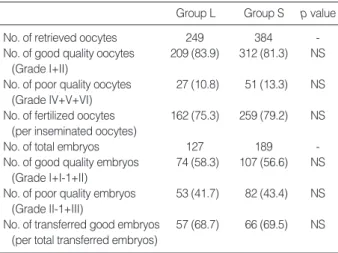
Table 3 showed that there was no significant difference of oocyte and embryo quality between the 2 groups. In addi- tion, the fertilization rate was also similar in the 2 groups (75.3% vs. 79.2%, p=0.343).
In Table 4, the patient’s convenience and the cost of med- ication for COH were summarized. The frequency of visit- ing hospital (3.3±0.5 vs. 22.2±2.0, p<0.0001) and the total number of injections with gonadotrophin and GnRHa (12.8±1.2 vs. 33.5±3.5, p<0.0001) were highly reduced in group L. The total cost of gonadotrophin and GnRHa con- sumed for COH was increased in group L (851.1±233.0 USD vs. 1,174.3±86.2 USD, p<0.0001).
DISCUSSION
The long protocol using GnRHa and gonadotrophin has been well known to be useful in COH of IVF-ET (11, 12).
In spite of the benefits of long protocol, multiple daily injec- tions of GnRHa are bothersome for women undergoing COH, including pain, psychosocial distress, and frequent hospital visits. Moreover, Wasser et al. (19) suggested that psychoso- cial distress contributes significantly to the etiology of some forms of infertility. So, simplifying the process of stimula-
tion cycle is valuable to reduce patient’s inconvenience and stress. Recently, self-injecting pen type of rFSH has been widely used and it has been shown to improve the patient’s convenience (20). In comparison with daily administration of short-acting GnRHa, a single administration of long-act- ing GnRHa can append these advantages by reducing the number of injections in COH (13). Taken together, a single administration of long-acting GnRHa in combination with self-injecting pen type of rFSH can significantly improve the patient’s convenience and comfort. In our data, the frequen- cy of hospital visits and the number of injections (GnRHa and gonadotrophins) were significantly decreased by using long-acting GnRHa. In addition, the reduced number of visiting hospital can significantly decrease the cost for med- ical service.
Along with previous reports (13, 14, 16, 21, 23), this study demonstrated that a single administration of long-acting GnRHa does not prolong the duration of ovarian stimula- tion. However, recent meta-analytical study concluded that the duration of ovarian stimulation was significantly increas- ed in the long-acting GnRHa group than in short-acting GnRHa group (17). It is noteworthy to note that the differ-
Group L Group S p value
No. of IVF-ET cycles 22 28 -
Duration of stimulation (day)* 11.8±1.2 11.3±1.6 NS Estradiol on hCG injection 1,935.0±1524.5 2,630.1±1210.0 0.045
day*
No. of retrieved oocytes* 11.3±9.0 13.7±6.3 NS Total dosage of rFSH for 2,354.5±244.2 2,012.5±626.1 0.034
COH (IU)*
Dosage of rFSH/oocyte 336.7±228.3 296.7±540.4 0.016 (IU/ea)*
No. of produced embryos* 5.8±2.1 6.8±2.7 NS Transferred embryos/cycle* 3.8±0.9 3.4±1.1 NS Transferred good embryos/ 2.6±1.7 2.4±1.2 NS
cycle*
-hCG positive cycles� 17 (77.3) 16 (57.1) NS
Clinical pregnancy 16 (72.7) 15 (53.6) NS
Implantation rate (%) 31.3 20.0 NS
Early pregnancy loss� 1 (5.9) 1 (6.3) NS
Table 2. Ovarian responses and clinical outcomes in the 2 groups
*Values are mean±SD; � -hCG ≥5 mIU/mL; �No fetal heart activity in -hCG positive cycles.
IVF-ET, in vitro fertilization and embryo transfer; hCG, human chorionic gonadotrophin; rFSH, recombinant follicle-stimulating hormone; COH, controlled ovarian hyperstimulation.
Values in parentheses are percentage.
Group L Group S p value
No. of retrieved oocytes 249 384 -
No. of good quality oocytes 209 (83.9) 312 (81.3) NS (Grade I+II)
No. of poor quality oocytes 27 (10.8) 51 (13.3) NS (Grade IV+V+VI)
No. of fertilized oocytes 162 (75.3) 259 (79.2) NS (per inseminated oocytes)
No. of total embryos 127 189 -
No. of good quality embryos 74 (58.3) 107 (56.6) NS (Grade I+I-1+II)
No. of poor quality embryos 53 (41.7) 82 (43.4) NS (Grade II-1+III)
No. of transferred good embryos 57 (68.7) 66 (69.5) NS (per total transferred embryos)
Table 3. Quality of oocytes and embryos in the 2 groups
Values in parentheses are percentage.
Group L Group S p value No. of hospital visits before 3.3±0.5 22.2±2.0 <0.0001
ovum pick-up
No. of injections before hCG 12.8±1.2 33.5±3.5 <0.0001 administration (rFSH+GnRHa)
Cost of drug administration* 1,124.3±82.5 814.8±223.1 <0.0001 (rFSH+GnRHa) (1,174.3±86.2)(851.1±233.0) Table 4. Cost and convenience of controlled ovavian hyperstim- ulation in the 2 groups
*Values are Korean Won (×1,000).
Values in parentheses are US dollar (1 USD=957.4 Korean Won).
rFSH, recombinant follicle-stimulating hormone; GnRHa, gonadotrophin- releasing hormone agonist.
ence of duration of gonadotrophin treatment was less than 1 day. So, it would be concluded that the difference of dura- tion in ovarian stimulation was not clinically important in both groups.
Also, the total dose of gonadotrophin required for COH is another important point for both physicians and the patients to consider when choosing the type of GnRHa and protocol because it can change the cost of COH. Numerous studies using human menopausal gonadotrophin reported that there was a controversy in the augmentation of total gonadotrophin consumption in the long-acting GnRHa group as compared with the short-acting GnRHa group (13-16, 21, 22). This controversy was also found in other studies using highly puri- fied urinary FSH (24, 25). In our study, the total amount of rFSH required for COH significantly increased in the long- acting GnRHa group as compared with the short-acting GnRHa group, and this increased gonadotrophin consump- tion consequently elevated the cost of COH in the long-acting GnRHa group. From this study, however, we may suggest a solution to compensate the increased cost of gonadotrophin with reduced number of hospital visits. As shown in Table 4, the cost for COH was significantly increased in the long-act- ing GnRHa group, because the total dose of rFSH increased and the long-acting form of GnRHa was more expensive than short-acting form. To the best of our knowledge, there has been no report to compare the clinical efficacy of long-acting GnRHa with that of short-acting GnRHa in combination with self-injecting pen type rFSH. In the long protocol, the combination of long-acting GnRHa with self-injecting pen type rFSH can reduce the number and the cost of hospital vis- its to have an injection of GnRHa and gonadotrophins. Con- sequently, the total cost of COH using long-acting GnRHa became similar to the cost using short-acting GnRHa. More- over, the reduced frequency of injection and hospital visits can improve the patient’s quality of life, including convenience, less pain, and psychosocial comfort.
No matter what benefits the use of long-acting GnRHa may have as compared with short-acting GnRHa, the out- come of pregnancy is the most valuable factor in IVF-ET cycles. So, the use of long-acting GnRHa must have no detri- mental effect on pregnancy outcome. Most of previous stud- ies showed that there was no significant difference in preg- nancy rate between long-acting and short-acting GnRHa (14, 16, 21-24). In this study, the clinical pregnancy rate as well as implantation rate was about 1.5 fold higher in the long-acting GnRHa group than in the short-acting GnRHa group, but this difference had no statistical significance because of the small sample size. In addition, we found that the qual- ity of retrieved oocytes and produced embryos was not sig- nificantly different between the 2 groups.
In conclusion, our study demonstrated that a single admin- istration of long-acting GnRHa in combination with self- injecting pen type of gonadotrophin can improve the patient’s quality of life without a significant difference in clinical out-
comes and total cost for COH of IVF-ET cycles. So, we would suggest that a single administration of long-acting GnRHa as a good alternative for improving patient’s convenience and psychosocial comfort during COH of long protocol.
ACKNOWLEDGMENTS
The authors thank Yoon Jeong Lee and Mi Jin Ryu at the Laboratory of Reproductive Medicine, Samsung Women’s Hospital for their critical comments on the manuscript.
REFERENCES
1. Loumaye E. The control of endogenous secretion of LH by gonado- trophin-releasing hormone agonists during ovarian hyperstimula- tion for in-vitro fertilization and embryo transfer. Hum Reprod 1990;
5: 357-76.
2. Smitz J, Van Den Abbeel E, Camus M, Devroey P, Tournaye H, Van Steirteghem AC. The effect of gonadotrophin-releasing hormone (GnRH) agonist in the follicular phase on in vitro fertilization out- come in normo-ovulatory women. Hum Reprod 1992; 7: 1098-102.
3. Tummon IS, Daniel SA, Kaplan BR, Nisker JA, Yuzpe AA. Ran- domized, prospective comparison of luteal leuprolide acetate and gonadotropins versus clomiphene citrate and gonadotropin in 408 first cycles of in vitro fertilization. Fertil Steril 1992; 58: 563-8.
4. Dimitry ES, Bates SA, Oskarsson T, Margara R, Winston RM. Pro- gramming in vitro fertilization for a 5- or 3-day week. Fertil Steril 1991; 55: 934-8.
5. Polan ML, Daniele A, Russell JB, DeCherney AH. Ovulation induc- tion with human menopausal gonadotropin compared to human uri- nary follicle-stimulating hormone results in a significant shift in fol- licular fluid androgen levels without discernible differences in gran- ulosa-luteal cell function. J Clin Endocrinol Metab 1986; 63: 1284- 91.
6. Testart J, Forman R, Belaisch-Allart J, Volante M, Hazout A, Strubb N, Frydman R. Embryo quality and uterine receptivity in in-vitro fertilization cycle with or without agonists of gonadotrophin-releas- ing hormone. Hum Reprod 1989; 4: 198-201.
7. Tur-Kaspa I, Confino E, Dudkiewicz AB, Myers SA, Friberg J, Gle- icher N. Ovarian stimulation protocol for in-vitro fertilization with gonadotropin-releasing hormone agonist widens the implantation window. Fertil Steril 1990; 53: 859-64.
8. Frydman R, Belaisch-Allart J, Parneix I, Forman R, Hazout A, Tes- tart J. Comparison between flare up and down regulation effects of luteinizing hormone-releasing hormone agonist in an in vitro fertil- ization program. Fertil Steril 1988; 50: 471-5.
9. Abdalla HI, Ahuja KK, Leonard T, Morris NN, Honour JW, Jacobs HS. Comparative trial of luteinizing hormone-releasing hormone analog/human menopausal gonadotropin and clomiphene citrate/
human menopausal gonadotropin in assisted conception program.
Fertil Steril 1990; 53: 473-8.
10. Hughes EG, Fedorkow DM, Daya S, Sagle MA, Van de Koppel P,
Collins JA. The routine use of gonadotrophin-releasing hormone agonists prior to in-vitro fertilization and gamete intra-fallopian trans- fer: a meta-analysis of randomized controlled trials. Fertil Steril 1992; 58: 888-96.
11. Ron-El R, Herman A, Golan A, van der Ven H, Caspi E, Diedrich K. The comparison of early follicular and midluteal administration of long acting gonadotropin-releasing hormone agonist. Fertil Ster- il 1990; 54: 233-7.
12. Tan SL, Kingsland C, Campbell S, Mills C, Bradfield J, Alexander N, Yovich J, Jacobs HS. The long protocol of administration of gona- dotropin-releasing hormone agonist is superior to the short protocol for ovarian stimulation for in vitro fertilisation. Fertil Steril 1992;
57: 810-4.
13. Oyesanya OA, Teo SK, Quah E, Abdurazak N, Lee FY, Cheng WC.
Pituitary down-regulation prior to in-vitro fertilization and embryo transfer: a comparison between a single dose of Zoladex depot and multiple daily doses of Suprefact. Hum Reprod 1995; 10: 1042-4.
14. Hsieh Y, Tsai H, Chang C, Lo H. Comparison of a single half-dose, long-acting form of gonadotropin-releasing hormone analog (GnRH- a) and a short-acting form of GnRH-a for pituitary suppression in a controlled ovarian hyperstimulation program. Fertil Steril 2000; 73:
817-20.
15. El-Nemr A, Bhide M, Khalifa Y, Al-Mizyen E, Gillott C, Lower AM, Al-Shawaf T, Grudzinskas JG. Clinical evaluation of three different gonadotrophin-releasing hormone analogues in an IVF programme:
a prospective study. Eur J Obstet Gynecol Reprod Biol 2002; 103:
140-5.
16. Geber S, Sales L, Sampaio MA. Comparison between a single dose of goserelin (Depot) and multiple daily doses of leuprolide acetate for pituitary suppression in IVF treatment: a clinical endocrinologi- cal study of the ovarian response. J Assist Reprod Genet 2002; 19:
313-8.
17. Albuquerque LE, Saconato H, Maciel MC, Baracat EC, Freitas V.
Depot versus daily administration of GnRH agonist protocols for pituitary desensitization in assisted reproduction cycles: a Cochrane review. Hum Reprod 2003; 18: 2008-17.
18. Cheon KW, Byun HK, Yang KM, Song IO, Choi KH, Yoo KJ. Effi- cacy of recombinant human follicle-stimulating hormone in improv- ing oocyte quality in assisted reproductive techniques. J Reprod Med 2004; 49: 733-8.
19. Wasser SK, Sewall G, Soules MR. Psychosocial stress as a cause of infertility. Fertil Steril 1993; 59: 685-9.
20. Pang SC. A pen injection device for self-administration of recombi- nant follicle-stimulating hormone for fertility treatments. Expert Rev Med Devices 2005; 2: 27-32.
21. Tapanainen J, Hovatta O, Juntunen K, Martikainen H, Ratsula K, Tulppala M, Tuomivaara L. Subcutaneous goserelin versus intranasal buserelin for pituitary down-regulation in patients undergoing IVF:
a randomized comparative study. Hum Reprod 1993; 8: 2052-5.
22. Tsai HD, Chen CM, Lo HY, Chang CC. Subcutaneous low dose leuprolide acetate depot versus leuprolide acetate for women under- going ovarian stimulation for in-vitro fertilization. Hum Reprod 1995;
10: 2909-12.
23. Dada T, Salha O, Baillie HS, Sharma V. A comparison of three gona- dotrophin-releasing hormone analogues in an in-vitro fertilization programme: a prospective randomized study. Hum Reprod 1999;
14: 288-93.
24. Dal Prato L, Borini A, Trevisi MR, Bonu MA, Sereni E, Flamigni C.
Effect of reduced dose of triptorelin at the start of ovarian stimula- tion on the outcome of IVF: a randomized study. Hum Reprod 2001;
16: 1409-14.