Received: 2012.5.26. Revised: 2012.7.16. Accepted: 2012.7.18.
Corresponding author: Suk-Joo Choi, MD, PhD
Department of Obstetrics and Gynecology, Samsung Medical Center, Sungkyunkwan University School of Medicine, 81 Irwon- ro, Gangnam-gu, Seoul 135-710, Korea
Tel: +82-2-3410-3546 Fax: +82-2-3410-0630 E-mail: [email protected]
This is an Open Access article distributed under the terms of the Creative Commons Attribution Non-Commercial License (http://creativecommons.org/licenses/
by-nc/3.0/) which permits unrestricted non-commercial use, distribution, and reproduction in any medium, provided the original work is properly cited.
Copyright © 2012. Korean Society of Obstetrics and Gynecology http://dx.doi.org/10.5468/KJOG.2012.55.10.699
pISSN 2233-5188 · eISSN 2233-5196
Preterm birth (PTB) is defined as birth before 37 completed weeks of gestation, which occurs in approximately 10% of all pregnan- cies [1]. PTB causes about 70% of all neonatal deaths of non- anomalous infants, as well as neonatal morbidities including respiratory distress syndrome, intraventricular hemorrhage, nec- rotizing enterocolitis, bronchopulmonary dysplasia and long-term complications such as cerebral palsy [2,3]. The PTB rate has risen worldwide, and in South Korea, the PTB rate has also risen from 4.3% in 1995 to 10% in 2003 [1,4].
There are many known risk factors for PTB, but one of the most
VAGINAL MICRONIZED NATURAL PROGESTERONE TREATMENT AND REDUCED RISK OF RECURRENT PRETERM BIRTH
Lindsay Ji Hyun Seong, MD, Min Ji Kim, MD, Yeri Lee, MD, So-Yeon Yoon, MD, Hyun-Hwa Cha, MD, Hye-Min Kwak, MD, Suk-Joo Choi, MD, PhD, Soo-young Oh, MD, PhD, Cheong-Rae Roh, MD, PhD, Jong-Hwa Kim, MD, PhD
Department of Obstetrics and Gynecology, Samsung Medical Center, Sungkyunkwan University School of Medicine, Seoul, Korea
Objective
To evaluate whether the administration of vaginal natural micronized progesterone is associated with reduction of recurrent preterm birth (PTB) in women with prior history of spontaneous PTB.
Methods
We retrospectively evaluated the obstetric and neonatal outcomes of all women with history of spontaneous PTB that delivered from January 2008 through April 2012. Spontaneous PTB was defined as PTB before 37 weeks of gestation due to spontaneous preterm labor or preterm premature rupture of membranes. Pregnancies with multiple gestation and those who received cerclage operation during previous or current pregnancy were excluded. Patients in the progesterone group were instructed to self- administer 100 or 200 mg vaginal micronized natural progesterone capsule. We evaluated the difference in recurrent PTB rate between the progesterone group (n = 73) and the non-user group (n = 158).
Results
The incidence of recurrent spontaneous PTB before 37 weeks’ gestation was significantly lower in the progesterone group than the non-user group (21.9% vs. 43.0%, P=0.002). Multivariate analysis showed that progesterone therapy was associated with a decrease in the incidence of recurrent PTB before 37 weeks’ gestation (odds ratio, 0.382; 95% confidence interval, 0.169-0.863;
P=0.021) independent of confounding variables.
Conclusion
Micronized vaginal progesterone supplement therapy was associated with a reduction of recurrent PTB risk in women with previous spontaneous PTB history.
Keywords: Progesterone; Preterm birth; Recurrence; Prevention
important factors is previous history of PTB [1]. As mentioned be- fore, global incidence of PTB rate is approximately 10%, but the rate of PTB increases up to 20%−50% in women with history of PTB, and the risk of PTB increases considerably with the number of previous PTBs [5-8].
For more than 30 years, progesterone administration has been advocated for the prevention of PTB in women considered to be at high risk for PTB [9]. However, the results of the earlier stud- ies on the efficacy and safety of this treatment were controversial [10]. In 2004, two randomized controlled trials suggested that the prophylactic administration of progesterone in pregnant women at high risk for PTB, including those with prior history of PTB, is asso- ciated with a reduction of 60% to 78% in PTB rate [11,12]. After on, several randomized controlled trials reported that the use of progesterone reduced the risk of recurrent PTB [13-19]. In 2008, the American College of Obstetricians and Gynecologist published a committee opinion recommending the use of progesterone supplementation to prevent recurrent PTB in women with a single- ton pregnancy and a prior spontaneous PTB due to spontaneous preterm labor or premature rupture of membranes [20].
However, the efficacy of the progesterone supplement therapy during pregnancy to prevent a recurrent PTB has never been studied in Korea. Therefore, primary objective of this retrospective study was to evaluate whether the prophylactic administration of vaginal micronized progesterone is associated with the reduction of recurrent PTB risk in women with a prior history of spontaneous PTB in Korean women.
Materials and Methods
We retrospectively evaluated the obstetric and neonatal outcomes of all women with history of one or more previous spontaneous PTB that delivered from January 2008 to April 2012. Spontane- ous PTB was defined as PTB before 37 weeks of gestation due to spontaneous preterm labor or preterm premature rupture of membranes (PPROM). The exclusion criteria were multiple gesta- tions either previous or current pregnancy, cerclage during both previous or current pregnancy, and previous intentional PTB due to maternal or fetal indications, such as preeclampsia and fetal growth restriction.
Patients who used progesterone were instructed to self-administer vaginal micronized natural progesterone (Utrogestan, Besins Healthcare, Brussels, Belgium or Yenatron, Acraf S.p.A., Roma, Italy) 100 or 200 mg capsule. The treatment was initiated at
16 weeks of gestation or at first visit to our hospital beyond 16 weeks of gestation. The treatment was continued until either 34 to 37 completed weeks of gestation or occurrence of PTB.
Control group consisted of singleton pregnant women with history of one or more previous spontaneous PTB and delivered in our hospital during the same study period, but who never used pro- gesterone during current pregnancy. Patient selection, the dose of progesterone and the time of initiation and duration of the treat- ment were decided by the physicians’ discretion.
Information of the previous pregnancy outcome such as number of previous term birth, number of previous PTB, gestational age and indication of the previous PTB was collected. Obstetric outcome of the current pregnancy including the rate of recurrent PTB before 34 weeks and 37 weeks of gestation of the two groups was com- pared.
The Fisher’s exact test or Pearson’s chi-square test was used for categorical variables. The Student’s T-test or Mann-Whitney U test was used for continuous variables. The relationship between the incidence of PTB and independent variables including the number of previous PTB history, gestational age at previous PTB, indica- tions of previous PTB and midtrimester cervical length were ana- lyzed by multiple logistic regression analysis. A P-value of less than 0.05 was considered statistically significant.
Results
A total of 231 women were included in the study: 73 in the pro- gesterone group and 158 in the non-user group. There were no significant differences in maternal characteristics including number of previous term and preterm births, and gestational age at previ- ous PTB between the non-user group and progesterone group (Table 1). But there were more PPROM of indication for previous PTB in the progesterone group compared to the non-user group.
Although mean cervical length during midtrimester ultrasound was not significantly different between two groups, more women in the progesterone group had cervical length less than 25 mm.
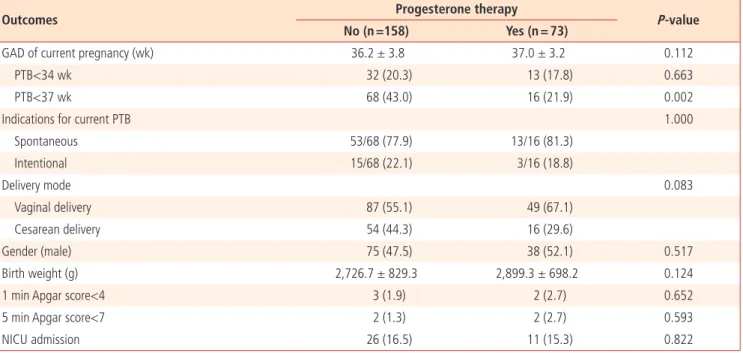
The incidence of recurrent PTB before 37 weeks of gestation was significantly lower in the progesterone group than the non-user group (21.9% vs. 43.0%, P=0.002) (Table 2). However, the rate of recurrent PTB before 34 weeks of gestation was similar in the two groups. There were no significant differences in other outcomes such as delivery mode, birth weight, 1-minute and 5-minute Apgar scores, and admission to neonatal intensive care unit.
Relationship between the incidence of PTB and independent vari-
ables were analyzed by multiple logistic regression analysis (Table 3). Midtrimester cervical length was significantly associated with the risk of recurrent PTB (odds ratio [OR], 0.916; 95% confidence interval [CI], 0.879−0.955). Use of progesterone was associated with significant reduction in recurrent PTB (OR, 0.382; 95% CI, 0.169−0.863).
We compared the characteristics and outcome of women who were treated with progesterone and delivered at term and those who delivered at preterm despite progesterone therapy (Table 4).
Women who were treated with progesterone and delivered at preterm were more likely to have two or more previous PTB his- tory compared to those who were treated with progesterone and delivered at term. Gestational age of previous PTB, number of previous term delivery, gestational age at initiation and duration of the treatment, and indications of previous PTB were not differ- ent between the two groups. More women in the progesterone group who delivered at preterm received 200 mg than 100 mg progesterone and had shorter midtrimester cervical length than
those who delivered at term. However, previous term birth history, number of previous PTB history, gestational age at delivery and in- dications of previous PTB were not significantly different between those who used 200 mg and 100 mg progesterone (data not shown). Multivariate analysis showed that midtrimester cervical length was significantly associated with the risk of recurrent PTB (OR, 0.920; 95% CI, 0.854−0.990; P=0.027), but dose of proges- terone was not significantly associated with the risk of recurrent PTB (OR, 1.457; 95% CI, 0.385−5.520; P=0.580).
Discussion
In this retrospective study, we found that the rate of recurrent PTB in women with previous history of spontaneous PTB was over 40%, but the rate decreased to 21.9% when prophylactic vagi- nal micronized natural progesterone was used. The reduction of recurrent PTB after the treatment with vaginal micronized natural Table 1. Maternal characteristics: progesterone group vs. non‐user group
Characteristics Progesterone therapy
P‐value
No (n =158) Yes (n = 73)
Age (yr) 33.0 ± 4.0 33.3 ± 3.2 0.591
Previous TB history 31 (19.6) 19 (26.0) 0.272
Number of previous TB 0.435
1 28 (17.7) 16 (21.9)
≥2 3 (1.9) 3 (4.1)
Number of previous PTB history 0.869
1 146 (92.4) 67 (91.8)
≥2 12 (7.6) 6 (8.2)
GAD of previous PTB (wk) 32.7 ± 4.3 31.7 ± 4.8 0.113
Distribution of GAD of previous PTB 0.510
PTB <24 wk 7 (4.5) 6 (8.2)
PTB 24-28 wk 22 (14.1) 9 (12.3)
PTB 28-34 wk 30 (19.2) 22 (30.1)
PTB 34-37 wk 97 (62.2) 36 (49.3)
Indications for previous PTB 0.033
PTL 80 (50.6) 26 (35.6)
PPROM 78 (49.4) 47 (64.4)
Midtrimester CL (mm)
a31.0 ± 11.2 31.7 ± 10.5 0.737
Midtrimester CL<25 mm
a40/95 (42.1) 16/68 (23.5) 0.014
Values are presented as mean ± standard deviation or number (%).
TB, term birth; PTB, preterm birth; GAD, gestational age at delivery; PTL, preterm labor; PPROM, preterm premature rupture of membranes; CL, cervical length.
a
Analyzed only in patients with the data on midtrimester cervical length that were available.
progesterone was statistically significant after controlling indepen- dent confounding factors. Our study is probably the first in Korea to report on progesterone treatment for prevention of PTB.
Early prediction and prevention is the most effective manage- ment of PTB. With the advances in obstetrics, a great advances were made in identification of risk factors for PTB, as well as early prediction of PTB such as measurement of cervical length and cer- vicovaginal fibronectin [21-24]. Risk factors of spontaneous PTB include prior history of PTB, ethnicity of pregnant women, multiple pregnancies, smoking, uterine anomaly and history of curettage or cervical conization [1,5]. Among these risk factors, prior PTB history is the most important factor and it can increase more than 2 fold of recurrence risk in their next pregnancy [7]. Defining risk factors and early prediction of PTB is important because it enables
to recognize high-risk women and allows initiation of risk-specific treatment [5]. Progesterone is one of the few proven effective methods to prevent PTB in women with previous history of spon- taneous PTB and in women with short cervical length [25].
The role and mechanism of progesterone in preventing PTB is not fully understood; it is known to relax the uterine smooth muscle, inhibition of oxytocin effects on the myometrium, and the forma- tion of myometrial gap junction [10]. It has also been shown to regulate uterine contractility and prevent cervical ripening, which may play a role in onset of labor. Progestins are available in natu- ral micronized or synthetic formulations for oral, intramuscular or vaginal administration. Also, the efficacy of progesterone for prevention of PTB varies depending on patient’s characteristics, cervical length, history of PTB, and administration route or forms Table 2. Pregnancy outcomes: progesterone group vs. non‐user group
Outcomes Progesterone therapy
P‐value
No (n =158) Yes (n = 73)
GAD of current pregnancy (wk) 36.2 ± 3.8 37.0 ± 3.2 0.112
PTB<34 wk 32 (20.3) 13 (17.8) 0.663
PTB<37 wk 68 (43.0) 16 (21.9) 0.002
Indications for current PTB 1.000
Spontaneous 53/68 (77.9) 13/16 (81.3)
Intentional 15/68 (22.1) 3/16 (18.8)
Delivery mode 0.083
Vaginal delivery 87 (55.1) 49 (67.1)
Cesarean delivery 54 (44.3) 16 (29.6)
Gender (male) 75 (47.5) 38 (52.1) 0.517
Birth weight (g) 2,726.7 ± 829.3 2,899.3 ± 698.2 0.124
1 min Apgar score<4 3 (1.9) 2 (2.7) 0.652
5 min Apgar score<7 2 (1.3) 2 (2.7) 0.593
NICU admission 26 (16.5) 11 (15.3) 0.822
Values are presented as mean ± standard deviation or number (%).
GAD, gestational age at delivery; PTB, preterm birth; NICU, neonatal intensive care unit.
Table 3. Relationship between the incidence of preterm birth less than 37 weeks of gestation and independent variables analyzed by multiple logistic regression
Variables Odds ratio 95% confidence interval P‐value
Number of previous PTB history 2.038 0.662-6.269 0.214
GAD of previous PTB (wk) 1.007 0.926-1.096 0.870
Indications for previous PTB (PPROM) 1.450 0.645-3.256 0.369
Midtrimester CL (mm) 0.916 0.879-0.955 <0.001
Progesterone therapy 0.382 0.169-0.863 0.021
PTB, preterm birth; GAD, gestational age at delivery; PPROM, preterm premature rupture of membranes; CL, cervical length.
of progesterone.
Several studies reported 17 α-hydroxyprogesterone caproate (17 α-OHP-C) can prevent recurrent PTB in women with previous
history of PTB [18,26]. However, there aren’t any studies on the effect of 17 α-OHP-C on prevention of PTB in women with short cervical length yet. Although there have been studies on gel type Table 4. Comparison of the characteristics and outcome of women in the progesterone group who delivered at preterm vs. term
Characteristics Preterm birth
(n =16) Term birth
(n = 57) P‐value
Age (yr) 32.9 ± 3.9 33.4 ± 3.0 0.600
Previous TB history 6 (37.5) 13 (22.8) 0.333
Number of previous TB 0.138
1 4 (25.0) 12 (21.1)
≥2 2 (12.5) 1 (1.8)
Number of previous PTB history 0.019
1 12 (75.0) 55 (96.5)
≥2 4 (25.0) 2 (3.5)
GAD of previous PTB (wk) 31.0 ± 5.3 31.8 ± 4.6 0.565
Distribution of GAD of previous PTB 0.898
PTB<24 wk 2 (12.5) 4 (7.0)
PTB 24‐28 wk 2 (12.5) 7 (12.3)
PTB 28‐34 wk 5 (31.3) 17 (29.8)
PTB 34‐37 wk 7 (43.8) 29 (50.9)
Indications for previous PTB 0.859
PTL 6 (37.5) 20 (35.1)
PPROM 10 (62.5) 37 (64.9)
Progesterone therapy
Dose 100 mg 6 (37.5) 37 (64.9) 0.049
200 mg 10 (62.5) 20 (35.1)
GA at initiation (wk, median [range]) 23.7 (16.0−32.1) 22.1 (16.0-32.3) 0.903 Duration of therapy (day, median [range]) 58 (8-118) 68 (12-137) 0.903
CL at initiation (mm, median [range])
a25.3 ± 10.4 33.6 ± 9.8 0.004
CL<25 mm
a7/16 (43.8) 9/52 (17.3) 0.029
GAD of current pregnancy (wk) 31.8 ± 3.0 38.5 ± 0.9 <0.001
Delivery mode 0.004
Vaginal delivery 6 (37.5) 43 (75.4)
Cesarean delivery 10 (62.5) 14 (24.6)
Gender (male) 5 (31.3) 33 (57.9) 0.059
Birth weight (g) 1,897.9 ± 587.4 3,180.4 ± 409.1 <0.001
1 min Apgar score<4 1 (6.3) 1 (1.8) 0.393
5 min Apgar score<7 1 (6.3) 1 (1.8) 0.393
NICU admission 11 (68.8) 0 (0) <0.001
Values are presented as mean ± standard deviation or number (%).
TB, term delivery; PTB, preterm birth; GAD, gestational age at delivery; PTL, preterm labor; PPROM, preterm premature rupture of membranes; GA, ges- tational age; CL, cervical length; NICU, neonatal intensive care unit.
a
Analyzed only in patients with the data on midtrimester cervical length that were available.
or oral vaginal micronized natural progesterone, there are still controversies on which subjects to be used [16,17,27,28]. In our study, we used micronized natural vaginal progesterone tablet in patients with PTB history because 17 α-OHP-C and progesterone vaginal gel were not available in our hospital and we assumed that oral progesterone therapy might be ineffective for prevention of PTB.
Vaginal micronized natural progesterone was proved to be effec- tive in preventing PTB in women with previous PTB history. In the randomized placebo-controlled trial of de Fonseca et al. [11], 100 mg of vaginal progesterone were used between 24 and 34 weeks of gestation in high risk women with history of previous PTB in over 90% of the subjects. They reported that progesterone was effective in preventing PTB (progesterone group 13.8% and non- user group 28.5%). Preterm birth before 34 weeks of gestation was significantly lower in progesterone group (2.8%) compared to placebo group (18.6%). In another randomized placebo-controlled trial of Majhi et al. [19], 100 mg of vaginal progesterone were used in women with previous PTB history from 20−24 to 36 weeks of gestation, and result showed that PTB rate was signifi- cantly lower in progesterone group than placebo group (12% vs.
38%; RR, 0.32; 95% CI, 0.14−0.72). In 2011, Cetingoz et al. [13], reported a randomized placebo controlled trial of 100 mg vaginal progesterone in high risk women starting from 24 to 34 weeks of gestation. The result showed that administering vaginal progester- one reduced preterm labor (25% vs. 45.7%, P<0.05), PTB before 37 weeks (40% vs. 57.2%, P<0.05) and 34 weeks (8.8% vs.
24.3%, P<0.05) of gestation. Our result also showed that vaginal micronized progesterone therapy was significantly associated with the reduction of PTB less than 37 weeks of gestation. However, the rate of recurrent PTB before 34 weeks of gestation decreased only from 20.3% to 17.8% with the use of vaginal progesterone and the difference was not statistically significant. This may be due to small number of study population and it is the main limitation of our study.
Short cervical length is one of the most important risk factor in PTB [21-24], and progesterone treatment is effective in reducing the risk of PTB in women with short cervical length [15,16]. Fetal Medicine Foundation reported a trial of approximately 24,000 low-risk women who were routinely checked for cervical length during their prenatal care [15]. 250 women with cervical length less than 15 mm were randomly allocated to receive 200 mg vagi- nal progesterone or placebo from 24 to 34 weeks of gestation.
The result showed progesterone reduces the risk of spontaneous PTB before 34 weeks of gestation by 44.2% (19.2% vs. 34.4%;
RR, 0.56; 95% CI, 0.36−0.86). In our study, we included women with previous PTB history, but 34.3% (56/163) of them had short cervical length less than 25 mm. Interestingly, although more women in the progesterone group had short cervical length, the risk of recurrent PTB was significantly lower in this group.
Dose of progesterone may be one of the important factors as- sociated with preventing recurrent PTB. In previous studies, 100 mg progesterone was used in women with previous PTB history [11,13,19] and 200 mg progesterone was used in women with short cervical length [15]. But, in our study, there were no stan- dardized criteria for the dose of progesterone and this is another main limitation of this retrospective study. We prescribed 100 mg progesterone to 30/73 (41.1%) women and 200 mg progesterone to 43/73 (58.9%) women. An intriguing result of our study was that more women in the progesterone group who delivered at pre- term received 200 mg progesterone than those who delivered at term. This may be due to that more women who delivered at pre- term had short cervical length than those who delivered at term.
We tended to use 200 mg progesterone in women with short cer- vical length (25% vs. 45.7%, P<0.05). However, the result of our multivariate analysis showed that the dose of progesterone was not independently associated with risk of recurrent PTB.
Although this is the first report on the effect of progesterone therapy on preventing PTB in Korea, there still remain several limitations to our study. First, because of the retrospective nature of the study, the patients in both groups were heterogeneous in terms of patient selection, the dose of progesterone and the time of initiation and duration of the treatment. And information on compliance of medication and side effects of the vaginal proges- terone were not available. Lastly, small number of patients is the main limitation to our study. Therefore, additional well-designed prospective studies are needed such as specific indications, opti- mal dose and regimen, optimal gestational age at initiation and end of treatment. In conclusion, micronized vaginal progesterone supplement therapy was associated with a significant reduction of recurrent PTB risk in women with previous spontaneous PTB his- tory.
References
1. Goldenberg RL, Culhane JF, Iams JD, Romero R. Epidemiology and causes of preterm birth. Lancet 2008;371:75-84.
2. Moster D, Lie RT, Markestad T. Long-term medical and social con-
sequences of preterm birth. N Engl J Med 2008;359:262-73.
3. Saigal S, Doyle LW. An overview of mortality and sequelae of preterm birth from infancy to adulthood. Lancet 2008;
371:261-9.
4. Koo YH, Kim SK, Skim JY, Won HS, Lee PR, Kim A. Analysis of preterm birth rate based on birth certificate data: from 1995 to 2003. Korean J Obstet Gynecol 2006;49:1855-65.
5. Iams JD, Berghella V. Care for women with prior preterm birth.
Am J Obstet Gynecol 2010;203:89-100.
6. Iams JD, Goldenberg RL, Mercer BM, Moawad A, Thom E, Meis PJ, et al. The preterm prediction study: recurrence risk of spon- taneous preterm birth. National Institute of Child Health and Human Development Maternal-Fetal Medicine Units Network.
Am J Obstet Gynecol 1998;178:1035-40.
7. McManemy J, Cooke E, Amon E, Leet T. Recurrence risk for preterm delivery. Am J Obstet Gynecol 2007;196:576 e.1-6.
8. Mercer BM, Goldenberg RL, Moawad AH, Meis PJ, Iams JD, Das AF, et al. The preterm prediction study: effect of gesta- tional age and cause of preterm birth on subsequent obstetric outcome. National Institute of Child Health and Human Devel- opment Maternal-Fetal Medicine Units Network. Am J Obstet Gynecol 1999;181:1216-21.
9. Keirse MJ. Progestogen administration in pregnancy may pre- vent preterm delivery. Br J Obstet Gynaecol 1990;97:149-54.
10. How HY, Sibai BM. Progesterone for the prevention of preterm birth: indications, when to initiate, efficacy and safety. Ther Clin Risk Manag 2009;5:55-64.
11. da Fonseca EB, Bittar RE, Carvalho MH, Zugaib M. Prophylac- tic administration of progesterone by vaginal suppository to reduce the incidence of spontaneous preterm birth in women at increased risk: a randomized placebo-controlled double- blind study. Am J Obstet Gynecol 2003;188:419-24.
12. Meis PJ, Klebanoff M, Thom E, Dombrowski MP, Sibai B, Moawad AH, et al. Prevention of recurrent preterm delivery by 17 alpha-hydroxyprogesterone caproate. N Engl J Med 2003;348:2379-85.
13. Cetingoz E, Cam C, Sakalli M, Karateke A, Celik C, Sancak A.
Progesterone effects on preterm birth in high-risk pregnan- cies: a randomized placebo-controlled trial. Arch Gynecol Ob- stet 2011;283:423-9.
14. DeFranco EA, O’Brien JM, Adair CD, Lewis DF, Hall DR, Fusey S, et al. Vaginal progesterone is associated with a decrease in risk for early preterm birth and improved neonatal outcome in women with a short cervix: a secondary analysis from a randomized, double-blind, placebo-controlled trial. Ultrasound Obstet Gynecol 2007;30:697-705.
15. Fonseca EB, Celik E, Parra M, Singh M, Nicolaides KH; Fetal Medicine Foundation Second Trimester Screening Group. Pro- gesterone and the risk of preterm birth among women with a short cervix. N Engl J Med 2007;357:462-9.
16. Hassan SS, Romero R, Vidyadhari D, Fusey S, Baxter JK, Khandelwal M, et al. Vaginal progesterone reduces the rate of preterm birth in women with a sonographic short cervix:
a multicenter, randomized, double-blind, placebo-controlled trial. Ultrasound Obstet Gynecol 2011;38:18-31.
17. Rai P, Rajaram S, Goel N, Ayalur Gopalakrishnan R, Agarwal R, Mehta S. Oral micronized progesterone for prevention of preterm birth. Int J Gynaecol Obstet 2009;104:40-3.
18. Saghafi N, Khadem N, Mohajeri T, Shakeri MT. Efficacy of 17al- pha-hydroxyprogesterone caproate in prevention of preterm delivery. J Obstet Gynaecol Res 2011;37:1342-5.
19. Majhi P, Bagga R, Kalra J, Sharma M. Intravaginal use of natural micronised progesterone to prevent pre-term birth: a randomised trial in India. J Obstet Gynaecol 2009;29:493-8.
20. Society for Maternal Fetal Medicine Publications Committee.
ACOG Committee Opinion number 419 October 2008 (replac- es no. 291, November 2003). Use of progesterone to reduce preterm birth. Obstet Gynecol 2008;112:963-5.
21. Goffinet F. Primary predictors of preterm labour. BJOG 2005;112 Suppl 1:38-47.
22. Iams JD, Goldenberg RL, Meis PJ, Mercer BM, Moawad A, Das A, et al. The length of the cervix and the risk of spontaneous premature delivery. National Institute of Child Health and Hu- man Development Maternal Fetal Medicine Unit Network. N Engl J Med 1996;334:567-72.
23. Grimes-Dennis J, Berghella V. Cervical length and prediction of preterm delivery. Curr Opin Obstet Gynecol 2007;19:191-5.
24. Honest H, Forbes CA, Duree KH, Norman G, Duffy SB, Tsourapas A, et al. Screening to prevent spontaneous pre- term birth: systematic reviews of accuracy and effectiveness literature with economic modelling. Health Technol Assess 2009;13:1-627.
25. Dodd JM, Flenady VJ, Cincotta R, Crowther CA. Progesterone for the prevention of preterm birth: a systematic review. Ob- stet Gynecol 2008;112:127-34.
26. Rizzo G, Capponi A, Angelini E, Vlachopoulou A, Grassi C, Romanini C. The value of transvaginal ultrasonographic ex- amination of the uterine cervix in predicting preterm delivery in patients with preterm premature rupture of membranes.
Ultrasound Obstet Gynecol 1998;11:23-9.
27. O’Brien JM, Adair CD, Lewis DF, Hall DR, Defranco EA, Fusey
S, et al. Progesterone vaginal gel for the reduction of recur- rent preterm birth: primary results from a randomized, double- blind, placebo-controlled trial. Ultrasound Obstet Gynecol 2007;30:687-96.
28. Glover MM, McKenna DS, Downing CM, Smith DB, Croom CS, Sonek JD. A randomized trial of micronized progesterone for the prevention of recurrent preterm birth. Am J Perinatol 2011;28:377-81.
천연 미세화 프로게스테론 질정 치료의 조산 재발 예방 효과
성균관대학교 삼성서울병원 산부인과
성지현, 김민지, 이예리, 윤소연, 차현화, 곽혜민, 최석주, 오수영, 노정래, 김종화
목적
이전 자연발생적 조산의 병력이 있는 임산부에서 프로게스테론 질정 치료가 조산의 재발예방에 효과가 있는지 알아보고자 하였다 연구방법
2008년 1월부터 2012년 4월까지 분만한 임산부 중 이전에 37주 미만의 조산 병력이 있는 임산부의 의무기록을 후향적으로 고찰하였다.
이전 또는 현 임신이 쌍태임신인 경우, 이전 조산의 원인이 조기진통이나 조기 양막파열이 아닌 의도적 조산인 경우, 자궁경부봉축술을 시 행한 경우를 제외한 231명을 대상으로 하였다. 프로게스테론 사용군은 천연 미세화 프로게스테론 질정 100 mg 또는 200 mg을 매일 투 여하였다. 프로게스테론 사용군(73명)과 비사용군(158명) 사이에 조산의 재발빈도 차이를 분석하였다.
결과
프로게스테론 사용군의 조산 재발률은 16/73 (21.9%)로 비사용군의 68/158 (43.0%)에 비해 낮았다(P=0.002). 다변량 분석에서 프로게스 테론 사용은 이전 조산의 횟수, 이전 조산의 임신주수, 이전 조산의 적응증, 자궁목 길이를 보정한 이후에도 조산 재발률의 유의한 감소와 관계 있었다(오즈비, 0.341; 95% 신뢰구간, 0.175-0.666; P=0.002).
결론
본 연구 결과 이전에 자연발생적 조산의 병력이 있는 임산부에서 천연 미세화 프로게스테론 질정 치료는 조산 재발의 위험을 줄일 수 있 는 것으로 나타났다.
중심단어: 프로게스테론, 이전 조산 기왕력, 조산 재발, 예방