Received: December 5, 2017 Revised: December 16, 2017 Accepted: December 17, 2017 TRAUMA AND INJURY
Correspondence to Gil Jae Lee, M.D.
Department of Trauma Surgery, Gachon University Gil Medical Center, 21 Nam- dong-daero 774beon-gil, Namdong-gu, Incheon 21565, Korea
Tel: +82-32-460-3010 Fax: +82-32-460-2372
E-mail: [email protected]
http://www.jtraumainj.org Copyright © 2017 The Korean Society of Trauma
Management of High-grade Blunt Renal Trauma
Min A Lee, M.D., Myung Jin Jang, M.S., Gil Jae Lee, M.D.
Department of Trauma Surgery, Gachon University Gil Medical Center, Incheon, Korea
Purpose: Blunt injury accounts for 80-95% of renal injury trauma in the United
States. The majority of blunt renal injuries are low grade and 80-85% of these injuries can be managed conservatively. However, there is a debate on the management of patients with high-grade renal injury. We reviewed our experience of renal trauma at our trauma center to assess management strategy for high-grade blunt renal injury.
Methods: We reviewed blunt renal injury cases admitted at a single trauma center be-
tween August 2007 and December 2015. Computed tomography (CT) scan was used to diagnose renal injuries and high–grade (according to the American Association for the Surgery of Trauma [AAST] organ injury scale III-V) renal injury patients were included in the analysis.
Results: During the eight–year study period, there were 62 AAST grade III-V pa-
tients. 5 cases underwent nephrectomy and 57 underwent non-operative management (NOM). There was no difference in outcome between the operative group and the NOM group. In the NOM group, 24 cases underwent angioembolization with a 91%
success rate. The Incidence of urological complications correlated with increasing grade.
Conclusions: Conservative management of high-grade blunt renal injury was consid-
ered preferable to operative management, with an increased renal salvage rate. How- ever, high-grade injuries have higher complication rates, and therefore, close observa- tion is recommended after conservative management.
Keywords: Trauma; Kidney injury; Therapeutic embolization; Conservative treatment
Management of High-grade Blunt Renal Trauma
Min A Lee, M.D., Myung Jin Jang, M.S., Gil Jae Lee, M.D.
Department of Trauma Surgery, Gachon University Gil Medical Center, Incheon, Korea
Purpose: Blunt injury accounts for 80-95% of renal injury trauma in the United
States. The majority of blunt renal injuries are low grade and 80-85% of these injuries can be managed conservatively. However, there is a debate on the management of patients with high-grade renal injury. We reviewed our experience of renal trauma at our trauma center to assess management strategy for high-grade blunt renal injury.
Methods: We reviewed blunt renal injury cases admitted at a single trauma center be-
tween August 2007 and December 2015. Computed tomography (CT) scan was used to diagnose renal injuries and high–grade (according to the American Association for the Surgery of Trauma [AAST] organ injury scale III-V) renal injury patients were included in the analysis.
Results: During the eight–year study period, there were 62 AAST grade III-V pa-
tients. 5 cases underwent nephrectomy and 57 underwent non-operative management (NOM). There was no difference in outcome between the operative group and the NOM group. In the NOM group, 24 cases underwent angioembolization with a 91%
success rate. The Incidence of urological complications correlated with increasing grade.
Conclusions: Conservative management of high-grade blunt renal injury was consid-
ered preferable to operative management, with an increased renal salvage rate. How- ever, high-grade injuries have higher complication rates, and therefore, close observa- tion is recommended after conservative management.
Keywords: Trauma; Kidney injury; Therapeutic embolization; Conservative treatment
INTRODUCTION
Renal injury occurs in up to 5% of trauma patients, and accounts for 24% of traumatic abdominal solid organ injuries [1]. Blunt injury accounts for 80 to 95% of renal injury trauma in the United States [2]. The majority of blunt renal injuries are low grade and 80 to 85% of these injuries can be managed conservatively [3]. In recent years, non–operative management (NOM) has been re- ported as safe and effective, even in hemodynamically un- stable high grade renal injury patients in some literature [4]. However, there is still debate over the management of high-grade renal injury patients. We reviewed our ex- perience of renal trauma at our trauma center in order to assess management strategy for high grade blunt renal injury.
METHODS
We reviewed blunt renal injury cases admitted at a single trauma center between August 2007 and December 2015.
Data were collected from chart review and included pa- tient age, gender, injury mechanism, site of injury, grade of injury, the injury severity score (ISS), vital signs, labo- ratory data, complications, treatment options, and length of hospital stay.
Renal injury was diagnosed from history, symptoms, and physical and radiologic examinations. All patients underwent contrast-enhanced computed tomography (CT) at ER admission. On CT, renal injury was classified according to the American Association for the Surgery of Trauma (AAST) organ injury scale.
Among renal injury patients, cases of high–grade renal injury (AAST grades III, IV, and V) were included in the analysis. Patients with thrombotic injury in the renal ar- tery with renal infarction or patients who had underlying renal disease, such as polycystic kidney disease, were ex- cluded. Since 2010, a radiologist has been recruited and a trauma surgeon has made a decision about renal injury.
Therefore, we compared the changes in the treatment methods before and after 2010. Statistical analysis was performed using Sigmastat software version 2.0 (IBM Corp., Armonk, NY, USA).
RESULTS
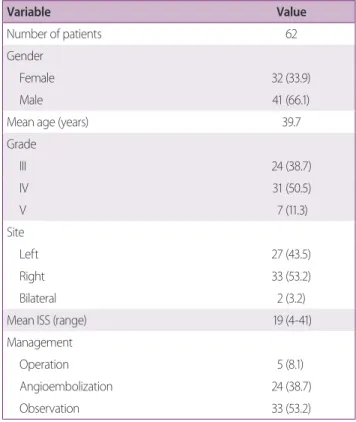
During the eight-year study period, of the 139 patients with traumatic blunt renal injury, 31 were grade I, 46 were grade II, 24 were grade III, 31 were grade IV, and 7 were grade V. We analyzed 62 high-grade patients (AAST III-V). Of these patients, 33 had injury on the right side, 27 on the left, and 2 patients had bilateral renal injury.
Mean ISS was 19 (Table 1).
Five patients underwent immediate exploratory lap- arotomy, endovascular embolization was performed in
Table 1. Demographics and clinical presentation
Variable Value
Number of patients 62
Gender
Female 32 (33.9)
Male 41 (66.1)
Mean age (years) 39.7
Grade
III 24 (38.7)
IV 31 (50.5)
V 7 (11.3)
Site
Left 27 (43.5)
Right 33 (53.2)
Bilateral 2 (3.2)
Mean ISS (range) 19 (4-41)
Management
Operation 5 (8.1)
Angioembolization 24 (38.7)
Observation 33 (53.2)
Values are presented as number (%) unless otherwise indicated.
ISS: injury scaled score.
Table 2. comparison of outcomes
Variables Operation (n=5) NOM (n=57) p-value
Complication 1 (20) 12 (21) 0.956
ICU stay 5.8±5.0 6.2±9.3 0.553
Hospital stay 19.6±18 26.3±17.6 0.124
Mortality 0 (0) 0 (0)
Values are presented as mean±standard deviation or number (%).
NOM: non-operative management, ICU: intensive care unit.
24 patients, and 33 patients underwent observational management. Therefore, 57 patients of high grade renal injury underwent non-operative management (NOM), consisting bed rest and monitoring of vital signs and hematocrit levels. Endovascular embolization was per- formed in patients who had persistent or delayed bleeding but hemodynamically stable. Five patients underwent ne- phrectomy. These cases were hemodynamically unstable with renal hemorrhage and underwent exploration and nephrectomy.
No mortality related to renal injury in either the opera- tive group or the NOM group occurred. On comparison of outcomes, there were no differences between operative and NOM group in terms of complications and length of intensive care unit (ICU) or hospital stay (Table 2). Com- plications associated with renal injury occurred in 13 pa- tients (20%): four patients had urine leakage (6.5%); three had delayed bleeding (4.8%); two had hydronephrosis (3.2%); two had pseudoaneurysm (3.2%); one patient had an abscess; and one had renal failure. The Incidence of urological complications correlated with increasing grade (grade III=8.3%, grade IV=22.6%, and grade V=57.1%;
p=0.021) (Table 3).
DISCUSSION
Over the past few years, the management of traumatic blunt renal injury has changed from operative exploration to NOM [5]. While NOM of blunt renal injuries is estab- lished, NOM of high-grade renal injuries remains contro-
versial [3].
Peters and Bright reported that the rate of delayed ne- phrectomy after conservative management was 14.6%
and that conservative management resulted in a longer hospital stay [6]. Husmann et al. suggested that renal ex- ploration and surgical repair improved prognosis [7].
Danuser et al. reported that primary conservative man- agement of blunt kidney rupture was related to less blood loss and damage to the renal parenchyma compared to patients treated with initial surgery [8]. Wessells et al.
reported that renal preservation could lead to improved outcomes compared to nephrectomy [9].
In our study, emergency surgery was performed in five cases (8.1%) of traumatic blunt renal injury. Among emergency operations, four cases were performed before 2009. They were hemodynamically unstable on ER admis- sion. After resuscitation, they maintained a systolic blood pressure of 90 mmHg or more; however, exploratory laparotomy and nephrectomy were performed in cases of sustained ongoing bleeding within 24 hours. Exploration was determined based on the surgeon’s preference or availability of angiography. After 2009, high-grade renal injury with ongoing bleeding was managed conservatively in most cases. Comparing before and after 2009, the ob- servation management rate had not changed; however, angioembolization ratio had increased (Fig. 1). Improve- ments in resuscitation management of trauma patients changed the concept of NOM in high-grade renal injury and highly-selective embolization skills shifted the treat- ment strategy toward NOM in severe blunt renal trauma patients [10-12]. Angioembolization was performed in cases of extravasation on abdominal/pelvic CT or of sus-
Table 3. Urologic complication by gradeNo. by grade III (24) IV (31) V (7)
Urinary leakage - 1 3
Bleeding 1 1 1
Hydronephrosis - 2 -
Pseudoaneurysm - 2 -
Abscess - 1 -
Renal failure 1 - -
Total 2 7 4
Complication rate by grade 8.3% 22.6% 57.1%
Number of cases
Before 2009 After 2010
Fig. 1. Severe blunt renal injury management strategies.
Op Angio Observation
pected ongoing bleeding.
In both the operative and NOM groups, no mortality was related to renal injury. The incidence of complication, and length of ICU or hospital stay showed no significant differences between the two groups (Table 2).
In a series of 26 patients with grade IV-V blunt renal injury, Bozeman et al. found no statistically significant difference in morbidity between operative and non–
operative group [3]. Altman et al. reported that patients managed conservatively had less morbidity [10]. Brewer et al. successfully managed unstable grade V patients by percutaneous embolization [4].
An adaptive indication of operation for blunt renal injury is continuing hemodynamic instability owing to renal hemorrhage unresponsive to aggressive resuscitation [1]. Primary conservative management is the treatment option even for high-grade injury in resuscitation patient.
Complications increased with the grade of injury rather than the initial treatment method, and were detected on routine follow-up CT. We performed routine follow up imaging approximately seven days after blunt renal inju- ry. Blankenship et al. recommended follow-up CT after 48 hours in AAST grade IV-V renal injury patients or pa- tients with clinical signs of complications [13]. Malcolm et al. stated that routine follow-up imaging is unnecessary in blunt renal injury of grades I-III [14] because it did not alter clinical management [1].
Almost all complications were managed by percutane- ous drainage, retrograde stent placement. Among grade V patients, one patient had massive urine leakage at the level of the renal pelvis and one had persistent urine leakage over 19 days, despite retrograde stent placement, and the need for nephrectomy was considered. As a result, two grade V injury patients underwent delayed nephrectomy.
There were seven grade V injury patients, of whom one underwent emergency nephrectomy. Ureteropelvic junc- tion avulsion and laceration of the renal pelvis require surgical repair [15]. Urine leakage can be managed with stent placement for four to six weeks [16]. The renal fail- ure patient was older and had severe associated injury (ISS 29), and, therefore, could not recover from acute kidney injury as a result of initial hemodynamic shock.
As a result, in 88% of high-grade blunt renal injury (grade III-V) patients and 57% of grade V injury patients,
the kidney was salvaged. There were seven grade V injury patients, one of whom underwent emergency nephrec- tomy. Two of the remaining six cases underwent delayed nephrectomy owing to urinary leakage. Primary NOM resulted in a more than 50% renal salvage rate in grade V renal injury patients.
CONCLUSION
Conservative rather than operative management is pre- ferred in high-grade blunt renal injury. This is due to improvements in the resuscitation therapy quality of trauma surgeons and the development of highly selective angioembolization. However, there is an increased com- plication rate in high-grade injuries, and close observation is recommended for high-grade renal injury after conser- vative management.
REFERENCES
1. Morey AF, Brandes S, Dugi DD 3rd, Armstrong JH, Breyer BN, Broghammer JA, et al. Urotrauma: AUA guideline. J Urol 2014;192:327-35.
2. Gourgiotis S, Germanos S, Dimopoulos N, Vougas V, Anasta- siou T, Baratsis S. Renal injury: 5-year experience and literature review. Urol Int 2006;77:97-103.
3. Bozeman C, Carver B, Zabari G, Caldito G, Venable D. Selective operative management of major blunt renal trauma. J Trauma 2004;57:305-9.
4. Brewer ME Jr, Strnad BT, Daley BJ, Currier RP, Klein FA, Mo- bley JD, et al. Percutaneous embolization for the management of grade 5 renal trauma in hemodynamically unstable patients:
initial experience. J Urol 2009;181:1737-41.
5. Hurtuk M, Reed RL 2nd, Esposito TJ, Davis KA, Luchette FA.
Trauma surgeons practice what they preach: The NTDB story on solid organ injury management. J Trauma 2006;61:243-54;
discussion 254-5.
6. Peters PC, Bright TC 3rd. Blunt renal injuries. Urol Clin North Am 1977;4:17-28.
7. Husmann DA, Gilling PJ, Perry MO, Morris JS, Boone TB. Ma- jor renal lacerations with a devitalized fragment following blunt abdominal trauma: a comparison between nonoperative (ex-
pectant) versus surgical management. J Urol 1993;150:1774-7.
8. Danuser H, Wille S, Zöscher G, Studer U. How to treat blunt kidney ruptures: primary open surgery or conservative treatment with deferred surgery when necessary? Eur Urol 2001;39:9-14.
9. Wessells H, Suh D, Porter JR, Rivara F, MacKenzie EJ, Jurkov- ich GJ, et al. Renal injury and operative management in the United States: results of a population-based study. J Trauma 2003;54:423-30.
10. Altman AL, Haas C, Dinchman KH, Spirnak JP. Selective non- operative management of blunt grade 5 renal injury. J Urol 2000;164:27-30; discussion 30-1.
11. Buckley JC, McAninch JW. Selective management of isolated and nonisolated grade IV renal injuries. J Urol 2006;176(6 Pt 1):2498-502; discussion 2502.
12. Chow SJ, Thompson KJ, Hartman JF, Wright ML. A 10-year review of blunt renal artery injuries at an urban level I trauma
centre. Injury 2009;40:844-50.
13. Blankenship JC, Gavant ML, Cox CE, Chauhan RD, Gingrich JR. Importance of delayed imaging for blunt renal trauma.
World J Surg 2001;25:1561-4.
14. Malcolm JB, Derweesh IH, Mehrazin R, DiBlasio CJ, Vance DD, Joshi S, et al. Nonoperative management of blunt renal trau- ma: is routine early follow-up imaging necessary? BMC Urol 2008;8:11.
15. Aragona F, Pepe P, Patanè D, Malfa P, D'Arrigo L, Pennisi M.
Management of severe blunt renal trauma in adult patients: a 10-year retrospective review from an emergency hospital. BJU Int 2012;110:744-8.
16. Alsikafi NF, McAninch JW, Elliott SP, Garcia M. Nonoperative management outcomes of isolated urinary extravasation follow- ing renal lacerations due to external trauma. J Urol 2006;176(6 Pt 1):2494-7.