Journal of Trauma and Injury Vol. 27, No. 3, September, 2014
� Address for Correspondence : In-Seok Jang, M.D.
Department of Cardiovascular and Thoracic Surgery, Gyeongsang National University Hospital, 79 Gangnam-ro, Jinju, Gyeongsangnam-do, 660-701, Korea
Tel : 82-55-750-8695, Fax : 82-55-753-8138, E-mail : [email protected] Submitted : April 10, 2014 Revised : June 10, 2014 Accepted : July 8, 2014
I. 서 론
교통사고로 인하여 가장 빈번하게 발생하는 복부장기의 손 상은 간손상이다. 간은 혈관이 풍부하고 장막이 없기 때문에 아무리 작은 손상이라도 지속적인 출혈이 발생할 수 있다.
외상성 간손상은 지속적인 출혈과 담즙의 복강내 누출이 발 생하므로 보편적으로 수술적인 치료가 필요할 것으로 생각되
어 왔다. 하지만, Farnell(1) 등은 혈역학적으로 안정되어 있 는 간손상의 경우 즉각적인 수술적 치료보다는 혈관색전술을 포함한 보존적인 치료가 좋은 결과를 가져올 수 있다고 보고 하였다. 현재 많은 의료기관에서 혈역학적으로 안정된 간손 상인 경우에는 보존적인 치료를 시도하고 있다. 본 병원에서 간우엽이 거의 파열된 심한 간손상에 대하여 보존적 치료를 경험하였기에 보고한다.
전단교통사고에 의한 광범위 간장손상 - 보존치료 1례
경상대학교 의학전문대학원 흉부외과학교실, 경상대학교 건강과학대학원, 1마취과학교실, 2내과학교실 장인석, 김성환, 이정은, 김종우, 최준영, 신일우1, 김현옥2
- Abstract -
Extensive Blunt Hepatic Injury due to Cross-over Traffic Accident - A Case Report of Conservative Management
In-Seok Jang, M.D., Sung Hwan Kim, M.D., Jung Eun Lee, M.D., Jong Woo Kim, M.D., Jun Young Choi, M.D., Il Woo Shin, M.D.
1, Hyun Ok Kim, M.D.
2Department of Cardiovascular and Thoracic Surgery,
1Department of Anesthesiology,
2
Internal Medicine, Gyeongsang National University Hospital, Institute of Health Science, Gyeongsang National University, Health Science Institutes, Gyeongsang National University
The severity of blunt hepatic injury correlates with internal organ damage. We experienced a patient, who had an extensive crushed liver injury. The patient was a 28-year-old man, who was involved in a traffic accident in which a wheel ran over his right upper abdomen. A grade V severe hepatic laceration was diagnosed with computed tomogra- phy. His vital signs were stable, so we could wait for times with conservative management. Bile leakage led to biloma and bile spillage into the peritoneal space. Selective percutaneous drainage was needed to control the several biloma.
After four months of conservative management, could the patient was discharged in good condition. [ J Trauma Inj 2014;27:84-88 ]
Key Words: Trauma, Liver laceration, Hepatic injury, Traffic accident, Cross over injury
II. 증 례
28세 남자가 복부 팽만으로 응급실에 내원하였다. 병력에 서 술에 취한 상태에서 보행자 교통사고을 입었고, 인근병원
에 내원하여 수축기 혈압이 80 mmHg 이하의 저혈압이 측 정되어서 급히 본원 응급실로 이송되었다.
이송자가 전한 목격자의 증언에 따르면 외상의 원인은 환 자가 길가에 누워있는데, 승용차의 바퀴가 환자의 상복부를
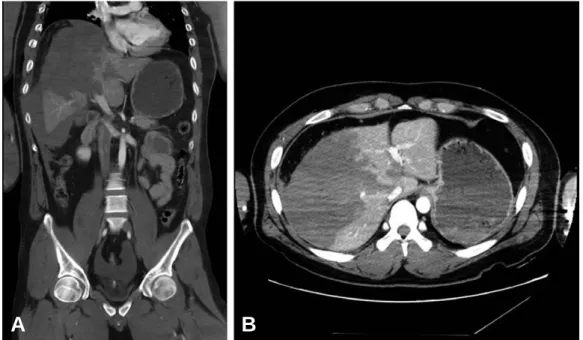
Fig. 1. Abdominal computed tomography finding showed at immediate post injury. (A) Deep laceration of hepatic right lobe is showed in coronal view of computed tomography. Crushing liver injury is showed mainly right lobe. Bleeding is localized at perihepatic area. There is no fluid collection in peritoneal cavity. (B) Blunt injury damaged to liver right lobe in transverse view of computed tomography. Blunt laceration injury depth reaches to inferior vena cava.
A B
Table 1. Liver injury scale (1994 revision).(3)
Gradea Injury Description
I Hematoma Subcapsular, < 10% surface
Laceration Capsular tear
< 1 cm parenchymal depth
II Hemaoma Subcapsular
10~50% surface area; Intraparenchymal,
< 10 cm in diameter
Laceration 1~3 cm parenchymal depth
< 10 cm in length
III Hematoma Subcapsular
> 50% surface area or expanding;
Ruptured subcapsular or parenchymal hematoma Intraparenchymal hematoma > 10 cm or expanding Laceration > 3 cm parenchymal depth
IV Laceration Parenchymal disruption involving 25~75% of hepatic lobe or 1-3 Couinaud’s segments within a single lobe
V Laceration Parenchymal disruption involving > 75% of hepatic lobe or
> 3 Couinaud’s segments within single lobe Vascular Juxtahepatic venous injuries;
i.e. retrohepatic vena cava/central major hepatic veins
VI Vascular Hepatic avulsion
a Advance one grade for multiple injuries, up to grade III
타고 넘어가면서 복부손상이 발생하였다고 하였다고 하였다.
자동차 바퀴가 완전히 넘어가지는 않은 것으로 보이고, 우측 상복부 피부에 타이어 바퀴 자국이 선명하게 찰과상으로 관 찰되었다. 그 외 다른 신체의 손상은 관찰되지 않았다.
내원했을 때 환자의 의식은 혼란스러웠으며, 협조가 안 되 는 상태였다. 맥박이 약하게 촉지되었고, 수축기 혈압이 80 mmHg으로 측정되었다. 호흡수 28회/분, 체온 37도, 맥박수 80회/분 이었다. 맥박산소포화도는 88%로 측정되어 산소를 5
L/min으로 흡입시키며맥박산소포화도는 95%로 유지되었다.
검사실 혈액검사에서 혈색소 12.6 g/dL, 백혈구 12,640/
UL, 혈소판수치 164 K/UL, amylase 77 IU/L (29~110), Lipase 34 IU/L (14~60)였다.
흉부씨티에서 우측에 3, 4, 5, 6, 7번 늑골 골절이 관찰되 었으며, 좌측에 4, 5, 6번 늑골 골절이 관찰되었으나, 혈흉이 나 기흉은 관찰되지 않았다. 복부CT에서 간의 우엽이 거의 파열된 상태의 간손상이 관찰되었으며(Fig. 1), 이로 인하여
Fig. 2. Follow up abdomen computed tomography finding. (A) At 9 hours after injury, crushing hepatic right lobe is founded in coronal section, hemorrhage is localized at peri-hepatic area. There is no change with compared to immediate trauma. (B) At 4 days after injury, hepatic right lobe hemorrhage transformed to hematoma. There is huge amount of peritoneal fluid around the peritoneal space. (C) At 1 month after injury, He needed peritoneal catheter for biloma drainage. (D) At 3 months after injury, There are small radio-opaque catheters in hepatic right lobe area. Catheter was inserted through right abdominal skin.
Peritoneal fluid has disappeared.
A B C D
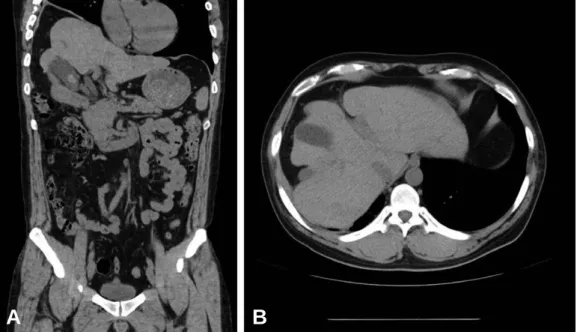
Fig. 3. CT finding at 15 months after injury. (A) Coronal section, right hepatic lobe is slinking after injury, there is no peritoneal biloma. (B) transverse section, right hepatic lobe has been healed with scar. Ovid gallbladder is located within right lobe.
A B
간장과 우측 횡격막 사이에는 다량의 혈복강이 관찰되었다.
우측 간엽이 75%이상 파열된 것을 확인할 수 있었기에 간손 상척도로 판단한다면 간손상단계는 5단계였다(Table 1).
생리식염수를 빠르게 주입하면서, 혈압이 수축기압이 80~90 mmHg로 유지되었지만, 혈복강이 진행하고 있다고 판단하였기에 농축적혈구 5 unit를 수혈하였고, 혈액응고를 유도하기 위하여 신선동결혈장을 3 unit을 같이 수혈하였다.
수혈후 수축기 혈압은 100 mmHg로 상승하였다.
금식을 유지하면서 9시간 후에 복부CT를 추적하였더니 (Fig. 2A), 더 이상 혈복강이 증가되는 소견은 관찰되지 않 아서 보존적인 치료를 목적으로 일반병실로 환자를 옮겼다.
금식을 유지하면서 보존적인 치료를 시행하였고, 4일 뒤 복 부CT를 촬영하여(Fig. 2B) 혈복강이 증가되지 않았지만, 혈 액과 담즙으로 예상되는 체액이 전체 복강으로 퍼져 있는 것 을 확인하였다. 한 달 뒤 간우엽의 열상으로 복강내 담즙이 유출되어, 담즙이 복강내 다발적으로 정체되어 있는 소견이 관찰되었다(Fig. 2C). 경피적 배액술을 시행하였으며, 배액 관을 유지하면서 경과 관찰하였으며, 다른 부위에서 저류되 는 소견이 관찰되면 새로운 배액관의 삽입을 시행하였다 (Fig. 2D). 경피 배액술을 시행하며, 치료한 후 4개월째 퇴 원이 가능하였다. 15개월이 지난 뒤 외래에서 촬영한 복부 씨티 소견에서 간장 열상은 치유된 소견이 관찰되었으며, 복 강내 다발성 담즙정체도 모두 흡수된 것으로 확인되었다 (Fig. 3).
III. 고 찰
간손상의 가장 흔한 원인은 교통사고로 알려져 있으며, 전 체 사망률은 9.8%로 알려져 있다.(5) 간손상의 호발 연령은 20대이며, 가장 유용하게 사용할 수 있는 진단법은 복부 CT 촬영이다.(6,7)
자동차, 오토바이 등의 운송 수단이 발달하면서 교통수단 에 의한 외상이 발생률이 증가하였고, 이에 따라 최근 20년 간 간장 손상이 증가하고 있다. 간구조의 복잡성으로 간장의 손상은 임상적으로 다양한 형태로 발생한다. 간장외막의 경 미한 열상에서 간내 동맥, 정맥을 포함한 하대 정맥의 손상 을 동반한 광범위한 간장 실질의 파열이 발생할 수 있다. 경 미한 간장의 손상은 검사도중 우연히 발견되지만, 심한 간장 손상의 경우는 심각한 쇽을 유발하며, 복부 팽만이 발생하 고, 즉각적인 소생술이 필요할 수 있으며, 응급 수술을 필요 로 할 수 있다.
간장의 손상 가능성을 의심하고, 손상을 확인하며, 분류하 는 것은 적절한 처치를 계획하는데 필요하다. 지난 30년간 간장 손상의 치료에 중요한 발전이 있었다. 간장의 관통상에 대한 수술적인 치료는 모두가 받아들이는 필수적인 방법이지 만, 간장의 둔상에 의한 손상의 경우에는 모두가 동의하는
방법이 없었다. 1990년대 초까지만 하더라도, 대부분의 간장 의 둔상에 대한 일차적인 치료는 지혈과 담관의 손상에 따른 담즙의 누출을 확인하기 위하여 수술적인 치료를 시도하였 다. 하지만, 혈압이 안정되어 있으며, 출혈이 자연적으로 멈 추는 경우의 50~80%는 보존적인 치료로 효과적으로 치료 하고 있다. 하지만, 출혈이 진행되는 심한 간장 손상이 있어 서 혈압이 불안정한 경우에는 지혈을 시키고 광범위한 간장의 손상에 대한 처치를 위하여 응급상황에서 수술이 필요하다.
간장손상의 분류는 손상자체의 심한 정도뿐 아니라, 동반 된 손상의 심한 정도를 참작하는 것이 필요하다. 간장손상의 손상 정도의 분류는 예후와 연관되어 만들어져 있다. 간장손 상의 분류는 치료의 방법을 결정하고 전반적인 치료의 계획 을 세우기 위하여 몇 가지 원칙을 충족하여야 한다. 그 조건 은 첫째, 손상의 원인을 확인하고 해부학적인 손상의 범위를 확인할 수 있어야 한다. 둘째, 어떤 치료를 선택할 것인지, 예를 들면 수술적인 치료와 보존 치료를 선택할 수 있도록 도움을 주어야 한다. 셋째, 손상의 정도를 나타내는 단계가 발생 가능한 후유증이나 결과를 예측할 수 있어야 한다. 마 지막으로 이러한 분류는 객관적이고, 일관적으로 적용될 수 있어서 전향적, 후향적으로 실제로 간 손상에서 적용이 가능 한 것이어야 한다.
미국외상학회(American Association for the Surgery of Trauma)위원회가 1987년 결성되어 각 장기 손상에 대한 분류를 시작하였으며, 1988년 위원회에서 첫 분류 방식인 장 기손상분류(Organ Injury Scale, OIS) OIS-1을 발표하였 고,(2) 이 분류법은 비장과 간 손상에 대하여 1994년 개정판 으로 1995년 간손상의 개정된 분류법을 제시하였다.(3) 윤 (4) 등은 대한외상학회지에서 가장 흔한 복부손상의 원인인 간손상의 경우 외과적인 치료가 중요한 역할을 하고 있지만, 혈압이 안정적이라면 보존적인 치료를 할 수 있다는 전제하 에서 예후인자에 대하여 보고하였다. 이들은 저혈압이 가장 위험한 인자로 결론을 내리면서, 혈압이 불안정한 경우에는 적극적인 수술적인 역할을 시행하는 것이 환자의 생존율 향 상에 필요할 것이라고 주장하였다.
간손상을 치료방법을 결정하는 데 혈압이 안정적으로 유지 되는지의 여부가 중요하다는 것은 많은 동의를 얻고 있다. 혈 역학적으로 안정된 상태에서는 보존적인 치료를 시도해 볼 수 있는 데, 여기서 보존적인 치료의 기준에 대하여 Coughlin(8) 등 이 70 kg 성인을 기준으로 혈액을 4 unit 이상 수혈이 필요 하지 않고, 복강내 구획증후군이 없는 경우라고 정의하였다.
간손상을 입은 후 8~12시간 동안 활력징후가 안정적인지가 적극적인 수술적인 치료의 필요성을 정하는데 중요한 요인이 라는 주장하며, LIS (Liver Injury Score) 척도가 4 이상이더 라도 보존적인 치료를 고려할 수 있다고 주장하였다.(6,8)
둔상에 의한 간손상의 경우는 85%에서 보존적인 치료가 가능하다고 하며, 수술적인 치료보다는 보존적인 치료의 장
점으로 복부감염을 줄이고, 수혈을 줄이고, 재원기간을 줄일 수 있다는 보고가 있다.(9)
하지만, 간손상 척도가 낮고 혈압이 안정적이더라고 수술 이 필요한 경우를 반드시 인지하여야 한다. 혈색소가 지속적 으로 감소되거나, 동반된 복부장기 손상이 있는 경우, 복부 구획증후군이 있거나, 혈종이 6개의 구획이상, 2개 이상의 엽을 짓누르는 경우에는 적극적인 수술적인 치료를 고려하여 야 한다.(10,11)
REFERENCES