eISSN 2287-1683 pISSN 1738-8767 Journal of Trauma and Injury Vol. 29, No. 4, December, 2016 http://dx.doi.org/10.20408/jti.2016.29.4.191
─ 191 ─
� Case Report �
� Address for Correspondence : Kyoung Hoon Lim, M.D.
Department of Surgery, Kyungpook National University Hospital, 130 Dongdeok-ro, Jung-gu, Daegu 41944, Korea
Tel : 82-53-420-5605, Fax : 82-53-421-0510, E-mail : [email protected]
Submitted : December 2, 2016 Revised : December 2, 2016 Accepted : December 30, 2016
Pseudo-renal Failure Caused by Urinary Bladder Rupture in Multiple Trauma Patient
Jihoon Jang, M.D., Kyoung Hoon Lim, M.D.
Department of Surgery, Kyungpook National University Hospital, Daegu, Korea
Pseudo-renal failure presents with renal failure characteristics, such as hypercreatininemia and hyperkalemia without a change in glomerular filtration rate or structure of the kidney. Pseudo-renal failure due to trauma is difficult to diag- nose, because symptoms are non-specific and other factors may cause hypercreatininemia and hyperkalemia. In a trau- ma patient, especially one with pelvic injury, the abrupt elevation of potassium, blood urea nitrogen, and creatinine lev- els without previous medical history is a key feature in the diagnosis of urinary ascites. We report a case of pseudo-renal failure caused by intraperitoneal bladder rupture in a multiple trauma patient. [ J Trauma Inj 2016; 29: 191-194 ]
Key Words: Trauma, Bladder rupture, Pseudo-renal failure, Urinary ascites
─ 192 ─
- Journal of Trauma and Injury Vol. 29, No. 4 -
Fig. 1. Chest computed tomographic scan showing multiple rib fractures (arrow), right minimal hemothorax, and right subcutaneous emphysema.
Fig. 3. Retrograde cystography showing an intraperitoneal leak- age of radiologic contrast (arrow) suggesting intraperi- toneal rupture of bladder.
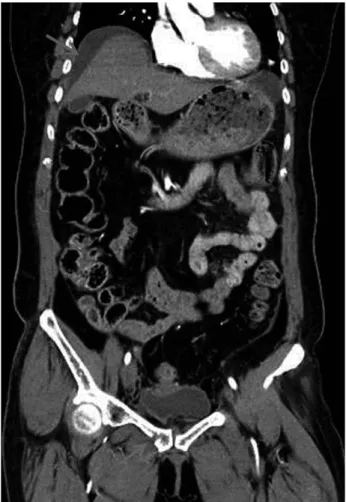
Fig. 2. Abdomen computed tomographic scan showing right pubic ramus fracture, and moderate intraperitoneal fluid collection (arrow) without intraperitoneal organ injury.
─ 193 ─
Jihoon Jang, et al. Pseudo-renal Failure from Urinary Bladder Rupture
Fig. 4. Fourteen days after the operation, retrograde cystogra- phy revealing no intraperitoneal leakage of radiologic contrast.
REFERENCES
01) Kilari SK, Amancharla LY, Bodagala VL, Mulakala AJ, Bushan JV, Vishnubhotla SK. Pseudo-renal failure due to intraperitoneal bladder rupture and silent subdural hematoma following a fall in an alcoholic. Int Urol Nephrol 2007; 39:
947-9.
02) Urry RJ, Clarke DL, Bruce JL, Laing GL. The incidence, spectrum and outcomes of traumatic bladder injuries within the Pietermaritzburg Metropolitan Trauma Service. Injury 2016; 47: 1057-63.
03) Andreev E, Koopman M, Arisz L. A rise in plasma creatinine that is not a sign of renal failure: which drugs can be responsi- ble? J Intern Med 1999; 246: 247-52.
04) Martens P. Pseudorenal failure secondary to reversed intraperitoneal autodialysis. Case Rep Nephrol 2013: 982391.
05) Kuroki Y, Mizumasa T, Nagara T, Tsuchimoto A, Yotsueda H, Ikeda K, et al. Pseudorenal failure due to intraperitoneal bladder rupture after blunt trauma: usefulness of examining ascitic fluid sediment. Am J Emerg Med 2012; 30: 1326 (e1-3).
06) Zhou C, Ying X, Feng W. Pseudo-acute Renal Failure due to Intraperitoneal Urine Leakage. Intern Med 2015; 54: 1777-80.
07) Heyns CF, Rimington PD. Intraperitoneal rupture of the blad- der causing the biochemical features of renal failure. Br J Urol 1987; 60: 217-22.
08) Pintar TJ, Wilke RA. Urinary ascites: spontaneous bladder rupture presenting as acute oliguric renal failure. Am J Med 1998; 105: 347-9.
09) Wystrychowski A, Nowicki M, Kokot F. Hyponatraemic renal pseudofailure--don’t forget the possibility of uroperi- toneum. Nephrol Dial Transplant 1996; 11: 2491-2.
─ 194 ─
- Journal of Trauma and Injury Vol. 29, No. 4 -