외상후 복부 다발성 고형장기 손상
울산대학교병원 응급의학과, 영상의학과1 박형도∙김선휴∙이종화1∙홍정석∙홍은석
─ Abstract ─
Multiple Intraabdominal Solid Organ Injuries after Blunt Trauma
Hyung Do Park, M.D., Sun Hyu Kim, M.D.,
Jong Hwa Lee, M.D.1, Jung Seok Hong, M.D., Eun Seog Hong, M.D.
Department of Emergency Medicine and Radiology1 Ulsan University Hospital, University of Ulsan College of Medicine
Purpose: This study evaluated the characteristics and the prognosis of multiple intraabdominal solid organ injuries, including those to the liver, spleen, and kidney, after blunt trauma.
Methods: From January 2001 to March 2009, 39 patients with multiple intraabdominal solid organ injuries, which had been confirmed by contrast-enhanced computed tomography after blunt trauma, were included in this retrospective study. The injury severity score (ISS), abbreviated injury scale (AIS), revised trauma score (RTS), American Association for the Surgery of Trauma (AAST) injury grade of solid organs, initial hemody- namic status, blood gas analysis, blood transfusion, and the mortality were the main outcome measurements.
Results: Injured groups were classified into liver/kidney (n=17), liver/spleen (n=4), spleen/kidney (n=13), and liver/kidney/spleen (n=5) groups. Patients were older in the liver/kidney group than in the liver/kidney/spleen group (43 vs 18 years, p=0.023). The initial systolic blood pressures tended to be lower in the liver/kidney group than in the other groups (84 vs 105, 112, and 114 mmHg, p=0.087). The amounts of 24- hour packed RBC transfusion were 32 units in the liver/kidney group and 4 units in the liver/kidney/spleen group, but the difference was not statistically significant. Differences were found in neither the RTS, ISS, and AIS for head, chest, abdominal, and pelvic injuries nor the AAST injury grade for solid organ, but injuries to the chest were more severe in the liver/spleen group than in the spleen/kidney group (AIS 4.0 vs 2.8, p=0.028).
Conservative treatment was the most frequent applied treatment in all groups. There were 6 mortalities : 3 due to hypovolemia, 2 to sepsis, and 1 to brain injury. Mortalities occurred only in the liver/kidney group.
Conclusion: Patients who had intraabdominal solid organ injuries of the liver and the kidney simultaneously, tended to be transfused more at an early time after trauma, to have lower initial systolic blood pressures, and to have a higher mortality. (J Korean Soc Traumatol 2009;22:193-8)
Key Words: Blunt injuries, Abdomen, Multiple trauma
� Address for Correspondence : Sun Hyu Kim, M.D.
Department of Emergency Medicine, Ulsan University Hospital, University of Ulsan College of Medicine, 290-3, Jeonha-dong, Dong-gu, Ulsan 682-714, Korea
Tel : 82-52-250-8405, Fax : 82-52-250-8071, E-mail : [email protected]
접수일: 2009년 8월 14일, 심사일: 2009년 9월 1일, 수정일: 2009년 9월 14일, 승인일: 2009년 9월 25일
I. 서 론
복부 둔상에 의한 복부의 고형장기 손상은 비장, 간 손 상의 빈도가 높고, 후복막강 장기로는 콩팥의 손상 빈도가 높다.(1) 복부 둔상후의 고형장기 손상에 대해서는 응급실 에서의 외상초음파(focosed assessment sonography in trau- ma, FAST)나,(2,3) 복부 전산화단층촬영(computed tomography, CT)으로 주로 진단하게되고,(4) 최근 들어 거 듭되는 기술의 발전으로 CT 검사에 소요되는 시간이 단축 되고 있으며, 또한 영상의 질 또한 향상되고있어 진단 영 역에서의 CT의 역할은 한층 높아지고 있다.(5,6) CT 검사 를 통해 고형장기 손상이 확인된 경우, 환자의 임상 증상 및 혈역학적 상태 등의 소견을 종합적으로 판단해 임상의 는 치료 방침을 결정하게 된다.
복부 둔상 후에 CT에서 고형장기 손상이 확인된 경우 국내에서 단일 고형 장기 손상에 대한 치료 및 예후에 대 한 여러 연구가 있어왔으나,(7-9) 다발성 고형장기 손상이 있는 경우의 특성 및 예후에 대해서 보고된 바가 없다. 이 에 저자는 외상으로 인한 고형장기의 손상이 다발성으로 발생한 환자 중 빈도가 높은 비장, 간, 콩팥에서의 다발성 손상을 보였던 환자를 대상으로 특성 및 예후에 대해 알 아보고자 하였다.
II. 대상 및 방법
2002년 1월부터 2009년 3월까지 울산대학교병원 응급실 로 외상의 인한 복부 손상으로 내원한 환자 중, 복부 조영 제 증강 CT 촬영에서, 비장, 간, 콩팥의 고형장기 중 두 개 이상의 장기 손상을 보였던 환자를 연구 대상으로 하 였다. 연구 대상 기간중 응급실로 내원한 환자수는 221,738
명이었고, 이중 외상으로 내원한 환자수는 56,853명이었다.
외상 환자중 복부 CT 촬영을 시행한 환자수는 1831명, CT 에서 복부 손상이 있었던 환자는 490명, 비장, 간, 콩팥의 고형장기 손상이 있었던 환자는 218명이었다. 이중 간, 콩 팥, 비장에서의 다발성 고형장기 손상이 있었던 44명의 환 자를 연구 대상으로 하였고, 의무기록이 불충분하거나, CT 촬영 기록은 있으나, CT를 확인할 수 없었던 5례를 제외 한 39명의 환자를 최종적으로 연구에 포함시켰다.
환자는 다발성 복부 고형장기 손상 유형에 따라, 간/콩 팥, 간/비장, 비장/콩팥, 간/콩팥/비장의 복합 손상군으로 분류하였고, 인구통계학적 지표, 초기 활력 징후, 손상기전, 내원 시의 Revised Trauma Score (RTS)와 각 손상 부위에 대한 Abbreviated injury scale (AIS) 및 Injury Severity Score (ISS)를 측정하였다. 환자의 초기 말초혈액 검사와 동맥혈검사를 분석하였고, 수혈양, 중환자실 입원 및 사망 에 대해서 분석하였다. 복부 CT를 이용하여 영상의학과 전 문의에 의해 고형 장기 손상 부위 및 정도를 판독하였고, 손상 정도는 미국외상의협회(American Association for the Surgery of Trauma, AAST)의 장기 손상 등급 기준에 따 라 분류하였다. 사망한 환자에서 사망 원인을 조사하였다.
통계적 검정은 SPSS 17.0 프로그램(SPSS for window release 17.0, SPSS Inc, USA)을 이용하여 빈도분석을 시행 하였고, 다집단 비교를 위해 ANOVA 및 사후분석, Kruskal Wallis test 및 Mann Whitney test, chi-square test 의 Fisher’s exact test를 이용하였고, 95% 신뢰구간으로 p 값 0.05를 통계적 유의 수준으로 하였다.
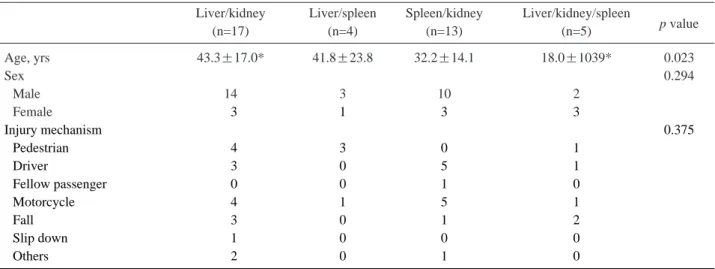
Table 1. Demographics of the patients with multiple intraabdominal solid organ injuries after blunt trauma
Liver/kidney Liver/spleen Spleen/kidney Liver/kidney/spleen
p value
(n=17) (n=4) (n=13) (n=5)
Age, yrs 43.3±17.0* 41.8±23.8 32.2±14.1 18.0±1039* 0.023
Sex 0.294
Male 14 3 10 2
Female 03 1 3 3
Injury mechanism 0.375
Pedestrian 04 3 0 1
Driver 03 0 5 1
Fellow passenger 00 0 1 0
Motorcycle 04 1 5 1
Fall 03 0 1 2
Slip down 01 0 0 0
Others 02 0 1 0
*p<0.05 by post Hoc test of ANOVA
III. 결 과 1. 환자의 특성
대상 환자 39명의 평균 연령은 36.2±17.8세 이었고, 남자 가 29명(74.4%)이었다. 손상기전은 교통사고 29명(보행자 8명, 운전자 9명, 동승자 1명, 오토바이 11명), 추락사고 6 명, 낙상 1명, 기타 손상 3명이었다. 복부 고형장기 복합 손상 유형은 간/콩팥 17명, 간/비장 4명, 비장/콩팥 13명, 간/콩팥/비장 모두 손상된 경우가 5명이었다. 각 복합 손 상 유형 군 간의 나이는 간/콩팥 손상 군이 43세로 간/콩 팥/비장 군의 18세보다 많았다(p=0.023). 각 군 간의 성별, 손상 기전에서도 차이는 없었다(Table 1).
각 군간 응급실 내원 후의 초기 혈압, 동맥혈가스검사에 서의 pH, 혈색소 수치에서 차이는 없었다. 내원후 24시간 이내 투여된 수혈된 농축 적혈구는 간/콩팥 손상 군에서 32단위로, 간/비장, 간/콩팥/비장 손상 군의 2단위, 4단위 보다 많았으나 통계적으로 유의하지는 않았다(p=0.084) (Table 2).
2. 손상 정도 및 동반 손상
외상 지수인 RTS와 ISS에서 각 군간의 차이는 없었고, 해부학적 위치별 손상 정도로 머리, 가슴, 복부, 골반 부위 에서의 손상 정도 및 복부 고형 장기 손상에 대한 CT에서 의 각 고형 장기별 AAST 손상 등급 또한 각 군 간의 차 이가 없었다(Table 3).
3. 치료 및 임상 결과
간/콩팥 손상 군에서 초기 치료는 보존적 치료 11명, 수 술 3명, 혈관조영술 3명이었고, 비장/콩팥 손상 군에서는 보존적 치료 9명, 수술 2명, 혈관조영술 2명이었다. 간/비 장 손상군 및 간/콩팥/비장 손상 군에서도 각각 75%(3/4), 60%(3/5)로 보존적 치료를 했던 경우가 많았 다. 중환자실 입원 기간은 간/콩팥 손상 군과 비장/콩팥 손상 군에서 간/비장 및 간/콩팥/비장 손상 군에 비해 짧 은 경향이 있었다(p=0.061). 사망은 간/콩팥 손상 군에서 만 6명이 있었다(Table 4).
Table 2. Clinical Characteristics of the patients with multiple intraabdominal solid organ injuries after blunt trauma Liver/kidney Liver/spleen Spleen/kidney Liver/kidney/spleen
p value
(n=17) (n=4) (n=13) (n=5)
Initial SBP* (mmHg) 84.5±40.5 105.5±15.3 112.8±26.1 114.8±18.6 0.087
Initial DBP�(mmHg) 58.8±23.2 67.8±6.9 071.2±17.5 074.0±11.4 0.256
Initial pH 7.26±0.22 07.23±0.08 07.39±0.05 07.33±0.09 0.388
Initial hemoglobin (g/dL) 12.4±1.50 12.5±2.1 12.7±2.5 10.1±5.9 0.312
24 hour PRBC� 32.1±35.0 02.3±0.6 06.3±5.0 04.3±5.2 0.084
*SBP: systolic blood pressure, �DBP: diastolic blood pressure, �PRBC: packed red blood cell
Table 3. Injury severity and associated injury in patients with multiple intraabdominal solid organ injuries after blunt trauma Liver/kidney Liver/spleen Spleen/kidney Liver/kidney/spleen
p value
(n=17) (n=4) (n=13) (n=5)
RTS* 10.7±2.30 09.5±3.8 11.6±1.10 11.4±0.50 0.283
ISS� 32.2±11.5 38.0±6.0 29.0±11.6 41.8±9.40 0.138
AIS�head 1.5±1.8 02.0±1.4 0.8±1.5 2.8±1.6 0.156
AIS chest 2.5±1.5 03.0±2.0 1.9±1.4 2.8±1.6 0.533
AIS abdomen 4.1±0.8 04.0±0.0 4.2±0.6 4.4±0.9 0.741
AIS pelvis 1.0±1.3 02.0±1.4 1.2±1.3 1.6±1.5 0.546
AAST§liver 2.2±1.2 02.0±0.8 2.0±0.7 0.871
AAST kidney 3.0±1.3 2.3±0.9 3.4±1.5 0.157
AAST spleen 02.8±0.5 3.2±1.1 2.4±2.1 0.532
*RTS: reviese trauma score, �ISS: injury severity score, �AIS: abbreviated injury scale,
§AAST: American Association for the Surgery of Trauma
4. 사망 분석
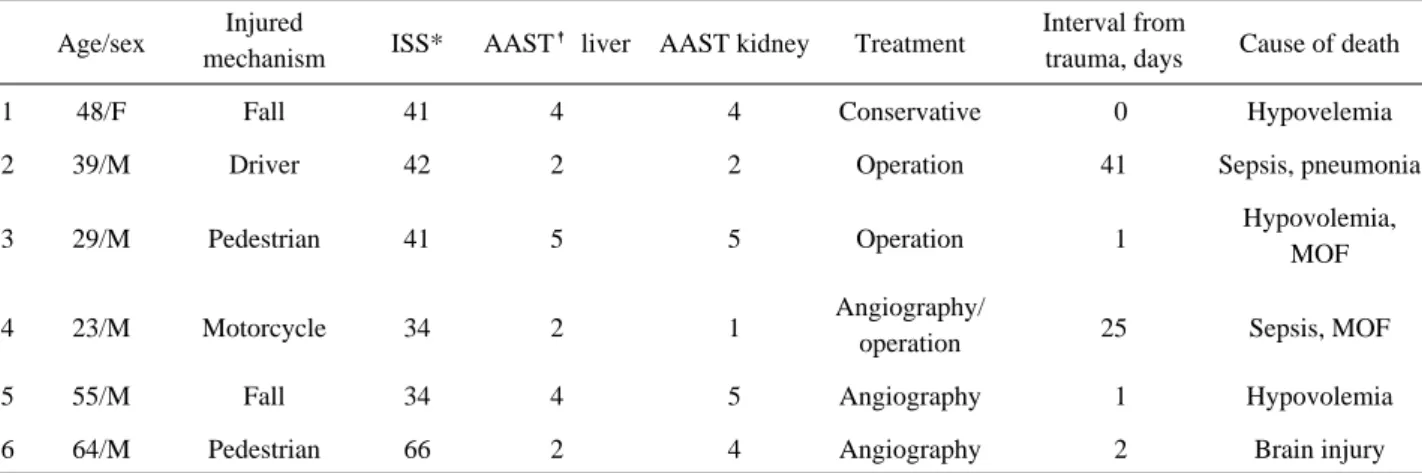
사망자는 모두 간/콩팥 손상 군에서 있었고, 손상 기전은 추락 2명, 교통사고 4명(보행자 2명, 운전자 1명, 오토바이 1명)이었다. 지속적인 출혈로 응급실에서 사망한 경우가 1 명에서 있었고, 수술을 시행했으나 지속적인 출혈과 다발성 장기부전이 동반된 경우가 1명에서 있었다. 1차적 치료로 수술을 시행했으나 중환자실 입원 중에 폐렴과 패혈증으로 1명이 사망하였으며, 3명은 응급실에서 1차적 치료로 혈관 조영술 및 동맥 색전술을 시행받았으나, 저혈량성쇼크, 중 증 뇌손상, 패혈증으로 각각 사망하였다(Table 5).
IV. 고 찰
둔상에 의한 복부 고형장기 손상에서 일반적으로 손상 의 정도가 심하거나, 단일 장기 손상 보다는 다발성 장기 손상이 동반될 경우에 예후가 좋지 않다.(10,11) 이번 연구 는 복부 둔상에 의한 다발성 고형장기 손상에서 2개 보다 는 3개의 고형장기 손상이 있을 경우 또는 복부 일 측에 서의 고형장기 손상이 있을 경우보다는 양 측에서의 고형 장기 손상이 있을 경우에 환자 예후가 좋지않을 것이라는
가정 하에 임상자료를 분석하였다. 응급실 내원 당시의 신 체 전반의 손상 지표인 ISS에서 간/콩팥/비장의 3개 고형 장기 손상이 있었던 군에서 가장 심한 손상의 경향을 보 였지만, 결과적으로는 간/콩팥 손상 군에서만 6명의 사망 환자가 있었다. 이에 대한 원인으로는 간/콩팥 손상 군에 서 응급실 내원 당시 초기 혈압이 낮은 경향을 보였고 또 한 24시간 수혈양도 많은 경향을 보였던 사실로 설명할 수가 있을 것이다. 복부 외상 환자의 예후에 영향을 미치 는 인자는 의식상태, 초기 혈압, 혈색소, 혈중 크레아티닌 수치 등이 알려져 있다.(9) 하지만 초기 혈색소 수치의 경 우 출혈 정도와 출혈의 지속여부에 대해 충분히 반영을 하지 못해, 임상의로서 초기 혈색소 수치에 의존한 판단은 매우 위험할 수 있다. 본 연구에서도 각 손상 군 간에 초 기 혈색소 수치에서의 차이는 없었으나, 간/콩팥 손상 군 에서 타 군에 비해 낮은 초기 혈압과, 더 많은 양의 수혈 이 필요했던 사실에서 내부 출혈이 지속되고 있었던 빈도 가 높았고 예후에 영향을 미쳤을 것으로 예측할 수 있었 다. 복부 둔상 후의 내부 고형장기 손상에서 출혈 양과 지 속적인 출혈 여부는 사고 당시의 사고 기전, 충격 강도, 충 격의 직접적인 위치 등과 관계가 있을 것이나 본 연구 결 과로 추정하기는 어렵다.
Table 4. Clinical outcomes in patients with multiple intraabdominal solid organ injuries after blunt trauma
Liver/kidney Liver/spleen Spleen/kidney Liver/kidney/spleen
p value
(n=17) (n=4) (n=13) (n=5)
Treatment, n 0.985
Conservative 11 3 9 3
Operative 03 1 2 1
Angiographic 03 0 2 1
ICU stay, days 6.2±11.1 19.8±10.9 6.1±5.6 18.4±11.9 0.061
Mortality, n(%) 6/17 (35.3%) 0/4 (0%) 0/13 (0%) 0/5 (0%) 0.027
*ICU: intensive care unit
Table 5. Mortality cases in patients with multiple intraabdominal solid organ injuries after blunt trauma Age/sex Injured
ISS* AAST� liver AAST kidney Treatment Interval from
Cause of death
mechanism trauma, days
1 48/F Fall 41 4 4 Conservative 00 Hypovelemia
2 39/M Driver 42 2 2 Operation 41 Sepsis, pneumonia
3 29/M Pedestrian 41 5 5 Operation 01 Hypovolemia,
MOF
4 23/M Motorcycle 34 2 1 Angiography/
25 Sepsis, MOF
operation
5 55/M Fall 34 4 5 Angiography 01 Hypovolemia
6 64/M Pedestrian 66 2 4 Angiography 02 Brain injury
*ISS: injury severity score, �AAST: American Association for the Surgery of Trauma
복부 고형장기 손상에 대해서는 환자 상태에 따라 수술 적 치료나 혈관조영술을 통한 중재적 시술을 포함하는 비 수술적 치료를 할 것인가를 결정하게된다. 최근의 치료 경 향은 복부 고형장기 손상의 경우 혈역학적으로 안정적이 고 유강 장기 손상이 동반되지 않은 경우에 보존적 치료 를 시행하는 것을 원칙으로 하고있다.(12) 최근 중환자 집 중 치료, 약물 치료, 동맥 색전술 등 다양한 치료 영역에서 의 발전으로 복부 고형장기 손상에서의 성공적인 비수술 적 치료 결과를 보고하고 있다.(13-15) 특히 혈관조영술 및 동맥색전술의 급격한 발전으로 4등급 이상의 심한 고 형장기 손상을 보이는 경우에도, 동반된 심한 손상이 있거 나 혈역학적으로 불안정한 경우 또는 방사선학적 중재적 시술 등의 보존적 치료가 실패한 경우에만 수술적 치료를 시행하고있다. Malhotra 등(16)은 수술적 치료에 비해 혈 역학적으로 안정되어 있는 외상성 간 손상 환자에서 비수 술적 치료로 예후가 좋은 결과를 보고하였다.
본 연구에서 저혈량성 쇼크나 중증 뇌손상으로 사망한 환자 이외에 입원중 사망했던 환자 2명은 모두 수술적 치 료를 시행했으나 첫 24시간에 투여된 신선냉동혈장과 농 축적혈구의 수혈 양이 각각 135, 134단위의 대량 수혈이 이루어졌던 환자들로 지속적인 출혈과 대량 수혈에 의한 범발성 혈관내 응고장애 등의 합병증이 병발하였다. 대량
수혈의 경우 지혈작용변화, 산소공급능력 저하, 산염기변 화, 고칼륨증, 저칼슘증, 저체온증, 혈액에 의한 감염질환의 증가, 폐기능장애와 같은 합병증을 가지고 있어 대량수혈 은 환자에게 많은 부담을 지우며, 특히 다발성 복부고형장 기 손상이 있는 환자들은 전반적으로 향상성을 유지하려 는 보상기전이 저하되어 있으므로 합병증의 위험성이 증 가한다.(17)
본 연구는 단일 응급의료센터의 후향적 연구로 연구 대 상이 많지 않았다는 제한점이 있다. 이번 연구에서 예측하 였던 2개의 고형장기 손상이 있었던 경우보다 3개의 고형 장기 손상이 있었던 경우에 또는 일 측의 고형장기 손상이 있었던 경우보다는 양 측의 고형장기 손상이 있었던 경우 에 예후가 안좋을 것이라는 가설과는 다른 결과를 보여, 이번 결과를 광범위하게 일반화시키기에 제약이 있을 수 있어 향후 전향적 대규모 연구가 필요할 것으로 사료된다.
V. 결 론
외상으로 인한 복부의 다발성 고형장기 손상이 있었던 환자에서 간/콩팥의 복합 손상이 있었던 경우에서 응급실 내원후 24시간 이내 투여된 수혈양이 많은 경향이 있었으 며, 사망한 환자가 많았다.
Fig. 1. Contrast enhanced abdominal computed tomography scan shows the four groups in this study: (A) hepatic subcapsular hematoma of grade I and renal laceration of grade IV of liver/kidney group, (B) hepatic subcapsular hematoma and splenic subcapsular hematoma of liver/spleen group, (C) segmental lacerated spleen of grade IV (left) and partial lacerated kidney of grade II (right) of spleen/kidney group, (D) hepatic subcapsular hematoma, major devascularization of spleen of grade IV (left), and shattered kidney of grade V (right) of liver/kidney/spleen group.
A C
B D
REFERENCES
01) Abdominal Trauma. In: American College of Surgeons Committee on Trauma. Advanced Trauma Life Support. 7th ed. American College of Surgeons 2007:
131-45.
02) Healey MA, Simons RK, Winchell RJ, Gosink BB, Casola G, Steele JT, et al: A prospective evaluation of abdominal ultrasound in blunt trauma: Is it useful? J Trauma 1996;40:875-83.
03) Kirkpatrick AW, Sirois M, Laupland KB, Goldstein L, Brown DR, Simons RK, et al: Prospective evaluation of hand-held focused abdominal sonography for trauma(FAST) in blunt abdominal trauma. Can J Sug, 2005;48:453-60.
04) Moore EE, Cogbill TH, Jurkovich GJ, Shackford SR, Malangoni MA, Champion HR. Organ injury scaling:
spleen and liver (1994 revision). J Trauma.
1995;38:323-4.
05) Hamilton JD, Kumaravel M, Censullo ML, Cohen AM, Kievlan DS, West OC. Multidetector CT evaluation of active extravasation in blunt abdominal and pelvic trauma patients. Radiographics 2008;28:1603-16.
06) Maturen KE, Adusumilli S, Blane CE, Arbabi S, Williams DM, Fitzgerald JT, et al. Contrast-enhanced CT accurately detects hemorrhage in torso trauma:
direct comparison with angiography. J Trauma 2007;62:740-5.
07) Baik JJ, Kim JI, Choi SH, Choi YC, Jun SY, Lee JH, et al: Nonoperative Management of Blunt Liver Trauma. J Korean Soc Traumatol 2005;18:161-71.
08) Cha SH, Jung YS, Won JH, Kim WW, Wang HJ, Kim MW, et al: Use of a Postpoerative Hepatic Arterial Embolization in Patients with Postoperative Bleeding due to Severe Hepatic Injuries. J Korean Soc
Traumatol 2006;19:59-66.
09) Kim HJ, Kim HS, Seo KW, Ju JK, Ryu SY, Kim JC, et al: Analysis of the Prognostic Factors for Abdominal Trauma. J Korean Soc Traumatol 2007;20:12-8.
10) Heuer M, Taeger G, Kaiser GM, Nast-Kolb D, Kuehne CA, Ruchholtz S, et al. Prognostic factors of liver injury in polytraumatic patients. Results from 895 severe abdominal trauma cases. J Gastrointestin Liver Dis 2009;18:197-203.
11) Schnu¨riger B, Inderbitzin D, Schafer M, Kickuth R, Exadaktylos A, Candinas D. Concomitant injuries are an important determinant of outcome of high-grade blunt hepatic trauma. Br J Surg 2009;96:104-10.
12) Janzen DL, Zwirewich CV, Breen DJ, Nagy A.
Diagnostic accuracy of helical CT for detection of blunt bowel and mesenteric injuries. Clin Radiol 1998;53:193- 7.
13) Holden A. Abdomen-Interventions for solid organ injury. Injury 2008;39: 1275-89.
14) Preˆtre R, Mentha G, Huber O, Meyer P, Vogel J, Rohner A. Hepatic trauma: risk factors influencing outcome. Br J Surg 1988;75:520-4.
15) Fang JF, Chen RJ, Lin BC, Hsu YB, Kao JL, Chen MF. Blunt hepatic injury: minimal intervention is the policy of treatment. J Trauma 2000;49:722-8.
16) Malhotra AK, Fabian TC, Croce MA, Gavin TJ, Kudsk KA, Minard G, et al. Blunt hepatic injury: a paradigm shift from operative to nonoperative manage- ment in the 1990s. Ann Surg 2000;231:804-13.
17) Cosgriff N, Moore EE, Sauaia A, Kenny-Moynihan M, Burch JM, Galloway B. Predicting life-threatening coagulopathy in the massively transfused trauma patient: hypothermia and acidoses revisited. J Trauma 1997;42:857-61.