• 검색 결과가 없습니다.

Apoptotic Effects of 6-Gingerol in Human Breast Cancer Cells

N/A
N/A
Protected

Academic year: 2021

Share "Apoptotic Effects of 6-Gingerol in Human Breast Cancer Cells"

Copied!
6
0
0

로드 중.... (전체 텍스트 보기)

전체 글

(1)

http://dx.doi.org/10.11620/IJOB.2015.40.4.223

Apoptotic Effects of 6-Gingerol in Human Breast Cancer Cells

Hyun-Woo Kim

1

, Deuk-Hee Oh

1

, Jeong-Tae Koh

2

, and Young-Chai Lim

1*

1

Department of Pharmacology, Chonnam National University Medical School, Gwangju, Korea

2
Dental Science Research Institute and BK21 Project, School of Dentistry, Chonnam National University, Gwangju, Korea (received December 14, 2015; revised December 16, 2015; accepted December 17, 2015)

*Correspondence to: Young-Chai Lim, Department of Pharmacology, Chonnam National University Medical School, 160 Baekseo-Ro, Dong-Gu, Gwangju, 501-746, Korea.

Tel.: +82-62-220-4236, Fax: +82-62-232-6974 E-mail: [email protected]

This is an Open-Access article distributed under the terms of the Creative Commons Attribution Non-Commercial License (http://creati- vecommons.org/licenses/by-nc/3.0) which permits unrestricted non- commercial use, distribution, and reproduction in any medium, pro- vided the original work is properly cited.

6-Gingerol exerts anti-tumor effects in various cancer cell models. We evaluated the effect of 6-gingerol on the growth of MCF-7 breast cancer cells and MCF-10A breast epithelial cells to determine whether any growth-inhibitory effects found were attributable to apoptosis, and to elucidate the underlying mechanism of action. 6-Gingerol inhibited the viability of both cell lines in a dose- and time-dependent manner; however, the degree of inhibition was greater in MCF-7 than MCF-10A cells. By flow cytometry, induction of dose- and time-dependent apoptosis was found, and the magnitude of apoptosis was also markedly greater in MCF-7 than MCF-10A cells. Expression of caspase-3 and poly (ADP-ribose) polymerase (PARP) was observed in MCF-7 cells treated with 6-gingerol, and further cleavage of PARP occurred in these cells. We suggest that 6-gingerol induces apoptosis in human breast cancer cells mainly by promoting caspase-3 expression and subsequent degradation of PARP.

Key words: 6-Gingerol; Apoptosis; Caspase-3; PARP;

Human Breast Cancer Cells

Introduction

Breast cancer cells have been known to cause metastatic lesions in oral sites such as jaws, mandible, maxilla, tongue, and etc [1,2]. Ginger (Zingiber officinale) has been used world wide as a spice and a traditional herb to mitigate headache, nausea, cold, and etc [3]. It has pungent phenolic substances collectively known as gingerol, shogaol, zingerone, and etc [4]. Of these, 6-gingerol has been known to have anti-oxidant [5], anti-inflammatory [6], and anti-tumor effects [7,8]. 6-Gingerol has been shown to produce anti-tumor effects in various cancer cell models.

6-Gingerol inhibited pulmonary metastasis in mice bearing B16F10 cells by the activation of CD8 T cells [9] and inhibited the skin tumor growth in ICR mouse and blocked the azoxymethane-induced intestinal carcinogenesis in rodents [10]. 6-Gingerol caused anti-tumor effects also in other various cancer cell models. For example, 6-gingerol produced cell death in HL-60 cell lines by DNA fragmentation [11], and it also caused viability reduction in gastric cancer cells [12], prostate cancer cells [13], and colorectal cancer cells [14].

The effect of 6-gingerol in human breast cancer cell model however is not known so far, although breast cancer is the most common cancer and also the principal cause of death from cancer among worldwide women [15].

Therefore, we investigated first whether 6-gingerol induce

223

(2)

224 Hyun-Woo Kim, Deuk-Hee Oh, Jeong-Tae Koh, and Young-Chai Lim

anti-tumor effects in human breast cancer cells, which are possibly related with metastasis to oral regions. We elucidated further the mechanisms responsible for 6-gingerol-induced anti-tumor effects in case that 6-gingerol exerts such effects.

Materials and Methods

Cell culture

MCF-7 (human breast cancer cell lines) and MCF-10A (human breast epithelial cell lines) cells were grown in RPMI-1640 media supplemented with 5% fetal bovine serum, penicillin (100 kU/L), streptomycin (100 mg/L), and 2 mM of glutamine. The cell cultures were maintained at 37℃ in a 5% CO

2

incubator.

MTT assay

The cell viability was assessed by MTT assay. This assay was based upon the reduction of MTT through the mitochondrial succinate dehydrogenase of intact cells into a purple formazan product. 1ml aliquot of the exponentially growing MCF-7 and MCF-10A cells containing 1×10

5

cells/ml was added to each well of 24-well plates. These cells were incubated with various amounts of the 6-gingerol dissolved in 0.1 % ethanol. Two or three replicate wells were utilized in each point of the experiments. MTT solution was added and incubated for 2 hrs at 37℃ in a 5% CO

2

incubator. The resulting MTT-formazan product was dissolved by the same volume of lysis buffer and the incubation was continued overnight at 37℃. The amount of formazan was determined by measuring the absorbance at 570 nm using a Bio-Rad 550 ELISA microplate reader.

Flow cytometry assay

Flow cytometric DNA analysis was done by the available method with minor modifications. Growing MCF-7 and MCF-10A cells at a density of 1×10

5

cells/ml were untreated or treated with 6-gingerol. The cells were then prepared as a single cell suspension in PBS, fixed with ice-cold 70% ethanol, and maintained at 4℃

overnight. The cells were harvested by 500×g centrifugation for 10 min, resuspended in PBS supplemented with 0.1% Triton-X 100 and DNase free

RNase (100 g/ml), incubated at 37℃ for 30 min, and stained with propidium iodide in the dark at 4℃ for 30 min. The red fluorescence of the individual cell was measured with the flow cytometry (BD FACScalibur flow cytometer, USA).

Western blotting assay

Equal amount of proteins (20 ~ 50 μg) were separated by SDS-PAGE. After electrophoresis, the gel was blotted onto a PVDF membrane. The blotted membranes were first blocked with TBS containing 5% nonfat dried milk for 2 hrs at room temperature and followed by probing with primary antibodies against proteins-of-interest in 3% nonfat dried milk at 4 °C for overnight. Membranes were washed three times with TBST and incubated with secondary antibodies for 2 hrs. Then membranes were washed three times with TBST and visualized using ECL detection system by LAS-3000 luminescent image analyzer (Fuji Photo Film, Tokyo, Japan). The primary antibodies against caspase-3 and poly (ADP-ribose) polymerase (PARP) were purchased from Cell Signaling Technology (Beverly, MA, USA).

Statistics

Data are presented with mean ± SD or SE. Statistical analysis was done using Student’s t-test and ANOVA.

Significance was defined as P < 0.05.

Results

Effect of 6-gingerol on cell viability in breast cells We evaluated the effects of 6-gingerol on cell viability in MCF-7 cancer cells and MCF-10A epithelial cells.

These human breast cells were treated with the wide range of 50, 100, 200, and 300 µM of 6-gingerol for 12, 24, and 48 hrs. The viability was determined by MTT assay.

6-Gingerol produced dose- and time-dependent inhibition of

cell viability in both human breast cancer and epithelial

cells. However, the magnitude of inhibition was greater in

MCF-7 cells than in MCF-10A cells in every dose and

time. When cells were treated for 24 hrs, 6-gingerol

inhibited 33.4% (200 µM) and 43.9% (300 µM) in MCF-7

cells while 26.8% (200 µM) and 34.4% (300 µM) in

MCF-10A cells. When treated for 48 hrs, 6-gingerol

(3)

Fig. 1. Effect of 6-gingerol on the inhibition of cell viability in human breast cells. The cell viability was measured by MTT assay.

The white bar is MCF-10A breast epithelial cells and the black bar MCF-7 breast cancer cells. Cells were treated with 50, 100, 200, and 300 µM of 6-gingerol for 12, 24, and 48 hrs. Data was presented with mean ± SD.

*

P < 0.05 compared to the control group.

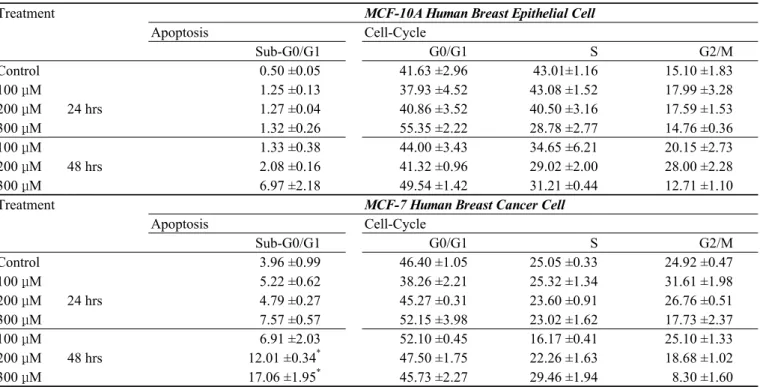
Table 1. Flow cytometry analysis of MCF-10A and MCF-7 cells treated with various concentrations of 6-gingerol for 24 and 48 hrs

Treatment MCF-10A Human Breast Epithelial Cell

Apoptosis Cell-Cycle

Sub-G0/G1 G0/G1 S G2/M

Control 0.50 ±0.05 41.63 ±2.96 43.01±1.16 15.10 ±1.83

100 μM 1.25 ±0.13 37.93 ±4.52 43.08 ±1.52 17.99 ±3.28

200 μM 24 hrs 1.27 ±0.04 40.86 ±3.52 40.50 ±3.16 17.59 ±1.53

300 μM 1.32 ±0.26 55.35 ±2.22 28.78 ±2.77 14.76 ±0.36

100 μM 1.33 ±0.38 44.00 ±3.43 34.65 ±6.21 20.15 ±2.73

200 μM 48 hrs 2.08 ±0.16 41.32 ±0.96 29.02 ±2.00 28.00 ±2.28

300 μM 6.97 ±2.18 49.54 ±1.42 31.21 ±0.44 12.71 ±1.10

Treatment MCF-7 Human Breast Cancer Cell

Apoptosis Cell-Cycle

Sub-G0/G1 G0/G1 S G2/M

Control 3.96 ±0.99 46.40 ±1.05 25.05 ±0.33 24.92 ±0.47

100 μM 5.22 ±0.62 38.26 ±2.21 25.32 ±1.34 31.61 ±1.98

200 μM 24 hrs 4.79 ±0.27 45.27 ±0.31 23.60 ±0.91 26.76 ±0.51

300 μM 7.57 ±0.57 52.15 ±3.98 23.02 ±1.62 17.73 ±2.37

100 μM 6.91 ±2.03 52.10 ±0.45 16.17 ±0.41 25.10 ±1.33

200 μM 48 hrs 12.01 ±0.34

*

47.50 ±1.75 22.26 ±1.63 18.68 ±1.02

300 μM 17.06 ±1.95

*

45.73 ±2.27 29.46 ±1.94 8.30 ±1.60

Cells were treated with 100, 200, and 300 µM of 6-gingerol for 24 and 48 hrs and analyzed by the flow cytometry. All phases are represented in percentage. Each experiment was separately performed in triplicate. Data are shown as mean ± SE. 6-Gingerol treated cells displayed significant apoptosis as compared to control treated cells (P〈0.05 for all concentrations of both cell lines).

*represents the most marked apoptotic effects by 200 and 300 µM of 6-gingerol for 48 hrs in MCF-7 cells.

(4)

226 Hyun-Woo Kim, Deuk-Hee Oh, Jeong-Tae Koh, and Young-Chai Lim

inhibited particularly 52.6% (200 µM) and 79.2% (300 µM) in MCF-7 cells while 43.7% (200 µM) and 56.8%

(300 µM) in MCF-10A cells. Maximal inhibition of cell viability was observed at 300 µM of 6-gingerol following 48 hrs treatment in MCF-7 cells (Fig. 1).

Flow cytometry analysis of breast cells treated with 6-gingerol

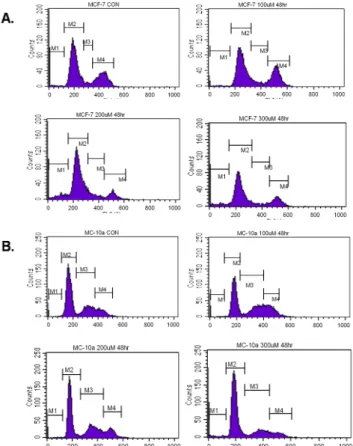
To elucidate the mechanism for 6-gingerol-induced inhibition of cell viability, we performed flow cytometry analysis on both MCF-7 and MCF-10A cells (Fig. 2 and Table 1). 6-Gingerol induced dose- and time-dependent apoptosis in MCF-7 cells. Particularly, 12.0 % and 17.1

% in Sub-G0/G1 phase at 200 and 300 µM of 6-gingerol following 48 hrs treatment was respectively observed in MCF-7 cells. Similar apoptotic pattern was noted in MCF-10A cells and however the magnitude of cell death was quite smaller than that of MCF-7 cells. In addition to

Fig. 2. Histogram of DNA distribution in 6-gingerol treated MCF-7 (A) and MCF-10A (B) cells treated with 100, 200, and 300 µM of 6-gingerol for 24 and 48 hrs. These cells were then harvested, washed in PBS, fixed with 70% ethanol, and stained with propidium iodide. DNA contents were then analyzed by the flow cytometry.

apoptosis, 6-gingerol produced transiently cell cycle arrest without dose- or time-dependent relationship. That is, increase in G1-phase was observed temporarily at 300 µM of 6-gingerol for 24 hrs in MCF-10A cells. MCF-7 cells displayed G1-phase arrest only at 300 µM for 24 hrs and 100 µM for 48 hrs of 6-gingerol treatment (Table 1).

These results suggest that apoptosis is mainly responsible for the inhibition of cell viability by 6-gingerol in MCF-7 cells, although cell cycle arrest is transiently observed.

Caspase-3 activation and PARP cleavage

In order to elucidate the molecular pathways for 6-gingerol-induced apoptosis in MCF-7 cells, we performed the western blotting analysis of apoptotic proteins.

6-Gingerol induced the expression of caspase-3 in these cells. The distinct dose-dependent fashion was not observed.

However, 6-gingerol induced the similar time-dependent fashion, which was observed in earlier experiments on cell viability and flow cytometry (Fig. 3A). Since PARP-specific cleavage follows the activation of caspase-3 in apoptotic pathways, we conducted the western blotting experiment using the antibody against PARP. PARP expression was not observed in 24 hrs but observed in 48 hrs treatment of 6-gingerol. Increasing the dose of 6-gingerol in 48 hrs treatment produced further cleavage of PARP into an 85 kDa fragment (Fig. 3B). However, the dose-dependent fashion in cleavage was not observed.

Fig. 3. Total cellular proteins from these cells treated with

6-gingerol were prepared and western blotting were performed

with an antibody-specific corresponding proteins. (A) Effect of

6-gingerol on the expression of caspase-3 in MCF-7 cells

treated with 100, 200, and 300 µM of 6-gingerol for 24 and 48

hrs, and (B) expression of PARP in MCF-7 cells treated with

100, 200, and 300 µM of 6-gingerol for 24 and 48 hrs

(5)

Discussion

We demonstrated that 6-gingerol induced dose- and time-dependent apoptosis in human breast cancer cells first in this study. Similar dose- and time-dependent fashion of apoptosis was also observed in MCF-10A breast epithelial cells, although its magnitude was smaller than that of MCF-7 breast cancer cells. The molecular mechanism for 6-gingerol-induced apoptosis was further presented as the activation of caspase-3 and the degradation of PARP in breast cancer cells. In addition to apoptosis, 6-gingerol produced transient cell cycle arrest.

6-Gingerol caused anti-tumor effects also in other various cancer cell models by others. For example, 6-gingerol-induced cell death in HL-60 cell lines by DNA fragmentation [10], and it also produced viability reduction in gastric cancer cells [12]. Like our results showing cell cycle arrest and caspase-3-mediated cell death in human breast cancer cells, 6-gingerol caused cell cycle arrest and caspase-3-dependent apoptosis both in human prostate cancer cells [13] and colorectal cancer cells [14].

The caspases are a family of proteins, which are very responsible for the apoptosis. These enzymes are known as cysteine proteases and exist within the cells as the inactive proforms. They could be cleaved to form active enzymes following induction of apoptosis [16]. The PARP (poly (ADP-ribose) polymerase), one of the important DNA repair enzymes was identified to be a substrate for the caspases.

The ability of PARP to repair DNA damage is inhibited following cleavage of PARP by caspase-3 [17]. In addition to 6-gingerol, Amooranin (herbal preparation), roscovitine (inhibitor of cyclin-dependent kinase), and methotrexate (antifolate) also induced apoptosis in MCF-7 cells by expression of caspase-3 and cleavage of PARP [18-20].

Many anti-cancer drugs can usually arrest cell cycle and then induce apoptosis [21,22]. In a similar manner, cell cycle arrest was transiently appeared and disappeared in our study, and then the dose- and time-dependent casepase-3 expression and PARP degradation followed.

Based upon the apoptotic effects of 6-gingerol in human breast cancer cell models, it is suggested that 6-gingerol could be developed as one of anti-breast cancer drugs. More basic biological researches to investigate the mechanism for 6-gingerol-induced responses and animal model studies need

to be carried out beforehand. Certain herbal agents in combination with tamoxifen, well-known anti-breast cancer drug, produced greater inhibitory effects on the growth of human breast cancer cells than herbal agents alone [23,24].

Therefore, further research to test the synergistic anti-cancer effects of 6-gingerol and typical chemotherapeutic drugs for breast cancer could be necessary.

In conclusion, this study demonstrated that 6-gingerol induces dose- and time-dependent apoptotic effects mediated mainly through the expression of caspase-3 and subsequent degradation of PARP in human breast cancer cell models.

Conflict of interest

The authors declare that they have no competing interest.

References

1. Van der Wall RI, Buter J, Van der Waal I. Oral metastasis:

report of 24 cases. Br J Oral Maxillofac Surg. 2003;41;3-6.

doi:10.1016/S0266-4356(02)00301-7.

2. Thorawat A, Naikmasur VG, Patil P, Perumal P. Secondary metastasis to mandible from breast carcinoma-a rare case report. J Clin Diagn Res. 2015;9:zd25-zd26. doi:10.7860/

JCDR/2015/12986.6224.

3. Grant KL, Lutz RB. Gingerol. Am J Health Syst Pharm.

2000;57:945-947.

4. Surh YJ, Lee E, Lee JM. Chemoprotective properties of some pungent ingredients present in red pepper and ginger. Mutat Res. 1998;402:259-267. doi:10.1016/S0027-5107(97)00305-9.

5. Kuo JM, Yeh DB, Pan BS. Rapid photometric assay evaluating antioxidative activity in edible plant material. J Agric Food Chem. 1999;47:3206-3209. doi:10.1021/jf981351o.

6. Lantz RC, Chen GJ, Sarihan M, Solyom AM, Jolad SD, Timmermann BN. The effect of extracts from ginger rhizome on inflammatory mediator production. Phytomedicine.

2006;14:123-128. doi:10.1016/j.phymed.2006.03.003.

7. Shukla Y, Singh M. Cancer preventive properties of ginger:

a brief review. Food Chem Toxicol. 2007;45:683-690.

doi:10.1016/j.fct.2006.11.002.

8. Manju V, Nalini N. Chemopreventive efficacy of ginger, a naturally occurring anticarcinogen during the initiation, post-initiation stages of 1,2 dimethylhydrazine-induced colon cancer. Clin Chim Acta. 2005;358:60-67. doi:10.1016/

j.cccn.2005.02.018.

9. Suzuki F, Kobayashi M, Komatsu Y, Kato A, Pollard RB. A traditional Chinese herbal medicine, inhibits pulmonary metastasis of B16 melanoma. Anticancer Res. 1997;17:

873-878.

10. Park KK, Chun KS, Lee JM, Lee SS, Surh YJ. Inhibitory

(6)

228 Hyun-Woo Kim, Deuk-Hee Oh, Jeong-Tae Koh, and Young-Chai Lim

effects of [6]-gingerol, a major pungent principle of ginger, on phorbol ester-induced inflammation, epidermal ornithine decarboxylase activity and skin tumor promotion in ICR mice. Cancer Lett. 1998;129:139-144. doi:10.1016/

S0304-3835(98)00081-0.

11. Lee E, Surh YJ. Induction of apoptosis in HL-60 cells by pungent vanilloids, [6]-gingerol and [6]-paradol. Cancer Lett.

1998;134:163-168. doi:10.1016/S0304-3835(98)00253-5.

12. Ishiguro K, Ando T, Maeda O, Ohmiya N, Niwa Y, Kadomatsu K, Goto H. Gingerol ingredients reduce viability of gastric cancer cells via distinct mechanisms. Biochem Biophys Res Commun. 2007;36:2218-2223. doi:10.1016/

j.bbrc.2007.08.012.

13. Shukla Y, Prasad S, Tripathi C, Singh M, George J, Kalra N.

In vitro and in vivo modulation of testosterone mediated alterations in apoptosis reated proteins by 6-gingerol. Mol Nutr Food Res. 2007;51:1492-1502. doi: 10.1002/mnfr.2 00700197.

14. Lee SH, Cekanova M, Baek SJ. Multiple mechanisms are involved in 6-gingerol induced cell growth arrest and apoptosis in human colorectal cancer cells. Mol Carcinog.

2008;47:197-208. doi:10.1002/mc.20374.

15. Bray F, McCarron P, Parkin DM. The changing global patterns of female breast cancer incidence and mortality.

Breast Can Res. 2004;6:229-239. doi:10.1186/bcr932.

16. Yuan J, Horvitz HR. A first insight into molecular mechanisms of apoptosis. Cell. 2004;23:53-56.

17. Koh DW, Dawson TM, Dawson VL. Mediation of cell death by poly(ADP-ribose) polymerase-1. Pharmacol Res.

2005;52:5-14. doi:10.1016/j.phrs.2005.02.011.

18. Thangaiyan R, Liming W, Sipra B. Novel triterpenoid 25-hydroxy-3-oxoolean-12-en-28-oic acid induces growth arrest and apoptosis in breast cancer cells. Breast Can Res Treat. 2007;101:27-36. doi:10.1007/s10549-006-9275-z.

19. Wojciechowski J, Horky M, Gueorguieva M, Wesierska- Gadek J. Rapid onest of nucleolar disintegration preceding cell cycle arrest in roscovitine-induced apoptosis of human MCF-7 breast cancer cells. Int J Cancer. 2003;106:486-495.

doi:10.1002/ijc.11290.

20. Deepali KH, Gerald AD, Teneille DW, Kara RJ, Xu D, Irene FN, David AG. Influence of p53 and caspase-3 activity on cell death and senescence in response to methotrexate in the breast tumor cell. Biochem Pharmacol. 2004;68:1699-1708.

doi:10.1016/j.bcp.2004.06.033.

21. Weinert TA, Hartwell LH. Characterization of RAD9 of Saccharomyces cerevisiae and evidence that its function acts posttranslationary in cell cycle arrest after DNA damage. Mol Cell Biol. 1990;10:6554-6564.

22. O’onnor PM, Ferris DK, Pagano M, Draetta G, Pines J, Hunter T, Longo DL, Kohn KW. G2 delay induced by nitrogen mustard in human cells affects cyclin A/cdk2, and cyclin B1/cdc2-kinase complexes differently. J Biol Chem.

1993;268:8298-8303.

23. Chisholm K, Bray BJ, Rosengren RJ. Tamoxifen and epigallocatechin gallate are synergistically cytotoxic to MDA-MB-231 human breast cancers cells. Anticancer Drugs. 2004;9:889-897.

24. Al-Akoum M, Dodin S, Akoum A. Synergistic cytotoxic effects of tamoxifen and black cohosh on MCF-7 and MDA-MB-231 human breast cancer cells: an in vitro study.

Can J Pharmacol. 2007;85:1153-1159. doi:10.1139/Y07-111.

수치

Table 1. Flow cytometry analysis of MCF-10A and MCF-7 cells treated with various concentrations of 6-gingerol for 24 and 48 hrs
Fig. 2. Histogram of DNA distribution in 6-gingerol treated  MCF-7 (A) and MCF-10A (B) cells treated with 100, 200, and  300 µM of 6-gingerol for 24 and 48 hrs

참조

관련 문서

Result : Sophorae Radix inhibited the growth of AGS cells in a dose-dependent fashion. Also we showed that Sophorae Radix induced apoptosis in AGS cells by MTT assay, caspase

S100A8 and S100A9 suppressed the cell survival, and this suppression was found to be associated with apoptosis because they increased the number of apoptotic cells in a dose-

Our results demonstrate that the silencing of ANT2 expression using a DNA vector-based iRNA approach induces apoptotic cell death and cytotoxic bystander effects that elicit anticancer

It was found that EEHF could inhibit the cell proliferation of U937 cells in a concentration-dependent manner, which was associated with apoptotic cell death

We demonstrated that ionizing radiation utilizes PI3K-JNK signaling pathway for amplifying mitochondrial dysfunction and susequent apoptotic cell death: We showed

ated apoptotic pathway, and down-regulation of c-FLIP plays an important role in overcoming TRAIL resistance and is caused by facilitating autophagy-mediated

The in- hibitor of apoptosis protein family (IAPs): an emerging ther- apeutic target in cancer. Caspase-dependent non-apoptotic processes in development. Cell Death

Previously, we reported that 20-O-( β -D-gluco- pyranosyl)-20(S)-protopanaxadiol (Compound K, a meta bolite of ginseng saponin) induces mitochondria-dependent and