Screening of Phenolic Compounds with Inhibitory Activities against HMG-CoA Reductase
Kun Ho Son
1, Ju Yeon Lee
1, Jeong Soon Lee
2, Sam Sik Kang
3, Ho Yong Sohn
1and Chong Suk Kwon
1*
1Department of Food Science and Nutrition, Andong National University, Andong 36729, Korea
2Forest Resources Development Institute of Gyeongsangbuk-do, Andong 36605, Korea
3Natural Products Research Institute, Seoul National University, Seoul 08826, Korea
Received October 27, 2016 /Revised November 15, 2016 /Accepted December 1, 2016
High level of plasma cholesterol is strongly associated with the development of atherosclerosis and coronary heart disease. Clinical trials designed to reduce plasma cholesterol level by diet or pharmaco- logical intervention have resulted in marked reduction of disease incidence. The enzyme 3-hydroxy- 3-methylglutaryl coenzyme A (HMG-CoA) reductase which reduces cholesterol biosynthesis in the liv- er is the key enzyme of the mevalonate pathway that produces cholesterol. In this study, 71 naturally occurring phenolic compounds were tested for inhibitory activities against HMG-CoA reductase.
Eleven compounds out of 71 showed inhibitory activities: three hydrolyzable tannin (geraniin, ace- tonyl geraniin and pentagalloyl β-D-glucose), four benzoic acid derivatives (benzoic acid, trans-cin- namic acid, 2,4-dihydroxybenzoic acid and 2,5-dihydroxybenzoic acid), and four naphthoquinone de- rivatives (1,2-naphthoquinone, 1,4-naphthoquinone, plumbagin and shikonin). At the concentration of 10 μg/ml, 1,4-naphthoquinone inhibited HMG-CoA reductase by 99.4%, and then plumbagin 91.4%, pentagalloyl β-D-glucose 46.6%, 2,4-dihydroxybenzoic acid 40.9%, shikonin 37.7%, 1,2-naphthoquinone 36.6%, trans-cinnamic acid 32.0%, acetonyl geraniin 30.2%, benzoic acid 28.5%, geraniin 28.3% and 2,5-dihydroxybenzoic acid 22.3%, respectively. IC
50values of 1,4-naphthoquinone and plumbagin was 2.1 μg/ml and 5.8 μg/ml, respectively.
Key words : HMG CoA reductase, 1,4-naphthoquinone, plumbagin, pentagalloyl β-D-glucose
*Corresponding author
*Tel : +82-54-820-5484, Fax : +82-54-820-7804
*E-mail : [email protected]
This is an Open-Access article distributed under the terms of the Creative Commons Attribution Non-Commercial License (http://creativecommons.org/licenses/by-nc/3.0) which permits unrestricted non-commercial use, distribution, and reproduction in any medium, provided the original work is properly cited.
Journal of Life Science 2017 Vol. 27. No. 3. 325~333 DOI : https://doi.org/10.5352/JLS.2017.27.3.325
서 론
심혈관계 질환은 2013년 통계 자료에 따르면 세계적으로 질환별 사망률 순위에 있어서 1위[60]이며 우리나라에서도 사 망률 2위인 질병이다[69]. 심혈관계 질환으로 인한 사망자 수 가 2013년에는 전 세계적으로 1,700만 명, 우리나라에서는 57,182 명으로 알려져 있다[60, 69]. 여러 역학 조사 결과로부터 심혈관계 질환 발생의 주 위험 요인이 콜레스테롤, 혈압, 흡연 그리고 운동 부족인 것으로 알려지면서[4, 20, 21], 식생활을 비롯한 생활 습관의 변화와 함께 약물 요법을 병행하여 혈청 콜레스테롤 수치를 낮추고자 중재하는 노력들이 시행되었고, 그 결과 이들 질환의 발병률도 감소하는 것으로 나타났다[9].
체내에서 사용되는 콜레스테롤의 70% 이상은 콜레스테롤 신생합성 과정에서 만들어지므로, 콜레스테롤 합성을 억제하 는 것이 혈장 콜레스테롤을 감소시키는 효과적인 방법이다.
현재 임상적으로 고콜레스테롤혈증 치료에 가장 널리 처방되 고 있는 statin [5, 22]은 콜레스테롤 생합성 과정의 율속효소인 3-hydroxy-3-methylglutaryl coenzyme A (HMG-CoA) re- ductase의 경쟁적 억제제이다[17]. Statin에 의해 콜레스테롤 생합성이 억제되면 세포 내 콜레스테롤 농도가 감소하고, 이 에 대해 세포는 sterol regulating binding protein-2 (SREBP-2) 의 활성화와 LDL-receptor 수의 증가를 통해 혈액 콜레스테롤 의 세포 내 유입을 증가시키게 되고 이로 인해 혈중 콜레스테 롤 농도는 낮아지게 된다[74]. 이와 같은 statin의 혈장 콜레스 테롤 저하 효과에도 불구하고 당뇨병 위험성의 증가, 간 손상, 신경계 이상 및 근육통 등의 부작용들이 보고되고 있다. 따라 서 statin의 단독 사용으로 인한 부작용은 감소시키면서 치료 효과는 상승시킬 수 있는 치료제 또는 치료보조제의 개발을 위한 연구가 계속되고 있다.
최근 들어 polyphenol 함량이 높은 식품의 섭취는 심혈관
계 질환 사망률을 감소시키며[19, 54], 또한 polyphenol의 항산
화 작용으로 인해 LDL의 산화가 억제되어 죽상 동맥 경화증
의 진행이 억제된다는 동물실험 결과들이 보고되고 있다[76,
77]. Polyphenol은 화학적 구조에 따라 체내 흡수율, 항산화
활성, 세포 수용체 및 효소와의 상호 작용도 매우 다양한 것으
로 알려져 있다[65]. 따라서 본 연구에서는 식물로부터 혈장
콜레스테롤 감소 활성을 가지는 물질을 발굴하고자 이전의
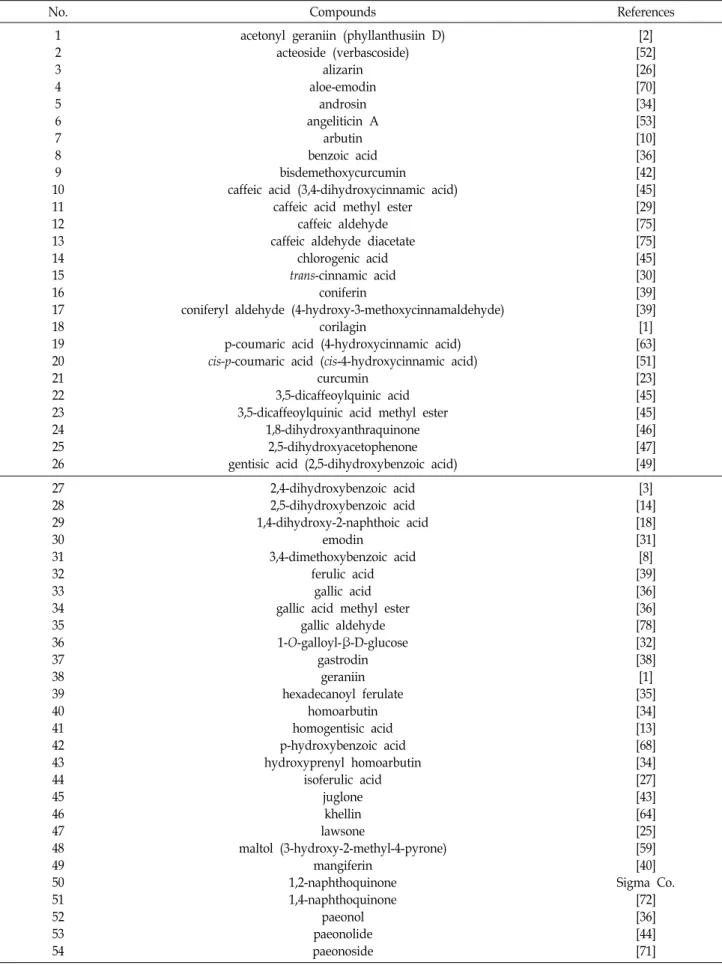
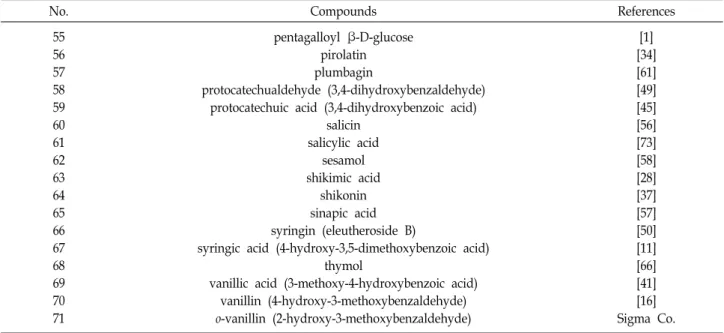
Table 1. The list of 71 phenolic compounds
No. Compounds References
1 2 3 4 5 6 7 8 9 10 11 12 13 14 15 16 17 18 19 20 21 22 23 24 25 26
acetonyl geraniin (phyllanthusiin D) acteoside (verbascoside)
alizarin aloe-emodin
androsin angeliticin A
arbutin benzoic acid bisdemethoxycurcumin
caffeic acid (3,4-dihydroxycinnamic acid) caffeic acid methyl ester
caffeic aldehyde caffeic aldehyde diacetate
chlorogenic acid trans-cinnamic acid
coniferin
coniferyl aldehyde (4-hydroxy-3-methoxycinnamaldehyde) corilagin
p-coumaric acid (4-hydroxycinnamic acid) cis-p-coumaric acid (cis-4-hydroxycinnamic acid)
curcumin 3,5-dicaffeoylquinic acid 3,5-dicaffeoylquinic acid methyl ester
1,8-dihydroxyanthraquinone 2,5-dihydroxyacetophenone gentisic acid (2,5-dihydroxybenzoic acid)
[2]
[52]
[26]
[70]
[34]
[53]
[10]
[36]
[42]
[45]
[29]
[75]
[75]
[45]
[30]
[39]
[39]
[1]
[63]
[51]
[23]
[45]
[45]
[46]
[47]
[49]
27 28 29 30 31 32 33 34 35 36 37 38 39 40 41 42 43 44 45 46 47 48 49 50 51 52 53 54
2,4-dihydroxybenzoic acid 2,5-dihydroxybenzoic acid 1,4-dihydroxy-2-naphthoic acid
emodin
3,4-dimethoxybenzoic acid ferulic acid
gallic acid gallic acid methyl ester
gallic aldehyde 1-O-galloyl-β-D-glucose
gastrodin geraniin hexadecanoyl ferulate
homoarbutin homogentisic acid p-hydroxybenzoic acid hydroxyprenyl homoarbutin
isoferulic acid juglone
khellin lawsone
maltol (3-hydroxy-2-methyl-4-pyrone) mangiferin
1,2-naphthoquinone 1,4-naphthoquinone
paeonol paeonolide paeonoside
[3]
[14]
[18]
[31]
[8]
[39]
[36]
[36]
[78]
[32]
[38]
[1]
[35]
[34]
[13]
[68]
[34]
[27]
[43]
[64]
[25]
[59]
[40]
Sigma Co.
[72]
[36]
[44]
[71]
Table 1.
Continued
No. Compounds References
55 56 57 58 59 60 61 62 63 64 65 66 67 68 69 70 71
pentagalloyl β-D-glucose pirolatin plumbagin
protocatechualdehyde (3,4-dihydroxybenzaldehyde) protocatechuic acid (3,4-dihydroxybenzoic acid)
salicin salicylic acid
sesamol shikimic acid
shikonin sinapic acid syringin (eleutheroside B)
syringic acid (4-hydroxy-3,5-dimethoxybenzoic acid) thymol
vanillic acid (3-methoxy-4-hydroxybenzoic acid) vanillin (4-hydroxy-3-methoxybenzaldehyde) o-vanillin (2-hydroxy-3-methoxybenzaldehyde)
[1]
[34]
[61]
[49]
[45]
[56]
[73]
[58]
[28]
[37]
[57]
[50]
[11]
[66]
[41]
[16]
Sigma Co.
선행연구를 통하여 식물체로부터 분리한 phenol compound 및 관련 화합물 71종에 대해 HMG-CoA reductase 저해 활성 을 탐색하였다.
재료 및 방법
실험재료
본 실험에서 사용한 71종의 페놀 화합물은 Table 1과 같다.
66종의 화합물은 이전의 선행연구 과정에서 참고문헌에 제시 된 방법으로 천연물로부터 분리 및 구조 동정하였고, 5종의 화합물(1,2-naphthoquinone, 1,4-naphthoquinone, plumbagin, shikonin, o-vanillin)은 Simga사(St. Louis, MO, USA)에서 구 입하여 사용하였다. 시료는 Dimethyl sulfoxide (DMSO)로 1 mg/ml 농도로 희석하여 최종 농도 10 μg/ml에서 활성을 측 정하였다.
HMG-CoA reductase 활성
콜레스테롤 합성 억제 활성은 HMG-CoA reductase assay kit (Sigma, St. Louis, MO, USA)를 사용하여 in vitro에서 측정 하였다. 간략하면, HMG-CoA reductase에 의해 HMG-CoA가 mevalonate로 환원될 때 NADPH가 NADP
+로 산화되는 정 도를 340 nm에서 15분간 흡광도의 변화로 측정하였다(Molec- ular Devices Co., Sunnyvale, CA, USA). Pravastatin을 pos- itive control로 사용하여 시료의 저해 활성과 비교하였다.
HMG-CoA reductase 활성 저해율(%)은 blank의 흡광도 변화 (100% 활성)에 대한 시료의 흡광도 변화로 계산하였다[저해율 (%) = (1–시료의 흡광도 변화/Blank의 흡광도 변화) ×100].
HMG-CoA reductase 활성 저해율이 20% 이상인 시료들에
대해서는 저해율 50%를 나타내는 시료 농도(IC
50)를 구하였다.
결과 및 고찰
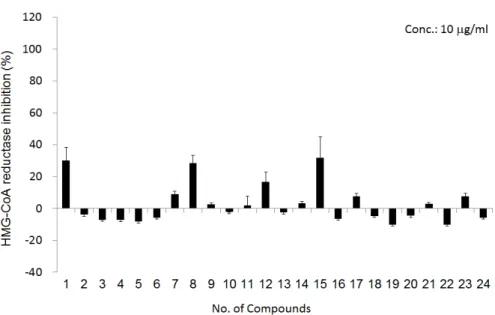
페놀 및 관련 화합물 71종의 HMG-CoA reductase 저해 활 성을 시료 농도 10 μg/ml에서 측정한 결과는 Fig. 1, Fig. 2 및 Fig. 3과 같다. HMG-CoA reductase 저해율이 가장 높은 화합물은 1,4-naphthoquinone으로 99.4%의 저해율을 보였고, 다음으로 plumbagin 91.4%, pentagalloyl β-D-glucose 46.6%, 2,4-dihydroxybenzoic acid 40.9%, shikonin 37.7%, 1,2-naph- thoquinone 36.6%, trans-cinnamic acid 32.0%, acetonylger- aniin 30.2%, benzoic acid 28.5%, geraniin 28.3%, gentisic acid (2,5-dihydroxybenzoic acid) 22.3%의 순이었다. 이상 11종의 페놀 화합물을 대상으로 IC
50값을 계산한 결과(Table 2), 1,4- naphthoquinone의 IC
50가 2.1 μg/ml로 가장 낮았으며, plum- bagin과 pentagalloyl β-D-glucose은 각각 5.8 μg/ml과 13.1 μg/ml으로 나타났다. 1,4-naphthoquinone과 plumbagin의 경 우, 5 μg/ml에서도 각각 90.3%와 43.3%의 저해율을 나타내었 다(Table 2).
저해 활성이 강한 11종 화합물은 각각 가수분해성 tannin
(geraniin, acetonyl geraniin, pentagalloyl β-D-glucoee) 3종,
benzoic acid 유도체(benzoic acid, trans-cinnamic acid, 2,4-
dihydroxybenzoic acid, 2,5-dihydroxybenzoic acid) 4종, 그리
고 naphthoquinone 유도체(1,2-naphthoquinone, 1,4-naph-
thoquinone, plumbagin, shikonin) 4종으로 분류되었으며, 구
조는 Fig. 4와 같다. 저해 활성을 나타내는 물질들 간의 구조적
인 관련성을 살펴 본 결과, 4 종의 naphthoquinone 유도체
(1,2-naphthoquinone, 1,4-naphthoquinone, plumbagin 및
Fig. 1. HMG-CoA reductase inhibition (%) of phenolic compounds (From no. 1 to 24). Final concentration of sample is 10 μg/ml.
Compounds: 1, acetonyl geraniin (phyllanthusiin D); 2, acteoside (verbascoside); 3, alizarin; 4, aloe-emodin; 5, androsin; 6, angeliticin A; 7, arbutin; 8, benzoic acid; 9, bisdemethoxycurcumin; 10, caffeic acid (3,4-dihydroxycinnamic acid); 11, caffeic acid methyl ester; 12, caffeic aldehyde; 13, caffeic aldehyde diacetate; 14, chlorogenic acid; 15, trans-cinnamic acid; 16, coniferin;
17, coniferyl aldehyde (4-hydroxy-3-methoxycinnamaldehyde); 18, corilagin; 19, p-coumaricacid (4-hydroxycinnamic acid); 20, cis-p-coumaricacid (cis-4-hydroxycinnamic acid); 21, curcumin; 22, 3,5-dicaffeoylquinic acid; 23, 3,5-dicaffeoylquinic acid methyl ester; 24, 1,8-dihydroxyanthraquinone.
Fig. 2. HMG-CoA reductase inhibition (%) of phenolic compounds (From no. 25 to 48). Final concentration of sample is 10 μg/ml.
25, 2,5-dihydroxyacetophenone; 26, gentisic acid (2,5-dihydroxybenzoic acid); 27, 2,4-dihydroxybenzoic acid; 28, 3,5-dihydrox- ybenzoic acid; 29, 1,4-dihydroxy-2-naphthoic acid; 30, emodin; 31, 3,4-dimethoxybenzoic acid; 32, ferulic acid; 33, gallic acid;
34, gallic acid methyl ester; 35, gallic aldehyde; 36, 1-O-galloyl-β-D-glucose; 37, gastrodin; 38, geraniin; 39, hexadecanoyl ferulate; 40, homoarbutin; 41, homogentisic acid; 42, p-hydroxybenzoic acid; 43, hydroxyprenyl homoarbutin; 44, isoferulic acid; 45, juglone; 46, khellin; 47, lawsone; 48, maltol (3-hydroxy-2-methyl-4-pyrone).
shikonin) 가운데서 두 개의 carbonyl group이 para 위치에 존재하는 1,4-naphthoquinone, plumbagin 및 shikonin의 IC
50값이 각각 2.1, 5.8 및 18.6 μg/ml이었고, ortho 위치에 존재하는 1,2-naphthoquinone은 34.1 μg/ml을 나타내어 carbonyl
group이 para 위치에 있는 화합물의 HMG-CoA reductase 저
해 활성이 더 높음을 알 수 있었으며, para 위치에 carbonyl
group을 갖고 있는 화합물들 간에도 phenol성 hydroxyl
group이 없는 1,4-naphthoquinone의 활성이 가장 높고, 다음
Fig. 3. HMG-CoA reductase inhibition (%) of phenolic compounds (From no. 49 to 71). Final concentration of sample is 10 μg/ml.
49, mangiferin; 50, 1,2-naphthoquinone; 51, 1,4-naphthoquinone; 52, paeonol; 53, paeonolide; 54, paeonoside; 55, pentagalloyl β-D-glucose; 56, pirolatin; 57, plumbagin; 58, protocatechualdehyde (3,4-dihydroxybenzaldehyde); 59, protocatechuic acid (3,4-dihydroxybenzoic acid); 60, salicin; 61, salicylic acid; 62, sesamol; 63, shikimic acid; 64, shikonin; 65, sinapic acid; 66, syringin (eleutheroside B); 67, syringic acid (4-hydroxy-3,5-dimethoxybenzoic acid); 68, thymo; 69, vanillic acid (3-methoxy- 4-hydroxybenzoic acid); 70, vanillin (4-hydroxy-3-methoxybenzaldehyde); 71, o-vanillin (2-hydroxy-3-methoxybenzaldehyde).
Table 2. HMG-CoA reductase inhibition (%) and half maximal inhibitory concentration (IC50) of phenolic compounds
Compounds Concentration (μg/ml) IC50
(μg/ml)
1.0 2.5 5.0 10.0 25.0 50.0
acetonyl geraniin (phyllanthusiin D) benzoic acid
trans-cinnamic acid 2,4-dihydroxybenzoic acid gentisic acid (2,5-dihydroxybenzoic acid)
geraniin 1,2-naphthoquinone 1,4-naphthoquinone pentagalloyl β-D-glucose
plumbagin shikonin
28.4
1.11
66.2
6.9
5.7
15.3 90.3 15.4 43.3
30.2 28.5 32.0 40.9 22.3 28.3 36.6 99.4 46.6 91.4 37.7
83.1 47.9 78.7 47.9 27.5 44.3 39.0
91.2
59.6
91.8
65.1 81.6 97.9
92.3
16.0 37.9 34.5 26.2 32.3 24.5 34.1 2.1 13.1 5.8 18.6
으로 hydroxyl group을 한 개 갖고 있는 plumbagin, 그리고 두 개 있는 shikonin의 순으로 저해 활성이 감소하여 hydroxyl group의 수가 많을수록 활성이 감소하는 경향을 나타내었다.
천연에 존재하는 naphtoquinone에는 1,4-naphthoquinone, 1,2-naphthoquinone, juglone, droserone, plumbagin, shiko- nin 등이 있으며, 이들의 기능성으로는 세포독성, 항균, 항진 균, 항바이러스, 살충, 항염증 및 해열작용 등이 알려져 있다 [7]. 특히 plumbagin은 세포와 동물실험에서 콜레스테롤과 중 성지방을 감소시키며[67], 항동맥경화 활성[15]을 가지는 것이 보고되어 있다. Pentagalloyl β-D-glucose의 경우, 콜레스테롤 합성 효소 중의 하나인 squalene synthase 활성[62]과 angio- tensin I 에 의해 유도되는 혈압상승을 유의적으로 억제하는
것이 보고되어 있다[55]. Cinnamic acid, 3,4-dihydroxycin- namate 및 3,4-dihydroxyhydrocinnamate가 고콜레스테롤 식 이 동물의 간 HMG-CoA reductase 활성을 유의적으로 억제하 였다는 보고도 있다[48]. Geraniin은 비만을 유도한 흰 쥐에서 혈장 중성지방과 콜레스테롤을 감소시키고 지방 축적을 억제 하며[12], gentisic acid는 LDL 산화를 억제한다는 보고가 있다 [6].
가수분해성 tannin 3종은 대극(Euphorbia pekinensis) 지상부
에서, benzoic acid는 작약(Paeonia lactiflora)에서, trans-cin-
namic acid는 나팔꽃(Pharbitis nil.) 종자인 견우자에서, 2,4-di-
hydroxybenzoic acid는 옻나무(Phus verniciflua) 심재에서,
2,5-dihydroxybenzoic acid는 잔나비걸상 버섯(Ganoderma ap-
A, B C
D E
F G H
I J K
Fig. 4. Structure of phenolic compounds. A, geraniin; B, acetonyl geraniin; C, pentagalloyl β-D-glucose; D, benzoic acid; E, trans-cin- namic acid; F, 2,4-dihydroxybenzoic acid; G, gentisic acid (2,5-dihydroxybenzoic acid); H, 1,2-naphthoquinone; I, 1,4-naph- thoquinone; J, plumbagin; K, shikonin.
planatum)에서 각각 분리하였으며, naphthoquinone 유도체 4
종의 경우 참고 문헌에 제시한 바와 같이 식물에서 분리 보고 된바 있는 화합물이지만 본 연구에서는 표준품을 구입(Sigma 사)하여 사용하였다. 71종의 페놀 화합물을 대상으로 HMG- CoA reductase 저해 활성을 탐색한 결과, 1,4-naphthoquinone 과 plumbagin의 저해 활성이 강한 것으로 확인되었으며, 이들 을 이용한 고콜레스테롤혈증 개선 효과를 가지는 건강기능성 식품 또는 약품의 개발을 위한 추후 연구가 필요한 것으로 사료된다.
감사의 글
이 논문은 2015학년도 안동대학교 연구비에 의하여 연구되
었음.
References
1. Ahan, B. T., Lee, S. C., Park, W. Y., Lee, S. H., Ro, J. S., Lee, K. S. and Ryu, E. K. 1992. Pharmacognostical study on Euphorbia ebracteolata (II)-On the chemical study of the tannins and related compounds. Kor. J. Pharmacogn. 23, 211- 217.
2. Ahn, B. T. and Kang, S. S. 1996. Phenolic compounds from Aerial Parts of Euphorbia pekinensis. Kor. J. Pharmacogn. 27, 142-145.
3. Ahn, E. M., Park, S. J., Choi, W. C., Choi, S. H. and Baek, N. I. 2007. Antioxidant activity of isolated compounds from the heartwoods of Rhus verniciflua. J. Kor. Soc. Appl. Biol.
Chem. 50, 358-361.
4. Anderson, K. M., Wilson, P. W., Garrison, R. J. and Castelli, W. P. 1987. Longitudinal and secular trends in lipoprotein cholesterol measurements in a general population sample.
The Framingham offspring study. Atherosclerosis 68, 59-66.
5. Ansell, B. J., Watson, K. E. and Fogelman, A. M. 1999. An evidence-based assessment of the NCEP adult treatment panel II guidelines. JAMA 282, 2051-2057.
6. Ashidate, K., Mimura, M. D., Tohda, H., Miyazaki, S., Teramoto, T., Yamamoto, Y. and Hirata, Y. 2005. Gentisic acid, an aspirin metabolite, inhibits oxidation of low-density lipoprotein and the formation of cholesterol ester hydro- peroxides in human plasma. Eur. J. Pharmacol. 513, 173-179.
7. Babula, P., Adam, V., Havel, L. and Kizek, R. 2007. Naph- thoquinones and their pharmacological properties. Ceská a Slovenská Farmacie (in Czech) 56, 114-120.
8. Barger, G. and Silberschmidt, R. 1928. CCCLXXXIV.—The constitution of laurotetanine. J. Chem. Soc. 17, 2919-2927.
9. Blankenhorn, D. H., Johnson, R. L., Nessim, S. A., Azen, S. P., Sanmarco, M. E. and Selzer, R. H. 1987. The cholesterol lowering atherosclerosis study (CLAS): design, methods and baseline results. Control Clin. Trials. 8, 356-387.
10. Cho, J. Y., Park, K. Y., Lee, K. H., Lee, H. J., Lee, S. H., Cho, J. A., Kim, W. S., Shin, S. C., Park, K. H. and Moon, J. H. 2011. Recovery of arbutin in high purity from fruit peels of pear (Pyrus pyrifolia Nakai). Food Sci. Biotec. 20, 801- 807.
11. Cho, J. Y., Xing, Y., Park, K. H., Park, H. J., Park, S. Y., Moon, J. H. and Ham, K. S. 2013. Isolization and identi- fication of antioxidative compounds and their activities from Suaeda japonica. Food Sci. Biotechnol. 22, 1547-1557.
12. Chung, A. P. Y. S., Ton, S. H., Gurtu, S. and Palanisamy, U. D. 2014. Ellagitannin geraniin supplementation amelio- rates metabolic risks in high-fat diet-induced obese Sprague Dawley rats. J. Funct. Food 9, 173-182.
13. Dai, J., Kardono, L. B. S, Tsauri, S., Padmawinata, K., Pezzuto, J. M. and Kinghorn, A. D. 1991. Phenylacetic acid derivatives and a thioamide glycoside from Entada phaseo- loides. Phytochemistry 30, 3749-3752.
14. De Koster, C. G., Niemann, G. J. and Heerma, W. 1986. Fast atom bombardment mass spectrometry of hydroxybenzoic acids. Fresenius' Z. Anal. Chem. 323, 321-325.
15. Ding, Y., Chen, Z. J., Liu, S., Che, D., Vetter, M. and Chang, C. H. 2005. Inhibition of Nox-4 activity by plumbagin, a plant-derived bioactive naphthoquinone. J. Pharm. Pharmacol.
57, 111-116.
16. Egawa, T., Akiyo, K. and Hiroshi, T. 2006. Structural deter- mination of vanillin, isovanillin and ethylvanillin by means of gas electron diffraction and theoretical calculations. J.
Mol. Struct. 794, 92-102.
17. Endo, A. 1992. The discovery and development of HMG- CoA reductase inhibitors. J. Lipid Res. 33, 1569-1582.
18. Eom, J. E., Kwon, S. C. and Moon, G. S. 2012. Detection of 1,4-dihydroxy-2-naphthoic acid from commercial mak- geolli products. Prev. Nutr. Food Sci. 17, 83-86.
19. Giugliano, D. 2000. Dietary antioxidants for cardiovascular
prevention. Nut. Metab. Cardivasc. Dis. 10, 38-44.
20. Gordon, T. and Kannel, W. B. 1972. Predisposition to athero- sclerosis in the head, heart, and legs. The Framingham study. JAMA 221, 661-666.
21. Grundy, S. M. 1977. Treatment of hypercholesterolemia. Am.
J. Clin. Nutr. 30, 985-992.
22. Grundy, S. M. 1998. Statin trials and goals of cholester- ol-lowering therapy. Circulation 97, 1436-1439.
23. Han, S. Y. and Choi, S. C. 2002. Antibacterial activity and identification of the active compound from Turmeric extract.
J. Kor. Soc. Dyers Finishers 14, 11-17.
24. Haslam, E., Haworth, R. D., Mills, S. D., Rogers, H. J., Armitage, R. and Searle, T. 1961. 359. Gallotannins. Part II.
Some esters and depsides of gallic acid. J. Chem. Soc. 1836- 1842.
25. Hiroshige. Y., Miyuki, Y., Yukiko, S., Masatake, I., Mutsuko, O., Yohko, F., Keiki, K., Yukio, O. and Yo, U. 1979. Tauto- merism of 4-amino- and 4-arylamino-1,2-naphthoquinones.
Chem. Pharm. Bull. 28, 207-1213.
26. Jeon, J. H., Song, H. Y., Kim, M. G. and Lee, H. S. 2009.
Anticoagulant properties of alizarin and its derivatives de- rived from the seed extract of Cassia obtusifolia. J. Kor. Soc.
Appl. Biol. Chem. 52, 163-167.
27. Jeong, D. M., Jung, H. A., Kang, H. S. and Choi, J. S. 2008.
Peroxynitrite scavengers from Phellinus linteus. Nat. Prod.
Sci. 14, 1-11.
28. Jeong, O. J. and Jung, I. C. 2006. Phenolic compounds of ligustrum japonicum leaves. J. Kor. Soc. Food Sci. Nut. 35, 713-720.
29. Jung, D. Y., Ha, H. K., Lee, H. Y., Kim, C. S., Lee, J. H., Bae, K. H., Kim, J. S. and Kang, S. S. 2008. Triterpenoid saponins from the seeds of Pharbitis nil. Chem. Pharm. Bull.
56, 203-206.
30. Jung, H. W., Choi, J. Y., Lee, J. G., Choi, E. H., Oh, J. S., Kim, D. C., Kim, J. A., Park, S. H., Son, H. K. and Lee, S. H. 2007. Isolation of melanogenesis inhibitors from Cinnamomi cortex. Kor. J. Pharmacogn. 38, 382-386.
31. Kang, S. S. and Woo, W. S. 1982. Anthraquinones from the leaves of Polygonum sachalinense. Kor. J. Pharmacogn. 13, 7-9.
32. Kashiwada, Y., Nonaka, G. I., Nishioka, I. and Yamagishi, T. 1988. Galloyl and hydroxycinnamoylglucoses from rhubarb. Phytochemistry 27, 1473-1477.
33. Kim, J. S., Yean, M. H., Seo, H. K., Lee, J. H. and Kang, S. S. 2009. Phytochemical studies on lonicera caulis (2) - Aliphatic and phenolic compounds. Kor. J. Pharmacogn. 40, 326-333.
34. Kim, J. S., Shim, S. H., Xu, Y. N., Kang, S. S., Son, K. H., Chang, H. W., Kim, H. P. and Bae, K. H. 2004. Phenolic glycosides from Pyrola japonica. Chem. Pharm. Bull. 52, 714-717.
35. Kim, J. S., Han, S. J., Byun, J. H., Xu, Y. N., Yoo, S. W., Kang, S. S., Son, K. H., Chang, H. W. and Kim, H. P. 2001.
Minor constituents from the roots of Sophora flavescens. Nat.
Prod. Sci. 7, 5-8.
36. Kim, J. S., Kim, Y. J., Lee, J. Y. and Kang, S. S. 2008.
Phytochemical studies on Paeoniae radix (2); Phenolic and
related compounds. Kor. J. Pharmacogn. 39, 28-36.
37. Kim, J. S., Han, Y. S. and Kang, M. H. 2006. Identification of shikonin and its derivatives from Lithospermum erythro- rhizon. J. Kor. Soc. Food Sci. Nutr. 35, 177-181.
38. Kim, K. T., Kim, J. G., Park, S. H., Lee, J. H., Lee, S. H., Kim, K. H. and Park, S. N. 2004. Anti-melanogenesis Effect of phenolic compounds isolated from Gastrodia elata. J. Soc.
Cosmet. Scientists Korea 30, 33-38.
39. Kim, T. H., Shin, S. R., Kim, T. W., Lee, I. C., Park, M. Y.
and Jo, C. 2009. A tyrosinase inhibitor isolated from the seeds of Eriobotrya japonica. Kor. J. Food Preserv. 16, 435-441.
40. Kim, W. J., Veriansyah, B., Lee, Y. W., Kim, J. H. and Kim, J. D. 2010. Extraction of mangiferin from Mahkota Dewa (Phaleria macrocarpa) using subcritical water. J. Ind. Eng.
Chem. 16, 425-430.
41. Kim, W. J., Lee, K. T., Lee, H. J. and Cho, S. T. 2014.
Extractives from wood of Euonymus japonica. J. Kor. For. Soc.
103, 133-121.
42. Kiuchi F., Goto, Y., Sugimoto, N., Akao, N., Kondo, K. and Tsuda, Y. 1993. Nematocidal activity of turmeric: synergistic action of curcuminoids. Chem. Pharm. Bull. 41, 1640-1643.
43. Kobayashi, M., Terui, Y., Tori, K. and Tsuji, N. 1976.
Carbon-13 NMR spectra of juglone, naphthazarin and their derivatives. Tetrahedron Lett. 17, 619-620.
44. Lau, C. K., Patrice, P. C., Dufresne, C. and Scheigetz, J. 1987.
Novel cyclization of S-(0–acetylaryl) dimethylthiocarbamates.
A new synthesis of 3-hydroxybenzothiophenes and 2-hy- droxythiochromones. J. Org. Chem. 52, 1670-1673.
45. Lee, E. J., Kim, J. S., Kim, H. P., Lee, J. H. and Kang, S.
S. 2010. Phenolic constituents from the flower buds of Lonicera japonica and their 5-lipoxygenase inhibitory activ- ities. Food Chem. 120, 134-139.
46. Lee, H. S. 2010. Suppressive effects of dihydroxyan- thraquinone derivatives against inducible nitric oxide synthase. J. Kor. Soc. Appl. Biol. Chem. 53, 831-837.
47. Lee, J. Y., Lee, E. J., Kim, J. S., Lee, J. H. and Kang, S. S.
2011. Phytochemical studies on Rehmanniae radix preparata.
Kor. J. Pharmacogn. 42, 117-126.
48. Lee, M. K., Park, Y. B., Moon, S. S., Bok, S. H., Kim, D.
J., Ha, T. Y., Jeong, T. S., Jeong, K. S. and Choi, M. S. 2007.
Hypocholesterolemic and antioxidant properties of 3-(4-hy- droxyl)propanoic acid derivatives in high-cholesterol fed rats. Chem. Biol. Interact. 170, 9-19.
49. Lee, S. H., Shim S. H., Kim, J. S., Shin, K. H. and Kang, S. S. 2005. Aldose reductase inhibitors from the fruiting bod- ies of Ganoderma applanatum. Biol. Pharm. Bull. 28, 1103-1105.
50. Lee, S. H., Kang, S. S., Cho, S. H., Ryu, S. N. and Lee, B.
J. 2005. Determination of eleutherosides B and E in various parts of Acanthopanax species. Kor. J. Pharmacogn. 36, 70-74.
51. Lee, S. H., Kim, W. S., Park, K. H. and Moon, J. H. 2013.
Isolation and identification of 3 low-molecular compounds from pear (Pyrus pyrifolia Nakai cv. Chuhwangbae) fruit peel. Kor. J. Food Sci. Technol. 45, 174-179.
52. Lee, S. Y., Yean, M. H., Kim, J. S., Lee, J. H. and Kang, S. S. 2011. Phytochemical studies on Rehmanniae radix. Kor.
J. Pharmacogn. 42, 127-137.
53. Li, Y., Yang, S. and Bai, S. 2009. Studies on chemical con- stituents from roots of Angelica polymorpha. Zhong Yao Cai 34, 854-857.
54. Limpe, J. W. 1999. Health effects of vegetables and fruit:
assessing mechanisms of action in human experimental studies. Am. J. Clin. Nutr. 70, 475S-490S.
55. Liu, J. C., Hsu, F. L., Tsai, J. C., Chan, P., Liu, J. Y., Thomas, G. N., Tomlinsonm, B., Lo, M. Y. and Lin, J. Y. 2003.
Antihypertensive effects of tannins isolated from traditional Chinese herbs as non-specific inhibitors of angiontensin con- verting enzyme. Life Sci. 73, 1543-1555.
56. Liu, X., Zhang, B., Chou, G., Yang, L. and Wang, Z. 2012.
Chemical constituents from Imperata cylindrica. Zhong Yao Cai 37, 2296-2300.
57. Massow, F. V. and Smith, M. A. 1976. Indirect 13C–1H cou- pling in asymmetrically trisubstituted benzenes: a carbon-13 nuclear magnetic resonance study. J. Chem. Soc. 9, 977-980.
58. Neering, H., Vitányi, B. E., Malten, K. E., van Ketel, W. G.
and van Dijk, E. 1975. Allergens in sesame oil contact dermatitis. Acta. Derm. Venereol. 55, 31-34.
59. Ning, Y., Sun, J., Lv, H. N., Tu, P. F. and Jiang, Y. 2013.
Chemical constituents from seeds of Vigna umbellata. Zhong Yao Cai. 38, 1938-1941.
60. O’Rourke, Y., VanderZanden, A., Shepard, D. and Leach- Kemon, K. 2015. Cardiovascular disease worldwide, 1990- 2013. JAMA 314, 1905.
61. Padhye, S. B and Kulicarni, B. A. 1974. PMR evidence for hydrogen bonding in naturally occurring isomeric juglones.
J. Magn. Reson. 16, 150-152.
62. Park, J. K., Cho, H. J., Lim, Y., Cho, Y. H. and Lee, C. H.
2002. Hypocholestrolemic effect of CJ90002 in hamsters: A potent inhibitor for squalene synthase from Paeonia moutan.
J. Microbiol. Biotechnol. 12, 222-227.
63. Quick, J. and Meltz, C. 1978. Treatment of cinnamic acids with polyphosphoric acid. Chem. Commun. 8, 355.
64. Sayed, H. M., Mohamed, M. H., Farag, S. F., Mohamed, G.
A. and Proksch, P. 2007. A new steroid glycoside and furo- chromones from Cyperus rotundus L. Nat. Prod. Res. 21, 343- 350.
65. Scalbert, A. and Williamson, G. 2000. Dietary intake and bioavailability of polyphenols. J. Nutr. 130, 2073S-85S.
66. Schulte, K. E., Reisch, J. and Hopmann, J. 1963.
Polyacetylene und Phenoläther als inhaltsstoffe der Wurzeln von Pulicaria-Arten. Arch. Pharm. Ber. Dtsch. Pharm. Ges. 296, 353-364.
67. Sharma, I., Gusain, D. and Dixit, V. P. 1991. Hypolipidaemic and antiatherosclerotic effects of plumbagin in rabbits.
Indian J. Physiol Pharmacol. 35, 10-14.
68. Shin, H. J., Lee, S. Y., Kim, J. S., Lee, S. H., Choi, R. J., Chung, H. S., Kim, Y. S. and Kang, S. S. 2012. Sesquiterpenes and other constituents from Dendranthema zawadskii var. lat- ilobum. Chem. Pharm. Bull. 60, 306-314.
69. Statistics Korea. 2013. Statistics of the cause of death.
70. Sydiskis, R. J., Owen, D. G., Lohr, J. L., Rosler, K. H. and Blomster, R. N. 1991. Inactivation of enveloped viruses by anthraquinones extracted from plants. Antimicrob. Agents.
초록:페놀 화합물로부터 HMG-CoA reductase 저해 활성 물질 탐색
손건호
1․이주연
1․이정순
2․강삼식
3․손호용
1․권정숙
1*
(1안동대학교 생활과학대학 식품영양학과, 2경상북도산림자원개발원, 3서울대학교 천연물과학연구소)
심혈관계 질환은 질환별 사망률 순위에 있어서 세계에서는 1위이며, 우리나라에서는 2위인 질병이다. 심혈관계 질환 발생의 주 위험 요인인 콜레스테롤은 HMG-CoA reductase에 의해 간에서 신생합성이 조절된다. 현재 고콜 레스테롤혈증 치료에 statin이 널리 사용되고 있지만 광범위한 부작용이 보고되고 있어서 이를 대체하거나 보조할 수 있는 천연물 유래의 기능성 물질 개발이 필요한 실정이다. 따라서 본 연구에서는 혈장 콜레스테롤 감소 활성을 가지는 물질을 발굴하고자 71종의 페놀 및 그와 관련된 화합물들을 대상으로 10 ug/ml 농도에서 HMG-CoA re- ductase 저해 활성을 탐색하였다. 그 결과, 1,4-naphthoquinone의 HMG-CoA reductase 저해율이 99.4%로 가장 높았고, 다음으로 plumbagin 91.4%, pentagalloyl β-D-glucose 46.6%, 2,4-dihydroxybenzoic acid 40.9%, shikonin 37.7%, 1,2-naphthoquinone 36.6%, trans-cinnamic acid 32.0%, acetonylgeraniin 30.2%, benzoic acid 28.5%, ger- aniin 28.3%, gentisic acid 22.3%의 순이었다. IC
50값을 계산한 결과, 1,4-naphthoquinone가 2.1 μg/ml로 가장 낮았 으며, plumbagin과 pentagalloyl β-D-glucose은 각각 5.8 μg/ml과 13.1 μg/ml으로 나타났다. 1,4-naphthoquinone 과 plumbagin의 경우, 5 μg/ml에서도 각각 90.3%와 43.3%의 저해율을 나타내었다.
Chemother. 35, 2463-2466.
71. Vermes, B., Farkas, L., Nogradi, M., Wagner, H. and Dirscherl, R. 1976. The synthesis of afzelin, paeonoside and kaempferol 3-O-β-rutinoside. Phytochemistry 15, 1320-1321.
72. Wang, Y. N., Shi, G. L., Ren, J. J., Zhao, L., Du, J., Liu, Y.
B. and Zhao, L. L. 2009. Structure identification of an acar- icidal active ingredient from green walnuts husks (Juglans regia). Bioinform. Biomed. Eng. 3, 1-4.
73. Wee, J. J., Park, J. D., Kim, M. W. and Lee, H. J. 1989.
Identification of phenolic antioxidant components isolated from Panax ginseng. J. Kor. agric. Chem. Soc. 32, 50-56.
74. Wierzbicki, A. S. 2003. New lipid-lowering agents. Expert Opin. Emerg. Drugs. 8, 365-376.
75. Woo, W. S. and Kang, S. S. 1979. A new phenolic aldehyde
from the seeds of Phytolacca americana. Kor. J. Pharmacogn.
10, 83-84.
76. Xu, R., Yokoyama, W. H., Irving, D., Rein, D., Walzem, R.
L. and German, J. B. 1998. Effect of dietary catechin and vitamin E on aortic fatty streak accumulation in hyper- cholesterolemic hamsters. Atherosclerosis 137, 29-36.
77. Yamaloshi, J., Ktaoka, S., Koga, T. and Ariga, T. 1999. Proan- thocyanidinrich extract from grape seed attenuates the de- velopment of arotic atherosclerosis in cholesterol-fed rabbits.
Atheroscelerosis 142, 139-149.
78. Yean, M. H., Kim, J. S., Hyun, Y. J., Hyun, J. W., Bae, K.
H. and Kang, S. S. 2012. Terpenoids and phenolics from Geum japonicum. Kor. J. Pharmacogn. 43, 107-121.