• 검색 결과가 없습니다.

Prognostic Significance of Immunohistochemical Expression of p53 and Retinoblastoma Gene Protein (pRB) in Curatively Resected Gastric Cancer

N/A
N/A
Protected

Academic year: 2021

Share "Prognostic Significance of Immunohistochemical Expression of p53 and Retinoblastoma Gene Protein (pRB) in Curatively Resected Gastric Cancer"

Copied!
7
0
0

로드 중.... (전체 텍스트 보기)

전체 글

(1)

Prognostic Significance of Immunohistochemical Expression of p53 and Retinoblastoma Gene Protein

(pRB) in Curatively Resected Gastric Cancer

Hong Suk Song, M.D., In Ho Kim, M.D.

2

, Soo Sang Sohn, M.D.

2

, Kun Young Kwon, M.D.

3

and Won Sik Lee, M.D.

4

Departments of Internal Medicine, General Surgery

2

and Pathology

3

, Keimyung University School of Medicine, Daegu, Korea; Department of Internal Medicine, Fatima Hospital

4

, Daegu, Korea

Background : The aim of this study was to determine the prognostic significance of the expression of p53 and retinoblastoma (Rb) gene products in cases of curatively resected gastric adenocarcinoma, by immunohistochemical analysis.

Methods : Between January 1996 and December 2001, 736 curatively resected gastric cancer patients underwent immunohistochemical staining for p53 or Rb proteins (pRb), and we retrospectively analyzed the correlation of our results with the clinical outcomes of these cases.

Results : High levels of expression of p53 (>25% p53-positive cells) and Rb (>50% Rb-positive cells) proteins were detected in 40.1% and 43.7% of cases, respectively. Tubular type was found to frequently exhibit higher levels of p53 expression (high expression in 44.2%) than signet ring cell type (high expression in 26.0%) (p=0.042). The incidence of vascular invasion was lower in the high pRb expressors (43.2%) than in the pRb low expressors (56.8%), but this was not a statistically significant discrepancy (p=0.063). Preoperative CEA levels were found to be low in high pRb expressors: initial CEA level in the high pRb expressors was 2.31±3.30 ng/mL, and was 5.18±24.80 ng/mL in the low pRb expressors (p=0.033). Tumor depth and node metastasis were both independent of the levels of expression of p53 and Rb proteins. The seven-year overall survival rate and relapse-free survival rates of patients were 87.2% and 75.7%, respectively. Multivariate Cox regression analysis indicated that tumor stage, tumor size, patient age and pRb expression were the significant prognostic factors with regard to overall survival, and tumor stage and age were both significant factors with regard to relapse-free survival.

Conclusion : Immunohistochemical staining of retinoblastoma gene products was an independent prognostic factor for the prediction of overall survival in curatively resected gastric cancer patients.

Key Words : Gastric cancer, Prognosis, p53, Rb gene, Immunohistochemistry

∙Received : July 27, 2004

∙Accepted : September 22, 2004

∙Correspondence to : Hong Suk Song, M.D., Department of Hematooncology, Dongsan Medical Center, Keimyung University School of Medicine, 194 Dongsan-dong, Choong-Koo, Daegu, 700-712, Korea Tel : 82-53-250-7436, Fax : 82-53-250-7434

E-mail : [email protected]

INTRODUCTION

Gastric cancer is one of the most common cancers, repre- senting the second leading cause of cancer deaths in Korea. A population-based cancer registry was established on January 1, 1997 to estimate the incidence of cancer in Daegu. The

age-standardized incidence rates (ASR) of gastric cancer were

73.5 per 100,000 males and 28.9 per 100,000 females, as

reported by the Daegu Cancer Registry in 2002. Recently, the

proportion of gastric cancer cases among all malignancies is

declining: annual reported cases of gastric cancer constituted

24.1% of all cancers in 1990, and 20.8% of all cancers in 2000,

(2)

Number of patients Male 736

Sex Male

Female

494 (67.1%) 242 (32.9%)

Age, years Mean

Range

57.1 19-80

Operation method Total gastrectomy

Subtotal gastrectomy D1, D1 + α D2, D2 + α

114 (15.5%) 622 (84.5%) 232 (31.5%) 504 (68.5%)

Stage T1/T2/T3/T4

N0/N1/N2 IA IB II IIIA IIIB

378/138/217/3 467/173/96 338 (45.9%) 104 (14.1%) 115 (15.6%) 106 (14.4%) 73 (9.9%)

Follow-up period, months Median

Range

37.8 0.8-97.3 Table 1. Clinical characteristics of curatively resected gastric cancer patients

as reported by the Korea Cancer Registry Program. This decline appears to be due principally to changes in diet and food preparation, as well as an increased incidence of early diagnosis of gastric cancer.

Greater insight has recently been gained into the biological properties of tumor cells. Tumor suppressor gene products are of specific interest, as they play important roles in cell cycle regulation. The p53 tumor suppressor gene normally regulates cell proliferation

1, 2)

and programmed cell death

3, 4)

. Abnormalities of the p53 tumor suppressor gene have been implicated in both tumorigenesis and tumor progression. The retinoblastoma gene is a prototype of the tumor suppressor gene which controls the cell cycle at the G1 phase

5, 6)

, and the Rb gene product (pRb) functions as a signal transducer, connecting the cell cycle with the transcriptional machinery. The Rb gene product, pp110Rb, is a nuclear phosphoprotein which exhibits DNA binding pro- perties

6)

, and it is cyclically phosphorylated and dephosphorylated during the cell cycle, playing a significant role in regulation

5-7)

. Loss of pRB function deprives the cell of an important mechanism for halting proliferation

8)

. The importance of p53 expression has been extensively analyzed with regard to a plethora of human malignancies, including gastric cancer, by immunohistochemical methods, while the role of retinoblastoma gene protein expression has been studied, but certainly not to so significant a degree

9)

. The prognostic roles of the above gene expressions with regard to gastric cancer remain contro- versial. The purpose of this study was to determine the prognostic significance of p53 and Rb protein expression in curatively resected gastric adenocarcinoma.

MATERIALS AND METHODS

Patients and setting

From January 1996 to December 2001, 2,104 pathologically confirmed gastric cancer patients were registered in our hospital. Of these, 1,158 were curatively resected patients. In 736 of these patients, immunohistochemical analyses of p53 or Rb proteins were performed. We reviewed the clinicopathological parameters of TNM stage, the World Health Organization classifications, histological grades, Lauren classifications, Ming classifications, vascular invasion rates, and nerve invasion rates in all 736 patients. Staging evaluation was done according to the 5th edition guidelines published by the American Joint Committee of Cancer.

Curative resection was defined as the removal of all gross

tumors, and the demonstration of tumor-negativity by microscopic

examination, in both proximal and distal surgical margins. Total

gastrectomy was performed in 114 patients (15.5%), subtotal

gastrectomy in 622 patients (84.5%), D1 and D1+α resection in

232 patients (31.5%), and D2 and D2+α resection in 504

patients (68.5%). 494 (67.1%) of these patients were male, and

242 (32.9%) were female. The mean age of the subjects was

57.1 years (range: 19-80 years). Staging was as follows: IA in

338 (45.9%) patients, IB in 104 patients (14.1%), II in 115

patients (15.6%), IIIA in 106 patients (14.4%), and IIIB in 73

patients (9.9%). The median follow-up duration was 37.8

months (range: 0.8 to 97.3 months) (Table 1).

(3)

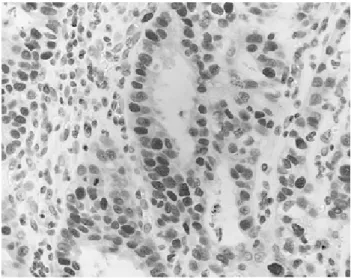
Figure 1. Immunohistochemical staining for Rb evidences high expression in the nuclei of tumor cells (×400).

Immunohistochemical staining

Immunohistochemical staining was performed using the avidin-biotin-peroxidase complex with monoclonal antibodies against p53 (NCL-p53-D07, Novocastra Laboratories, Newcastle, United Kingdom), and Rb (14001A, Pharmingen, USA). Repre- sentative paraffin blocks containing tumors isolated from each case subject were sectioned into 5 μm slices and affixed to slides, then dried for 1 hour at 60℃. The sections were deparaffinized in xylene, and rehydrated with a descending series of alcohol concentrations. Endogenous peroxidase activity was blocked by 3% hydrogen peroxidase for 15 minutes, followed by washing with phosphate buffered saline (PBS), at a pH of 7.2. The sections were then subjected to a heat antigen retrieval process, by autoclaving with 1% zinc sulfate solution for 5 minutes. After 20 minutes of cooling at room temperature, the sections were incubated with 10% normal horse serum (Vectastain Elite kit) for 30 minutes. After decanting away the excess serum, sections were incubated with primary antibody for 2 hours at 37℃. In the p53 study, DO7 monoclonal antibody was used at a 1:100 dilution (Novocastra, Newcastle, UK), and in the Rb study, the monoclonal antibody NCL-Rb1 was used, at a 1:500 dilution (Pharmingen, USA). The sections were subsequently incubated with prediluted biotinylated anti-mouse immunoglobulin (Vectastain Elite kit) for 30 minutes at 37℃.

After washing with PBS, the sections were allowed to react with peroxidase-conjugated streptoavidin (Dako, USA) at a dilution of 1:500 for 30 minutes at 37℃. After washing with PBS, peroxidase activity was evaluated with 3,3'-diaminobenzidine tetrahydrochloride (DAB), and the sections were counterstained with Mayer's hematoxylin.

All sections were examined by 2 pathologists, who were blind to the clinical outcomes and features of the patients. The sections were scored according to the percentage of positive cells using the following categories: 0=negative, 1=1~10%, 2=11~25%, 3=26~50%, 4=51~75% and 5=76~100%. A breast cancer biopsy specimen showing intense uniform positivity for pRb was used as a positive control, as was a squamous cell lung cancer biopsy specimen exhibiting uniform positivity for p53.

In the statistical analysis of p53 and Rb expression, the tmors were further categorized, into three and two groups respectively. Tumors expressing p53 protein in over 25% of cells with strong staining were designated as high p53 expressors, and tumors expressing p53 protein in 1~25% of cells or weak staining were designated as low p53 expressors.

Tumors exhibiting no p53 expression were designated negative p53 expressors. With regard to pRb expression, tumors expressing pRb in over 50% of cells with strong staining were designated high pRb expressors, and tumors expressing pRb in less than 50% of cells or weak staining were designated as low

pRb expressors (Figure 1). These classifications were predicated on the observations of previous studies

10)

.

Statistics

Statistical analysis was performed using χ-2 tests, in order to compare percentages in cross tabulations, and independent sample t-tests were used to compare the means. Survival curves were generated by the Kaplan-Meier method, and compared using the log-rank test. To determine the significant prognostic factors in terms of survival and relapse-free survival, multivariate analysis was performed with the Cox proportional hazards regression model. All significance levels listed refer to two-sided tests. p values of <0.05 were considered to be significant.

Statistical analyses were performed using SPSS for Windows 11.0 (Chicago, Il, USA).

RESULTS

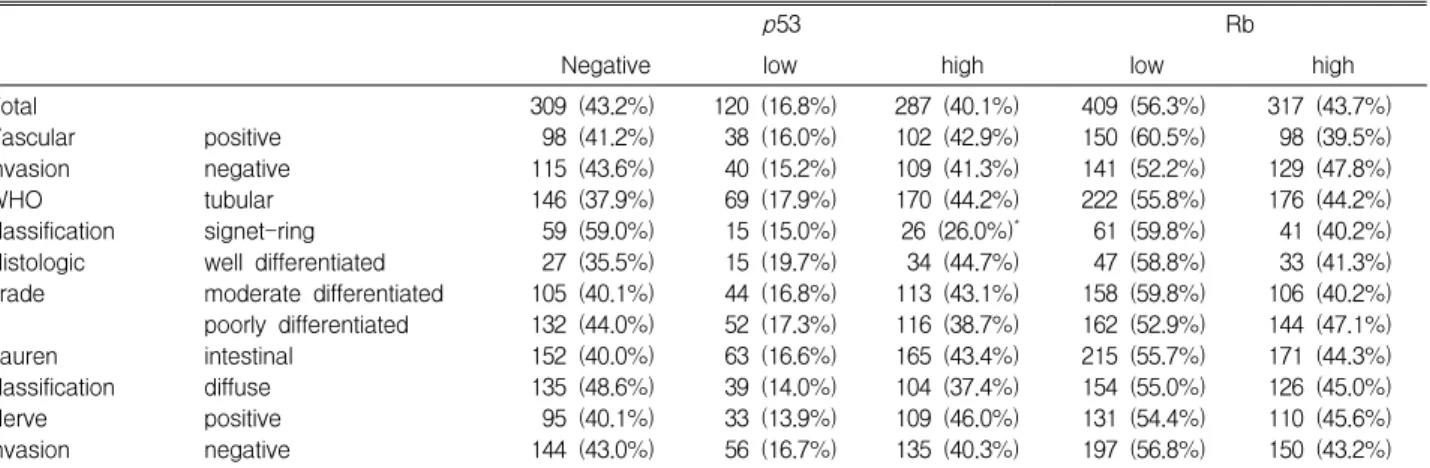
Tumor samples with high, low and no p53 protein expression were found in 287 (40.1%), 120 (16.8%) and 309 (43.2%) of the 716 samples. High and low pRb expressors were found in 317 (43.7%) and 409 (56.3%) of the 726 samples examined, respectively (Table 2).

Correlation with clinicopathologic parameters

According to the classifications provided by the World Health

Organization, tubular-type adenocarcinoma (low and high p53

expressors in 17.9% and 44.2%) was frequently more p53

positive than signet ring cell type (low and high p53 expressors

in 15.0% and 26.0%) (p=0.042). The incidence of vascular

(4)

p53 Rb

Negative low high low high

Total Vascular invasion WHO classification Histologic grade

Lauren classification Nerve invasion

positive negative tubular signet-ring well differentiated moderate differentiated poorly differentiated intestinal

diffuse positive negative

309 (43.2%) 98 (41.2%) 115 (43.6%) 146 (37.9%) 59 (59.0%) 27 (35.5%) 105 (40.1%) 132 (44.0%) 152 (40.0%) 135 (48.6%) 95 (40.1%) 144 (43.0%)

120 (16.8%) 38 (16.0%) 40 (15.2%) 69 (17.9%) 15 (15.0%) 15 (19.7%) 44 (16.8%) 52 (17.3%) 63 (16.6%) 39 (14.0%) 33 (13.9%) 56 (16.7%)

287 (40.1%) 102 (42.9%) 109 (41.3%) 170 (44.2%) 26 (26.0%)

*

34 (44.7%) 113 (43.1%) 116 (38.7%) 165 (43.4%) 104 (37.4%) 109 (46.0%) 135 (40.3%)

409 (56.3%) 150 (60.5%) 141 (52.2%) 222 (55.8%) 61 (59.8%) 47 (58.8%) 158 (59.8%) 162 (52.9%) 215 (55.7%) 154 (55.0%) 131 (54.4%) 197 (56.8%)

317 (43.7%) 98 (39.5%) 129 (47.8%) 176 (44.2%) 41 (40.2%) 33 (41.3%) 106 (40.2%) 144 (47.1%) 171 (44.3%) 126 (45.0%) 110 (45.6%) 150 (43.2%)

*
p<0.05: WHO classification according to p53 expression

Table 2. Immunohistochemical expression rates according to histologic characteristics of curatively resected gastric cancer patients

1 year 3 year 5 year 7 year Mean (months)

Total 97.5% 86.9% 79.2% 75.7% 81.9

p53 high

low negative

98.1%

98.1%

96.6%

88.2%

91.1%

84.3%

78.1%

82.2%

78.9%

78.1%

72.6%

75.3%

74.5 82.0 78.2

p=.719

Rb high

low

98.7%

96.5%

87.9%

86.0%

78.1%

79.4%

72.9%

78.1%

74.7

79.0 p=.741

Table 4. Relapse free survival rate of curatively resected gastric cancer patients

1 year 3 year 5 year 7 year Mean (months)

Total 96.1% 89.6% 88.0% 87.2% 87.8

Stage IA

IB II IIIA IIIB

98.2%

96.1%

96.4%

94.0%

88.4%

97.5%

92.7%

90.3%

76.5%

63.7%

97.5%

92.7%

86.2%

73.9%

56.6%

97.5%

92.7%

86.2%

66.5%

56.6%

90.6 91.2 81.2 67.9 57.3

p=.000

p53 high

low negative

95.0%

96.6%

96.7%

90.0%

90.7%

88.7%

90.0%

85.3%

87.7%

90.0%

85.3%

86.2%

79.5 87.1 83.5

p=.914

Rb high

low

96.8%

95.2%

92.7%

87.2%

92.7%

84.8%

92.7%

83.3%

82.4

81.5 p=.013

Table 3. Overall survival rate of curatively resected gastric cancer patients invasion was lower in the high pRb expressors (43.2%) than in the low pRb expressors (56.8%), but this was not a statistically significant difference (p=0.063). Preoperative CEA levels were low in the high pRb expressors: the initial CEA level in the high pRb expressors was 2.31±3.30 ng/mL, and 5.18±24.80 ng/mL in the low pRb expressors (p=0.033).

No significant correlations were observed with regard to the overexpression of p53 and Rb proteins, and Lauren classifi- cations, Ming classifications, tumor size, depth of invasion (pT

category), lymph node involvement (pN category), or pathologic stages.

Survival analysis

The 7-year overall survival rate was 87.2% among the total patient population (Table 3) and the relapse-free survival rate (Table 4) was 75.7% among the total patient population.

According to stage, the 7-year overall survival rate of stage IA

was 97.5%, stage IB 92.7%, stage II 86.2%, IIIA 66.5% and

(5)

Overall survival Relapse free survival

RR 95% CI RR 95% CI

Age

Stage I vs. II I vs. IIIA I vs. IIIB Tumor size Rb

1.030 2.144 5.561 8.305 1.107 0.557

1.007 0.945 2.737 3.932 1.001 0.333

1.053 4.867 11.295 17.542 1.224 0.933

1.019 7.032 14.676 25.379 1.044 0.925

1.000 3.311 7.178 12.110 0.958 0.617

1.037 14.931 30.003 53.187 1.139 1.385 Table 5. Multivariate analysis of the prognostic factors for total survival and relapse free survival in curatively resected gastric cancer patients

stage IIIB 56.6% (p=0.000).

There were no significant differences detected in terms of total survival (p=0.914) and relapse-free survival rates (p=0.719) between patients with no, low, and high p53 expression characteristics. The 7-year overall survival rate of high pRb expressors (92.7%) was better than in the low pRb expressors (83.3%) (p=0.013) but the 7-year relapse-free survival rate was similar between the two.

According to multivariate Cox regression analysis, tumor stage, tumor size, patient age, and pRb expression rates (RR 0.557, 95% CI 0.333-0.933) were the important prognostic factors in overall survival rates (Table 5).

DISCUSSION

Among the various malignancies, gastric cancer represents the second most common cause of cancer death throughout the world, and the prognosis for advanced gastric cancer remains quite poor. The expression of the p53 and Rb genes can be easily detected in a variety of human malignancies, including gastric cancer, by immunohistochemical methods, but its prognostic roles in gastric cancer remain controversial. The p53 tumor suppressor gene, which is localized in the short arm of human chromosome 17 (17p13.1), plays an important role in the control of tumors, by regulating the expression of vascular endothelial growth factor (VEGF)

11)

. The levels of wild-type p53 protein are normally extremely low and, due to its short half-life, it is undetectable by standard immunohistochemical staining in normal cells and tissues. Conversely, the mutated p53 protein accumulates in the nucleus, either by binding with other oncogenic proteins, or by prolonging its half-life

12)

. The nuclear accumulation of p53 was consistent with p53 mutation rates, and exhibited the same subtype specificity

13)

. About 40%

of our gastric cancer cases (287/716) evidenced high reactivity to p53, which is consistent with previous studies, in which p53 overexpression was found to be common in gastric cancers

14-18)

.

The Rb gene was the initial tumor suppressor gene discovered in childhood retinoblastomas

19)

. The Rb gene normally codes for a nuclear phosphoprotein, but both copies of the

gene are inactivated in retinoblastomas

19)

. It is now believed that the Rb protein (pRb), the product of the Rb gene, functions as a signal transducer, connecting the cell cycle with the transcriptional machinery. The Rb gene can be inactivated by DNA mutations, deletions, undetectable or reduced mRNA expression, or undetectable or aberrant protein production. Loss of pRB function deprives the cell of an important mechanism for halting proliferation

8)

. pRb phosphorylation induces the inactivation of its growth inhibitory functions, via the release of transcription factor E2F, which is required for progression into the S phase

8, 20)

. Ogawa et al.

9)

reported finding overexpression of the Rb gene in 51.1% of gastric cancer cases, and in our study, 43.7% (317/726) of cases exhibited a high degree of reactivity to Rb.

The majority of tumors exhibited Rb and p53 located in the nucleus. This is consistent with previous studies

21)

and appears to occur via the regulation of transcriptional factors.

Regarding the WHO histopathologic classifications, positive immunohistochemical staining of c-erbB-2 protein was signifi- cantly higher in the tubular type of gastric cancer than in the signet ring cell type

22)

. However, positive nuclear p53 expression was found to be significantly higher in the tubular type of gastric cancer in our study; positive p53 expression was detected in 62.1% of tubular type gastric cancer cases, but only in 41.0% of the signet ring cell type (p=0.042). This is similar to the results reported by Uchino et al.

12)

, in which nearly 40% of papillary adenocarcinomas were associated with the nuclear accumulation of the p53 protein. The incidence of c-erbB-2 expression was higher in intestinal-type carcinomas than in diffuse carcinomas

16)

, but in our study, we detected no differences between the Lauren classifications and p53 and Rb expression.

In the previous studies, p53 expression was associated with vascular invasion

14, 17, 23)

and in our study, vascular invasion

was less frequent in high pRb expressors than in low pRb

expressors. However, this was not a statistically significant

difference (p=0.063). No significant correlations were detected

with regard to age, sex, tumor size, depth of tumor invasion,

lymph node metastasis, or the overexpression of p53 and Rb

proteins in our study of curatively resected gastric cancer

(6)

patients.

In our study, the 7-year survival rate was 87.2% and the relapse-free survival rate was 75.7%. The 7-year survival rates, according to stage, were as follows: stage IA 97.5%, IB 92.7%, stage II 86.2%, stage IIIA 66.5% and stage IIIB 56.6%.

According to multivariate Cox regression analyses, tumor stage, tumor size, age, and Rb expression were the relevant prognostic factors in terms of total survival, and tumor stage and age were the most important prognostic factors with respect to relapse-free survival. Currently, the most accurate prognostic indicator for gastric cancer is tumor stage

24)

. Age is also an important prognostic factor in gastric cancer; however, it was associated with increased treatment-related mortality in our study

25)

. In our study, p53 overexpression was not found to be an independent prognostic marker. In previous studies, p53 expression was a useful marker in intestinal-type only

26, 27)

. Our study also determined no significant differences to exist with regard to Lauren histological types.

We did, however, demonstrate a significant difference in survival curves between high- and the low- expressors of the Rb gene. The Rb gene was found to be an independent prognostic factor in the prediction of total survival. It has been determined that reduced Rb expression was associated with poor prognoses in stage I and II non-small cell lung carcinoma

28)

, and that Rb-positive tumors were associated with significantly better survival rates inboth ovarian cancer

10)

and gastric cancer

9)

.

In conclusion, immunohistochemical staining for the Rb protein proved to be a clinically useful prognostic indicator in cases of curatively resected gastric cancer. Conversely, high p53 expression is not an independent indicator for survival.

Further prospective studies are warranted, in order to clarify the relationship between tumor suppressor proteins and gastric cancer prognoses, and cell cycle regulation associated with the action of these proteins.

REFERENCES

1) Mercer WE, Shields MT, Lin D, Appella E, Ullrich SJ. Growth suppression induced by wild-type p53 protein is accompanied by selective down-regulation of proliferating cell nuclear antigen expression. Proc Nat Acad Sci U S A 88:1958-1962, 1991 2) Fields S, Jang SK. Presence of a potent transcription activating

sequence in he p53 protein. Science 249:1046-1049, 1990 3) Sachs L, Lotem J. Control of programmed cell death in normal and

leukemic cells: new implications for therapy. Blood 82:15-21, 1993 4) Wyllie AH. Apoptosis and the regulation of cell numbers in normal

and neoplastic tissues: an overview. Cancer Metastasis Rev 11:

95-103, 1992

5) Wiman KG. The retinoblastoma gene: role in cell cycle control and

cell differentiation. FASEB J 7:841-845, 1993

6) Bookstein R, Lee WH. Molecular genetics of the retinoblastoma suppressor gene. Crit Rev Oncog 2:211-227, 1991

7) Buchkovich K, Duffy LA, Harlow E. The retinoblastoma protein is phosphorylated during specific phases of the cell cycle. Cell 58:

1097-1105, 1989

8) Weinberg RA. The retinoblastoma protein and cell cycle control. Cell 81:323-330, 1995

9) Ogawa M, Maeda K, Chung YS, Onoda N, Kato Y, Nakata B, Sowa M. Correlation between expression of RB protein and prognosis of gastric cancer. Gan To Kagaku Ryoho 23(Suppl 2):148-150, 1996 10) Dong Y, Walsh MD, McGuckin MA, Cummings MC, Gabrielli BG, Wright GR, Hurst T, Khoo SK, Parsons PG. Reduced expression of retinoblastoma gene product (pRB) and high expression of p53 are associated with poor prognosis in ovarian cancer. Int J Cancer 74:407-415, 1997

11) Maeda K, Kang SM, Onoda N, Ogawa M, Sawada T, Nakata B, Kato Y, Chung YS, Sowa M. Expression of p53 and vascular endothelial growth factor associated with tumor angiogenesis and prognosis in gastric cancer. Oncology 55:594-599, 1998

12) Finlay CA, Hinds PW, Tan TH, Eliyahu D, Oren M, Levine AJ.

Activating mutations for transformation by p53 produce a gene product that forms an hsc70-p53 complex with an altered half-life.

Mol Cell Biol 8:531-539, 1988

13) Uchino S, Noguchi M, Ochiai A, Saito T, Kobayashi M, Hirohashi S.

p53 mutation in gastric cancer: a genetic model for carcinogenesisis common to gastric and colorectal cancer. Int J Cancer 54:759-764, 1993

14) Maehara Y, Tomoda M, Hasuda S, Kabashima A, Tokunaga E, Kakeji Y, Sugimachi K. Prognostic value of p53 protein expression for patients with gastric cancer: a multivariate analysis. Br J Cancer 79:1255-1261, 1999

15) Gomyo Y, Ikeda M, Osaki M, Tatebe S, Tsujitani S, Ikeguchi M, Kaibara N, Ito H. Expression of p21(waf1/cip1/sdi1), but not p53 protein, is a factor in the survival of patients with advanced gastric carcinoma. Cancer 79:2067-2072, 1997

16) Shun CT, Wu MS, Lin JT, Chen SY, Wang HP, Lee WJ, Wang TH, Chuang SM. Relationship of p53 and c-erbB-2 expression to histological features: Helicobacter pylori infection and prognosis in gastric cancer. Hepatogastroenterology 44:604-609, 1997

17) Ichiyoshi Y, Oiwa H, Tomisaki S, Sakaguchi Y, Ohno S, Maehara Y, Sugimachi K. Overexpression of p53 is associated with growth pattern and prognosis in advanced gastric cancer. Hepatogastro- enterology 44:546-553, 1997

18) Lim BH, Soong R, Grieu F, Robbins PD, House AK, Iacopetta BJ.

p53 accumulation and mutation are prognostic indicators of poor survival in human gastric carcinoma. Int J Cancer 69:200-204, 1996 19) Friend SH, Bernards R, Rogelj S, Weinberg RA, Rapaport JM, Albert DM, Dryja TP. A human DNA segment with properties of the gene that predisposes to retinoblastoma and osteosarcoma. Nature 323:643-646, 1986

20) Kastan MB, Onyekwere O, Sidransky D, Vogelstein B, Craig RW.

Participation of p53 protein in the cellular response to DNA damage.

Cancer Res 51:6304-6311, 1991

21) Pedley J, Ablett EM, Pettit A, Meyer J, Donn IS, Sturm RA,

Parsons PG. Inhibition of retinoblastoma protein translation by UVB

(7)

in human melanocytic cells and reduced cell cycle arrest following repeated irradiation. Oncogene 13:1335-1342, 1996

22) Yokota J, Yamamoto T, Miyajima N, Toyoshima K, Nomura N, Sakamoto H, Yoshida T, Terada M, Sugimura T. Genetic alterations of the c-erb2 oncogene occur frequently in tubular adenocarcinoma of the stomach and are often accompanied by amplification of the v-erbA homologue. Oncogene 2:283-287, 1988

23) Gabbert HE, Muller W, Schneiders A, Meier S, Hommel G. The relationship of p53 expression to the prognosis of 418 patients with gastric carcinoma. Cancer 76:720-726, 1995

24) Santoro E, Carboni M, Catarci M, Carlini M, Carboni F, Zupi G, Vecchione A, D'Agnano I, Giannarelli D, Santoro R, Farofalo A.

DNA ploidy, proliferative index and EGF-R status in 130 cases of resected gastric cancer: a multivariate analysis. Hepatogastroenterology

44:826-837, 1997

25) Song H, Do Y, Kim I, Sohn S, Lee W. Prognostic significance of age in curatively resected gastric cancer. Proc Am Soc Clin Oncol 23:344, 2004

26) Guadagni S, Reed PI, Johnson BJ, de Bernardinis G, Catarci M, Valenti M, di Orio F, Carboni M. Early gastric cancer: follow-up after gastrectomy in 159 patients. Br J Surg 80:325-328, 1993

27) Hurlimann J, Saraga EP. Expression of p53 protein in gastric carcinomas: association with histologic type and prognosis. Am J Surg Pathol 18:1247-1253, 1994

28) Xu HJ, Hu SX, Cagle PT, Moore GE, Benedict WF. Absence of

retinoblastoma protein expression in primary non-small cell lung

carcinoma. Cancer Res 51:2735-2739, 1991

수치

Figure  1.  Immunohistochemical  staining  for  Rb  evidences  high  expression  in  the  nuclei  of  tumor  cells  (×400)
Table  2.  Immunohistochemical  expression  rates  according  to  histologic  characteristics  of  curatively  resected  gastric  cancer  patients

참조

관련 문서

Considering the important role of NRAMP1 gene in defending bacterial and viral infection, in this study, we investigated its mRNA expression in different

Reduced Fhit protein expression and loss of heterozygosity at Fhit gene in tumours from smoking and asbestos-exposed lung cancer patients.

We investigated the prognostic significance of TLE1 expression and its association with clinicopathological parameters in gastric cancer (GC) patients.. Materials and

Loss of expression of the PTEN gene product in the infiltrating ductal carcinoma of the breast and its relationship with clinico- pathologic

The levels of none of the common prognostic factors, including those of p16 and p53 gene expression, were associated with the progression-free survival or OS of stage 1a in the

The aims of this study were to detect p16 pro- tein expression loss and p53 protein overexpres- sion in pancreatic cancer using immunohisto- chemical staining, to analyze

We investigated whether multidrug resistance gene 1 (MDR1), multidrug resistance-related protein (MRP) and lung resistance protein (LRP) mRNA expres- sion are associated with

The immunohistochemistry results were interpreted as follows: strong p53 nuclear expression in at least 50% of tumor nuclei was interpreted as a positive result, strong