• 검색 결과가 없습니다.

Prognostic Significance of Immunohistochemical Expression of EGFR and C-erbB-2 Oncoprotein in Curatively Resected Gastric Cancer

N/A
N/A
Protected

Academic year: 2021

Share "Prognostic Significance of Immunohistochemical Expression of EGFR and C-erbB-2 Oncoprotein in Curatively Resected Gastric Cancer"

Copied!
6
0
0

로드 중.... (전체 텍스트 보기)

전체 글

(1)

240

Prognostic Significance of Immunohistochemical Expression of EGFR and C-erbB-2 Oncoprotein in Curatively Resected Gastric Cancer

Hong Suk Song, M.D.

1

, Young Rok Do, M.D.

1

, In Ho Kim, M.D.

2

, Soo Sang Sohn, M.D.

2

and Kun Young Kwon, M.D.

3

Departments of

1

Internal Medicine,

2

General Surgery and

3

Pathology, Dongsan Medical Center, Keimyung University School of Medicine, Daegu, Korea

P urpose: The purpose of this study was to investigate the prognostic significance of the expression of E G F R and C -erbB-2 gene products by im munohistochem ical analysis for curatively resected gastric adenocarcinoma.

M aterials and M ethods: Between January 1996 and D ecember 2001, 739 patients with curatively resected gastric cancer patients underwent immunohistochemical staining for E G F R and C -erbB-2 proteins, and we retro- spectively analyzed their correlation with the clinical outcome.

Results: The overexpressions of EGFR and C-erbB-2 were 25.4% and 26.2% , respectively. The overexpressions of EGFR was associated with the more poorly differentiated tumor (p=0.000) and with neuronal invasion (p=0.03).

Overexpression of C-erbB-2 was associated with less vascular invasion (p=0.001). Tumor depth or node metastasis was not related to the overexpression of

E G F R or C -erbB-2. T he seven-year overall survival and relapse-free survival rates were 87.2% and 75.8% , re- spectively. U pon multivariate C ox regression analysis, the tumor stage, tumor size and patient age were important prognostic factors for overall survival, and tumor stage was the im portant factor for relapse-free survival. O ver- expressions of E G F R or c-erbB-2 were not significant prognostic factors.

C onclusion: Imm unohistochemical staining of E G F R and C -erbB-2 gene products were not independent prog- nostic factors for predicting the overall survival and the relapse-free survival in curatively resected gastric cancer.

(C ancer R esearch and T reatment 2004;36:240-245)

󰠏󰠏󰠏󰠏󰠏󰠏󰠏󰠏󰠏󰠏󰠏󰠏󰠏󰠏󰠏󰠏󰠏󰠏󰠏󰠏󰠏󰠏󰠏󰠏󰠏󰠏󰠏󰠏󰠏󰠏󰠏󰠏󰠏󰠏󰠏󰠏󰠏󰠏󰠏󰠏󰠏󰠏󰠏󰠏󰠏󰠏󰠏󰠏󰠏󰠏󰠏󰠏󰠏󰠏

󰠏

Key W ords: G astric cancer, P rognosis, Immunohisto- chemistry, E G F R , C -erbB-2

Correspondence: Hong Suk Song, Department of Hematooncology, Dongsan Medical Center, Keimyung University School of Medicine, 194 Dongsan-dong, Jung-gu, Daegu 700-712, Korea.

(Tel) 82-53-250-7436, (Fax) 82-53-250-7434, (E-mail) shs7436

@dsmc.or.kr

Received September 15, 2003, Accepted May 6, 2004

INTRODUCTION

Gastric cancer is one of the most common cancers and the second leading cause of cancer death in Korea (1). A population-based cancer registry was established in January 1, 1997 to estimate the incidence of cancer in Daegu. The age-standardized incidence rates (ASR) of gastric cancer were 69.0/100,000 people for males and 26.9/100,000 people for female by the Daegu Cancer Registry in 1997~1998 (2).

Recently, the proportion of gastric cancer cases among all the malignancies is declining; the annual reported cases of gastric cancer was 24.1% of all cancers in 1990, and 20.8% of all cancers in 2000 as reported by the Korea Cancer Registry

Program (3), and the decline is principally because of changes in the diet and food preparation, and also the early diagnosis of gastric cancer.

Greater insight has recently been gained into the biological

properties of tumor cells. Epidermal growth factor (EGF)

promotes the growth of cells from both an ectodermal and

mesodermal origin, and EFG plays an important role in cellular

proliferation, differentiation and tumor progression of human

gastric carcinomas (4). The EGF receptor/ligand system seems

to be involved in the regulation of gastric mucosa proliferation

and growth regulation of gastric carcinomas (5). Expression of

C-erbB-2 genes can easily be detected by immunohistochemical

methods in a variety of human malignancies including gastric

cancer. (6). C-erbB-2 has been linked to tumor progression. and

it is one of the well-known oncogenes involved in the patho-

genesis of non-small cell lung cancer. C-erbB-2 amplification

and overexpression are currently attracting a great deal of

attention because a new adjuvant therapy used against the

c-erbB-2 gene product, trastuzumab (Herceptin) has been

proved effective in treating the type of breast cancer having an

amplification and/or overexpression of c-erbB-2 (7). However,

the prognostic role of c-erbB-2 in gastric cancer as an indepen-

(2)

Table 1. Clinical characteristics of curatively resected gastric cancer patients

󰠚󰠚󰠚󰠚󰠚󰠚󰠚󰠚󰠚󰠚󰠚󰠚󰠚󰠚󰠚󰠚󰠚󰠚󰠚󰠚󰠚󰠚󰠚󰠚󰠚󰠚󰠚󰠚󰠚󰠚󰠚󰠚󰠚󰠚󰠚󰠚󰠚󰠚󰠚󰠚󰠚󰠚󰠚󰠚󰠚󰠚󰠚󰠚󰠚󰠚󰠚󰠚󰠚󰠚󰠚

Number of patients 739

Sex

Male 495 (67.0%)

Female 244 (33.0%)

Age, years

Median 59.0

Range 19~80

Operation method

Total gastrectomy 114 (15.4%)

Subtotal gastrectomy 625 (84.6%)

D1, D1 +a 232 (31.4%)

D2, D2 +a 507 (68.6%)

Stage

T1/T2/T3/T4 380/138/218/3

N0/N1/N2 469/174/96

IA 340 (46.0%)

IB 104 (14.1%)

II 116 (15.7%)

IIIA 106 (14.3%)

IIIB 73 ( 9.9%)

Follow-up period, months

Median 37.0

Range 0.2~96.7

󰠏󰠏󰠏󰠏󰠏󰠏󰠏󰠏󰠏󰠏󰠏󰠏󰠏󰠏󰠏󰠏󰠏󰠏󰠏󰠏󰠏󰠏󰠏󰠏󰠏󰠏󰠏󰠏󰠏󰠏󰠏󰠏󰠏󰠏󰠏󰠏󰠏󰠏󰠏󰠏󰠏󰠏󰠏󰠏󰠏󰠏󰠏󰠏󰠏󰠏󰠏󰠏󰠏󰠏󰠏

dent marker of poor prognosis still has to be confirmed by further studies.

The purpose of this study was to investigate the prognostic significance of immunohistochemical staining of EGFR and C-erbB-2 in curatively resected gastric adenocarcinoma.

MATERIALS AND METHODS

1) Patients and setting

From January 1996 to December 2001, 2,104 pathologically confirmed gastric cancer patients were registered in our hos- pital. Of these, there were 1,158 curatively resected patients, and immunohistochemical analyses of EGFR and c-erbB-2 were performed in 739 of these patients. We reviewed the clinicopathologic parameters of TNM stage, the World Health Organization classification, histological grade, Lauren classi- fication, Ming classification, vascular invasion and neuronal invasion of these patients. Staging evaluation was done by the guidelines of the American Joint Committee of the Cancer, 5th edition (8).

Curative resection was defined as the removal of all gross tumors and the demonstration of tumor-negative proximal and distal surgical margins by microscopic examination. A total gastrectomy was performed in 114 patients (15.4%), subtotal gastrectomy in 625 patients (84.6%), D1 and D1+α resection was performed in 232 patients (31.4%) and D2 and D 2+α resection was performed in 507 patients (68.6%). Four hundred ninety-five (67.0%) of these patients were male, and 244 (33.0%) of these patients were female. The median age of the subjects was 59.0 years (the range was 19~80 years). The

staging was as follows; IA in 340 (46.0%) patients, IB in 104 patients (14.1%), II in 116 patients (15.7%), IIIA in 106 patients (14.3%), and IIIB in 73 patients (9.9%) (Table 1).

2) Immunohistochemical staining

Immunohistochemical staining was performed using the avidin-biotin-peroxidase complex with monoclonal antibodies raised against EGFR (Sigma, diluteed 1:500, St Louis, MO and C-erbB-2 (NCL-L-CB11, diluted 1:40, Novocastra, UK).

Representative paraffin blocks containing tumor from each case were sectioned in 5μm slices and affixed to slides and then they were dried for 1 hour at 60

o

C. The sections were de-par- affined in xylene and rehydrated with a descending series of alcohol concentrations. Endogenous peroxidase activity was blocked by 3% hydrogen peroxidase for 15 min, and this was followed by washing with phosphate buffered saline (PBS), pH 7.2. The sections were then subjected to a heated antigen retrieval process by autoclaving with 1% zinc sulfate solution for 5 min. After cooling for 20 min at room temperature, the sections were incubated with 10% normal horse serum (Vectastain Elite kit) for 30 min. After decanting away the excess serum, the sections were incubated with primary antibody for 2 hour at 37

o

C. For the EGFR study, Sigma E2760 monoclonal antibody was used at a 1:500 dilution, and for the c-erbB-2 study, the monoclonal antibody NCL-L-CB11 was used at a 1:40 dilution (Novocastra, UK). The sections were subsequently incubated with prediluted biotinylated anti-mouse immunoglobulins (Vectastain Elite kit) for 30 min at 37

o

C.

After washing with PBS, the sections were reacted with peroxidase-conjugated streptoavidin (Dako, Denmark) at a dilution of 1:500 for 30 min at 37

o

C. After washing with PBS, the peroxidase activity was detected using 3,3'-diamino- benzidine tetrahydrochloride (DAB), and the sections were counterstained with Mayer's hematoxylin.

Two pathologists, who were blind to the clinical outcome and features of the patients, independently evaluated all the immunohistochemical slides. The tumor cells with a positive cytoplasmic staining for EGFR and C-erbB-2 in more than 10%

of tumor cells were interpreted as having a positive expression.

3) Statistical analysis

Statistical analysis was performed using χ-2 tests to compare percentages in the cross tabulations, and independent sample T tests were used to compare the means. Survival curves were generated by the Kaplan-Meier method (9), and they were compared by using the log-rank test (10). To determine the significant prognostic factors related to survival and relapse-free survival, multivariate analysis was performed with the Cox proportional hazards regression model (11). All the significance levels refer to two-sided tests. P values less than 0.05 were considered significant.

Statistical analyses were performed using SPSS for Windows 11.0 (Microsoft, Chicago, IL).

RESULTS

Tumor samples with positive staining for EGFR and

C-erbB-2 were found in 186 of the 732 samples (25.4%) and

193 of 738 (26.2%) samples examined, respectively (Table 2).

(3)

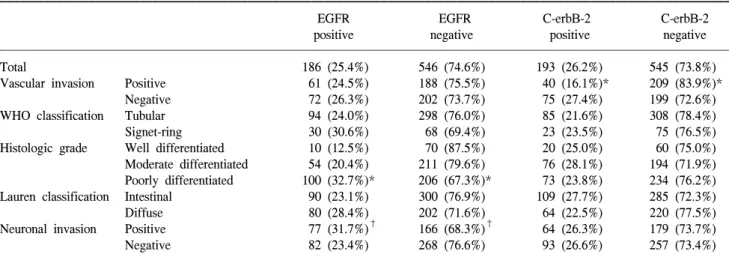
Table 2. Immunohistochemical expression rates according to histologic characteristics of curatively resected gastric cancer patients

󰠚󰠚󰠚󰠚󰠚󰠚󰠚󰠚󰠚󰠚󰠚󰠚󰠚󰠚󰠚󰠚󰠚󰠚󰠚󰠚󰠚󰠚󰠚󰠚󰠚󰠚󰠚󰠚󰠚󰠚󰠚󰠚󰠚󰠚󰠚󰠚󰠚󰠚󰠚󰠚󰠚󰠚󰠚󰠚󰠚󰠚󰠚󰠚󰠚󰠚󰠚󰠚󰠚󰠚󰠚󰠚󰠚󰠚󰠚󰠚󰠚󰠚󰠚󰠚󰠚󰠚󰠚󰠚󰠚󰠚󰠚󰠚󰠚󰠚󰠚󰠚󰠚󰠚󰠚󰠚󰠚󰠚󰠚󰠚󰠚󰠚󰠚󰠚󰠚󰠚󰠚󰠚󰠚󰠚󰠚󰠚󰠚󰠚󰠚󰠚󰠚󰠚󰠚󰠚󰠚󰠚󰠚󰠚󰠚󰠚󰠚󰠚󰠚󰠚󰠚

EGFR EGFR C-erbB-2 C-erbB-2

positive negative positive negative

󰠏󰠏󰠏󰠏󰠏󰠏󰠏󰠏󰠏󰠏󰠏󰠏󰠏󰠏󰠏󰠏󰠏󰠏󰠏󰠏󰠏󰠏󰠏󰠏󰠏󰠏󰠏󰠏󰠏󰠏󰠏󰠏󰠏󰠏󰠏󰠏󰠏󰠏󰠏󰠏󰠏󰠏󰠏󰠏󰠏󰠏󰠏󰠏󰠏󰠏󰠏󰠏󰠏󰠏󰠏󰠏󰠏󰠏󰠏󰠏󰠏󰠏󰠏󰠏󰠏󰠏󰠏󰠏󰠏󰠏󰠏󰠏󰠏󰠏󰠏󰠏󰠏󰠏󰠏󰠏󰠏󰠏󰠏󰠏󰠏󰠏󰠏󰠏󰠏󰠏󰠏󰠏󰠏󰠏󰠏󰠏󰠏󰠏󰠏󰠏󰠏󰠏󰠏󰠏󰠏󰠏󰠏󰠏󰠏󰠏󰠏󰠏󰠏󰠏󰠏

Total 186 (25.4%) 546 (74.6%) 193 (26.2%) 545 (73.8%)

Vascular invasion Positive 61 (24.5%) 188 (75.5%) 40 (16.1%)* 209 (83.9%)*

Negative 72 (26.3%) 202 (73.7%) 75 (27.4%) 199 (72.6%)

WHO classification Tubular 94 (24.0%) 298 (76.0%) 85 (21.6%) 308 (78.4%)

Signet-ring 30 (30.6%) 68 (69.4%) 23 (23.5%) 75 (76.5%)

Histologic grade Well differentiated 10 (12.5%) 70 (87.5%) 20 (25.0%) 60 (75.0%) Moderate differentiated 54 (20.4%) 211 (79.6%) 76 (28.1%) 194 (71.9%) Poorly differentiated 100 (32.7%)* 206 (67.3%)* 73 (23.8%) 234 (76.2%)

Lauren classification Intestinal 90 (23.1%) 300 (76.9%) 109 (27.7%) 285 (72.3%)

Diffuse 80 (28.4%) 202 (71.6%) 64 (22.5%) 220 (77.5%)

Neuronal invasion Positive 77 (31.7%)

166 (68.3%)

64 (26.3%) 179 (73.7%)

Negative 82 (23.4%) 268 (76.6%) 93 (26.6%) 257 (73.4%)

󰠏󰠏󰠏󰠏󰠏󰠏󰠏󰠏󰠏󰠏󰠏󰠏󰠏󰠏󰠏󰠏󰠏󰠏󰠏󰠏󰠏󰠏󰠏󰠏󰠏󰠏󰠏󰠏󰠏󰠏󰠏󰠏󰠏󰠏󰠏󰠏󰠏󰠏󰠏󰠏󰠏󰠏󰠏󰠏󰠏󰠏󰠏󰠏󰠏󰠏󰠏󰠏󰠏󰠏󰠏󰠏󰠏󰠏󰠏󰠏󰠏󰠏󰠏󰠏󰠏󰠏󰠏󰠏󰠏󰠏󰠏󰠏󰠏󰠏󰠏󰠏󰠏󰠏󰠏󰠏󰠏󰠏󰠏󰠏󰠏󰠏󰠏󰠏󰠏󰠏󰠏󰠏󰠏󰠏󰠏󰠏󰠏󰠏󰠏󰠏󰠏󰠏󰠏󰠏󰠏󰠏󰠏󰠏󰠏󰠏󰠏󰠏󰠏󰠏󰠏

*p<0.005: neuronal invasion according to EGFR expression,

p<0.05: histologic grade according to EGFR expression, and vascular invasion according to C-erbB-2 expression.

Table 3. Immunohistochemical expression rates according to tumor stage

󰠚󰠚󰠚󰠚󰠚󰠚󰠚󰠚󰠚󰠚󰠚󰠚󰠚󰠚󰠚󰠚󰠚󰠚󰠚󰠚󰠚󰠚󰠚󰠚󰠚󰠚󰠚󰠚󰠚󰠚󰠚󰠚󰠚󰠚󰠚󰠚󰠚󰠚󰠚󰠚󰠚󰠚󰠚󰠚󰠚󰠚󰠚󰠚󰠚󰠚󰠚󰠚󰠚󰠚󰠚

EGFR EGFR C-erbB-2 C-erbB-2

positive negative positive negative

󰠏󰠏󰠏󰠏󰠏󰠏󰠏󰠏󰠏󰠏󰠏󰠏󰠏󰠏󰠏󰠏󰠏󰠏󰠏󰠏󰠏󰠏󰠏󰠏󰠏󰠏󰠏󰠏󰠏󰠏󰠏󰠏󰠏󰠏󰠏󰠏󰠏󰠏󰠏󰠏󰠏󰠏󰠏󰠏󰠏󰠏󰠏󰠏󰠏󰠏󰠏󰠏󰠏󰠏󰠏

T1 87 (23.0%) 292 (77.0%) 101 (26.6%) 279 (73.4%) T2 34 (25.0%) 102 (75.0%) 40 (29.2%) 97 (70.8%) T3 65 (30.4%) 149 (69.6%) 50 (22.9%) 168 (77.1%) N0 114 (24.5%) 352 (75.5%) 115 (24.5%) 354 (75.5%) N1 42 (24.6%) 129 (75.4%) 49 (28.3%) 124 (71.7%) N2 30 (31.6%) 65 (68.4%) 29 (30.2%) 67 (69.8%) IA 78 (23.0%) 261 (77.0%) 86 (25.3%) 254 (74.7%) IB 21 (20.4%) 82 (79.6%) 32 (30.8%) 72 (69.2%) II 37 (32.5%) 77 (67.5%) 25 (21.7%) 90 (78.3%) IIIA 30 (28.8%) 74 (71.2%) 30 (28.3%) 76 (71.7%) IIIB 20 (27.8%) 52 (72.2%) 20 (27.4%) 53 (72.6%)

󰠏󰠏󰠏󰠏󰠏󰠏󰠏󰠏󰠏󰠏󰠏󰠏󰠏󰠏󰠏󰠏󰠏󰠏󰠏󰠏󰠏󰠏󰠏󰠏󰠏󰠏󰠏󰠏󰠏󰠏󰠏󰠏󰠏󰠏󰠏󰠏󰠏󰠏󰠏󰠏󰠏󰠏󰠏󰠏󰠏󰠏󰠏󰠏󰠏󰠏󰠏󰠏󰠏󰠏󰠏

Fig. 1. Overall survival curve of curatively resected gastric cancer patients.

EGFR and C-erbB-2 were expressed in the cytoplasm for all the cases, and C-erbB-2 was more strongly expressed along the cytoplasmic membrane.

1) Correlation with clinicopathologic parameters According to the World Health Organization classification, overexpression of C-erbB-2 was inversely associated with vascular invasion; vascular invasion was detected in 34.8% of patients with positive c-erbB-2 expressions, and in 51.2% of patients with negative c-erbB-2 expressions (p=0.001). Positive EGFR expressions were associated with more poorly differ- entiated tumor; there was EGFR expression in 32.7% of poorly differentiated tumor, 20.4% in moderately differentiated tumor and 12.5% in well differentiated tumor, respectively (p=0.000), and in neuronal invasions (p=0.03) (Table 2).

No significant correlation was observed for the overexpres- sion of EGFR and C-erbB-2, and the Lauren classification, Ming

classification, depth of invasion (pT category), lymph node involvement (pN category), and pathologic stage (Table 3).

2) Survival analysis

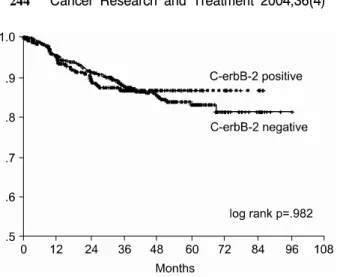
The 7-year overall survival rate (Fig. 1), and the relapse-free survival rate (Fig. 2) were 87.2%, and 79.8%, respectively.

There were no significant differences in the overall survival rate

and relapse-free survival rates between patients with positive

and negative EGFR expression (p=0.954, p=0.181, respectively)

(Fig. 3, 4), and positive and negative C-erbB-2 expression

(p=0.134, p=0.982, respectively) (Fig. 5, 6). According to mul-

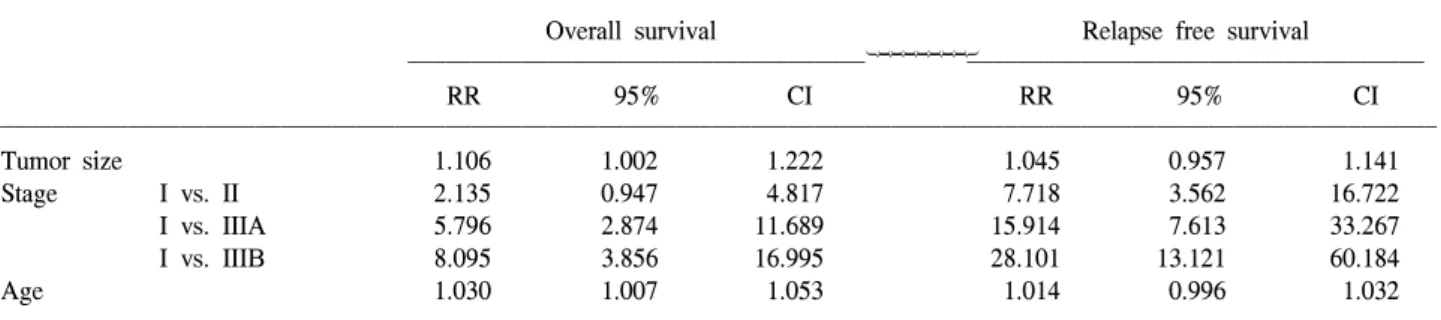
tivariate Cox regression analysis, the tumor stage, size and age

were important prognostic factors for overall survival, and

tumor stage was important for the relapse-free survival. Positive

expression of EGFR and C-erbB-2 were not independent

prognostic factors for survival rates (Table 4).

(4)

Table 4. Multivariate analysis of the prognostic factors for overall survival and relapse-free survival in curatively resected gastric cancer patients

󰠚󰠚󰠚󰠚󰠚󰠚󰠚󰠚󰠚󰠚󰠚󰠚󰠚󰠚󰠚󰠚󰠚󰠚󰠚󰠚󰠚󰠚󰠚󰠚󰠚󰠚󰠚󰠚󰠚󰠚󰠚󰠚󰠚󰠚󰠚󰠚󰠚󰠚󰠚󰠚󰠚󰠚󰠚󰠚󰠚󰠚󰠚󰠚󰠚󰠚󰠚󰠚󰠚󰠚󰠚󰠚󰠚󰠚󰠚󰠚󰠚󰠚󰠚󰠚󰠚󰠚󰠚󰠚󰠚󰠚󰠚󰠚󰠚󰠚󰠚󰠚󰠚󰠚󰠚󰠚󰠚󰠚󰠚󰠚󰠚󰠚󰠚󰠚󰠚󰠚󰠚󰠚󰠚󰠚󰠚󰠚󰠚󰠚󰠚󰠚󰠚󰠚󰠚󰠚󰠚󰠚󰠚󰠚󰠚󰠚󰠚󰠚󰠚󰠚󰠚

Overall survival Relapse free survival

󰠏󰠏󰠏󰠏󰠏󰠏󰠏󰠏󰠏󰠏󰠏󰠏󰠏󰠏󰠏󰠏󰠏󰠏󰠏󰠏󰠏󰠏󰠏󰠏󰠏󰠏󰠏󰠏󰠏󰠏󰠏󰠏󰠏󰠏󰠏󰠏}}}}}}}}󰠏󰠏󰠏󰠏󰠏󰠏󰠏󰠏󰠏󰠏󰠏󰠏󰠏󰠏󰠏󰠏󰠏󰠏󰠏󰠏󰠏󰠏󰠏󰠏󰠏󰠏󰠏󰠏󰠏󰠏󰠏󰠏󰠏󰠏󰠏󰠏

RR 95% CI RR 95% CI

󰠏󰠏󰠏󰠏󰠏󰠏󰠏󰠏󰠏󰠏󰠏󰠏󰠏󰠏󰠏󰠏󰠏󰠏󰠏󰠏󰠏󰠏󰠏󰠏󰠏󰠏󰠏󰠏󰠏󰠏󰠏󰠏󰠏󰠏󰠏󰠏󰠏󰠏󰠏󰠏󰠏󰠏󰠏󰠏󰠏󰠏󰠏󰠏󰠏󰠏󰠏󰠏󰠏󰠏󰠏󰠏󰠏󰠏󰠏󰠏󰠏󰠏󰠏󰠏󰠏󰠏󰠏󰠏󰠏󰠏󰠏󰠏󰠏󰠏󰠏󰠏󰠏󰠏󰠏󰠏󰠏󰠏󰠏󰠏󰠏󰠏󰠏󰠏󰠏󰠏󰠏󰠏󰠏󰠏󰠏󰠏󰠏󰠏󰠏󰠏󰠏󰠏󰠏󰠏󰠏󰠏󰠏󰠏󰠏󰠏󰠏󰠏󰠏󰠏󰠏

Tumor size 1.106 1.002 1.222 1.045 0.957 1.141

Stage I vs. II 2.135 0.947 4.817 7.718 3.562 16.722

I vs. IIIA 5.796 2.874 11.689 15.914 7.613 33.267

I vs. IIIB 8.095 3.856 16.995 28.101 13.121 60.184

Age 1.030 1.007 1.053 1.014 0.996 1.032

󰠏󰠏󰠏󰠏󰠏󰠏󰠏󰠏󰠏󰠏󰠏󰠏󰠏󰠏󰠏󰠏󰠏󰠏󰠏󰠏󰠏󰠏󰠏󰠏󰠏󰠏󰠏󰠏󰠏󰠏󰠏󰠏󰠏󰠏󰠏󰠏󰠏󰠏󰠏󰠏󰠏󰠏󰠏󰠏󰠏󰠏󰠏󰠏󰠏󰠏󰠏󰠏󰠏󰠏󰠏󰠏󰠏󰠏󰠏󰠏󰠏󰠏󰠏󰠏󰠏󰠏󰠏󰠏󰠏󰠏󰠏󰠏󰠏󰠏󰠏󰠏󰠏󰠏󰠏󰠏󰠏󰠏󰠏󰠏󰠏󰠏󰠏󰠏󰠏󰠏󰠏󰠏󰠏󰠏󰠏󰠏󰠏󰠏󰠏󰠏󰠏󰠏󰠏󰠏󰠏󰠏󰠏󰠏󰠏󰠏󰠏󰠏󰠏󰠏󰠏

Fig. 3. Overall survival curve of curatively resected gastric cancer patients according to EGFR expression.

Fig. 2. Relapse-free survival curve of curatively resected gastric cancer patients.

Fig. 4. Relapse-free survival curve of curatively resected gastric cancer patients according to EGFR expression.

Fig. 5. Overall survival curve of curatively resected gastric cancer

patients according to c-erbB-2 expression.

(5)

Fig. 6. Relapse-free survival curve of curatively resected gastric cancer patients according to c-erbB-2 expression.

DISCUSSION

Among the various malignancies, gastric cancer is the second most common cause of cancer death through out the world, and the prognosis for advanced gastric cancer is still very poor. The human C-erbB-2 gene is an oncogene encoding a 185-kDa glycoprotein that belongs to the transmembrane type 1 tyrosine kinase receptor family that includes the EGF receptors, HER3 and HER4. The increased expression of EGF receptor protein in gastric cancer appears to be related to the tumor󰡑s biologic aggressiveness (12). C-erbB-2 is frequently overexpressed in the adenocarcinomas of breast, ovary, lung and stomach (6).

Although the mechanism of erbB-2 overexpression is thought to be the result of transcriptional upregulation in many primary human carcinomas, the expression rate of c-erbB-2 or its mRNA level is usually lower than the level of the translated protein (13). Immunohistochemical membrane staining for c-erbB-2 protein has been reported to correspond well to gene amplification and the expression of protein (14), and in the current study, immunohistochemical staining of c-erbB-2 protein was usually found in the cytoplasm; stronger staining on the plasma membrane of cells in the intestinal metaplasia was found and membrane staining was detected only in the cancer cells.

In the pervious studies, the positive rate for c-erbB-2 expression in gastric cancer was 12-34% (15~17) and the c-erbB-2 expression rate for gastric cancer was 26.2% in our study. In regards to the WHO histopathologic type, the rate for positive immunohistochemical staining of the c-erbB-2 protein was significantly higher for the tubular cell type gastric cancer than signet ring cell type of gastric cancer (18,19). No correlation was demonstrated in our study between the ex- pression of c-erbB-2 and the WHO histopathologic types of gastric cancer. The incidence of c-erbB-2 expression is higher for the intestinal type than for the diffuse carcinoma (39.7%

vs. 18.4%) (15), but our study did not show any difference between the Lauren classification and the C-erbB-2 expressions.

For well-differentiated adenocarcinoma, the incidence of c-erbB-2 expression was shown to be higher than for the poorly differentiated carcinomas (20), but in our study, the expression

of c-erbB-2 and the histologic tumor grade was not related.

Vascular invasion had an inverse correlation to c-erbB-2 expression in our study; vascular invasion was detected for 34.8%

of patients with positive c-erbB-2 expression and in 51.2% of patients with negative c-erbB-2 expressions (p=0.001).

In the previous studies, EGFR expression was positive for 38% of the gastric tumors (21), and in our study, there was 25.4% rate of expression in the gastric tumors. Positive EGFR expressions were strongly associated with poorly differentiated tumors, and this is a similar result as was found in Koullias's study (21); there was 32.7% EGFR expression in the poorly differentiated tumor, 20.4% EGFR expression in moderately differentiated tumor and 12.5% EGFR expression in well differentiated tumor, respectively (p=0.000). The positive EGFR expression in gastric cancer was correlated with the histologic grade (p=0.000) and the neuronal invasion status (p=0.030).

There was no significant correlation found between age, sex, tumor size, depth of tumor invasion, lymph node metastasis and overexpressions of c-erbB-2 and EGFR in our study of curatively resected gastric cancer patients.

In our current study, the 7-year survival rate and relapse-free survival rate were 87.2% and 79.8% respectively. It has been found that patients with c-erbB-2 positive tumors had poor survival rates in many studies (12,15,20,22), and the relative risk of death for patients with c-erbB-2-positive tumors was increased 5-fold (20). The c-erbB-2 marker is a useful indicator of poor prognosis for the patients with well-differentiated adenocarcinomas (20) but not for patients with poorly dif- ferentiated carcinomas, and patients with c-erbB-2-positive tumors had poor survival rates in the early stages (23), but not in the advanced stages. However, in several Korean studies, no significant association was found between c-erbB-2 status and survival duration (24,25), which is the same result as found in our study. The survival rate was significantly lower for patients with EGFR positive tumors in several studies (12), but there was no significant relationship between the EGFR levels of the tumors and the overall survival in other studies (4), as was also the case in our study.

By the multivariate Cox regression analysis, stage, tumor size, and age were the important prognostic factors for overall survival, and tumor stage was the important prognostic factor for relapse-free survival. Currently, the most accurate prog- nostic indicator for gastric cancer is the tumor stage. In our study, there was no significant difference on the subset analysis according to Lauren histological type.

CONCLUSIONS

The immunohistochemical staining of EGFR and c-erbB-2 were not independent prognostic factors in curatively resected gastric cancer.

REFERENCES

1. Korea National Statistical Office. Annual report on the cause

(6)

of death statistics (based on vital registration). 2001;14-15.

2. Lee CW, Lee MY, Lim HS, Sohn SS, Jeon JK. Cancer inci- dence in Daegu in 1997-1998: the first results of the SDaegu Cancer Registry. J Korean Cancer Assoc 2001;33:136-148.

3. Headquarter of Korea Central Cancer Registry. Cancer registry system in Korea. Available from: URL: http://www.ncc.re.kr.

4. Garcia I, Vizoso F, Andicoechea A, Raigoso P, Verez P, Alexandre E, Garcia-Muniz JL, Allende MT. Clinical signi- ficance of epidermal growth factor receptor content in gastric cancer. Int J Biol Markers 2001;16:183-188.

5. Kopp R, Ruge M, Rothbauer E, Cramer C, Kraemling HJ, Wiebeck B, Schildberg FW, Pfeiffer A. Impact of epifermal growth factor (EGF) radioreceptor analysis on long-term survival of gastric cancer patients. Anticancer Res 2002;22:

1161-1167.

6. Takehara T, Kunitomo K, Kono K, Kitahara F, Lizuka H, Matsumoto Y, Fujino MA, Ooi A. Status of c-erbB-2 in gastric adenocarcinoma: a comparative study of immunohistochem- istry, fluorescence in situ hybridization and enzyme- linked immunosorbennt assay. Int J Cancer 2002;98:833-837.

7. Baselga J, Tripathy D, Mendelsohn J, Baughman S, Benz CC, Dantis L, Sklarin NT, Seidman AD, Hudis CA, Moore J, Rose PP, Twaddell T, Henderson IC, Norton L. Phase II study of weekly intravenous trastuzumab (Herceptin) in patients with HER2/neu-overexpressing metastatic breast cancer. Sem Oncol 1999;26:78-83.

8. American Joint Committee on Cancer. AJCC cancer staging manual. 5th ed. Philadelphia; Lippincott-Raven, 1997;71-76.

9. Kaplan EL, Meier P: Nonparametric estimation for incomplete observations. J Am Statist Assoc 1958;53:457-481.

10. Mantel N, Haenszel W. Statistical aspects of the analysis of data from retrospective studies of disease. J Nat Cancer Inst 1959;22:719-748.

11. Cox DR: Regression models and life tables. J Roy Stat Soc 1972;34:187-220.

12. Tokunaga A, Onda M, Okuda T, Teramoto T, Fujita I, Mizutani T, Kiyama T, Yoshiyuki T, Nishi K, Mtsukura N.

Clinical significance of epidermal growth factor (EGF), EGF receptor, and c-erbB-2 in human gastric cancer. Cancer 1995;

75:1418-1425.

13. Bae CD, Juhnn YS, Park JB. Post-translational control of c-erb B-2 overexpression in stomach cancer cells. Exp Mol Med 2001;33:15-19.

14. Lemoine NR, Jain S, Silvestre F, Lopes C, Huches CM, McLelland E, Gullick WJ, Filipe MI. Amplification and overexpression of the EGF receptor and C-erbB-2 proto- onco- genes in human stomach cancer. Br J Cancer 1991;64:79-83.

15. Shun CT, Wu MS, Lin JT, Chen SY, Wang HP, Lee WJ, Wang TH, Chuang SM. Relationship of p53 and c-erbB-2

expression to histological features. Helicobacter pylori infec tion and prognosis in gastric cancer. Hepatogastroenterology 1997;44:604-609.

16. Yonemura Y, Ninomiya I, Yamaguchi A, Fushida S, Kimura H, Ohoyama S, Miyazaki I, Endou Y, Tanaka M, Sasaki T.

Evaluation of immunoreactivity for erbB-2 protein as a marker of poor short term prognosis in gastric cancer. Cancer Res 1991;51:1034-1038.

17. Santoro E, Carboni M, Catarci M, Carlini M, Carboni F, Zupi G, Vecchione A, D'Agnano I, Giannarelli D, Santoro R, Faro- falo A. DNA ploidy, proliferative index and EGF-R status in 130 cases of resected gastric cancer- a multivariate analysis.

Hepatogastroenterology 1997;44:826-837.

18. Falck VG, Gullick WJ. c-erbB-2 oncogene product staining in gastric adenocarcinoma. An immunohistochemical study. J Pathol 1989;159:107-111.

19. Yokota J, Yamamoto T, Miyajima N, Toyoshima K, Nomura N, Sakamoto H, Yoshida T, Terada M, Sugimura T. Genetic alterations of the c-erb2 oncogene occur frequently in tubular adenocarcinoma of the stomach and are often accompanied by amplification of the v-erbA homologue. Oncogene 1988;2:

283-287.

20. Motojima K, Furui J, Kohara N, Izawa K, Kanematsu T, Shiku H. erbB-2 expression in well-differentiated adenocarcinoma of the stomach predicts shorter survival after curative resection.

Surgery 1994;115:349-354.

21. Koullias GJ, Kouraklis GP, Raftopoulos IS, Davaris PS, Papadopoulos SA, Golematis BC. Increased estrogen receptor and epidermal growth factor receptor gene product co- expres- sion in surgically resected gastric adenocarcinomas. J Surg Oncol 1996;63:166-171.

22. Sanz-Ortega J, Steinberg SM, Moro E, Saez M, Lopez JA, Sierra E, Sanz-Esponera J, Merino MJ. Comparative study of tumor angiogenesis and immunohistochemistry for p53, c- ErbB2, c-myc and EGFr as prognostic factors in gastric cancer.

Histol Histopathol 2000;15:455-462.

23. Mizutani T, Onda M, Tokunaga A, Yamanaka N, Sugisaki Y.

Relationship of C-erbB-2 protein expression and gene am- plification to invasion and metastasis in human gastric cancer.

Cancer 1993;72:2083-2088.

24. Kim JP, Oh ST, Hwang TS, Chi JG. The prognostic sig- nificance of c-erbB-2 and p53 protein expressions in gastric carcinoma-a multivariate analysis of prognostic factors. J Korean Med Sci 1994;9:248-253.

25. Jang WI, Yang WI, Lee CI, Kim HS, Song KS, Cho MY, Park

JK, Shim YH. Immunohistochemical detection of p53 protein,

c-erbB-2 protein, epidermal growth factor receptor protein and

proliferating cell nuclear antigen in gastric carcinoma. J

Korean Med Sci 1993;8:293-304.

수치

Table  1.  Clinical  characteristics  of  curatively  resected  gastric  cancer  patients
Table  2.  Immunohistochemical  expression  rates  according  to  histologic  characteristics  of  curatively  resected  gastric  cancer  patients
Table  4.  Multivariate  analysis  of  the  prognostic  factors  for  overall  survival  and  relapse-free  survival  in  curatively  resected  gastric  cancer  patients
Fig.  6.  Relapse-free  survival  curve  of  curatively  resected  gastric  cancer  patients  according  to  c-erbB-2  expression.

참조

관련 문서

In addition, the expression of REDD1 was increased when Huh7 cells were treated with PA, and overexpression of REDD1 affected cell survival and lipid

Patient had laparoscopic surgery on the adnexal tumor and excised tissue was removed through Douglas pouch incision by single surgeon.. Results: The mean age

(A) Before repair of RCT shows fatty degeneration of supraspinatus (stage 2) and infraspinatus (stage 3) muscle and atrophy (Grade 2) (B) After 18months later

Results : The expression of p21 was increased in boderline serous tumor and serous cystadenocarcinoma in contrast to benign serous tumors. The expression of

These results demonstrated that a positive role of Slug and Twist in tumor invasion in CRA, and inverse correlation between Twist and Slug expression

4 > Effects of Taro on COX-2 expression and iNOS expression(hot water) in human thyroid cancer cells. The cells were pretreated for 48hours with either

A retrospective analysis of invasive tumor percentages of GSS tumor samples showed that samples with high tumor content correlated well with FNAB samples

The results of the regression analysis, the relationship between the ship management cost and the ship age & size showed very strong positive(+) in both container and