ISSN 2234-3806 • eISSN 2234-3814
http://dx.doi.org/10.3343/alm.2016.36.5.420
The Prognostic Value of Serum Levels of Heart-Type Fatty Acid Binding Protein and High Sensitivity
C-Reactive Protein in Patients With Increased Levels of Amino-Terminal Pro-B Type Natriuretic Peptide
Ji Hun Jeong, M.D., Yiel Hea Seo, M.D., Jeong Yeal Ahn, M.D., Kyung Hee Kim, M.D., Ja Young Seo, M.D., Moon Jin Kim, M.D., Hwan Tae Lee, M.D., and Pil Whan Park, M.D.
Department of Laboratory Medicine, Gachon University Gil Medical Center, Incheon, Korea
Background: Amino-terminal pro-B type natriuretic peptide (NT-proBNP) is a well-estab- lished prognostic factor in heart failure (HF). However, numerous causes may lead to ele- vations in NT-proBNP, and thus, an increased NT-proBNP level alone is not sufficient to predict outcome. The aim of this study was to evaluate the utility of two acute response markers, high sensitivity C-reactive protein (hsCRP) and heart-type fatty acid binding pro- tein (H-FABP), in patients with an increased NT-proBNP level.
Methods: The 278 patients were classified into three groups by etiology: 1) acute coronary syndrome (ACS) (n=62), 2) non-ACS cardiac disease (n=156), and 3) infectious disease (n=60). Survival was determined on day 1, 7, 14, 21, 28, 60, 90, 120, and 150 after en- rollment.
Results: H-FABP (P <0.001), NT-proBNP (P =0.006), hsCRP (P <0.001) levels, and sur- vival (P <0.001) were significantly different in the three disease groups. Patients were di- vided into three classes by using receiver operating characteristic curves for NT-proBNP, H-FABP, and hsCRP. Patients with elevated NT-proBNP ( ≥3,856 pg/mL) and H-FABP (≥8.8 ng/mL) levels were associated with higher hazard ratio for mortality (5.15 in NT- proBNP and 3.25 in H-FABP). Area under the receiver operating characteristic curve analysis showed H-FABP was a better predictor of 60-day mortality than NT-proBNP.
Conclusions: The combined measurement of H-FABP with NT-proBNP provides a highly reliable means of short-term mortality prediction for patients hospitalized for ACS, non- ACS cardiac disease, or infectious disease.
Key Words: Amino-terminal pro-B type natriuretic peptide, Heart-type fatty acid binding protein, High sensitivity C-reactive protein, Prognostic marker
Received: December 11, 2015 Revision received: March 22, 2016 Accepted: June 2, 2016
Corresponding author: Pil Whan Park Department of Laboratory Medicine, Gachon University Gil Medical Center, 21 Namdong-daero, 774 beon-gil, Namdong-gu, Incheon 21565, Korea Tel: +82-32-460-3834
Fax: +82-32-460-3415 E-mail: [email protected]
© The Korean Society for Laboratory Medicine This is an Open Access article distributed under the terms of the Creative Commons Attribution Non-Commercial License (http://creativecom- mons.org/licenses/by-nc/4.0) which permits unrestricted non-commercial use, distribution, and reproduction in any medium, provided the original work is properly cited.
INTRODUCTION
Serum level of amino-terminal pro-B type natriuretic peptide (NT-proBNP) is a prognostic marker of adverse outcomes among patients with preexisting and newly diagnosed heart fail- ure (HF) [1, 2]. NT-proBNP levels also correlate with acute coro-
nary syndrome (ACS), and have slightly better prognostic sensi- tivity than cardiac troponin levels. In low risk patients, combining cardiac troponin and NT-proBNP in a “rule-out” marker-based model may provide an opportunity to safely discharge these pa- tients without stress testing, which would spare individual pa- tients and the healthcare system much effort and cost [3, 4].
Numerous diseases, other than those involving the heart, such as septic shock, acute respiratory distress syndrome, acute pulmonary embolism, renal failure, and brain hemorrhage are also associated with an elevated serum NT-proBNP level [5].
Furthermore, age-related increases in sub-clinical cardiac ab- normalities and reduced renal function may elevate NT-proBNP levels [5]. Therefore, an elevated NT-proBNP level alone is in- sufficient to predict mortality, and additional tools are needed to refine risk stratification.
High sensitivity C-reactive protein (hsCRP) is an acute-phase protein and an exquisitely sensitive systemic marker of inflam- mation or tissue damage with broad clinical monitoring utility.
hsCRP has attracted interest as a prognostic marker in ACS be- cause of the recognition that atherosclerosis is an inflammatory disease [6]. In addition, an elevated hsCRP level has been as- sociated with adverse outcomes in patients with ACS [7] or chronic HF [8].
Fatty acid binding proteins (FABPs) are small soluble non-en- zyme proteins (14-15 kDa) composed of 132 amino acids.
FABPs are involved in the intracellular transport of long-chain bioactive fatty acids [9], and are one of the most abundant pro- teins in the heart, comprising 5-15% of the total cytosolic protein pool. Heart-type FABP (H-FABP) exists in high concentrations in the heart, but is not cardiac specific and occurs in other tissues, albeit at much lower concentrations [10]. Because it is small, H- FABP is secreted from injured cells during the early phase of damage [11]. In fact, H-FABP has been evaluated as an early biomarker for cardiovascular disease and as a prognostic indica- tor of adverse cardiac events [12-14]. However, the relationship between serum H-FABP concentrations and outcomes has not been fully evaluated in patients with other diseases.
In this study, we assessed the prognostic value of combined measurement of acute reactant markers (H-FABP and hsCRP) with NT-proBNP in patients with ACS, non-ACS, and infection.
We compared the sensitivity, specificity, and area under the ROC curve (AUC) with those of H-FABP, hsCRP, and NT- proBNP in patients with elevated NT-proBNP.
METHODS
1. Patient selectionTwo hundred seventy-eight patients with an increased serum NT-proBNP level that were admitted to, or visited, the outpatient clinic at Gachon University Gil Medical Center, Korea, during one month (January 2013), were enrolled. This study was ap- proved by our institutional review board (GCIRB2013-23), and the requirement of informed consent was exempt according to the institutional review board. The clinical characteristics of the 278 patients are summarized in Table 1. We classified patients with an increased serum NT-proBNP level into three groups by etiology: 1) ACS and cardiac arrest (ACS group; n=62), 2) non- ACS cardiac disease (non-ACS group; n=156), and 3) infection and sepsis (infection group; n=60). The non-ACS group con- sisted of the regular follow-up of 156 patients with known car- diac disease (n=57), combined non-ACS diseases (n=42), HF (n=33), arrhythmia (n=10), valvular disease (n=9), aortic dis- section (n=3), and cardiomyopathy (n=2).
2. Determinations of serum NT-proBNP, H-FABP, and hsCRP levels
H-FABP (HiSens h-FABP LTIA, HBI, Anyang, Korea) and hsCRP (Siemens Diagnostics, Tarrytown, NY, USA) levels were mea- Table 1. Baseline characteristics of the 278 patients by disease group
Variables
Disease group
Total
N=278 P
ACS
N=62 Non-ACS
N=156 Infection
N=60
Age (yr), median (1Q, 3Q) 62.5 (54.8, 76.8) 72.0 (57.5, 80.0) 67.5 (55.0, 78.0) 71.0 (57.0, 80.0) 0.509
Male, N (%) 37 (59.7) 84 (53.8) 37 (61.7) 158 (56.8) 0.511
NT-proBNP (pg/mL), median (1Q, 3Q) 1,187.0 (656.3, 5,179.0) 2,100.5 (1,021.3, 5,382.5) 3,239.5 (1,230.5, 11,335.8) 1,985.5 (999.5, 5,858.0) 0.005 H-FABP (ng/mL), median (1Q, 3Q) 8.0 (1.8, 38.1) 4.0 (2.0, 9.0) 10.4 (4.9, 29.9) 5.7 (2.3, 16.5) <0.001 hsCRP (mg/dL), median (1Q, 3Q) 2.2 (0.6, 5.1) 0.3 (0.1, 1.3) 12.7 (4.9, 18.5) 1.0 (0.2, 5.2) <0.001 Survival periods (days), median (1Q, 3Q) 150.0 (48.0, 150.0) 150.0 (150.0, 150.0) 150.0 (29.3, 150.0) 150.0 (150.0, 150.0) <0.001
Mortality during 150 days, N (%) 19 (30.6) 25 (16.0) 24 (40.0) 68 (24.5) 0.001
Kruskal Wallis test was used for continuous values, and Fisher’s exact test was used for categorical values.
Abbreviations: ACS group, acute coronary syndrome and cardiac arrest; Non-ACS group, non-ACS cardiac disease; Infection group, infection and sepsis; NT- proBNP, amino-terminal pro-B type natriuretic peptide; H-FABP, heart-type fatty acid binding protein; hsCRP, high sensitivity C-reactive protein; Q, quartile.
sured by using an immunoturbidimetric assay (Advia 2400 ana- lyzer, Siemens Diagnostics). Serum levels of NT-proBNP were measured by using an electrochemiluminescence immunoassay on a Cobas e411 analyzer (Roche Diagnostics, Mannheim, Ger- many).
3. Clinical assessments
All 278 patients were followed up for 150 days post-enrollment.
The study endpoint was a composite of death and survival, and was determined on study days 1, 7, 14, 21, 28, 60, 90, 120, and 150.
4. Statistical analyses
Data were analyzed by using SPSS version 17.0 software (IBM, Chicago, IL, USA). Baseline characteristics were assessed by using Kruskal Wallis test for continuous values and Fisher’s ex- act test for categorical values. P values of <0.05 were deemed significant.
Correlation coefficients (adjusted by age and disease group) between markers and survival time were evaluated by partial correlation analysis. The correlation coefficient (r) can range from -1 to +1, with -1 indication a perfect negative correlation, +1 indicating a perfect positive correlation, and 0 indicating no correlation at all. If the r was analyzed to positive value, we could conclude positive correlation between two values. Refer- ence ranges according to age were different in detecting NT- proBNP, and age was analyzed as a confounding factor.
The accuracies of NT-proBNP, H-FABP, and hsCRP for mor- tality prediction were assessed by ROC curve analysis, which was performed by using the Youden index J. This index is the point on the ROC curve furthest from the line of equality (diago- nal line) and can be used to distinguish between non-informa- tive (AUC=0.5), less accurate (0.5<AUC≤0.7), moderately ac- curate (0.7 <AUC ≤0.9), highly accurate (0.9 <AUC <1), and perfect tests (AUC =1). Comparisons between AUC values of the markers were assessed by using MedCalc statistical soft- ware version 12.7.2 (MedCalc Software, Ostend, Belgium) using the method devised by DeLong et al [15].
The cumulative survival curves of NT-proBNP, H-FABP, and hsCRP levels were computed by using the Kaplan-Meier method and MedCalc software. Cox proportional hazard analy- sis was performed to determine the prognostic significance of NT-proBNP, H-FABP, and hsCRP, and disease groups were used as variables. Hazard ratios (HR) were adjusted by age.
RESULTS
H-FABP (P <0.001), NT-proBNP (P =0.005), and hsCRP (P <0.001) levels, survival period (P <0.001), and 150 day mor- tality (P =0.001) were statistically different between the three disease groups (Table 1). A significant difference in the median NT-proBNP levels was found in three disease groups (ACS group: 1,187.0 pg/mL, non-ACS group: 2,100.5 pg/mL, and in- fection groups: 3,239.5 pg/mL, P =0.005). A significant differ- ence in the median H-FABP levels was also observed in disease groups (ACS group: 8.0 ng/mL, non-ACS group: 4.0 ng/mL, and infection group: 10.4 ng/mL). The median hsCRP level was also significantly different among the three groups (ACS group: 2.2 mg/dL, non-ACS group: 0.3 mg/dL, and infection group: 12.7 mg/dL).
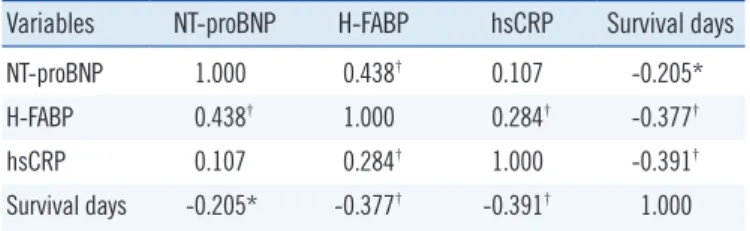
In the correlation analysis among the markers, Pearson’s cor- relation coefficient (r) was 0.438 between NT-proBNP and H- FABP (P <0.001), 0.107 between NT-proBNP and hsCRP (P =0.075), and 0.284 between H-FABP and hsCRP (P <0.001). NT-proBNP (r =-0.205, P =0.001), H-FABP (r = -0.377, P <0.001), and hsCRP (r=-0.391, P <0.001) showed negative correlations between survival and elevated markers (Table 2).
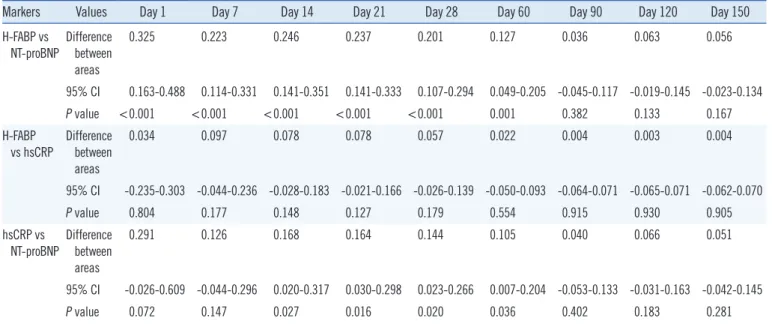
Because AUC is a measure of overall test performance, the prognostic performance of different markers can be assessed by comparing their AUCs. AUCs of the three markers in the 278 patients showed differences during the 60-day follow-up period.
H-FABP was superior to NT-proBNP for predicting mortality in patients with an increased NT-proBNP level (Table 3, P ≤0.001), whereas hsCRP was better than NT-proBNP as a prognostic marker of mortality from day 14 to 60 (Table 3, P =0.016- 0.036).
In the 278 patients, the sensitivity, specificity, cut-off concen-
Table 2. Partial correlation coefficient between the three markers and survival days in all 278 patients
Variables NT-proBNP H-FABP hsCRP Survival days
NT-proBNP 1.000 0.438† 0.107 -0.205*
H-FABP 0.438† 1.000 0.284† -0.377†
hsCRP 0.107 0.284† 1.000 -0.391†
Survival days -0.205* -0.377† -0.391† 1.000 Partial correlation coefficient adjusted by age and disease group.
*Correlation is significant at the 0.01 level; †Correlation is significant at the 0.001 level.
Abbreviations: NT-proBNP, amino-terminal pro-B type natriuretic peptide;
H-FABP, heart-type fatty acid binding protein; hsCRP, high sensitivity C-re- active protein.
tration, and prognostic efficiency of NT-proBNP, H-FABP, and hsCRP were analyzed by ROC curve analysis on days 1, 7, 14, 21, 28, 60, 90, 120, and 150 after enrollment. Patients were di- vided into three classes by marker concentration. Marker levels
were determined to be the minimum and maximum values for discriminating mortality based on optimal cut-off values of the AUC in the NT-proBNP level ( <1,117 pg/mL, ≥1,117 pg/
mL <3,856 pg/mL, ≥3,856 pg/mL), H-FABP level ( <7.4 ng/
Table 3. Comparison of ROC curves in all 278 patients
Markers Values Day 1 Day 7 Day 14 Day 21 Day 28 Day 60 Day 90 Day 120 Day 150
H-FABP vs NT-proBNP
Difference between areas
0.325 0.223 0.246 0.237 0.201 0.127 0.036 0.063 0.056
95% CI 0.163-0.488 0.114-0.331 0.141-0.351 0.141-0.333 0.107-0.294 0.049-0.205 -0.045-0.117 -0.019-0.145 -0.023-0.134 P value <0.001 <0.001 <0.001 <0.001 <0.001 0.001 0.382 0.133 0.167 H-FABP
vs hsCRP
Difference between areas
0.034 0.097 0.078 0.078 0.057 0.022 0.004 0.003 0.004
95% CI -0.235-0.303 -0.044-0.236 -0.028-0.183 -0.021-0.166 -0.026-0.139 -0.050-0.093 -0.064-0.071 -0.065-0.071 -0.062-0.070
P value 0.804 0.177 0.148 0.127 0.179 0.554 0.915 0.930 0.905
hsCRP vs NT-proBNP
Difference between areas
0.291 0.126 0.168 0.164 0.144 0.105 0.040 0.066 0.051
95% CI -0.026-0.609 -0.044-0.296 0.020-0.317 0.030-0.298 0.023-0.266 0.007-0.204 -0.053-0.133 -0.031-0.163 -0.042-0.145
P value 0.072 0.147 0.027 0.016 0.020 0.036 0.402 0.183 0.281
Abbreviations: NT-proBNP, amino-terminal pro-B type natriuretic peptide; H-FABP, heart-type fatty acid binding protein; hsCRP, high sensitivity C-reactive protein; CI, confidence interval.
Table 4. Optimal cut-off values of NT-proBNP, H-FABP, and hsCRP for discriminating mortality based on the maximum value of the area under ROC curve (AUC), and sensitivities, specificities, and mortalities during the follow-up period in all 278 patients
Day 1 Day 7 Day 14 Day 21 Day 28 Day 60 Day 90 Day 120 Day 150
NT-proBNP (pg/mL) AUC 0.500 0.655 0.618 0.613 0.638 0.697 0.735 0.710 0.728
Cut-off 1,117* 1,117 1,117 1,117 1,117 3,518 3,856† 3,856 3,856
Sensitivity 1.000 1.000 0.920 0.931 0.941 0.646 0.683 0.656 0.662
Specificity 0.309 0.322 0.324 0.329 0.336 0.687 0.739 0.738 0.748
95% CI 0.338-0.663 0.541-0.769 0.509-0.726 0.516-0.710 0.548-0.729 0.621-0.773 0.667-0.803 0.637-0.783 0.658-0.798
H-FABP (ng/mL) AUC 0.826 0.878 0.864 0.850 0.839 0.824 0.771 0.773 0.783
Cut-off 8.8† 8.8 7.8 7.5 7.5 7.4* 7.4 7.4 7.4
Sensitivity 1.000 1.000 1.000 0.966 0.941 0.896 0.817 0.797 0.794
Specificity 0.643 0.670 0.652 0.647 0.656 0.678 0.688 0.692 0.700
95% CI 0.719-0.932 0.815-0.940 0.809-0.918 0.795-0.905 0.785-0.893 0.773-0.875 0.710-0.833 0.713-0.833 0.726-0.841
hsCRP (mg/dL) AUC 0.792 0.781 0.786 0.777 0.782 0.802 0.775 0.776 0.779
Cut-off 5.0† 4.8 3.7 2.4 2.3* 2.4 2.7 2.4 2.3
Sensitivity 0.833 0.706 0.720 0.759 0.765 0.792 0.700 0.719 0.735
Specificity 0.750 0.747 0.727 0.663 0.672 0.704 0.729 0.720 0.729
95% CI 0.611-0.972 0.672-0.890 0.704-0.868 0.701-0.853 0.713-0.852 0.744-0.860 0.717-0.833 0.719-0.833 0.724-0.835
Mortality (%) 2.15 6.12 9.00 10.4 12.2 17.3 21.6 23.0 24.5
*minimum cut-off values; †maximum cut-off values.
Abbreviations: See Table 3.
mL, ≥7.4 ng/mL <8.8 ng/mL, ≥8.8 ng/mL), and hsCRP level (<2.3 mg/dL, ≥2.3 mg/dL<5.0 mg/dL, ≥5.0 mg/dL) (Table 4).
The AUC for H-FABP was larger than that of NT-proBNP or hsCRP until 60 days after sampling (Table 4).
Kaplan-Meier curves showed that the elevated serum NT- proBNP and H-FABP levels were prognostic markers of mortal- ity over 150 days in each disease group (Fig. 1), and mortality rates increased in proportion to NT-proBNP (Fig. 1A, D, G) and H-FABP levels (Fig. 1B, E, H). However, an elevated hsCRP level only affected mortality in the cardiac disease groups (Fig.
1C, F) over 150 days, and the mortality rate increased in pro- portion to the hsCRP level.
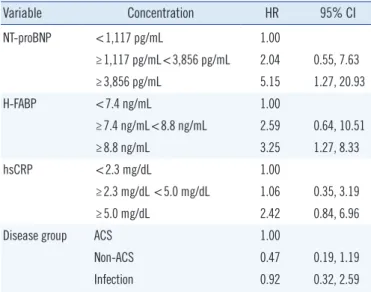
By multivariate Cox proportional hazards regression analysis adjusted for age, patients with an H-FABP of ≥8.8 ng/mL had a 3.25-fold increased risk of death as compared with patients in the reference group (<7.4 ng/mL) during the 150 day follow-up period (95% confidence interval [CI]: 1.27-8.33, Table 5). For NT-proBNP, patients with levels ≥3,856 pg/mL had a higher risk of death than the reference group (HR: 5.15; 95% CI: 1.27- 20.93, Table 5). The concentration of hsCRP did not increase Fig. 1. Kaplan-Meier analysis of survival in patients in the ACS group (n=62) stratified into three groups based on (A) NT-proBNP, (B) H- FABP, and (C) hsCRP levels. Kaplan-Meier analysis of survival in the non-ACS group (n=156) classified by (D) NT-proBNP, (E) H-FABP, and (F) hsCRP levels. Kaplan-Meier analysis of survival in patients with infection & sepsis (n=60) for (G) NT-proBNP, (H) H-FABP, and (I) hsCRP levels.
Abbreviations: ACS, acute coronary syndrome; NT-ProBNP, amino-terminal pro-B type natriuretic peptide; H-FABP, heart-type fatty acid binding protein;
hsCRP, high sensitivity C-reactive protein.
100 90 80 70 60 50 40
100 95 90 85 80 75 70 65 60
100 90 80 70 60 50
100 90 80 70 60 50 40
100 95 90 85 80 75 70 65 60
100 90 80 70 60 50 40 30 20 10
100 90 80 70 60 50 40 30
100 90 80 70 60 50 40
100 95 90 85 80 75 70 65 60 55
0 50 100 150
0 50 100 150
0 50 100 150
0 50 100 150
0 50 100 150
0 50 100 150
0 50 100 150
0 50 100 150
0 50 100 150
Survival period (days)
Survival period (days)
Survival period (days)
Survival period (days)
Survival period (days)
Survival period (days)
Survival period (days)
Survival period (days)
Survival period (days)
Survival probability (%) Survival probability (%) Survival probability (%) Survival probability (%) Survival probability (%) Survival probability (%) Survival probability (%) Survival probability (%) Survival probability (%)
P <0.001
P <0.001
P =0.000
P <0.001
P <0.001
P =0.010
P <0.001
P <0.001
P =0.578 A
D
G
B
E
H
C
F
I
NT-proBNP <1,117 pg/mL ≥1,117 pg/mL <3,856 pg/mL ≥3,856 pg/mL
NT-proBNP <1,117 pg/mL ≥1,117 pg/mL <3,856 pg/mL ≥3,856 pg/mL
NT-proBNP <1,117 pg/mL ≥1,117 pg/mL <3,856 pg/mL ≥3,856 pg/mL
H-FABP <7.4 ng/mL ≥7.4 ng/mL <8.8 ng/mL ≥8.8 ng/mL
H-FABP <7.4 ng/mL ≥8.8 ng/mL
H-FABP <7.4 ng/mL ≥7.4 ng/mL <8.8 ng/mL ≥8.8 ng/mL
hsCRP <2.3 mg/dL ≥2.3 mg/dL <5.0 mg/dL ≥5.0 mg/dL
hsCRP <2.3 mg/dL ≥2.3 mg/dL <5.0 mg/dL ≥5.0 mg/dL
hsCRP <2.3 mg/dL ≥2.3 mg/dL <5.0 mg/dL ≥5.0 mg/dL
Table 5. Hazard ratios of death for NT-proBNP, H-FABP, hsCRP, and disease group adjusted for age in all 278 patients
Variable Concentration HR 95% CI
NT-proBNP <1,117 pg/mL 1.00
≥1,117 pg/mL<3,856 pg/mL 2.04 0.55, 7.63
≥3,856 pg/mL 5.15 1.27, 20.93
H-FABP <7.4 ng/mL 1.00
≥7.4 ng/mL<8.8 ng/mL 2.59 0.64, 10.51
≥8.8 ng/mL 3.25 1.27, 8.33
hsCRP <2.3 mg/dL 1.00
≥2.3 mg/dL <5.0 mg/dL 1.06 0.35, 3.19
≥5.0 mg/dL 2.42 0.84, 6.96
Disease group ACS 1.00
Non-ACS 0.47 0.19, 1.19
Infection 0.92 0.32, 2.59
Abbreviations: HR, hazard ratio; CI, confidence interval; NT-proBNP, amino- terminal pro-B type natriuretic peptide; H-FABP, heart-type fatty acid binding protein; hsCRP, high sensitivity C-reactive protein; ACS, acute coronary syndrome.
the risk of death compared with the reference group.
DISCUSSION
In this study, the usefulness of H-FABP and hsCRP serum lev- els, in combination with NT-proBNP serum levels, was investi- gated for risk stratification in patients with ACS, non-ACS, and infectious disease. In the 278 patients examined, concentra- tions of NT-proBNP and H-FABP showed positive correlations (r =0.438, P <0.001), and H-FABP was a superior marker to predict mortality than NT-proBNP. NT-proBNP and hsCRP did not show a statistical correlation; however, hsCRP was a supe- rior prognostic marker than NT-proBNP. Concentrations of H- FABP and hsCRP were also positively correlated (r =0.284, P <0.001), but there was no significant difference in predicting mortality (Tables 3 and 4).
The AUCs of H-FABP were larger for all patients (0.824- 0.878) at days 1, 7, 14, 21, 28, and 60 after enrollment than those of hsCRP (0.777-0.792) or NT-proBNP (0.500-0.697). H- FABP was a powerful marker of short-term mortality (until day 60), and the difference between the prognostic efficacies of H- FABP and NT-proBNP was remarkable in all patients. These findings indicate that H-FABP has a good prognostic accuracy for predicting mortality within 60 days. The result of survival analysis using the above-described cut-off levels showed that H- FABP levels were positively correlated with mortality in all three
patient groups. Patients with an H-FABP level ≥8.8 ng/mL had a 3.25-fold increased risk of death as compared with patients in the reference group (<7.4 ng/mL) during the follow-up period (95% CI: 1.27-8.33, Table 5). These findings are concordant with those of others. For example, Viswanathan et al [16] re- ported an association between elevated H-FABP and the risks of 12-month mortality and myocardial re-infarction in 966 patients with suspected ACS, and Jo et al [17] found that H-FABP was an independent prognostic marker for predicting 28-day mortal- ity in patients with severe sepsis and septic shock [17].
Among patients with elevated NT-proBNP, H-FABP, and hsCRP levels, there was a correlation with increased mortality in different disease groups (Fig. 1), except for hsCRP in the infec- tion group. Regarding mortality prediction, hsCRP was useful in the ACS and non-ACS cardiac disease groups, but could not predict mortality in the infection group. In previous reports, in- creased serum concentrations of hsCRP were well correlated with functional limitations and prognosis in patients with cardio- vascular diseases [7, 8, 18, 19]. However, some major studies found a poor correlation between hsCRP and mortality in pa- tients with infection or sepsis [20]. Muller et al [21] and Kruger et al [22], in studies of community-acquired pneumonia, found that hsCRP levels were not a useful marker for predicting the clinical severity of pneumonia.
In the present study, in patients with an elevated NT-proBNP level, increases in serum H-FABP levels were identified as an independent predictor of short-term mortality (within 60 days), and correlated with mortality in three disease groups. Patients with H-FABP levels ≥8.8 ng/mL had a 3.25-fold increased risk of death as compared with patients in the reference group (<7.4 ng/mL) after adjusting for the age effect. Therefore, clini- cians can estimate that patients with elevated levels of NT- proBNP and H-FABP, who have cardiac or infectious disease at admission or when visiting an outpatient clinic, had a higher risk of mortality than patients with lower levels had. Thus, it appears this simple evaluation using a combination of biomarkers would help clinicians devise risk stratification for mortality.
The limitation of this study was that blood samples were not obtained serially from time of symptom onset. Thus, we were unable to examine relationships between the three marker lev- els and disease status.
In conclusion, the combined measurement of H-FABP with NT-proBNP provides a highly reliable means of short-term mor- tality prediction for patients hospitalized for ACS, a non-ACS cardiac disease, or infectious disease.
Authors’ Disclosures of Potential Conflicts of Interest
No conflicts of interest relevant to this article were reported.
REFERENCES
1. Baggish AL, van Kimmenade RR, Januzzi JL Jr. Amino-terminal pro-B- type natriuretic peptide testing and prognosis in patients with acute dyspnea, including those with acute heart failure. Am J Cardiol 2008;
101:49-55.
2. Doust JA, Glasziou PP, Pietrzak E, Dobson AJ. A systematic review of the diagnostic accuracy of natriuretic peptides for heart failure. Arch In- tern Med 2004;164:1978-84.
3. Mathewkutty S, Sethi SS, Aneja A, Shah K, Iyengar RL, Hermann L, et al. Biomarkers after risk stratification in acute chest pain (from the BRIC Study). Am J Cardiol 2013;111:493-8.
4. Christenson E and Christenson RH. The role of cardiac biomarkers in the diagnosis and management of patients presenting with suspected acute coronary syndrome. Ann Lab Med 2013;33:309-18.
5. Ray P, Delerme S, Jourdain P, Chenevier-Gobeaux C. Differential diag- nosis of acute dyspnea: the value of B natriuretic peptides in the emer- gency department. QJM 2008;101:831-43.
6. Lindahl B. Acute coronary syndrome-the present and future role of bio- markers. Clin Chem Lab Med 2013;51:1699-706.
7. Kim H, Yang DH, Park Y, Han J, Lee H, Kang H, et al. Incremental prog- nostic value of C-reactive protein and N-terminal proB-type natriuretic peptide in acute coronary syndrome. Circ J 2006;70:1379-84.
8. Windram JD, Loh PH, Rigby AS, Hanning I, Clark AL, Cleland JG. Rela- tionship of high-sensitivity C-reactive protein to prognosis and other prognostic markers in outpatients with heart failure. Am Heart J 2007;
153:1048-55.
9. Offner GD, Brecher P, Sawlivich WB, Costello CE, Troxler RF. Character- ization and amino acid sequence of a fatty acid-binding protein from human heart. Biochem J 1988;252:191-8.
10. Glatz JF and van der Vusse GJ. Cellular fatty acid-binding proteins: their function and physiological significance. Prog Lipid Res 1996;35:243-82.
11. Lippi G, Mattiuzzi C, Cervellin G. Critical review and meta-analysis on
the combination of heart-type fatty acid binding protein (H-FABP) and troponin for early diagnosis of acute myocardial infarction. Clin Biochem 2013;46:26-30.
12. Komamura K, Sasaki T, Hanatani A, Kim J, Hashimura K, Ishida Y, et al.
Heart-type fatty acid binding protein is a novel prognostic marker in pa- tients with non-ischaemic dilated cardiomyopathy. Heart 2006;92:615-8.
13. Liao J, Chan CP, Cheung YC, Lu JH, Luo Y, Cautherley GW, et al. Hu- man heart-type fatty acid-binding protein for on-site diagnosis of early acute myocardial infarction. Int J Cardiol 2009;133:420-3.
14. Okamoto F, Sohmiya K, Ohkaru Y, Kawamura K, Asayama K, Kimura H, et al. Human heart-type cytoplasmic fatty acid-binding protein (H- FABP) for the diagnosis of acute myocardial infarction. Clinical evalua- tion of H-FABP in comparison with myoglobin and creatine kinase iso- enzyme MB. Clin Chem Lab Med 2000;38:231-8.
15. DeLong ER, DeLong DM, Clarke-Pearson DL. Comparing the areas un- der two or more correlated receiver operating characteristic curves: a nonparametric approach. Biometrics 1988;44:837-45.
16. Viswanathan K, Kilcullen N, Morrell C, Thistlethwaite SJ, Sivananthan MU, Hassan TB, et al. Heart-type fatty acid-binding protein predicts long-term mortality and re-infarction in consecutive patients with sus- pected acute coronary syndrome who are troponin-negative. J Am Coll Cardiol 2010;55:2590-8.
17. Jo YH, Kim K, Lee JH, Rhee JE, Kang KW, Rim KP, et al. Heart-type fat- ty acid-binding protein as a prognostic factor in patients with severe sepsis and septic shock. Am J Emerg Med 2012;30:1749-55.
18. Lagrand WK, Visser CA, Hermens WT, Niessen HW, Verheugt FW, Wolbink GJ, et al. C-reactive protein as a cardiovascular risk factor:
more than an epiphenomenon? Circulation 1999;100:96-102.
19. Ridker PM. Clinical application of C-reactive protein for cardiovascular disease detection and prevention. Circulation 2003;107:363-9.
20. Silvestre J, Póvoa P, Coelho L, Almeida E, Moreira P, Fernandes A, et al.
Is C-reactive protein a good prognostic marker in septic patients? Inten- sive Care Med 2009;35:909-13.
21. Müller B, Harbarth S, Stolz D, Bingisser R, Mueller C, Leuppi J, et al.
Diagnostic and prognostic accuracy of clinical and laboratory parame- ters in community-acquired pneumonia. BMC Infect Dis 2007;7:10.
22. Krüger S, Ewig S, Marre R, Papassotiriou J, Richter K, von Baum H, et al. Procalcitonin predicts patients at low risk of death from community- acquired pneumonia across all CRB-65 classes. Eur Respir J 2008;31:
349-55.