with HF, early identification of high-risk patients along with aggressive treatment is important.3 For this purpose, N-terminal pro-B type natriuretic peptide (NT-proBNP) has been advocated as a valuable biomarker in patients with HF. NT-proBNP is elevated and its serum concentra-
H
eart failure (HF), a disabling condition with poor prognosis, is a huge burden of global health.1 In spite of continued effort for the better manage- ment, the mortality and readmission rate of HF still remains high.2 In order to improve the outcome of patientsReceived January 5, 2017; revised manuscript received March 4, 2017; accepted March 21, 2017; released online April 21, 2017 Time for primary review: 28 days
Department of Internal Medicine, Seoul National University College of Medicine, Boramae Medical Center, Seoul (H.-L.K., M.-A.K.);
Department of Internal Medicine, Seoul National University College of Medicine, Bundang Hospital, Seongnam (D.-J.C.);
Department of Cardiovascular Medicine, Dongtan Sacred Heart Hospital, College of Medicine, Hallym University, Hwasung (S.H., K.-H.R.); Department of Internal Medicine, Sungkyunkwan University College of Medicine, Samsung Medical Center, Seoul (E.-S.J.); Department of Internal Medicine, Chungbuk National University College of Medicine, Cheongju (M.-C.C.);
Department of Internal Medicine, University of Ulsan College of Medicine, Asan Medical Center, Seoul (J.-J.K.); Department of Internal Medicine, Yonsei University Wonju Christian Hospital, Wonju (B.-S.Y.); Department of Internal Medicine, Gachon University Gil Hospital, Incheon (M.-S.S.); Department of Internal Medicine, Chungnam National University College of Medicine, Daejoen (I.-W.S.); Department of Internal Medicine, Chonnam National University College of Medicine, Gwangju (Y.A.); Department of Internal Medicine, Yonsei University Severance Hospital, Seoul (S.-M.K.); Department of Internal Medicine, Yeungnam University College of Medicine, Daegu (Y.-J.K.); Department of Internal Medicine, Keimyung University College of Medicine, Daegu (H.S.K.); Department of Internal Medicine, Kyungpook National University College of Medicine, Daegu (S.C.C.); Department of Internal Medicine, Seoul National University College of Medicine, Seoul (B.-H.O.); and Department of Internal Medicine, Sejong General Hospital, Bucheon (M.-M.L.), Korea
Mailing address: Myung-A Kim, MD, PhD, Division of Cardiology, Department of Internal Medicine, Seoul National University College of Medicine, Boramae Medical Center, 20, Boramae-ro 5-gil, Dongjak-gu, Seoul 07061, Korea. E-mail: [email protected] ISSN-1346-9843 All rights are reserved to the Japanese Circulation Society. For permissions, please e-mail: [email protected]
Gender Difference in the Prognostic Value of N-Terminal Pro-B Type Natriuretic Peptide in Patients
With Heart Failure
― A Report From the Korean Heart Failure Registry (KorHF) ―
Hack-Lyoung Kim, MD; Myung-A Kim, MD; Dong-Ju Choi, MD; Seongwoo Han, MD;
Eun-Seok Jeon, MD; Myeong-Chan Cho, MD; Jae-Joong Kim, MD; Byung-Su Yoo, MD;
Mi-Seung Shin, MD; In-Whan Seong, MD;Youngkeun Ahn, MD; Seok-Min Kang, MD;
Young-Jo Kim, MD; Hyung Seop Kim, MD; Shung Chull Chae, MD; Byung-Hee Oh, MD;
Myoung-Mook Lee, MD; Kyu-Hyung Ryu, MD on behalf of the Korean Heart Failure Registry
Background: Very little data is available to evaluate the gender-specific role of N-terminal pro-B type natriuretic peptide (NT-proBNP).
This study was performed to investigate whether there is a gender difference in the prognostic value of NT-proBNP in patients hos- pitalized for heart failure (HF).
Methods and Results: A total of 2,280 patients hospitalized with HF (67.9±14.3 years, 50.9% women) from the nationwide registry database were analyzed. Composite events including all-cause mortality and HF readmission were assessed. During the mean follow-up period of 1,245±824 days, there were 1,067 cases of composite events (49.7%). NT-proBNP levels were significantly higher in patients with events than those without in both genders (P<0.001 for each). A higher NT-proBNP level was an independent predic- tor of events (highest vs. lowest tertile: hazard ratio [HR], 1.74; 95% confidence interval [CI], 1.25–2.43; P=0.001) in men, even after controlling for potential confounders. However, NT-proBNP was not associated with the occurrence of composite events in women in the same multivariable analysis (P>0.05).
Conclusions: In patients with HF, the NT-proBNP level seems to be a more valuable marker in the prediction of long-term mortality and HF readmission in men than in women.
Key Words: Gender; Heart failure; N-terminal pro-B type natriuretic peptide; Prognosis
Heart Failure
HF, involving 24 well-qualified cardiac centers in Korea.17 Between June 2004 and April 2009, patients hospitalized for HF were asked to participate in the registry. HF on admission was diagnosed according to the Framingham criteria,18 and the diagnosis was confirmed again at the time of hospital discharge. Patients’ data was entered into the Korean Heart Failure (KorHF) Registry database via a web-based electronic data capture system that included an electronic case report form.17 Data collection and audi- tion were performed by the KorHF Registry Steering Committee at the Korean Society of Heart Failure. Among initially screened 3,427 patients with HF, NT-proBNP was available in 2,280 patients (66.5%), and these patients were analyzed in this study. This study complies with the Declaration of Helsinki, and the institutional review board at each participating hospital approved the study protocol.
Written informed consent was obtained from each study patient.
Data Collection
Patient’s height and body weight were measured at the time of admission. Body mass index (BMI) was calculated by dividing weight in kilograms by height squared in tion is closely associated with mortality and hospitalization
in patients with HF.4–8
There are substantial differences between men and women in the pathophysiology and disease manifestations of HF.9–11 However, studies focusing on gender differences in biomarkers for HF have been scarce. Although several studies have indicated different blood levels of brain natri- uretic peptide (BNP) or NT-proBNP between genders,12–15 only a few studies have performed gender-specific analysis in the prognostic value of these biomarkers in HF. Never- theless, their results are still conflicting.12,16
Data on gender differences for the prognostic value of NT-proBNP is essential for the interpretation of NT- proBNP results, and it would provide additional guidance of HF therapy. Therefore, the present study was performed to investigate whether there are gender differences in the ability of NT-proBNP levels to predict mortality and HF readmission in HF patients.
Methods Study Population
Study data was derived from the nationwide registry of
Table 1. Baseline Characteristics of Study Patients
Characteristic Total
(n=2,280) Men
(n=1,119) Women
(n=1,161) P value*
Age, years 67.9±14.3 64.6±14.4 71.0±13.5 <0.001
BMI, kg/m2 23.1±3.9 23.4±3.9 22.7±3.9 <0.001
SBP, mmHg 131±29 129±29 132±30 0.035
DBP, mmHg 77.9±18.2 78.2±19.0 77.7±17.3 0.459
Heart rate, beats/min 91.0±25.6 90.4±24.7 91.6±26.4 0.275
Previous medical history, %
HF 30.2 30.5 29.8 0.715
Myocardial infarction 15.4 18.3 12.7 <0.001
Chronic kidney disease 8.9 9.7 8.2 0.130
Hypertension 47.4 44.9 49.8 0.019
Diabetes mellitus 30.5 30.4 30.7 0.885
Underlying conditions, %
Ischemic 42.4 46.3 38.5
Non-ischemic 51.9 48.1 55.6 0.001
Unknown 5.7 5.6 5.8
Laboratory findings
Hemoglobin, g/dL 12.4±2.3 13.1±2.3 11.6±2.0 <0.001
BUN, mg/dL 24.7±15.5 25.3±16.0 24.2±14.9 0.083
Creatinine, mg/dL 1.49±1.31 1.61±1.36 1.37±1.24 <0.001
Sodium, mEq/L 138±5 138±4 138±5 0.670
NT-proBNP, pg/mL 8,481±9,843 7,543±9,274 9,385±10,285 <0.001 Echocardiographic findings
LVEDD, mm 56.7±10.2 59.3±10.2 54.1±9.6 <0.001
LVESD, mm 44.3±12.1 47.4±12.0 41.4±11.5 <0.001
LVEF, % 39.5±15.8 36.7±15.0 42.2±16.2 <0.001
Left atrial size, mm 56.6±32.2 56.0±32.9 57.3±31.6 0.603
Medications at discharge, % n=2,148 n=1,048 n=1,100
β-blockers 40.6 39.8 41.3 0.530
RAS-blockers 46.8 47.1 46.5 0.783
*P values were obtained from the comparisons between men and women. BMI, body mass index; BUN, blood urea nitrogen; DBP, diastolic blood pressure; HF, heart failure; LVEDD, left ventricular end-diastolic dimension; LVEF, left ventricular ejection fraction; LVESD, left ventricular end-systolic dimension; NT-proBNP, N-terminal-pro-brain natri- uretic peptide; RAS, renin-angiotensin system; SBP, systolic blood pressure.
were considered potential confounders and adjusted dur- ing the multivariable analyses:17 age (<65 vs. ≥65 years), BMI (<23 vs. ≥23 kg/m2),21 prior history of HF, HF etiol- ogy, SBP (≥100 vs. <100 mmHg), heart rate (<100 vs. ≥100 beats/min), hemoglobin (≥12 vs. <12 g/dL),22 creatinine (<2.0 vs. ≥2.0 mg/dL),23 sodium (≥135 vs. <135 mEq/L), LVEF (≥50 vs. <50%) and HF medications at discharge.
Kaplan-Meier survival curves with log-rank comparison were plotted to demonstrate different event rates according to NT-proBNP values in men and women. NT-proBNP was categorized into three groups based on tertiles during multivariable analysis and Kaplan-Meier survival analysis.
A P value of <0.05 was considered statistically significant.
All statistical analyses were conducted using SPSS version 18.0 (IBM Co., Armonk, NY, USA).
Results Baseline Clinical Characteristics
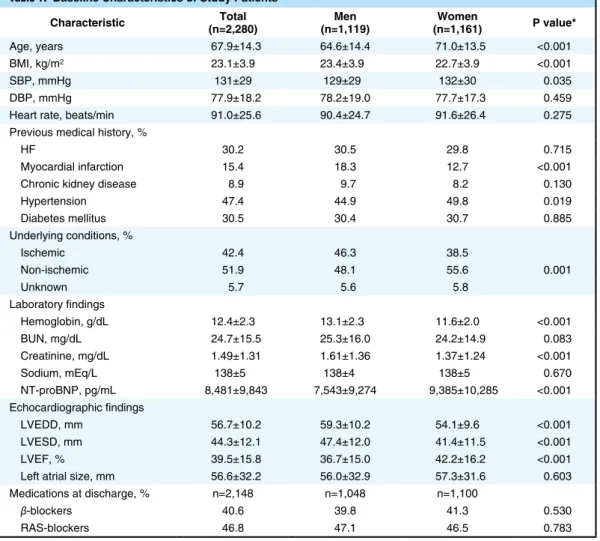
The baseline clinical characteristics of the study patients are shown in Table 1. The mean age of the total study population was 67.9±14.3 years. The study patients con- sisted of 1,119 men (49.1%) and 1,161 women (50.9%).
Women were older than men (71.0±13.5 vs. 64.6±14.4 years, P<0.001), and had smaller BMIs. SBP at the time of admission was higher in women than in men. The inci- dence of prior myocardial infarction was higher in men and the incidence of hypertension was higher in women.
The incidence of ischemic etiology of HF was higher in men than in women. In laboratory findings, the hemoglo- bin level was lower and renal function was better in women than in men. Discharge medications including β-blocker meters. Systolic and diastolic blood pressure (SBP and
DBP) and heart rate were measured by a trained nurse using an oscillometric device. Information on previous medical history or concomitant medical problems includ- ing HF, myocardial infarction, chronic kidney disease, hypertension and diabetes mellitus was obtained. HF etiol- ogy was classified as ischemic or non-ischemic. Major laboratory parameters suggested as prognostic markers in HF were measured using a venous blood sample. These parameters included hemoglobin, blood urea nitrogen, cre- atinine and sodium. Transthoracic echocardiography was performed, and left ventricular (LV) dimensions, LV ejec- tion fraction (LVEF) and left atrial size were measured according to the current guidelines.19 Medications at the time of discharge were also reviewed, and information on the use of β-blocker, renin-angiotensin system (RAS) blockers including angiotensin-converting enzyme inhibi- tor and angiotensin II receptor blocker was collected.
Clinical Events
Three types of clinical events focused in this study were: (1) in-hospital mortality; (2) all-cause mortality after discharge;
and (3) composite events including all-cause mortality and HF readmission during follow up. Clinical events were assessed by research coordinators by reviewing medical records, and telephone contact was performed if necessary using a standardized report form.
NT-ProBNP Measurement
NT-proBNP was measured at the time of admission with the electro-chemiluminescence immunoassay method using an Elecsys 2010 analyzer (Roche Diagnostics) or NT-proBNP assay for Dimension platform (Siemens Medical Solutions Diagnostics).20
Statistical Analysis
Continuous variables are presented as mean ± standard deviation (SD), and categorical variables are expressed as percentages. Univariate comparisons between men and women were performed using Student’s t-test for continu- ous variables and the chi-squared test for dichotomous variables. Age-adjusted mean values of NT-proBNP were compared between genders using analysis of covariance (ANCOVA). Multiple binary logistic regression analysis was performed to determine an independent association between NT-proBNP and in-hospital mortality. After excluding patients with in-hospital mortality, Cox propor- tional hazard analysis was performed to determine inde- pendent associations of NT-proBNP with mortality and composite events after discharge. The following variables
Figure 1. NT-proBNP levels in men and women with heart failure. NT-pro-BNP, N-terminal pro-brain natriuretic peptide;
ANCOVA, analysis of covariance.
Table 2. Clinical Events
Total Men Women P value*
In-hospital mortality
n 2,280 1,119 1,161
In-hospital mortality, n (%) 132 (5.8) 71 (6.3) 61 (5.2) 0.276
Event after discharge
n 2,148 1,048 1,100
Mortality, n (%) 694 (32.3) 337 (32.1) 357 (32.4) 0.742
Mortality+HF admission, n (%) 1,067 (49.7) 503 (48.0) 564 (51.2) 0.129
*P values were obtained from the comparisons between men and women. HF, heart failure.
During the mean follow-up duration of 1,245±824 days (median, 1,431 days; interquartile range, 418–1,979 days), there were 694 mortality cases (32.3%) and 1,067 cases of composite events (all-cause mortality+HF readmission) (49.7%). There were no gender differences in the occur- rences of these events (mortality, 32.1% in men vs. 32.4%
in women, P=0.742; composite events, 48.0% in men vs.
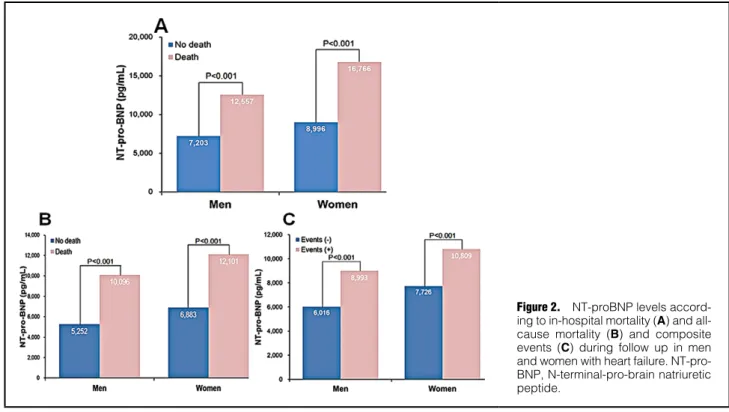
51.2% in women, P=0.129). NT-proBNP levels were sig- nificantly higher in patients with any events including in- hospital mortality (14,502±13,071 vs. 8,119±9,494 pg/mL, P<0.001), mortality after discharge (10,465±10,707 vs.
6,077±7,636 pg/mL, P<0.001) and composite events after discharge (9,374±10,145 vs. 6,864±8,620 pg/mL, P<0.001) and RAS-blockers were not different between genders.
Women had a smaller LV size and better LV systolic func- tion than men on echocardiographic examinations. The serum NT-proBNP level was significantly higher in women than in men, even after controlling for aging effect (9,385±10,285 vs. 7,543±9,274 pg/mL, ANCOVA, P<0.001) (Figure 1).
Clinical Events and NT-ProBNP
The incidences of clinical events are demonstrated in Table 2. A total of 132 patients (5.8%) died during initial hospitalization. There was no gender difference in in-hos- pital mortality (6.3% in men vs. 5.2% in women, P=0.276).
Figure 2. NT-proBNP levels accord- ing to in-hospital mortality (A) and all- cause mortality (B) and composite events (C) during follow up in men and women with heart failure. NT-pro- BNP, N-terminal-pro-brain natriuretic peptide.
Table 3. Independent Predictors for In-Hospital Mortality
Variable Men Women
OR (95% CI) P value OR (95% CI) P value
Age ≥65 years 1.05 (0.47–2.35) 0.895 1.37 (0.48–3.91) 0.548
BMI ≥23 kg/m2 1.48 (0.68–3.22) 0.314 1.18 (0.52–2.67) 0.680
Prior history of HF 1.36 (0.63–2.94) 0.427 3.03 (1.30–7.05) 0.010
Ischemic cause of HF 0.94 (0.52–1.68) 0.843 1.29 (0.70–2.38) 0.407
SBP <100 mmHg 2.31 (0.94–5.68) 0.067 1.84 (0.61–5.54) 0.278
Heart rate ≥100 beats/min 1.11 (0.50–2.46) 0.796 1.25 (0.54–2.88) 0.601 Hemoglobin <12 g/dL 1.36 (0.58–3.15) 0.471 1.12 (0.45–2.79) 0.805 Serum creatinine ≥2.0 mg/dL 3.14 (1.35–7.27) 0.008 4.92 (1.96–12.33) 0.001
Sodium <135 mEq/L 1.50 (0.67–3.35) 0.318 3.81 (1.71–8.50) 0.001
LVEF <50% 0.87 (0.34–2.24) 0.783 1.52 (0.58–4.02) 0.391
NT-proBNP
Lowest tertile 1 1
Middle tertile 1.21 (0.40–3.65) 0.728 1.05 (0.33–3.38) 0.925
Highest tertile 2.32 (0.80–6.68) 0.118 1.16 (0.36–3.72) 0.793
CI, confidence interval; OR, odds ratio. Other abbreviations as in Table 1.
mortality (Table 3). Among potential variables, renal dys- function (serum creatinine ≥2.0 mg/dL) was an indepen- dent predictor of in-hospital mortality in men (P<0.05). In women, prior history of HF, renal dysfunction (serum creatinine ≥2.0 mg/dL) and hyponatremia (serum sodium
<135 mEq/L) were independent predictors of in-hospital mortality (P<0.05 for each). The predictive value of NT- proBNP in in-hospital mortality was not observed in either men or women in these multivariable analyses (P>0.05 for each). Multivariable Cox regression analyses were per- formed to investigate independent predictors of all-cause mortality after discharge (Table 4). Old age, low BMI, ischemic etiology of HF, and impaired renal function were independent predictors of mortality after discharge in men (P<0.05 for each). A higher NT-proBNP level was also than in those without. These results were consistent in
both men (12,557±13,200 vs. 7,203±8,858 pg/mL, P<0.001 for in-hospital mortality [Figure 2A]; 10,096±10,011 vs.
5,252±7,036 pg/mL, P<0.001 for mortality after discharge [Figure 2B]; and 8,993±9,405 vs. 6,016±8,140 pg/mL, P<0.001 for composite events after discharge [Figure 2C]) and women (16,766±12,652 vs. 8,996±9,996 pg/mL, P<0.001 for in-hospital mortality [Figure 2A]; 12,101±11,275 vs.
6,883±8,104 pg/mL, P<0.001 for mortality after discharge [Figure 2B]; and 10,809±10,708 vs. 7,726±9,008 pg/mL, P<0.001 for composite events after discharge [Figure 2C]).
Prognostic Value of NT-ProBNP
Multivariable binary logistic regression analyses were per- formed to investigate independent predictors of in-hospital
Table 4. Independent Predictors for Mortality After Discharge
Variable Men Women
HR (95% CI) P value HR (95% CI) P value
Age ≥65 years 2.84 (1.94–4.17) <0.001 2.31 (1.51–3.47) <0.001
BMI ≥23 kg/m2 0.65 (0.47–0.89) 0.007 0.72 (0.54–0.95) 0.024
Prior history of HF 1.77 (0.94–1.77) 0.104 1.03 (0.75–1.41) 0.825
Ischemic cause of HF 1.39 (1.02–1.89) 0.036 1.19 (0.88–1.62) 0.242
SBP <100 mmHg 0.82 (0.50–1.33) 0.425 1.25 (0.74–2.10) 0.395
Heart rate ≥100 beats/min 0.83 (0.59–1.17) 0.305 1.15 (0.85–1.55) 0.348 Hemoglobin <12 g/dL 1.37 (0.99–1.91) 0.056 1.15 (0.84–1.58) 0.371 Serum creatinine ≥2.0 mg/dL 1.56 (1.05–2.32) 0.026 2.25 (1.45–3.47) <0.001 Sodium <135 mEq/L 0.96 (0.66–1.41) 0.858 2.02 (1.43–2.84) <0.001
LVEF <50% 1.21 (0.81–1.79) 0.334 0.94 (0.69–1.28) 0.720
β-blocker use 0.83 (0.60–1.15) 0.267 1.08 (0.80–1.46) 0.575
RAS-blocker use 0.80 (0.58–1.09) 0.169 0.62 (0.46–0.84) 0.002
NT-proBNP
Lowest tertile 1 1
Middle tertile 1.84 (1.21–2.81) 0.004 0.79 (0.55–1.14) 0.223
Highest tertile 2.31 (1.49–3.56) <0.001 1.41 (0.96–2.05) 0.075
Abbreviations as in Tables 1,3.
Table 5. Independent Predictors for Composite Events After Discharge
Variable Men Women
HR (95% CI) P value HR (95% CI) P value
Age ≥65 years 1.81 (1.39–2.37) <0.001 2.34 (1.71–3.19) <0.001
BMI ≥23 kg/m2 0.90 (0.71–1.15) 0.421 0.83 (0.66–1.04) 0.107
Prior history of HF 1.73 (1.35–2.21) <0.001 1.50 (1.17–1.91) 0.001 Ischemic cause of HF 1.01 (0.79–1.29) 0.918 1.11 (0.87–1.42) 0.363
SBP <100 mmHg 0.58 (0.63–1.29) 0.904 1.23 (0.83–1.82) 0.285
Heart rate ≥100 beats/min 0.90 (0.69–1.17) 0.456 0.95 (0.75–1.21) 0.730 Hemoglobin <12 g/dL 1.24 (0.94–1.62) 0.117 0.92 (0.72–1.17) 0.537 Serum creatinine ≥2.0 mg/dL 1.41 (0.93–1.96) 0.035 1.59 (0.97–2.59) 0.110 Sodium <135 mEq/L 1.27 (0.94–1.71) 0.116 1.60 (1.20–2.13) 0.001
LVEF <50% 1.05 (0.78–1.41) 0.727 1.31 (1.02–1.68) 0.033
β-blocker use 0.86 (0.68–1.10) 0.253 0.97 (0.77–1.23) 0.852
RAS-blocker use 1.01 (0.78–1.27) 0.988 0.71 (0.56–0.91) 0.006
NT-proBNP
Lowest tertile 1
Middle tertile 1.51 (1.11–2.05) 0.007 0.93 (0.70–1.22) 0.610
Highest tertile 1.74 (1.25–2.43) 0.001 1.17 (0.87–1.56) 0.279
Abbreviations as in Tables 1,3.
Discussion
The aim of this study was to investigate gender differences in the prognostic value of NT-proBNP in patients hospi- talized for HF. There was no NT-proBNP value in the prediction of in-hospital mortality in either gender. The NT-proBNP level was independently associated with long- term clinical events including mortality and HF readmis- sion in men. Otherwise, a higher NT-proBNP level was associated with a higher event rate in univariate analysis, but the prognostic power of NT-proBNP was diminished to be statistically insignificant after controlling for poten- tial confounders in multivariable analysis in women.
The role of NT-proBNP in the prediction of future car- diovascular events in patients with HF has been widely acknowledged.4–8 Our study also showed similar findings that NT-proBNP levels were a significant independent pre- dictor of mortality and HF readmission in the total study population (data not shown). However, there has been limited data on gender-specific analysis of the prognostic value of NT-proBNP in HF. In our study, more specific analysis by gender stratification showed that long-term prognostic value of NT-proBNP was significant only in men but not in women. In agreement with our findings, Nakada et al demonstrated that high BNP levels were associated with long-term cardiovascular mortality and significantly associated with mortality after discharge in
men (highest vs. lowest tertile: hazard ratio [HR], 2.31;
95% confidence interval (CI), 1.49–3.56; P<0.001). In women, old age, low BMI, low serum sodium, impaired renal function and non-use of a RAS blocker were inde- pendently associated with mortality (P<0.05 for each).
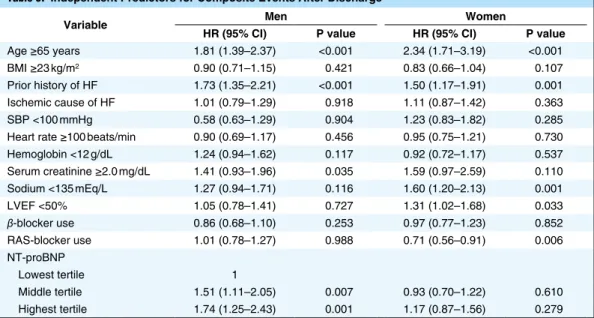
However, the same multivariable analysis showed that the predictive value of NT-proBNP was not significant in women (P>0.05). The independent predictors of composite events are shown in Table 5. Old age, HF history, and impaired renal function were associated with composite events in men (P<0.05 for each). A higher NT-proBNP was also an independent predictor of composite events in men (highest vs. lowest tertile: HR, 1.74; 95% CI, 1.25–
2.43; P=0.001). In women, old age, HF history, low serum sodium, low LVEF and non-use of a RAS-blockers were associated with composite events (P<0.05 for each).
However, NT-proBNP was not associated with the occur- rence of composite events in women (P>0.05). Kaplan-Meier survival curves demonstrated that NT-proBNP value in the prediction of mortality was more pronounced in men compared to women (Figure 3A,B). Kaplan-Meier survival curves demonstrated significantly different composite event-free survival rates according to NT-proBNP tertiles in men (log-rank P<0.001) but not in women (log-rank P=0.158) (Figure 3C,D).
Figure 3. Survival rates (A,B) and event-free survival rates (C,D) according to NT-proBNP tertiles in men and women with heart failure. NT-pro-BNP, N-terminal-pro-brain natriuretic peptide.
ing pathophysiology.
Our results suggest that NT-proBNP may be a more appropriate test to predict long-term future events in men compared to women. This information provides us with further insight into different biological bases of HF between men and women, and emphasizes the need of gender-specific approach for the best use of NT-proBNP.
Several limitations of our study should be addressed. As only 66.5% of patients with available NT-proBNP were selected from the registry database, there was a possibility of selection bias. The lack of data on sex hormones or menopausal status did not confer possible relationships between estrogen levels and the prognostic value of NT- proBNP. As all of our study patients were Korean, direct application of our results to other ethnic groups may there- fore be difficult. Lack of information on the dosage and adherence of cardiovascular drugs, and device therapy such as implantable cardioverter-defibrillator or cardiac resynchronization therapy is another limitation of this study, because these factors might have an effect on patient outcomes.
In conclusion, NT-proBNP may be a stronger predictor of long-term mortality and HF re-admission in men than in women with HF. The gender effect should be considered in the use of NT-proBNP for the better management strat- egy in HF patients.
Funding None.
Conflicts of Interest
The authors declare there is no conflict of interest associated with this manuscript.
References
1. Ambrosy AP, Fonarow GC, Butler J, Chioncel O, Greene SJ, Vaduganathan M, et al. The global health and economic burden of hospitalizations for heart failure: Lessons learned from hos- pitalized heart failure registries. J Am Coll Cardiol 2014; 63:
1123 – 1133.
2. Cowie MR, Wood DA, Coats AJ, Thompson SG, Suresh V, Poole-Wilson PA, et al. Survival of patients with a new diagnosis of heart failure: A population based study. Heart 2000; 83:
505 – 510.
3. Sartipy U, Dahlstrom U, Edner M, Lund LH. Predicting sur- vival in heart failure: Validation of the MAGGIC heart failure risk score in 51,043 patients from the Swedish heart failure reg- istry. Eur J Heart Fail 2014; 16: 173 – 179.
4. Waldo SW, Beede J, Isakson S, Villard-Saussine S, Fareh J, Clopton P, et al. Pro-B-type natriuretic peptide levels in acute decompensated heart failure. J Am Coll Cardiol 2008; 51:
1874 – 1882.
5. Januzzi JL, Bayes-Genis A. Evolution of amino-terminal pro-B type natriuretic peptide testing in heart failure. Drug News Perspect 2009; 22: 267 – 273.
6. Lainchbury JG, Campbell E, Frampton CM, Yandle TG, Nicholls MG, Richards AM. Brain natriuretic peptide and N-terminal brain natriuretic peptide in the diagnosis of heart failure in patients with acute shortness of breath. J Am Coll Cardiol 2003;
42: 728 – 735.
7. Bettencourt P, Azevedo A, Pimenta J, Frioes F, Ferreira S, Ferreira A. N-terminal-pro-brain natriuretic peptide predicts outcome after hospital discharge in heart failure patients. Circulation 2004; 110: 2168 – 2174.
8. van Kimmenade RR, Pinto YM, Bayes-Genis A, Lainchbury JG, Richards AM, Januzzi JL Jr. Usefulness of intermediate amino-terminal pro-brain natriuretic peptide concentrations for diagnosis and prognosis of acute heart failure. Am J Cardiol 2006; 98: 386 – 390.
9. Vaccarino V, Parsons L, Every NR, Barron HV, Krumholz HM.
Sex-based differences in early mortality after myocardial infarc- tion: National registry of myocardial infarction 2 participants. N HF admission in men but not in women among 748 con-
secutive patients with acute decompensated HF.16 Meyer et al performed gender comparisons in 351 men and 215 women with HF, and demonstrated gender-stratified Kaplan-Meier survival curves for 3-year all-cause mortal- ity based on NT-proBNP.24 Much to our surprise, the survival graph patterns are very similar to those shown in our study (Figure 3). Duschek et al assessed the prognostic value of NT-proBNP in 205 elderly patients undergoing carotid endarterectomy, although they were not HF patients, and showed that the pre-operative plasma level of NT-proBNP is a predictive marker for long-term survival in men but not in women.25 In contrast to those studies, a study by Christ et al involving 452 patients with acute dyspnea indicated that a higher BNP level was a more powerful predictor of death in women compared to men.26 Hsich et al analyzed 99,930 HF patients, and showed that BNP levels were correlated with in-hospital mortality in both genders after controlling for 20 clinical variables.12 However, gender difference in the prognostic values of BNP in long-term clinical outcomes were not assessed in that study.12 Similar to this study, Franke et al followed up 2,019 men and 530 women with chronic HF for 5 years, and showed that NT-proBNP levels correlate well with survival rates in both genders.27 However, the dispropor- tion of men and women in this study should be considered when interpreting the results. In these current literatures, discrepancies regarding gender-related BNP or NT-proBNP values are mainly attributed to different study populations, clinical end-points, follow-up periods and HF management.
These conflicting results warrant further well-designed studies in the future.
Mechanistic explanation for gender differences in prog- nostic value of NT-proBNP was not provided by our study. Complex pathophysiology such as different hor- monal influences, gender-specific molecular mechanisms, co-morbidities, and psychosocial factors may play a role.
Previous data suggest that the production and release of NT-proBNP are significantly different according to gen- der, and that sex hormones play a role interacting with regulation of neurohormones, including natriuretic pep- tide.13,15,28 Specifically, it has been suggested that blood NT-proBNP levels are decreased by testosterone and increased by estrogen.13 Indeed, age-adjusted NT-proBNP levels were significantly higher in women than in men in our study, which is in good agreement with the results of prior studies.12–15 However, whether gender difference in NT-proBNP biology and its circulating levels influences the prognostic ability of NT-proBNP remains unclear. A plausible explanation is that different clinical characteris- tics such as age, BMI, blood pressure, HF etiology, labora- tory findings and LV size and function between men and women might have an effect on the ability of NT-proBNP to predict future events. Nevertheless, gender differences in NT-proBNP value were obvious, even after controlling for these potential confounders in our multivariable analyses.
A recent study by Kang et al analyzed 528 HFpEF and 1,142 HFrEF patients from the KorHF registry, and showed that the plasma level of NT-proBNP is a powerful prognostic factor in both HFpEF and HFrEF.20 In addi- tion, we controlled the effect of LVEF in multivariable analysis. Therefore, it may be hard to consider a higher incidence of HFpEF in women than in men as a potential mechanism for gender-specific value of NT-proBNP.
Further investigations are needed to elucidate its underly-
Guidelines and Standards Committee and the Chamber Quantification Writing Group, developed in conjunction with the European Association of Echocardiography, a branch of the European Society of Cardiology. J Am Soc Echocardiogr 2005;
18: 1440 – 1463.
20. Kang SH, Park JJ, Choi DJ, Yoon CH, Oh IY, Kang SM, et al.
Prognostic value of NT-proBNP in heart failure with preserved versus reduced EF. Heart 2015; 101: 1881 – 1888.
21. Kamiya K, Masuda T, Matsue Y, Inomata T, Hamazaki N, Matsuzawa R, et al. Complementary role of arm circumference to body mass index in risk stratification in heart failure. JACC Heart Fail 2016; 4: 265 – 273.
22. Varadarajan P, Gandhi S, Sharma S, Umakanthan B, Pai RG.
Prognostic significance of hemoglobin level in patients with con- gestive heart failure and normal ejection fraction. Clin Cardiol 2006; 29: 444 – 449.
23. Desai AS, Swedberg K, McMurray JJ, Granger CB, Yusuf S, Young JB, et al. Incidence and predictors of hyperkalemia in patients with heart failure: An analysis of the CHARM Program.
J Am Coll Cardiol 2007; 50: 1959 – 1966.
24. Meyer S, van der Meer P, van Deursen VM, Jaarsma T, van Veldhuisen DJ, van der Wal MH, et al. Neurohormonal and clinical sex differences in heart failure. Eur Heart J 2013; 34:
2538 – 2547.
25. Duschek N, Skrinjar E, Waldhor T, Vutuc C, Daniel G, Hubl W, et al. N-terminal pro B-type natriuretic peptide (NT pro-BNP) is a predictor of long-term survival in male patients of 75 years and older with high-grade asymptomatic internal carotid artery ste- nosis. J Vasc Surg 2011; 53: 1242 – 1250.
26. Christ M, Laule-Kilian K, Hochholzer W, Klima T, Breidthardt T, Perruchoud AP, et al. Gender-specific risk stratification with B-type natriuretic peptide levels in patients with acute dyspnea:
Insights from the B-type natriuretic peptide for acute shortness of breath evaluation study. J Am Coll Cardiol 2006; 48: 1808 – 1812.
27. Franke J, Lindmark A, Hochadel M, Zugck C, Koerner E, Keppler J, et al. Gender aspects in clinical presentation and prognostica- tion of chronic heart failure according to NT-proBNP and the heart failure survival score. Clin Res Cardiol 2015; 104: 334 – 341.
28. Clerico A, Recchia FA, Passino C, Emdin M. Cardiac endocrine function is an essential component of the homeostatic regulation network: Physiological and clinical implications. Am J Physiol Heart Circ Physiol 2006; 290: H17 – H29.
Engl J Med 1999; 341: 217 – 225.
10. Levy D, Larson MG, Vasan RS, Kannel WB, Ho KK. The pro- gression from hypertension to congestive heart failure. JAMA 1996; 275: 1557 – 1562.
11. Chin MH, Goldman L. Gender differences in 1-year survival and quality of life among patients admitted with congestive heart failure. Med Care 1998; 36: 1033 – 1046.
12. Hsich EM, Grau-Sepulveda MV, Hernandez AF, Eapen ZJ, Xian Y, Schwamm LH, et al. Relationship between sex, ejection fraction, and B-type natriuretic peptide levels in patients hospi- talized with heart failure and associations with inhospital out- comes: Findings from the get with the guideline-heart failure registry. Am Heart J 2013; 166: 1063 – 1071.
13. Lam CS, Cheng S, Choong K, Larson MG, Murabito JM, Newton-Cheh C, et al. Influence of sex and hormone status on circulating natriuretic peptides. J Am Coll Cardiol 2011; 58:
618 – 626.
14. Masson S, Latini R, Anand IS, Vago T, Angelici L, Barlera S, et al. Direct comparison of B-type natriuretic peptide (BNP) and amino-terminal proBNP in a large population of patients with chronic and symptomatic heart failure: the Valsartan Heart Failure (Val-HeFT) data. Clin Chem 2006; 52: 1528 – 1538.
15. Redfield MM, Rodeheffer RJ, Jacobsen SJ, Mahoney DW, Bailey KR, Burnett JC Jr. Plasma brain natriuretic peptide concentra- tion: Impact of age and gender. J Am Coll Cardiol 2002; 40:
976 – 982.
16. Nakada Y, Kawakami R, Nakano T, Takitsume A, Nakagawa H, Ueda T, et al. Sex differences in clinical characteristics and long-term outcome in acute decompensated heart failure patients with preserved and reduced ejection fraction. Am J Physiol Heart Circ Physiol 2016; 310: H813 – H820.
17. Choi DJ, Han S, Jeon ES, Cho MC, Kim JJ, Yoo BS, et al.
Characteristics, outcomes and predictors of long-term mortality for patients hospitalized for acute heart failure: A report from the Korean Heart Failure Registry. Korean Circ J 2011; 41:
363 – 371.
18. Ho KK, Anderson KM, Kannel WB, Grossman W, Levy D.
Survival after the onset of congestive heart failure in Framingham Heart Study subjects. Circulation 1993; 88: 107 – 115.
19. Lang RM, Bierig M, Devereux RB, Flachskampf FA, Foster E, Pellikka PA, et al. Recommendations for chamber quantifica- tion: A report from the American Society of Echocardiography’s