Case report
Child Kidney Dis 2018;22:71-74
DOI: https://doi.org/10.3339/jkspn.2018.22.2.71
ISSN 2384-0242 (print) ISSN 2384-0250 (online)
Calcified Macroplastique Substance: A Rare Cause of Recurrent Gross Hematuria after Endoscopic Injection
Endoscopic subureteral injection for treatment of vesicoureteral reflux (VUR) is known to be safe and efficient due to its minimal invasive nature. Being non-migra- tory, non-antigenic, and biocompatible, Macroplastique (Polydimethylsiloxane) is likely to be stable over time. A 5-year-old boy with a past history of subureteral administration of Macroplastique for unilateral Grade V VUR 4 years ago presented with recurrent gross and microscopic hematuria, along with suprapubic pain. On computed tomography (CT) abdomen, calcified material, suspected to be a stone, was visualized in the bladder. On diagnostic cystoscopy, calcification was seen around the orifice site where Macroplastique injection had been performed. We removed the calcific material by Holmium laser. Endoscopic subureteric implanta- tion has several advantages, but nevertheless, vigilance is needed to detect long- term complications, especially in patients with gross or microscopic hematuria.
Key words: Vesico-ureteral reflux, Endoscopic injection, Calcification
Min Hae Seo, M.D.1 Ji Yeon Song, M.D.1
Jae Min Chung, M.D., Ph.D.2 Sang don Lee, M.D., Ph.D.2 Su Young Kim, M.D., Ph.D.1 Seong Heon Kim, M.D1
Department of Pediatrics1, Pusan National University Children’s Hospital, Yangsan, Korea, Department of Urology2, Pusan National University Yangsan Hospital, Yangsan, Korea
Corresponding author:
Seong Heon Kim, M.D.
Department of Pediatrics, Pusan National University Children’s Hospital, 20 Geumo- ro, Mulgeum-eup, Yangsan, Goungnam 50612, Korea
Tel: +82-55-360-3163 Fax: +82-55-360-2181 E-mail: [email protected] Received: 29 August 29 Revised: 17 September 2018 Accepted: 4 October 2018
This is an open-access article distributed under the terms of the Creative Commons Attribu tion Non-Commercial License (http://
crea tivecom mons.org/licenses/by-nc/4.0/) which permits unrestricted non-commercial use, distribution, and reproduction in any medium, provided the original work is properly cited.
Copyright © 2018 The Korean Society of Pediatric Nephrology
Introduction
Vesicoureteral reflux (VUR) is present in about 1% of normal healthy child
ren and in 30–50% of children with symptomatic urinary tract infections (UTIs)1). The most common presenting symptom of VUR is pyelonephritis, which can lead to renal injury and subsequent renal impairment or endstage renal disease2). Children with VUR may be managed either medically or sur
gically. The rationale for medical management is prevention of UTI using daily antibiotic prophylaxis, regular timed voiding and, in some cases, anticholi
nergic medication. The surgical management of VUR consists of repair of the ureterovesical junction (UVJ) abnormality3). In recent years, endoscopic sub
ureteral transurethral injection (STING) has become the firstline therapy for children with VUR owing to its high success rate and minimum complica
tions4). The substance used for endoscopic injection should be nontoxic, bio
compatible, nonmigratory, and nonantigenic, causing minimal local in
flammation. Macroplastique is one of the most popular bulking agents and has wide application in the medical field, especially in endoscopic manage
ment of VUR5). We report a case of gross hematuria caused by calcified Macro
plastique substance injected to initially treat unilateral VUR.
72 Child Kidney Dis • 2018;22:71-74 www.chikd.org Case report
A 5yearold boy presented to our pediatric emergency department with intermittent gross hematuria and supra
pubic pain since several months. He was treated with anti
biotics for suspected cystitis, whenever he had such symp
toms in the past and symptoms were disappeared in several days. He suffered from recurrent febrile UTIs since 4 months of age, and was diagnosed with unilateral grade V VUR and the febrile UTIs were not responsive to prophylactic anti
biotics, hence Macroplastique injection was performed at 9 months of age (Fig. 1).
Followup VCUG performed 3 months after injection showed a resolution of VUR. After 2 years from Macropla
stique injection, gross hematuria appeared first time. Also, two times microscopic hematuria and three times gross hematuria broke out. His mother gave a history of trans
parent powdery material in his urine frequently, after Ma
croplastique injection. Whenever hematuria presented, we checked urine calcium/creatinine ratio and the results were
always within age specific reference ranges. Also his 24 hours urine calcium was 19.76 mg (1.31 mg/kg). On exa
mination, he was afebrile with stable vital signs. Initial uri
nalysis showed isomorphic hematuria and mild proteinuria.
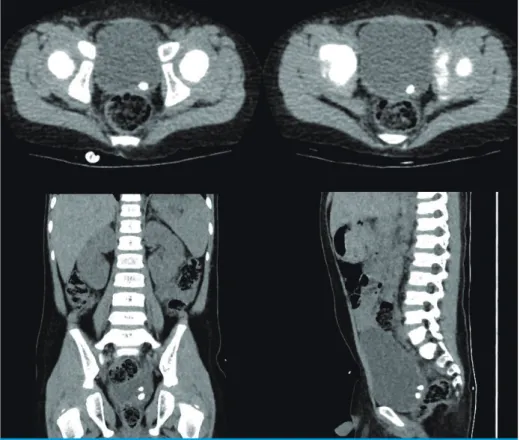
We performed CT abdomen, which demonstrated two 0.7 cm hyperdense lesions in the left posterior aspect of the bladder and suspected stones at the UVJ or in the bladder (Fig. 2). Ultrasonography (US) showed previous mild pel
viectasia of the left kidney (0.3 cm) and two hyperechoic foci with posterior acoustic shadowing, in the left posterior aspect of the bladder. However, the lesion did not move with pos ition changes. Therefore, to find out the exact problem, considering a past medical history of Macroplastique in
jection, we decided to perform a diagnostic cystoscopy.
On cystoscopy, calcifications were seen, leading to mu
cosal erosions around the orifice where Macroplastique injection had been injected previously. The calcifications on the mucosal area causing mucosal erosion were succes
sfully removed with the help of laser (Fig. 3). Symptoms of gross hematuria, suprapubic pain, and dysuria were gradu
ally relieved after treatment. We have checked routine uri
n alysis and US after seven months from cystoscopy. There were no identifiable calcifications in bladder mucosa al
though we cannot exactly evaluate as follow up CT scan was not done. His symptoms have not recurred till date.
Discussion
Endoscopic subureteral injection has gained popularity and has evolved as the prime therapeutic alternative to antibiotic prophylaxis and ureteroneocystostomy, since its initial description by Matouschek in 1981, and its first clinical use reported by O’Donnell and Puri in 19846,7). In
traoperative complications following injection of bulking agent had a remarkably low incidence, and complications were limited to infection and/or bleeding. Postoperative complications were also extremely rare8). Several bulking agents with numerous advantages as well as drawbacks have been used to treat reflux, including polytetrafluoroe
thylene, collagen, autologous injectables, Macroplastique (Uroplasty, Minnetonka, USA), and dextranomer/hyalu
ronic acid copolymer (Deflux; Oceana Therapeutics, Inc, Edison, USA). Among these agents, Macroplastique is one Fig.1. Voiding cystourethrography shows grade V reflux before
intraureteral Macroplastique injection therapy.
Seo MH, et al. • Calcified Macroplastique after Endoscopic Injection 73 www.chikd.org
of the most popular agents and has wide application in the medical field. Macroplastique, made of solid silicone elas
tomer, a nonbiodegradable substance, is reabsorbed and exchanged with a reactive transudate containing fibroblasts, which then facilitate its encapsulation4). Since the success rate was dependent on the kind of bulking agent injected, many studies have demonstrated the overall success rate of each material, and no significant difference was observed in cure rates4,9). Some previous studies have reported that VUR was better corrected in the Macroplastique group
(86.2%) than in Deflux group (71.4%)5). Most studies focus on success rates, but postoperative complications after en
doscopic therapy of VUR, or procedurerelated complica
tions (obstruction, contralateral VUR, voiding anomalies) should be evaluated, to confirm overall safety of the pro
cedure or operation1). One study demonstrated several shortterm complications after endoscopic injection of Macroplastique. Four patients who had recurrent UTIs and unilateral or bilateral VUR underwent endoscopic injection of Macroplastique. Several months after the pro
Fig. 2. Computed tomography image shows 0.7cm sized hyperdense lesions in bladder.
Fig. 3. (A) On diagnostic cystoscopy, 0.7cm sized yellowish im pacted stones were observed at left posterior aspect of the bladder. (B) Mucosa erosions were observed and stones were removed by Holmium laser.
74 Child Kidney Dis • 2018;22:71-74 www.chikd.org
cedure, they developed flank pain, highgrade fever, and oliguria, and were diagnosed with ureteral obstruction, urosepsis, acute renal failure, or VUR. Intravenous anti
biotics were administered and percutaneous nephrostomy was performed. However, unfortunately, all the patients had to ultimately undergo ureteroneocystostomy1).
Recently in Korea, a small number of case reports similar to ours have been published. In one study, a 10yearold girl, underwent subureteral administration of Macropla
stique to treat bilateral VUR, following which she had re
current pyelonephritis. US revealed two bladder stones (2.0 cm and 1.3 cm) near the right trigonal area of the bladder, 6 years after the endoscopic injection. Complete stone re
moval using cystolitholapaxy was performed10). In another study, a 38yearold male patient who had undergone Ma
croplastique injection 7 years ago due to VUR, had left sided abdominal pain. CT abdomen showed a stone (0.83 cm) near the left UVJ and it was removed using Holmium laser. As seen in our case report, both patients who were injected with Macroplastique several years ago had stones in the bladder or at the UVJ. After removing the stones with laser treatment, recurrent pyelonephritis and abdominal pain disappeared completely11).
Calcified Macroplastique substance in the submucosa can lead to mucosal erosions as it is grows. If mucosal ero
sions get worse, hematuria and symptoms of cystitis may develop, which if untreated, may lead to UVJ obstruction.
Considering the increasing number of patients of VUR re
ceiving Macroplastique injection, long term standardized followup is required, and physicians should recognize the late complications after endoscopic bulking agent admini
stration. Also, recurrent hematuria after endoscopic injec
tion should be thoroughly evaluated.
Ethics statement
This study was approved by Pusan National University Yangsan hospital's Institutional Review Board (IRB No.
052018136).
Conflicts of interest
No potential conflict of interest relevant to this article was reported.
References
1. Kempf C, Winkelmann B, Roigas J, Querfeld U, Muller D. Severe complications after endoscopic injection of polydimethylsiloxane for the treatment of vesicoureteral reflux in early childhood.
Scand J Urol Nephrol 2010;44;347-53.
2. Kim SO, Shin BS, Hwang IS, Hwang EC, Oh KJ, Jung SI, et al. Clinical efficacy and safety in children with vesicoureteral reflux of a single injection of two different bulking agents--polydimethyl siloxane (Macroplastique) or dextranomer/hyaluronic acid co polymer (Deflux): a short-term prospective comparative study.
Urol Int 2011;87;299-303.
3. Mohamed EA, Shehata FH, Abdelbaset EA, Abdelkhalek MA, Abdelatif AH, Galal HA. Longterm outcome of Macroplatique injection for treatment of vesicoureteral reflux in children. Afr J Paediatr Surg 2014;11;174-8.
4. Bae YD, Park MG, Oh MM, Moon DG. Endoscopic Subureteral Injection for the Treatment of Vesicoureteral Reflux in Children:
Polydimethylsiloxane (Macroplastique(R)) versus Dextranomer/
Hyaluronic Acid Copolymer (Deflux(R)). Korean J Urol 2010;51;
128-31.
5. Oswald J, Riccabona M, Lusuardi L, Bartsch G, Radmayr C. Pro spective comparison and 1-year follow-up of a single endoscopic subureteral polydimethylsiloxane versus dextranomer/hyalu ronic acid copolymer injection for treatment of vesicoureteral reflux in children. Urology 2002;60;894-7.
6. Matouschek E. New concept for the treatment of vesico-ureteral reflux. Endoscopic application. Arch Esp Urol 1981;34;385-8.
7. O'Donnell B. Puri P. Treatment of vesicoureteric reflux by endo scopic injection of Teflon. Br Med J (Clin Res Ed) 1984;289;7-9.
8. Moore K, Bolduc S. Prospective study of polydimethylsiloxane vs dextranomer/hyaluronic acid injection for treatment of vesicou reteral reflux. J Urol 2014;192;1794-9.
9. Dirim A, Hasirci E. Turunc T, Aygun C, Ozkardes H. Single injection results of endoscopic treatment of vesicoureteric reflux with different tissue-bulking substances in patients with end stage renal failure. J Endourol 2011;25;831-5.
10. Choi JY, Kim HT, Ko YH, Lee YH, Song PH. Recurrent Urinary Tract Infection by Bladder Stone Resulting from Subureteral Injection Polydimethylsiloxane (Macroplastique®) for Treatment of Vesi coureteral Reflux. Urogenital Tract Infection 2016;11;62.
11. Kim JH. Bladder Stone after Intraureteral Polydimethylsioxane (Macroplastique) Injection Therapy in Vesicoureteral Reflux Pa tient. Soonchunhyang Medical Science 2018;24;92-4.