- 721 -
Optimization of 1(3)-Palmitoyl-2-Oleoyl-3(1)-Stearoyl Glycerol Produced via Lipase-catalyzed Esterification Using the Response Surface Methodology
Yun-Ik Hwang, Jung-Ah Shin, Jeung-Hee Lee, Soon-Taek Hong and Ki-Teak Lee
†Dept. of Food Science and Technology, Chungnam National University, Daejeon 305-764, Korea
Camellia Oil로부터 1(3)-Palmitoyl-2-Oleoyl-3(1)-Stearoyl Glycerol을 함유한 효소적 합성반응물의 최적화 연구
황윤익․신정아․이정희․홍순택․이기택
†충남대학교 식품공학과
Abstract
1(3)-palmitoyl-2-oleoyl-3(1)-stearoyl-(POS)-glycerol-enriched reaction products were synthesized from camellia oil, palmitic ethyl ester, and stearic ethyl ester via lipase-catalyzed interesterification. Response surface methodology (RSM) was employed to optimize the production of the POS-enriched reaction product (Y1, %) and the stearic- and palmitic-acid contents at the sn-2 position due to acyl migration (Y2, %). The reaction factors were the enzyme amount (X1, 2-6%), reaction time (X2, 60-360 min), and substrate molar ratio of camellia oil to palmitic ethyl ester and stearic ethyl ester (X3, 1-3 mol). The predictive models for Y1 and Y2 were adequate and reproducible as no lack of fit was signified (0.128 and 0.237) and as there were satisfactory levels of R2 (0.968 and 0.990, respectively). The optimal conditions for the reaction product for maximizing Y1 while minimizing Y2 were predicted at the reaction combination of 5.86% enzyme amount, 60 min reaction time, and 1:3 substrate molar ratio (3 moles of palmitic ethyl ester and 3 moles of stearic ethyl ester). Actual reaction was performed under the same conditions as above, and the resulting product contained 20.19% TAG-P/O/S and 12.71% saturated fatty acids at the sn-2 position.
Key words:camellia oil, lipase-catalyzed interesterification, cocoa butter equivalent, 1(3)-palmitoyl-2-oleoyl- 3(1)-stearoyl (POS) glycerol, acyl migration, response surface methodology
서 론
1)
코코아 버터(cocoa butter, CB)는 초콜릿 과자 산업에서 매우 중요한 원료이며 아주 독특한 물리적 특성을 가지고 있다. 초콜릿은 실온에서는 고체형태를 유지하고 있지만 입 안에 들어가면 급격하게 녹는데, 그 이유 중의 하나는 CB를 구성하고 있는 주된 triacylglycerides(TAG)의 형태가 포화(saturated)–불포화(unsaturated)–포화(saturated) 지방 산으로 구성된 대칭형 SUS 형태를 가지기 때문이다(1). 주 로 CB로 만들어진 초콜릿은 입안에서 부드러운 맛과 느낌 을 주며, 우수한 조직감, 보형 안정성, 구용성, 스냅성 등을
†
Corresponding author. E-mail:[email protected] Phone:82-42-821-6729, Fax:82-42-822-6729
보인다. 그러나 이러한 장점에도 불구하고 CB는 초콜릿을 구성하는 원료 중 비싼 원료 중의 하나이고 원료 수급이 불안정하다는 점 때문에 CB를 대체할 수 있는 코코아버터 대체지(cocoa butter equivalent, CBE)의 개발이 이루어지고 있다(2,3).
초콜릿을 만드는데 사용되는 CBE의 구성 지방산과 TAG 조성은 CB의 그것들과 유사하다. CB의 TAG 조성은 약 40%의 1(3)-palmitoyl-2-oleoyl-3(1)-stearoyl glycerol(POS), 27% 내외의 1,3-distearoyl-2-oleoyl glycerol(SOS), 그리고 약 20% 내외의 1,3-dipalmitoyl-2-oleoyl glycerol(POP)과 소 량의 기타 TAG를 보이고 있으며, 대부분 CB의 경우 POS가 가장 높은 함량을 가지고 있다(4).
최근 CBE 개발 연구를 위해 사용되는 유지 가공기술은
유지분자간의 esterification(에스테르 교환반응)으로 이 반
응은 사용되는 촉매에 따라 효소적 촉매 공법과 화학적 촉매공법으로 나눌 수 있다. 효소적 촉매 공법으로 유지를 가공하였을 경우 반응 시 사용되는 에너지의 양이 비교적 적으며, 최종 생성물의 손실도 적고 또한 효소의 위치 특이 성을 이용하여 합성하고자 하는 TAG의 구성형태를 맞춤형 으로 생산할 수 있다. 현재 상업적으로 사용되고 있는 대표 적인 효소의 예는 Thermomyces lanuginosa 로부터 유래된 immobilized lipase from Thermomyces lanuginosus (Lipozyme TLIM)과 Rhizomucor miehei 로부터 유래한 immobilized lipase from Rhizomucor miehei (Lipozyme RMIM)등이다(5-8). 한편, camellia oil을 구성하고 있는 TAG 중 약 70%이상이 triolein으로 이루어져 있기 때문에, sn-1,3 위치 선택성이 있다고 알려진 Lipozyme TLIM를 촉 매로 이용하여 palmitic과 stearic ethyl ester를 camellia oil과 에스테르반응을 수행하면 POS를 합성할 수 있다. 그러나 사용된 기질들이 함유하고 있는 다양한 지방산들로 인하여 POS 이외에 다른 TAG들도 합성되며, 특히 acyl migration에 의한 1-palmitoyl-2-stearoyl-3-oleoyl glycerol(PSO)/1-oleoyl-2- stearoyl-3-palmitoyl glycerol(OSP)/1-oleoyl-2-palmitoyl-3- stearoyl glycerol(OPS)/1-stearoyl-2-palmitoyl-3-oleoyl glycerol (SPO) 등과 같은 비대칭형 TAG분자들도 나타날 수 있다.
즉, sn-1,3 selective 효소인 Lipozyme TLIM에 의하여 POS가 주로 합성되지만, 부반응인 acyl migration에 의하여 합성된 POS의 sn-1,3 위치에 먼저 결합된 palmitoyl과 stearoyl기들 이 sn-2 위치로 이동하여 PSO와 OPS 또는 이들과 유사한 구조를 가지는 OSP, SPO 등도 구성될 수 있는 것이다.
본 연구에서는 camellia oil과 palmitic 및 stearic ethyl ester 를 Lipozyme TLIM으로 반응하여 CB의 주요 TAG 성분인 POS를 많이 함유한 효소반응물을 반응표면분석법(response surface methodology, RSM)으로 최적화 합성을 하고자 하였 다. 이를 위하여 효소 양, 반응시간, 기질의 몰비율을 독립 변수로 하여, 중심 합성 계획에 의한 반응 표면 분석을 이용 하였고, 종속변수로써 효소 합성반응물중 TAG-P/O/S (palmitic, stearic과 oleic 지방산을 각각 1 분자씩 어느 위치 이던지 함유한 TAG, 즉 POS 및 PSO/OSP/OPS/SPO)의 합성 율(Y
1, %)을 높이고자 하였다(9). 한편, 효소 합성반응물의 acyl migration등에 의하여 sn-2 위치에 결합(이동)한 palmitic과 stearic acid의 양(P/S-sn-2, Y
2, %)을 낮추기 위한 최적화 조건도 살펴보았고, 얻어진 RSM 예측 반응조건을 따라 다시 재합성하여 구성 TAG 분자들의 조성을 reversed-phase high performance liquid chromatography (RP-HPLC)로 분석하였다.
재료 및 방법
실험재료
본 실험에 사용된 camellia oil는 시중에서 구입하였으며,
90%이상의 순도를 가지고 있는 stearic ethyl ester와 palmitic ethyl ester는 (주) 네오메가에서 제공을 받았다. 반응촉매로 는 Lipozyme TLIM을 Novozymes A/S (Bagsvaerd, Denmark)로부터 구입하여 사용하였다. 유지시료의 sn-2 위 치 지방산 조성을 분석하기 위한 pancreatic lipase (Type
Ⅱ, crude)는 Sigma Chemical Co (St Louis, MO, USA)에서 구입하였다. 이외의 기기 분석에 사용한 시약은 모두 분석 용 특급시약을 사용하였다.
반응표면분석법(response surface methodology, RSM) 실험 설계
중심합성실험계획(central composite face design)으로 factor에 반응효소의 양(X
1= 2, 4, 6%), 반응시간(X
2= 60, 120, 360 min), camellia oil에 대한 stearic과 palmitic ethyl ester 기질 몰비율(X
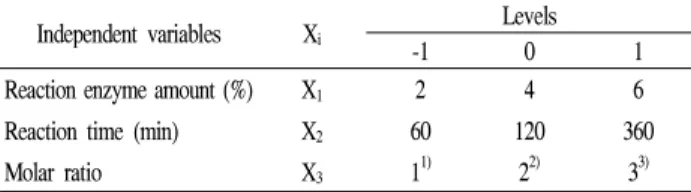
3= 1, 2, 3 mol)을 각각 설정하고, 이 독립변수들을 -1, 0, 1로 3단계로 부호화한 후(Table 1), 17개 의 설정된 실험 조건에서 반응을 수행하였다. 이때, X
3인 camellia oil에 대한 기질의 몰비율은 stearic과 palmitic ethyl ester기질의 혼합물이므로 X
3= 1이라는 것은 Table 1에 설명 되어진 것과 같이 1 mole의 camellia oil에 대한 1 mole의 stearic과 1 mole의 palmitic ethyl ester을 의미한다. 종속 변수 Y
1은 효소 합성반응물중 반응 후 palmitic, stearic과 oleic 지방산을 각각 1 분자씩 어느 위치이던지 함유한 TAG 분자(TAG-P/O/S)의 합성율(%)이고, Y
2는 부반응인 acyl migration등에 의하여 생성된 PSO, OPS, OSP, SPO 등의 sn-2 위치에 결합(이동)한 palmitic과 stearic acid의 양 (P/S-sn-2, %)이었다. 각 반응은 다음과 같이 진행되었다.
Screw cap이 있는 삼각 flask에 중심합성실험계획에 의해서 주어진 반응조건에 따라 기질인 camellia oil과 stearic과 palmitic ethyl ester를 각각의 molar ratio (1, 2, 3, mol/mol)에 맞게 혼합하였다. 이후 혼합된 기질의 총 부피에 설정된 비율별로 Lipozyme TLIM을 첨가한 후, 설정된 반응시간별 로 반응온도인 46℃를 유지해가며 200 rpm으로 설정된 shaking water bath (Vision scientific Co, Korea)를 이용하여 각각의 반응을 수행하였다. 반응물은 syringe filter (0.5 µm, Toyo Roshi kaisha, Japan)를 이용하여 여과하였다.
Table 1. Level of each independent variable for the central composite design
Independent variables Xi Levels
-1 0 1
Reaction enzyme amount (%) X1 2 4 6
Reaction time (min) X2 60 120 360
Molar ratio X3 11) 22) 33)
1)X3= 1 means 1 mole of camellia oil reacted with 1 mole of palmitic ethyl ester and 1 mole of stearic ethyl ester
2)X3= 2 means 1 mole of camellia oil reacted with 2 mole of palmitic ethyl ester and 2 mole of stearic ethyl ester
3)X3= 3 means 1 mole of camellia oil reacted with 3 mole of palmitic ethyl ester and 3 mole of stearic ethyl ester
지방산 분석
반응된 시료들의 지방산 조성을 분석하기 위해서 다음과 같이 분석이 수행되었다. 먼저 반응 시료 100 µL를 취해서 5 mL hexane에 희석한 후 thin-layer chromatography (TLC) silica plate (10 × 20 cm, Merck, Germany)에 petroleum ether:
diethyl ether: acetic acid (90:10:1, v/v/v)로 구성된 전개용매 로 중성지질을 각각 분리하였다. 이후 분리된 TAG 부분만 을 취하여 0.5 N NaOH 메탄올 용액 1.5 mL를 가하여 100℃
에서 5분간 가온 후에 25℃에서 냉각하였다. 이후 10%
BF
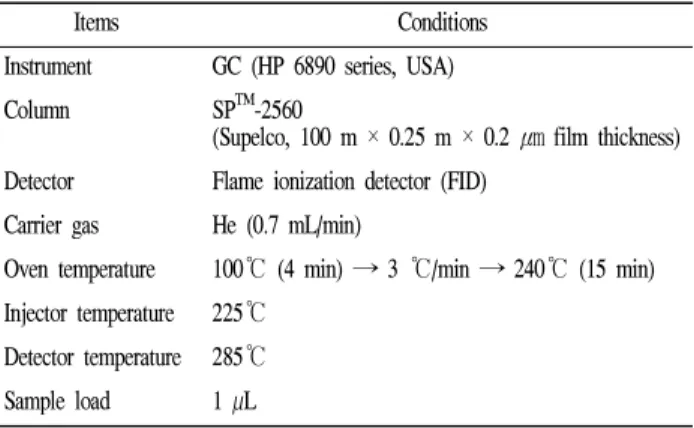
3-methanol로 유도체화 한 후에 지방산 분석은 gas chromatograph (GC, Hewlett packard 6890 series, Avondale, PA, USA)를 이용하여 분석하였다(7). 분석조건은 Table 2 에 나타내었다. 반응된 시료들의 sn-2 위치의 지방산 조성 을 알아보기 위해서 pancreatic lipase를 이용하여 가수분해 하였다. Screw cap이 달린 test tube에 반응물 약 7 mg의 무게를 측정하고, 7 mL의 tris-HCl buffer (pH 7.6), 1.75 mL의 0.05% bile salt 용액과 0.7 mL의 2.2% CaCl
2용액을 넣고 반응물과 같은 중량의 pancreatic lipase 7 mg을 혼합하 였다. 1분간 충분히 vortex 후 37℃로 유지되는 항온수조에 반응된 test tube를 넣고 3분간 더 반응하였다. 이를 2회 반복한 후 4 mL의 diethyl ether를 첨가하여 충분히 vortex 후 정치하였다. 분리된 상층부만을 취하여 anhydrous sodium sulfate column을 통과시켜 수분을 제거한 후, TLC plate (silica gel 60 F
254, 20 × 20 cm, Merck KGaA, Germany)에 전개하였다. 이때 사용된 전개 용액은 n-hexane: diethyl ether:
acetic acid (50:50:1, v/v/v)이었으며, 전개 후 얻고자 하는 2-monoacylglyceride 부분만을 취하여 앞에 설명한 방법으로 지방산을 분석하였다. 모든 분석은 2회 진행되었다(10).
Table 2. Gas chromatograph operating conditions for analysis of fatty acid composition
Items Conditions
Instrument GC (HP 6890 series, USA) Column SPTM-2560
(Supelco, 100 m × 0.25 m × 0.2 ㎛ film thickness) Detector Flame ionization detector (FID)
Carrier gas He (0.7 mL/min)
Oven temperature 100℃ (4 min) → 3 ℃/min → 240℃ (15 min) Injector temperature 225℃
Detector temperature 285℃
Sample load 1 µL
RP-HPLC를 이용한 TAG 조성 분석
TAG분자들의 분리를 위하여 reversed-phase HPLC 분석 을 실시하였다. 분석에 사용된 기기는 Younglin SP930D dual pump (Younglin, Anyang, Korea)에 evaporative light scattering detector (ELSD, SEDEX Model 75, Sedere,
Alfortville, France)을 장착하여 이루어졌다. ELSD의 온도 는 40℃로 하였고, 분석에 사용된 칼럼은 ODS 4 µm Nova-Pak C18 (150 × 3.9 mm, Waters, Milford, MA, USA) 이었다. 분석용매는 (A) acetonitrile과 (B) iso-propanol : hexane = 2:1(v/v)을 사용하였으며, 초기 A와 B의 용매 비율 은 80:20(v/v)으로 45분간 용리비가 54: 46(v/v)이 되도록 linear하게 흘려주었다. 이후 54:46(v/v)의 용리비를 15분간 유지한 후, 다시 A와 B 용매의 용리비가 80:20(v/v)이 되도 록 5분간 linear하게 흘려주면서 5분간 유지하여 초기화하 였다. 분석시료(약 10 mg)를 20 mL의 chloroform에 녹여 20 µL를 HPLC에 주입하였고, 반응물은 retention time (RT) 와 partition number (PN) 사이의 관계식을 이용하여 TAG 형태를 유추하였다. 아래식에서 CN는 TAG의 전체 탄소수 를 나타내며, ND는 총 이중결합의 수를 나타낸다.
Partition number (PN) = total number of carbons (CN) - 2 × total number of double (ND)
결과 및 고찰
중심합성 계획을 이용한 반응 표면분석
Camellia oil과 palmitic과 stearic ethyl ester를 기질로 sn-1,3 위치에 선택적으로 반응하는 Lipozyme TLIM을 이 용하여 1(3)-palmitoyl-2-oleoyl-3(1) stearoyl glycerol (POS) 를 함유한 효소 합성반응물을 생성하고자 하였다. 중심합 성계획(central composite face design)을 이용하여 독립변수 로써 반응효소의 양(X
1= 2, 4, 6%), 반응시간(X
2= 60, 120, 360 min), 그리고 camellia oil에 대한 stearic과 palmitic ethyl ester의 각각의 기질 비율(X
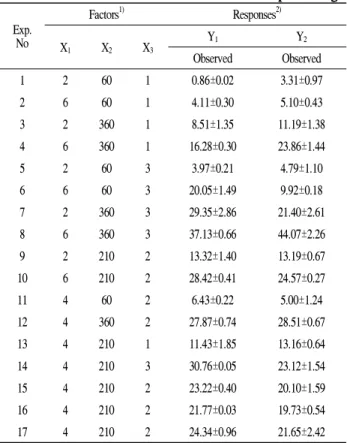
3= 1, 2, 3 mol)을 설정하였다 (Table 3). 이는 예비 실험으로 확인 결과 반응효소의 양이 8-10%이상일 경우 POS의 합성시 부반응인 acyl migration 이 큰 폭으로 증가하고, 이에 의하여 TAG의 sn-2 위치에 많은 양의 stearic이나 palmitic acid가 존재하는 PSO/
OPS/OSP/SPO이 존재할 수 있음을 확인하였기 때문이며, 따라서 이들 부 반응물의 생성량을 최소화하기 위하여 사용 될 반응효소의 양이 6%이상 넘지 않게 하였다. 또한 반응 시간이 6시간 이상일 경우 효소 합성반응물의 합성이 둔화 되었기 때문에 반응시간을 6시간(360 min) 이내로 정하였 다. 이렇게 정해진 17가지 각각의 실험에 대한 효소 합성반 응물중 TAG-P/O/S의 합성량(Y
1, %)과 acyl migration에 의 하여 생성될 수 있는 TAG 분자들(예, PSO/OPS/OSP/SPO 등)의 sn-2 위치에 존재하는 palmitic과 stearic acid 양(Y
2,
%)을 Table 3에 나타내었다. Y
1(효소 합성 반응물 중
TAG-P/O/S의 합성량)의 경우 최고 37.13%(반응번호 8)에
서 최소 1% 미만(반응번호 1)으로 나타났으며, 반응시간이
길수록, 사용된 반응효소의 비율이 높을수록, 그리고 기질
비율이 클수록 Y
1의 값이 커지는 경향을 나타내었다. 한편, 중심합성 계획의 ANOVA 결과 Y
1에 대한 lack of fit이 P=0.128로써 모형에 적합 하였고, Y
1에 대한 R
2(coefficient of determination)값은 0.968으로 5% 이내의 유의수준에서 인정되었다. Y
2의 경우 lack of fit이 P=0.273, R
2값은 0.990 이었다(data not shown). Y
1과 Y
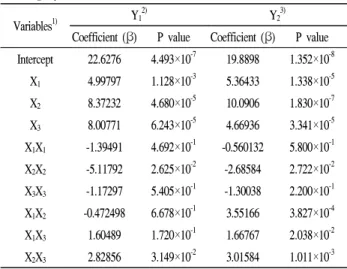
2에 대한 회귀 계수는 Table 4에 나타내었고 이를 통해서 다음과 같은 반응표면 회귀식 을 구하였다.
3 3 2 3
Y=β o+∑β
iX
i+∑β
iiX
i2+∑ ∑β
ijX
iX
ji=1 i=1 i=1 j=i+1
Table 3. Three-factors and three-levels of central composite design Exp.No
Factors1) Responses2)
X1 X2 X3 Y1 Y2
Observed Observed
1 2 60 1 0.86±0.02 3.31±0.97
2 6 60 1 4.11±0.30 5.10±0.43
3 2 360 1 8.51±1.35 11.19±1.38
4 6 360 1 16.28±0.30 23.86±1.44
5 2 60 3 3.97±0.21 4.79±1.10
6 6 60 3 20.05±1.49 9.92±0.18
7 2 360 3 29.35±2.86 21.40±2.61
8 6 360 3 37.13±0.66 44.07±2.26
9 2 210 2 13.32±1.40 13.19±0.67
10 6 210 2 28.42±0.41 24.57±0.27
11 4 60 2 6.43±0.22 5.00±1.24
12 4 360 2 27.87±0.74 28.51±0.67
13 4 210 1 11.43±1.85 13.16±0.64
14 4 210 3 30.76±0.05 23.12±1.54
15 4 210 2 23.22±0.40 20.10±1.59
16 4 210 2 21.77±0.03 19.73±0.54
17 4 210 2 24.34±0.96 21.65±2.42
1)X1= enzyme amount (2, 4, 6 %), X2= reaction time (60, 120, 360 min), X3= substrate molar ratio of camellia oil to stearic and palmitic ethyl ester (1:1, 1:2, 1:3 mol:mol). See Table 1.
2)Y1= TAG-P/O/S (TAG % containing each one mole of palmitic, stearic and oleic moiety at any sn-position; i.e. POS and PSO/OSP/OPS/SPO would be produced through acyl migration).
Y2= P/S-sn-2 (Fatty acid % of palmitic and stearic acid at sn-2 position of TAG).
Y
1(TAG-P/O/S, %) =
22.6276+4.99797X
1+8.37231X
2+8.00771X
3-1.39491X
12-5.1 1792X
22-1.17297X
32-0.472498X
1X
2+1.60489X
1X
3+2.82856 X
2X
3Y
2(S/P-sn-2, %)=
19.8898+5.36433X
1+10.0906X
2+4.66936X
3-0.560132X
12-2.
68584X
22-1.30038X
32+3.55166X
1X
2+1.66767X
1X
3+3.01584 X
2X
3Camellia oil과 palmitic 및 stearic ethyl ester를 기질로 sn-1,3 위치에 특이적으로 반응하는 Lipozyme TLIM으로 반응 할 때, Y
1(효소 합성반응물중 TAG-P/O/S의 합성량)은 높은 수치를 보이면서도 Y
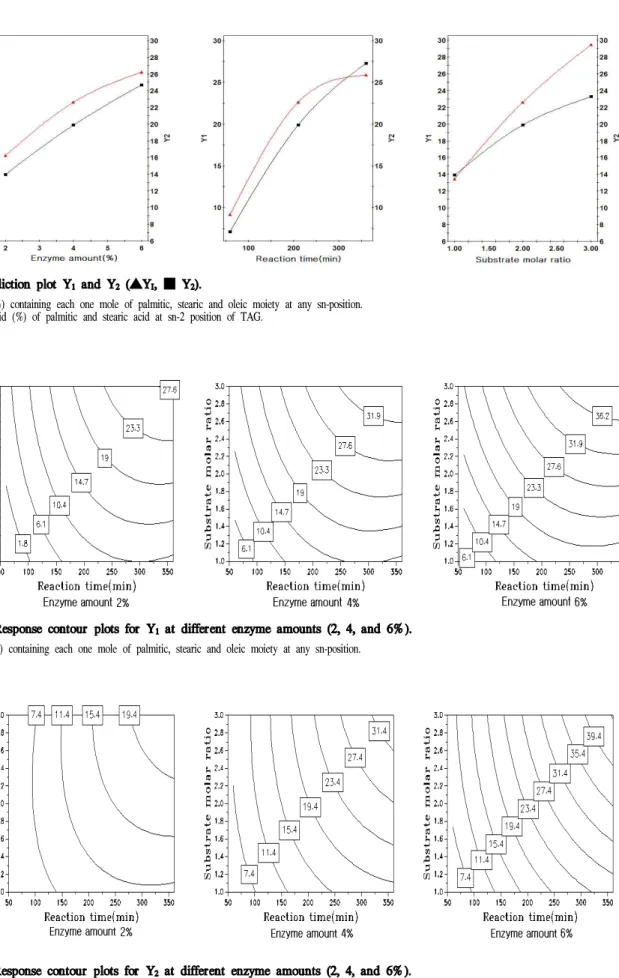
2(효소 합성반응물의 sn-2 위치에 존재하는 palmitic과 stearic acid의 양)는 낮아야 대칭형인 POS를 효율적으로 합성할 수 있다. Fig. 1에서 반응효소의 양(X
1)이 높아질수록 Y
1이 증가하는 경향을 보였고, 반응시 간(X
2)과 Y
1의 관계는 반응초기부터 200 min 까지는 Y
1이 급격히 증가하다가 200 min 이후부터는 증가율은 떨어졌고 300 min 이후에는 Y
1증가에 큰 변화가 보이지 않았다.
한편, 기질비율(X
3)이 높아질수록 Y
1이 증가하는 경향을 보였다. Y
2의 경우, 반응시간, 반응효소의 비율, 그리고 기 질비율이 증가할수록 또한 Y
2도 비례적으로 증가하는 추세 를 보였는데, 이는 acyl migration의 발생정도가 이들과 매우 관련이 있기 때문이다. Fig. 2A와 2B는 Y
1와 Y
2가 반응효소 비율에 따른 반응시간과 반응기질의 비율의 관계를 등고선 으로 나타낸 것이며, 만일 반응효소비율이 2%에서 6%로 증가가 되어도 같은 Y
1와 Y
2의 값은 사용되는 반응기질의 비율이 적어지고, 반응시간이 짧아져도 얻을 수 있음을 보 여주고 있다. 한편, Table 4에서는 독립변수(X
1과 X
2, X
3)와 종속변수 Y
1과 Y
2의 상호간의 유의성을 보여주고 있다.
Y
1에 대하여 효소양(X
1), 반응시간(X
2), 기질몰비율(X
3)이 모두 유의적으로 영향을 미치는 것으로 나타났다. 그 중에 서도 X
2와X
3가 좀더 유의적인 영향을 보였다. Y
2에 대하여 는 X
1, X
2, X
3이 모두 유의적으로 영향을 미치는데, 그 중에 서도 X
2가 가장 유의적인 것으로 나타났다. 한편, 이와 같이 얻어진 반응 표면 분석 결과를 이용하여 포화-불포화-포화 지방산을 가진 대칭형 POS를 효율적으로 합성할 수 있는 최적화 반응 조건을 예측해 보았다. Y
2를 최소화 시키는 반응조건에서는 Y
1의 값이 매우 적어지므로 Y
2의 수치를 10%로 지정하였을 때, Y
1을 최대화시키기 위한 예측반응 조건을 반응표면분석 프로그램(Modde Softwasre, version 5.0, Umetrics)을 이용하여 분석하였다. 따라서 Modde 5.0의 optimizer를 이용하여 반응물의 생성을 최대로 하면서 acyl migration의 발생을 10%(코코아버터 대체지인 CBE의 경우 에 sn-2 위치에 포화지방산이 약 10% 정도 존재하기 때문) 이내로 억제하기 위한 최적의 반응조건은 효소양(X
1)=
5.9%, 반응시간(X
2)= 60 min, 그리고 기질비율(X
3)= 1:3(1
mole의 camellia oil: 3 mole의 palmitic ethyl ester + 3 mole의
stearic ethyl ester)이었다. 이때의 효소 합성반응물중
TAG-P/O/S의 합성량(Y
1)은 18.8% 이었고 acyl migration에
의한 효소 합성반응물의 sn-2 위치에 존재하는 palmitic과
stearic acid의 양(Y
2)는 10.4%로 예측되었다(data not
shown). 이와 같은 예측조건에서 효소 합성반응물이 실제
적으로 재합성되었고, RP-HPLC를 통한 TAG분자들의 전
체 구성과 TAG-P/O/S의 양(Y
1), 그리고 sn-2 위치에 존재하
는 palmitic과 stearic acid의 양을 분석하였다.
Fig. 1. Prediction plot Y1 and Y2 (▲YI, ■ Y2).
Y1 = TAG (%) containing each one mole of palmitic, stearic and oleic moiety at any sn-position.
Y2 = Fatty acid (%) of palmitic and stearic acid at sn-2 position of TAG.
Fig. 2(A). Response contour plots for Y1 at different enzyme amounts (2, 4, and 6%).
Y1 = TAG (%) containing each one mole of palmitic, stearic and oleic moiety at any sn-position.
Fig. 2(B). Response contour plots for Y2 at different enzyme amounts (2, 4, and 6%).
Y2 = Fatty acid (%) of palmitic and stearic acid at sn-2 position of TAG.
Fig. 3. Chromatograms of the reversed-phase HPLC (A) camellia oil and (B) product containing 1(3)-palmitoyl-3(1)-stearoyl-2-oleoyl glycerol (POS) which was obtained from the interesterification with camellia oil, palmitic ethyl ester, and stearic ethyl ester.
The reaction conditions; substrate molar ratio = 1:3 (1 mole of camellia oil: 3 mole of palmitic ethyl ester + 3 mole of stearic ethyl ester), reaction time = 60 min, and enzyme amount = 5.9%. Peak number is explained in Table 5.
Table 4. Regression coefficients and significance of the second- order polynomials for Y1 and Y2
Variables1) Y12) Y23)
Coefficient (β) P value Coefficient (β) P value Intercept 22.6276 4.493×10⁻⁷ 19.8898 1.352×10-8
X1 4.99797 1.128×10⁻³ 5.36433 1.338×10-5 X2 8.37232 4.680×10⁻⁵ 10.0906 1.830×10-7 X3 8.00771 6.243×10⁻⁵ 4.66936 3.341×10-5 X1X1 -1.39491 4.692×10⁻¹ -0.560132 5.800×10-1 X2X2 -5.11792 2.625×10⁻² -2.68584 2.722×10-2 X3X3 -1.17297 5.405×10⁻¹ -1.30038 2.200×10-1 X1X2 -0.472498 6.678×10⁻¹ 3.55166 3.827×10-4 X1X3 1.60489 1.720×10⁻¹ 1.66767 2.038×10-2 X2X3 2.82856 3.149×10⁻² 3.01584 1.011×10⁻³
1)X1= enzyme amount (2, 4, 6%), X2= reaction time (60, 120, 360 min), X3= substrate molar ratio of camellia oil to stearic and palmitic ethyl ester (1:1, 1:2, 1:3 mol:mol).
See Table 1.
2)Y1= TAG-P/O/S (TAG% containing each one mole of palmitic, stearic and oleic moiety at any sn-position; i.e. POS and PSO/OSP/OPS/SPO would be produced through acyl migration).
3)Y2= P/S-sn-2 (Fatty acid% of palmitic and stearic acid at sn-2 position of TAG).
Reversed-phase HPLC와 지방산 분석
Figure 3는 최적화 하여 얻어진 반응조건인 효소양(X
1)=
5.9%, 반응시간(X
2)= 60 min, 그리고 기질비율(X
3)= 1:3에 서 합성된 반응물을 reversed-phase HPLC 로 분석한 결과를 나타낸 그림이다. 비교를 위해 기질로 사용된 camellia oil도 함께 분석을 하였다. Camellia oil의 주요 TAG 조성은 POL/PLO, PLP/SLP, OOO, POO, SOO 등인데 비하여, 합성 된 반응물은 LOO, POL/PLO, PLP/SLP, OOO, POO, POP/PPO, SOO, POS/PSO (i.e. TAG-P/O/S), SOS/SSO (P=
palmitic acid O= oleic acid, S= stearic acid, L= linoleic acid) 로 이루어져 있었다. Table 5는 camellia oil과 최적 반응 조건에서 얻어진 효소 합성반응물의 TAG를 area %로 나타 내고 있다. Camellia oil은 POL/PLO (6.27%), PLP/SLP (1.79%), OOO (74.59%), POO (15.47%), SOO (1.88%)이고, 효소 합성반응물은 LOO (0.94%), POL/PLO (1.83%), PLP/
SLP (0.54%), OOO (%14.24), POO (31.66%), POP/PPO
(12.24%), SOO (13.88%), POS/PSO (i.e. TAG-P/O/S,
21.07%), SOS/SSO (3.59%)로 구성되어 있었다. Camellia
oil의 경우 PN=48의 TAG들이 90% 함량을 보였으며 효소
합성반응물은 PN=48과 PN=50에서 90%이상 함량을 보였
다. 반응 표면 분석에 의한 최적화 조건에서 얻어진 효소
합성반응물의 지방산 조성을 분석하여 Table 6과 같이 나타
내었다. 효소 합성반응물의 주요지방산은 oleic acid (C18:1,
54.56%)이었고, palmitic acid (C16:0, 23.29%), stearic acid
(C18:0, 17.66), linoleic acid (C18:2, 4.49%)가 존재하였다.
Sn-2 위치에서의 지방산 조성에서도 oleic acid (C18:1, 80.42%)로 제일 많이 나타났고, palmitic acid (C16:0, 7.70%), stearic acid (C18:0, 5.01%), linoleic acid (C18:2, 6.86%) 순으로 나타났으며, sn-1,3 위치에서의 지방산조성 에서는 oleic acid (C18:1, 41.64%)와 palmitic acid (C16:0, 31.08%) 그리고 stearic acid (C18:0, 23.97%)가 주를 이루었 고 소량의 linoleic acid (C18:2, 3.31%)가 나타났다.
Table 5. Triacylglycerol compositions (area%) of camellia oil and the reaction product
Peak number1) PN2) Compounds3) Camellia oil Reaction product4)
1 46 LOO - 0.94
2 46 POL/PLO 6.27 1.83
3 46 PLP/SLP 1.79 0.54
4 48 OOO 74.59 14.24
5 48 POO 15.47 31.66
6 48 POP/PPO - 12.24
7 50 SOO 1.88 13.88
8 50 POS/PSO - 21.07
9 52 SOS/SSO - 3.59
1)Peak numbers are from the Fig. 3.
2)PN: partition number that was described in material and methods.
3)TAG containing acyl moiety in which P = palmitic acid, O = oleic acid, S = stearic acid, L = linoleic acid.
4)Product containing POS which was obtained from the interesterification with camellia oil, palmitic ethyl ester, and stearic ethyl ester. The reaction conditions; substrate molar ratio = 1:3 (1 mole of camellia oil: 3 mole of palmitic ethyl ester + 3 mole of stearic ethyl ester), reaction time = 60 min, and enzyme amount = 5.9%.
Table 6. Composition of total and positional fatty acid (sn-2 and sn-1,3 positions) in the reaction product1)
Fatty acid(area %) Total sn-2 position sn-1,3 position C16:0 23.29±1.53 7.70±1.10 31.08±2.61 C18:0 17.660.60 5.01±0.11 23.97±0.88 C18:1 54.56±1.57 80.42±1.16 41.64±2.71
C18:2 4.49±0.29 6.86±0.34 3.31±0.31
ΣUSFA2) 59.05±0.99 87.29±0.67 44.95±1.62 ΣSFA3) 40.95±0.99 12.71±0.67 55.05±1.62
1)Product containing POS which was obtained from the interesterification with camellia oil, palmitic ethyl ester, and stearic ethyl ester. The reaction conditions; substrate molar ratio = 1:3 (1 mole of camellia oil: 3 mole of palmitic ethyl ester + 3 mole of stearic ethyl ester), reaction time = 60 min, and enzyme amount = 5.9%.
2)The sum of total unsaturated fatty acid
3)The sum of total saturated fatty acid