Relationships of Coagulation Factor XIII Activity with Cell-Type and Stage of Non-Small
Cell Lung Cancer
Seung Heon Lee,
1In Bum Suh,
2Eun Joo Lee,
3Gyu Young Hur,
4Sung Yong Lee,
4Sang Yeub Lee,
3Chol Shin,
1Jae Jeong Shim,
4Kwang Ho In,
3Kyung Ho Kang,
4Se Hwa Yoo,
3and Je Hyeong Kim
11Division of Pulmonary, Sleep and Critical Care Medicine, Department of Internal Medicine, Korea University Ansan Hospital, Korea University College of Medicine, Ansan;
2Department of Clinical Pathology, College of Medicine, Kangwon National University, Chuncheon;
3Division of Respiratory and Critical Care Medicine, Department of Internal Medicine, Korea University Anam Hospital, Korea University College of Medicine, Seoul;
4Division of Respiratory and Critical Care Medicine, Department of Internal Medicine, Korea University Guro Hospital, Korea University College of Medicine, Seoul, Korea.
Received: January 3, 2013 Revised: February 21, 2013 Accepted: March 9, 2013
Corresponding author: Dr. Je Hyeong Kim, Division of Pulmonary, Sleep and Critical Care Medicine, Department of Internal Medicine, Korea University Ansan Hospital, 123 Jeokgeum-ro, Danwon-gu, Ansan 425-707, Korea.
Tel: 82-31-412-5950, Fax: 82-31-413-5950 E-mail: [email protected]
∙ The authors have no financial conflicts of interest.
© Copyright:
Yonsei University College of Medicine 2013 This is an Open Access article distributed under the terms of the Creative Commons Attribution Non- Commercial License (http://creativecommons.org/
licenses/by-nc/3.0) which permits unrestricted non- commercial use, distribution, and reproduction in any medium, provided the original work is properly cited.
Purpose: Factor XIII (FXIII), a thrombin-activated plasma transglutaminase zy- mogen, is involved in cancer development and progression through a triggered coagulation pathway. The aim of this study was to examine whether FXIII activi- ty levels differed in non-small cell lung cancer (NSCLC) patients according to histological types and TNM stage when compared with healthy subjects. Materi- als and Methods: Twenty-eight NSCLC patients and 28 normal controls who had been individually age-, gender-, body mass index-, smoking status-, and smoking amount-matched were enrolled: 13 adenocarcinomas, 11 squamous cell carcinomas, and four undifferentiated NSCLCs; four stage I, two stage II, 12 stage III, and 10 stage IV NSCLCs. FXIII activity was measured using fluores- cence-based protein arrays. Results: The median FXIII activity level of the NSCLC group [24.2 Loewy U/mL, interquartile range (IQR) 14.9-40.4 Loewy U/mL] was significantly higher than that of the healthy group (17.5 Loewy U/
mL, IQR 12.6-26.4 Loewy U/mL) (p=0.01). There were no differences in FXIII activity between adenocarcinoma (median 18.6 Loewy U/mL) and squamous cell carcinoma (median 28.7 Loewy U/mL). NSCLC stage significantly influenced FXIII activity (p=0.02). The FXIII activity of patients with stage III NSCLC (me- dian 27.3 Loewy U/mL, IQR 19.3-40.5 Loewy U/mL) was significantly higher than those of patients with stage I or II (median 14.0 Loewy U/mL, IQR 13.1- 23.1 Loewy U/mL, p=0.04). FXIII activity was negatively correlated with aPTT in NSCLC patients (r=-0.38, p=0.04). Conclusion: Patients with advanced-stage NSCLC exhibited higher coagulation FXIII activity than healthy controls and early-stage NSCLC patients.
Key Words: Factor XIII, histological type, neoplasm staging, non-small-cell lung carcinoma
MATERIALS AND METHODS
Subjects
The NSCLC patients were prospectively enrolled at Korea University Ansan Hospital from September 2009 to March 2010. NSCLC was diagnosed through biopsies of primary lesions in patients with abnormalities on plain chest radiog- raphy and chest computed tomography scans. The stages of lung cancer were determined according to the National Com- prehensive Cancer Network guidelines.19 As a healthy con- trol group, age-, gender-, body mass index (BMI)-, smoking status-, and smoking amount-matched subjects were selected among participants in the Korean Health and Genome Study (KHGS), an ongoing population-based prospective cohort study that has been conducted since 2001.20 Participants with histories of cancer in other organs, coagulopathy, dia- betes mellitus, dyslipidemia, cardiovascular disease, or any medications were excluded. The study protocol was ap- proved by the institutional review board of the Korea Uni- versity Ansan Hospital and informed consent was obtained from all study participants.
Factor XIII activity assay
Plasma samples were collected from NSCLC patients and healthy subjects, and stored at -80°C. The FXIII activity as- say was performed using fluorescence-based protein arrays.
To fabricate the fibrinogen arrays, well-type amine arrays were incubated with fibrinogen. Reaction mixtures were pre- pared in a solution containing CaCl2, thrombin and plasma.
An aliquot of the reaction mixture was then applied to each of the array wells. After washing, FXIII-catalyzed cross- linking of biotinamido pentylamine and fibrin were probed with Cy3-conjugated streptavidin. The arrays were dried and scanned with a fluorescence scanner using a 543 nm la- ser (ScanArray Express, PerkinElmer Life and Analytical Sciences, Boston, MA, USA). The fluorescence intensity of array spots measured with the ScanArray Express program was representative of the FXIII activity in each sample. The FXIII activity was expressed as Loewy unit per milliliter (Loewy U/mL).21
Statistical analysis
Differences in baseline characteristics between NSCLC pa- tients and healthy subjects were analyzed using the Mann- Whitney test and presented as median and interquartile ranges (IQR). In subgroup analysis, the associations be-
INTRODUCTION
Lung cancer is the primary cause of cancer-related mortality worldwide.1 Non-small cell lung cancer (NSCLC) accounts for about 75% of all lung cancer cases.2 Despite recent ther- apeutic advances in NSCLC, the overall 5-year survival is only around 15% for all stages.1 The main reason for treat- ment failure is delayed diagnosis, as the disease has often al- ready achieved local advanced or metastatic phases by the time it is detected.3 Currently, there are no validated bio- markers for early lung cancer detection and tumor progres- sion. Thus, the investigation of detective biomarkers has garnered great attention in lung cancer research.4,5
Coagulation factors participate in inflammatory respons- es and tumorigenic conditions. About 50% of all cancer pa- tients and 90% of patients with metastases show coagula- tion abnormalities of different levels,6 and antithrombotic therapy has been reported to prolong survival time among patients with small cell lung cancer.7 Additionally, coagula- tion factors have been shown to promote tumor cell growth, invasion, metastasis, and angiogenesis;8 moreover, coagula- tion abnormalities have been suggested as affecting tumor dissemination via multiple mechanisms.9,10
Factor XIII (FXIII), including fibrinogen and fibrin, con- tribute to the final step in the coagulation cascade. FXIII, also known as fibrin stabilizing factor, is a member of the transglutaminase family,11 and is purported to exert anti- apoptotic effects on endothelial cells and promote angio- genic activity.11 Active FXIII catalyzes the formation of co- valent cross links between γ-glutamyl and ε-lysyl residues of adjacent fibrin monomers, mechanically strengthening fibrin and protecting the newly formed fibrin network from destruction by the powerful fibrinolytic process.12 Since sev- eral FXIII substrates such as fibronectin and fibrinogen are known to be important in tumor stroma formation and me- tastasis,13-15 it has been suggested that FXIII activity may also be important in tumor development and metastasis.
Accordingly, many clinical studies have reported the asso- ciation of FXIII with human malignancies, including oral cancer,16 hepatocellular carcinoma,17 ovarian cancer,6 and leukemia.18 However, the role of FXIII in NSCLC has not yet been studied.
The purpose of this study was to compare FXIII activity in NSCLC patients with that in matched healthy subjects, and to determine whether there are differences in FXIII ac- tivity level according to histological type and TNM stage.
RESULTS
Subject characteristics
Table 1 presents the baseline characteristics of the partici- pants. The mean age of the 28 NSCLC patients was 64.4 years; 22 (78.6%) were male. There were no significant dif- ferences in age, gender, height, weight, BMI, smoking status and smoking amount between the NSCLC and healthy group.
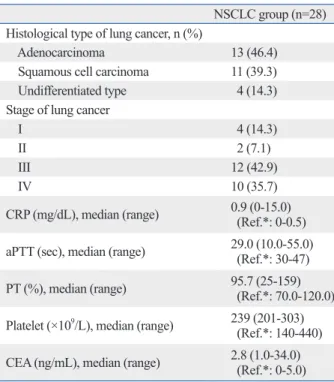
The histological types and stages of the NSCLC group are as follows: 13 adenocarcinomas, 11 squamous cell carcino- mas, and four undifferentiated carcinomas; four stage I, two stage II, 12 stage III, and 10 stage IV NSCLCs (Table 2).
The median activated prothromboplastin time (aPTT) was 29.0 second (normal range: 30-47 seconds).
Factor XIII activity
The median FXIII activity level of the NSCLC group (24.2 Loewy U/mL, IQR 14.9-40.4 Loewy U/mL) was signifi- cantly higher than that of the healthy group (17.5 Loewy U/
mL, IQR 12.6-26.4 Loewy U/mL) (p=0.01) (Table 1).
FXIII activity in patients with squamous cell carcinoma (median 28.7 Loewy U/mL, IQR 20.3-42.2 Loewy U/mL) was significantly higher than in the healthy group (median 17.5 Loewy U/mL, IQR 12.6-26.4 Loewy U/mL, p=0.01) (Fig. 1). However, there were no differences in FXIII activ- ity between the healthy group and patients with adenocarci- noma (median 18.6 Loewy U/mL, IQR 13.4-26.9 Loewy U/mL) (p=0.38) and between the patients with adenocarci- noma and squamous cell carcinoma (p=0.12). In addition, there were no differences in FXIII activity between patients with adenocarcinoma and those with squamous cell carci- tween FXIII activities and cell types or stages of NSCLC
were analyzed by Kruskal-Wallis ANOVA. FXIII activities between two groups were compared using Mann-Whitney tests. We calculated Pearson correlation coefficients for es- timating relationships between variables. All tests were two- sided, and differences of p<0.05 were considered statistical- ly significant. SPSS software version 12.0 (Statistical Package for Social Sciences, Chicago, IL, USA) was used for all statistical analyses.
Table 1. Basic Characteristics of Participants
NSCLC group Healthy group p value
Participants (number) 28 28 -
Gender, male : female (number) 22 : 6 22 : 6 -
Age (yrs) 64.4±9.2 65.4±10.1 0.55
Height (cm) 162.0±8.7 161.1±8.9 0.72
Weight (kg) 60.5±8.7 62.9±10.0 0.17
BMI (kg/m2) 23.1±2.9 24.1±2.6 0.15
Smoking status (number)
Current smoker 12 12 -
Ex-smoker 7 7 -
Non-smoker 9 9 -
Smoking amount (pack×yrs) 29.4±26.4 27.2±27.6 0.72
FXIII activity (Loewy U/mL) (median, IQR) 24.2, 14.9-40.4 17.5, 12.6-26.4 0.01
BMI, body mass index; NSCLC, non-small cell lung cancer; FXIII activity, factor XIII activity; IQR, interquartile range.
Table 2. Characteristics of NSCLC Patients
NSCLC group (n=28) Histological type of lung cancer, n (%)
Adenocarcinoma 13 (46.4)
Squamous cell carcinoma 11 (39.3) Undifferentiated type 4 (14.3) Stage of lung cancer
I 4 (14.3)
II 2 (7.1)
III 12 (42.9)
IV 10 (35.7)
CRP (mg/dL), median (range) 0.9 (0-15.0) (Ref.*: 0-0.5) aPTT (sec), median (range) 29.0 (10.0-55.0)
(Ref.*: 30-47)
PT (%), median (range) 95.7 (25-159)
(Ref.*: 70.0-120.0) Platelet (×109/L), median (range) 239 (201-303)
(Ref.*: 140-440) CEA (ng/mL), median (range) 2.8 (1.0-34.0)
(Ref.*: 0-5.0) CRP, C-reactive protein; aPTT, activated partial thromboplastin time; PT, prothrombin time; CEA, carcinoembryogenic antigen; NSCLC, non-small cell lung cancer.
*Ref. means reference range.
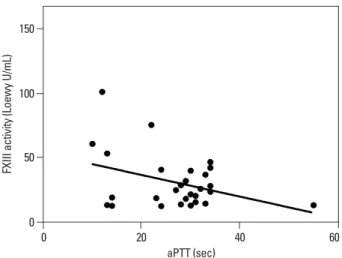
FXIII activity was negatively correlated with aPTT in NSCLC patients (Fig. 3), but not with prothrombin time (PT). There was moderate negative correlation between FXIII activity and aPTT, in which the correlation coefficient was -0.38 (p=0.04) in itself, and -0.48 (p=0.03) when ad- justed with PT.
DISCUSSION
The results of this study showed that FXIII activity was higher in patients with NSCLC than in the healthy group.
Patients with squamous cell carcinoma and stage III and IV disease showed significantly higher FXIII activities than those of the healthy group. Additionally, FXIII activity was higher in patients with stage III disease than in patients with stages I or II. Moreover, FXIII activity was negatively cor- related with aPTT in NSCLC patients.
Coagulation abnormalities have been suggested to influ- ence tumor dissemination via multiple mechanisms.9,10 The inhibition of coagulation factors, including FXIII, have been reported to decrease metastatic progression.22,23 In a previ- noma of stages I-IIIa (median 14.00 vs. median 26.10,
p=0.17) and of stages IIIb-IV (median 24.78 vs. median 28.69, p=0.35).
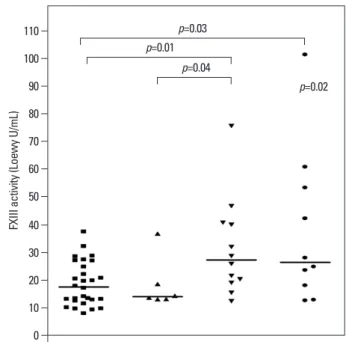
In the analysis based on TNM stages of NSCLC, FXIII ac- tivities were significantly different among the healthy group and patients of different NSCLC stage (p=0.02, by Kruskal- Wallis test). FXIII activity in patients with stage III NSCLC (median 27.3 Loewy U/mL, IQR 19.3-40.5 Loewy U/mL) was significantly higher than that in both the healthy group (median 17.5 Loewy U/mL, IQR 12.6-26.4 Loewy U/mL, p=0.01) and the patients with stage I or II NSCLC (median 14.0 Loewy U/mL, IQR 13.1-23.1 Loewy U/mL, p=0.04) (Fig. 2). FXIII activity in patients with stage IV NSCLC (median 26.4 Loewy U/mL, IQR 16.8-55.2 Loewy U/mL) was significantly higher than that of the healthy group (p=0.03). However, there were no differences in FXIII activ- ity between the patients with stage IV NSCLC and the pa- tients with stage III NSCLC, or between the patients with stage IV NSCLC and patients with stages I or II NSCLC.
Also, there was no significant difference in FXIII activity in separate analysis according to T stage, N stage, or M stage, respectively.
Fig. 1. FXIII activities were significantly different among the healthy, adeno- carcinoma, and squamous cell carcinoma groups (p=0.03). FXIII activity in squamous cell carcinoma (median 28.7 Loewy U/mL, IQR 20.3-42.2 Loewy U/mL) was significantly higher than that in the healthy group (median 17.5 Loewy U/mL, IQR 12.6-26.4 Loewy U/mL, p=0.01), but there were no differ- ences between adenocarcinoma (median 18.6 Loewy U/mL, IQR 13.4-26.9 Loewy U/mL) and squamous cell carcinoma. Comparisons were performed using Kruskal-Wallis and Mann-Whitney tests. FXIII, factor XIII; Adeno, ad- enocarcinoma; Squamous, squamous cell carcinoma; IQR, interquartile range.
Fig. 2. TNM stage of NSCLC significantly influenced FXIII activity (p=0.02).
FXIII activity in patients with stage III NSCLC (median 27.3 Loewy U/mL, IQR 19.3-40.5 Loewy U/mL) was significantly higher than that in both the healthy controls (median 17.5 Loewy U/mL, IQR 12.6-26.4 Loewy U/mL, p=0.01) and the patients with stage I or II disease (median 14.0 Loewy U/mL, IQR 13.1- 23.1 Loewy U/mL, p=0.04). FXIII activity in patients with stage IV NSCLC (median 26.4 Loewy U/mL, IQR 16.8-55.2 Loewy U/mL) was significantly higher than that in the healthy group. Comparisons were performed using Kruskal-Wallis tests and Mann-Whitney tests. NSCLC, non-small cell lung cancer; FXIII, factor XIII; IQR, interquartile range.
0 0
10
10 20
20 30
30 40
40 50
50 60
60 70
70 80 90 100 110
FXIII activity (Loewy U/mL) FXIII activity (Loewy U/mL)
Healthy (n=28) Adeno (n=13) Squamous (n=11) Healthy (n=28) Stage I, II (n=6) Stage III (n=10) Stage IV (n=12)
p>0.05 p=0.01
p=0.04
p=0.03
p=0.02
p=0.01 p=0.03
increased FXIII activities are supposed to be due to increased FXIII-A secretion from damaged tumor-associated macro- phages and increased vascular permeability factor/vascular endothelial growth factor (VEGF), which is a key element for angiogenesis and coagulation/fibrinolysis activation.29 This phenomenon was predominant in squamous cell carci- noma rather than in adenocarcinoma, according to a previous report.30 Considering our results, FXIII activity may be a po- tential novel biomarker for NSCLC, and further investiga- tions are necessary to reveal the effect of FXIII activity on cell type, progression, and prognosis in NSCLC patients.
However, there are some contradictions with the reports in patients with breast cancer31 and advanced gastrointestinal tu- mors,32 as these patients had reduced FXIII levels.
There are some limitations to the present study. First, the sample size was small. In order to match age, gender, BMI, smoking status, and smoking amount and exclude factors which could potentially influence FXIII activity, a limited number of NSCLC patients and participants from KHGS were enrolled. Therefore, it was impossible to perform sub- group analysis of undifferentiated cell types or make com- parisons with other cell types. Second, because this was a cross-sectional study, the effect of FXIII activity on progno- sis could not be evaluated. Finally, the relationship of other coagulation factors such as fibrinogen and D-dimer were not analyzed.
In conclusion, FXIII activity in NSCLC patients and pa- tients with advanced stages was significantly increased compared to those of strictly matched healthy subjects and patients with earlier stages of disease, respectively. These findings suggest potential roles for FXIII in NSCLC pro- gression. Therefore, further studies with larger sample sizes are necessary to investigate the role of FXIII in lung cancer biology.
REFERENCES
1. Kamangar F, Dores GM, Anderson WF. Patterns of cancer inci- dence, mortality, and prevalence across five continents: defining priorities to reduce cancer disparities in different geographic re- gions of the world. J Clin Oncol 2006;24:2137-50.
2. Travis WD, Travis LB, Devesa SS. Lung cancer. Cancer 1995;
75(1 Suppl):191-202.
3. Pastorino U. Lung cancer screening. Br J Cancer 2010;102:1681-6.
4. Coate LE, John T, Tsao MS, Shepherd FA. Molecular predictive and prognostic markers in non-small-cell lung cancer. Lancet On- col 2009;10:1001-10.
5. Montuenga LM, Pio R. Current challenges in lung cancer early detection biomarkers. Eur J Cancer 2009;45 Suppl 1:377-8.
ous study, elevated plasma fibrinogen was positively corre- lated with tumor size, advanced stage and squamous cell type of NSCLC.15 Additionally, abnormal prothrombin time, higher platelet count, fibrinogen and D-dimer were all shown to be associated with poor prognosis in NSCLC.24 Approximately 90% of cancer patients with metastasis and half of all cancer patients have abnormal coagulation pa- rameters, including shortened aPTT and increased levels of other related coagulation factors.25 Our results validated the relationship between coagulation factor levels and measured coagulation testing. FXIII is a heterotetramer that consists of two globular A subunits and two strand like B subunits.26 FXIII is responsible for the formation of fibrin in the final stage of coagulation cascade,27 and participates in hemosta- sis, angiogenesis, wound healing and maintenance of preg- nancy.28 The levels of FXIII-A subunit, which are converted from FXIII, are usually higher in females, elderly patients, and smokers.28 Therefore, in our study, 28 NSCLC patients were compared with individually age-, gender-, BMI-, smok- ing status-, and smoking amount-matched healthy subjects.
Studies of FXIII activity in tumor biology are scarce.
FXIII has been shown to support metastasis primarily by limiting NK cell-mediated clearance of micrometastatic tu- mor cells through cross-linking fibrin,22 which is also sup- posed to function as a promoter for stable adhesion for early metastasis.14 FXIII also plays an important role in tumor an- giogenesis by direct stimulation of endothelial cell prolifera- tion, migration and survival.11 In this study of NSCLC, FXIII activity in patients with advanced stage disease was signifi- cantly higher than that in patients with earlier stage disease, which was consistent with a previous study regarding the po- tential role of FXIII in tumor biology.11,14 The reasons for the
Fig. 3. aPTT and FXIII activity showed a significant correlation in NSCLC patients (r=-0.38, p=0.04). aPTT, activated prothromboplastin time; FXIII, fac- tor XIII; NSCLC, non-small cell lung cancer.
0 50 100 150
FXIII activity (Loewy U/mL)
0 20
aPTT (sec)
40 60
19. Rami-Porta R, Crowley JJ, Goldstraw P. The revised TNM stag- ing system for lung cancer. Ann Thorac Cardiovasc Surg 2009;
15:4-9.
20. Kim SJ, Suk MH, Choi HM, Kimm KC, Jung KH, Lee SY, et al.
The local prevalence of COPD by post-bronchodilator GOLD cri- teria in Korea. Int J Tuberc Lung Dis 2006;10:1393-8.
21. Kwon MH, Kong DH, Jung SH, Suh IB, Kim YM, Ha KS. Rapid determination of blood coagulation factor XIII activity using pro- tein arrays for serodiagnosis of human plasma. Anal Chem 2011;
83:2317-23.
22. Palumbo JS, Barney KA, Blevins EA, Shaw MA, Mishra A, Flick MJ, et al. Factor XIII transglutaminase supports hematogenous tu- mor cell metastasis through a mechanism dependent on natural killer cell function. J Thromb Haemost 2008;6:812-9.
23. Bobek V, Kovarík J. Antitumor and antimetastatic effect of warfa- rin and heparins. Biomed Pharmacother 2004;58:213-9.
24. Ferrigno D, Buccheri G, Ricca I. Prognostic significance of blood coagulation tests in lung cancer. Eur Respir J 2001;17:667-73.
25. Gouin-Thibault I, Samama MM. Laboratory diagnosis of the thrombophilic state in cancer patients. Semin Thromb Hemost 1999;25:167-72.
26. Adány R, Bárdos H. Factor XIII subunit A as an intracellular transglutaminase. Cell Mol Life Sci 2003;60:1049-60.
27. Lorand L. Factor XIII and the clotting of fibrinogen: from basic research to medicine. J Thromb Haemost 2005;3:1337-48.
28. Ichinose A. Physiopathology and regulation of factor XIII.
Thromb Haemost 2001;86:57-65.
29. Bárdos H, Juhász A, Répássy G, Adány R. Fibrin deposition in squamous cell carcinomas of the larynx and hypopharynx.
Thromb Haemost 1998;80:767-72.
30. Roselli M, Mineo TC, Basili S, Mariotti S, Martini F, Bellotti A, et al. Vascular endothelial growth factor (VEGF-A) plasma levels in non-small cell lung cancer: relationship with coagulation and platelet activation markers. Thromb Haemost 2003;89:177-84.
31. Jiang WG, Ablin R, Douglas-Jones A, Mansel RE. Expression of transglutaminases in human breast cancer and their possible clini- cal significance. Oncol Rep 2003;10:2039-44.
32. Born P, Lippl F, Ulm K, Gerein P, Lersch C, Eckel F, et al. Re- duced levels of coagulation factor XIII in patients with advanced tumor disease. Hepatogastroenterology 2000;47:194-8.
6. Wang X, Wang E, Kavanagh JJ, Freedman RS. Ovarian cancer, the coagulation pathway, and inflammation. J Transl Med 2005;3:25.
7. Kakkar AK, Levine MN, Kadziola Z, Lemoine NR, Low V, Patel HK, et al. Low molecular weight heparin, therapy with dalteparin, and survival in advanced cancer: the fragmin advanced malignan- cy outcome study (FAMOUS). J Clin Oncol 2004;22:1944-8.
8. Sampson MT, Kakkar AK. Coagulation proteases and human can- cer. Biochem Soc Trans 2002;30:201-7.
9. Camerer E, Qazi AA, Duong DN, Cornelissen I, Advincula R, Coughlin SR. Platelets, protease-activated receptors, and fibrino- gen in hematogenous metastasis. Blood 2004;104:397-401.
10. Palumbo JS, Kombrinck KW, Drew AF, Grimes TS, Kiser JH, Degen JL, et al. Fibrinogen is an important determinant of the metastatic potential of circulating tumor cells. Blood 2000;96:
3302-9.
11. Dardik R, Loscalzo J, Inbal A. Factor XIII (FXIII) and angiogene- sis. J Thromb Haemost 2006;4:19-25.
12. Katona E, Nagy B, Kappelmayer J, Baktai G, Kovács L, Mári- aligeti T, et al. Factor XIII in bronchoalveolar lavage fluid from children with chronic bronchoalveolar inflammation. J Thromb Haemost 2005;3:1407-13.
13. Labat-Robert J. Fibronectin in malignancy. Semin Cancer Biol 2002;12:187-95.
14. Palumbo JS, Potter JM, Kaplan LS, Talmage K, Jackson DG, De- gen JL. Spontaneous hematogenous and lymphatic metastasis, but not primary tumor growth or angiogenesis, is diminished in fibrin- ogen-deficient mice. Cancer Res 2002;62:6966-72.
15. Jones JM, McGonigle NC, McAnespie M, Cran GW, Graham AN. Plasma fibrinogen and serum C-reactive protein are associat- ed with non-small cell lung cancer. Lung Cancer 2006;53:97-101.
16. Vairaktaris E, Vassiliou S, Yapijakis C, Spyridonidou S, Vylliotis A, Derka S, et al. Increased risk for oral cancer is associated with coagulation factor XIII but not with factor XII. Oncol Rep 2007;
18:1537-43.
17. An Y, Bekesova S, Edwards N, Goldman R. Peptides in low mo- lecular weight fraction of serum associated with hepatocellular carcinoma. Dis Markers 2010;29:11-20.
18. Kiss F, Hevessy Z, Veszprémi A, Katona E, Kiss C, Vereb G, et al.
Leukemic lymphoblasts, a novel expression site of coagulation factor XIII subunit A. Thromb Haemost 2006;96:176-82.