INTRODUCTION
Virtually everyone infected with Helicobacter pylori develops life-long chronic gastritis, but only a minority of infected indi- viduals will develop a clinically relevant disease, such as pep- tic ulcer or gastric carcinoma. The mechanisms responsible for the diversity of clinical outcomes of H. pylori infection are not well established. Both host genetic factors and specific properties of the bacterial strains are suggested to play an important role in the development of H. pylori-related diseases. Putative vir- ulence factors of H. pylori may include colonization factors, such as urease, adhesion, and motility, and such disease-associated factors as cytotoxicity (1-3).
A multitude of in vitro and animal studies investigating the virulence factors of H. pylori have been performed. Defined laboratory strains, or culture collection strains of H. pylori have frequently been used in such experiments. However, it is evi- dent that such laboratory strains may have quite different prop- erties from those of corresponding organisms under in vivo condition. An example of this was the repeated subcultures of Streptococcus mutans, which resulted in the loss of its adhesive qualities and changes in expression of surface proteins (4-7).
In vitro cultivation of H. pylori isolates on solid media may result in loss of the antigenic O side-chain (8). Also, specific mutants of the original organisms can be made by adjusting the culture condition (9, 10). Therefore, the virulence factors of laboratory strains, following repeated subcultures, may be quite different from those of the original H. pylori strain.
To investigate the effect of sequential subculture on the vir- ulence factors of H. pylori, we have conducted in vitro experi- ments on a defined form of H. pylori and its progeny after repeat- ed subcultures, investigating their adhesion, motility, and cytotoxicity, and the gastric inflammation they cause in the Mongolian gerbil.
MATERIALS AND METHODS Preparation of bacteria and subculture
H. pylori SS1 strain was obtained from A. Lee (School of Microbiology and Immunology, The University of New South Wales, Sydney, Australia) in 1998. The organism was subcultured in twice sequentially and admixed with brain
Sung Soo Kim, Hak Sung Lee, Young Seok Cho, Youn Soo Lee*, Choon Sang Bhang, Hiun Suk Chae, Sok Won Han, In Sik Chung, Doo Ho Park
Division of Gastroenterology, Department of Internal Medicine, Department of Clinical Pathology*, College of Medicine, Catholic University of Korea, Seoul, Korea
Address for correspondence In Sik Chung, Professor Division of Gastroenterology Department of Internal Medicine
Kangnam St. Mary's Hospital, 505 Banpo-dong, Seocho-gu, Seoul 137-040, Korea
Tel : +82.2-590-1402, Fax : +82.2-590-1409 E-mail : [email protected]
*We received financial support for this research from the research fund of Catholic University Medical College.
�This article was selected for poster presentation at the XIVth International Workshop on Gastroduode- nal Pathology and Helicobacter pylori, Strasbourg.
302
The Effect of the Repeated Subcultures of Helicobacter pylori on Adhesion, Motility, Cytotoxicity, and Gastric Inflammation
In vitro subcultures of bacteria can lead to genetic and phenotypic changes. This study aimed at investigating the effect of repeated subcultures on the adhesion, motility, cytotoxicity, and gastric inflammation caused by Helicobacter pylori. H.
pylori SS1 strain was subcultured 64 times on agar plates containing Brucella broth and 5% bovine calf serum. The adhesion, motility, cytotoxicity, and gastric inflammation produced in Mongolian gerbils were compared between the first and 64th subcultured strain. The adhesion rates, following 3 hr exposure of AGS cells to either the first strain or the 64th-transferred strain, were 21% and 12%, respectively. The motility of the 64th-transferred strain decreased significantly when compared to the 1st strain (9.1 mm vs. 15.1 mm). The cytotoxicity index tended to be higher in the first strain than in the 64th-transferred strain (73.7% vs. 69.2%).
The initial infection rate on the gerbils showed no difference between the two strains.
However, chronic gastric inflammation of the first strain-infected gerbils was some- what more severe than that of the 64th-transferred strain-infected gerbils. There- fore, the use of repeatedly subcultured strains of H. pylori in virulence experiments can lead to different results from thoses of the original strain.
Key Words : Helicobacter pylori; Growth; Adhesions; Motility; Gastritis
Received : 7 February 2002 Accepted : 7 March 2002
heart infusion broth containing 20% (v/v) glycerol, then stored at -70℃for about 30 months. The stored organisms were thawed, and grown on Brucella agar (Difco Inc., Detroit, Mich., U.S.A.) containing 5% (v/v) bovine calf serum which was incubated at 37℃, 10% (v/v) CO2, 95% humidity for 3 days.
These organisms were used as the first ancestor strain (first strain) in this experiment. Then, the first strain was sequen- tially subcultured 64 times under the same culture conditions.
The first strain and 64th-transferred strain (‘64th strain') used
in these experiments were incubated on the liquid media con- taining Brucella broth and 5% (v/v) bovine calf serum in a shaking incubator at 10% CO2(v/v) and 95% humidity at 37℃for 30 hr prior to use. All in vitro experiments were performed in triplicate.
Adhesion rate
The adhesion of H. pylori to the AGS cell line was quantified by measuring bacterial urease activity as previously described (11). Briefly, 1×10⁵AGS cells per well were cultured in 96- well tissue culture plates with medium containing 1×10⁹ organisms per well of H. pylori. After 3 hr, the plate was washed with phosphate-buffered saline (PBS) to remove the H. pylori that did not adhere. Saline containing 2% (w/v) urea and 0.03% (w/v) phenol red was then added and the bacterial urease activity was assayed by measuring the optical density at 540 nm. Cells treated with culture medium without H.
pylori served as negative controls. The index was calculated at percentage of optical density of co-cultured H. pylori per that of H. pylori alone.
Motility
Motility was determined in a semisolid medium that con- sisted of Brucella broth, 5% (v/v) bovine calf serum, and 0.4%
(w/v) agarose (Difco, Detroit, MI, U.S.A.) as previously de- scribed (2). The melted medium was poured into petri dish- es (60 mm in diameter) and solidified. The agar plates were dried for 30 min on a clean bench, and then a paper disk (6 mm in diameter) was placed in the center of the agar plate.
Effect of Subculture on H. pylori 303
Adhesion index(%)
40
30
20
10
0
1st strain 64th strain
Fig. 1. Differences in adhesion rates after exposure to the first strain and 64th-transferred strain of H. pylori. The adhesion rate upon AGS cells is significantly lower in the 64th-transferred strain than in the first strain.
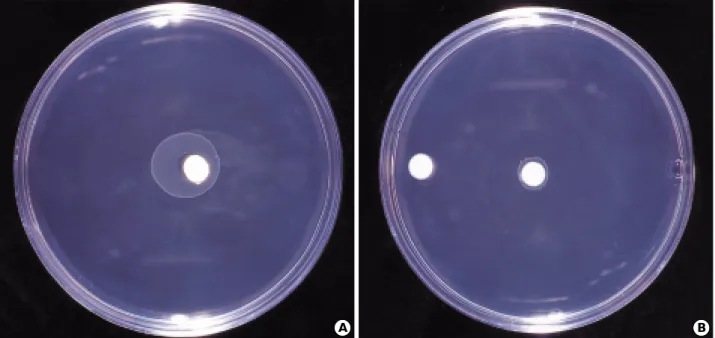
Fig. 2.Motility of H. pylori in semisolid medium. The first strain (A) spread widely in the medium. The 64th-transferred strain (B) show a narrow growth zone around a paper disk.
A B
The culture broth of H. pylori (10 L; 1×10⁷ organisms) was inoculated onto the paper disk and the agar plate was incu- bated at 37℃, 10% (v/v) CO2, 95% humidity, for five days.
The diameter of the growth zone was measured using a slide caliper.
Vacuolating cytotoxic activity
Cytotoxicity was quantified by measuring the cellular release of lactose dehydrogenase (LDH) into the culture medium as previously described (12). Briefly, 1×10⁵AGS cells per well were cultured in 96-well tissue culture plates with medium containing 1×10⁹organisms per well of H. pylori. After 9 hr, the plate was centrifuged for 10 min at 250 g, and 100 L
of supernatant from the well was transferred into a new micro- plate. The concentration of LDH was then measured using a cytotoxicity kit from TaKaRa Biomedicals (Shiga, Japan).
AGS cells alone in culture medium served as negative controls.
Gastric inflammation
Five-week-old male Mongolian gerbils were fasted for 24 hr and then challenged orally with 0.4 mL of culture broth containing H. pylori (1×10⁹ CFU/mL) using a 0.9×70 mm sized Zonde needle (Dae Jong Instrument Co., Seoul, Korea), and this was repeated twice during five days. Two weeks and 12 weeks after inoculation, animals were killed and the stomach was dissected. Half of the stomach was used
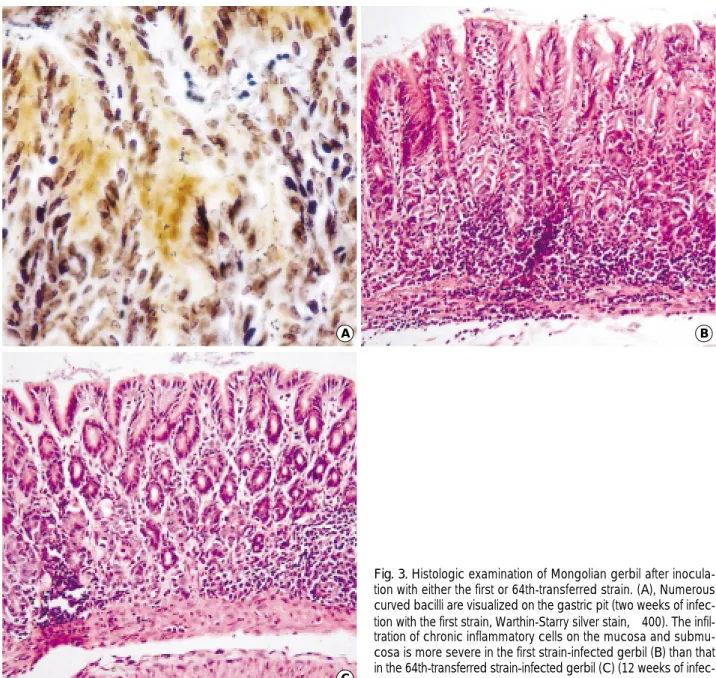
Fig. 3.Histologic examination of Mongolian gerbil after inocula- tion with either the first or 64th-transferred strain. (A), Numerous curved bacilli are visualized on the gastric pit (two weeks of infec- tion with the first strain, Warthin-Starry silver stain,×400). The infil- tration of chronic inflammatory cells on the mucosa and submu- cosa is more severe in the first strain-infected gerbil (B) than that in the 64th-transferred strain-infected gerbil (C) (12 weeks of infec- tion, H&E,×200).
A
C
B
for urease testing and the culture of H. pylori, and the remaining stomach was fixed in 10% (v/v) neutral buffered formalin for histological examination. H. pylori infection was confirmed by positive culture, or when both the urease test and histology were positive. Gastric inflammation, such as infiltration of PMN neutrophils and monocytes, was assessed according to the updated Sydney system (13).
RESULTS Adhesion rate
The repeated subculture was proven to decrease the cellular adhesion of H. pylori. The adhesion rate of the first strain to AGS cells was significantly higher than that of the 64th strain.
The adhesion indices following 3 hr exposure of the first strain and 64th strain to the AGS cells were 21% and 12%, respec- tively (Fig. 1).
Motility
The change of motility was also significant following repeat- ed subculturing of H. pylori. The motility of the 64th strain decreased markedly compared to that of the first strain. The diameter of the growth zone of the first strain was 15.1± 0.9 mm, whereas that of the 64th strain decreased to 9.1± 0.6 mm (Fig. 2).
Cytotoxicity
Exposure of AGS cells to either the first or 64th strains for
9 hr significantly increased LDH release into the culture medi- um. Exposure of AGS cells to the first strain increased LDH release somewhat more than exposure to the 64th strain. The increment of LDH in the first strain was 73.7±2.7%, and that in the 64th strain was 69.2±2.3%.
Gastric inflammation
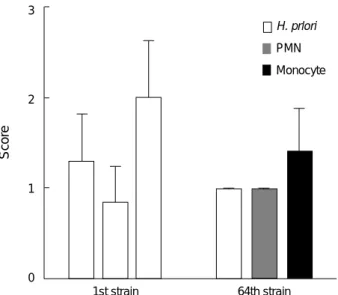
Infection rates at two weeks after inoculation was not dif- ferent between the first strain-infected gerbils and the 64th strain-infected gerbils. In both groups, 8 of the 10 inoculat- ed gerbils were confirmed to be infected (80%). However, gastric inflammation, which was assessed at 12 weeks after infection, was somewhat different between the first strain- infected gerbils and the 64th strain-infected gerbils. The chron- ic inflammation in the first strain-infected gerbils tended to be more severe than that in 64th strain-infected gerbils. The mean score of monocyte infiltration in the first strain-infected gerbils was 2.0±0.78, and that in the 64th strain-infected gerbils was 1.4±0.54 (Fig. 3, 4).
DISCUSSION
Although host genetic and environmental factors may have an important role in H. pylori-induced diseases, bacterial vir- ulence factors such as urease, motility, adhesins, or cytotoxins are responsible for the colonization and inflammation of H.
pylori (1, 3, 14).
These results demonstrated that repeated subculturing of H. pylori could change the biological activity of the virulence factors. The adhesion rate, motility, and cytotoxicity of the original strains decreased following 64 successive propagations in vitro. Gastric inflammation produced by the subcultured strain was less severe than that of the original strain. There- fore, various in vitro and in vivo virulence experiments using the old and several-times-transferred strains of H. pylori demon- strated different results from those of the original strains.
Our results may undoubtedly be expected when considering previous studies. In many reports, subcultures of the bacteria and cell lines can lead to genetic and phenotypic changes. For example, Streptococcus mutans freshly isolated from saliva showed decreased ability to adhere following a number of in vitro subcultures (4, 5). A variant strain, Xc100L, which was iso- lated following 100 times subcultures of Streptococcus mutans, strain Xc, showed a decrease in the production of a surface protein antigen with a molecular mass of 190 kDa (PAc).
This was associated with changes in transcriptional regula- tion of the gene (6, 7).
For experimental purposes, specific mutants of the origi- nal organisms can be made by nutritional limitations and atmospheric changes during growth. A TEM-1 derived vari- ant beta-lactamase with increased resistance to beta-lactamase inhibitors was obtained by repeated subcultures of E. coli J62-
Effect of Subculture on H. pylori 305
Score
3
2
1
0
1st strain 64th strain
Fig. 4. Differences in gastric inflammation in a gerbil infected for 12 weeks. Although there is no statistical difference, the chronic inflammatory cell infiltration tends to be higher in the first strain than in the 64th strain.
H. prlori PMN Monocyte
2 for five days in the presence of subinhibitory concentrations of amoxacillin plus clavulanic acid (9). In vitro, spontaneous mutants resistant to fluoroquinolones are frequent in methi- cillin-resistant Staphylococcus aureus when selected on isosen- sitest-agar containing 1 g/mL of ciprofloxacin (10).
In addition, the plating of successive Staphylococcus aureus subcultures of daily transfers proved that genetic mutants are responsible for antigen variation (15). Changes in the genet- ic expression of several proteins following subculture of pri- mary rat astrocytes were also demonstrated (16).
Fresh clinical isolates of H. pylori expressed high-molecu- lar weight lipopolysaccharide (LPS) with an O side-chain (S- LPS). Following numerous in vitro passages on solid media, low- molecular-weight LPS (R-LPS) was produced (8). However, this change could be reversed when grown in liquid media.
Culture collection strains that were subcultured many times also produced R-LPS when grown on solid media, but when the same strains were grown under liquid conditions, S-LPS was produced. They presumed these changes in phenotypic expression were caused by a difference in the growth condi- tion of solid media compared with in vivo conditions. How- ever, the changes of virulent properties in our experiments were not reversed when the organisms were grown in liquid media before use.
We conducted in vivo experiments to determine whether the changes in the virulence properties, following repeated subculture, affect the inflammation of the gerbil gastric mucosa.
Although the initial infection rate was not different, the chronic inflammation of the stomach tended to be different between the first strain and the 64th strain.
In summary, subcultures of H. pylori leads to changes in the biological activity of virulence factors, such as adhesion, motility, and cytotoxicity, and that these changes can affect the degree of gastric inflammation in animal models. There- fore, the use of repeatedly subcultured strains in virulence experiments can lead to different results from those of the original strains of H. pylori. Many in vivo and in vitro experi- ments have been performed or are still ongoing to explore the disease-specific virulence factors of H. pylori. Therefore, it is important to keep the culture conditions for H. pylori as simi- lar as possible with the intragastric environment.
REFERENCES
1. Graham DY, Yamaoka Y. Disease-specific Helicobacter pylori vir-
ulence factors: the unfulfilled promise. Helicobacter 2000; 5(Suppl.
1): S3-9.
2. Iwao E, Hirayama F, Takagi S, Yokoyama Y, Ikeda Y. Virulence fac- tors of Helicobacter pylori affecting its gastric colonization in Mon- golian gerbils. J Gastroenterol 1999; 34(Suppl. 11): 47-54.
3. Yoshiyama H, Nakazawa T. Unique mechanism of Helicobacter pylori for colonizing the gastric mucus. Microbes Infect 2000; 2: 55-60.
4. Orstavik J, Orstavik D. Influence of in vitro propagation on the adhe- sive qualities of Streptococcus mutans isolated from saliva. Acta Odontol Scand 1982; 40: 57-63.
5. Westergren G, Olsson J. Hydrophobicity and adherence of oral strep- tococci after repeated subculture in vitro. Infect Immun 1983; 40:
432-5.
6. Koga T, Asakawa H, Okahashi N, Takahashi I. Effect of subcultur- ing on expression of a cell-surface protein antigen by Streptococcus mutans. J Gen Microbiol 1989; 135: 3199-207.
7. Yamashita Y, Tsukioka Y, Nakano Y, Shibata Y, Koga T. Molecular and genetic analysis of multiple changes in the levels of production of virulence factors in a subcultured variant of Streptococcus mutans. FEMS Microbiol Lett 1996; 144: 81-7.
8. Walsh EJ, Moran AP. Influence of medium composition on the growth and antigen expression of Helicobacter pylori. J Appl Microbiol 1997; 83: 67-75.
9. Thomson CJ, Amyes SG. Selection of variants of the TEM-1 beta- lactamase, encoded by a plasmid of clinical origin, with increased resistance to beta-lactamase inhibitors. J Antimicrob Chemother 1993; 31: 655-64.
10. Witte W, Grimm H. Occurrence of quinolone resistance in Staphy- lococcus aureus from nosocomial infection. Epidemiol Infect 1992;
109: 413-21.
11. Rosberg K, Hubinette R, Nygard G, Berglindh T, Rolfsen W. Studies of Helicobacter pylori in a gastric mucosa in vitro animal model. Scand J Gastroenterol 1991; 26: 43-8.
12. Smoot DT, Wynn Z, Elliott TB, Allen CR, Mekasha G, Naab T, Ashk- torab H. Effects of Helicobacter pylori on proliferation of gastric epithelial cells in vitro. Am J Gastroenterol 1999; 94: 1508-11.
13. Dixon MF, Genta RM, Yardley JH, Correa P. Classification and grading of gastritis. The updated Sydney System. International Work- shop on the Histopathology of Gastritis, Houston 1994. Am J Surg Pathol 1996; 20: 1161-81.
14. Gschwantler M, Dragosics B. Physiopathology of Helicobacter pylori infections. Acta Med Austriaca 2000; 27: 117-21.
15. Pereira AT. Further studies on antigen variation in Staphylococcus aureus. J Clin Microbiol 1981; 13: 245-7.
16. Passaquin AC, Schreier WA, de Vellis J. Gene expression in astrocytes is affected by subculture. Int J Dev Neurosci 1994; 12: 363-72.