Lipase-producing Filamentous Fungi from Non-dairy Creamer Industrial Waste
Desty Triyaswati and Miftahul Ilmi*
Faculty of Biology, Universitas Gadjah Mada, Jl. Teknika Selatan, Sekip Utara, Yogyakarta 55281, Indonesia
Received: December 23, 2019 / Revised: February 14, 2020 / Accepted: February 17, 2020
Introduction
Lipase (triacylglycerol acyl hydrolase, E.C. 3.1.1.3) is an enzyme that catalyzes the hydrolysis and synthesis of triglycerides and other water-insoluble esters [1]. Lipase naturally hydrolyzes ester bonds at triglycerides in the presence of excess water. Besides that, lipase can cata- lyze the esterification reaction of fatty acids with alcohol when water concentration in the environment is low [2, 3]. In addition to the hydrolysis and esterification reactions, lipases are also able to catalyze the transes- terification reaction converting triglycerides and alcohol into fatty acid alkyl esters and glycerol as the end prod-
ucts. Transesterification reaction is used in biodiesel synthesis [4].
Lipases can be produced by plants, animals, and microorganisms [5, 6]. Microbes, e.g. bacteria and fungi, are the most potential sources of lipase used in industry [1]. Fungal lipases gained significant attention in the industries due to their substrate specificity and stability under varied chemical and physical conditions. For instance, fungal lipase from Alternaria brassicicola was potential for detergent industry due to its optimum hydrolysis activity at pH 9 and temperature 25℃ [7].
Furthermore, fungal enzymes are produced extracellu- lar so can be extracted easily, which significantly reduces the cost and makes this source preferable over bacteria [8].
Lipase-producing filamentous fungi can be obtained from soil [6], sea water [9], and oil mill wastes [8].
Lipase-producing fungi have been isolated from environments containing lipids. The non-dairy creamer industrial waste has a high amount of lipids so it is a potential source for the isolation of lipase-producing fungi. However, the study of fungi that secrete lipase from this industrial waste has not been reported. The purpose of this study was to obtain lipase-producing filamentous fungi from non-dairy creamer industrial waste. Mineral salt and potato dextrose agar were used as media for the isolation process. The qualitative screening was conducted using phenol red agar medium and the quantitative screening using broth medium containing glucose and olive oil. Isolates producing the highest amounts of lipase were identified with molecular methods. We found that 5 out of 19 isolated filamentous fungi are lipase producers. Further analysis showed that isolate Ms.11 produced the highest amount of lipase compared to others. Based on ITS sequence Ms.11 was identified as Aspergillus aculeatus. The lipase activity in medium containing 1%
glucose + 1% olive oil at pH 7.0 and 30℃ after 96 and 120 h of incubation was 5.13 ± 0.30 U/ml and 5.22 ± 0.59 U/ml, respectively. The optimum lipase activity was found at pH 7.0, 30℃ and using methanol or ethanol in the reaction tube. Lipase was more stable at 20−30℃ and maintained 85% of its activity. It was concluded that isolate Ms.11 is a potential source of lipase that catalyzes transesterification reactions. Further studies are required to optimize lipase production to make the strain suitable for industry purposes.
Keywords: Filamentous fungi, internal transcribed spacer, lipase, non-dairy creamer
*Corresponding author Tel: +6281392709667 E-mail: [email protected]
© 2020, The Korean Society for Microbiology and Biotechnology
Industrial waste that uses vegetable oil as raw material can also be a source of lipase-producing filamentous fungi. Aspergillus fumigatus, Aspergillus terreus, and Penicillium sp. were lipase producers found from olive oil industrial waste [10] while species of Aspergillus, Peni- cillium, Trichoderma and Mucor were obtained from palm oil industrial wastes [11]. Aspergillus is one of genus that contains many lipase producing species [12].
Non-dairy creamer is creamer commonly used as flavor enhancers for drinks, such as coffee and generally made from coconut oil and palm oil [13]. PT. Kievit Indonesia is producer of non-dairy creamer and its industrial waste is assumed still containing lipid which is potential source of fungi that secret lipase. However, study on lipase-producing filamentous fungi from non- dairy creamer industrial waste has never been done.
The purpose of this study is to obtain lipase-producing filamentous fungi from non-dairy creamer industrial waste. Here, we screened lipase producer of fungi from non-dairy creamer industrial waste with qualitative and quantitative approaches. Then we did molecular identifi- cation of the potential isolate. Further, lipase production profile and enzyme characterization were determined.
Materials and Methods
Sample collection
Sample was obtained from PT. Kievit Indonesia, Salatiga, Central Java, Indonesia. The sample was col- lected using sterile plastic bags and brought to labora- tory using cool box. The sample was stored at 4℃ prior to isolation step.
Isolation of filamentous fungi
Medium used in this isolation was Mineral Salt Agar (MSA) and Potato Dextrose Agar (PDA). Mineral salt agar was modified from previous study [11]. The medium contained virgin olive oil (10 ml/l), Tween 80 (1 ml/l), (NH4)2SO4 (5 g/l), Na2HPO4 (6 g/l), KH2PO4 (2 g/l), MgSO4 (3 g/l), CaCl2 (3 g/l) and agar (20 g/l). PDA was prepared by dissolving 3.9 g PDA (Merck, Germany) in 100 ml distilled water. Both media were sterilized by autoclave at 1 atm, 121℃ for 15 min.
Ten gram solid sample was suspended in 90 ml sterile water and the solution was shaken for 30 sec. Superna- tant (100 µl) was spread on media and incubated at
room temperature for 5 days. Grown fungi colonies were purified by streaking on PDA plate and incubated at room temperature for 3 days. Then, every single colony formed was transferred into PDA slant and stored in low temperature. Isolates from MSA and PDA media were labeled with Ms and Pd, respectively.
Screening of lipase-producing filamentous fungi
Qualitative screening. Medium used in this screening was phenol-red agar modified from previous study [14].
The medium contained phenol red (0.04% w/v), olive oil (0.1% v/v), Tween 80 (0.1% v/v), CaCl2 (0.1% w/v), and agar (2% w/v). The pH was adjusted to 7 using NaOH 1 N. The medium was sterilized by autoclave at 1 atm, 121℃ for 15 min.
Isolates were inoculated to medium on petri dish and incubated at room temperature for 3 days. All experi- ments were done in triplicate. Plates were analyzed after incubation. The color change of medium from red to yellow was used as an indicator of lipase activity. The potency of the isolates for enzyme production was deter- mined based on lypolytic index measured with the fol- lowing equation [15]:
Quantitative screening. Two strains with the highest lypolytic index from previous screening were used for lipase production. Lipase was produced by Submerged Fermentation (SmF) using medium based on Adham and Ahmed [16]. The medium consisted of peptone 3%, MgSO4.7H2O 0.05%, KCl 0.05%, K2HPO4 0.2%, olive oil 0.5% and glucose 0.5%. Fifty ml medium was placed in 250 ml flask sterilized by autoclave at 1 atm, 121℃ for 15 min.
The sterile media in Erlenmeyer flasks were inocu- lated with spore or hypha suspension until final concen- tration reached 106 CFU/ml [17]. Each isolate inoculated into 4 flasks. The flasks were incubated at room tem- perature with 200 rpm shaking for 96 h. Every 24 h, 1 flask of each isolate was filtered using a pre-weighted filter paper. The obtained biomass on filter paper was washed with distilled water prior to drying in oven at 70℃ for 24 h. After 24 h, the weight of biomass was determined. The filtrate was stored at 4℃ for lipase activity assay. All experiments were done in triplicate.
Lypolytic index = Diameter of yellow zone (mm) Diameter of colony (mm)
Lipase activity assay
Esterification activity of lipase was assayed based on colorimetric method [18]. One hundred µl of filtrate was mixed with 1 ml substrate (0.5 M oleic acid and 0.5 M ethanol in isooctane) for 20 min at 30℃. The reaction was stopped by placing the mixture in the ice bath for 5 min. One hundred µl of sample from top layer (organic phase) of previous mixture was then added to 1900 µl isooctane and 400 µl Cupric-Acetate Pyridine (CAP) reagent. The mixture was homogenized with vortex for 5 sec and allowed to stand for 20 min until the aqueous phase (bottom layer) and organic phase (top layer) sepa- rated. Absorbance value of the organic phase was then measured at λ = 715 nm. One unit of esterification activity (U) is defined as the amount of oleic acid (μmol/ml) that is converted to products per minute [19].
Molecular Identification
The molecular identification was carried out on isolate that produced the highest lipase amount. The selected isolate was grown in 30 ml Potato Dextrose Broth (PDB) incubated at 30℃, 48 h, 200 rpm shaking. The mycelia were harvested by centrifugation at 4000 rpm for 10 min. The genomic deoxyribonucleic acid (gDNA) was isolated from the mycelia using Zymo Research Kit (Zymo Research Corporation, USA) according to the manufacturer's instructions. Then, the purity of gDNA was measured by spectrophotometry method at λ 260/
280 using Nanodrop (Maestrogen, Taiwan).
The ITS region of ribosomal DNA was amplified using primer ITS1 (5´-TCC GTA GGT GAA CCT GCG G-3´) as forward primer and ITS4 (5´-TCC TCC GCT TAT TGA TAT GC-3´) as reverse primer. The PCR reaction volume was 50 µl containing 25 µl Mix PCR Go Taq, 20 μl Nucle- ase-free water, 3 μl gDNA, 1 μl forward primer and 1 μl reverse primer. Steps of PCR were initial denaturation (95℃ for 5 min), denaturation (95℃ for 30 sec), anneal- ing (55℃ for 1 min), extension (72℃ for 1 min) and final extension (72℃ for 6 min) [9]. Denaturation, annealing and extension were done in 35 cycles using thermocycler PCR (Biorad, Germany).
The PCR product (3 µl) was subjected to 1% agarose gel electrophoresis, run at 110 V in TBE buffer for 30 min. The gel was mixed with SYBR Safe dye and the band at gel was visualized using UV Transilliuminator (Maestrogen, Taiwan). The size of the band was esti-
mated using DNA marker AccuBand™ 100 bp + 3K DNA Ladder II. Then, the PCR product was sequenced by 1st Base Asia, Malaysia.
The consensus sequence was obtained from forward and reverse sequences that were edited with GeneStudioTM Pro. Then, the sequence was analyzed with Basic Local Alignment Search Tool (BLAST) at www.ncbi.nih.gov to determine its similarity with references found in GenBank database. Ten strains from GenBank with the highest similarity were selected for tree reconstruction.
The nucleotides were aligned with ClustalW in software Molecular Evolution Genetic Analysis version 6 (MEGA 6). The genetic distance was determined using Tamura 3-Parameter. Then, the phylogenetic tree was recon- structed based on Neighbour-Joining method with boot- strap value of 1000 (replication).
Lipase production profile
The profile of lipase production was carried out on isolate that produced the highest lipase amount. The lipase was produced by Submerged Fermentation (SmF) on different carbon source, pH, temperature, and incu- bation period. All experiments were done in triplicate.
Effect of carbon source on lipase production. Medium used in this production was modified medium from Adham and Ahmed [16]. Fifty ml medium consisting of peptone 3%, MgSO4.7H2O 0.05%, KCl 0.05%, K2HPO4 0.2%. Glucose 2%, olive oil 2%, and olive oil 1% + glucose 1% were supplemented separately to the medium. The sterile media were inoculated with spore suspension until final concentration reached 106 spores/ml and incu- bated at room temperature with 200 rpm shaking for 96 h. Then, biomass and lipase activity were determined.
Effect of pH on lipase production. Fifty ml medium with optimum carbon source was used for this step. The pH of medium was adjusted to 4−9 using NaOH and HCL. The sterile media were inoculated with spore sus- pension until final concentration reached 106 spores/ml and incubated at room temperature with 200 rpm shak- ing for 96 h. Then, biomass and lipase activity were determined.
Effect of temperature on lipase production. Fifty ml medium with optimum carbon source and pH was used
in this step. The sterile media were inoculated with spore suspension until final concentration reached 106 spores/ml and incubated at 25−40℃ with 200 rpm shak- ing for 96 h.
Effect of incubation period on lipase production. Fifty ml medium with optimum carbon source and pH was used in this step. The sterile media were inoculated with spore suspension until final concentration reached 106 spores/ml and incubated at optimum temperature with 200 rpm shaking for 168 h. Every 24 h, biomass and lipase activity were determined.
Enzyme characterization
Lipase from isolate that produced the highest lipase amount was characterized its activity and stability. Par- tial purification was done prior to enzyme characteriza- tion to obtain higher purity of enzyme [20].
Partial purification. Partially purified enzyme was obtained by precipitation using ammonium sulphate with 50% of saturation. Solid ammonium sulphate (37.66 g) was added to 120 ml crude extract enzyme at 20℃ and allowed to stand for 48 h at 4℃. The precipitate was obtained by centrifugation at 4000 rpm for 10 min at 4℃. The precipitate was resuspended with a minimal amount of distilled H2O and dialyzed against distilled water using a successive large volume of H2O [16]. The total activity of precipitate and dialysate was assayed using previously described methods while the total pro- tein was determined using Lowry method [21].
Effect of pH and temperature on lipase activity. The effect of pH on lipase activity was measured at various pH ranging from 3 to 10. The pH of the enzyme suspen- sion was varied using different buffers (citrate buffer for pH = 3−6, phosphate buffer for pH = 6−8 and borate buf- fer for pH = 7−9). The effect of temperature on lipase activity was carried out at 20, 25, 30, 35 and 40℃. The enzyme assay was performed as described earlier to determine the optimum pH and temperature.
Effect of alcohol on lipase activity. The effect of alcohol on lipase activity was performed using methanol, etha- nol and n-butanol as substrate. The concentration ratio of oleic acid and alcohol was 0.5 M to 0.5 M. The lipase
activity was assayed at optimum pH and temperature.
Effect of temperature on lipase stability. Enzyme solu- tion was incubated at 20, 25, 30, 35, and 40℃ for 1 h.
The remaining enzyme activity was then determined and compared with the control without incubation.
Statistical analysis
The data of lipase production and enzyme characteri- zation were analyzed by One-Way Analysis of Varian (ANOVA) and followed by Duncan's Multiple Range Test (DMRT) with p < 0.05 using software SPSS Statistics version 20 (IBM, USA).
Results
Lipase-producing filamentous fungi
Nineteen filamentous fungi were obtained from non- dairy creamer industrial waste. Isolates have been puri- fied on PDA media. The fungi were screened with phenol red agar medium that contains lipid as a carbon and energy source for fungi. Color change of medium indi- cates lipase activity. Lipase will hydrolyze lipid to fatty acids which alter pH medium from neutral (red) to acid (yellow) [14]. Five of nineteen isolates form yellow zone on phenol red medium. Among those 5 isolates, Ms.11 and Pd.8 show the highest lipolytic index, 1.44± 0.007 and 1.20± 0.015, respectively (Table 1) and selected for quantitative screening.
Quantitative screening of lipase-producing filamentous fungi
Lipases of isolates Ms.11 and Pd.8 were produced by submerged fermentation using medium containing 0.5%
olive oil and 0.5% glucose. The lipase productivities were observed every 24 h for 96 h. The result shows that lipase activity of Ms.11 (3.76± 0.20 U/ml) is higher than
Table 1. Lipolytic index of lipase-producing fungi.
No. Isolate Lipolytic Index
1 Ms.2 1.15 ± 0.141
2 Ms.8 1 ± 0
3 Ms.11 1.44 ± 0.007
4 Pd.4 1.17 ± 0.166
5 Pd.8 1.20 ± 0.015
Pd.8 (3.36± 0.84 U/ml) after 96 h incubation (Table 2).
Moreover, Ms.11 and Pd.8 have maximum lipase pro- duction, 0.44± 0.03 and 0.38 ± 0.05 U/mg biomass, respectively. Statistical analysis showed that lipase pro- duction of Ms.11 at 96 h incubation gave a significantly high result when compared with Pd.8 (p < 0.05). Based on these findings, Ms.11 was selected for morphological observation, molecular identification and lipase produc- tion profile.
Identification of filamentous fungi
Molecular identification of isolate Ms.11 is based on sequence of ITS region using ITS1 and ITS4 primers.
Electrophoresis of PCR product showed that the length of amplified ITS1-5,8SSU-ITS2 region is 500−600 bp (Fig. 1). BLAST analysis indicates that Ms.11 has high similarity to Aspergillus sp. 2011.9 and strains of Aspergillus aculeatus group (Table 3). Phylogenetic tree with Neighbour-Joining algoritma shows that Ms.11 has close genetic relationship to A. aculeatus B and A.
aculeatus NFML CH59 131 (Fig. 2). Aspergillus niger ATCC 16888 was selected as an outgroup. Identical species based on the results of the BLAST analysis must have a query coverage value ≥ 80% and sequence simi-
larity value ≥ 97−100% [22]. Ms.11 has query coverage
≥ 99% and similarity > 98% to all strains in the phyloge- netic tree. Based on these findings, Ms.11 is considered as a member of species Aspergillus aculeatus.
Lipase production
Effect of carbon source on lipase production. The effect of carbon source on the lipase production of Ms.11 was tested using glucose 2%, olive oil 2%, and olive oil 1% + Table 2. Lipase activity and biomass of Ms.11 and Pd.8.
Incubation (h)
Ms.11 Pd. 8
Lipase activity (U/ml)
Biomass (mg/ml)
Lipase production (U/mg biomass)
Lipase activity (U/ml)
Biomass (mg/ml)
Lipase production (U/mg biomass)
24 1.56 ± 0.34 5.80 ± 0.92 0.27 ± 0.02 1.15 ± 0.12 5.67 ± 0.31 0.20 ± 0.01
48 2.47 ± 0.20 8.07 ± 0.64 0.31 ± 0.02 2.23 ± 0.27 11.87 ± 0.99 0.19 ± 0.01
72 3.40 ± 0.52 9.53 ± 0.95 0.36 ± 0.03 2.43 ± 0.34 9.80 ± 1.56 0.25 ± 0.05
96 3.76 ± 0.20 8.60 ± 0.80 0.44 ± 0.03 3.36 ± 0.84 8.73 ± 1.10 0.38 ± 0.05
Fig. 1. Electrophoresis of PCR product of Ms.11 ITS region.
(A) Marker (B) Amplicon 549 bp.
Table 3. BLAST analysis of Ms.11 with its closest species.
No Strain Query cover (%) Similarity (%) Accession number
1 Aspergillus sp. 2011.9 99 99.14 KP668958.1
2 A. aculeatus KUASN10 99 99.14 MN186997.1
3 A. aculeatus CEP4 99 99.14 MN173148.1
4 A. aculeatus NFML CH59 131 99 99.14 KM458836.1
5 A. aculeatus Z2 99 98.97 MH892845.1
6 A. aculeatus B 100 98.81 MK788185.1
7 A. aculeatus Ekm II 99 98.97 MF151167.1
8 A. aculeatus F027 99 98.97 MN088378.1
9 A. aculeatus KUASN14 99 98.97 MN187974.1
10 A. aculeatus aay1 99 99.31 KY315561.1
glucose 1%. The culture incubated with 200 rpm shaking at room temperature for 96 h. Lipase activity (U/ml), bio- mass (mg/ml) and lipase production (U/mg biomass) can be seen in Fig. 3. The result shows that the highest lipase activity of Ms.11 (4.74± 1.42 U/ml) is produced in medium of olive oil 1% + glucose 1%, while growth in glucose 2% produces the lowest lipase activity (0.85± 0.28 U/ml). Based on the ratio between lipase activity and biomass among the tested carbon source, medium containing olive oil 1% + glucose 1% gives the highest lipase production (0.37± 0.03 U/mg biomass) and signifi- cantly different (p < 0.05) to other carbon sources.
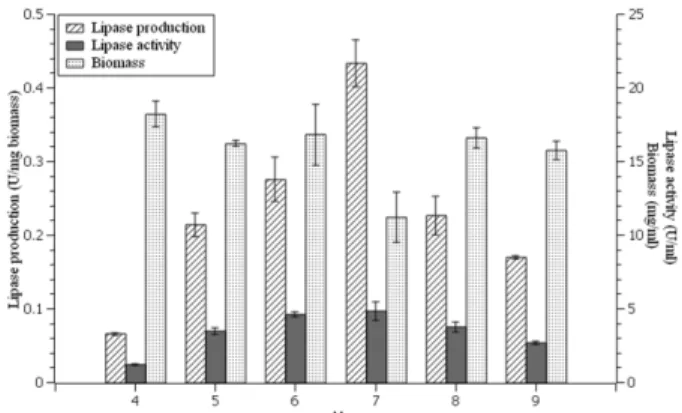
Effect of pH on lipase production. The effect of pH on the lipase production of Ms.11 was tested using medium containing olive oil 1% + glucose 1% at pH 4−9. The culture incubated with 200 rpm shaking at room tem- perature for 96 h. Lipase activity (U/ml), biomass (mg/
ml) and lipase production (U/mg biomass) can be seen in Fig. 4. The result shows that high lipase activity was found in slightly acidic conditions to neutral. Ms.11 pro- duces high lipase activity at pH 6 and 7, 4.59± 0.17 U/ml and 4.83± 0.62 U/ml, respectively. Based on ratio between lipase activity and biomass, lipase production at pH 7 gives the highest productivity (0.43± 0.03 U/mg Fig. 2. Phylogenetic tree of isolate Ms.11 using MEGA 6 program with Neighbor-Joining method and 1000 replication (bootstrap).
Fig. 3. Lipase activity, biomass, and lipase production of Ms.11 on different carbon source. Incubation at room tem- perature for 96 h with 200 rpm shaking.
Fig. 4. Lipase activity, biomass, and lipase production of Ms.11 at different pH using medium containing olive oil 1%
+ glucose 1%. Incubation at room temperature for 96 h with 200 rpm shaking.
biomass) and significantly different (p < 0.05) with other pH. The production in other pH gave much lower results.
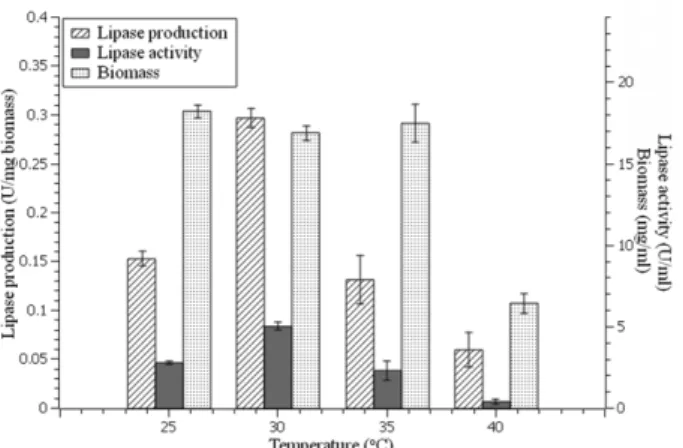
Effect of temperature on lipase production. The effect of temperature on the lipase production of Ms.11 was tested using medium containing olive oil 1% + glucose 1% which was adjusted to pH 7. The culture incubated with 200 rpm agitation at 25−40℃ for 96 h. Lipase activity (U/ml), biomass (mg/ml) and lipase production (U/mg biomass) can be seen in Fig. 5. Among the tested temperatures, Ms.11 produces the highest lipase activity at 30℃ (5.00 ± 0.25 U/ml) while 40℃ gave the lowest activity (0.39± 0.15 U/ml). Furthermore, Fig. 5 shows that optimum lipase production 0.30± 0.01 U/mg bio- mass) was found at 30℃ and significantly different (p < 0.05) with other temperatures.
Effect of incubation period on lipase production. The effect of incubation period on the lipase production of Ms.11 was tested using medium containing olive oil 1%
+ glucose 1% which was adjusted to pH 7. The culture incubated with 200 rpm shaking at 30℃ for 168 h. Bio- mass and lipase activity were determined every 24 h.
Fig. 6 shows that high lipase activity was produced after incubation for 96 and 120 h, 5.13± 0.30 U/ml and 5.22± 0.59 U/ml, respectively. Optimum lipase produc- tion (0.31± 0.02 U/mg biomass) was found after 96 h and stable until 120 h (0.30± 0.04 U/mg biomass). After
120 h incubation period, lipase production begins to decrease until 168 h of incubation period (0.05± 0.001 U/
mg biomass) due to the decline of lipase activity and the increase of biomass.
Enzyme characterization
Effect of pH on lipase activity. The effect of pH on lipase activity was measured at various pH of solution enzyme ranging from 3 to 9. Fig. 7 shows that lipase tends to be active under slightly acidic conditions to neutral. Opti- mum lipase activity (7.09± 0.61 U/mg protein) was found at pH 7 using phosphate buffer and significantly different (p < 0.05) with other pH.
Effect of temperature on lipase activity. The effect of Fig. 5. Lipase activity, biomass, and lipase production of
Ms.11 at different temperature using medium containing olive oil 1% + glucose 1% at pH 7 and 96 h incubation time with 200 rpm shaking.
Fig. 6. Lipase activity, biomass, and lipase production of Ms.11 using medium containing olive oil 1% + glucose 1%
at pH 7. Incubation at 30℃ with 200 rpm shakingfor 168 h and harvested every 24 h.
Fig. 7. Activity of Ms. 11 lipase at various reaction pH. The pH of enzyme solution was adjusted using different buffers (citrate buffer for pH = 3-5, phosphate buffer for pH = 5-7 and borate buffer for pH = 7-9). Same letters indicate not signifi- cantly different according to Duncan’s test (α = 0.05).
temperatures was determined by assaying lipase activ- ity at different temperatures (20−40℃). The pH of enzyme solution was 7 using phosphate buffer. Opti- mum lipase activity was found at 30℃ and significantly different (p < 0.05) with other temperatures. Fig. 8 shows that lipase activity increases at reaction tempera- ture 20 to 30℃ and then decreases until the temperature reach 40℃ (1.37 ± 0.16 U/mg). Optimum activity of lipase from Ms.11 occurs at 30℃ corresponds to opti- mum lipase production at 30℃.
Effect of alcohol on lipase activity. The effect of alcohol on lipase activity was performed by using methanol, eth- anol, and n-butanol as substrates in esterification reac-
tion. Lipase activity was assayed at optimum pH and temperature. Fig. 9 shows the highest to the lowest enzyme activity was found in ethanol, methanol, and n- butanol, respectively. However, methanol and ethanol have similar specific activities, 5.17± 0.47 and 5.78 ± 0.33 U/mg, respectively. On the other hand, lipase activ- ity in the reaction using butanol is significantly different (p < 0.05) than the others.
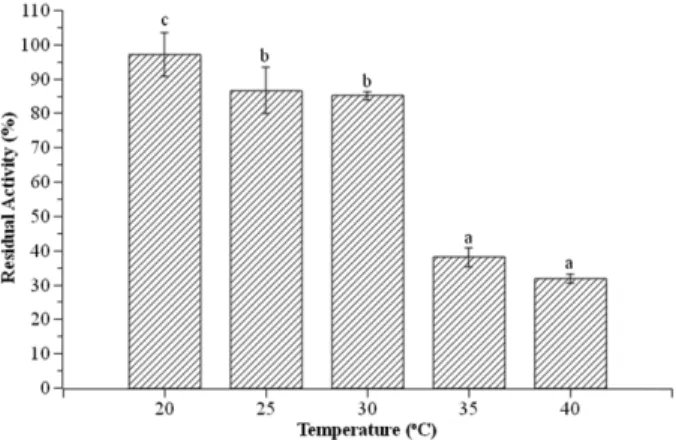
Effect of temperature on lipase stability. The effect of temperature on lipase stability was done by incubating enzyme solution at 20−40℃ for 1 h. Then, lipase activity was assayed at optimum pH and temperature. Fig. 10 shows that lipase is able to maintain its activity >85%
after 1 h incubation at temperature of 20−30℃. How- ever, lipase can only maintain its activity <40% after 1 h incubation at temperature of 35−40℃.
Discussion
There are five lipase-producing filamentous fungi obtained from non-dairy creamer industrial waste and the highest lipase production is isolate Ms.11. Ms.11 is a member of Aspergillus aculeatus group based on molecu- lar identification using sequence analysis of Internal Transcribed Spacer (ITS). The region of Internal Tran- scribed Spacer (ITS) is known as a universal DNA bar- code for fungi [23] and has been determined as the main barcode for molecular identification of fungi [24]. Fur- Fig. 8. Ms. 11 lipase activity at various temperatures (20,
25, 30, 35 and 40℃). The reaction using phosphate buffer pH 7 as enzyme solution. Same letters indicate not significantly dif- ferent according to Duncan’s test (α = 0.05).
Fig. 9. Activity of Ms. 11 lipase using different alcohols as substrate (methanol, ethanol and n-butanol). Same letters indicate not significantly different according to Duncan’s test (α = 0.05).
Fig. 10. Stability of Ms.11 lipase at various temperatures (20, 25, 30, 35 and 40℃) with 1 h preincubation. The reac- tion was done at 30℃ using phosphate buffer pH 7 as enzyme solution. Same letters indicate not significantly different according to Duncan’s test (α = 0.05).
thermore, the sequence variation of ITS regions has led to their use in phylogenetic studies of many different organisms [9].
Aspergillus aculeatus belongs to niger group [25].
Aspergillus aculeatus is known for its ability to produce β-glucosidase (specific activity ≥180 U/mg) which is higher than other fungi [26]. Aspergillus aculeatus spe- cies is generally found in soil and the fungus can act as phosphate-solubilizing fungus [27], as well as producing several types of enzymes, such as pectinase [28], ligno- cellulose-degrading enzymes [29], carboxymethyl cellu- lase and xylanase [30]. Roy et al. [31] obtained lipase- producing Aspergillus aculeatus from soil contaminated dairy waste with optimum hydrolysis activity of 9.51 U/
ml. However, the esterification activity of lipase from Aspergillus aculeatus has not been determined.
Aspergillus aculeatus Ms.11 produced the highest lipase production (0.44± 0.03 U/mg biomass) after 96 h incubation using medium containing 0.5% olive oil and 0.5% glucose. This lipase production was higher than that reported by Adham and Ahmed [16] where Asper- gillus niger NRRL3 had lipase production 0.37 U/mg biomass after 96 h incubation using the same medium.
Ms. 11 needed glucose as an initial nutrient for cell growth and would produce high amounts of lipase after glucose was depleted. Mucor griseocyanus grown on medium containing glucose and coconut oil produced the highest lipase on the 3rd day after glucose in the medium run out [32].
Increasing the concentration of carbon sources in the medium from glucose 0.5% + olive oil 0.5% to glucose 1%
+ olive oil 1% made the lipase production (the ratio between lipase activity (U/ml) and biomass (mg/ml)) of Ms.11 decreased due to increased biomass. However, the increased concentration of the carbon source caused an increase in lipase activity from 3.76± 0.20 to 4.74 ± 1.42 U/ml. Adham and Ahmed [16] reported that an increase in carbon source from 1% glucose + olive oil to 2% glucose + olive oil can increase lipase activity of Aspergillus niger NRRL3. Moreover, lipase is inducible enzymes and generally produced in the presence of lipid as inducers, such as animal fat and vegetable oil [33].
Lipase production will increase if suitable inducer is added to the growth medium of microorganisms. Olive oil is one of the best inducers in lipase production [12, 33].
pH and temperature are abiotic factors that signifi- cantly affect the production of microbial enzymes. Berto et al. [7] stated that the optimum pH for lipase produc- tion was dependent on the fungal species. According to our result, maximum lipase production of Ms.11 was obtained on neutral pH and corresponded to El-Ghonemy et al. [34] that optimum lipase production of Curvularia sp. DHE 5 was found at pH 7. Furthermore, the result showed that lipase activity of Ms.11 in pH 7 at room temperature (4.83± 0.62 U/ml) was lower than 30℃
(5.00± 0.25 U/ml). Other filamentous fungi known to produce optimum lipase at 30℃ were Penicillum chrysogenum [35] and Aspergillus fumigatus MTCC 9657 [36]. In addition, biomass of Ms.11 in pH 7 at 30℃ also increased compared to room temperature. Tempera- ture required for lipase production corresponds with the conditions of microorganisms growth [37]. Lipase-pro- ducing microorganisms are generally mesophilic, grow- ing at temperatures between 25−40℃ [38].
Ms.11 growth for 168 h (7 days) incubation formed diauxic curve, as a response to two types of carbon sources in the medium [39] and a form of adaptation to maximize the growth of microorganisms in a multi- nutrient environment [40]. In this study, glucose and olive oil were used as carbon source. The diauxic curve is a combination of two microorganism growth curves. The first curve shows the use of the first carbon source, glucose, and the second curve shows the use of the sec- ond carbon source, olive oil, after glucose has depleted.
Glucose is a simpler molecule than olive oil so it can be directly absorbed by microbes as a carbon source. Fig. 6 showed the increase of biomass and lipase activity from 24 to 72 h of incubation. Then, biomass decreased after 96 h indicating a second lag phase as well as a shift to the second growth curve [40]. The highest lipase activity was found at 96 and 120 h of incubation which showed high olive oil utilization as a second carbon source. In addition, maximum lipase activity indicated that glucose in the medium has been used up [32].
pH is one of the important factors that influence enzyme activity. Enzymes have certain pH condition when they are most active [41]. According to our result, lipase from Ms.11 has optimum activity at pH 7. Ibrahim et al. [42] found that pH 7 was the optimum condition for Humicola lanuginosa lipase activity, however, Aspergillus niger J-1 [43] and A. niger NCIM 1207 [44] had optimum
activity under acidic conditions, pH 6 and 3, respec- tively. Decreased lipase activity can occur due to dena- turation processes caused by change of environmental pH [45]. Negative and positive charged amino acid will interact to form ionic bond (salt bridge) which is one of the supporting bonds that form tertiary structure of enzymes. Extreme pH will break the ionic bonds by changing amino acid charge and producing a repulsive force. This will make enzyme structure unfolded and lead to change of conformity and lack of catalytic proper- ties of enzyme [41, 45]. Furthermore, enzyme properties correlated to its source. Optimum activity of lipase from Ms.11 occurred at neutral condition corresponded to optimum lipase production at neutral condition as well.
Temperature is also one of the important factors that influence enzyme activity. The result showed that lipase from Ms.11 has optimum activity at 30℃. Rajeswari et al. [35] and Pera et al. [46] reported that lipase from Penicillum chrysogenum and Aspergillus niger MYA 135 reached maximum activity at 30℃. High temperatures will disrupt the three-dimensional structure of enzymes then enzymes are denatured and lose their catalytic properties [41]. Moreover, enzyme properties correlated to its source. Optimum activity of lipase from Ms.11 occurred at 30℃ corresponded to optimum lipase pro- duction at 30℃ as well.
Lipase has alcohol specificity for the best esterification result. The result showed that lipase from Ms.11 has the best result using methanol and ethanol. Lipase from Rhizomucor miehei showed the best results using buta- nol, whereas lipases from Thermomyces lanuginosus showed the best results using ethanol and butanol [47].
Bernardes et al. [48] and Lotti et al. [49] mentioned that lipase can catalyze transesterification reaction in bio- diesel production using triglycerides and short chain alcohols, methanol and ethanol. Alcohol acts as a sub- strate for esterification or transesterification, however, alcohol is also a denaturing agent for protein or enzyme [50]. Low activity of lipase in n-butanol treatment might occur due to the sensitivity of the enzyme to n-butanol.
Aspergillus niger MYA 135 lipase was more stable in methanol and ethanol exposure and able to maintain 100% of its enzymatic activity, while n-butanol exposure can reduce enzymatic activity up to 40% [46] and even lose all of its enzymatic activity [51].
Lipase from Ms.11 is quite susceptible to tempera-
tures above 30℃. According to the result, the lipase loses 60% of its activity after being exposed at 35−40℃ for 1 h.
Temperature 30℃ is the optimum lipase activity, how- ever, exposure at 30℃ for 1 h is considered hot and can damage bonds forming tertiary structure and lead to decrease activity. Adham and Ahmed [16] proved that Aspergillus niger NRRL3 lipase was able to maintain
>80% of its activity after 1 h incubation at temperature of 20−40℃ and its activity decreased significantly after 1 h incubation at 60℃. It indicated that each enzyme has different temperature stability which is influenced by the supporting bonds in the enzyme molecule.
We successfully obtained lipase-producing filamentous fungi from non-dairy creamer industrial waste. Isolate producing the highest amount lipase was Ms.11 which identified as Aspergillus aculeatus based on Internal Transcribe Spacer (ITS) sequence. Lipase from Ms.11 was inducible enzyme and had the best esterification reaction using short chain alcohol, methanol and etha- nol, which used in biodiesel industry. Further study to assay transesterification activity using different oil as substrate is needed. Moreover, optimization of lipase production is required to make the strain suitable for lipase industry.
Acknowledgments
This study was partly supported by the RTA program of Universitas Gadjah Mada (nr. 3002/UN1/DITLIT/DIT-LIT/LT/2019). We also thank to PT. Kievit Indonesia for providing us with sample.
Conflict of Interest
The authors have no financial conflicts of interest to declare.
References
1. Abdelmonaem M, Hatem B, Imen G, Jeannette BH. 2010. Classifi- cation of EC 3.1.1.3 bacterial true lipases using phylogenetic analysis. Afr. J. Biotechnol. 9: 8243-8247.
2. Singh AK, Mukhopadhyay M. 2012. Overview of fungal lipase: A review. Appl. Biochem. Biotechnol. 166: 486-520.
3. Ponnarasy G, Khan MdMR, Kalam MdA, Mahmud MS. 2014. Light induced esterification of oleic acid catalyzed by Pseudomonas Cepacia Lipase. Int. J. Environ. Sci. Dev. 5: 344-346.
4. Hassan MHj, Kalam MdA. 2013. An Overview of biofuel as a renewable energy source: development and challenges. Procedia Eng. 56: 39-53.
5. Gupta R, Gupta N, Rathi P. 2004. Bacterial lipases: an overview of production, purification and biochemical properties. Appl.
Microbiol. Biotechnol. 64: 763-781.
6. Shreya, Sharma AK, Sharma V, Saxena J. 2018. Isolation and screening of lipolytic soil fungi. Int. J. Pharm. Biol. Sci. 8: 391-396.
7. Berto P, Belingheri L, Dehorter B. 1997. Production and purifica- tion of a novel extracellular lipase from Alternaria brassicicola.
Biotechnol. Lett. 19: 533-536.
8. Gopinath SCB, Hilda A, Anbu P. 2005. Extracellular enzymatic activity profiles in fungi isolated from oil-rich environments.
Mycoscience 46: 119-126.
9. Sadati R, Barghi A, Larki RA. 2015. Isolation and screening of lipo- lytic fungi from coastal waters of the southern caspian sea (North of Iran). Jundishapur J. Microbiol. 8: 1-7.
10. Rihani A, Tichati L, Soumati B. 2018. Isolation and identification of lipase- producing fungi from local olive oil manufacture in East of Algeria. Chem Chem. Eng. Biotechnol. Food Ind. 19: 13-22.
11. Nwuche CO, Ogbonna JC. 2011. Isolation of lipase producing fungi from palm oil Mill effluent (POME) dump sites at Nsukka.
Braz. Arch Biol. Technol. 54: 113-116.
12. Sharma R, Chisti Y, Banerjee UC. 2001. Production, purification, characterization, and applications of lipases. Biotechnol. Adv. 19:
627-662.
13. Rosida DF, Mulyani T, Septalia LR. 2016. A comparative study of non-dairy cream based on the type of leguminosae protein source in terms of physico chemical properties and organoleptic.
Agric. Agric. Sci. Procedia. 9: 431-439.
14. Lee LP, Karbul HM, Citartan M, Gopinath SCB, Lakshmipriya T, Tang T-H. 2015. Lipase-Secreting Bacillus Species in an oil-con- taminated habitat: promising strains to alleviate oil pollution.
BioMed. Res. Int. 2015: 1-9.
15. Gohel V, Singh A, Vimal M, Ashwini P. 2006. Bioprospecting and antifungal potential of chitinolytic microorganisms. Afr. J.
Biotechnol. 5: 54-72.
16. Adham NZ, Ahmed EM. 2009. Extracellular lipase of Aspergillus niger NRRL3; production, partial purification and properties.
Indian J. Microbiol. 49: 77-83.
17. Lima LGR, Gonçalves MMM, Couri S, Melo VF, Sant’Ana GCF, Costa ACA da. 2019. Lipase production by Aspergillus niger C by sub- merged fermentation. Braz. Arch Biol Technol. 62: 1-14.
18. Kwon DY, Rhee JS. 1986. A simple and rapid colorimetric method for determination of free fatty acids for lipase assay. J. Am. Oil Chem. Soc. 63: 89-92.
19. Ilmi M, Hidayat C, Hastuti P, Heeres HJ, van der Maarel MJEC.
2017. Utilisation of Jatropha press cake as substrate in biomass and lipase production from Aspergillus niger 65I6 and Rhizomucor miehei CBS 360.62. Biocatal. Agric. Biotechnol. 9: 103-107.
20. Arya A, Kumar A, Jha J. 2018. Understanding Enzymes: An Intro- ductory Text. Drawing Pin Publishing, New Delhi, India.
21. Lowry OH, Rosebrough NJ, Farr AL, Randall RJ. 1951. Protein measurement with the Folin phenol reagent. J. Biol. Chem. 193:
265-276.
22. Raja HA, Miller AN, Pearce CJ, Oberlies NH. 2017. Fungal identifi-
cation using molecular tools: A primer for the natural products research community. J. Nat. Prod. 80: 756-770.
23. Mahmoud AGY, Zaher EHF. 2015. Why nuclear ribosomal internal transcribed spacer (ITS) has been selected as the DNA barcode for fungi? Adv. Genet. Eng. 04: 1-2.
24. Begerow D, Nilsson H, Unterseher M, Maier W. 2010. Current state and perspectives of fungal DNA barcoding and rapid iden- tification procedures. Appl. Microbiol. Biotechnol. 87: 99-108.
25. Silva DM, Batista LR, Rezende EF, Fungaro MHP, Sartori D, Alves E.
2011. Identification of fungi of the genus Aspergillus section nigri using polyphasic taxonomy. Braz. J. Microbiol. 42: 761-73.
26. Molina G, Contesini FJ, de Melo RR, Sato HH, Pastore GM. 2016. β- Glucosidase from Aspergillus. pp. 155-169. New and Future Developments in Microbial Biotechnology and Bioengineering.
27. Yin Z, Fan B, Roberts D, Chen S, Shi F, Buyer J, et al. 2017. Enhance- ment of maize growth and alteration of the rhizosphere micro- bial community by phosphate-solubilizing fungus Aspergillus aculeatus P93. J. Agric. Biotechnol. 2: 1-10.
28. de Oliveira RL, da Silva OS, Converti A, Porto TS. 2018. Thermody- namic and kinetic studies on pectinase extracted from Aspergil- lus aculeatus: Free and immobilized enzyme entrapped in alginate beads. Int. J. Biol. Macromol. 115: 1088-1093.
29. Suwannarangsee S, Arnthong J, Eurwilaichitr L, Champreda V.
2014. Production and characterization of multi-polysaccharide degrading enzymes from Aspergillus aculeatus BCC199 for sac- charification of agricultural residues. J. Microbiol. Biotechnol. 24:
1427-1437.
30. Boonmee A. 2012. Hydrolysis of various thai agricultural bio- masses using the crude enzyme from Aspergillus aculeatus iizuka FR60 isolated from soil. Braz. J. Microbiol. 43: 456-466.
31. Roy M, Kumar R, Ramteke A, Sit N. 2018. Identification of lipase producing fungus isolated from dairy waste contaminated soil and optimization of culture conditions for lipase production by the isolated fungus. J. Microbiol. Biotechnol. Food Sci. 8: 698-704.
32. Armas JC, Mendoza JCD, Hernández JLM. 2008. Mucor griseocy- anus lipase: production, characterization and study of some cat- alytic properties of the Immobilized Enzyme. Food Technol.
Biotechnol. 46: 195-201.
33. Silva OBW, Mitidieri S, Schrank A, Vainstein MH. 2005. Production and extraction of an extracellular lipase from the entomopatho- genic fungus Metarhizium anisopliae. Process Biochem. 40: 321- 326.
34. El-Ghonemy DH, El-Gamal M, Tantawy AE, Ali TH. 2017. Extracel- lular alkaline lipase from a novel fungus Curvularia sp. DHE 5:
optimization of physicochemical parameters, partial purification and characterization. Food Technol. Biotechnol. 55: 206-217.
35. Rajeswari T, Palaniswamy M, Rose BS, Shyni PM, Padmapriya B.
2011. Biosynthesis of novel alkaline lipase production from Peni- cillum Chrysogenum suitable for detergent formulation. Res. J.
Pharm. Biol. Chem. Sci. 2: 128-141.
36. Rajan A, Nair AJ. 2011. A comparative study on alkaline lipase production by a newly isolated Aspergillus fumigatus MTCC 9657 in submerged and solid-state fermentation using economically
and industrially feasible substrate. Turk. J. Biol. 569-574.
37. Salihu A, Alam Z. 2012. Production and applications of microbial lipases: A review. Sci. Res. Essays. 7: 2667-777.
38. Ayinla ZA, Ademakinwa AN, Agboola FK. 2017. Studies on the optimization of lipase production by Rhizopus sp. ZAC3 isolated from the contaminated soil of a palm oil processing shed. J. Appl.
Biol. Biotechnol. 5: 30-37.
39. Wang X, Xia K, Yang X, Tang C. 2019. Growth strategy of microbes on mixed carbon sources. Nat. Commun. 10: 1279.
40. Chu D, Barnes DJ. 2016. The lag-phase during diauxic growth is a trade-off between fast adaptation and high growth rate. Sci. Rep.
6: 25191.
41. Robinson PK. 2015. Enzymes: principles and biotechnological applications. Essays Biochem. 59: 1-41.
42. Ibrahim CO, Hayashi M, Nagai S. 1987. Purification and some properties of a thermostable lipase from Humicola lanuginosa No. 3. Agric. Biol. Chem. 51: 37-45.
43. Falony G, Armas JC, Mendoza JCD, Hernández JLM. 2006. Produc- tion of extracellular lipase from Aspergillus niger by solid-state fermentation. Food Technol. Biotechnol. 44: 235-240.
44. Mahadik ND, Puntambekar US, Bastawde KB, Khire JM, Gokhale DV. 2002. Production of acidic lipase by Aspergillus niger in solid state fermentation. Process Biochem. 38: 715-721.
45. Kishore D, Kundu S, Kayastha AM. 2012. Thermal, chemical and
pH induced denaturation of a multimeric β-Galactosidase reveals multiple unfolding pathways. PLoS One. 7: e50380.
46. Pera LM, Romero CM, Baigori MD, Castro GR. 2006. Catalytic properties of lipase extracts from Aspergillus niger. Food Technol.
Biotechnol. 44: 247-252.
47. Rodrigues RC, Volpato G, Wada K, Ayub MAZ. 2008. Enzymatic synthesis of biodiesel from transesterification reactions of vege- table oils and short chain alcohols. J. Am. Oil Chem. Soc. 85: 925- 930.
48. Bernardes OL, Bevilaqua JV, Leal MCMR, Freire DMG, Langone MAP. 2007. Biodiesel fuel production by the transesterification reaction of soybean oil using immobilized lipase. Appl. Biochem.
Biotechnol. 7: 105-114.
49. Lotti M, Pleiss J, Valero F, Ferrer P. 2015. Effects of methanol on lipases: Molecular, kinetic and process issues in the production of biodiesel. Biotechnol. J. 10: 22-30.
50. Herkovits TT, Gadegbeku B, Jaillet H. 1970. On the structural sta- bility and solvent denaturation of proteins. J. Biol. Chem. 245:
2588-2598.
51. Romero CM, Pera LM, Loto F, Vallejos C, Castro G, Baigori MD.
2012. Purification of an organic solvent-tolerant lipase from Aspergillus niger MYA 135 and its application in ester synthesis.
Biocatal. Agric. Biotechnol. 1: 25-31.