Treatment of Chronic Myofascial Pain with Botulinum Toxin : Case Report
Seong-Ju Hong, D.D.S., Chang-Lyuk Yoon, D.D.S.,M.S.D, h.D., Jong-Mo Ahn, D.D.S.,M.S.D.,Ph.D., Ji-Won Ryu, D.D.S.,M.S.D.
Department of Oral medicine, School of Dentistry, Chosun University
MyoFascial Pain Syndrome(MFPS) is defined as a regional pain syndrome characterized by muscle pain caused by myofascial trigger points (MTrPs). Myofascial pain is a common cause of persistent regional pain such as neck pain, shoulder pain, headaches, and orofacial pain. Clinicians who deal with orofacial pain must also understand the role of myofascial pain.
This case report presents the treatment of botulinum toxin A for chronic myofascial pain.
Key words : Botulinum toxin A, Chronic pain, Myofascial pain, Orofacial pain
1)Ⅰ. INTRODUCTION
Myofascial pain syndrome(MFPS) is defined as a regional pain syndrome characterized by muscle pain caused by myofascial trigger points.1,2) It is a common dysfunction with a lifetime prevalence of up to 85% in the general population.3) Myofascial pain is a common cause of persistent regional pain such as neck pain, shoulder pain, headaches, and orofacial pain.4-7) The clinicians who deal with orofacial pain must understand the role of myofascial pain. It has been reported that approxi-
Corresponding author : Ji-Won Ryu
Department of Oral Medicine, Chosun University 421, School of Dentisty Seosuk-dong Dong-Gu, Gwang-Ju, 501-825
Tel: 062-220-3897 Fax: 062-234-2119
E-mail: [email protected] Received: 2010-05-21
Accepted: 2010-06-15
* This study was supported by research funds from Chosun University, 2009)
mately 50% of all temporomandibular disorders (TMDs) are masticatory myalgias or painful masticatory muscle disorders.8)
Treatment of masticatory MFPS may include pharmacologic therapy (Nonsteroidal anti- inflammatory drugs, muscle relaxants, tricyclic antidepressants, anxiolytics), occlusal appliance/
splint therapy, trigger point therapy (spray and stretch, injections), and physical therapy (mandibular exercises). Most of the treatment methods for MFPS are aimed to reduce the pain in trigger points and reduce muscle spasms. However, recurrence is frequent. Several clinical studies have demonstrated an overlap in nociceptive processing between the trigeminal and cervical systems.9,10) Nowadays, an analgesic effect for Botulinum toxin type A(BTXA) has been reported in animal studies.11-13) Human clinical trials also support an analgesic effect for botulinum toxins.14-18)
This case report presents the treatment of botulinum toxin A for chronic myofascial pain.
Ⅱ. CASE
A 31-year-old female patient visited the Department of Oral Diagnosis and Oral Medicine in the Chosun University, Dental Hospital, Gwang-ju, Korea, with a chief complaint of continuous pain in the both temporomandibular joint(TMJ) on May 10, 2006. The patient also complained of headache (bilateral temporal area) and shoulder pain.
She stated that spontaneous throbbing pain in the both TMJ, which was aggravated by mandibular movement, and joint sound had appeared following a unilateral chewing habit due to dental treatment 2 years before. In measuring pain intensity by visual analogue scale(VAS), her pain was 8.
The patient reported that pain attacks occurred 4~5 times/day, and persisted until she took analgesics.
The oral appliance was given at a local dental clinic on May 2005, and was worn all day long except for mealtimes.
The symptoms had improved somewhat with splint, but became progressively worse again after the treatment was completed.
Joint pain appeared with headache in both temporal regions, pain in neck and shoulder, and nasal congestion.
Because of the pain, she quit her job and was highly depressed.
In the orofacial pain evaluation, she reported daytime clenching, unilateral chewing(right side),
Fig. 1. The results of the head and neck muscle palpation(black dot: the area tender to palpation)
nail and cheek biting. There were no significant medical problems.
Her active/passive mouth opening length was 38/42 ㎜ each, with pain of both TMJ. Also there was limitation of jaw protrusion(4 ㎜) with pain of left masseteric region, and masseter muscle pain in the both sides during lateral excursion of mandible.
In head and neck muscle palpation, she had tenderness in both temporalis, masseter, TMJ, retrodiscal area, right trapezius, and left sternocleidomastoideus muscle area.(Fig. 1) But there were no specific findings on radiographic examination.
When all above signs and symptoms were considered, the TMJ arthralgia and myalgia were diagnosed temporally. Patient education and physical therapy were practiced, also nonsteroidal anti-inflammatory drugs(nabumetone 500 mg b.i.d) and tricyclic antidepressants(amitriptyline 10 ㎎ hs) were prescribed for 3 weeks.
After 3 weeks, she said that medication was effective for her pain, but temporary.
Medication and stabilization-splint treatment were applied after myofascial pain syndrome (MFPs) was diagnosed, but there was no observable change in the patient's condition.
After the patient had given informed consent, Botulinum toxin type A(BTXA) treatment(Botox®, Allergan Inc, Irvine, California; both superficial masseter, each 25 units) was begun on September 8, 2006.(Fig. 2)
Fig. 2. First and second injection sites: Masseter muscles
In the 1-month follow up after BTXA treatment, she reported that her pain was relieved, especially continous pain. However, her pain reappeared after 3 months in botulinum toxin treatment area.
Therefore, a second injection of BTXA was given.
At the 1-month follow up after the second injection, she stated that her pain was entirely relieved.
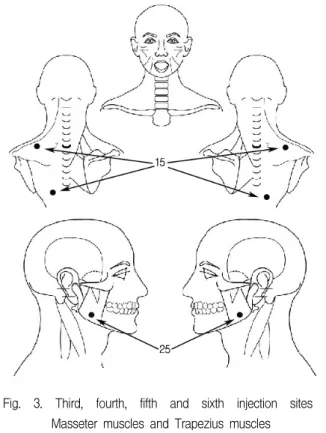
However, 3 months later, she complained her pain had returned, and she felt that her facial pain was accompanied by shoulder pain. A third injection was considered and given, and at that time, both sides of the trapezius muscle area were also injected.(Fig. 3) She did not visit our clinic for 5 months, then there were a 4th, 5th, and 6th injection at the same site. Figure 4 shows the pain intensity.
The mean duration of BTX efficacy is 3, 4, 5, 7, 16 months, in order. Since the final injection, she has not returned to the Department of Oral Diagnosis and Oral Medicine.
Fig. 3. Third, fourth, fifth and sixth injection sites : Masseter muscles and Trapezius muscles
Fig. 4. The pain intensity followed by treatment (VAS: Visual Analogue Scale)
Ⅲ. DISCUSSION
Steinder19) first used the term myofascial in 1940 when describing a radiating pain in the lower back.
The prevalence of musculoskeletal pain identified as myofascial pain is considered to be 37% in males and 65% in females.20) Travell and Simons21) have defined myofascial pain as pain and/or autonomic phenomena referred from active trigger points
(TPs), with associated dysfunction. Pain is dull or achy and associated with autonomic changes such as sweating, lacrimation, flushing, and vasomotor and temperature changes.22,23)
We diagnosed her pain tentatively as TMJ arthralgia, and myalgia. This was because we did not find the referral pattern on muscle palpation.
However, considering the general circumstances, she reported headache associated TMDs symptoms, autonomic symptoms such as swelling, conjuctival injections. Also, she stated that her already existed shoulder pain was aggravated after TMD symptoms appeared. The reason why MFPS was not originially diagnosed was the absence of a referral pattern in the palpation test. This was probably due to the trigger points being in a latent state at that time. Graff-Radford SB20) stated in his review that the TPs may present clinically as either active or latent. When active, digital palpation produces pain referral to a distant site. When latent, palpation may be locally tender, but no referral occurs. Myofascial pain is not confined to one dermatomal, myotomal, or visceral division, but may spread outside these limits.
In general, patients with muscle pain complaints are commonly seen by clinicians treating pain, especially pain of musculoskeletal origin. If undiagnosed, the patients tend to be overinvestigated and undertreated, leading to chronic pain syndrome.24) It is very important for clinicians to find the active TPs in myofascial pain patients , because the success of the treatment is mainly dependent on finding the source of pain.
In this case, the first mode of treatment: the medication, was effective for pain. The visual analogue scale(VAS) dropped dramatically from 8 to 3 after the TCA prescription.(Fig.4) Also she mentioned that medication was effective not only for pain but also for autonomic symptoms.
Pharmacologic intervention for myofascial pain is sometimes essential to allow central nervous system inhibition and facilitate the peripheral therapies.20)
Antidepressants are thought to exert their
therapeutic action through changes in monoamine neurotransmitter activity.20) Most TCAs are broad in their action and are thought to have numerous functions. Sharav et al. 25) demonstrated the effects amitriptyline has in reducing myofascial pain.
In this case, we did not continue the pharmacologic treatment although the TCA medication was highly effective for pain. The patient was a fertile woman, so she wanted to change the treatment modality if there was an alternative therapy. So we changed the pharmacologic treatment to splint therapy.
In orofacial pain, splint treatment is highly effective for myofascial pain. A number of clinical studies have specifically evaluated the treatment of myofascial pain by stabilization splint(SS) therapy, and articles demonstrating clinical success have been published.26-28) The stabilization splint is a hard acrylic splint that provides a temporary and removable ideal occlusion. Providing an occlusion by the use of splint therapy reduces abnormal muscle activity and produces “neuromuscular balance.”29)
However, in this case, the stabilization splint treatment was not effective for pain. The patient complained of constant pain so that we prescibed the TCA medication. So the patient wanted the another treatment if one existed.
Since the first reports on the possible antinociceptive effect after Botulinum neurotoxin injections 30,31), three mechanisms have been suggested to support this effect: neuromuscular block at the level of SNARE proteins; inhibition of nociceptive pathways by modulating the release of calcitonin gene-related peptide (CGRP), substance P (SP) both peripherally and centrally etc.; and an effect on the vascular circulation.
The recent review32) of the Botulinum toxin for pain suggested that Botulinum toxins are effective in myofascial pain syndrome, neuropathic pain, and joint pain.
In the botulinum toxin treatment, the pain was dramatically decreased. However, in the first and second injection of the botulinum toxin treatment,
the period between injections was relatively short.
Considering the unsuccessful splint treatment and the 1st and 2nd injection of the botulinum toxin, the true source of the pain in this case may not have been in the orofacial area. In the third injection of the botulinum toxin treatment, we added a second injection site: both sides of the trapezius .(Fig. 3) We could not follow-up on the patient because the patient did not visit our clinic regulary.
However, with reference to the patient's statement in return-visits for additional injections, the trapezius injection was effective for pain. We injected her 6 times, in total. As far as we know, this is the first case report on myofascial pain treated with repeated BTXA injections.
The clinicians who deal with orofacial pain have a tendency to focus on the pain in the orofacial area. However, several clinical studies have demonstrated an overlap in nociceptive processing between the trigeminal and cervical systems.33-35) Nociceptive information from the trigeminal and cervical territories activates the neurons in the trigeminal nucleus caudalis that extend to the C2 spinal segment and lateral cervical nucleus in the dorsolateral cervical area.36) These neurons are classified as multimodal because they receive sensory information from more than one afferent type. Clinically, trigeminal activation produces symptoms in the trigeminal and cervical territory and cervical activation produces symptoms in the cervical and trigeminal territory. In this case, botulinum toxin injection to the trapezius muscle was effective for pain not only in the orofacial area but also in the cervical area. Therefore, clinicians should consider the role of the cervical area relating to the treatment of the chronic orofacial pain.
REFERENCES
1. Hong CZ, Simons DG. Pathophysiologic and electro- physiologic mechanism of myofascial trigger points.
Arch Phys Med Rehabil 1998;79:863–872.
2. Simons DG, Travell JG, Simons LS. Travell &
Simons’s Myofascial Pain and Dysfunction: The Trigger Point Manual. 2nd edi., Baltimore, 1999,
Williams & Wilkins, pp. 11-86.
3. Fleckenstein J, Zaps D, Ruger LJ, et al. Discrepency between prevalence and perceived effectiveness of treatment methods in myofascial pain syndrome:
Results of a cross-sectional, nationwide survey. BMC Musculoskelet Disord 2010;11:32–41.
4. Svensson P, List T, Hector G. Analysis of stimulus- evoked pain in patients with myofascial temporoman- dibular pain disorders. Pain 2001;92:399-409.
5. Fricton JR, Kroening R, Haley D, Siegert R.
Myofascial pain syndrome of the head and neck: a review of clinical characteristics of 164 patients. Oral Surg Oral Med Oral Pathol 1985;60:615-623.
6. Fricton JR. Myofascial pain: clinical characteristics and diagnostic criteria. J Musculoskel Pain 1993;1:
37-47.
7. Han SC, Harrison P. Myofascial pain syndrome and triggerpoint management. Reg Anesth 1997;22:89–
101.
8. Stohler CS. Masticatory myalgias. In Oral and Maxillofacial Surgery. Temporomandibular Disorders.
Philadelphia, 2000, WB Saunders, pp.38–45.
9. Piovesan EJ, Werneck LC, Teive HA, et al.
Neurophysiology of pain in tentorial irritation:
description of a case secondary to medulloblastoma.
Arq Neuropsiquiatr 1998;56:677-682.
10. Hutchinson PJ, Pickard JD, Higgins JN. Vertebral artery dissection presenting as cerebellar infarction. J Neurol Neurosurg Psychiatry 2000;68:98–99.
11. Aoki KR. Review of a proposed mechanisms for the antinociceptive action of botulinum toxin type A.
NeuroToxicology 2005;26:785–793.
12. Rand J, Whaler BC. Impairment of sympathetic transmission by Botulinum toxin. Nature 1965;206:588 –591.
13. Filippi GM, Errico P, Santarelli R, Bagolini B, Manni E. Botulinum A toxin effects on rat jawmuscle spindles. Acta Otolaryngol 1993;113:400–404.
14. Jankovic J, Tintner R. Botulinum toxin for the treatment of cervical dystonia. Expert Opinion 2001;2:1985–1994.
15. Babcock MS, Foster L, Pasquina P, Jabbari B.
Treatment of pain attributed to plantar fasciitis with Botulinum toxin A: A short-term, randomized, placebo-controlled, double-blind study. Am J Phys Med Rehabil 2005;84:649–654.
16. Abbott JA, Jarvis SK, Lyons SD, Thompson A, Vancaille TG. Botulinum toxin type A for chronic pain and pelvic floor spasm in women: A randomized
controlled trial. Obstet Gynecol 2006;108:915–923.
17. Silberstein S, Mathew N, Saper J, Jenkins S.
Botulinum toxin type A as a migraine preventive treatment. For the BOTOX Migraine Clinical Research group. Headache 2000;40:445–450.
18. Foster L, Clapp L, Erickson M, Jabbari B. Botulinum toxin A and chronic low back pain. Neurology 2001;56:1290–1293.
19. Steinder A. The interpretation of the sciatic radiation and the syndrome of low back pain. J Bone Joint Surg 1940;22:28-34.
20. Graff-Radford SB. Regional myofascial pain syndrome and headache: principles of diagnosis and management. Curr Pain Headache Rep 2001;5(4):
376-381.
21. Travell JG, Simons DG. Myofascial Pain and Dysfunction: The Trigger Point Manual. Baltimore, 1983, Williams and Wilkins, pp 24-25.
22. Graff-Radford SB. Myofascial pain: diagnosis and management. Curr Pain Headache Rep 2004;8:
463-467.
23. Fricton JR, Kroening R, Haley D, Siegert R.
Myofascial pain syndrome of the head and neck: a review of clinical characteristics of 164 patients. Oral Surg Oral Med Oral Pathol 1985;60:615–623.
24. Majlesi J, Unalan H. Effect of treatment on trigger points. Curr Pain Headache Rep 2010;14(5):353-360.
25. Sharav Y, Singer E, Schmidt E, et al.: The analgesic effect of amitriptyline on severe facial pain. Pain 1987;31:199-203.
26. Tsuga K, Akagawa Y, Sakaguchi R, Tsuru H. A short-term evaluation of the effectiviness of stabilisation therapy for specific symptoms of temporomandibular joint dysfunction syndrome. J Prosthet Dent 1989;61:610-613.
27. Gray RJM, Davies SJ, Quale AA. A comparison of two splints in the treatment of TMJ myofascial pain:
can occlusal analysis be used to predict success of splint therapy? Br Dent J 1991;170:257-261.
28. Davies SJ, Gray RJM. The pattern of splint usage in the management of two common temporomandibular disorders. Part III: Long-term follow-up in an assessment of splint therapy in the management of disc displacement with reduction and pain dysfunction syndrome. Br Dent J 1997;183:279-283.
29. Al-Ani Z, Gray RJ, Davies SJ, Sloan P, Glenny AM.
Stabilization splint therapy for the treatment of temporomandibular myofascial pain: a systematic review. J Dent Educ 2005;69(11):1242-1250.
30. Brin MF, Fahn S, Moskowitz C, et al. Localized injections of botulinum toxin for the treatment of focal dystonia and hemifacial spasm. Adv Neurol 1988;50:599–608.
31. Tarsy D, First ER. Painful cervical dystonia: clinical features and response to treatment with botulinum toxin. Mov Disord 1999;14:1043–1045.
32. Qerama E, Fuglsang-Frederiksen A, Jensen TS. The role of botulinum toxin in management of pain: an evidence-based review. Curr Opin Anaesthesiol 2010;
23(5):602-610.
33. Kerr FW. A mechanism to account for frontal headache in cases of posterior fosse tumors. J Neurosurg 1961;18:605-609.
34. Piovesan EJ, Werneck LC, Teive HA, et al.
Neurophysiology of pain in tentorial irritation:
description of a case secondary to medulloblastoma.
Arq Neuropsiquiatr 1998;56:677-682.
35. Hutchinson PJ, Pickard JD, Higgins JN: Vertebral artery dissection presenting as cerebellar infarction. J Neurol Neurosurg Psychiatry 2000;68:98-99.
36. Piovesan EJ, Kowacs PA, Oshinsky ML. Convergence of cervical and trigeminal sensory afferents. Curr Pain Headache Rep 2003;7(5):377-83.
국문초록
보툴리눔 톡신을 이용한 만성 근막통증의 치료 증례
조선대학교 치과대학 구강내과학교실, 홍성주․안종모․윤창륙․유지원
근막통증은 발통점에 의해 야기되는 근육통을 특징으로 하는 전반적인 통증 증후군으로 정의될 수 있다. 근막통증은 경부 통, 견통, 두통 및 구강안면통증이 지속적으로 존재할 수 있는 흔한 원인이 될 수 있다. 구강안면통증을 치료하는 의사들은 근막통증이 구강안면통증에 기여하는 바에 대하여 이해하고 있어야 한다.
본 증례는 보툴리눔 톡신 A형을 이용한 만성 근막통증의 성공적인 치료에 대하여 보고하고자 한다.
주제어 : 근막통증, 보툴리눔 톡신 A형, 구강안면통증, 만성 통증