1. Introduction
We now live in the real and/or potential threat of war, especially the war against terrorism or the war for new imperialism, which has launched by the United States after the suicide attacks on the Twin Towers and the Pentagon in September 11, 2001 (9/11). Just after the 9/11 attack, an article in the Financial Times titled, ‘The Need for a new
Imperialism’, describes Afghanistan as a ‘failed state’ and the new imperialism as ‘defensive’ against such a ‘failed state’. The Chicago Sun-Times echoed this theme in a column headlined ‘Imperialism is the answer’.
It seems evident that the new imperialism of the Bush administration is not entirely the product of the post-Cold War era. Nor of course is it simply the result of political situation that has developed since
* This paper was presented at the closing plenary session of the 3rd meeting of the East Asian Regional Conference in Alternative Geography, held in Tokyo and Osaka, 5 - 9 August 2003.
** Professor, Major in Geography Education, Daegu University, Daegu, Korea, [email protected]
The New Imperialism, New Security Strategy of the U.S., and the Future of East Asia *
Byung-Doo Choi**
신제국주의, 미국의 신안보전략, 그리고 동아시아의 미래*
최 병 두**
Abstract : In this paper, we first understand the concept of imperialism as a ‘a dialectical relation between territorial and capitalistic logics of power’, as suggested by Harvey, and its history with three phases, the last of which would be seen as the phase of new imperialism. Secondly, we examine the New Security Strategy of the U.S which can be seen as a reflection of the new imperialism of the U.S. with its neo-conservative Bush administration, and explain the wars in Afghanistan and Iraq as the implementation of the new imperialism. And then we take a close look on the current geopolitical situation of East Asia, especially North and South Korea, Japan and China, in terms of the new imperialist foreign policy of the Bush administration. Finally, we consider the limits of the new imperialism of the U.S. and globally emerging movements of anti-imperialism.
Key Words : New imperialism, the new security strategy of the U.S., 9/11 terror, geopolitics of East Asia, movement of anti-imperialism.
요약: 이 논문에서, 우리는 우선 제국주의의 개념을 하비(Harvey)가 제안한 바와 같이‘권력의 영토적 논리와
자본주의적 논리 간의 변증법적 관계’로 이해하고, 그 역사를 3단계로 구분하여 마지막 단계가 바로 신제국주의
단계로 정의한다. 두 번째로 우리는‘미국의 신안보전략’을 신보수주의적 부시 행정부의 신제국주의를 반영한 것
으로 이해하고, 아프카니스탄과 이라크의 전쟁을 이러한 신제국주의의 수행으로 설명하고자 한다. 그리고 우리는 부시 행정부의 신제국주의적 해외정책이라는 점에서 동아시아, 특히 북한과 남한, 일본 그리고 중국의 현재적 지 정학적 상황에 대해 살펴보고자 한다. 끝으로 우리는 미국의 이러한 신제국주의가 내재하고 있는 한계들과 전지 구적으로 부상하고 있는 반제국주의 운동의 의의를 고찰한다.
주요어 : 신제국주의, 미국의 신안보전략, 9/11 테러, 이라크전쟁, 동아시아의 지정학, 반제국주의 운동
the terrorist massacre of 9/11. However, just as the Western economy has assumed a new global form in the globalisation of capital, so the emergent global political formation has taken a new shape of imperi- alism under the impact of the Bush administration’s response to 9/11.
The war against terrorism pursued for the new imperialism seems to be never-ending, as the impe- tus of globalisation of capitalist economy is ever- increasing. As the Bush administration declared that the war in Afghanistan was only the first round in the war against terrorism, and the second round has been already conducted in the war in Iraq. As with Afghanistan and Iraq, the Bush administration labels Iran and North Korea and other states as part of ‘axis of evil’. Thus there would be the third round, the forth, and so on.
The preparation of the U.S. for the next rounds either with mere threat or actual violence of latter countries would further strengthen both the new imperialism and the globalisation of capital. But at the same time, people in the globe, regardless where they live either in the U.S. or elsewhere, would be more depressed and more suffered from such situa- tion. How can we understand this situation? How can we overcome the new imperialism as well as global terrorism?
One of vital approaches in which we can see and overcome the current situation of the global terror- ism and the new imperialism must be critical geog- raphy or ‘critical’ geopolitics in particular. Critical geopolitics should engage with the new imperialism implied in the fundamental change in U.S. geopoliti- cal strategy, as for example Dodds(1993) and O Tuathail(1997) investigated the Gulf War and the conflict in Bosnia. Though Cohen(2003) wants to take ‘geopolitical realities and U.S. foreign policy’ in pursuit of the war on terrorism into consideration seriously, it is Harvey’s deeper insights on the New Imperialism(2003) that seem to be more helpful for us to see and overcome the current situation, as implied throughout this paper.
2. New Imperialism and its History
1) Concept of New Imperialism
In considering the new imperialism, we first need to define what is imperialism rather than what is
‘new’. Imperialism in a tentative manner can be defined as “a system by which the dominant power, through military conquest, colonization, or direct control of investment and trade, expropriates the land, natural resources, and labor of another people for its own enrichment.”
The term ‘imperialism’ however presents difficult because it has quite a number of meanings. In partic- ular, Lenin gave the term a very special meaning: he claimed that ‘imperialism’ was the next and final stage of capitalism. Though we all may be well aware of this definition, it seems clear that this is an unacceptable expropriation of a term widely used.
Thus it can be argued that “Imperialism is not a stage, not even the highest stage, of capitalism: from the beginning it is inherent in capitalism’s expan- sion”, as suggested by Samir Amin (Amin, 2001).
Wallterstein has echoed this definition: “imperialism is an integral part of the capitalist world-economy.
… It always will be there as long as we have a capi- talist world-economy (Wallerstein, 2003).”
Perhaps, we may agree with this kind of usage of the term. Imperialism has been inherent in capital- ism from the beginning. But the distinctive charac- ters of imperialism in each age and each region should not be ignored. “Different states produce dif- ferent imperialisms, as was obviously so with the British, French, Dutch, Belgian, etc.(Harvey, 2003).”
Thus we need to divide some phases of imperialism, and hence we can see what is ‘new’ in the current imperialism as one distinctive phase.
In considering the definition of the new imperial- ism, an other big problem is how to understand the relationship between economy and politics implied in the term. Neither Lenin nor Amin and Wallerstein examine carefully this problem, intermingling one to
the other.
In relation to this problem, Bamyeh(2000) points out that “it seemed abundantly clear that the entire logic of history could be anchored on the harmo- nious synchronization of the wheels of economy and politics, … However, it can be countered that this symbiosis between governance and specific econom- ic interests is contingent ….” Seen from this point of view, at the current phase of imperialism, one can detect the emergence of a new form of imperialism, an imperialism less attached to economic or other material interests than previous forms of imperial- ism, or than the traditional theory of imperialism has proposed.
One may agree with this kind of conception of new imperialism. As shown on the surface of the imperialist phenomena generated by the neo-conser- vative administration of Bush, it appears global power rather than specific material interests of eco- nomic groups or classes that justifies sui generis the new global order. But it seems to me more persua- sive to argue that transnational capital, including mercurial financial capital, needs a global state or imperialist strategy of states in order to transcend ter- ritorial boundaries of parochial sovereignties, than to say about contemporary capital’s own ability to do so through increasingly complicated schemes.
In his lectures given at the Oxford University just before the breakout of the Iraq war, Harvey talked about ‘new imperialism’ and edits them to publish at the end of this year (and hence now in a form of unpublished manuscripts). In this book, he wants to see “the current condition of global capitalism and the role that a ‘new’ imperialism might be playing within it”. Even for him, “Imperialism is a word that trips easily off the tongue. But it has such different meanings that it is difficult to use it without clarifica- tion as an analytic rather than polemical term.”
Harvey then defines “that special brand of it called ‘capitalist imperialism’ as a contradictory fusion of ‘the politics of state and empire’ (imperial- ism as a distinctively political project on the part of
actors whose power is based in command of a terri- tory and a capacity to mobilize its human and natur- al resources towards political, economic and military ends) and ‘the molecular processes of capital accu- mulation in space and time’ (imperialism as a dif- fuse political-economic process in space and time in which command over and use of capital takes pri- macy) (Harvey, 2003).”
With the former we see the political, diplomatic and military strategies invoked and used by a state (or a political power bloc) as it struggles to assert its interests and achieve its goals in the world at large that is, the territorial logics of politics, while with the latter, we examine the ways in which economic power flows across and through continuous space, towards or away from territorial entities through the daily practices of production, capital flows, labor migration, technology transfer, flows of information, cultural impulses, and the like, that is, the capitalistic logics of economy.
According to Harvey, capitalist imperialism arises out of ‘a dialectical relation between territorial and capitalistic logics of power’. The two logics are dis- tinctive and in no way reducible to each other, but they are tightly interwoven. The outcomes can vary substantially over space and time. “Each logic throws up contradictions that have to be contained by the other. The endless accumulation of capital, for example, produces periodic crises within the territo- rial logic because of the need to create a parallel accumulation of political/military power. When political control shifts within the territorial logic, flows of capital must likewise shift to accommodate.
States regulate their affairs according to their own distinctive rules and traditions and so produce dis- tinctive styles of governance (Harvey, 2003).”
Like Bamyeh, Harvey wants to distinguish the logics of imperialist politics and those of capitalist economy. But unlike Bamyeh who simply talks about ‘the increasing contingent distance between capital and the state’ in the contemporary world, Harvey goes further to see the dialectical relation
between territorial and capitalistic logics of power.
Though it is difficult for me to describe the full histo- ry of imperialism with application of his suggestion, there seems no doubt that imperialism has two edges of sword: one is that of territorial (political) power the other that of capitalist (economic) power, that it would be self-destructive when the two edges of one sword will fight with each other.
2) History of the New Imperialism
It is as difficult to describe history of imperialism as to define its concept, because different scholars understand its history with different starting point and different periodisation of it. As we have seen in the above, Amin(2001) want to see the history of imperialism with three phases starting from 15-16 Centuries with the mercantilist capitalism, through the second phase with the industrial capitalism, to the third new phase of imperialism. Foster(2003b), like Amin, also describes the history of imperialism with three phases, but he begins from the classic phase of imperialism of the late nineteenth and early twentieth centuries, through the second phase after the War to the collapse of the Cold War, to the third since then as the American neo-imperialism.
With what he calls ‘the Western-global state’, Shaw(2000, 2002) understands its history developing
“since the terminal crisis of the classic inter-imperial system (1939-1945), and has evolved from the Western bloc-state that developed in the inter-bloc system of the Cold War(1945-1989), With the col- lapse of the internationally weaker, quasi-imperial Soviet bloc(1989-1991), the Western state has increas- ingly extended its reach and its institutions to the globe as a whole, and has simultaneously harnessed the legitimate global institutions of the United Nations system to its dominance (Shaw, 2002).”
Harvey(2003) describes the history of American imperialism, especially focusing on the shifting materials bases of U.S. hegemony since the end of the nineteenth Century: 1) the rise of Bourgeois imperialism (1870-1945), 2) the post war history of
American hegemony (1945-70), 3) neo-liberal hege- mony, 1970-2000; and 4) optional phase of new imperialism now. These kinds of description of his- tory of imperialism are based mainly on its own def- inition of imperialism, but tell us quite confusing story of imperialism. It is however not our purpose here to investigate the full history of imperialism, but to see briefly pre-history of what we call the
‘new’ imperialism. We simply follow Harvey’s peri- odisation of history of imperialism, but considering its global dimension, not focusing specifically on the history of U.S. imperialism.
(1) The first phase: the classic imperialism (From the later 19C to the Second World War) According to the most incisive analysis of imperi- alism, made by Lenin at the time of the First World War, imperialism can be described as “a special stage in the development of capitalism”. We have already asserted it as an unacceptable definition of imperial- ism. But we have to understand the implication of his analysis that was designed to show that antagonism and wars between the great powers were not the result of bad politics, but arose from the dynamic of capitalist development itself. This is indeed the ten- dency that Karl Marx had identified toward the con- centration and centralization of capital. The imperial- ism of his period of course had its own distinctive features, for example, the breakdown in British hege- mony in its territorial logic, and the growth of monopoly capitalism, or capitalism dominated by large firms, resulting from the concentration and cen- tralization of production, in its capitalist logic.
As some major enterprises within a particular capitalist country become bigger and fewer, private monopoly capital becomes closely integrated with the state. At the same time, the internationalization of the productive forces compels capitals to compete for markets, investments and raw materials at the global level. The result is that competition between capitals increasingly takes on the form of military rivalries among nation-states. Further, because the
world economy is characterized by combined and uneven development (in order words, because the relations among states are unequal), a small number of advanced countries come to dominate the rest of the world by virtue of their productive resources and military strength (Gasper, 2001).
In the last two decades of the 19th century, the major powers divided most of the world between themselves, in a sense that, “colonies must be obtained or planted in order that no useful corner of the world may be overlooked or left unused,” as once admitted by Woodrow Wilson. The underlying motive for this imperialist expansion was profit.
Colonies offered the capitalists of the colonial pow- ers protected outlets for investment and military bases to protect routes to investment elsewhere. As the empires spread, however, and there were few territories left to conquer, the major powers increas- ingly came into conflict with one another. Each side built up its own armed forces, creating a drive toward war that eventually culminated in two world wars that killed tens of millions.
(2) The second phase: the modern imperialism.
(From the Second World War to the collapse of the Cold War)
With the end of the Second world War, many colo- nized countries including Korea were liberated from the major empires, and hence one might expect that with decolonization the previous empires might loss their hegemony and become weak. Imperialism however continued to evolve beyond this classic phase which ended with the Second World War and subsequent decolonization movement. After the Second World War, imperialism changed itself in important ways. Competition between a number of a different powers was replaced by the division of the world into two global military alliances dominated by two superpowers, the U.S. and USSR. Meanwhile the old colonial empires were slowly dismantled, partly because of struggles for national liberation and partly because of declining economic importance of
the colonies. The two superpowers continued to imposed their will on lesser states through political, economic and frequently military means.
This modern imperialism in the 1950s and 1960s later phase presented its own historically specific characteristics. The most important of these was the United States replacing British hegemony over the capitalist world economy. The other was the exis- tence of the Soviet Union, creating space for revolu- tionary movements in the third world, and helping to bring the leading capitalist powers into a Cold War military alliance reinforcing U.S. hegemony.
The United States utilized its hegemonic position to establish the Bretton Woods institutions - GATT, IMF and World Bank(Foster, 2003b).
The post-1945 developments were in a certain sense outside the framework of traditional anti- imperialist thought. They were, however, anticipat- ed by one of the classic Marxist writers, Karl Kautsky. His ideas appear prophetic from today’s standpoint, although because he was a ‘reformist’
denigrated by Lenin and the dominant Communist tradition in Marxism. That is, Kautsky argued that there were ‘two’ possible outcomes to the coming clash of imperialism. Either there would be a contin- uing cycle of war, which would have the negative consequences for democracy that other Marxists foresaw. Or the war would lead to the victory of a single ‘ultra-imperialism’, which would suppress the violent contradictions between Western capitalist states. Ultra-imperialism would lead to a new phase of democratic, internationalist consolidation and give capitalism, for the time being, a new moral superiority (Shaw, 2002).
(3) The third phase : the neo-liberal imperialism (From the collapse of the Soviet Union to the present)
The collapse of the Soviet Union in the late 1980s has resulted in a removal of a vital military counter- weight to U.S. imperialism. The U.S. was left far and away the world’s most powerful political and mili-
tary state, as its rulers feel free from all constraints to exercise its military forces like the unchallenged masters of the world. It is now well known that the 1991 Gulf War was fought to reassert U.S. control over Middle Eastern oil. Just as the Gulf War, the wars in Afghanistan and Iraq was (at least partly) motivated by the U.S. ruling class’s desire to gain access to Central and Middle East Asia’s oil and nat- ural gas and a geopolitical advantage of the region.
The U.S. militarism of course had deeper roots in the need of the United States, as the hegemonic power of the capitalist world economy, to keep the doors open for foreign investment by resorting to force, if necessary. In this sense, we can ask what was implied when Henry Kissinger declared in 2001, the United States had achieved a “pre-emi- nence not enjoyed by even the greatest empires of the past(Foster, 2003a)”: Henry Kissinger’s foreign policy prescription that calls upon Washington to take steps to ensure that no power emerges regional- ly or globally that can unite with others against the United States (Cohen, 2003). What was the U.S. to do with its numerous ‘surplus of power?. The answer of the Bush(both elder and ist son), particularly after 9/11, has been to pursue its imperial ambitions through renewed interventions in the global capital- ist system. The main object of such military inva- sions is regime change and the subsequent restruc- turing of the economy of the so-called ‘rogue state’
to make it conform to the dominant requirements of the capitalist world economy.
Indeed, the massive shift in the global balance of power that followed the collapse of the Soviet Bloc has had profound implications for global political sta- bility and economic prosperity, which has been called a ‘New World Order(NWO)’. This NWO is witness- ing the re-emergence of a more open and explicit form of imperialism, in which national sovereignty is more readily overridden by a hegemonic power pur- suing its own self-defined national interests. Neo-lib- erals believe that deregulated, competitive markets will tend towards a stable, full employment equilibri-
um which maximises efficiency. It is clear that neo-lib- erals have provided a fertile soil for the more explicit and open imperialism that has begun to surface in the NWO and that has replace the furtive and covert forms that were more typical of the Cold War era.
Overt imperialism requires self-righteousness, supreme confidence and an utter conviction that one’s actions are ‘for the best’ (Bienefeld, 1994).
In considering this kind of neo-liberal imperial- ism, optimists may see a ‘New World Order’ as ben- eficial in which a peace dividend can finance enhanced human welfare, reduced inequality and environmental protection. The neoliberal policy pre- scriptions such as deregulation of market, privatisa- tion of enterprise, liberalisation of trade are all argued to be desirable policy initiatives that will enhance both efficiency and welfare. Even the glob- alisation guided with the neo-liberal imperialism, it has been argued, is inevitable, technologically deter- mined, and a utopia of the inexorable rise of the global village. Pessimists however fear increased social and economic polarisation and growing politi- cal instability as the logic of a deregulated global market is more aggressively imposed by a hegemon- ic power that has little need to compromise in the absence of a rival hegemonic power or a widely accepted rival ideology.
3. The New Security Strategy of the U.S. and its Implementation
1) The Neo-Conservative Strategy of the U.S.
Harvey(2003) understand the current situation of the U.S. imperialism as optional, but “the options for the United States are limited” in a sense that though the Bush administration’s shift towards unilateral- ism with unchallengeable military power, “this is occurring in the midst of several signs of loss of dominance in the realms of production and now (though as yet less clearly) finance. Whether or not
this will lead later to a catastrophic break up of the system (perhaps by a return to Lenin’s scenario of violent competition between capitalist power blocs) is hard even to imagine let alone predict.” Besides the matter of whether the Bush administration war- ranted by the neo-imperialist temptation will lead later to a catastrophic break up of the system, we are here consider some changing nature of the Bush administration, as Harvey describes it as a optional shift from the ‘neo-liberal’ to the ‘neo-conservative’
policy.
One of official documents which enable us to see the nature of the Bush administration is the National Security Strategy of the Untied States released in September 2002. It starts with the statement that
“The great struggles of the twentieth century between liberty and totalitarianism ended with a decisive victory for the forces of freedom - and a sin- gle sustainable model for national success.” It seems for the Bush administration as the result of this kind of national success that “Today, the United States enjoys a position of unparalleled strength and great economic and political influence.” Even though it is described that “in keeping with our heritage and principles, we do no use our strength to press for unilateral advantage. We seek instead to create a bal- ance of power that favors human freedom,” we can see few lines below a statement that “The events of September 11, 2001, taught us that tweak states, like Afghanistan, can pose as great a danger to our national interests as strong states (The White House, 2002).”
Along this line, the document claims, “The U.S.
national security strategy will be based on a distinct- ly American internationalism that reflects the union of our values and our national interests. The aim of this strategy is to help make the world not just safer but better.” To achieve this aim, for the Bush admin- istration, the United States will
- champion aspirations for human dignity;
- strengthen alliances to defeat global terrorism and work to prevent attacks against us and our
friends;
- work with others to defuse regional conflicts;
- prevent our enemies from threatening us, our allies, and our friends, with weapons of mass destruction;
- ignite a new era of global economic growth through free markets and free trade;
- expand the circle of development by opening societies and building the infrastructure of democracy;
- develop agendas for cooperative action with other main centers of global powers; and - transform America’s national security institu-
tions to meet the challenges and opportunities of the twenty-first century (The White House, 2002).
The rest of National Security Strategy of the Untied States is devoted to explain these requirements in details. This official document which can be accessed through internet all over the world appears ambiva- lent. Like the neo-liberal globalization, it still gives some optimistic view on the world where “the United States enjoys a position of unparalleled strength and great economic and political influence,”
and that the U.S. will not only “defend the peace by fighting terrorists and tyrants” but also “preserve the peace by building good relations among the great powers.” But for the pessimists, this is only a ideological disguise to conceal the neo-conservative and neo-imperialist temptation, which is more explicitly expressed in other documents.
Ironically, since the collapse of the Soviet bloc, the influence of the Pentagon (the hardliners or neo-con- servatives) has increased while the State Department(the hawks or neo-liberals) control over foreign policy has steadily diminished. One distinc- tive and influential group in the former is the Project for the New American Century (PNAC), established in the spring of 1997, as a non-profit, educational orga- nization whose goal is to promote American global leadership (William Kristol is chairman of the pro- ject). PNAC, as a supposed NPO, which wants to
make the 21C the New American Century has been dedicated to a few fundamental propositions, as described on the front page of its website(http://www.newamericancentury.org/),
“that American leadership is good both for America and for the world; that such leadership requires mili- tary strength, diplomatic energy and commitment to moral principle.”
A report of PNAC, Rebuilding America’s Defenses:
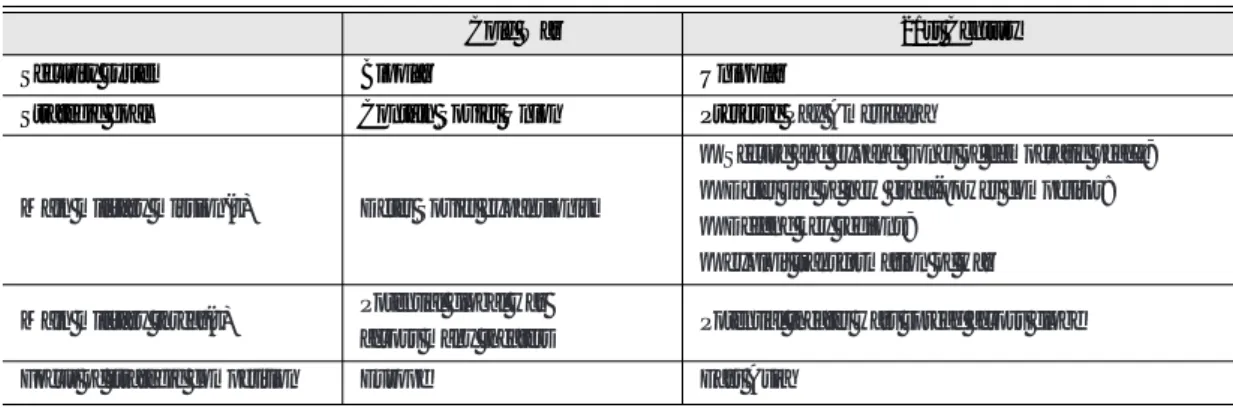
Strategy, Forces and Resources for a New Century (September 2002) describes more explicitly its “belief that America should seek to preserve and extend its position of global leadership by maintaining the pre- eminence of U.S military forces.” According to this report, on the basis of a comparison between the Cold-War era and the 21C (see table 1), it may be claimed that “at present the United States faces no global rival. America’s grand strategy should aim to preserve and extend this advantageous position as far into the future as possible.” This report suggests four core mission for U.S. military forces:
defend the American homeland;
fight and decisively win multiple, simultaneous major theater wars;
perform the ‘constabulary’ duties associated with shaping the security environment in criti- cal region;
transform U.S. forces to exploit the ‘revolution in military affairs’.
And finally it is required that “To carry out these core missions, we need to provide sufficient force and budgetary allocations.”
Seen from the above documents, it is apparent that, in order to make the 21st century the new American century, the neo-conservatives (with the hawks) who have gained the upper hand in the Bush administration attempt a fundamental reorder- ing of the strategy of U.S. global engagement. What makes different and what is so alarming about the new grand security strategy of the U.S. are four qualitatively different components of U.S. foreign and military policy (three of them are already point- ed out by Barry (2000)) : anti-multilateralism, mili- tarism, warlordism, and moral absolutism.
(1) With the end of the Cold-War, the framework of multilateralism (or bilateralism) has been disinte- grated. Though the cold-war framework for interna- tional politics had already thrust global political affairs into a Hobbesian world where power not rea- sons prevails, the U.S. in the era of the post-Cold- War comes to enjoy its almighty power without any great competitive powers. This situation is described even in a metaphor of boxing: “Until another great- power challenger emerges, the United States can enjoy a respite from the demands of international leadership. Like a boxer between championship bouts, America can afford to relax and live the good life (report of PNAC).” The modern or conventional
Table 1. A comparison between the Cold War era and the 21st Century by PNAC
Cold War 21st Century
Security system Bipolar Unipolar
Strategic goal Contain Soviet Union Preserve Pax Americana
Secure and expand zones of democratic peace;
Main military mission(s) Deter Soviet expansionism Deter rise of new great-power competitor:
Defend key regions;
exploit transformation of war Main military threat(s) Potential global war
Potential theater wars spread across globe across many theaters
Focus of strategic competition Europe East Asia http://www.newamericancentury.org/RebuildingAmericasDefenses.pdf (p.14)
Cold War 21st Century
realism - with its attendant balance-of-power poli- tics, great power alliances, deterrence, and contain- ment - is no longer applicable in a unipolar world.
(2) What makes such aggressive anti-multilateral- ism possible for the neo- conservatives is militarism.
They do not hesitate to provoke it, as described in the founding statement of principles of PNAC: “As the 20th century draws to a close, the United States stands as the world’s most preeminent power. Having led the West to victory in the Cold War, America faces an opportunity and a challenge …… Yet unless the United States maintains sufficient military strength, this opportunity will be lost.” What is required for them is “a military that is strong and ready to meet both present and future challenges.” To maintain mil- itary primacy at all costs is to discourage and resist the emergence of any rival superpower.
(3) The U.S. militarism seems to be sublimed to warlordism or even warlordship. The neo-conserva- tives seem to emphasize the reeminence of U.S. mili- tary forces, not merely to maintain for threat but to exercise in real wars. “Instead of the realpolitik that has characterized conservative foreign policy strate- gizing, the Untied States has reverted to ‘machtpoli- tik or the exercise of sheer military power, uncon- strained by international norms, treaties, or alliances.” (Barry, 2002). The Bush administration’s
“National Security Strategy of the Untied States” can be seen as justifying the rise of a new warlordism in the U.S. government.
(4) The supremacy of the U.S. are supported not only its military powers, but also its moral abso- lutism. The intervention into ‘failed states’ or ‘rogue states’ as well as ‘war on terrorism’ is justified by the self-styled international norms of freedom, democra- cy, peace, and even free market and development.
Instead of liberal political values, the supremacists driving U.S. foreign policy of the Bush administra- tion are more comfortable with stark moral con- trasts, linking its mission to the apocalyptic conflict between good and evil, which simply leads to the civilisation/barbarity dichotomy (Barry, 2002).
2) The New Imperialist War as an Implementation of the Strategy
Now it becomes apparent that the wars in Afghanistan and Iraq should be seen an implemen- tation of the new security strategy of the U.S. estab- lished by the Bush neo-conservative administration in order to realize its neo-imperial goal. To see why the U.S. conducted these wars, several kinds of rea- sons have been supposed. One of the supposed rea- sons is ‘the inner dialectic of U.S. civil society’. In 2002 after the war in Afghanistan, the German Minister of Justice argues “the adventurism of the Bush administration abroad was designed to divert attention from its difficulties at home (cited from Harvey, 2003).” Indeed at the time, the Bush admin- istration was faced with rising unemployment, cor- porate scandals, accounting failures, failures of regu- lation, Pension funds lost, etc., that is, a crisis at home. But this is only one reason, if it is.
The second reason supposed is ‘all about oil’, as has been pointed out by Harvey(2003), “Opponents of war with Iraq frequently depict the conflict as all about oil.” But the U.S. government either dismisses that claim out of hand as preposterous or ignores the question entirely. There is no question that oil is cru- cial. But exactly how and in what sense is not so easy to determine. A narrow conspiracy thesis rests on the idea that the government in Washington is noth- ing more than an oil mafia that has usurped the pub- lic domain. This idea is supported by the close con- nections of Bush and Cheney to oil interests coupled with reports that Halliburton, Vice-President Cheney’s old company, stands to gain nearly a bil- lion in contracts for oil services in the immediate aftermath of the war.
The third reason has a close relation with the sec- ond. Numerous critics of the current expansion of the American empire have argued that the United States under the administration of Bush has been taken over by a neo-conservative cabal strongly backed by President Bush. The cabal has planned and brought
about the war. This kind of cabal thesis also may not be sustained. For we need to recognize that “imperi- alism in this case, as always, is not simply a policy but a systematic reality arising from the very nature of cap- italist development.” The historical changes in impe- rialism defy any attempt to reduce current develop- ments to the misguided ambitions of a few powerful individuals. It is therefore necessary to address the historical underpinnings of the new age of U.S. impe- rialism (Foster, 2003b).
Those supposed reasons to explain why the wars were broken out seem not sufficient to see the whole story of the wars. The wars has a longer story as Harvey(2003) describes,
“Iraq [as well as Afghanistan] had long been a central concern for the neo-conservatives, but the difficulty was that public support for military inter- vention was unlikely to materialize without some catastrophic event on the scale of Pearl Harbor, as they put it. 9/11 provided the golden opportunity and a moment of social solidarity and patriotism was seized upon to construct an American national- ism that could provide the basis for a different form of imperialist endeavor and internal control. … After 9/11, the neo-conservatives have had their Pearl Harbor. The difficulty was that Iraq plainly had no connection with al-Qaeda and the fight against ter- rorism had to take preference. In the invasion of Afghanistan, the military tested out much of its new weaponry in the field, almost as a dress-rehearsal for what they might do in Iraq and elsewhere.”
As implemented through those two wars, the U.S.
grand strategy developed by the Bush administra- tion extends beyond the war on terrorism to a radi- cal reassessment of U.S. foreign and military policy in the unipolar world. Not only would the United States no longer count on coalitions for great powers to guarantee collective security, it also would pre- vent the rise of any potential global rival - keeping U.S. ‘military strengths beyond challenges’(Barry, 2002). His moral clarity about the ‘axis of evil’ and his warning that you are ‘either with us or with the terrorists’ reflect an unnuanced approach to using U.S. military force.
One, even on the part of critical standpoint on the U.S. strategy, like Harvey(2003), may expect that the ambition of the neo-conservatives in the U.S. would be not realized with the two wars. “Those two wars are not, however, the limit to neo-conservative impe- rial ambition. They have already begun to speak of Iran (which, after the occupation of Iraq will be total- ly surrounded by the U.S. military and clearly threatened) and have launched accusations against Syria that speak of consequences. … The neo-conser- vatives are, it seems, committed to nothing short of a plan for total domination of the globe. In that ordered world of a Pax Americana, it is hoped that all segments may flourish under the umbrella of free-market capitalism.”
On the other hand, one even within the camp of the neo-conservatives, as Donnelly(2003) complains, may criticize the New Security Strategy of the U.S. in a sense that “the Bush Doctrine does not elaborate an actual strategy - in the sense of a ‘how to’ plan - for preserving the Pax Americana.” In his view, the Bush administration’s National Security Strategy speaks of preserving U.S. military strength, econom- ic growth, and overall national power. but it does not explicitly set strategic priorities. With respect to this problem, Donnelly suggests an urgent instition- alisation of unipolarity. According to him, one can not imagine how the United States can maintain global leadership without running the risks of
‘imperial overstretch’ unless it forges a new set of international institutions such as a reformed United Nations, a new NATO etc.
Such an institionalisation of unipolarity does not exclude strategic partners. In Donnelly’s view, there are many states with a tremendous stake in extend- ing the Pax Americana; Great Britain. But he as other neo-conservatives, thinks China is the peer competi- tor of the U.S. Thus he argues, “While it is true that China has the potential to become the canonical
‘global peer’ of the United States, the global ‘correla- tion of forces’ seems very heavily in the U.S.’s favor.”
And he suggests that “In addition to conducting
combined exercises with Japan, South Korea, India, Australia, and others in a one-on-one fashion, the United States needs to build a larger security archi- tecture - something like NATO - in other regions and with other partners.” (Donnelly, 2003). How terrible the results of this kind of security architecture [in East Asia against China] would be.
4. East Asia in the Age of the New Imperialism
There is no doubt that East Asia is has been dra- matically affected by the shift in U.S. policy. The Bush administration has committed to change U.S.
policy toward Asia. It aimed at reversing the Clinton-era policies of engagement with North Korea and China, and strengthening military alliances perceived as having been slighted under Clinton, particularly with Japan, but also with South Korea, Philippines, and Taiwan (Gershman, 2002).
The aftermath of 9/11 enabled the U.S. to expand its military presence throughout the Asia/pacific region through military operations, exercises, aid, and training programs that have consolidated the U.S. hegemonic military presence and deepened military cooperation in the region. The net effect of these expanded ties has been to expand the capacity for U.S. force projection. In particular, after the 9/11 attacks and the launch of the Bush administration’s
‘war on terrorism’, military and security issues were slated to displace economics as the priority concerns of U.S. policy toward the region.
With North Korea, the Bush administration has most clearly departed from the policies of its prede- cessor. One of the Clinton administration’s impor- tant achievements in its foreign policy was the nego- tiation of the Agreed Framework in 1994, under which North Korea agreed to freeze its nuclear pro- gram in exchange for heavy fuel oil shipments and the construction of two nuclear ractors. With such a strategy of the U. S. to North Korea which well
matched with South Korean President Kim Dae Jung’s ‘sunshine policy’ with the North, tensions fell to their lowest levels since the end of the Korean war. The historic ‘South-North Joint Declaration’ of June 15, 2000 in which the South and the North Korea agreed to ‘solve the question of the country’s reunification independently and by the concerted efforts of the Korean nation responsible for it.
But the Clinton-era policies of engagement was rejected by hardliners of the Bush administration.
The Bush neo-conservative team came into skeptical about the existing policy, and opted for a more
‘hardheaded’ engagement, in which North Korea was going to be asked to show substantial progress on security fronts - transparency, weapons prolifera- tion, conventional forces levels - before the relation- ship could move forward (Kristol, 2002). The Bush administration thus has suspended talks with North Korea, and attacked it as part of an ‘axis of evil’. It has been overtly said that North Korea might be next on U.S. imperialism’s hit list after Iraq. In a response to this, the Pyongyang regime of Kim, Jung-Il pulled out of the Nuclear Non-Proliferation Treaty, demanding that Washington resume sus- pended shipments of fuel oil and begin talks on a
‘non-aggression’ treaty. But North Korea’s acknowl- edgement of the weapons program, like its acknowl- edgement that it had abducted Japanese citizens in the 1970s, seems aimed at a broader dialogue with the Bush administration.
In a response to this proclaim of North Korea, Bush clearly admit that a dialogue is possible and even better in spite of he described North Korea as part of the axis of evil. In an interview with reporters, Bush(2002) says, “I view the North Korean situation as one that can be resolved peacefully, through diplomacy. The international community - particularly those countries close to North Korea - understand the stakes involved. … There is strong consensus, not only amongst the nations in the neighborhood and our friends, but also with interna- tional organizations, such as the IAEA, that North
Korea ought to comply with international regula- tions. I believe this can be done peacefully, through diplomacy, and we will continue to work that way.”
As the interview was held just before the war in Iraq, one may think the “Bush administration’s stat- ed intention of pursuing ‘peaceful diplomacy’ with North Korea exposes the utter hypocrisy of its pre- text for war against Iraq.” But it seems certain that the Bush administration stance has been divided as to how to respond to the recent situation of North Korea (the intra-administration debate over how to respond to the North Korean situation may have broader effects on U.S. policy). Even Kristol who is chairman of PNAC writes that, “When North Korea admitted that Pyongyang had retained a secret nuclear weapons program, the Bush administration has been properly stern and sober, indicating that North Korea’s behavior must stop and must not be rewarded. But the administration has also felt the need to reassure us that North Korea is not like Iraq (Kristol, 2002).”
What kinds of difference are between North Korea and Iraq, which lead Kristol to see a “differ- ence [which] lies in the means appropriate to the dif- ferent circumstances”? (Kristol, 2002). According to him, North Korea has nuclear weapons and a mili- tary poised to destroy much of South Korea. Iraq doesn’t have those weapons. “North Korean retalia- tion, and the resulting war on the Korean Peninsula, would be ‘absolutely devastating’.” Moreover removing Saddam Hussein from power by military means makes sense because it is just, it is doable, and the likely costs to innocent civiliants and American forces are low. But the same can’t be said with any confidence of an attempt to remove Kim Jong Il and to liberate North Korea. These two rea- sons are exactly the same with Bush’s answer to a reporter’s question.
This kind of response to North Korea seems to continue even after the Iraq war. The solution to the North Korean nuclear problem seems to lie in offer- ing North Korea a peace treaty in lieu of the so-
called nonaggression pact that the reclusive state seeks in vain. (The Korea Herald, July 28, 2003). The peace treaty should fulfill Pyungyang’s principal goal: regime survival. Though North Korea requires a bilateral negotiation, the format of the much-dis- puted multilateral talks on the North Korean nuclear problem would most likely become a six-way dia- logue including South Korea, North Korea, the United States, China, Japan and Russia, which North Korea has expressed its agreement few days ago.
Even Tony Blair has intervened in preparing such a multilateral talks, as he visited South Korea and with President Roh Moo-Hyun agreed to work together to bring North Korea into multilateral talks as soon as possible.
It must be very difficult to see what will be hap- pen in a near feature in the Korean Peninsula. At a meeting cerebrating 50th year after the armistice of the Korean war, Bruce Cummings expresses his view that there may be a war in Korea, if Bush would be re-elected next year. But he once said that a war in Korea after the Iraq war would help Bush’s reelection. This is not however to admit Bamyeh’s conception of the new imperialism that “Instead of exercising hegemony for the purpose of influencing specific directions, the imperialism of today has only an irrational attachment to the principle of hegemo- ny.” The Bush administration seems quite rational in pursuing their interests. Rather than admitting “the logic of the new imperialism does not have this cal- culative vantage point,” North Korea and the U.S.
(and other neighbourhood countries) would be very anxious to calculate what would be more appropri- ate for its own interests in the future. This becomes more understandable when we look about what is going on in Japan and China.
The Bush administration’s approach to Japan can be seen in the so-called Armitage Report, the prod- uct of a study group led by the Clinton administra- tion’s official Joseph Nye and current Deputy secre- tary of State Richard Armitage. The report places security at the center of the U.S. - Japan relationship
and conceives of the U.S.-Japan security alliance as the primary anchor for U.S. force project in the pacif- ic and Indian Oceans (Gershman, 2002). But the Bush administration wants a more substantial mili- tary partnership. The response of Japan at the begin- ning of the Bush administration seems not to want such a relationship. In a contrast to the Bush admin- istration, Japan’s foreign policy places a greater emphasis on multilateralism. But the Bush adminis- tration has pushed Japan further toward collective defense, steps foreshadowed in the late 1990s by Japan’s approval of the revised U.S.-Japan security guidelines and its agreement to cooperate in pursu- ing theater missile defense (TMD).
In fact, Japan dispatched five vessels to participate in the multinational naval contingent that was part of Operation Enduring Freedom in Afghanistan, marking the first wartime dispatch of naval vessels for operations abroad since the end of World War II.
Moreover, Japanese Prime Minister Junichiro Koizumi has called for the repeal, or at least a rein- terpretation of Article 9 of Japan’s constitution, which forbids Japan to wage war. A reinterpretation would allow Japan to use military force as part of
‘collective security’ operations. But, until recently Japan has worried about criticism of its neighbour- hood countries. “Anything involving a more formal military role for Japan in the region remains contro- versial both within Japan and among many of its Asian neighbors, including those friendly to Washington, such as South Korea. Most countries in the region see a more militarily assertive Japan as destabilizing and a danger (Gershman, 2002).”
But on 26, July, the legislation authorizing the troop dispatch passed an upper house committed with sup- port from the light-wing Koizumi’s three-party coali- tion, which controls a majority in both chambers of Parliament. The bill was forced through the commit- tee as a group of outraged and shoving opposition lawmakers scrambled toward the committee chair- man, while ruling party lawmakers rushed to protect him. The prime minister has campaigned hard for the
peace-keeping bill, which authorizes sending Japanese ground troops to provide non-combat sup- port for U.S.-led forces in Iraq. Military planners are reportedly considering sending a contingent of up to 1,000 combat engineers and other troops for transport and construction duties. Opposition parties say such a mission could violate Japan’s pacifist constitution and put its troops in the line of fire.
The situation of China is quite different from Japan, as China has been pointed out the neo-conser- vatives in the Bush administration as the most possi- ble candidate of ‘peer competitor’ with the U.S.. In the first draft of the 1992 Defense Policy Guidance drafted by Paul Wolfwitz and Lewis Libby, it was unclear where the new rival to U.S. supremacy would most likely emerge. Europe and Japan as well as China were among the candidates. By the time the Bush administration came into office, however, the proponents of this doctrine of supremacy saw only one possible peer competitor emerging in the foreseeable future, China.
the Bush administration seems to be divided on its approach to China from the moment it took office. Hardline neo-conservatives have been backed by an even more rabid informal network of China- bashers known as the ‘Blue Team’ who are based in congressional staff, right-wing think thanks, and media outlets. on the other hand, in the more mod- erate realpolitik camp have been the hawks who have played a balancing role on policy toward China. Early in the Bush administration, the hawks appeared ascendant, their rhetoric considerably sharper than that of the Clinton administration.
Bush denounced Clinton’s efforts to forge a ‘strate- gic partnership’ with China, referring instead to China as a ‘strategic competitor’. The Clintonesque pattern of engagement did prevail at key points, however, such as the resolution of the April 2001 imbroglio involving the PC-3 spy plane collision.
It seems on the part of the Bush administration that, having apparently lost the intra-administration battle over how to conduct direct relations with
China, it has focused on upgrading relations with Taiwan and other allies in the region. It is also a sim- ilar situation on the part of China. it is not easy to see preciously what is Chinese response to the Bush administration’s foreign policy to China and its neo- conservative imperialism. It seems true that “The Iraqi war has convinced the Chinese Communist Party leadership that some form of confrontation with the U.S. could come earlier than expected.
Beijing has also begun to fine-tune its domestic and security policies to counter the perceived threat of U.S. ‘neo-imperialism’.”
5. The Limits to the New Imperialism and Anti-Imperial Movements
We should know about the limits to or contradic- tory natures of the new imperialism, if we are going to organize movements against it. Until the Bush administration has made clear its own nature of the new imperialism, the neo-liberal economic strategy of the West seemed to have nothing to do with the formal empire which classic Marxists linked to the first phase of capitalist economy in the late nine- teenth-century. In a similar manner, the globalisation of transnational capital supported by WTO, IMF, World Bank, etc., seemed to be buttressed only by indirect political dominance. But now it is extremely clear that globalisation does not work without the new imperialism. Nevertheless, the nature of new imperialism can be distorted, and its problem becomes ambiguous, because of some ideological discourses. Beyond the ideology for the new imperi- alism, we can find a turning point and its moments.
Fukuyama’s thesis on the End of History (1989) continues to be the most significant statement of the ideology of globalisation. He proclaimed the differ- entiation between states(or societies) which have reached the finite ‘global’ stage of civilization (liberal capitalism plus parliamentary democracy) and states
‘mired in history’ which still remained in uncivilized
stages (neither with free market nor democracy).
This discourse constituted the ideological back- ground of the proclamation of the ‘new world order’
by Bush Sr. which was the next step from the con- frontational freedom drive under Reagan and Thatcher, and beyond to the identification of the
‘Axis of Evil’ by Bush Jr. .
Another champion in ideological discourse for new imperialism is Samuel Huntington who came up with his Clash of Civilizations (1993). But accord- ing Edward Said, a most acute critic of Orientalists, Huntington was not careful enough to examine the fact that ‘the major contest in most modern cultures concerns the definition or interpretation of each cul- ture’. This goes way beyond a simplistic clash of cul- tures. Huntington’s clash became a road map for American foreign policy because it is basically an ideology: a very handy ideology to fill the vacuum created by the end of the ideology-heavy Cold War (Escabar, 2001).
It seems clear that both the arguments of Fukuyama in the End of History and Huntington in the Clash of Civilizations holds that with the end of the Cold War, the preparation for war to defend freedom against dictatorship can shift to policing the remaining pockets of non-integration. But another reading of history is always possible. In their semi- nal book Empire, Tony Negri and Michael Hardt (2002) argue that the processes of globalisation have generated a universal and oppressive new imperial- ism, but stress that a real humanist alternative to imperialism and war is more than possible.
If Ibn Khaldun, a Muslim historian and geograph- er of the 14th century, were alive today, he would tell us that American civilization has expanded to almost limitless power. And when you reach Absolute Power, the only way is down. Not only the eminent Muslim reached this conclusion, but also many other Western icons including professor Paul Kennedy (2001), who excelled in his examination of the concept of overextension of great powers. Ibn Khaldun and Paul Kennedy would probably agree
that America is now overextended and that overex- tended civilizations will decline (Escabar, 2001).
I think history is marked by cycles and pendulum swings. It may be that the recent rightward shifts in the Bush administration seized and supported by neo-conservative and neo-imperialists supporters will be turned back by the next administration or Congress. There are also signs that, as the hawks and hardliners have pursued their neo-imperial security strategy for unilateralism, they are coming up hard against the exigencies of realpolitik - the need for alliances, the importance of multilateral cover, and the successful diplomatic maneuvering of the other powers to set alternative agendas in motion. This is evident in the case of North Korea in a new game of negotiation with the U.S. The neo- imperial supremacy pursued by the Bush adminis- tration - with its dismissal of international coopera- tion, its ‘peace through strength’ credo, and its end- less war on evil - will be only a passing political moment or the ideological and operative framework for international relations in the early 21st century.
Where and how can we find moments for the turning point of history dominated by the U.S. neo- imperialism? There seems to be at least four moments for it. One is ‘increasing cost of war and military maintenance’. The cost of the Iraqi war, according to plausible estimates, cannot be less than
$200 billion and will possibly be much more. “To be sure, there is plenty of surplus capital to fund the war, but it will demand its rate of return, which either means profits of defense and reconstruction contractors and/or payments of interest on govern- ment debts. Dropping bombs is not productive investment and returns no value back into the circu- lation and accumulation process, unless, that is, we consider a fall in the price of oil to $20 a barrel as part of a rate of return on military action in Iraq (Harvey, 2003).” And the U.S. plans normal spend- ing on its military that is equivalent to the rest of the world put together. The danger of over-reach is seri- ous, particularly since Federal budget deficits loom
larger and larger in the fiscal landscape and budget crises at the state and local levels are already biting hard into levels of public service provision.
The second moment may be domestic conflicts within neo-conservatives of the U.S. Around the neo-imperialist security strategy, especially with its militarism and warlordism, is a certain possibility of conflicts and devisions within neo-conservatives of the Bush administration or within elite classes of the U.S. In this sense, Harvey argues that “the more problematic the neo-conservative form of gover- nance appears both internally and internationally, the more there will likely be division and dissent even within the elite classes over the direction the territorial logic of power should take. The current difficulties within the neo-liberal model and the threat it now poses to the United States itself, may even provoke calls for an alternative logic of territor- ial power to be constructed (Harvey, 2003).”
The third seems to be global conflicts with alliances against the U.S. : Even though it is written in New Security Strategy, “We are also guided by the conviction that no nation can build a safer, better world alone. Alliances and multilateral institutions can multiply the strength of freedom-loving nations,” the neo-conservatives do not want any great competitive powers in the world, as suggested with so strong conviction through PNAC. But this is
“another aspect of the potential damage that the neo-conservative imperialist project might inflict.
The unilateralist assertion of U.S. imperial power fails entirely to recognize the high degree of cross- territorial integration that now exists within the capi- talistic organization of the circulation and accumula- tion of capital (Harvey, 2003).”
There remains a final but most important moment for the turning point from the new imperialism: anti- imperial movements from the below. The greatest hope in these dire circumstances caused by the new imperialism lies in a rising tide of revolt from the below, both in the United States and globally. The growth of the anti-globalization movement, which
dominated the world stage for nearly two years fol- lowing the events in Seattle in November 1999, was succeeded in February 2003 by the largest global wave of anti-imperialist war protests in human his- tory. Never before has the world’s population risen up so quickly and in such massive numbers in the attempt to stop a new imperialist war. “The new age of imperialism is also a new age of revolt (Foster, 2003b).”
In the 1990’s an international movement started to emerge that brought together a broad coalition against neo-liberalism, linking people in struggle all over the world. This broad movement, as yet, has no common purpose beyond a wish to address the unfairness of global capitalism. Large parts of this movement were influenced by anarchism or by ideas that have organisational similarities with anachism like Zapatista and radical environmental- ism. These often defined themselves in opposition to the party building strategy of Leninism and social democracy. But now the purpose of movements becomes more clear: they are against the new con- servative warlordism, against the new imperialism Already hundreds of millions of people across the globe have come out in opposition to the U.S. wars in Afghanistan and Iraq.
As imperialism spirals out of control, and as the manifestations of its wickedness penetrate every pore of human existence everywhere, the resistance against it also has emerged from every cell of social and political organization, taking many diverse forms that defy easy encapsulation. As the forms of protest and resistance have multiplied, the problem of choosing an appropriate political strategy will become that much more difficult. Is the resistance to be mounted globally? or are we to fight every little tyranny everywhere? (Bagchi, 2003).
One may identify two kinds of lines of the anti- imperialist struggles. On the one hand there are those who believe in the necessity of squaring up for battle against global transnational capital and fight- ing to reverse the ‘imperialist’ policies that have
allowed it. On the other hand, there are others who are convinced that the fight against tyrannies that are crippling the lives of people has to be conducted here and now. But we cannot accept this dichotomy as a valid representation of today’s resistance to imperialist capitalism. The fight against imperialism must encompass all aspects of life including the forms of transnational capital, neo-liberal ideology, global state, and the so-called civil society, as well (Bagchi, 2003).
Mass demonstrations in South Korea against the presence of 37,000 American troops in that country illustrate well some important characters of recent movements against new imperialism. The protests were touched off after soldiers driving an American armored personnel carrier killed two schoolgirls during a training exercise last summer, then escalat- ed when a U.S. military court acquitted the soldiers.
Hundreds of thousands gathered in Seoul and other cities in early December for the largest anti- American demonstrations in the country’s history.
This protests against the U.S. troops was connected to those against the U.S. war in Iraq. The movement has some implications for both micro- and macro- geopolitics against the new imperialism (Choi, 2003).
The real battleground where this has to be fought out, of course, is within the United States. On this count, there is some ground for faint hope since the severe curtailment of civil liberties and the long- standing recognition that imperialism abroad will be bought at the cost of tyranny at home, provides a serious basis for political resistance (Harvey, 2003).
At least part of the answer will depend on the will- ingness of Americans to reach beyond their deeply felt sense of victimization in the aftermath of September 11, 2001.
Whether or not that happens depends critically upon the balance of political forces within the United States. While this may not be determinant, it will play a huge role in our individual and collective futures. With respect to that, the rest of the world can only watch, wait and hope. But one certain thing
can be said. Across-the-board anti-Americanism from the rest of the world will not and cannot help.
Those struggling in the United States to construct an alternative, both internally and with respect to for- eign engagements, need all the sympathy and sup- port they can get. In the same way that the inner/outer dialectic plays such a crucial role in the construction of neo-conservative imperialism, so a reversal of that dialectic has a crucial role to play in anti-imperialist politics (Harvey, 2003).
The American people must prepare themselves and organize themselves in opposition to the capital- ist war program. In the present period, U.S. imperi- alism’s war program is intensifying the contradic- tions of capitalism all along the line. The capitalist- imperialist system in the U.S. is built on war and militarism and U.S. imperialism’s ‘war against international terrorism’ seems to be a blueprint for war against the countries and peoples of the whole world. To oppose the capitalist program, the people need to build up the broadest possible front against war and imperialism.
6. Conclusions
The U.S. militarism in its overextension is neither simply (even mainly) a production of the Cold War competition with Soviet Union, nor is a result of the collapse of the latter. The U.S. militarism had deeper roots in the need of the United States, as the hege- monic power of the capitalist world economy, U.S.
military interventions belonged to the larger phenom- enon of imperialism in all of its historical complexity and to the U.S. role as the hegemonic power of the capitalist world (Foster, 2003b). In order to see such a historical complexity and to the U.S. security strategy for the hegemonic power of the capitalist world, it is important to see the connection between neo-imperi- alism and globalization with a dialectical relation between territorial and capitalistic logics of power.
The 21st century has been planned as the new
American century by the neo-conservatives of the U.S.. They pursue not that the United States must be more powerful, or most powerful, but that it must be absolutely powerful. This new age of the 21st cen- tury overshadowed by the U.S. neo-conservative imperialism, however, will generate its own contra- dictions, amongst them attempts by other major powers to assert their influence, resorting to similar belligerent means, and all sorts of strategies by weaker states and non-state actors to engage in
‘asymmetric’ forms of warfare. Given the unprece- dented destructiveness of contemporary weapons, which are diffused ever more widely, the conse- quences for the population of the world could well be devastating beyond anything ever before wit- nessed. Rather than generating a new ‘Pax Americana’ the United States may be paving the way to new global holocausts (Foster, 2003b).
Armstrong, after a close study of these documents on the new security strategy planned by the Bush administration, concludes: ‘The plan is for the United States to rule the world. The overt theme is unilateralism, but it is ultimately a story of domina- tion. It calls for the United States to maintain its overwhelming military superiority and prevent new rivals from rising up to challenge it on the world stage. It calls for dominion over friends and enemies alike (Armstrong, cited in Harvey, 2003).” The irony in all this is that having helped bring down the Soviet Union, the U.S. is now pursuing the very poli- tics for which that ‘evil empire’ was condemned and opposed. There is, in this, as Harvey points out, another possible irony: if the Soviet Empire was real- ly brought down by excessive strain on its economy through the arms race, then will the U.S. in its blind pursuit of military dominance, undermine the eco- nomic foundations of its own power?.
Imperialism cannot bring genuine liberation to oppressed people, because by its very nature it is driven by the economic and political interest of the world’s most powerful countries. While claiming to stand for democracy and freedom, the U.S. has for
decades backed undemocratic and repressive regimes across the Middle East in order to protect its continued access to cheap oil (Gasper, 2001). We must demand a genuinely democratic foreign policy which puts an end to all U.S. military intervention and aggression, withdraws all U.S. troops stationed abroad, and ends the militarization of economic and social life.
Acknowledgement
I appreciate Professor David Harvey for his send- ing me a manuscript of his last book, The New Imperialism, before its publication, so that I gained much insight from his work to write this paper. I also appreciate Professor Edward Soja and other partici- pants at the 3rd EARCAG meeting, who suggested some useful comments and discussion on this paper.
Reference
Amin, S., 2001, Imperialism and globalization, Monthly Review, 53(2).
Arrighi, G., 1994, The Long Twentieth Century: Money, Power, and the Origins of Our Times, Verso, London.
Bamyeh, M.A., 2000, The new imperialism: six the- ses, Social Text, 62, 18(1).
Barry, T., 2002, The U.S. power complex: what’s new, http://www.fpif.org/papers/ 02power/
index_body.html.
Bienefeld, M., 1994, The new world order: echoes of a new imperialism, Third World Quarterly, 15(1).
Bush, G.W., 2002, President discusses Iraq and North Korea with reporters (December 31, 2002), http://www.whitehouse.gov/news/
releases/2002/12/20021231-1.html.
Choi, B-D., 2003, Micro-geopolitics against the U.S.
forces in S. Korea local problems caused by
the U.S. military bases and strategies for their resolution (paper presented at a workshop of the 3rd EARCAG meeting held in Tokyo and Osaka, 5-9 August, 2003).
Cohen, S.B., 2003, Geopolitical realities and United States foreign policy, Political Geography, 22, 1-33.
Dodds, K., 1994, Geopolitics and foreign policy:
recent developments in Anglo-American political geography and international rela- tions, Progress in Human Geography, 18, 186- 208.
Donnelly, T., 2003, What’s next? preserving American primacy, institutionalizing unipo- larity (http://www.aei.org/pbulications/
pubID.16999,filter/pub_detail.asp.).
Escabar, P., 2001, Commentary: The New Imperialism, Online Asia Times (http://www.
atimes.com/c-asia/CK06Ago1. html).
Foster, J.B., 2003a, Imperial American and war, Monthly Review, 55(1).
__________ , 2003b, The new age of imperialism, Monthly Review, 55(3).
Fukuyama, F., 1989, The End of History, Penguin.
Gasper, P., 2001, Dividing the globe in the name of democracy and freedom: Washington’s new imperialism, Socialist Worker online (http://
socialistworker.org /2001/387/387_08_
imperialism.shml.).
Gershman, J., 2002, Remaking policy in Asia?
(http://www.fpif.org/papers/asia/index _body.html).
Gowan, P., Panitch, L., and Shaw, M., 2002, The state, globalisation and the new imperialism:
a roundtable discussion, First Press (online Journal: (http://www.theglobalsite.ac.kr/
press/201gowan.htm).
Harvey, D., 2003, The New Imperialism, Oxford University Press.
Huntington, S., 1993, Clash of Civilizations, Foreign Affairs.
Kennedy, P., 2001, Global Trends & Global Governance,
Pluto Press.
Kristol, W. and Schmitt, G., 2002, Lessons of a nuclear North Korea, The Weekly Standard (October, 28, 2002).
Negri, T. and Hardt, M., 2002, Empire, Harvard University Press.
O Tuathail, G., 1999, A strategic sign: the geopolitical significance of ‘Bosnia’ in U.S. foreign policy, Environment and Planning D: Society and Space, 17, 515-33.
Shaw, M., 2002, Exploring imperia: Western-global power amidst the wars of quasi-imperial states, First Press (online journal: http://
www.theglobalsite.ac.kr/press/ 212shaw.htm).
The Project for the New American Century, 2000,
Rebuilding America’s Defenses: Strategy, Forces and Resources for a New Century (http://www.
newamericancentury. org.
The White House, 2002, The National Security Strategy of the United States of America (http://www.
whitehouse.gov).
van der Pijl, K., 2002, The aesthetics of empire and the defeat of the left, First Press (online jour- nal: http://www. theglobalsite.ac.kr/
press/212vanderpijl.htm).
Wallerstein, I., 2003, U.S. weakness and the struggle for hegemony, Monthly Review, 55(3).
Received October 24, 2003 Accepted December 03, 2003