Received November 10, 2015, Revised February 23, 2016, Accepted for publication March 7, 2016
Corresponding author: Eung Ho Choi, Department of Dermatology, Yonsei University Wonju College of Medicine, 20 Ilsan-ro, Wonju 26426, Korea.
Tel: 82-33-741-0623, Fax: 82-33-748-2650, E-mail: [email protected] This is an Open Access article distributed under the terms of the Creative Commons Attribution Non-Commercial License (http://creativecommons.
org/licenses/by-nc/4.0) which permits unrestricted non-commercial use, distribution, and reproduction in any medium, provided the original work is properly cited.
Copyright © The Korean Dermatological Association and The Korean Society for Investigative Dermatology
Ann Dermatol Vol. 28, No. 6, 2016 https://doi.org/10.5021/ad.2016.28.6.690
ORIGINAL ARTICLE
Application of Topical Acids Improves Atopic Dermatitis in Murine Model by Enhancement of Skin Barrier
Functions Regardless of the Origin of Acids
Noo Ri Lee, Hae-Jin Lee, Na Young Yoon, Donghye Kim, Minyoung Jung, Eung Ho Choi
Department of Dermatology, Yonsei University Wonju College of Medicine, Wonju, Korea
Background: The acidic pH of the stratum corneum (SC) is important for epidermal permeability barrier homeostasis.
Acidification of the skin surface has been suggested as a ther- apeutic strategy for skin disorders such as atopic dermatitis (AD). Objective: We performed an animal study to evaluate the usefulness of acidification of SC for inhibition of AD le- sions and to find out if the therapeutic effect of vinegar is at- tributable to its herbal contents, rather than its acidity.
Methods: Five groups of six oxazolone-treated (Ox)-AD mice were treated for three weeks with creams of different acidity:
vehicle cream alone (pH 5.5), neutralized vinegar cream (pH 7.4), pH 5.0 vinegar cream, pH 3.5 vinegar cream, and pH 3.5 hydrogen chloride (HCl) cream. Also, we have compared two groups of Ox-AD mice treated with pH 5.5 vehicle cream or pH 5.5 vinegar cream. Results: Ox-AD mice treated with acidic creams exhibited fewer AD-like lesions, had sig- nificantly lower eczema scores, decreased basal by trans- epidermal water loss (TEWL), and increased SC hydration compared to the groups given only vehicle and neutral cream. There was no significant difference between the acid- ic vinegar and HCl groups. Between the groups treated with vehicle and pH 5.5 vinegar cream, there was no difference in eczema score, basal TEWL and SC hydration. Conclusion:
Application of topical acids, regardless of their source mate- rials, inhibits the development of AD lesions by maintenance of skin surface pH and skin barrier function in murine model.
(Ann Dermatol 28(6) 690∼696, 2016) -Keywords-
Atopic dermatitis, Skin barrier, Skin pH, Topical acid, Vinegar
INTRODUCTION
The stratum corneum (SC) of skin normally has an acidic pH, which is referred to as the “acid mantle”1. This acidic pH is important for the protective functions of skin, in- cluding permeability barrier homeostasis1-3, SC integrity and cohesion1,3, antimicrobial defense1,4-6, and primary cytokine activation7. Three endogenous pathways as well as exogenous mechanisms have been identified as con- tributing to the acidic pH of the SC: 1) the non-en- ergy-dependent Na+/H+ antiporter, NHE18, 2) generation of free fatty acids from phospholipids by secretory phos- pholipase A23,9,10, and 3) generation of urocanic acid from histidine by histidase11. Deterioration of any of these path- ways leads to an elevation in SC pH linked to the alter- ation of permeability barrier homeostasis and SC in- tegrity/cohesion.
The pH of the SC increases in developmentally impaired neonatal skin, aged skin12-14, and inflammed skin15 such as that found in atopic dermatitis (AD). Therefore, the re- versal of pH abnormality may be a possible preventive or therapeutic strategy for these problems16,17. Acidification of the SC improves permeability barrier homeostasis by in- creasing the activity of the two key ceramide-generating
enzymes such as β-glucocerebrosidase and acidic sphin- gomyelinase13,18,19, and reinforces SC integrity and cohe- sion by decreasing the activity of serine proteases (SPs).
SPs not only inactivate lipid-processing enzymes18, but al- so degrade the proteins that form corneodesomsomes1 and inhibit the secretion of lamellar body20.
In the oxazolone-induced AD (Ox-AD) murine model, acidification of the SC by topical application of lacto- bionic acid as polyhydroxyl acid prevented the emergence of the features of AD by maintaining normal barrier func- tion and resulted in a significant reduction in histologic evidence of inflammation16. Recently we also reported that acidic cream inhibited the occurrence of respiratory allergic inflammation as well as AD-like skin lesions in atopic march murine models developed in flaky tail mice and Ox-AD mice by repeated house dust mite applica- tion21,22. Clinically, a therapeutic effect of acidic water bathing on AD patients was also evaluated by us23.
Vinegar has been traditionally used in Korean folk medi- cine for the treatment of many dermatoses including eczema. The therapeutic effect has been assumed to be at- tributable to various source materials such as herbal in- gredients contained in the vinegar.
To find out if the therapeutic effect of vinegar is attribut- able to its source materials, rather than its acidity, we con- ducted an animal experiment using Ox-AD mice treated with creams of different acidity made using different sour- ces of acid including Korean traditional vinegar.
MATERIALS AND METHODS
Animal experiment
All animal procedures were approved by the Yonsei University at Wonju College of Medicine Institutional Animal Care and Use Committee (2011-49). Thirty female hairless mice (hr/hr) were obtained from OrientBio (Seongnam, Korea) and Ox was purchased from Sigma-Aldrich Co. (St. Louis, MO, USA). CetaphilⓇ cream (Galderma Laboratories, Cranbury, NJ, USA) was used as the vehicle.
To generate mice with AD-like dermatitis, all mice were sensitized with a single topical application of 1% Ox.
After one week of Ox sensitization, the mice were treated topically with 0.1% Ox once every other day for 3 weeks24,25. Ox-AD mice were divided into five groups of 6 mice each, depending on the creams applied to their skin.
Mice were treated with vehicle cream alone (pH 5.5, CetaphilⓇ), neutralized vinegar cream (pH 7.4), pH 5.0 vinegar cream, pH 3.5 vinegar cream, or pH 3.5 hydro- chloric acid (HCl) cream twice daily for 3 weeks, in paral- lel with Ox challenges. All of the acidic creams were
made in our laboratory using CetaphilⓇ cream as vehicle and vinegar. Vinegar was added to the vehicle cream until the pH reaches pH 3.5. To make pH 5.0 or 5.5 vinegar creams, 10mM NaOH was also added until pH rises up to the levels we intended. Vinegar is a fermented acid origi- nated from fruits and herbs home made by traditional method which contains various acetic acids, amino acids and many herbal contents that are thought to have anti-ox- idative effects in oriental medicine from ancient times.
The creams were applied 1 hour after Ox challenges on the day both interventions are done. Skin surface pH of normal young mice is around pH 5.514, and the pH of ve- hicle (CetaphilⓇ) cream itself was 5.5. We wanted to fig- ure out if the herbal contents in vinegar have a beneficial effect on skin permeability barrier function, other than acidity. So, we have done an additional experiment using Ox-AD mice to compare the vehicle and vinegar cream with same acidity (pH 5.5). The application of vehicle (CetaphilⓇ cream) and pH 5.5 vinegar cream was done to two groups of mice, four mice each as described pre- viously.
Eczema scores were measured and photographs were tak- en of gross AD lesions of each group before and after the application of topical creams. The eczema clinical score was defined as the sum of individual scores graded as 0 (none), 1 (mild), 2 (moderate), and 3 (severe) for the symp- toms of erythema, edema, and lichenification26,27. The ex- coriation was excluded as it is difficult to be evaluated from mice subjects. Transepidermal water loss (TEWL) was measured on the dorsal skin of mice using a Tewa- meter (Courage & Khazaka, Cologne, Germany), and SC hydration was measured with a Corneometer (Courage &
Khazaka) before and after the application of topical creams.
To estimate any side effects with acidic creams, we ap- plied acidic creams (pH 5.0 vinegar, pH 3.5 vinegar, and pH 3.5 HCl creams) on normal skin of hairless mice for 3 weeks twice daily without any additional interventions.
Evaluation of maintenance of acidity obtained by application of acidic creams
To evaluate how long the lowered pH by application of acidic creams maintains, we performed a test on normal human skin. As the measurement of skin surface pH can be influenced by psychological stress and physical activity of mice, the test could not be done with animals.
Therefore, we applied acidic creams (pH 3.5 vinegar, pH 3.5 HCl, and pH 5.0 vinegar cream) on human forearms with normal skin (n=4). Skin surface pH was measured right after application of acidic creams, 15 minutes, 1 hour, 3 hours, 6 hours, and 12 hours after application.
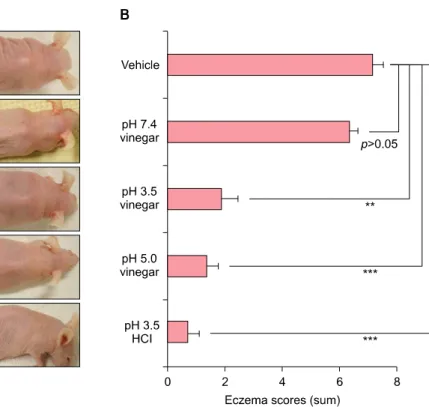
Fig. 1. (A) Oxazolone-treated atopic dermatitis (Ox-AD) mice groups treated with pH 3.5 vinegar cream, pH 5.0 vinegar cream, or pH 3.5 hydrogen chloride (HCl) cream exhibited fewer AD-like lesions than mice treated with only vehicle cream (pH 5.5) or neutralized vi- negar cream (pH 7.4). (B) Eczema scores were significantly higher in the vehicle group than in the acidic cream treatment groups. There was no difference in the eczema scores between vehicle group and neu- tralized vinegar cream treated group.
Eczema scores were determined by the sum of the severity of ery- thema, edema, and lichenification.
Severity: absent (0), mild (1), mo- derate (2), and severe (3). Results are shown as the mean±standard error of the mean. **p<0.05,
***p<0.001.
The experiment was done only once.
Statistical analysis
To compare eczema scores, basal TEWL, and SC hydra- tion in Ox-AD mice groups, we used the one-way ANOVA test. Dunnett test for the post test was done to compare each group with the vehicle group. Statistical analyses were performed using Prism 5 (Graphad Software, San Diego, CA, USA).
RESULTS
SC acidification inhibits the development of AD-like lesions in Ox-AD mice
Initial Ox challenge provoked acute allergic contact der- matitis, and multiple Ox challenges resulted in the devel- opment of AD-like lesions. To determine whether SC acid- ification by application of acidic cream including vinegar prevents the development of AD-like lesions, we com- pared the gross lesions of the Ox-AD mice in different treatment groups. Compared to the mice groups given on- ly vehicle cream, the mice groups given the acidic pH 5.0 vinegar cream, pH 3.5 vinegar cream, or pH 3.5 HCl cream exhibited fewer AD-like lesions with less erythema, edema, scales, and lichenification. There was no differ- ence between mice group given only vehicle cream and those given neutralized (pH 7.4) vinegar cream (Fig. 1).
SC acidification improves the epidermal permeability barrier in Ox-AD mice
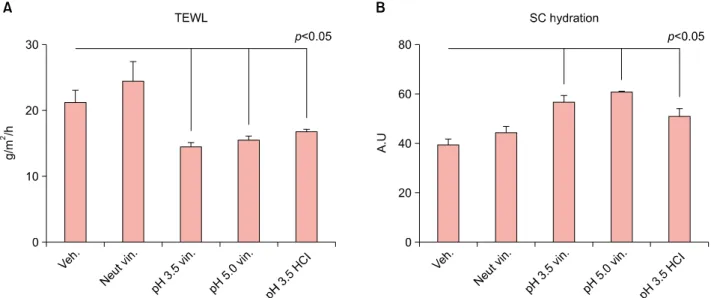
Repeated Ox challenges producing AD-like lesions dis- rupted the epidermal permeability barrier in mice. To evaluate the effect of SC acidification including vinegar therapy on skin barrier function, we compared basal TEWL between groups. The basal TEWLs of the vehicle cream (CetaphillⓇ cream, pH 5.5) and neutralized vinegar cream (pH 7.4) groups were significantly higher than those of the pH 5.0 vinegar, pH 3.5 vinegar, and pH 3.5 HCl groups (Fig. 2A). Likewise, SC hydration, which is known to be low in AD skin, was significantly lower in the vehicle and neutralized vinegar groups than in the pH 5.0 vinegar, pH 3.5 vinegar, and pH 3.5 HCl groups (Fig.
2B). These results imply that SC acidification, not just from vinegar treatment, can improve the epidermal perme- ability barrier disrupted due to Ox treatment. In the addi- tional experiment, there was no difference in clinical ec- zema score, basal TEWL, SC hydration between the ve- hicle group (pH 5.5) and the pH 5.5 vinegar group (Fig.
3). By this we could regard the effect of vinegar on epi- dermal permeability barrier results from its acidic pH, not due to its herbal contents. After applying acidic creams on normal skin of hairless mice for 3 weeks, no mouse showed scratching behavior or abnormal skin finding, im- plying that acidic creams have no cutaneous side effects.
Fig. 2. (A, B) Significant decreases in basal transepidermal water loss (TEWL) and significant increases in stratum corneum (SC) hydration were observed in the mouse groups treated with pH 3.5 hydrogen chloride (HCl) cream or pH 3.5 and 5.0 vinegar creams compared with vehicle (veh.) or neutralized vinegar (neut vin.) cream. No significant differences were seen between the acidic vinegar-treated and HCl-treated group. Results are shown as the mean±standard error of the mean.
Fig. 3. (A) Eczema scores and (B) skin permeability barrier functions of Ox induced AD model mice after application of vehicle and pH 5.5 vinegar creams. Ox: oxazolone-treated, AD: atopic dermatitis, TEWL: transepidermal water loss, SC: stratum corneum.
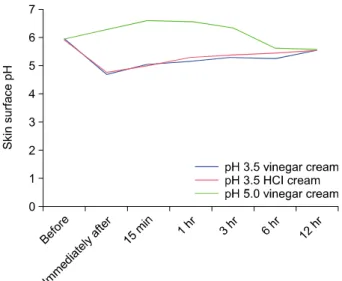
Acidity of skin surface obtained by application of acidic creams is maintained for considerable period Right after application of acidic creams, the skin surface pH immediately decreased except for pH 5.0 vinegar cream. Although pH rised after 15 minutes, the slope of increase was gentle and low pH maintained throughout 6 hours after application of creams (Fig. 4).
DISCUSSION
The acidic pH of the SC is critical for key epidermal func- tions such as permeability barrier homeostasis, SC in- tegrity/cohesion (desquamation), initiation of skin in-
flammation, and antimicrobial defense28. In inflammatory dermatoses, both an elevation in the SC pH and deterio- ration of these key functions are observed.
Recently, the efficacy of SC acidification in the treatment of developmentally impaired skin has been studied.
Hyper-acidification was revealed to enhance the structure and function of normal mouse skin17 and to normalize the impaired barrier function of neonatal29 and aged14 human and in rodent skin in which SC acidification is impaired. It was demonstrated that maintenance of SC acidity by top- ical acidic application prevents the emergence of AD16 and the occurrence of respiratory allergic inflammation.
Our recent study22 was performed to evaluate if the devel- opment of airway allergy as well as AD can be prevented
Fig. 4. Maintenance of acidic pH after application of pH 3.5 vinegar, pH 3.5 hydrogen chloride (HCl) and pH 5.0 vinegar cream. Immediately after application of acidic cream, the skin surface pH decreased in pH 3.5 vinegar cream and HCl cream but not in pH 5.0 vinegar cream. Although pH rised after 15 minutes, the slope of increase was gentle, therefore low pH was maintained throughout 6 hours after application of acidic creams.
by acidification of skin with fixed pH (2.8) cream by using atopic march model, whereas this study was to find out if AD development can be different according to applied pH in AD model.
Traditional vinegar, which is extracted from fermented herbs, has long been used for the treatment of some der- matitis including eczema in Korean folk medicine. We be- lieve that its efficacy for the treatment of eczema was due to its acidity, not due to the herbal content. Therefore, in order to elucidate whether the effects of traditional vinegar treatment result from its acidity or from other components of source materials, we compared the effects of treatment with pH 3.5 or 5.0 vinegar cream to pH 3.5 HCl and pH 5.5 vehicle cream in an Ox-AD murine model. Ox-AD mice treated with low pH creams showed less AD-like le- sions and better epidermal permeability barrier function compared to those treated with vehicle cream or neutral- ized cream. On the other hand, Ox-AD mice treated with pH 5.5 vinegar cream showed the same permeability bar- rier functions and AD lesions as vehicle (pH 5.5) group.
This finding suggests that pH 5.5 is not enough to improve skin barrier in Ox-AD murine model and the other in- gredients of the vinegar do not contribute to improved skin barrier function and anti-inflammation. The two ex- periments described above were preformed separately, us- ing different mice groups. Therefore, the values of eczema scores, TEWL, and SC hydration may be quite different in the subjects.
We have already done an experiment using topical corti- costeroid in other study22,30. Through the results of these both experiments, we have confirmed that acidification of skin had comparable effect for skin permeability barrier as topical corticosteroid, so we did not use positive control in this study.
In our additional study to evaluate the maintenance of acidic pH of skin surface obtained by acidic creams, the pH dropped immediately after application and low pH tended to rise slowly but maintained throughout 6 hours except for pH 5.0 vinegar or vehicle cream. On the other hand, the Ox-AD mice group given the pH 5.0 vinegar cream exhibited fewer AD-like lesions and improved skin permeability barrier functions than the vehicle group (pH 5.5). We believe that the discrepancy owes to the differ- ence in the thickness of SC layer between human and mouse skin. As the SC of mouse skin is much thinner than human, the acidic cream could pass through the SC more easily and quickly. Furthermore, disrupted skin barrier of Ox-AD mouse skin would have assisted for the pene- tration of acidic creams into the SC-SG junction to take effect.
In addition, NaOH added to neutralize the cream may have acted as an irritant and caused bias the results.
However, according to Fig. 1 and Fig. 2, there was no stat- istical difference in eczema score and skin barrier function between pH 3.5 and pH 5.0 vinegar cream applied groups. If NaOH acted as an irritant and vinegar itself act- ed to protect skin barrier, then pH 3.5 vinegar cream ap- plied group should have shown a better skin barrier func- tion, which did not. Therefore this implies that in the set- ting of low pH, the NaOH does not act as an irritant. This corresponds with the report by Korting et al.31, which showed no difference in skin roughness and TEWL that represent skin irritation, when the same cleansing prepara- tions except for the pH itself based on a different amount of NaOH included are used. In Fig. 4, the pH showed to be elevated temporarily after application of pH 5.0 vine- gar cream, but statistically insignificant. The beneficial ef- fect on skin permeability barrier of acid application has been already well described in a review article by Ali and Yosipovitch32, twice daily application of lactic acid for- mulation significantly improved barrier function as meas- ured by TEWL and increased total ceramide fraction in vivo. Therefore, we concluded that the acidic cream appli- cation showed beneficial effect on skin barrier function solely due to its acidity.
Our study shows again that acidification of the SC inhibits the development of AD lesions in Ox-AD mice through improvement of skin barrier function regardless of the source materials of the acid. Also, we could identify that
vinegar renders beneficial effects on AD due to its acidity, not by its herbal contents. Collectively, maintenance of acidic skin surface pH by topical application of acidic cream could be an effective therapeutic modality for AD by improvement of skin barrier function.
ACKNOWLEDGMENT
This study was supported by a grant of the Korean Health Technology R&D Project, Ministry of Health & Welfare, Republic of Korea (Grant no. HN10C0033).
REFERENCES
1. Hachem JP, Crumrine D, Fluhr J, Brown BE, Feingold KR, Elias PM. pH directly regulates epidermal permeability barrier homeostasis, and stratum corneum integrity/co- hesion. J Invest Dermatol 2003;121:345-353.
2. Mauro T, Holleran WM, Grayson S, Gao WN, Man MQ, Kriehuber E, et al. Barrier recovery is impeded at neutral pH, independent of ionic effects: implications for extra- cellular lipid processing. Arch Dermatol Res 1998;290:
215-222.
3. Fluhr JW, Kao J, Jain M, Ahn SK, Feingold KR, Elias PM.
Generation of free fatty acids from phospholipids regulates stratum corneum acidification and integrity. J Invest Der- matol 2001;117:44-51.
4. Devillers AC, de Waard-van der Spek FB, Mulder PG, Oranje AP. Treatment of refractory atopic dermatitis using 'wet-wrap' dressings and diluted corticosteroids: results of standardized treatment in both children and adults.
Dermatology 2002;204:50-55.
5. Korting HC, Hübner K, Greiner K, Hamm G, Braun-Falco O. Differences in the skin surface pH and bacterial microflora due to the long-term application of synthetic detergent preparations of pH 5.5 and pH 7.0. Results of a crossover trial in healthy volunteers. Acta Derm Venereol 1990;70:429-431.
6. Elias PM. The skin barrier as an innate immune element.
Semin Immunopathol 2007;29:3-14.
7. Hachem JP, Behne M, Fluhr J, Feingold KR, Elias PM.
Increased stratum corneum pH promotes activation and release of primary cytokine from the stratum corneum attributable to activation of serine proteases. J Invest Dermatol 2002;119:258.
8. Behne MJ, Meyer JW, Hanson KM, Barry NP, Murata S, Crumrine D, et al. NHE regulates the stratum corneum permeability barrier homeostasis. Microenvironment acidi- fication assessed with fluorescence lifetime imaging. J Biol Chem 2002;277:47399-47406.
9. Mao-Qiang M, Jain M, Feingold KR, Elias PM. Secretory phospholipase A2 activity is required for permeability barrier homeostasis. J Invest Dermatol 1996;106:57-63.
10. Mazereeuw-Hautier J, Redoules D, Tarroux R, Charveron M, Salles JP, Simon MF, et al. Identification of pancreatic
type I secreted phospholipase A2 in human epidermis and its determination by tape stripping. Br J Dermatol 2000;
142:424-431.
11. Krien PM, Kermici M. Evidence for the existence of a self-regulated enzymatic process within the human stratum corneum -an unexpected role for urocanic acid. J Invest Dermatol 2000;115:414-420.
12. Behne MJ, Barry NP, Hanson KM, Aronchik I, Clegg RW, Gratton E, et al. Neonatal development of the stratum corneum pH gradient: localization and mechanisms leading to emergence of optimal barrier function. J Invest Dermatol 2003;120:998-1006.
13. Fluhr JW, Behne MJ, Brown BE, Moskowitz DG, Selden C, Mao-Qiang M, et al. Stratum corneum acidification in neonatal skin: secretory phospholipase A2 and the sodium/
hydrogen antiporter-1 acidify neonatal rat stratum corneum.
J Invest Dermatol 2004;122:320-329.
14. Choi EH, Man MQ, Xu P, Xin S, Liu Z, Crumrine DA, et al.
Stratum corneum acidification is impaired in moderately aged human and murine skin. J Invest Dermatol 2007;
127:2847-2856.
15. Fluhr JW, Elias PM. Stratum corneum pH: formation and function of the ‘acid mantle’. Exog Dermatol 2002;1:163- 175.
16. Hatano Y, Man MQ, Uchida Y, Crumrine D, Scharschmidt TC, Kim EG, et al. Maintenance of an acidic stratum corneum prevents emergence of murine atopic dermatitis. J Invest Dermatol 2009;129:1824-1835.
17. Hachem JP, Roelandt T, Schürer N, Pu X, Fluhr J, Giddelo C, et al. Acute acidification of stratum corneum membrane domains using polyhydroxyl acids improves lipid processing and inhibits degradation of corneodesmosomes. J Invest Dermatol 2010;130:500-510.
18. Hachem JP, Man MQ, Crumrine D, Uchida Y, Brown BE, Rogiers V, et al. Sustained serine proteases activity by prolonged increase in pH leads to degradation of lipid processing enzymes and profound alterations of barrier function and stratum corneum integrity. J Invest Dermatol 2005;125:510-520.
19. Holleran WM, Takagi Y, Uchida Y. Epidermal sphingo- lipids: metabolism, function, and roles in skin disorders.
FEBS Lett 2006;580:5456-5466.
20. Hachem JP, Houben E, Crumrine D, Man MQ, Schurer N, Roelandt T, et al. Serine protease signaling of epidermal permeability barrier homeostasis. J Invest Dermatol 2006;
126:2074-2086.
21. Lee HJ, Lee NR, Jung M, Kim DH, Choi EH. Atopic march from atopic dermatitis to asthma-like lesions in NC/Nga mice is accelerated or aggravated by neutralization of stratum corneum but partially inhibited by acidification. J Invest Dermatol 2015;135:3025-3033.
22. Lee HJ, Yoon NY, Lee NR, Jung M, Kim DH, Choi EH.
Topical acidic cream prevents the development of atopic dermatitis- and asthma-like lesions in murine model. Exp Dermatol 2014;23:736-741.
23. Lee NR, Lee HJ, Yoon NY, Kim D, Jung M, Choi EH. Acidic water bathing could be a safe and effective therapeutic
modality for severe and refractory atopic dermatitis. Ann Dermatol 2016;28:126-129.
24. Lee HJ, Jung M, Kim JH, Yoon NY, Choi EH. The effect of adipose-derived stem cell-cultured media on oxazolone treated atopic dermatitis-like murine model. Ann Dermatol 2012;24:181-188.
25. Man MQ, Hatano Y, Lee SH, Man M, Chang S, Feingold KR, et al. Characterization of a hapten-induced, murine model with multiple features of atopic dermatitis: structural, immunologic, and biochemical changes following single versus multiple oxazolone challenges. J Invest Dermatol 2008;128:79-86.
26. Suto H, Matsuda H, Mitsuishi K, Hira K, Uchida T, Unno T, et al. NC/Nga mice: a mouse model for atopic dermatitis.
Int Arch Allergy Immunol 1999;120 Suppl 1:70-75.
27. Yang F, Tanaka M, Wataya-Kaneda M, Yang L, Nakamura A, Matsumoto S, et al. Topical application of rapamycin ointment ameliorates Dermatophagoides farina body ex- tract-induced atopic dermatitis in NC/Nga mice. Exp Der-
matol 2014;23:568-572.
28. Elias PM. Stratum corneum defensive functions: an inte- grated view. J Invest Dermatol 2005;125:183-200.
29. Fluhr JW, Mao-Qiang M, Brown BE, Hachem JP, Moskowitz DG, Demerjian M, et al. Functional consequences of a neutral pH in neonatal rat stratum corneum. J Invest Dermatol 2004;123:140-151.
30. Yoon NY, Jung My, Kim DH, Lee HJ, Choi EH. Topical glucocorticoid or pimecrolimus treatment suppresses thymic stromal lymphopoietin-related allergic inflammatory me- chanism in an oxazolone-induced atopic dermatitis murine model. Arch Dermatol Res 2015;307:569-581.
31. Korting HC, Megele M, Mehringer L, Vieluf D, Zienicke H, Hamm G, et al. Influence of skin cleansing preparation acidity on skin surface properties. Int J Cosmet Sci 1991;
13:91-102.
32. Ali SM, Yosipovitch G. Skin pH: from basic science to basic skin care. Acta Derm Venereol 2013;93:261-267.