DOI 10.4134/JKMS.2010.47.2.311
CHARACTERIZATION OF THE GROUPS D p+1 (2) AND D p+1 (3) USING ORDER COMPONENTS
Mohammad Reza Darafsheh
Abstract. In this paper we will prove that the groups D
p+1(2) and D
p+1(3), where p is an odd prime number, are uniquely determined by their sets of order components. A main consequence of our result is the validity of Thompson’s conjecture for the groups D
p+1(2) and D
p+1(3).
1. Introduction
For a positive integer n, let π(n) denote the set of all prime divisors of n. If G is a finite group, we set π(G) = π(|G|). The Gruenberg-Kegel graph of G, or the prime graph of G, is denoted by GK(G) and is defined as follows. The vertex set of GK(G) is the set π(G) and two distinct primes p and q are joined by an edge if and only if G contains an element of order pq. We denote the connected components of GK(G) by π 1 , π 2 , . . . , π s(G) , where s(G) denotes the number of connected components of GK(G). If the order of G is even, the notation is chosen so that 2 ∈ π 1 . It is clear that the order of G can be expressed as the product of the numbers m 1 , m 2 , . . . , m s(G) , where π(m i ) = π i , 1 ≤ i ≤ s(G). If the order of G is even and s(G) ≥ 2, according to our notation m 2 , . . . , m s(G)
are odd numbers. The positive integers m 1 , m 2 , . . . , m s(G) are called the order components of G and OC(G) = {m 1 , m 2 , . . . , m s(G) } is called the set of order components of G. If the finite groups G and H have the same order components we are interested to know if G is isomorphic to H. For many simple groups H with s(H) ≥ 2, the answer to the above question is affirmative. However if s(H) = 1 the answer is negative. The simple groups B n (q) and C n (q), where n = 2 m ≥ 4 and q is odd, have the same order components but they are not isomorphic. Hence it is natural to adopt the following definition.
Definition 1. Let G be a finite group. The number of non-isomorphic finite groups with the same order components as G is denoted by h(G) and is called the h-function of G. For any natural number k we say the finite group G is k-recognizable by its set of order components if h(G) = k. If h(G) = 1 we
Received May 26, 2008.
2000 Mathematics Subject Classification. 20D05, 20D60.
Key words and phrases. prime graph, order component, linear group.
c
°2010 The Korean Mathematical Society
311
say that G is characterizable by its set of order components or briefly G is a characterizable group. In this case G is uniquely determined by the set of its order components.
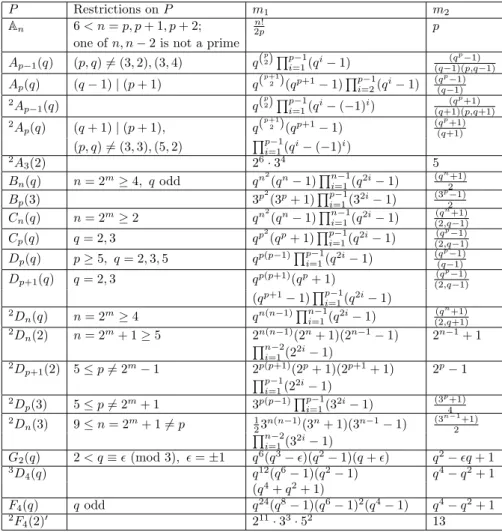
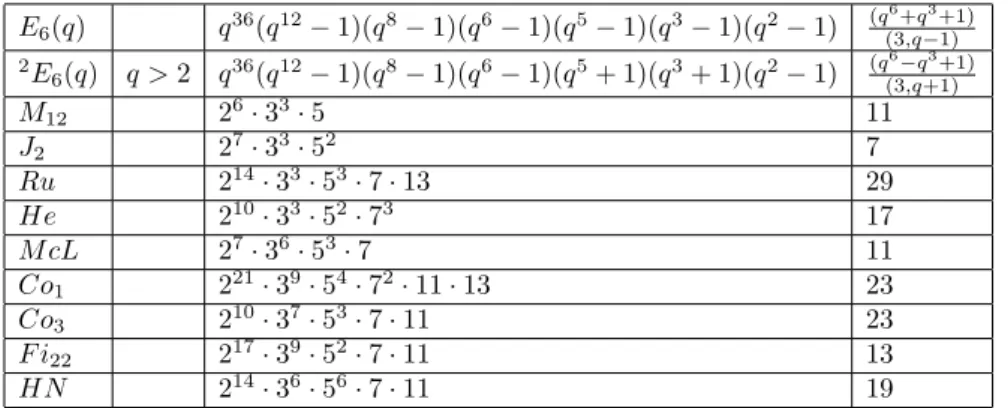
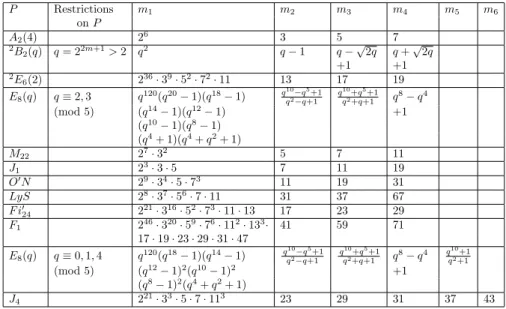
Obviously for any finite groups G we have h(G) ≥ 1. The components of the Gruenberg-Kegel graph GK(P ) of any non-abelian finite simple group P with GK(P ) disconnected are found in [21] and [24] from which we can deduce the component orders of P. These information which will be used in proving our main result are listed in Tables 1, 2, and 3.
Table 1. The order components of finite simple groups P with s(P ) = 2 (p an odd prime)
P Restrictions on P m 1 m 2
A n 6 < n = p, p + 1, p + 2; 2p n! p
one of n, n − 2 is not a prime
A p−1 (q) (p, q) 6= (3, 2), (3, 4) q(
p2) Q p−1
i=1 (q i − 1) (q−1)(p,q−1) (q
p−1)
A p (q) (q − 1) | (p + 1) q(
p+12)(q p+1 − 1) Q p−1
i=2 (q i − 1) (q (q−1)
p−1)
2 A p−1 (q) q(
p2) Q p−1
i=1 (q i − (−1) i ) (q+1)(p,q+1) (q
p+1) 2 A p (q) (q + 1) | (p + 1), q(
p+12)(q p+1 − 1) (q (q+1)
p+1)
(p, q) 6= (3, 3), (5, 2) Q p−1
i=1 (q i − (−1) i )
2 A 3 (2) 2 6 · 3 4 5
B n (q) n = 2 m ≥ 4, q odd q n
2(q n − 1) Q n−1
i=1 (q 2i − 1) (q
n2 +1)
B p (3) 3 p
2(3 p + 1) Q p−1
i=1 (3 2i − 1) (3
p2 −1) C n (q) n = 2 m ≥ 2 q n
2(q n − 1) Q n−1
i=1 (q 2i − 1) (2,q−1) (q
n+1) C p (q) q = 2, 3 q p
2(q p + 1) Q p−1
i=1 (q 2i − 1) (2,q−1) (q
p−1) D p (q) p ≥ 5, q = 2, 3, 5 q p(p−1) Q p−1
i=1 (q 2i − 1) (q (q−1)
p−1) D p+1 (q) q = 2, 3 q p(p+1) (q p + 1) (2,q−1) (q
p−1)
(q p+1 − 1) Q p−1
i=1 (q 2i − 1)
2 D n (q) n = 2 m ≥ 4 q n(n−1) Q n−1
i=1 (q 2i − 1) (2,q+1) (q
n+1)
2 D n (2) n = 2 m + 1 ≥ 5 2 n(n−1) (2 n + 1)(2 n−1 − 1) 2 n−1 + 1 Q n−2
i=1 (2 2i − 1)
2 D p+1 (2) 5 ≤ p 6= 2 m − 1 2 Q p(p+1) p−1 (2 p + 1)(2 p+1 + 1) 2 p − 1
i=1 (2 2i − 1)
2 D p (3) 5 ≤ p 6= 2 m + 1 3 p(p−1) Q p−1
i=1 (3 2i − 1) (3
p4 +1)
2 D n (3) 9 ≤ n = 2 m + 1 6= p 1 2 3 n(n−1) (3 n + 1)(3 n−1 − 1) (3
n−12 +1) Q n−2
i=1 (3 2i − 1)
G 2 (q) 2 < q ≡ ² (mod 3), ² = ±1 q 6 (q 3 − ²)(q 2 − 1)(q + ²) q 2 − ²q + 1
3 D 4 (q) q 12 (q 6 − 1)(q 2 − 1) q 4 − q 2 + 1
(q 4 + q 2 + 1)
F 4 (q) q odd q 24 (q 8 − 1)(q 6 − 1) 2 (q 4 − 1) q 4 − q 2 + 1
2 F 4 (2) 0 2 11 · 3 3 · 5 2 13
Table 1. (continued)
E 6 (q) q 36 (q 12 − 1)(q 8 − 1)(q 6 − 1)(q 5 − 1)(q 3 − 1)(q 2 − 1) (q (3,q−1)
6+q
3+1)
2 E 6 (q) q > 2 q 36 (q 12 − 1)(q 8 − 1)(q 6 − 1)(q 5 + 1)(q 3 + 1)(q 2 − 1) (q (3,q+1)
6−q
3+1)
M 12 2 6 · 3 3 · 5 11
J 2 2 7 · 3 3 · 5 2 7
Ru 2 14 · 3 3 · 5 3 · 7 · 13 29
He 2 10 · 3 3 · 5 2 · 7 3 17
M cL 2 7 · 3 6 · 5 3 · 7 11
Co 1 2 21 · 3 9 · 5 4 · 7 2 · 11 · 13 23
Co 3 2 10 · 3 7 · 5 3 · 7 · 11 23
F i 22 2 17 · 3 9 · 5 2 · 7 · 11 13
HN 2 14 · 3 6 · 5 6 · 7 · 11 19
Table 2. The order components of finite simple groups P with s(P ) = 3 (p an odd prime)
P Restrictions on P m
1m
2m
3A
nn > 6, n = p, p − 2
2n(n−2)n!p p − 2
are primes
A
1(q) 3 < q ≡ ² (mod 4), q − ² q
(q+²)2² = ±1
A
1(q) q > 2, q even q q − 1 q + 1
2
A
5(2) 2
15· 3
6· 5 7 11
2
D
p(3) p = 2
m+ 1 ≥ 5 2 · 3 Q
p−2p(p−1)(3
p−1− 1)
(3p−12+1) (3p4+1)i=1
(3
2i− 1)
2
D
p+1(2) p = 2
n− 1, n ≥ 2 2 Q
p(p+1)p−1(2
p− 1)
i=1
(2
2i− 1) 2
p+ 1 2
p+1+ 1 G
2(q) q ≡ 0 (mod 3) q
6(q
2− 1)
3q
2− q + 1 q
2+ q + 1
2
G
2(q) q = 3
2m+1> 3 q
3(q
2− 1) q − √
3q + 1 q + √ 3q + 1 F
4(q) q even q
24(q
6− 1)
2(q
4− 1)
2q
4+ 1 q
4− q
2+ 1
2
F
4(q) q = 2
2m+1> 2 q
12(q
4− 1)(q
3+ 1) q
2− p
2q
3+ q
2+ p 2q
3+ q − √
2q + 1 q + √ 2q + 1
E
7(2) 2
63· 3
11· 5
2· 7
3· 11 · 13· 73 127
17 · 19 · 31 · 43
E
7(3) 2
23· 3
63· 5
2· 7
3· 11
2· 13
2·
19 · 37 · 41 · 61 · 73 · 547 757 1093
M
112
4· 3
25 11
M
232
7· 3
2· 5 · 7 11 23
M
242
10· 3
3· 5 · 7 11 23
J
32
7· 3
5· 5 17 19
HiS 2
9· 3
2· 5
37 11
Suz 2
13· 3
7· 5
2· 7 11 13
Co
22
18· 3
6· 5
3· 7 11 23
F i
232
18· 3
13· 5
2· 7 · 11 · 13 17 23
F
32
15· 3
10· 5
3· 7
2· 13 19 31
F
22
41· 3
13· 5
6· 7
2· 11 · 13· 31 47
17 · 19 · 23
Table 3. The order components of finite simple groups P with s(P ) > 3
P Restrictions m
1m
2m
3m
4m
5m
6on P
A
2(4) 2
63 5 7
2
B
2(q) q = 2
2m+1> 2 q
2q − 1 q − √
2q q + √ 2q
+1 +1
2
E
6(2) 2
36· 3
9· 5
2· 7
2· 11 13 17 19
E
8(q) q ≡ 2, 3 q
120(q
20− 1)(q
18− 1)
q10q2−q−q+15+1q10+q5+1 q2+q+1
q
8− q
4(mod 5) (q
14− 1)(q
12− 1) +1
(q
10− 1)(q
8− 1) (q
4+ 1)(q
4+ q
2+ 1)
M
222
7· 3
25 7 11
J
12
3· 3 · 5 7 11 19
O
0N 2
9· 3
4· 5 · 7
311 19 31
LyS 2
8· 3
7· 5
6· 7 · 11 31 37 67
F i
0242
21· 3
16· 5
2· 7
3· 11 · 13 17 23 29 F
12
46· 3
20· 5
9· 7
6· 11
2· 13
3· 41 59 71
17 · 19 · 23 · 29 · 31 · 47
E
8(q) q ≡ 0, 1, 4 q
120(q
18− 1)(q
14− 1)
qq102−q−q+15+1q10+q5+1
q2+q+1
q
8− q
4 qq102+1+1(mod 5) (q
12− 1)
2(q
10− 1)
2+1
(q
8− 1)
2(q
4+ q
2+ 1)
J
42
21· 3
3· 5 · 7 · 11
323 29 31 37 43
In [19] and [20] it is proved that if n = 2 m ≥ 4, then h(B n (q)) = h(C n (q)) = 2 for q odd and h(B n (q)) = h(C n (q)) = 1 for q even. In [9] it is proved that h(B p (3)) = h(C p (3)) = 2, where p is an odd prime number. The following groups have been proved to be characterizable by their order components by various authors: All the sporadic simple groups [2], P SL 2 (q), 2 D n (3), where 9 ≤ n = 2 m + 1 is not a prime, 2 D p+1 (2), where p is a prime number and 5 < p 6= 2 m − 1, in [3], [6] and [23], respectively. Some projective special linear (unitary) groups have been characterized in [11], [13], [14], [15] and [17]. A few of the alternating or symmetric groups are proved to be characterizable by their order components in [1] and [18]. The groups 2 D p (3), where p ≥ 5 is a prime number not of the form 2 m + 1, and 2 D n (2), where n = 2m + 1 ≥ 5 are characterized by the set of order components in [10] and [12], respectively.
Based on these results we put forward the following conjecture.
Conjecture 1. Let P be a non-abelian finite simple group with s(P ) ≥ 2. If G is a finite group and OC(G) = OC(P ), then either G ∼ = P or G ∼ = B n (q) or C n (q), where n = 2 m ≥ 4 and q is an odd prime power, or G ∼ = B p (3), C p (3), where p is an odd prime number.
A motivation for characterizing finite groups by the set of their order com- ponents is the following conjecture due to J. G. Thompson.
Conjecture 2 (Thompson). For a finite group G let N (G) = {n ∈ N | G has a
conjugacy class of size n}. Let Z(G) = 1 and M be a non-abelian finite simple
group satisfying N (G) = N (M ). Is it true that G ∼ = M ?
In [4] it is proved that if s(M ) ≥ 3, then the above conjecture holds. Also in [4] it is proved that if G and M are finite groups with s(M ) ≥ 2, Z(G) = 1, N (G) = N (M ), then |G| = |M |, in particular s(M ) = s(G) and OC(G) = OC(M ). Therefore if the simple group M is characterizable by the set of its order components, then Thompson’s Conjecture holds for M.
There is another conjecture due to W. Shi and J. Bi which states:
Conjecture 3. Let G be a group and M a finite simple group. Then G ∼ = M if and only if
(a) |G| = |M | and
(b) π e (G) = π e (M ), where π e (G) denotes the set of order elements of G.
Clearly conditions (a) and (b) above imply OC(G) = OC(M ). Therefore if the group G is characterizable by its order components, then we will deduce G ∼ = M and Conjecture 3 is true for M. According to the main theorem of this paper which is stated below, Conjectures 2 and 3 are true for the simple groups D p+1 (2) and D p+1 (3), where p is an odd number.
In this paper we consider the simple groups D p+1 (2) and D p+1 (3), and prove that these groups are characterizable by their order components. Another name for these group is O + 2(p+1) (q) or P Ω + 2(p+1) (q), where q = 2, 3. More precisely we will prove:
Main Theorem. If a finite group G has the same set of order components as D p+1 (2) or D p+1 (3), then G ∼ = D p+1 (2) or D p+1 (3).
2. Preliminary results
The structure of finite groups with disconnected Gruenberg-Kegel graph follows from Theorem A of [24] which will be stated below:
Lemma 1. Let G be a finite group with s(G) ≥ 2. Then one of the following holds:
(1) G is either a Frobenius or 2-Frobenius group.
(2) G has a normal series 1 E H E K E G such that H is a nilpotent π 1 - group, K/H is a non-abelian simple group, G/K is a π 1 -group, |G/K| divides
|Out(K/H)| and any odd order component of G is equal to one of the odd order components of K/H.
To deal with the first case in the above lemma we need the following results which are taken from [5] and [2], respectively.
Lemma 2. (a) Let G be a Frobenius group of even order with kernel and complements K and H, respectively. Then s(G) = 2 and the prime graph components of G are π(H) and π(K).
(b) Let G be a 2-Frobenius group of even order. Then s(G) = 2 and G has a normal series 1 E H E K E G such that |K/H| = m 2 , |H| |G/K| = m 1 and
|G/K| divides |K/H| − 1 and H is a nilpotent π 1 -group.
Lemma 3. Let G be a finite group with s(G) ≥ 2. If H E G is a π i -group, then ( Q s(G)
j=1, j6=i m j ) | (|H| − 1).
By the above lemma if H is a π 1 -subgroup of G, H E G, and s(G) = 2, then m 2 | |H| − 1 or |H| ≡ 1 (mod m 2 ). The following result of Zsigmondy [25] is important in some number theoretical considerations.
Lemma 4. Let n and a be integers greater than 1. Then there exists a prime divisor p of a n − 1 such that p does not divide a i − 1 for all 1 ≤ i < n, except in the following cases:
(1) n = 2, a = 2 k − 1, where k ≥ 2, (2) n = 6, a = 2.
The prime p in Lemma 4 is called a Zsigmondy prime for a n − 1.
Next we consider the simple groups D n (q). Using [7] we have |D n (q)| =
1
(4,q
n−1) q n(n−1) (q n − 1) Q n−1
i=1 (q 2i − 1) and for n > 3 all these groups are simple.
The outer automorphism group of D n (q) has order (2, q − 1) 2 · f · S 3 for n = 4, (2, q − 1) 2 · f · 2 for n > 4 even and (4, q n − 1) 2 · f · 2, n odd, where q = r f , r is a prime number. By [21] if p is an odd prime number, then s(D p+1 (2)) = s(D p+1 (3)) = 2. Therefore in these cases the prime graphs of D p+1 (q), q = 2, 3, have two components. The two order components by Table 1 are: m 1 = q p(p+1) (q p + 1)(q p+1 − 1) Q p−1
i=1 (q 2i − 1) and m 2 = (4,q q
pp−1 −1) = (2,q−1) q
p−1 , where q = 2 or 3. The prime components of the graph GK(D p+1 (q)) are π 1 = π(q(q p + 1) Q p−1
i=1 (q 2i − 1)) and π 2 = π( (2,q−1) q
p−1 ), where q = 2, 3.
3. Proof of Main Theorem
We assume G is a finite group with OC(G) = {m 1 , m 2 }, where m 1 and m 2 are the order components of the group D p+1 (q), where p is an odd prime number and q = 2 or 3. Therefore m 2 = 2 p − 1 or 3p2 −1 in the respective cases of q = 2 or 3. We will use the Lemma 1. Therefore we start with the following lemma.
Lemma 5. If G is a finite group with OC(G) = {m 1 , m 2 }, then G is neither a Frobenius nor a 2-Frobenius group.
Proof. First we assume G is a Frobenius group with complement H and kernel K and derive a contradiction. By Lemma 2 we have OC(G) = {|H| , |K|}.
Since |H| | |K| − 1 we must have |H| < |K| , hence |K| = m 1 = q p(p+1) (q p + 1)(q p+1 −1) Q p−1
i=1 (q 2i −1) and |H| = m 2 = (2,q−1) q
p−1 , where q = 2 or 3. Let r be a
Zsigmondy prime for q 2(p−1) −1, which exists by Lemma 4 because p ≥ 3. Then
r | q p−1 + 1 and from the order of D p+1 (q), q = 2, 3, we observe that the order
of a Sylow r-subgroup S of G, and hence K, is a divisor of q p−1 + 1. Since K
is a nilpotent normal subgroup of G we deduce S E G and using Lemma 3 the
divisibility relation m 2 | |S| − 1 must hold. Considering m 2 = 3
p2 −1 or 2 p − 1
and |S| | q p−1 + 1 in respective cases of q = 3 or 2, a contradiction is obtained.
Next assume that G is a 2-Frobenius group. By Lemma 2(b) there is a normal series 1 E H E K E G for G such that H is a nilpotent π 1 -group,
|K/H| = m 2 and |G/K| | (|K/H| − 1) = 2 p − 2 or 3p2 −3 . Therefore |G/K| | 2 p−1 − 1 or 3 p−1 − 1. Again if r is a Zsigmondy prime for q 2(p−1) − 1, then r - q p−1 − 1, where q = 2 or 3, hence r - |G/K| and from the Lemma 2 we deduce r | |H| . Since a Sylow r-subgroup of H has order r k and H is a nilpotent normal subgroup of G, using the Lemma 3 we deduce m 2 | r k − 1.
But r k | q p−1 + 1 and considering the cases q = 2 or 3 and m 2 = 2 p − 1 or 3p2 −1 , respectively, a contradiction is obtained. Therefore G is not a 2-Frobenius
group and the lemma is proved. ¤
The following lemma is useful in our further investigations. We remind that for a prime number r and a positive integer n, n r denotes the n-part of n, i.e., n = mn r , where (m, r) = 1.
Lemma 6. Let r be a prime divisor of a = Q n
i=1 (3 2i − 1). Then a r < 252n if r is odd and a r < 2 4n if r = 2. If r ≥ 7, then a r < 273n .
n .
Proof. First we assume r = 2. It is easy to verify that (3 2i − 1) 2 = 8(i) 2 . Hence when i varies in the interval 1 ≤ i ≤ n, we obtain 2 k | 8 n · 2 [n2]+[
n4]+··· , where a 2 = 2 k , therefore a 2 < 2 3n+
n2+
n4+··· < 2 4n .
Next we will assume that r is odd. Let e be the least positive integer for which r | 3 2e − 1, and set 3 2e = 1 + kr l , r - k. It is clear that if r | 3 2i − 1, 1 ≤ i ≤ n, then e | i. Therefore if we set s = [ n e ], then for the r-part of a we have:
a r = r ls+[sr]+[
r2s]+··· < r ls+
sr+
r2s+··· < r ls+
r−1s . The last inequality can be written as:
(∗) a r < r ls r
r−1s.
Since r l | 3 2e − 1 = (3 e − 1)(3 e + 1) and r is odd we deduce that r l | 3 e − 1 or r l | 3 e + 1 implying that in any case r l ≤ 3 e + 1. Now using (∗) we can write:
a r < r ls r
r−1s< (3 e + 1) s (3 e + 1)
r−1s= (3 e + 1)
r−1rs< (3 e + 1)
54s < (4 e )54s ≤ 252n , because r 6= 3. This proves a r < 252n . If r ≥ 7, then (3 e + 1)r−1rs ≤ (3 e + 1)
76s <
n , because r 6= 3. This proves a r < 252n . If r ≥ 7, then (3 e + 1)r−1rs ≤ (3 e + 1)
76s <
≤ (3 e + 1)
76s <
4
76se ≤ 273n proving a r < 273n . ¤
n . ¤
Now we continue the proof of the main theorem. By Lemmas 1 and 5, if G is a finite group with OC(G) = OC(D p+1 (q)), q = 2, 3, then there is a normal series 1 E H E K E G for G such that K/H is a non-abelian simple group, H and G/K are π 1 -groups and H is nilpotent. Moreover |G/K| divides
|Out(K/H)| and the odd order component of G which was denoted by m 2 is equal to one of the odd order components of K/H and s(K/H) ≥ 2.
Since P = K/H is a non-abelian simple group with disconnected Gruenberg-
Kegel graph, by the classification of finite simple groups we have one of the
possibilities in Tables 1, 2 or 3 for P. In the following we deal with these groups.
Note that we are characterizing two groups D p+1 (2) and D p+1 (3), where p is an odd prime number, and the odd order components of these groups are 2 p −1 and
3
p−1
2 , respectively. Therefore in each of the following case by case investigation we have subcases dealing with two different groups.
Case 1. P ∼ = A 2 (4), 2 A 3 (2), 2 A 5 (2), E 7 (2), E 7 (3), 2 E 6 (2), 2 F 40(2) or one of the 26 sporadic simple groups listed in Tables 1, 2 or 3.
The odd order component of D p+1 (2) or D p+1 (3) are m 2 = 2 p − 1 or 3p2 −1 , respectively. Using Tables 1-3, we obtain the following possibilities.
(a) OC(G) = OC(D p+1 (2)).
(J 2 , p = 3), (E 7 (2), p = 7), (HiS, p = 3), (F 2 , p = 5), (A 2 (4), p = 3), (M 22 , p = 3), (J 1 , p = 3), (O 0 N , p = 5), (Ly, p = 5), (J 4 , p = 5).
If p = 3, then OC(G) = OC(D 4 (2)), from which we obtain |G| = 2 12 ·3 5 ·5 2 ·7.
Using the condition |P | | |G|, only J 2 and A 2 (4) need further investigation.
By [7] we have |Out(A 2 (4))| = 12, |Out(J 2 )| = 2, hence from |G/H| |
|Aut(P )| we deduce 5 2 | |H| in the case of K/H ∼ = A 2 (4). Since H is nilpotent it is the direst product of its Sylow subgroups. Hence if Q is a Sylow 5-subgroup of H, then Q is characteristic in K, hence Q E G. Now an element of order 7 in G acts on Q by conjugation, where |Q| = 5 2 , and we must obtain a fixed element which results an element of order 35 in G. But then the prime graph of G would be connected, a contradiction.
Next we assume K/H ∼ = J 2 . In this case similar consideration as above shows that 3 2 | |H| and a Sylow 3-subgroup R of H has order 3 k , where 2 ≤ k ≤ 5.
But now an element of order 7 of G acting by conjugation on R must fix a non-trivial element of order 3 resulting an element of order 21 which makes the prime graph of G connected. This final contradiction rules out the case p = 3.
In the case (E 7 (2), p = 7) it is easy to see that |E 7 (2)| - |D 8 (2)|. For p = 5, it can be verified the orders of the groups F 2 , O 0 N , Ly and J 4 don’t divide the order of D 6 (2). This final contradiction rules out case (a).
(b) OC(G) = OC(D p+1 (3)).
( 2 F 40(2), p = 3), (F i 22 (2), p = 3), (Suz, p = 3), ( 2 E 6 (2), p = 3).
We have |G| = |D 4 (3)| = 2 13 · 3 12 · 5 2 · 7 · 13, and only the order of 2 F 40(2) divides the order of D 4 (3). Now from |G/H| | |Aut(P )| we obtain 7 | |H|, hence a Sylow 7-subgroup of H has order 7. Therefore an element of order 13 must commute with an element of order 7 contradicting disconnectedness of the prime graph of G. Therefore Case 1 can not happen.
Case 2. P ∼ = A n and either n = p 0 , p 0 + 1, p 0 + 2, one of n or n − 2 is not prime; or n = p 0 , p 0 − 2 are both prime, where p 0 > 6 is a prime number.
By Tables 1 and 2, the odd order components of A n are p 0 and(or) p 0 − 2.
(a) OC(G) = OC(D p+1 (2)).
If m 2 = 2 p − 1 = p 0 − 2, then p 0 = 2 p + 1 is a multiple of 3 and p 0 > 3,
contradicting primality of p 0 . Hence we assume m 2 = 2 p − 1 = p 0 . If p = 3,
then p 0 = 7 and |G| = 2 12 ·3 5 ·5 2 ·7. Since |Out(A 7 )| = 2, from |G/H| | |Aut(A 7 )|
we deduce that 5 | |H| , hence a Sylow 5-subgroup of H has order 5 or 5 2 . But then an element of order 7 in G must fix an element of order 5 because a Sylow 5-subgroup of H is normal in G, resulting the connectivity of the prime graph of D 4 (2), a contradiction.
Therefore we assume p ≥ 5, hence p 0 ≥ 31. By Lemma 1 in [22] there are at least three distinct primes p i such that 2 p−1 < p i < 2 p − 1. Of course we have p i | |A p0|. But considering the order of the group |D p+1 (2)| we observe that there are at most two prime divisors of |D p+1 (2)| between 2 p−1 and 2 p − 1, a contradiction.
(b) OC(G) = OC(D p+1 (3)).
If m 2 = 3p2 −1 = p 0 − 2, then p 0 = 3
p2 +3 which is not a prime number. Hence we assume m 2 = 3
p2 −1 = p 0 . If p = 3, then p 0 = 13. We have |G| = |D 4 (3)| = 2 13 .3 12 .5 2 .7.13 and obviously |A 13 | does not divide |D 4 (3)| . Hence we may assume p ≥ 5. The 3-part of |G| is 3 p(p+1) and we must have |A p
0| 3 | 3 p(p+1) . But the largest power of 3 dividing p 0 ! is [ p 30] + [ p 90] + · · · = 3p−2p−1 4 . It can be verified that if p ≥ 5, then 3
p−2p−1 4 > p 2 + p and hence |A p
0| 3 does not divide
] + [ p 90] + · · · = 3p−2p−1 4 . It can be verified that if p ≥ 5, then 3
p−2p−1 4 > p 2 + p and hence |A p
0| 3 does not divide
−2p−1 4 . It can be verified that if p ≥ 5, then 3
p−2p−1 4 > p 2 + p and hence |A p
0| 3 does not divide
|G| 3 , a contradiction.
Case 3. P ∼ = A p0−1 (q), (p 0 , q) 6= (3, 2), (3, 4).
From now on we use Lemma 9 in [23]. According to this lemma if r is an odd prime divisor of a = Q n
i=1 (2 2i − 1), then the r-part of a, i.e., a r , satisfies a r < 2 3n and moreover if r ≥ 5, then a r < 2 2n .
(a) OC(G) = OC(D p+1 (2)).
In this case we have:
(∗) q p0− 1
(q − 1)(p 0 , q − 1) = 2 p − 1.
From which we deduce q p0 ≥ 2 p . If p = 3, then it is easy to verify that the only solution of (q−1)(p qp0−1
0,q−1) = 7 are (p 0 , q) = (3, 2) and (3, 4) which are not the case by assumption. Therefore we assume p ≥ 5. Suppose p 0 ≥ 7 and let q = r f , r prime. From |P | | |G| = |D p+1 (2)| we deduce that r | |D p+1 (2)|. The r-part of
−1
0,q−1) = 7 are (p 0 , q) = (3, 2) and (3, 4) which are not the case by assumption. Therefore we assume p ≥ 5. Suppose p 0 ≥ 7 and let q = r f , r prime. From |P | | |G| = |D p+1 (2)| we deduce that r | |D p+1 (2)|. The r-part of
|P | is r f p0(p
0−1)/2 and we have q p
0(p
0−1)/2 > q 2(p
0+1) > 2 2(p+1) , since p ≥ 5 by Lemma 9 in [23] r must be even, i.e., r = 2.
Now since (p 0 , q − 1) ≤ q − 1 < q, from (∗) we can deduce:
2 p > q p0− 1
(q − 1)q = (q p0−1 + · · · + q + 1)/q = q p
0−2 + · · · + 1 + q −1 > q p
0−2 which implies 2 p > q 5 , because p 0 ≥ 7. Since q is a power of 2, the inequality 2 p > q 5 implies q 5 | 2 p .
Now again we rearrange (∗) as q p0 = 2 p (q −1)(p 0 , q −1)−q(p 0 , q −1)+(p 0 , q −
1) + 1 from which it follows that q 5 | −q(p 0 , q − 1) + (p 0 , q − 1) + 1 which in turn
implies that q = 2, and then (∗) implies p 0 = p. Therefore |G| = |D p+1 (2)| and
|P | = |A p−1 (2)|, hence from |G/H| | |Aut(P )| = 2 |A p−1 (2)| we obtain that a Zsigmondy prime for 2 p+1 − 1 must divide |H|. Since H is a nilpotent normal subgroup of G its Sylow subgroups are normal in G. If p = 5, then 7 | |H|
and a Sylow 7-subgroup of H has order at most 7 2 . Now an element of order 2 5 −1 = 31 must fix an element of order 7, contradicting disconnectedness of the prime graph of D 6 (2). Hence we will assume p > 5. Let s be a Zsigmondy prime for 2 p+1 − 1 which exists because p 6= 5. Therefore for a Sylow s-subgroup S of G, and hence of H, by Lemma 3, we must have |S| ≡ 1 (mod m 2 ), implying
|S| = 1 + k(2 p − 1) for some k. Since |S| ≤ 2 p+1 − 1 we deduce k = 1 or 2. If k = 1, then s = 2 p is not a prime, and if k = 2, then s = 2 p+1 − 1, again not a prime number. This final contradiction rules out the possibility of P ∼ = A p0(q) for p 0 ≥ 7. The special cases p 0 = 2, 3, 5 may be treated similarly which end to contradiction as well.
(b) OC(G) = OC(D p+1 (3)).
In this case we have
(∗∗) q p0− 1
(q − 1)(p 0 , q − 1) = 3 p − 1 2 .
If q = 2, then from (∗∗) we obtain 2 p0+1 − 3 p = 1 which is impossible because 3 p + 1 is not a multiple of 8. Hence we assume q ≥ 3. Now (∗∗) can be written as q p
0 = 1 + 3p2 −1 (q − 1)(p 0 , q − 1) from which we obtain q p
0 ≥ 3 p . Now if p 0 ≥ 11, then using the above inequality we can write:
2 −1 (q − 1)(p 0 , q − 1) from which we obtain q p
0≥ 3 p . Now if p 0 ≥ 11, then using the above inequality we can write:
q p0(p
0−1)/2 > q 4(p
0+1) ≥ 3 4(p+1) .
Therefore the r-part of |P | is more than 3 4(p+1) , where q = r f . By Lemma 6 we obtain r = 3.
Now using the same method as used in (a) we can show that 3 p is divisible by q 9 . If we rewrite (∗∗) as 2q p0 = 3 p (q −1)(p 0 , q −1)−q(p 0 , q −1)+(p 0 , q −1)+2, then q 9 | −q(p 0 , q − 1) + (p 0 , q − 1) + 2, from which we obtain q = 3 and the by (∗∗) we get p 0 = p. We have |G/H| | |Aut(A p−1 (3))| from which we obtain that a Zsigmondy prime s for 3 p+1 − 1 must divide |H| . Since H is a nilpotent normal subgroup of G the Sylow s-subgroup S of H is normal in G, and by Lemma 3 we obtain |S| ≡ 1 (mod m 2 ), implying |S| = 1 + k( 3p2 −1 ). Now from s | 3 p+1 − 1 we deduce that s | 3
p+12 + 1, but 1 + k( 3p2 −1 ) > 1 + 3
p+12 . This contradiction proves the impossibility of the case when p 0 ≥ 11.
2 −1 ). Now from s | 3 p+1 − 1 we deduce that s | 3
2 −1 ) > 1 + 3
If p 0 = 7, then from q 7 ≥ 3 p we obtain q 21 ≥ 3 3p > 2 4(p+1) , hence by Lemma 6, q must be a power of 2. Now the same method as above can be applied to obtain a contradiction.
Assume p 0 = 5. If (5, q−1) = 5, then q 5 = 1+5(q−1)( 3p2 −1 ) > 1+5(3 p −1) =
5 · 3 p − 4 > 2
5(p+1)4hence q 10 > 2
52(p+1) and by Lemma 6 either r = 2 or
r = 3. Hence the previous method can be applied. If (5, q − 1) = 1, then
q 5 = 1 + (q − 1) 3
p2 −1 , and if q 6= 3 we will obtain q 5 > 3 2 (3 p − 1) + 1 > 254(p+1) ,
hence q 10 > 2
52(p+1) . Therefore by Lemma 6, r = 2 or 3 where q = r f . Hence the previous method can be applied.
Finally assume p 0 = 3. In this case the equation (q−1)(p q3−1
0,q−1) = 3
p2 −1 has no solution for the prime power q.
Case 4. P ∼ = A p0(q), q − 1 | p 0 + 1.
In this case we have m 2 = qp0q−1 −1 and either q q−1
p0−1 = 2 p − 1 or q q−1
p0−1 = 3
p2 −1 . The equations in this case are the same as in the Case 3 and it is ruled out similarly.
Case 5. P ∼ = 2 A p0−1 (q) or 2 A p
0(q), q + 1 | p 0 + 1, (p 0 , q) 6= (3, 3), (5, 2).
We have m 2 = (q+1)(p qp0+1
0,q+1) or q q+1
p0+1 , respectively. Because of similarity we give details related to P ∼ = 2 A p
0(q), where q + 1 | p 0 + 1, (p 0 , q) 6= (3, 3), (5, 2).
(a) OC(G) = OC(D p+1 (2)).
In this case we have q q+1p0+1 = 2 p −1. If p = 3, then from this equation we deduce p 0 = 3 and q = 3 which is not the case. Therefore we assume p ≥ 5. Since q ≥ 2, from the last equality we obtain q p
0 > 2 p+1 . Therefore from p 0 ≥ 3 we obtain the following inequality:
q p0(p
0+1)/2 ≥ q 2p
0 > 2 2(p+1) .
Since p ≥ 5, by Lemma 9 in [23] r must be even, i.e., r = 2, where q = r f is a power of the prime number r. From the equation qp0q+1 +1 = 2 p − 1 we deduce 2 p = q
p0q+1 +q+2 ≥ q, and since q is a power of 2 we obtain q | 2 p . Now we can rewrite q q+1
p0+1 = 2 p − 1 as q p
0 = (q + 1)2 p − q − 2, from which we deduce q | q + 2, implying q = 2. Therefore we obtain the equation 2 p0 = 3 · 2 p − 4 which is a contradiction because p and p 0 are at lest 3. Hence this case is ruled out.
= 3 · 2 p − 4 which is a contradiction because p and p 0 are at lest 3. Hence this case is ruled out.
(b) OC(G) = OC(D p+1 (3)).
In this case we have
(∗) q p0+ 1
q + 1 = 3 p − 1 2 .
If q = 2, then (∗) can be written as 3 p+1 − 2 p0+1 = 5, and because p + 1 and p 0 +1 are even we can write 3 2(
p+12 ) −2 2(
p0+12 ) = 5. Reducing both sides modulo 5 we obtain (−1)
p+12 − (−1)
p0+12= 0. Therefore p + 1 = 4k and p 0 + 1 = 4k 0 and the original equation becomes 3 4k − 2 4k0 = 5. Now reducing both sides modulo 16 we obtain 1 = 5, a contradiction. The same arguments prove the equality (∗) is impossible for q = 3, 4 and 5. Therefore we will assume q ≥ 7.
Now (∗) can be rewritten as: q p0 = −1 + (q + 1)( 3p2 −1 ) ≥ −1 + 4(3 p − 1) = 4 · 3 p − 5 > 3 p+1 hence q p
0 > 3 p+1 . If p 0 ≥ 7 we have the following inequality:
2 −1 ) ≥ −1 + 4(3 p − 1) = 4 · 3 p − 5 > 3 p+1 hence q p
0> 3 p+1 . If p 0 ≥ 7 we have the following inequality:
q p0(p
0+1)/2 ≥ q 4p
0 > 3 4(p+1) . Therefore the r-part of |P | is more than 3 4(p+1) ,
where q = r f . By Lemma 6 we obtain r = 3.
Now from (∗) we obtain 3 p = 2qp0q+1 +q+3 > q and since q is a power of 3 we obtain q | 3 p . Next we rewrite (∗) as 2q p
0 = (q + 1)3 p − q − 3, from which we obtain q | q + 3, hence q = 3. Therefore we end with the equation 2 · 3 p0 = 4 · 3 p − 6 which is impossible because p and p 0 are both at least 3. This final contradiction rules out the possibility P = 2 A p0(q) for p 0 ≥ 7.
= 4 · 3 p − 6 which is impossible because p and p 0 are both at least 3. This final contradiction rules out the possibility P = 2 A p0(q) for p 0 ≥ 7.
If p 0 = 5 or 3, then from q + 1 | p 0 + 3 we obtain q = 2, 5 for p 0 = 5 and q = 3 for p 0 = 3, which are not the case because we are assuming q ≥ 7. Therefore the Case 5 is completely ruled out.
Case 6. P ∼ = B n (q), n = 2 m ≥ 4, q odd; C n (q), n = 2 m ≥ 2; 2 D n (q), n = 2 m ≥ 4.
In this case because of the similarity of arguments we give the details of the case P ∼ = B n (q). In this case we have qn2 +1 = 2 p − 1 or 3
p2 −1 and we deal with them separately. As usual we set q = r f , where r is a prime number.
(a) OC(G) = OC(D p+1 (2)).
We have qn2 +1 = 2 p − 1 which implies q n = 2 p+1 − 3 > 2 p . If p = 3, then q = 13 and n = 1 which is not the case. Hence we assume p ≥ 5. A Sylow r-subgroup of B n (q) has order q n
2 and we can write:
q n2 > q 3n > 2 3p ≥ 2 2(p+1)
which by Lemma 9 in [23] we deduce r = 2. Now it is easy to see that for q = 2 f the equation q n = 2 p+1 − 3 is impossible.
(b) OC(G) = OC(D p+1 (3)).
In this case we have qn2 +1 = 3
p2 −1 which implies q n = 3 p − 2 > 3 p−1 . It is clear that q n = 3 p − 2 does not hold for p = 3. Hence we assume p ≥ 5. Similar to case (a) we can write q n
2 ≥ q 4n > 3 4(p−1) > 3
52(p+1) , which by Lemma 6 implies r = 3 or 2. Now it is easy to see that the equation q n = 3 p − 2 does not hold for q = 2 f and q = 3 f .
Case 7. P ∼ = B p0(3).
In this case we have either 3p02 −1 = 2 p − 1 or 3
p02 −1 = 3
p2 −1 . In the first case we obtain 3 p
0 − 2 p+1 = −1 which is impossible [8]. In the second case we obtain p 0 = p. The outer automorphism group of P has order 2 and from |G/K|
| |Out(P )| = 2 we obtain G = K or |G/K| = 2. If G = K, then H = K which is a contradiction. If |G/K| = 2, then |G/K| · |H| = |G| |P | implying 2 |H| = 3 p (3 p+1 − 1), hence |H| = 3p(3
p+12 −1) . Let s be a Zsigmondy prime for 3 p+1 − 1 (the case p = 5 is ruled out similarly), then a Sylow s-subgroup S of H is normal in G and by Lemma 3 we have 3
p2 −1 | |S| − 1. Therefore we may write |S| − 1 = k( 3
p2 −1 ) for some k ∈ N. Now from |S| ≤ 3 p+1 − 1 we obtain k ≤ 6 and examination of each k leads to a contradiction. Therefore this case is ruled out.
Case 8. P ∼ = C p0(q), q = 2, 3; P ∼ = D p0(q), p 0 ≥ 5, q = 2, 3, 5.
(q), p 0 ≥ 5, q = 2, 3, 5.
In this case because of the similarity in arguments we give the details in the case P ∼ = D p0(5), p 0 ≥ 5. In this case we have 5p04 −1 = 2 p − 1 or 3
p2 −1 . If
4 −1 = 2 p − 1 or 3
p2 −1 . If
5
p0−1
4 = 2 p − 1, then 5 p
0= 2 p+2 − 3 > 2 p+1 and since a Sylow 5-subgroup of P has order 5 p0(p
0−1) , p 0 ≥ 5, we can write 5 p
0(p
0−1) ≥ 5 3p
0 > 2 3(p+1) which by Lemma 9 in [23] is impossible.
Therefore we assume 5p04 −1 = 3
p2 −1 which implies 5 p
0+ 1 = 2 · 3 p . The prime p 0 has one of the following forms p 0 = 6k+1 or p 0 = 6k+5. Since 5 6 ≡ 1 (mod 9) we obtain (5 6k+1 + 1) ≡ 6 (mod 9) and (5 6k+5 + 1) ≡ 3 (mod 9), hence 5 p0+ 1 is not divisible by 9 in both cases, a contradiction.
+ 1 is not divisible by 9 in both cases, a contradiction.
Case 9. P ∼ = D p0+1 (q), q = 2, 3.
In this case the odd order component of D p0+1 (2) is 2 p
0 − 1 and 3p02 −1 in the respective cases q = 2 and q = 3. Therefore 2 p
0 − 1 = 2 p − 1 or 3p2 −1 , and in the second case using [8] we get a contradiction, but in the first case we obtain p = p 0 . But then P ∼ = D p+1 (2) and |P | = |H/K| = |G| implies G ∼ = P ∼ = D p+1 (q) which is our desire case.
2 −1 in the respective cases q = 2 and q = 3. Therefore 2 p
0− 1 = 2 p − 1 or 3p2 −1 , and in the second case using [8] we get a contradiction, but in the first case we obtain p = p 0 . But then P ∼ = D p+1 (2) and |P | = |H/K| = |G| implies G ∼ = P ∼ = D p+1 (q) which is our desire case.
If 3p02 −1 = 2 p − 1 or 3
p2 −1 , then only the first case is possible from which we obtain p = p 0 and similar to above G ∼ = P ∼ = D p+1 (3) which is desired.
Case 10. P ∼ = 2 D n (2), n = 2 m + 1 ≥ 5; P ∼ = 2 D p0(3), 5 ≤ p 0 6= 2 m + 1 or P ∼ = 2 D n (3), 9 ≤ n = 2 m + 1 6= p 0 .
If m 2 is the odd order component of any of the above groups, then considering the equations m 2 = 2 p − 1 or m 2 = 3p2 −1 we obtain a contradiction by number theoretic methods.
Case 11. P ∼ = G 2 (q), 2 < q ≡ ² (mod 3), ² = ±1.
(a) OC(G) = OC(D p+1 (2)).
In this case we have q 2 −²q+1 = 2 p −1 which implies q 2 −²q = 2 p −2. Obviously q can not be any power of 2 and p = 3 is impossible. Therefore p ≥ 5. If ² = 1 then q 2 = 2 p + q − 2 > 2 p−1 which implies q 6 > 2 3(p−1) ≥ 2 2(p+1) , hence by Lemma 9 in [23] a contradiction is obtained.
If ² = −1, then q 2 + q = 2 p − 2, and can be verified that for p = 3 and 5 we obtain contradictions. Therefore we assume p ≥ 7. We can write q 2 +q = 2 p −2 as (2q +1) 2 = 2 p+2 −9 > 2 p+1 which implies 2q +1 > 2
p+12, hence 2q > 2
p+12−1 or q > 2
p−12− 1 2 > 2
p−22. Therefore q 6 > 2 3(p−2) ≥ 2 2(p+1) and again by Lemma 9 in [23] we obtain a contradiction.
(b) OC(G) = OC(D p+1 (3)).
In this case we have q 2 − ²q + 1 = 3p2 −1 . We will give the details only when
² = 1. We have q 2 − q = 3p2 −3 . If p = 3, then q = 4. Therefore |G/K| · |H| =
|G|
|P | = |D |G
4(3)|
2
(4)| = 2 · 3 9 . But |G/K| | |Out(G 2 (4))| = 2, hence if |G/K| = 1 we
get G = K which implies |H| = 2 · 3 9 . Hence by Lemma 3, m 2 = 13 | 2 · 3 9 − 1,
a contradiction. Therefore |G/K| = 2 implying |H| = 3 9 . Now by the Brauer
character table of G 2 (4) in [16] an element of order 13 in G 2 (4) fixes a non- trivial element in every G 2 (4)-module over GF (3), hence G has an element of order 13 × 3 which violates the disconnectedness of the prime graph of G.
Hence we may assume p ≥ 5. Now from q 2 = q + 3p2 −3 > 3 p−1 we deduce q 6 > 3 3(p−1) > 2
52(p+1) which holds because of p ≥ 5. Now by Lemma 6 we obtain q = 2 f . Because of q ≡ 1 (mod 3) and the fact that 9 - q 2 − q we obtain q ≡ 4 or 7 (mod 9), hence |Out(G 2 (q))| = f is prime to 3. Let t = |G/K|. Then t |H| = |D |G
p+1(3)|
2