DOI 10.3349/ymj.2008.49.5.714
Purpose: The aim of this study was to evaluate the efficacy of low-dose oral methotrexate (MTX) as a treatment for patients with Kawasaki disease (KD) which was resistant to intravenous immunoglobulin (IVIG). Patients and Methods:
The patients who had persistent or recrudescent fever after treatment with IVIG were subsequently treated with low-dose oral MTX [10 mg/body surface area (BSA)] once weekly. Results:
Seventeen patients developed persistent or recrudescent fever after treatment of KD with IVIG and were consequently given MTX. The proportion of children with coronary artery lesions (CALs) was 76%. The median value of maximum body temperatures decreased significantly within 24 hours of MTX therapy (38.6 vs. 37.0 , p < 0.001). The median CRP (C- reactive protein) level was found to be significantly lower 1 week after administering the first dose of MTX (8.9 mg/dL vs.
1.2 mg/dL, p < 0.001). The median duration of fever before MTX treatment was shorter in CALs (-) group than in CALs (+) group (7 days vs. 10 days, p = 0.023). No adverse effects of MTX were observed. Conclusion: MTX treatment for IVIG-resistant KD resulted in quick resolution of fever and rapid improvement of inflammation markers without causing any adverse effects. MTX therapy should further be assessed in a multicenter, placebo-blinded trial to evaluate whether it also improves coronary artery outcome.
Key Words: Kawasaki disease, methotrexate, resistance to immunoglobulin
INTRODUCTION
Kawasaki disease is an acute febrile, systemic
vasculitic syndrome of unknown etiology, occurring primarily in children younger than 5 years of age.
In 15% to 25% of children with untreated KD, coronary artery aneurysms or ectasia develop, which can lead to myocardial infarction, sudden death, or ischemic heart disease. The standard care for children with acute KD includes with high-dose intravenous immunoglobulin and aspirin.1,2 In 10% to 15% of KD patients, high-dose IVIG fails to initiate defervescence.3,4Although the majority of children who have incomplete responses to an initial dose of IVIG experience improvement in their condition with additional IVIG; some appear to have diseases refractory to this mode of therapy. However, coronary artery dilatation continues to progress in these patients. Corticos- teroids have been used to treat KD patients with recrudescent or persistent fever even after IVIG treatment. Several studies have shown that corticosteroids improve symptoms with no severe adverse events.5,6 However, the effects of steroids on coronary artery abnormalities are still uncer- tain.
We were impressed with several severe cases of KD that were unresponsive to repeated doses of IVIG and required 1 or 2 doses of MTX to sup- press the inflammatory response.7,8 We, therefore, investigated the effects of MTX on clinical symptoms, laboratory indices, and the progression of coronary artery dilatations in patients with IVIG-resistant KD. Also, we compared demo- graphic characteristics and laboratory findings between coronary artery lesions (+) and (-) groups.
Low-dose Methotrexate Therapy for Intravenous Immunoglobulin-resistant Kawasaki Disease
Taek Jin Lee,1 Ki Hwan Kim,2 Jin-Kyong Chun,2 and Dong Soo Kim2
1Department of Pediatrics, College of Medicine, Pochon CHA University, Seongnam;2Department of Pediatrics, Yonsei University College of Medicine, Seoul, Korea.
Received March 11, 2008 Accepted April 19, 2008
Reprint address: requests to Dr. Dong Soo Kim, Department of Pediatrics, Yonsei University College of Medicine, Severance Children's Hospital, 250 Seongsanno, Seodaemun-gu, Seoul 120-752, Korea. Tel: 82-2-2228-2050, Fax: 82-2-393-9118, E-mail:
PATIENTS AND METHODS Study subjects
Study subjects were patients with KD who were treated at Severance Children's Hospital, Korea, between August 2001 and July 2006. All patients fulfilled at least 5 of the 6 criteria for diagnosing KD. All patients were initially given high-dose IVIG (2 g/kg) and aspirin (100 mg/kg) within the first 10 days of fever onset. The patients were considered IVIG-resistant when fever ( 37.5 , axillary temperature) persisted or recurred 48 hours after treatment with high-dose IVIG and aspirin.
MTX treatment
The patients with IVIG-resistant KD were sub- sequently treated with low-dose oral MTX [10 mg/body surface area (BSA)] once weekly without folate supplementation. Administration of MTX was continued in all subjects until C-reactive protein (CRP) levels were normalized. Exclusion criteria included previous use of glucocorticoids, diagnosis of chronic liver disease, and presence of renal insufficiency. Day 1 was defined as the first day of administration of MTX. Written informed consent was obtained from the parents of children included in this study.
Laboratory tests were performed on all subjects before administration of MTX and once every week during hospitalization. Laboratory evalua- tion included white blood cell count, hematocrit, platelet count, aspartate aminotransferase, albumin, erythrocyte sedimentation rate, and CRP.
Harada's score was assessed within 24 hours before the start of MTX treatment.9 No patients were given any exogenous supplementation of albumin. Echocardiograms were performed weekly during hospitalization and 1 month after dis- charge. CALs were defined according to the criteria of the Japanese Ministry of Health.10 Statistical analysis
The Wilcoxon rank-sum tests were used to compare variables with non-normal distributions.
Categorical data was assessed using a 2test with
the Fisher exact test. All reported p values are two-sided, and p values of less than 0.05 were considered statistically significant.
RESULTS
Subjects characteristics
There were 17 KD patients who were sub- sequently treated with MTX when they had persistent or recrudescent fever after IVIG administration. Age at disease onset ranged from 4 months to 8 years (median, 2.7 years). The median duration of fever before initiating IVIG or MTX therapy was 4 days and 9 days, respectively.
Of these, 13 patients (76%) had CALs, consisting of 2 patients (12%) with giant aneurysms ( 8 mm), 3 patients (18%) with small aneurysms, and 8 patients (47%) with a transient dilatation during treatment. The 2 patients with giant aneurysms were either younger than 6 months or older than 6 years.
MTX treatment
The median value of maximum body tempera- tures decreased significantly within 24 hours of initiating MTX treatment (38.6 vs. 37.0 , p <
0.001) (Fig. 1). After giving the first dose of MTX, 3 patients had recrudescent fever on day 7, while 1 patient had fever on day 14. However, all 4 patients with recrudescent fever were responsive to the second or third dose of MTX within 24 hours of administration. The median CRP level decreased significantly 1 week after administra- tion of the first dose of MTX (8.9 mg/dL vs. 1.2 mg/dL, p < 0.001) (Fig. 2). MTX was discontinued with no recurrence of fever in all 17 patients. The median cumulative dose of MTX was 20 mg/BSA (range, 10 - 50). No adverse effects of MTX were observed.
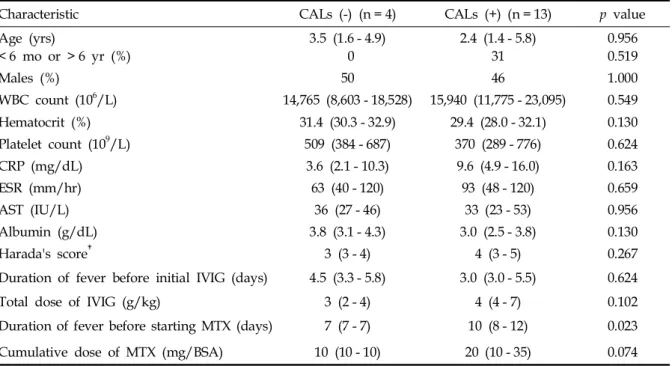
Comparison between CALs (-) and (+) groups There was no difference in the demographic characteristics and laboratory findings before MTX therapy between CALs (-) and (+) groups (Table 1). The median duration of fever before
Table 1. Comparison of Demographic Characteristics and Laboratory Findings before MTX Therapy between CALs (-) and (+) Groups*
Characteristic CALs (-) (n = 4) CALs (+) (n = 13) p value
Age (yrs)
< 6 mo or > 6 yr (%)
3.5 (1.6 - 4.9) 0
2.4 (1.4 - 5.8) 31
0.956 0.519
Males (%) 50 46 1.000
WBC count (106/L) 14,765 (8,603 - 18,528) 15,940 (11,775 - 23,095) 0.549
Hematocrit (%) 31.4 (30.3 - 32.9) 29.4 (28.0 - 32.1) 0.130
Platelet count (109/L) 509 (384 - 687) 370 (289 - 776) 0.624
CRP (mg/dL) 3.6 (2.1 - 10.3) 9.6 (4.9 - 16.0) 0.163
ESR (mm/hr) 63 (40 - 120) 93 (48 - 120) 0.659
AST (IU/L) 36 (27 - 46) 33 (23 - 53) 0.956
Albumin (g/dL) 3.8 (3.1 - 4.3) 3.0 (2.5 - 3.8) 0.130
Harada's score 3 (3 - 4) 4 (3 - 5) 0.267
Duration of fever before initial IVIG (days) 4.5 (3.3 - 5.8) 3.0 (3.0 - 5.5) 0.624
Total dose of IVIG (g/kg) 3 (2 - 4) 4 (4 - 7) 0.102
Duration of fever before starting MTX (days) 7 (7 - 7) 10 (8 - 12) 0.023
Cumulative dose of MTX (mg/BSA) 10 (10 - 10) 20 (10 - 35) 0.074
AST, aspartate aminotransferase; BSA, body surface area; CALs, coronary artery lesions; CRP, C-reactive protein; ESR, erythrocyte sedimentation rate; IVIG, intravenous immunoglobulin; MTX, methotrexate; WBC, white blood cell.
*Expressed as median (interquartile range) or percent.
Harada's score is a risk score of cardiac complications, commonly used in Japan.
Fig. 1. Changes in the maximum body temperature attained each day after treatment with MTX. The starting day of MTX was defined as day 1. The upper and lower ends of each box indicate the first and third quartiles, and the line inside the box represents the median value. The upper fence of a whisker corresponds with the largest value within 1.5 times the interquartile range above the third quartile and the lower fence of a whisker is the smallest value within 1.5 times the interquartile below the first quartile. Values beyond the fences are marked with circles. MTX, methotrexate. *p < 0.001.
Fig. 2.Changes in the serum level of CRP after treatment with MTX. Compared with the pretreatment phase, the reduction in serum levels of CRP on day 7 was significantly greater with MTX administration (p < 0.001).
The upper and lower ends of a box show the first and third quartiles, and the line inside the box the median value. The upper fence of a whisker represents the largest value within 1.5 times the interquartile range above the third quartile and the lower fence of a whisker the smallest value within 1.5 times the interquartile below the first quartile. Values beyond the fences are marked with circles. CRP, C-reactive protein; MTX, methotrexate.
starting MTX was shorter in CALs (-) group than in CALs (+) group (7 days vs. 10 days, p = 0.023).
DISCUSSION
MTX (4-aminno-N10-methylpteroyl glutamic acid) is an analogue of folic acid and functions as a folic acid antagonist like aminopterin. Since 1948, when Farber et al. first described clinical remissions in children with acute leukemia after treatment with aminopterin, MTX has been used to treat millions of patients with malignant and autoimmune diseases. It is estimated that at least 500,000 patients worldwide with rheumatoid arthritis have prescribed MTX, making it by far the most commonly used disease-modifying anti-rheumatic drug. MTX has been found to be safe and well tolerated with its current usage at low-doses.
Many pharmacological mechanisms of MTX action have been proposed, including inhibition of purine biosynthesis, promotion of adenosine release, inhibited production of proinflammatory cytokines, suppression of lymphocyte prolifera- tion, neutrophil chemotaxis and adherence, and reduction of serum immunoglobulin. However, the mechanism by which MTX at a low dose modulates inflammation is still unknown. Studies to date indicate that the most important actions of low-dose MTX are its effects on increasing adenosine level and reducing the pro-inflamma- tory while simultaneously increasing the anti- inflammatory cytokine levels. Higher levels of cyclic adenosine monophosphate (cAMP) produce a range of anti-inflammatory effects, which include decreased secretion of tumor necrosis factor (TNF), interferon (IFN)- , interleukin (IL)-12, IL-6,γ and inhibition of phagocytosis.11,12 Thus, adenosine- mediated anti-inflammatory effects may play a central role in producing the anti-inflammatory actions of MTX.13 Striking immune perturbations occur in acute KD, including marked cytokine cascade stimulation and endothelial cell activation.
Concentrations of many proinflammatory cyto- kines and chemokines, including TNF , INF- ,α γ IL-1, IL-6, and IL-8, are higher than normal during the acute phase of the disease.14,15The involvement of such an inflammatory process in KD led us to
consider the use of MTX in the treatment of KD.
In this study, MTX treatment resulted in rapid defervescence and improvement of acute-phase reactants in all patients with IVIG-resistant KD.
No patient had recurrent fever after cessation of MTX therapy. In all trials with MTX, the drug was found to be generally well tolerated, but with some toxicity; most commonly gastrointestinal, stomatitis, alopecia, marrow suppression, and liver function abnormalities. However, the median cumulative dose of MTX was so low that no adverse effects were observed. Aspirin appeared to decrease total clearance and renal clearance of MTX while concurrently increasing the area under the concentration-time curve (AUC) of MTX. The pharmacokinetic interaction between aspirin and MTX is greater than that of most other non- steroidal anti-inflammatory drugs, but this interaction is of little clinical significance.16
Current alternative treatments available after response failure to initial IVIG therapy are unsa- tisfactory because they cannot quickly attenuate systemic inflammation. A persistent, systemic inflammatory state results in a remarkably higher incidence of coronary artery involvement, as seen with IVIG-resistant patients, when compared with IVIG-responsive patients.17These findings suggest that earlier and more effective primary therapy is required for refractory KD. More aggressive primary treatment with adjuvant MTX might benefit children who are determined to be at high risk for IVIG-resistance at baseline. As very few options are available to clinicians after IVIG and aspirin fail to lower the temperature and CRP in acute KD patients, any drug that can prevent long-term sequelae such as coronary artery aneurysms should be credited and investigated in further similar trials. The small sample size in this single-center study provided insufficient power for the assessment of coronary artery outcome and adverse events. The most severe limitation of this study was the lack of a placebo group.
In summary, our patients treated with MTX experienced fast resolution of fever and rapid improvement of inflammation markers without causing adverse effects. MTX therapy should further be assessed in a multicenter, placebo- blinded trial to determine whether it improves coronary artery outcome.
REFERENCES
1. Furusho K, Kamiya T, Nakano H, Kiyosawa N, Shinomiya K, Hayashidera T, et al. High-dose intra- venous gammaglobulin for Kawasaki disease. Lancet 1984;2:1055-8.
2. Newburger JW, Takahashi M, Burns JC, Beiser AS, Chung KJ, Duffy CE, et al. The treatment of Kawasaki syndrome with intravenous gamma globulin. N Engl J Med 1986;315:341-7.
3. Sundel RP, Burns JC, Baker A, Beiser AS, Newburger JW. Gamma globulin re-treatment in Kawasaki disease.
J Pediatr 1993;123:657-9.
4. Burns JC, Capparelli EV, Brown JA, Newburger JW, Glode MP. Intravenous gamma-globulin treatment and retreatment in Kawasaki disease. US/Canadian Kawasaki Syndrome Study Group. Pediatr Infect Dis J 1998;17:
1144-8.
5. Wright DA, Newburger JW, Baker A, Sundel RP.
Treatment of immune globulin-resistant Kawasaki disease with pulsed doses of corticosteroids. J Pediatr 1996;128:146-9.
6. Hashino K, Ishii M, Iemura M, Akagi T, Kato H.
Re-treatment for immune globulin-resistant Kawasaki disease: a comparative study of additional immune globulin and steroid pulse therapy. Pediatr Int 2001;43:
211-7.
7. Lee MS, An SY, Jang GC, Kim DS. A case of intra- venous immunoglobulin-resistant Kawasaki disease treated with methotrexate. Yonsei Med J 2002;43:527-32.
8. Ahn SY, Kim DS. Treatment of intravenous immuno- globulin-resistant Kawasaki disease with methotrexate.
Scand J Rheumatol 2005;34:136-9.
9. Han BK, Lee HS, Kil HR, Han HS, Lee JH, Chung YH.
A study on clinical application of Harada's scoring
method to Kawasaki disease: suggesting the revision of the criteria for IVIG treatment of KD in Korea. J Korean Pediatr Soc 1997;40:539-48.
10. Research Committee on Kawasaki Disease. Report of subcommittee on standardization of diagnostic criteria and reporting of coronary artery lesions in Kawasaki disease. Tokyo, Japan: Ministry of Health and Welfare;
1984.
11. Figueíredo F, Uhing RJ, Okonogi K, Gettys TW, Johnson SP, Adams DO, et al. Activation of the cAMP cascade inhibits an early event involved in murine macrophage Ia expression. J Biol Chem 1990;265:12317-23.
12. Snijdewint FG, Kalinski P, Wierenga EA, Bos JD, Kapsenberg ML. Prostaglandin E2 differentially modulates cytokine secretion profiles of human T helper lymphocytes. J Immunol 1993;150:5321-9.
13. Riksen NP, Barrera P, van den Broek PH, van Riel PL, Smits P, Rongen GA. Methotrexate modulates the kinetics of adenosine in humans in vivo. Ann Rheum Dis 2006;65:465-70.
14. Furukawa S, Matsubara T, Jujoh K, Yone K, Sugawara T, Sasai K, et al. Peripheral blood monocyte/macrophages and serum tumor necrosis factor in Kawasaki disease.
Clin Immunol Immunopathol 1988;48:247-51.
15. Maury CP, Salo E, Pelkonen P. Circulating interleukin- 1 beta in patients with Kawasaki disease. N Engl J Med 1988;319:1670-1.
16. Rooney TW, Furst DE, Koehnke R, Burmeister L.
Aspirin is not associated with more toxicity than other nonsteroidal antiinflammatory drugs in patients with rheumatoid arthritis treated with methotrexate. J Rheumatol 1993;20:1297-302.
17. Wallace CA, French JW, Kahn SJ, Sherry DD. Initial intravenous gammaglobulin treatment failure in Kawasaki disease. Pediatrics 2000;105:E78.